Introduction
Population monitoring is a basic tool in animal ecology and wildlife conservation. Furthermore, assessing changes in local populations plays a critical role in appropriate wildlife management (Gibbs Reference Gibbs2000). Although information about population trends in Antarctic birds has increased in recent years (Woehler et al. Reference Woehler, Cooper, Crozall, Fraser, Kooyman, Miller, Nel, Patterson, Peter, Ribic, Salwicka, Trivelpiece and Weimerskirch2000), data about bird populations in the Antarctic are generally rare, fragmented and outdated, unevenly covering few localities and species. Counting breeding birds is a challenge to the researchers who visit these areas, and estimates are often based on extrapolations from opportunistic observations rather than on reliable censuses. Information about the population dynamics of Antarctic birds is crucial given the current threats affecting the region such as the climate change, particularly in the Antarctic Peninsula (Steig et al. Reference Steig, Schneider, Rutherford, Mann, Comiso and Shindell2009), increasing tourism and potential overfishing. The available information shows changes at the local population level in several species, such as penguins (Carlini et al. Reference Carlini, Coria, Santos, Negrete, Juares and Daneri2009, Trivelpiece et al. Reference Trivelpiece, Hinke, Miller, Reiss, Trivelpiece and Watters2011) and the Antarctic shag Phalacrocorax bransfieldensis Murphy (Del Hoyo et al. Reference Del Hoyo, Elliot and Sargatal1992, Casaux & Barrera Oro Reference Casaux and Barrera Oro2006). In some instances, population-related information remains unclear, such as for the giant petrel Macronectes giganteus (Gmelin) (Lynch et al. Reference Lynch, Naveen and Fagan2008). However, information about how global change can affect Antarctic birds needs to be based on the species and multiple locations to provide as general a pattern as possible.
One of the places for which the available information about the number of breeding birds is scarce and old is the Byers Peninsula, a protected area (SCAR 2003). Information on the level of those species breeding there and some census-based population estimates are now 45 years old (SCAR 2003). Byers Peninsula has been one of the largest ice-free areas in the Antarctic Peninsula over at least the last 3000 years (Björk et al. Reference Björck, Hakansson, Zale, Karlen and Jonsson1991, Reference Björck, Hjort, Ingólfsson, Zale and Ising1996), and birds have been present in the area for at least 1100 years (Emslie et al. Reference Emslie, Baumann and van Tuinen2011). Ice-free areas such as Byers Peninsula are probably particularly affected by the current climate change (Quayle et al. Reference Quayle, Peck, Peat, Ellis-Evans and Hurrigan2002, Toro et al. Reference Toro, Camacho, Rochera, Rico, Bañón, Fernandez-Valiente, Marco, Justel, Avendaño, Ariosa, Vincent and Quesada2007), and it seems likely that the birds would also be affected.
This study aims to provide new information on the abundance of breeding seabirds on the Byers Peninsula, specifically the Antarctic tern Sterna vittata Gmelin, the kelp gull Larus dominicanus Lichtenstein, the southern giant petrel Macronectes giganteus, the Antarctic skua Catharacta antarctica lonnbergi Mathews, the chinstrap penguin Pygoscelis antarctica Forster and gentoo penguin Pygoscelis papua Forster on Byers Peninsula to compare it with earlier information and to provide a baseline for future comparisons with a view to assessing the effect of climate change on this area.
Study area and methods
Byers Peninsula (62°34′35′′ to 62°40′35′′S, 60°54′14′′ to 61°13′07′′W) is located at the western extremity of Livingston Island (South Shetland Islands), and it is an ice-free area in summer. This peninsula has three groups of beaches: South, President (on the west coast) and Robbery (on the north coast). The study area includes two of these (the South and President Beaches) as well as the inland area of this Peninsula. Byers Peninsula is an Antarctic Specially Protected Area (no. 126, SCAR 2003).
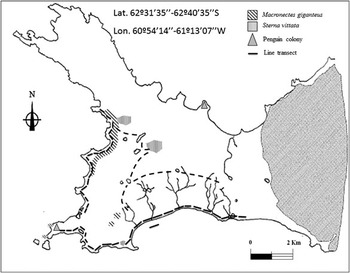
Line transects counts were used to estimate densities. Line transects included a belt of 50 m on either side, ranging in length from 0.35 to 4.48 km, and were conducted along the shoreline and inland (Fig. 1). Furthermore, birds were counted within and outside the belt. Density values were obtained according to D = (n 1 + n 2 / 2rl) x loge (n 1 + n 2 / n 2); where n 1 is the birds counted within the belt, n 2 the birds counted outside the belt, r = 50 m, l = length of the transect line (Greenwood Reference Greenwood1996). Transects along beaches were 14.42 km long, while the inland transects were 17.055 km long. Nests of the different species were counted directly. Nests and line transects were used to roughly estimate the Byers Peninsula breeding population for each species. The total population estimate of the species associated with the shoreline was evaluated from the density obtained (birds km-2) and multiplied by the Byers Peninsula surface area (70 km of shoreline x 0.1 km). For those species distributed both inland and along the shoreline, we multiplied the number of birds km-2 by the area of the Byers Peninsula (60 km2). We decided to use a surface unit (km2) rather than a linear unit (km) because there are colonies located at more than 100 m from the shoreline. As it is mostly flying birds that have a patchy distribution the population estimates for these species should be taken with caution. Line transects were done between 20 December 2008 and 6 January 2009.
Distribution of colonies of Antarctic tern, southern giant petrel and penguins. Discontinuous lines show the line transects.

Results
Antarctic terns had a similar density both on beaches (61.6 birds km-2) and inland (64.2 birds km-2). Therefore we pooled all the samples and estimated a general density of 62.4 birds km-2 with about 3746 individuals for the whole peninsula. Two large colonies included 198 and 114 nests (Fig. 1). Three smaller colonies accounted for a maximum of 25 pairs each.
Giant petrels were found only along the transect lines on beaches, and a mean of 398.96 birds km-2 was obtained, providing a maximum estimate of 2793 giant petrels in the area. We found 238 nests of southern giant petrels between Ocoa Point and Cerro Negro (a distance of 17.28 km, Fig. 1), giving a nest density of 13.77 nests km-1.
Kelp gulls showed a preference for beaches (269.1 birds km-2), which was underlined by the low density values obtained among inland samples (0.8 birds km-2). Overall, we estimated a population of 1884 individuals on Byers Peninsula. In this species, the census was done at the beginning of the chick rearing period when many chicks already showed a noticeable mobility, which probably resulted in an underestimation of the breeding pairs.
We found 15 nests of Antarctic skuas in 25 km2 and estimated 60–91 breeding birds for the whole of Byers Peninsula. Nests were found inland (5) and near beaches (10). No south polar skua (Catharacta maccormicki Saunders) was observed.
Finally, we counted 3000 and 50 nests of gentoo and chinstrap penguins, respectively, on Devils Point (Fig. 1). Further, a visit made in January 2009 reported around 1200 nests in just one location (Lair Point, Robbery beaches, Barbosa personal communication 2010, Fig. 1).
Discussion
Antarctic terns exhibited great variability in numbers of breeding pairs both between seasons and colonies (Peter et al. Reference Peter, Kaiser and Gebauer1988, Reference Peter, Kaiser and Gebauer1991, unpublished, Woehler et al. Reference Woehler, Cooper, Crozall, Fraser, Kooyman, Miller, Nel, Patterson, Peter, Ribic, Salwicka, Trivelpiece and Weimerskirch2000). Previous data reported a population of 3520 individuals (SCAR 2003). Thus, our results suggest that populations from this species have remained stable in the study area.
Previous studies reported a population of 216 breeding pairs of giant petrels (White Reference White1965). The breeding population therefore seems stable or may have increased in this area over the last 40 years if we consider that only the Southern and President Beaches were sampled. Moreover, the number of nests found in this study may have been underestimated because some nests could have been lost due to predation or abandonment. A similar population trend has been observed in the nearby colony of Hannah Point on Livingston Island, on Anvers Island and in other regions (Quintana et al. Reference Quintana, Punta, Copello and Yorio2006, Patterson et al. Reference Patterson, Woehler, Croxall, Cooper, Poncet, Peter, Hunter and Fraser2008, Reid & Huin Reference Reid and Huin2008). However, population trends in this species seem to show strong local-scale variability (Patterson et al. Reference Patterson, Woehler, Croxall, Cooper, Poncet, Peter, Hunter and Fraser2008), showing population declines in some localities; for instance on King George Island (Patterson et al. Reference Patterson, Woehler, Croxall, Cooper, Poncet, Peter, Hunter and Fraser2008).
White (Reference White1965) reported 448 nests of kelp gulls. Our data suggest that the kelp gull population in Byers Peninsula may have increased or at least remained stable. Similar trends have been obtained for this species in Admiralty Bay on King George Island (Sander et al. Reference Sander, Carneiro, Mascarello, dos Santos, Costa and Balbao2006).
White (Reference White1965) found 39 nests of Antarctic skua, so our data suggests a drop in population size. This trend seems to be general in the South Shetlands (Woehler et al. Reference Woehler, Cooper, Crozall, Fraser, Kooyman, Miller, Nel, Patterson, Peter, Ribic, Salwicka, Trivelpiece and Weimerskirch2000).
Croxall & Kirkwood (Reference Croxall and Kirkwood1979) reported 750 nests of gentoo penguin on Devils Point in 1965 and 900 nests in the Robbery beaches area. Our data suggest an increase in the gentoo penguin population in Byers Peninsula, which is in agreement with the general trend for this species in the Antarctic Peninsula (McClintock et al. Reference McClintock, Ducklow and Fraser2008), unlike the chinstrap penguin population, which is declining in the area (Barbosa et al. Reference Barbosa, Benzal, de León and Moreno2012). Previous data from 1966 have reported a population of around 5300 nests of this species in the area of Devils Point, of which 95% (5035 nests) were located on Demon Island and the remaining 265 nests were in the rookeries of Devils Point. The chinstrap penguin population in this area appears to have declined by 19%, consistent with the trends detected in the South Shetlands, where breeding pairs for this species have decreased by about 50% (Trivelpiece et al. Reference Trivelpiece, Hinke, Miller, Reiss, Trivelpiece and Watters2011).
In short, the population trends of Byers Peninsula breeding birds showed different specific patterns: the Antarctic tern population remained stable, the giant petrel and kelp gull populations remained stable or slightly increased, the gentoo penguin population increased and the Antarctic skuas and chinstrap penguins decreased.
Acknowledgements
José A. Gil-Delgado has been supported by several grants from the Spanish Ministries of Education and Science and of Science and Innovation as follows: grants CGL2005-06549-C02-02, CGL2007-29841-E and CTM2008-05205-E were given to Antonio Camacho (University of Valencia) and were co-financed by European FEDER funds. Grants CGL2005-06549-C02-01 and POL2006-06635 were given to Antonio Quesada (Autonomous University of Madrid). A. Barbosa was supported by the POL2006-05175 and CGL2007-60369 project funded by the Spanish Ministry of Science and Innovation and by the European Regional Development Fund. This article was published thanks to the financial support given by the Ministerio de Ciencia e Innovación (Spain) with the grant ref. CTM2011-12973-E. We thank N. Coria and an anonymous referee for helpful suggestions that improved an early version of the manuscript.