INTRODUCTION
Native speakers comprehending their first language (L1) must integrate a large amount of information in real time. This information contains cues from different levels of linguistic representation such as the phonetic properties and lexical features of different words, the (morpho)syntactic structures in which these words can be arranged, and different contextual factors that influence how the overall meaning of a sentence is interpreted (e.g., Gibson & Pearlmutter, Reference Gibson and Pearlmutter1998; Traxler, Reference Traxler2014; Van Dyke & Johns, 2012). The parser’s remarkably efficient ability to combine all this information makes language comprehension seem natural and effortless.
However, second language (L2) comprehension is a much more challenging task. Some have claimed that an important source of L2 processing difficulties is crosslinguistic influence exerted by the speaker’s L1. For example, native Chinese speakers have shown persistent difficulty with L2 English morphology. This is especially evident for the -s morpheme that attaches to main verbs to express agreement with third-person singular subjects, whereas native English speakers show targetlike performance (Chen, Shu, Liu, Zhao, & Li, Reference Chen, Shu, Liu, Zhao and Li2007; Jiang, Reference Jiang2004, Reference Jiang2007; Lardiere, Reference Lardiere1998a, Reference Lardiere1998b, Reference Lardiere2007). Despite these findings that emphasize differences, more recent studies provide evidence that L2 processing patterns can in fact converge on a system that resembles native speakers, even in cases in which the L1 and L2 differ in the grammatical features they express and how they are expressed (Foucart & Frenck-Mestre, Reference Foucart and Frenck-Mestre2012; Gillon Dowens, Vergara, Barber, & Carreiras, Reference Gillon Dowens, Vergara, Barber and Carreiras2010; Gillon Dowens, Guo, Guo, Barber, & Carreiras, Reference Gillon Dowens, Guo, Guo, Barber and Carreiras2011; Morgan-Short, Reference Morgan-Short2014; Steinhauer, Reference Steinhauer2014; Steinhauer, White, & Drury, Reference Steinhauer, White and Drury2009; White, Genesee, & Steinhauer, Reference White, Genesee and Steinhauer2012).
The present study investigates how native Chinese speakers process subject-verb agreement using neural measures, and, moreover, how sentence-internal cues to grammatical number influence the processing of this core morphosyntactic relation. Previous work by Tanner and Bulkes (Reference Tanner and Bulkes2015) showed that overtly quantifying a subject noun phrase (NP) increased native English speakers’ sensitivity to subject-verb agreement violations. Thus, the present study sets out to determine if L1 Chinese speakers capitalize on quantificational cues to process subject-verb agreement in English, despite the lack of agreement morphology in their native language, giving us a more complete picture of the specific features that influence L2 processing systems.
AGREEMENT PROCESSING IN ENGLISH
Compared to many other languages, English uses a relatively reduced set of morphemes to express agreement between different elements in a sentence. For example, in the domain of lexical verbs, this is limited to the third sg. –s. As such, native English speakers do not use agreement marking as a robust cue to sentence meaning and thematic role assignment in offline tasks, as opposed to native speakers of other morphologically richer languages with freer word order (Hernandez, Bates, & Avila, Reference Hernandez, Bates and Avila1994; MacWhinney, Bates, & Kliegl, Reference MacWhinney, Bates and Kliegl1984). Despite the more limited role that inflectional markers play in English morphosyntax and offline sentence interpretation, there is evidence that agreement plays an important role in online processing. Data from self-paced reading and eye-tracking experiments show that native English speakers slow down and show more regressive eye movements reading sentences with subject-verb agreement violations (Dillon, Mishler, Sloggett, & Phillips, Reference Dillon, Mishler, Sloggett and Phillips2013; Kreiner, Garrod, & Sturt, Reference Kreiner, Garrod and Sturt2013; Pearlmutter, Garnsey, & Bock, Reference Pearlmutter, Garnsey and Bock1999; Wagers, Lau, & Phillips, Reference Wagers, Lau and Phillips2009). This is evidence that English verbal agreement is rapidly used during naturalistic language processing tasks, and that agreement violations trigger processing difficulty.
Additionally, event-related brain potentials (ERPs) are another measure that has shown rapid online sensitivity to agreement in L1 English speakers. ERPs reflect synchronized neural responses to cognitive events and are recorded noninvasively at the scalp. ERPs give very precise temporal estimates of processes as they unfold, and show qualitative sensitivity to aspects of linguistic processing when time-locked to words in a sentence. One widely studied ERP component that has shown sensitivity to grammatical agreement is the P600. The P600 is a positive-going neural response that is reliably elicited after reading or listening to a morphosyntactic violation within a sentence; the P600 generally shows a latency between 500 to 800 ms after encountering the morphosyntactic violation and is largest over posterior regions of the scalp. Although the P600 is not a direct reflection of morphosyntactic processes (Brouwer, Fitz, & Hoeks, Reference Brouwer, Fitz and Hoeks2012; Chow & Phillips, Reference Chow and Phillips2013; Kim & Osterhout, Reference Kim and Osterhout2005; Kolk & Chwilla, Reference Kolk and Chwilla2007; Kolk, Chwilla, van Herten, & Oor, Reference Kolk, Chwilla, van Herten and Oor2003; Kuperberg, Kreher, Sitnikova, Caplan, & Holcomb, Reference Kuperberg, Kreher, Sitnikova, Caplan and Holcomb2007; Osterhout, McLaughlin, Kim, Greewald, & Inoue, Reference Osterhout, McLaughlin, Kim, Greewald, Inoue, Carreiras and Clifton2004; van de Meerendonk, Kolk, Vissers, & Chwilla, Reference van de Meerendonk, Kolk, Vissers and Chwilla2010; van Herten, Chwilla, & Kolk, Reference van Herten, Chwilla and Kolk2006), it reliably co-occurs with morphosyntactic anomalies, thus making it a good index of sensitivity to morphosyntactic manipulations, including subject-verb agreement (Coulson, King, & Kutas, Reference Coulson, King and Kutas1998; Hagoort, Brown, & Groothusen, Reference Hagoort, Brown and Groothusen1993; Nevins, Dillon, Malhotra, & Phillips, Reference Nevins, Dillon, Malhotra and Phillips2007; Osterhout & Mobley, Reference Osterhout and Mobley1995; Osterhout, Mckinnon, Bersick, & Corey, Reference Osterhout, Mckinnon, Bersick and Corey1996; Tanner & Bulkes, Reference Tanner and Bulkes2015; Tanner, Grey, & van Hell, Reference Tanner, Grey and van Hell2017; Tanner, Nicol, & Brehm, Reference Tanner and Hell2014; see Molinaro, Barber, & Carreiras, Reference Molinaro, Barber and Carreiras2011, for an overview).Footnote 1 When combined with the other studies using self-paced reading and eye-tracking, this ERP literature provides evidence that native English speakers attend to agreement relations during language comprehension.
In addition to observing the effects of (un)grammaticality on L1 English speakers’ comprehension of subject-verb agreement, more recent work has begun to investigate other factors that influence how this dependency is processed. Tanner and Bulkes (Reference Tanner and Bulkes2015) asked how quantification of a sentence’s subject NP modulates subject-verb agreement comprehension. The authors manipulated the subject-verb agreement grammaticality in unquantified (1a) and quantified (1b) sentences.
(1) a. The cookies taste/*tastes the best when dipped in milk.
b. Most cookies taste/*tastes the best when dipped in milk.
The crucial difference between the two conditions is that the unquantified subject NP in (1a) has one number cue in the form of the plural -s marker on cookies, while the quantified subject NP in (1b) contains two cues: the quantifier most and the plural morpheme on cookies. Thus, in both sentences, the subject’s number feature is plural, but in (1b) there is a second marking making the plural feature more salient, and allowing the comprehender to generate a prediction for a plural verb earlier than in (1a). In both sentence types, ungrammatical verbs generated a P600 for singular marked verbs; however, the P600 was significantly larger for the agreement violations in the quantified sentences (like 1b). The authors argued that quantifying the subject NP made L1 English comprehenders more sensitive to subject-verb agreement violations and that this effect was primarily attributable to increased predictability of verbal number features in the quantified condition.
These results also contribute to previous work showing native speakers effectively anticipate upcoming information during comprehension. Many studies have shown comprehenders can actively predict material in their L1 as a way to facilitate the integration of different cues involving phonology, verb semantics, category structures, and morphosyntactic features (e.g., Altmann & Kamide, Reference Altmann and Kamide1999; DeLong, Troyer, & Kutas, Reference DeLong, Troyer and Kutas2014; DeLong, Urbach, & Kutas, Reference DeLong, Urbach and Kutas2005; Federmeier & Kutas, Reference Federmeier and Kutas1999; Federmeier, Wlotko, De Ochoa-Dewald, & Kutas, Reference Federmeier, Wlotko, De Ochoa-Dewald and Kutas2007; Van Berkum, Brown, Zwitserlood, Kooijman, & Hagoort, Reference Van Berkum, Brown, Zwitserlood, Kooijman and Hagoort2005; Wicha, Moreno, & Kutas, Reference Wicha, Moreno and Kutas2004; though see Huettig & Mani, Reference Huettig and Mani2016; Ito, Corley, Pickering, Martin, & Nieuwland, Reference Ito, Corley, Pickering, Martin and Nieuwland2016; Luke & Christianson, Reference Luke and Christianson2016). However, it is less clear to what extent this is possible in L2 speakers. Some research indicates that in cases of high L2 proficiency or similar L1-L2 psychotypology, nonnative speakers are capable of using gender features to anticipate the referent of a sentence (Dussias, Kroff, Tamargo, & Gerfen, Reference Dussias, Kroff, Tamargo and Gerfen2013; Hopp, Reference Hopp2013), to use semantic constraint to predict grammatical features of lexical items (Foucart, Martin, Moreno, & Costa, Reference Foucart, Martin, Moreno and Costa2014), or to use verb semantics to predict upcoming referents (van Bergen & Flecken, Reference van Bergen and Flecken2017). Nevertheless, other work shows L2 speakers are less able to anticipate linguistic features in the input with the same efficacy as their native-speaking counterparts (Grüter, Lew-Williams, & Fernald, Reference Grüter, Lew-Williams and Fernald2012; Grüter, Rohde, & Schafer, Reference Grüter, Rohde and Schafer2017; Ito, Martin, & Nieuwland, Reference Ito, Martin and Nieuwland2017a, Reference Ito, Martin and Nieuwland2017b; Lew-Williams & Fernald, Reference Lew-Williams and Fernald2010; Martin et al., Reference Martin, Thierry, Kuipers, Boutonnet, Foucart and Costa2013). This contrast in the literature highlights the need for additional research that will contribute to a more nuanced understanding of the extent to which feature prediction in L2 sentence processing is possible.
ENGLISH-MANDARIN TYPOLOGICAL DIFFERENCES AND THEIR EFFECT ON (L2) SENTENCE PROCESSING
One important area where English and Mandarin differ is the use of agreement morphology to express relationships between constituents in a sentence. For many syntactic structures, English requires number agreement between two sentence elements. This study focuses on number agreement required between subjects and verbs. Developmental psycholinguistic studies of English agreement show that native speakers rapidly learn to incorporate number cues as a resource for computing dependencies between grammatical elements (e.g., Lukyanenko & Fisher, Reference Lukyanenko and Fisher2016).
Mandarin Chinese uses a severely reduced morphological system compared to English. Chinese is an isolating language that does not use verbal morphology to encode subject-verb agreement (Li & Thompson, Reference Li and Thompson1981). Furthermore, the plural morpheme is only permitted to co-occur with a very restricted set of nouns and pronouns, with a number of complex semantic and syntactic restrictions on its distribution (Li, Reference Li1999). Mandarin more commonly expresses plurality using lexical items, such as quantifiers like yìxiē “some” and xŭduō “many.” As Mandarin lacks overt agreement, important questions arise about how this phenomenon is processed by Mandarin speakers, given that their L1 parsers are not required to integrate surface inflectional morphemes associated with syntactic number. This has important implications for how L1 Chinese speakers will process agreement in a morphologically richer language such as English. L1 Chinese–L2 English speakers need to “reassemble” plural features onto morpholexical units in their L2; map a generalized [+plural] feature onto the nominal –s morpheme and a [-plural] feature onto the verbal –s morpheme in L2 English (Lardiere, Reference Lardiere, Liceras, Zobl and Goodluck2008, Reference Lardiere2009, Reference Lardiere, Gass and Mackey2012); and develop corresponding routines to process agreement between these items.
The difference in the extent to which Chinese and English express agreement has important consequences for L2 processing. Ample evidence exists of persistent and pervasive problems for Chinese-English bilinguals processing English agreement. For production, data from Lardiere’s (Reference Lardiere1998a, Reference Lardiere1998b, Reference Lardiere2007) case study of “Patty”—a highly proficient L1 Chinese speaker who had been living in the United States for nearly 20 years at the time of data collection—showed that she produced the third sg. -s morpheme on nonpast thematic main verbs in only 4.54% of obligatory contexts (see also Jia, Reference Jia2003).
Agreement problems have also been observed in comprehension studies. Using self-paced reading, Jiang (Reference Jiang2004, 2007) reports Chinese ESL participants showed less sensitivity than native speakers to number violations on nouns and verbs. The author interpreted these results as evidence that knowledge of plural morphology had not been incorporated into the automatic processing strategies of the L1 Chinese participants. In a separate ERP study, L1 Chinese comprehenders generated qualitatively different brain responses from native English speaker controls to sentences involving subject-verb agreement violations (Chen et al., Reference Chen, Shu, Liu, Zhao and Li2007). In that study, rather than showing classic P600 effects to agreement violations, native Mandarin speakers with high proficiency in L2 English showed late frontal negativities to English agreement violations. Similar transfer effects have also been reported in Chinese-English bilinguals in domains outside of agreement, such as interpreting thematic roles in sentences (Liu, Bates, & Li, Reference Liu, Bates and Li1992). Considered together, these studies provide evidence for persistent difficulty for L1 Chinese speakers’ production and comprehension of morphosyntactic agreement features in L2 English that seem to nearly ubiquitously result in nonnativelike outcomes, even at high proficiency.
However, despite the preponderance of evidence that L1 Chinese speakers experience difficulty processing agreement in L2 English, other ERP evidence has shown that speakers of typologically similar languages can acquire and process new syntactic features in a manner qualitatively similar to native speakers (e.g., Alemán Bañón, Fiorentino, & Gabriele, Reference Alemán Bañón, Fiorentino and Gabriele2014; Foucart & Frenck-Mestre, Reference Foucart and Frenck-Mestre2012). Indeed, in one study of late Chinese-Spanish bilinguals (late L2 learners of a typologically distant language), determiner-noun number and gender violations elicited P600 effects (Gillon Dowens et al., Reference Gillon Dowens, Guo, Guo, Barber and Carreiras2011). Thus, the conclusion that native Chinese speakers cannot acquire and process English agreement morphology may be premature. More research is needed on this topic, as well as on factors that may modulate (i.e., help or hinder) English agreement comprehension.
LEXICAL AND MORPHOLOGICAL CUES IN L2 AGREEMENT PROCESSING: HYPOTHESES
Thus far we have seen that L1 Chinese–L2 English bilinguals show persistent difficulties processing English agreement. However, research on other agreement phenomena and language pairings has shown that processing patterns can become more nativelike at both the behavioral and neural levels, even for features missing in the L1. One area where Mandarin and English are aligned is in the availability of quantification to mark number within NPs. Therefore, one salient possibility is that the presence of a plural quantifier—being a strong cue to NP plurality—will be a more effective cue than nominal number alone for Chinese speakers comprehending English. This could lead to better processing of agreement and more heightened sensitivity to agreement violations. In this case we would expect better behavioral discrimination between grammatical and ungrammatical sentences and greater neural sensitivity to agreement violations (i.e., a larger P600 effect) when sentences are overtly plurally quantified than when the subject NP carries a number-ambiguous determiner (i.e., the). Such a pattern would be reminiscent of the findings from monolingual English speakers reported by Tanner and Bulkes (Reference Tanner and Bulkes2015).
Another contrasting possibility derives from VanPatten’s Input Processing (IP) Theory (VanPatten, Reference VanPatten and VanPatten2004, Reference VanPatten, VanPatten and Williams2015; VanPatten & Cadierno, Reference VanPatten and Cadierno1993). IP attempts to explain what kinds of parsing strategies L2 comprehenders rely on as they process L2 input. One of its central claims is expressed in the Lexical Preference Principle. This states that when learners process a sentence containing a lexical item and a separate grammatical form that encode the same meaning, they will rely more heavily on the lexical item to parse the input. This is precisely the situation for the quantified sentences in this study. In a sentence starting with Most cookies taste…, the quantifier and the plural marking on the noun provide redundant surface cues about the plural feature of the subject NP. Therefore, following IP theory, the L1 Chinese speakers reading these sentences in English will process the plural feature on the quantifier, a lexical item, while attending less to both the -s morpheme on the noun, and perhaps not processing agreement features on the surface form of the verb (because agreement features are, by definition, completely redundant; Corbett, Reference Corbett2006). In such a case, we might expect that late Chinese-English bilinguals would show decreased sensitivity to subject-verb agreement violations when the subject NP is overtly quantified, as the number cue would be interpreted where it is most salient (at the quantifier), rather than on the correspondingly less salient agreement morphemes downstream. Such an outcome would indicate flexible and efficient allocation of processing resources, in line with the IP model.
To test whether Chinese speakers are restricted to nonnativelike processing of English agreement, and moreover, how quantificational cues may impact agreement in this population, we recorded ERPs in a large group of late but proficient L1 Chinese–L2 English bilinguals who were immersed in an English-speaking environment using the same experimental paradigm in Tanner and Bulkes (Reference Tanner and Bulkes2015). We also compare results from our present group of bilinguals to the monolingual English speakers studied in that original report to contrast processing profiles and integration of cues across the L1 and L2 populations.
We additionally considered whether individual differences in L2 English proficiency and verbal working memory (WM) capacity were systematically related both to participants’ P600 responses to agreement violations, and whether they further modulated participants’ use of quantificational cues. Prior work on L1 Chinese–L2 English bilinguals processing English agreement showed nonnativelike ERP effects (Chen et al., Reference Chen, Shu, Liu, Zhao and Li2007); however, it is possible that proficiency is a modulating variable regarding ERP responses, and L2 processing in general. Prior work has implicated L2 proficiency in the emergence of P600 effects in L2 grammatical processing contexts (McLaughlin et al., Reference McLaughlin, Tanner, Pitkänen, Frenck-Mestre, Inoue, Valentine and Osterhout2010; Steinhauer, Reference Steinhauer2014; Steinhauer et al., Reference Steinhauer, White and Drury2009; Tanner, McLaughlin, Herschensohn, & Osterhout, Reference Tanner, McLaughlin, Herschensohn and Osterhout2013; White et al., Reference White, Genesee and Steinhauer2012). Thus, we might expect a positive association between English proficiency and P600 effect amplitude. Additionally, if proficiency is associated with more nativelike use of linguistic cues in general, we would expect a further interaction between proficiency, grammaticality, and quantification. Such an outcome would indicate that as proficiency increases, P600s become larger in quantified situations, in a similar way to the native English speakers reported by Tanner and Bulkes (Reference Tanner and Bulkes2015).
Regarding WM, some recent evidence has shown that WM capacity has a positive relationship with nativelike sensitivity to both L2 agreement violations (Coughlin & Tremblay, Reference Coughlin and Tremblay2013) and L2 processing more generally (Linck, Osthus, Koeth, & Bunting, Reference Linck, Osthus, Koeth and Bunting2014; McDonald, Reference McDonald2006; Miyake & Friedman, Reference Miyake, Friedman, Healy and Bourne1998; Reichle, Tremblay, & Coughlin, Reference Reichle, Tremblay and Coughlin2016). We might therefore expect similar associations between participants’ WM capacity and the experimental variables as we predicted for proficiency: larger P600 effects, indexing greater sensitivity to L2 agreement violations, and a modulation of the interaction with quantification to resemble the monolingual English speakers’ effect with higher WM capacity.
METHOD
PARTICIPANTS
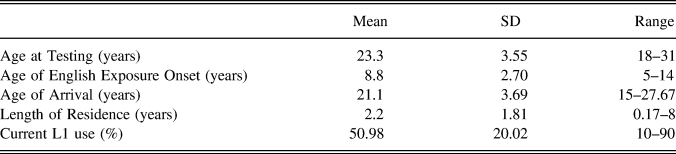
Forty-seven native speakers of Mandarin Chinese participated in the experiment. Participants were recruited from the graduate and undergraduate student populations at the University of Illinois. All Mandarin participants reported being raised in an exclusively Mandarin-speaking environment, received their primary educations (through at least grade 8) in Mandarin, became literate in Mandarin before beginning to learn English, and were late arrivals in the United States (after grade 8). All were strongly right handed by self-report (Oldfield, Reference Oldfield1971) and had normal or corrected-to-normal vision; none reported any history of head injuries or neurological impairment, and none reported taking psychoactive medication. Equipment failure prevented two participants from completing the experiment, four participants were removed for excessive EEG artifact, and one participant was excluded after reporting that she attended elementary school in English. This left a total of 40 L2 participants with acceptable data for analysis. The data from these participants will be compared to the 20 monolingual English speakers previously reported by Tanner and Bulkes (Reference Tanner and Bulkes2015). All participants provided informed consent and received a small amount of cash for taking part. See Table 1 for background information about the native Mandarin participants.
Background variables for native Mandarin participants

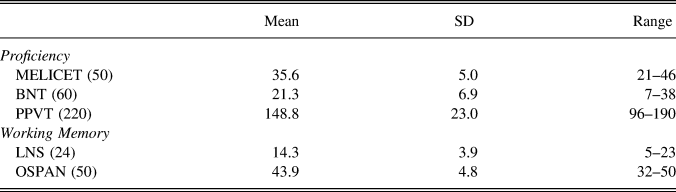
The participants’ English proficiency ranged from intermediate to advanced. This was determined by administering a modified version of the Michigan English Language Institute College English Test (MELICET), the Peabody Picture Vocabulary Test (PPVT: Dunn & Dunn, Reference Dunn and Dunn2007), and the Boston Naming Test (BNT: Goodglass, Kaplan, & Weintraub, Reference Goodglass, Kaplan and Weintraub1983). The MELICET is a sentence completion task that evaluates L2 speakers’ morphosyntactic knowledge, the PPVT is a measure of receptive vocabulary, and the BNT is a measure of productive vocabulary. See Table 3 for proficiency measure outcomes.
STIMULI
The test materials for this study were identical to those used by Tanner and Bulkes (Reference Tanner and Bulkes2015). Grammaticality (grammatical, ungrammatical) and quantification (quantified, unquantified) were crossed in a 2 × 2 design (see Table 2).
Example stimuli

Note. Critical verbs for ERP averaging are underlined.
The quantified sentences all began with either some or most, while sentences in the unquantified condition always started with the. The subject noun was always marked with a plural -s morpheme and grammaticality was determined by using either a singular or plural marked verb. One hundred twenty sentence sets were created using this design, with four versions of each sentence. These were distributed across four separate lists so that no participant saw more than one version of any sentence, with 30 critical sentences per condition per list. For a description of filler items, please see Tanner and Bulkes (Reference Tanner and Bulkes2015).
PROCEDURE
Participants came into the lab for individual testing sessions, with methods being nearly identical to those used by Tanner and Bulkes (Reference Tanner and Bulkes2015). After providing informed consent, participants completed the ERP/sentence processing task. In this task, each trial started with a screen with the question Ready? Participants pressed a button on a response pad when they were prepared for each sentence to begin. Upon starting sentence presentation, a fixation cross appeared for 300 ms. After a 200 ms blank screen, the words of each trial were presented in the center of the screen one at a time for 300 ms with a 200 ms interstimulus interval. Sentences were followed by a 950 ms blank screen, after which an acceptability judgment prompt with the words Good and Bad appeared. Participants pressed a button that corresponded to one of the two options. The pretask instructions explained that “good” sentences would be both grammatically and semantically acceptable. “Bad” sentences would either be ungrammatical or have an implausible meaning. Acceptability judgments were untimed, but participants were asked to respond as quickly and accurately as possible. The hand used for the “good” and “bad” responses were counterbalanced across participants. Before the task, participants were told to minimize movements and refrain from blinking during sentence presentation. Six practice sentences preceded the actual experiment.
Following the sentence processing experiment, participants completed a battery of individual difference tests for proficiency and WM. Proficiency was assessed using the MELICET, PPVT, and BNT. WM was assessed with an abbreviated version of the automated Operation Span Task (OSpan; Foster et al., Reference Foster, Shipstead, Harrison, Hicks, Redick and Engle2015; two blocks per participant) and a letter-number sequencing task (LNS; Shelton, Elliott, Hill, Calamia, & Gouvier, Reference Shelton, Elliott, Hill, Calamia and Gouvier2009). The OSpan task asks participants to solve mathematical equations while remembering letters associated with each equation in the order of presentation; partial scoring was used. The LNS presents 24 sequences of interspersed letters and numbers to participants and asks them to reorganize each sequence and report them as numbers in ascending order followed by letters in alphabetical order. Scores were the total number of sets correctly reported. Mean and variance measures for the proficiency and WM tasks are reported in Table 3.
English proficiency and working memory scores for the L1 Mandarin participants. The maximum score for each measure is indicated in parentheses.

DATA ACQUISITION AND ANALYSIS
Continuous EEG was recorded using 28 tin electrodes embedded in an elastic cap according to the extended 10-20 system (Jasper, Reference Jasper1958) using a BrainAmpDC bioamplifier system (Brain Products, Germany). Offline data processing was performed in EEGLAB (Delorme & Makeig, Reference Delorme and Makeig2004) and ERPLAB (Lopez-Calderon & Luck, Reference Lopez-Calderon and Luck2014) toolboxes for Matlab. Eye movements were monitored with electrodes placed below the left eye (referenced offline to FP1) and at the outer canthus of each eye (referenced offline in a right-to-left bipolar montage). Trials characterized by excessive eye movements, drift, alpha, or other artifacts were rejected. For participants with more than 20% of trials in one of the experimental conditions rejected due to eye movements (n = 15), independent components analysis was used to remove artifactual components. Artifactual components were identified by visual inspection of component time course and scalp topography. Blink- and saccade-corrected data were then rescreened for artifacts, with any remaining aberrant trials rejected. Finally, all data from any participant was excluded from analysis if more than 30% of the trials in any of the four experimental conditions were rejected due to excessive artifacts in the recording after correction, resulting in the exclusion of four participants (see preceding text). An average of 5.1% of trials were rejected across conditions after artifact correction. This proportion did not differ across experimental conditions. During data collection, impedances were held below 5kΩ at scalp electrodes, and below 15kΩ at ocular sites. Data were recorded online with a left mastoid reference and re-referenced offline to the algebraic mean of activity over the left and right mastoids.
Analog-to-digital conversion of the EEG signal was carried out at a sampling rate of 1,000 Hz using a 0.016–250 Hz analog band-pass filter; data were band-pass filtered offline with a second order 0.1–30 Hz IIR Butterworth filter (Tanner, Morgan-Short, & Luck, Reference Tanner, Morgan-Short and Luck2015). ERPs time-locked to the onset of the critical verb in each of the experimental sentences were averaged relative to a 200 ms prestimulus baseline. Mean amplitudes were computed for each participant in the 500–800 ms time window, as this corresponds to the traditional time window for the P600 component. We additionally analyzed the 300–500 ms time window to assess whether an N400 effect was present, as some prior work has shown that both L1 and L2 populations can display N400 effects in morphosyntactic contexts (Grey, Tanner, & Van Hell, Reference Grey, Tanner and Hell2017; McLaughlin et al., Reference McLaughlin, Tanner, Pitkänen, Frenck-Mestre, Inoue, Valentine and Osterhout2010; Osterhout, McLaughlin, Pitkänen, Frenck-Mestre, & Molinaro, Reference Osterhout, McLaughlin, Pitkänen, Frenck-Mestre and Molinaro2006; Tanner & Van Hell, Reference Tanner and Hell2014; Tanner et al., Reference Tanner, McLaughlin, Herschensohn and Osterhout2013).
Repeated measures analyses of variance (ANOVAs) were computed separately for midline and lateral electrode sites. Midline ANOVA factors were grammaticality, quantification, and anteriority (electrodes Fz, Cz, and Pz). Lateral electrodes were grouped into four regions of interest: left frontal (F7, F3, FC5, FC1), right frontal (F4, F8, FC2, FC6), left posterior (CP5, CP1, P7, P3), and right posterior (CP2, CP6, P4, P8). ANOVA factors over lateral sites were grammaticality, quantification, anteriority (anterior, posterior), and hemisphere (left, right). Only statistical effects involving the manipulated experimental factors (grammaticality and quantification) and their interaction with topographic factors are reported. Repeated measures with more than one degree of freedom in the numerator underwent the Greenhouse-Geisser correction for inhomogeneity of variance; corrected p-values but uncorrected degrees of freedom are reported. Investigation of individual difference interactions between the ERP and cognitive (proficiency and WM) variables used linear mixed effects regression; these models will be described in the following text. Behavioral results were analyzed using A-scores, a nonparametric signal detection statistic that represents the participants’ ability to discriminate between grammatical and ungrammatical sentences during the acceptability judgment task (Zhang & Mueller, Reference Zhang and Mueller2005).
RESULTS
ACCEPTABILITY JUDGMENT TASK
Mean behavioral performance for the end-of-sentence acceptability judgments are reported in Table 4. A-scores for the acceptability judgments were well above chance (chance A = .5), but there was no reliable difference between A-scores in the quantified and unquantified conditions, (t(39) = .7435, p = .46). This indicates that there was no reliable difference in participants’ discrimination of grammatical and ungrammatical sentences between the quantified and unquantified conditions.
Proportion of correct responses on acceptability judgment task. Standard errors are reported in parentheses.

ERPS
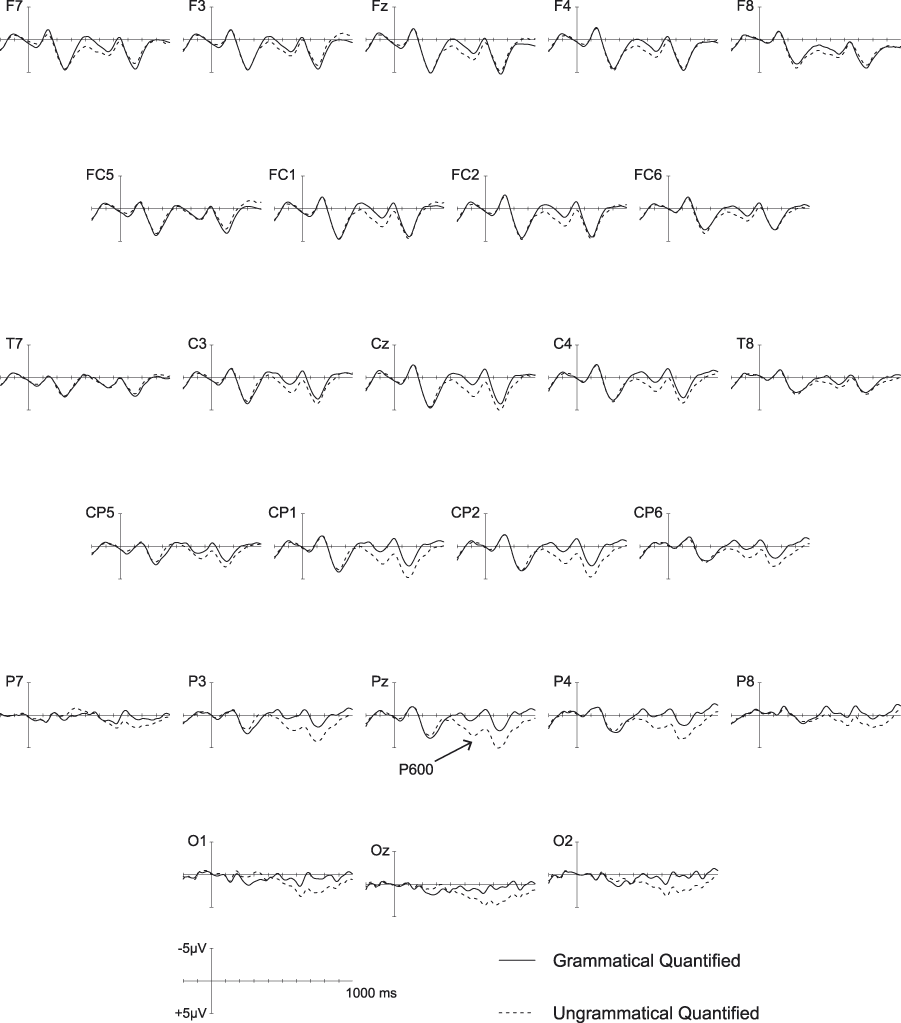
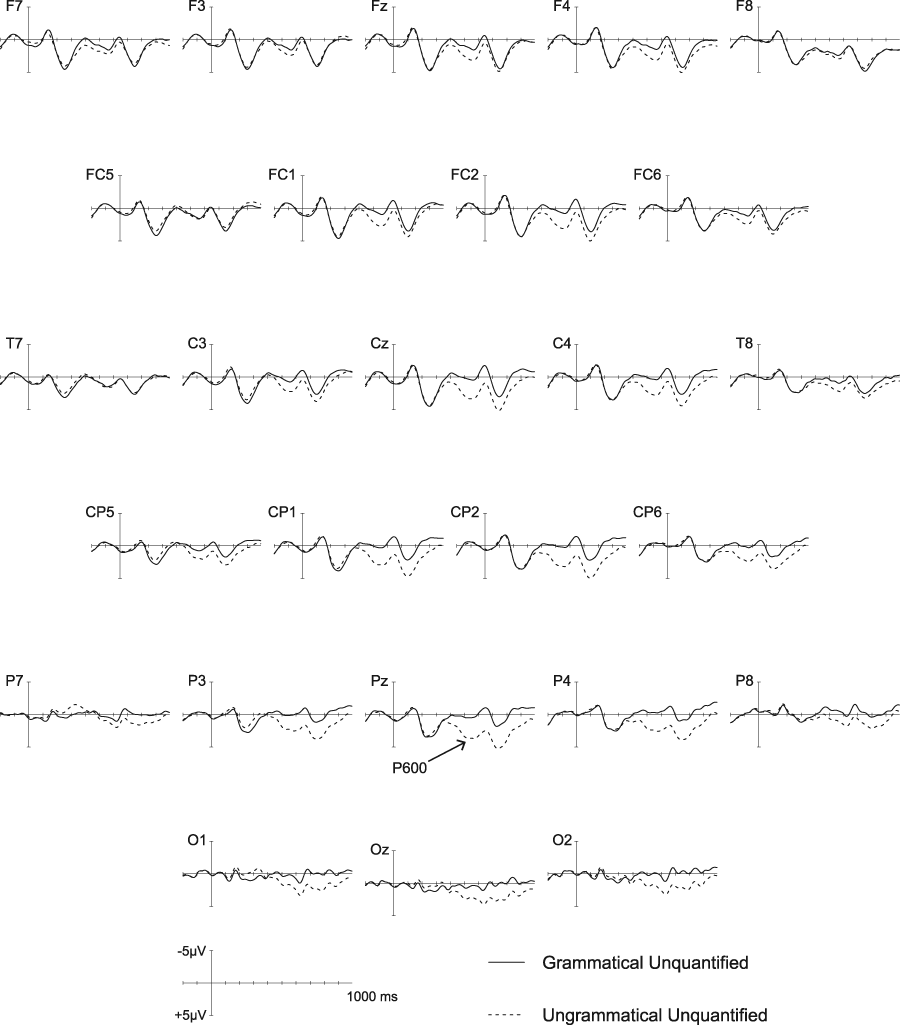
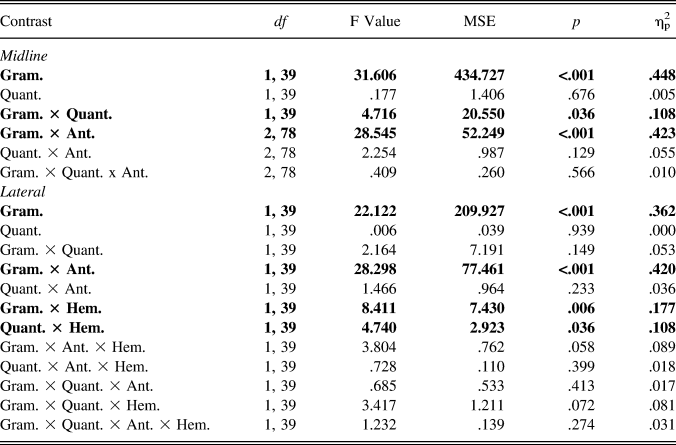
Visual inspection of the grand mean ERPs (Figures 1 and 2) showed that agreement violations elicited a late posterior positivity, relative to grammatical sentences. ANOVA results for the mean amplitude measured along the midline electrodes during the 300–500 ms time window showed a main effect of grammaticality in which brain responses were more positive in ungrammatical sentences (F(1, 39) = 13.529, p = .001, ηpFootnote 2 = .258). Over lateral sites there was a grammaticality by hemisphere interaction (F(1, 39) = 18.485, p < .001, ηpFootnote 2 = .322), indicating that the positivity was larger over right hemisphere electrodes. These results indicate the onset of the P600 during the 300–500 ms window. ANOVA results from the 500–800 ms time window are presented in Table 5. The main effects of grammaticality and interactions with anteriority show that brain responses to ungrammatical verbs were more positive-going than to grammatical verbs, and that this effect had a posterior scalp topography. This is typical of P600 effects.
Grand mean ERP waveforms for the grammatical (solid line) and ungrammatical (dotted line) verbs in the quantified condition at 26 scalp electrodes. Negative voltage is plotted up and the vertical calibration bar shows ±5µV. The waveforms depict 200 ms of prestimulus and 1,000 ms of poststimulus activity. All the waveforms in this paper were filtered with a 12-Hz low-pass filter for visual presentation only.

Grand mean ERP waveforms for the grammatical (solid line) and ungrammatical (dotted line) verbs in the unquantified condition at 26 scalp electrodes.

ANOVA results for the 500–800 ms time window

Significant results (p < .05) are bolded. Gram. = grammaticality, Quant. = quantification, Ant. = Anteriority, Hem. = hemisphere.
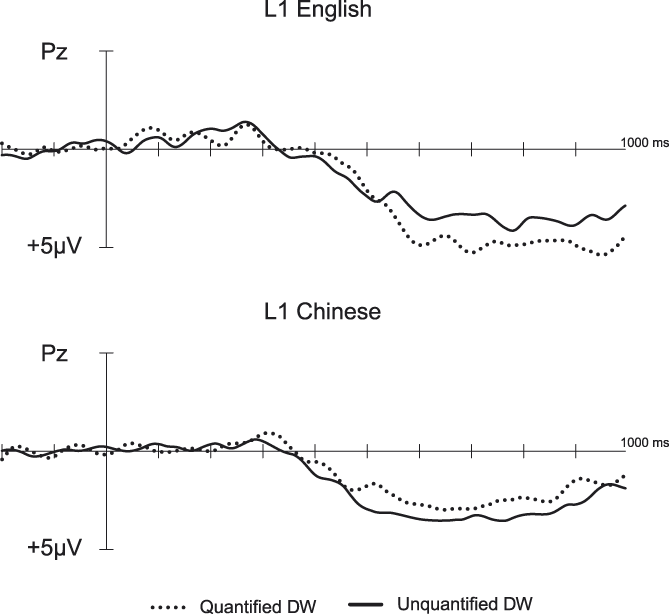
Importantly for present purposes, there was a significant interaction between grammaticality and quantification over midline electrodes, which also neared significance over lateral sites (grammaticality × quantification × hemisphere interaction; see also Tanner & Bulkes, Reference Tanner and Bulkes2015). Whereas this is a qualitatively similar pattern of statistical outcomes compared to Tanner and Bulkes’s monolingual study, it results from an opposite pattern in the data. Although ungrammaticalities elicited P600s in both the quantified and unquantified conditions in the Chinese-English bilinguals tested here, the effect was larger in the unquantified than quantified condition; recall that Tanner and Bulkes found larger P600s in the quantified condition. A comparison of effects between the monolingual English speakers and Chinese-English bilinguals is depicted in Figure 3. These show ungrammatical-minus-grammatical difference waves for both groups at midline parietal electrode Pz, where P600s are typically largest. A mixed ANOVA including both the English monolinguals and Chinese-English bilinguals using L1 as a between-subjects factor showed that the effects of quantification on the P600 differed across the two groups along the midline (grammaticality × quantification × L1 interaction: F(1, 58) = 11.750, p = .001, ηpFootnote 2 = .168). This contrast indicates that quantification had different effects on P600 amplitude in the two groups. Whereas quantifying the subject increased the P600 amplitude in L1 English speakers, it reduced the P600 amplitude in the L1 Chinese speakers.
Grand mean difference waves at the Pz electrode for the quantified (dotted line) and unquantified (solid line) ungrammatical minus grammatical conditions in each L1 group. Positive deviations from zero indicate a P600 effect.

INDIVIDUAL DIFFERENCES
To investigate whether the pattern of effects reported here differed based on the L2 participants’ English proficiency or WM capacity, we computed two linear mixed effects regression models to look for interactions between the manipulated experimental factors and the individual difference measures we collected (see Table 3). Composite measures for English proficiency and WM were computed by z-transforming and averaging the relevant individual difference measures (MELICET, PPVT, and BNT for proficiency; OSpan and LNS for WM). The dependent measure was mean amplitude in the 500–800 ms time window, computed over a centro-parietal region of interest where the P600 effects were largest (electrodes C3, Cz, C4, CP1, CP2, P3, Pz, P4: Tanner & Van Hell, Reference Tanner and Hell2014). Categorical fixed effects were grammaticality and quantification and their interaction (sum coded); separate models were computed with proficiency and WM (and their interaction with grammaticality and quantification) as continuous measures. Random effects were intercepts for subjects and by-subject slopes for grammaticality and quantification. Models were fit using the lmer function in the lme4 package (Bates, Mächler, Bolker, & Walker, Reference Bates, Mächler, Bolker and Walker2014) for R (v3.3.2, R Core Development team).
For the effects of grammaticality and the interaction with quantification, both mixed-effects models showed a qualitative pattern of results that mimicked the ANOVA (see preceding text). However, neither English proficiency nor WM reliably modulated either the P600 effect (where |t| > 2 is considered significant: grammaticality × proficiency interaction: β = 0.087, SE = 0.17, t = 0.50; grammaticality × WM interaction: β = -0.28, SE = 0.18, t = -1.59). Moreover, the reduction in the P600 associated with quantification was not reliably modulated by either proficiency or WM (grammaticality × quantification × proficiency interaction: β = 0.027, SE = 0.11, t = 0.25; grammaticality × quantification × WM interaction: β = 0.18, SE = 0.11, t = 1.62). Overall, this suggests that neither the P600 effect nor its reduction in quantified sentences was systematically contingent on either high proficiency or low WM.
DISCUSSION
The results of this study provide important information about the neural correlates of agreement processing by L1 Chinese–L2 English speakers, and moreover, about how sentence-internal quantificational cues modulate this processing. First, unlike prior reports of agreement processing in late Chinese-English bilinguals, subject-verb agreement violations elicited robust P600 effects in our participants. This novel result indicates that neural signatures of processing disruptions for English morphosyntax in L1 Chinese speakers can approximate those observed in native speakers. However, whereas the qualitative brain responses elicited by agreement violations were the same across the L1 and L2 groups (P600), there were also important differences between the two groups. Quantification increased native English comprehenders’ neural sensitivity to subject-verb agreement violations, whereas it had the opposite effect in our native Chinese comprehenders. This reduction in sensitivity in our L2 group suggests, on the one hand, that upstream plural quantification can modulate the bilingual participants’ use of downstream agreement morphology as was the case with natives, but on the other hand, that the nature of this modulation was qualitatively different between the two groups.
The first finding that the L1 Chinese–L2 English speakers tested in this study showed a P600 effect to subject-verb agreement violations is notable given that there are numerous reports of Chinese speakers having profound and pervasive difficulties in processing L2 English grammar, including reports of nonnativelike brain responses (Chen et al., Reference Chen, Shu, Liu, Zhao and Li2007; Guo, Guo, Yan, Jiang, & Peng, Reference Guo, Guo, Yan, Jiang and Peng2009; Jiang, Reference Jiang2004, Reference Jiang2007; Weber-Fox & Neville, Reference Weber-Fox and Neville1996). The P600 has for a long time been associated with morphosyntactic processing, as inflectional anomalies crosslinguistically reliably elicit this effect in grand mean analyses. In some studies of L2 learning, emergence of P600 effects has been taken as evidence for “grammaticalization” of L2 morphosyntactic information and the development of nativelike L2 grammatical processing (Foucart & Frenck-Mestre, Reference Foucart and Frenck-Mestre2012; Guo et al., Reference Guo, Guo, Yan, Jiang and Peng2009; McLaughlin et al., Reference McLaughlin, Tanner, Pitkänen, Frenck-Mestre, Inoue, Valentine and Osterhout2010; Osterhout et al., Reference Osterhout, McLaughlin, Pitkänen, Frenck-Mestre and Molinaro2006; Sabourin & Haverkort, Reference Sabourin, Haverkort, van Hout, Hulk, Kuiken and Towell2003; Sabourin & Stowe, Reference Sabourin and Stowe2008; Tanner et al., Reference Tanner, McLaughlin, Herschensohn and Osterhout2013; White et al., Reference White, Genesee and Steinhauer2012). Indeed, some have argued that identifying whether L2 inflectional anomalies elicit brain responses qualitatively similar to those seen in native speakers might constitute evidence about the fundamental nature of L2 processing mechanisms, and whether L2 grammatical processes can be nativelike (e.g., Sabourin, Reference Sabourin2009; see also Steinhauer, Reference Steinhauer2014). In this respect, the finding of a reliable, nativelike P600 might be taken as evidence that L1 Chinese–L2 English bilinguals can grammaticalize English inflectional morphology, at least with immersion experience.
However, a note of caution is needed before coming to this conclusion. Although morphosyntactic manipulations reliably elicit P600 effects, recent evidence from the L1 processing literature shows that the P600 is not specifically related to syntax (e.g., DeLong, Quante, & Kutas, Reference DeLong, Quante and Kutas2014; Kolk & Chwilla, Reference Kolk and Chwilla2007; Kolk et al., Reference Kolk, Chwilla, van Herten and Oor2003; Kuperberg et al., Reference Kuperberg, Kreher, Sitnikova, Caplan and Holcomb2007; Paczynski & Kuperberg, Reference Paczynski and Kuperberg2012; van de Meerendonk et al., Reference van de Meerendonk, Kolk, Vissers and Chwilla2010). Other work has shown that even literate monolinguals can show qualitative variability in brain responses elicited by inflectional anomalies, where some monolinguals do not show P600 effects (Grey et al., Reference Grey, Tanner and Hell2017; Tanner & Van Hell, Reference Tanner, Inoue and Osterhout2014; see also Pakulak & Neville, Reference Pakulak and Neville2010). More recent approaches to the functional interpretation of the P600 emphasize that it reflects more general processes associated with input monitoring, and perhaps indexes costs associated with processing input that conflicts with strong top-down expectations and prediction error (van de Meerendonk, Indefrey, Chwilla, & Kolk, Reference van de Meerendonk, Indefrey, Chwilla and Kolk2011; van de Meerendonk et al., Reference van de Meerendonk, Kolk, Vissers and Chwilla2010; van Herten et al., Reference van Herten, Chwilla and Kolk2006), ongoing problems with sentence interpretation (Brouwer et al., Reference Brouwer, Fitz and Hoeks2012), or general reanalysis and reprocessing (Metzner, von der Malsburg, Vasishth, & Rösler, Reference Metzner, von der Malsburg, Vasishth and Rösler2017; Tanner et al., Reference Tanner, Grey and van Hell2017; Weissman & Tanner, Reference Weissman and Tanner2017a, Reference Weissman and Tanner2017b). In light of these more recent findings, the emergence of the P600 in our group of late English learners does not necessarily provide evidence of domain-specific syntactic processes. However, it is clear that the large, reliable P600 effect provides evidence that our bilinguals have incorporated L2 English morphosyntactic features into their online processing systems in such a way that English subject-verb agreement violations lead to qualitatively similar physiological effects, which plausibly index monitoring and reprocessing responses, as in many monolingual English speakers.
One unanswered question about why agreement violations elicited a P600 in our participants, but not in prior work (Chen et al., Reference Chen, Shu, Liu, Zhao and Li2007) requires a consideration of differences between the two studies. First, the learner populations in these two experiments come from different environments. Chen and colleagues tested learners studying English in China; our participants were studying in the United States. Thus, it is likely both the quantity and quality of input (e.g., explicit classroom instruction or naturalistic exposure) that the two groups received differed. Our data suggest that extensive naturalistic exposure might play a key role in shaping L2 processing mechanisms for novel grammatical features. This falls in line with work establishing a link between immersive or immersion-like input and the eventual development of robust processing mechanisms for L2 lexical and grammatical information (Friederici, Steinhauer, & Pfeifer, Reference Friederici, Steinhauer and Pfeifer2002; Morgan-Short, Sanz, Steinhauer, & Ullman, Reference Morgan-Short, Sanz, Steinhauer and Ullman2010; Morgan-Short, Steinhauer, Sanz, & Ullman, Reference Morgan-Short, Steinhauer, Sanz and Ullman2012; Pliatsikas & Marinis, Reference Pliatsikas and Marinis2012; van Hell & Tanner, 2012). However, more studies are needed to identify the specific role of immersion for the present research questions. Another important contrast between the present study and Chen et al. (Reference Chen, Shu, Liu, Zhao and Li2007) is found in the experimental materials. The participants tested in this experiment read sentences with simple subject NPs. Chen and colleagues used complex subject NPs with prepositional phrase modifiers. Such structural variation and the differences in the cognitive demand exacted by them is one other factor that may have contributed to the outcomes of the two studies.
The second major finding in our study was the different use of quantificational cues by monolingual English speakers and the late L1 Chinese–L2 English bilinguals we tested. Quantifying a plural subject NP led to heightened sensitivity to agreement violations in native English speakers (indexed by P600 amplitude), but lower sensitivity in the L2 group. Tanner and Bulkes (Reference Tanner and Bulkes2015) hypothesized that the P600 modulation was a result of a change in strength of expectations for plural verb features due to quantification. Parsimony would lead us to a similar conclusion about the modulation seen in the bilingual group studied here, though the nature of the expectation effect triggered by the quantifier is clearly qualitatively different. If participants were simply responding to bottom-up input based on either feature or morpheme detection heuristics, brain responses to ungrammatical verbs would be identical in both the quantified and unquantified conditions. However, this was not the case. Our data provide clear evidence that upstream number information provided by quantification modulated downstream processing of verbal agreement morphology in our L2 group.
In some ways, this could be considered a form of anticipation, which has been argued to be reduced or absent in L2 processing. In our study, information provided early in a sentence changed processing later in a sentence, as was seen in the L1 group. However, conceiving of our L2 findings as “prediction” departs somewhat from how the term has been used in recent psycholinguistic work, namely as preactivation of upcoming input based on constraints provided by a sentence or discourse context (see, e.g., Kuperberg & Jaeger, Reference Kuperberg and Jaeger2016; Staub, Reference Staub2015, for recent discussions). An alternate and broader conception of prediction or anticipation might include recognizing the ability of comprehenders to dynamically update their representation of the message being conveyed based on salient input cues, and then flexibly allocate processing resources based on this prior information to best aid later comprehension. As Kuperberg and Jaeger state, “[P]rediction is not simply an ‘add-on’ that aids the recognition of bottom-up input; it plays a pivotal role in driving higher-level inference: the goal of comprehension itself” (2016, p. 47). When informative cues early in a sentence allow a comprehender to free up downstream processing resources to effectively incorporate new input, this could also be seen as a form of anticipation, though clearly not preactivation. Whether our present L2 findings and the broader conception of anticipation as flexible, rational resource allocation based on cue informativity that we have outlined here can ultimately be incorporated into models of linguistic prediction rests upon how current debates the mechanisms and role of prediction and anticipation play out over coming years (e.g., Huettig & Mani, Reference Huettig and Mani2016; Kuperberg & Jaeger, Reference Kuperberg and Jaeger2016; Luke & Christianson, Reference Luke and Christianson2016).
Why do the nonnatives in our study show increased sensitivity to agreement when quantification is absent, and decreased sensitivity when quantification is present? Two nonmutually exclusive answers come to mind readily based on the hypotheses laid out in the introduction. The first relates to effects of the L1 on L2 processing. Recall that quantification is a cue shared by the L1 and L2. This cross-language similarity could have two possible consequences. First, native Mandarin speakers may rely more on L1 cues to NP number, such that number information is integrated most robustly when it is available using a cue shared with the L1 (quantification). When no quantificational cue is available (as with unmarked determiners, like the), L1 Mandarin comprehenders of L2 English will be more reliant on other morphological number cues, such as agreement marking on the verb. Second, because Chinese does not overtly realize subject-verb agreement, it is reasonable to suggest that once the participants have established the subject’s number feature by integrating the quantifier, they will process the verb in a way that is more similar to their L1 processing pattern, which does not require attention to verbal inflections. Note, however, that participants were generally successful in discriminating grammatical and ungrammatical sentences behaviorally, and they showed robust P600 effects to all ungrammatical sentences. Processing of L2 morphology by Mandarin speakers is therefore not an all-or-nothing phenomenon as has sometimes been previously suggested (Jiang, Reference Jiang2004, Reference Jiang2007), but instead can be both generally successful, and subtly modulated by sentence-internal factors.
The second possibility derives from VanPatten’s IP principles. The Lexical Preference Principle holds that, when given the option of processing information that is carried both lexically and morphologically, L2 comprehenders will prefer to use the more salient lexical marking to encode meaning than less salient morphological markings. In the present study, number information is saliently lexically marked on plural quantifiers; when these are present, our nonnative comprehenders need not attend to later morphological markings to interpret number. However, when the determiner on the subject NP is number-ambiguous (e.g., the), subsequent number morphology, including agreement morphemes, may correspondingly increase in salience.Footnote 2
Note that these two possibilities both make the same prediction about the effects of quantification for our Mandarin-English bilinguals, but have very different loci. The first possibility derives from findings that there are robust influences of the L1 on the L2 and makes predictions about specific L1-L2 pairings; the second derives from research on general principles of nonnative processing and makes language-independent predictions (preference for lexical over morphological cues is not tied to any particular L1-L2 pairing). Because both explanations can account for our findings, the present data cannot discriminate between them. However, testing other language pairings can shed light on whether processing transfer or general L2 processing strategies are dominant in subtly modulating cue use in agreement processing. A series of studies by Ellis and Sagarra (Ellis & Sagarra, Reference Ellis and Sagarra2010, Reference Ellis and Sagarra2011; Sagarra & Ellis, Reference Sagarra and Ellis2013) used eye-tracking to investigate crosslinguistic effects on the processing of tense morphology in L2 Spanish and Latin, which is marked morphologically, but can also be marked lexically using an adverb. Notably, Mandarin speakers never learned to attend to L2 tense morphology, while Russian, Romanian, and Spanish speakers did, suggesting a strong role for L1 processing effects on the L2. To further investigate this, we are currently conducting a follow-up study that extends the present paradigm to L1 Spanish–L2 English speakers. Spanish is a morphologically rich language, and is similar to both Mandarin and English in using quantification within NPs to signal number, but is unlike Mandarin in that it also marks number obligatorily on nouns and verbs, more like English. If the Spanish-English bilinguals show results for quantification similar to the Mandarin speakers, this would suggest a stronger role for general L2 processing strategies, whereas if they pattern more closely to the English monolinguals, this would suggest a stronger role for processing transfer.
CONCLUSION
This study showed L1 Chinese ESL speakers produced a reliable P600 to subject-verb agreement violations in English. This is a novel result that shows previously unobserved processing similarities between native and nonnative speakers for this structure. However, differences with native English speakers were observed as a function of subject NP quantification. L1 English comprehenders were more sensitive to agreement violations when a quantifier was present in the subject NP, whereas the Mandarin-English bilingual comprehenders showed greater sensitivity to ungrammatical sentences when the quantifier was absent. These results suggest that whereas L2 learners are capable of incorporating novel morphosyntactic features into their online processing mechanisms, L2 processing can be impacted by features from the L1 and/or general L2 processing strategies. Our ERP results stand in clear contrast to prior self-paced reading work showing that Mandarin speakers of L2 English do not process English agreement (Jiang, Reference Jiang2004), and ERP work showing that English agreement may be processed in a nonnativelike way (Chen et al., Reference Chen, Shu, Liu, Zhao and Li2007). Moreover, the effect of quantification on agreement processing in our study was found in sensitive neural measures (ERPs), but not end-of-sentence behavioral judgments. In concert with some previous L2 ERP studies (McLaughlin, Osterhout, & Kim, Reference McLaughlin, Osterhout and Kim2004; Tanner, Inoue, & Osterhout, Reference Tanner and Hell2014; Tanner et al., Reference Tanner, McLaughlin, Herschensohn and Osterhout2013; Tokowicz & MacWhinney, Reference Tokowicz and MacWhinney2005), this shows that measures of neural activity during online processing can reveal important, subtle information about L2 processing not detectable by behavioral measurements alone.