Introduction and literature review
Rapid declines in fertility and mortality worldwide in recent decades have led to the growth of the older population. There has been a marked growth in the Eastern Mediterranean Region (EMR) although the pace of population ageing varies by country (Sibai et al. Reference Sibai, Sen, Baydoun and Saxena2004). Currently Lebanon has the highest percentage (7.4) of the population aged 65 or more years in the EMR, and over the coming decades it will experience an exceptionally rapid increase in the number of older people: the share is projected to reach 10 per cent by 2025 (Economic and Social Commission for Western Asia 2004; Sibai et al. Reference Sibai, Sen, Baydoun and Saxena2004). Until now, Lebanon has lacked an old-age pension scheme for the majority of its older population, particularly those not employed in the public sector. While old-age pensions and health-care insurance schemes are critical for the welfare of older adults, little attention has been given in Lebanon to the policies that force individuals to retire by the age of 60 years, or at most 64 years (Saab et al. Reference Saab, Damluji, Lakkis and Usta2003). Enforced retirement without a pension makes older adults economically and socially dependent upon their families, but the role of the family in providing ‘social protection’ has been weakening as a result of increased female participation in the labour force, a trend towards smaller nuclear families, and waves of emigration by young adults in response to the repeated wars and civil unrest (Sibai et al. Reference Sibai, Sen, Baydoun and Saxena2004). The vulnerability of older adults is exacerbated by the deteriorating economic conditions and the high cost of long-term health care. Up to 28 per cent of the country's population live below the absolute poverty line (Saab et al. Reference Saab, Damluji, Lakkis and Usta2003). All these factors make it imperative for older adults, especially the poor, to continue to work beyond the stipulated age of retirement.
Outside the world's richest countries, a sizeable proportion of older people continue to work beyond the customary retirement age, and others re-enter the labour force, change from full-time to part-time employment, or engage in other types of jobs (Purcell Reference Purcell2000, Reference Purcell2008; Steele Reference Steele1996). In Lebanon, people aged 65 or more years constitute 4.2 per cent of the labour force, and national estimates indicate that 42 per cent of men aged 65–69 years are economically active, and 25 per cent of those who are older (Lebanon Ministry of Social Affairs 2006). With the increase in life expectancy, the number of retirees and the mean duration of retirement are also increasing (Chou and Chi Reference Chi and Chou2001). While retirement can be beneficial and rewarding (Palmore, Fillenbaum and George Reference Palmore, Fillenbaum and George1984; Ross and Drentea Reference Ross and Drentea1998), it brings stresses associated with the losses of income, responsibility, friends, social activities and identity, all of which affect psychological wellbeing as well as quality of life (Bossé et al. Reference Bossé, Aldwin, Levenson and Ekerdt1987, Reference Bossé, Aldwin, Levenson, Workman-Daniels and Ekerdt1990; Gill et al. Reference Gill, Butterworth, Rodgers, Anstey, Villamil and Melzer2006; Ross and Drentea Reference Ross and Drentea1998). Given rapid population ageing, the lack of social and welfare support measures, and the specific demands on older people of a challenging economic situation, such as Lebanon's, there is a need to persuade policy makers and donor agencies to improve the quality of life of retired older adults. A prerequisite is to change their usual attitude that older people are a burden on public expenditure and to the nation, and to show them that many older people are productive in many ways and a societal asset.
The stresses of being old on low incomes
Depression is one of the most frequent and serious health problems among older adults (Cole and Dendukuri Reference Cole and Dendukuri2003). Chronic diseases and difficulties in carrying out the Activities of Daily Living (ADLs) are consistently found to be associated with depressive symptoms (Bisschop et al. Reference Bisschop, Kreigsman, Deeg, Beekman and van Tilburg2004; Bruce et al. Reference Bruce, Seeman, Merrill and Blazer1994; Penninx et al. Reference Penninx, Beekman, Ormel, Kriegsman, Boeke, Van Eijk and Deeg1996, Reference Penninx, Leveille, Ferrucci, Eijk and Guralnik1999). In addition, social capital and social support, which are partly assets and resources associated with being employed and that reduce with retirement, have been linked to better psychological wellbeing (Chi and Chou Reference Chi and Chou2001; Lee and Crittenden Reference Lee and Crittenden1996; Mui Reference Mui1996; Kawachi and Berkman Reference Kawachi and Berkman2001). Furthermore, Luoh and Herzog (Reference Luoh and Herzog2002) showed that paid work has a protective effect against poor self-rated health and subsequent mortality among older adults. Whereas early research on the association between work and mental health found that retirement brings relief from the psychosocial stresses of the work environment (Palmore, Fillenbaum and George Reference Palmore, Fillenbaum and George1984), it has also been shown that lower sense of control and other psychological symptoms are more commonly reported by retirees than by those engaged in work (Bossé et al. Reference Bossé, Aldwin, Levenson and Ekerdt1987; Moen Reference Moen1996; Ross and Drentea Reference Ross and Drentea1998). Financial stress following retirement is believed to be associated with decreased ‘sense of control’, which increases the level of stress and anxiety (Chou and Chi Reference Chi and Chou2001).
The burden of mental illness among old retirees is pronounced among the poor in urban areas. Harpham and Molyneux (Reference Harpham and Molyneux2001) noted that, in comparison to rural areas with agricultural activity, urban environments are physically and socially harsh, and have relatively few opportunities for income generation and employment, and a higher potential for depression. Given such disparities and disadvantages, and to reduce the burdens of retirement on both society and individuals, some governments have adopted policies to delay retirement and to encourage labour-force participation among older people (Duval Reference Duval2003). More generally, governments in rapidly developing countries avidly seek to implement measures that enable older people to continue to be productive, self-supporting and active members of their communities.
Aims and scope
In this paper, we shed light on the associations between work, retirement and mental health among disadvantaged older people in Beirut, and make recommendations about the policies that will encourage ‘successful ageing’ and ‘healthy ageing’. The aim is to assess the correlation between work and depression among a group of older adult males in three underprivileged districts of Beirut. The paper also examines the relative contributions of the covariates that have been found to affect the relationship, such as socio-demographic factors, health characteristics, financial resources and social capital. Despite the documented protective effect of work against mental illness, there are few research findings on labour-force status and mental health among older people (and evidence is totally lacking in Lebanon and neighbouring countries). We hypothesise that work after retirement is a protective factor against depression among elderly poor males in Beirut, controlling for socio-demographic factors, health characteristics, financial resources and social capital.
Methods
The study sample
The data for this paper were drawn from the older adults component of the Urban Health Study (UHS) conducted by the Center for Research on Population and Health (CRPH) at the American University of Beirut. The UHS aimed to assess the health of different population groups living in three poor communities of Beirut (Nabaa, Hay el Sullum and Borj el Barajneh Palestinian camp) and to investigate the effects of their living conditions on health. The previously mentioned communities are densely populated areas with poor physical infrastructure and limited work opportunities for its residents (for fuller descriptions of the districts' social and physical conditions, see Makhoul Reference Makhoul2003). Because no comprehensive sampling frame was available, households were sampled using a two-stage probability size-proportional design.Footnote 1 Altogether 740 male and female older adults were successfully interviewed in the three communities, with a response rate of 86.8 per cent. The reported analysis is exclusively of men, because very few older women were in the labour force at the time of the survey (6.6% of the sample).
The measures
Depression, the main outcome variable, was assessed using the 15-item Geriatric Depression Scale (GDS). The GDS questionnaire has been tested in different elderly populations, and has adequate sensitivity (ranging between 70.6 and 92.2 per cent) and specificity (ranging between 70.1 and 95.2 per cent) (Chan Reference Chan1996; Fernandez-San Martin et al. Reference Fernandez-San, Andrade, Molina, Munoz, Carretero, Rodriguez and Silva2002; Fountoulakis et al. Reference Fountoulakis, Tsolaki, Iacovides, Yesavage, O'Hara, Kazis and Ierodiakonou1999). GDS scores in this study were dichotomised, with subjects scoring ‘8’ and above being classified as ‘depressed’, and those with lower scores as ‘not depressed’ (Sheikh and Yesavage Reference Sheikh and Yesavage1986). A recent validation of the Arabic version of GDS has shown that this cut-off point (7/8) provides the best psychometric properties of the GDS among Lebanese older adults (Chaaya et al. Reference Chaaya, Sibai, Chemaitelly, Roueiheb, Al-Amin, Chahine and Mahfoud2008).
The main exposure variable, working status, was defined as working for pay at the time of the survey. The three original categories of ‘never worked’, ‘currently working’ and ‘not currently working’ were rationalised to ‘current worker’ and ‘former worker’. Only one man reported that he had never worked: he was excluded from the analysis. The survey collected detailed information on type of work, sector and satisfaction with work. Current and former workers were asked if they ever experienced retirement from a previous job and whether they had always been in the same job, and retirement was categorised as voluntary or forced. Forced retirement included all those who had to leave work because they had reached retirement age (64 years) and those forced to retire at younger ages.
The control variables were socio-demographic and health characteristics, financial resources, and social capital indicators. The socio-demographic variables were five-year age groups (60–64, 65–69, 70–74 and 75+ years), literacy (yes/no), community (Nabaa, Hay el Sullum and Borj el Barajneh Palestinian camp), and marital status (currently married/not currently married). Most of the ‘not married’ participants were widowed and only two were single and three divorced. Health characteristics included chronic conditions measured as the presence of any chronic illness (yes/no), difficulties in performing ADLs within the house (yes/no), and having health-care insurance (yes/no). The indicators of financial resources were income satisfaction, main source of income and yearly household income. Perceived income satisfaction, initially measured on a four-point Likert scale, was consolidated into ‘not satisfied’ and ‘satisfied’. The main source of income was categorised as ‘from the older adult him/herself’, ‘from spouse or children’, and ‘from relatives and others’. The respondents were also asked to state their exact household income in the previous year. The responses have been converted to United States (US) dollar equivalents, and dichotomised into less than $2,400 (the upper limit of the first quartile) or $2,400 or more. This cut-off point also corresponds to the official minimum yearly wage. Social capital indicators included affiliation to a social group/organisation (yes/no), trusting others in the community (trusting nobody, few, or ‘many and most’ people), availability of a care-giver in case of sickness, and availability of help with personal and financial problems. The latter three variables were measured as having help from ‘nobody’, from a family member living ‘inside the house’ or from a family member or a friend living ‘outside the house’.
The analyses
The bivariate associations between work (the independent variable) and depression (the outcome variable) and the influence of the confounding and mediating variables were examined using chi-squared tests. Variables that significantly associated (p<0.2) with both the independent and the outcome variables were included in the later multivariate logistic regressions – a conservative threshold for Type 1 errors to capture all potential confounders. To assess the effect of work on depression, five logistic regression models were fitted. The first included the socio-demographic variables (age group and literacy status). Models 2, 3 and 4 added the variables, respectively, for health factors (chronic conditions and disability), financial resources (main source of income) and social capital, and Model 5 included all the variables. Co-linearity diagnostics were performed, and co-variates that showed a variance inflation factor (VIF) of more than 2.5 were accounted for. The variable ‘main source of income’ was excluded from the logistic models because of co-linearity with employment status. The analyses were conducted using the Statistical Package for the Social Sciences (2003).
Results
Profiles of the respondents
Complete information on working status and depression was available for 320 men. Their mean age was 69 years (standard deviation ±7) with the highest percentages in the 60–64 and 65–69 age groups. The great majority (88.4%) were currently married, one-in-three were illiterate, and 98 (30.6%) had paid work at the time of the interview. Most current and former workers were in or had had full-time and unskilled jobs. One-fifth had been retired from a previous job (6% of current workers and 25% of former workers). Among the 62 former workers who had experienced retirement, 36 were forced to retire at or before 64 years of age, and the rest reported that their retirement was voluntary. One of the main reasons for being a former worker was having health problems.
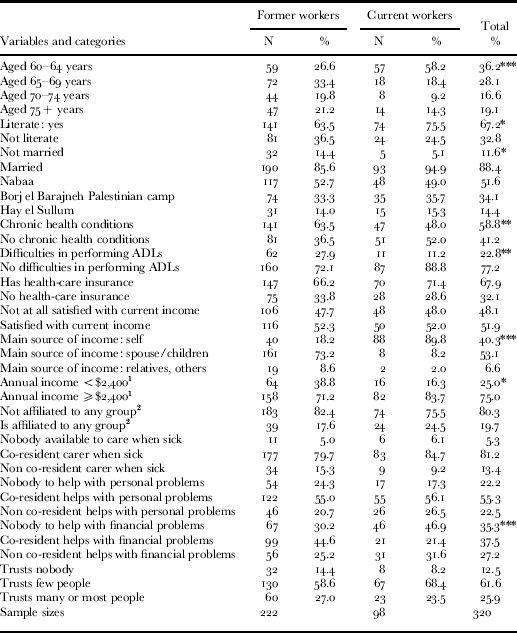
Table 1 presents the values of the potential co-variates by the main exposure variable, work status. All the socio-demographic attributes differed significantly according to work status, except for the type of community. Current workers were significantly more likely than former workers to be in the younger age group (60–64), literate and married, and they were significantly less likely to report chronic conditions and difficulties with ADLs. Similar proportions of both work status groups had health-care insurance. Not surprisingly, the great majority (89.8%) of current workers reported their earnings as the main source of household income, compared to only 18.2 per cent of those who were not in work. Former workers (38.8%) were more likely than current workers (16.3%) to report a household income of less than $2,400 for the year. Only one of the five social capital indicators was significantly associated with work status: more of the current workers reported having no one to help with financial problems, and former workers were more likely to report that a household member would help.
Socio-demographic, health-related, financial and social capital characteristics by current work status: older men in three low-income areas of Beirut, Lebanon, 2002
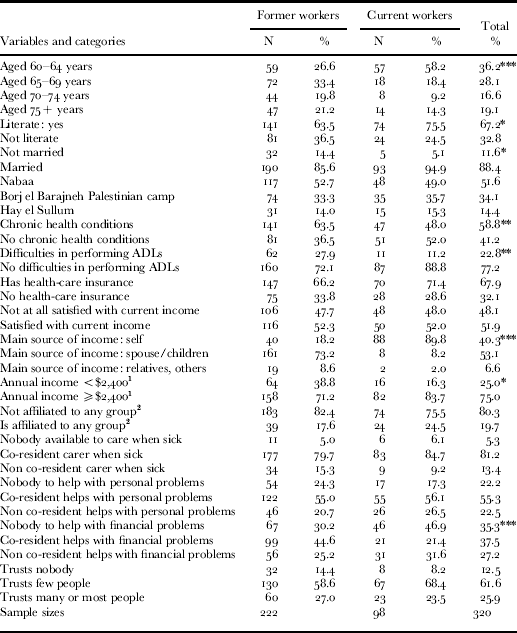
Notes: 1. Annual household income in US dollars. 2. Any social, local or corporate group. ADLs: Activities of Daily Living.
Significance levels:* p<0.05, ** p<0.01, *** p<0.001.
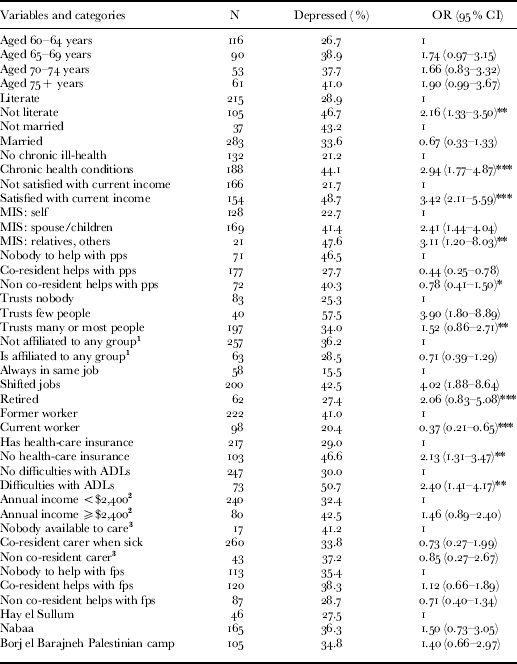
Based on the GDS scores, 111 respondents were assessed as depressed (score ⩾8). The bivariate analyses showed that among those who were currently working, 20.4 per cent were depressed, compared to 41.0 per cent of the former workers (unadjusted odds ratio (OR) 0.37, 95% confidence interval (CI) 0.21–0.65) (Table 2). Current workers who had always been in the same job had a significantly lower rate of depression (15.5%) than either those who had been retired from a previous job (27.4%) or those who had made a job shift (42.5%). Illiteracy, chronic illnesses, difficulties in performing ADLs and lack of health-care insurance significantly associated with depression. Those with chronic conditions and those with disabilities had 2.94 and 2.40 higher odds, respectively, of being depressed than others. Significantly more of those who were not satisfied with their income (48.7%) were depressed than those who were satisfied (21.7%), and those whose main sources of income were children/spouse or relatives/others were significantly more depressed than those whose main source was their own earnings (OR values of 2.41 and 3.11, respectively). Among the social capital variables, only ‘trust others’ and who was available to help with personal problems were significantly related to depression, e.g. 58 per cent of those who trusted nobody were depressed, compared to 34 per cent of those who trusted a few people, and 25 per cent of those who trusted many or most people. On the other hand, those who had a household member to help with personal problems were less likely to be depressed than those who had no one (OR 0.44).
Prevalence of depression by work status and selected covariates
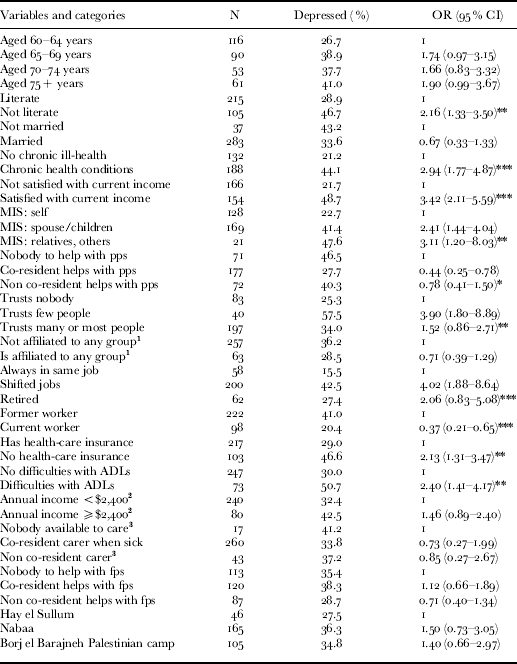
Notes: Of the entire sample 111 were ‘depressed’. 1. Any social, local or corporate group. 2. Annual household income in US dollars. 3. When sick. ADLs: Activities of Daily Living. fps: financial problems. MIS: main income source. OR: unadjusted odds ratio. pps: personal problems.
Significance levels:* p<0.05, ** p<0.01, *** p<0.001.
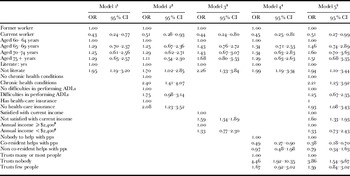
Table 3 shows the results of the logistic regressions. All five models indicated that depression was significantly associated with work status, and the influences of the socio-demographic, financial resources and social capital variables were broadly consistent. The health-related measures had the highest modifying influence on the relationship between work and depression (see particularly the OR values for having chronic health conditions and having difficulties carrying out ADLs; Table 3). In the fully adjusted model that included all the variables, being a current worker reduced by 50 per cent and significantly the odds of depression (OR 0.50, CI 0.25–0.96).
Results of the regression models for the association between depression and work status controlling for significant covariates

Notes: 1. Adjusted for socio-demographic characteristics. 2. Adjusted for socio-demographic and health characteristics. 3. Adjusted for socio-demographic and financial characteristics. 4. Adjusted for socio-demographic and social capital characteristics. 5. Adjusted for socio-demographic, health, financial and social capital characteristics. 6. Annual household income in US dollars. ADLs: Activities of Daily Living. CI: confidence interval. fps: financial problems. OR: odds ratio for depression. pps: personal problems.
Discussion
This paper has investigated the association of work with depression among community-dwelling older men living in three poor neighbourhoods in Beirut, Lebanon. The current study is among the few to address the effect of paid work on depression in this region, where issues affecting older people are rarely investigated or even acknowledged. The findings provide evidence that work is protective of depression. The association between work and depression has been reported previously in several studies. For instance, Duncan and Whitney (Reference Duncan and Whitney1990) found in a sample of people aged 55 or more years that older people who were engaged in either paid employment or volunteering had higher life satisfaction than others, but they did not separate the effects of paid work and volunteer work. A longitudinal study by Luoh and Herzog (Reference Luoh and Herzog2002) suggested that older workers engaged for 100 or more hours over a year were twice less likely to exhibit poor self-rated health or disability, and had only one-quarter the risk of mortality as compared to those working for less than 100 hours.
The benefits which accompany activity in old age can be associated with several psychosocial pathways. Maintaining an active lifestyle reflects positive self-identification as well as a high sense of wellbeing and satisfaction (Kart, Longino and Ullmann Reference Kart, Longino and Ullmann1989). Being in work activates various protective behaviours and attitudes, such as mild physical activity (LaCroix et al. Reference LaCroix, Guralnik, Berkman, Wallace and Satterfield1993), feelings of control (Hayward, Friedman and Chen Reference Hayward, Friedman and Chen1998; Herzog et al. Reference Herzog, Franks, Markus and Holmberg1998; Krause, Herzog and Baker Reference Krause, Herzog and Baker1992; Thoits and Hewitt Reference Thoits and Hewitt2001), and work-related social networking (Hayward, Friedman and Chen Reference Hayward, Friedman and Chen1998). In the present study, current workers were more likely than people not-in-work to trust others and to have someone to help with personal problems, which underlines the importance of work as a source of social capital. Income is another vital benefit of paid work. Mirowsky and Ross (Reference Mirowsky and Ross2001) found that not having wage income in a household increased the level of depression, which was associated with economic hardship. Furthermore, being involved in paid work and thus maintaining a sense of meaning and mastery are crucial among older men in developing country settings, where generally the cultural expectation is that they are the heads of households (Grundy and Holt Reference Grundy and Holt2001). Schröder-Butterfill's (Reference Schröder-Butterfill2004) study in Indonesia showed that it is not invariably the case for older people to be supported financially by their children, indeed on the contrary many had to remain economically active to support their families. Also, older people who are not economically active and who do not enjoy some sort of financial independence might lose their status as the household authority figures and become peripheral family members.
The participation in paid work by age groups in the three areas merits comment. Overall 20 per cent of the men aged 65 or more years, the official ages of retirement, were still working, and this percentage changed little with increasing age (20% per cent of those aged 70 or more years were in work, and 23% of those aged 75+ years). These rates of labour-force participation are higher than in the United States of America (17.8%) (Purcell Reference Purcell2000) and Greece (1%), close to the level in Turkey (25.4%), and lower than that in Syria (35%) (International Labour Office 2009). The variations may be attributed to the availability and coverage of social security income support, safety nets, public institutions and pension schemes for low-income older people. In Lebanon, the majority of older people do not receive pensions, and for those in the private sector who are covered by the National Social Security Fund, perversely they lose their health-care insurance on retirement (Sibai et al. Reference Sibai, Sen, Baydoun and Saxena2004). Continuing in paid work is therefore necessary for survival and to maintain even a modest standard of living: most people who have had low-status jobs can save too little to ensure their security and welfare in old age.
Some limitations of the study should be acknowledged. The cross-sectional design of the survey did not allow causal relationships to be specified or tested, and reverse causation is a possibility. A depressed person may be more likely to quit his work and become a former worker, or a person who quits work can become depressed. Furthermore, the small sample size precluded disaggregation; e.g. it was not possible to look in depth at the retirement experience as only 62 had retired from a previous job.
Conclusions and recommendations
Given the lack of pension schemes in Lebanon and many other developing countries, along with the psychological implications of retirement and the burden of mental health, increasing our understanding of the role of work in later adulthood is timely and of great importance. Paradoxically, the general tendency is to perceive old age as a stage of decline in abilities and health and of contracting opportunities for social and economic roles, all of which instil feelings of depression among older adults (Mirowsky and Ross Reference Mirowsky and Ross2001). Old age is not necessarily associated with decreased productivity, however, because those who can earn a living or who contribute to their families and communities through work and care are physically and mentally fit. More policy makers and social commentators should be aware that many older people are a resource, and can provide opportunities and possible solutions to family and community problems (Kerschner and Pegues Reference Kerschner and Pegues1998).
Lebanon hardly has social policies related to older people. When people are forced out of work, they have to rely on their accumulated earnings and support from their children, which among poor urban families in Lebanon can provide too little. Coupled with this, the incessant emigration of young adults has resulted in an increasing number of older people living alone and without assistance from their descendants. Around 5 per cent of older men in Lebanon lived alone in 1996, and in certain regions in the south such as Nabatieh, the share reaches 22.1 per cent (Sibai et al. Reference Sibai, Sen, Baydoun and Saxena2004). Lebanon therefore faces a great challenge to develop social policies and pension schemes appropriate to the country's changing demographic, social, cultural and economic conditions. A national strategy is needed that gives particular attention to employment opportunities and the ‘official’ retirement age. It is crucial that the Lebanese government recognise the right of older people for social inclusion, especially that they should not be excluded from paid employment, and implement their entitlements to health-care coverage along with a decent income or retirement pension, as recommended by the International Labour Organization.
The findings of the study should be drawn to the attention of the many employers that promote early retirement and that provide incentives to older workers to stop working. In the light of our findings, employees should be cautious when taking the retirement decision and should plan their retirement years in a way that maintains their engagement in non-work-related activities. More research on these topics is needed. A longitudinal study of a cohort of adults close to retirement could better ascertain the relationship between work and psychological wellbeing in Lebanon and in other countries with similar old-age income arrangements and social contexts.
Acknowledgements
The data for this paper were drawn from a larger inter-disciplinary research project, ‘Urban Health’, that is co-ordinated by the Center for Research on Population and Health at the American University of Beirut, Lebanon, with support from The Wellcome Trust, The Mellon Foundation and The Ford Foundation.