Introduction
With a total population of 83,892,200 by 1st April 2006, Vietnam was ranked the 14th most populous country in the world. The country's fertility has markably declined over the last decade and reached the replacement level of 2.1 in 2005 (General Statistics Office, 2007). Previous studies have shown that son preference is an important factor influencing the fertility decisions of Vietnamese couples (Haughton & Haughton, Reference Haughton and Haughton1995). Vietnamese women have adopted a range of strategies in order to obtain at least one son among their children (Belanger, Reference Belanger2006). An analysis of socio-political and health practices in Vietnam argued that the small size family norm, the recent reinforcement of the one-to-two child family policy, son preference, easy access to ultrasound screening and legal abortion are important factors influencing the sex ratio at birth (SRB) (Pham et al., Reference Pham, Hall, Hill and Rao2008). These factors all have an influence on the application of the stopping rule – the family's decision to cease childbearing once a desired size and sex composition of children is reached.
The SRB of Vietnam was reported at 110 male births per 100 female births (General Statistics Office, 2007), and increased at a very high rate of about 1% per year over the period 2005–2007, faster than the peak periods of Korea in the 1980s and in China in the 1990s (Guilmoto, Reference Guilmoto2008). The trend of increasing SRB in Vietnam has been recently confirmed (Guilmoto et al., Reference Guilmoto, Xuyen and Toan2009). Given public concerns about the high SRB, further research is required. However, little attention has been given to the stopping rule and its impact on the sex ratio of last births (SRLB) in Vietnam. This study analyses the operation and measures the impact of the stopping rule on the SRLB in Vietnam.
Theoretical framework
The stopping rule in fertility decision-making
The main expression of the stopping rule in human fertility is where couples decide to have no more additional children, based on their achievement of: (i) a desired number of children, and (ii) desired sex composition of their children. Otherwise, they progress to the next parity. While social and cultural factors across societies may alter what these desired outcomes are, the operation of the stopping rule remains the same.
The first empirical study on the scope of son preference used the population data of Taiwan in the 1970s (Coombs et al., Reference Coombs, Coombs and McClelland1975). In this study, the authors used a special data collection procedure and an ordinal scale for measuring the magnitude of son preference and the desired number of children in a sample of 437 respondents in Taiwan and 423 students in Michigan, US. However, such information is often not available from routine censuses and demographic surveys, which are usually the main data sources available in many countries. These demographic surveys only collect information on age and sex of children, and numbers of sons and daughters ever born, and would not include special data collection procedures.
Another attempt to measure the effect of sex preference on formulating family size was made by McClelland (Reference McClelland1979). He suggests that if the stopping rule is ‘to stop at two children if one boy and one girl are obtained, otherwise go to three children’, with a probability of 0.5 of having a boy and a girl in the first two births, then the expected average family size will be 2.5 children ((2×0.5)+(3×0.5)=2.5).
Son preference has been identified as an important factor influencing fertility decision-making (Widmer et al., Reference Widmer, McClelland and Nickerson1981), influencing the high SRB phenomenon in countries in South Asia (Pakistan, India), West Asia (Armenia, Azerbaijan and Georgia) and Central and East Asia (South Korea, China, Taiwan, Singapore and Vietnam) (Filmer et al., Reference Filmer, Friedman and Schady2008).
Clark (Reference Clark2000) demonstrated son preference in India by exploring the sex composition of children in Indian families, identifying two theoretical effects of son preference. First, smaller families had a significantly higher proportion of sons than larger families. Second, within a given family size, the characteristics of couples who wished to have sons were the same as the characteristics of couples who obtained a higher proportion of sons among their children.
The impact of the stopping rule on sex ratio of last birth
This study demonstrates the operation of the stopping rule and its impact on sex ratio of last births (SRLB, defined as sex ratio of the final births, when women have ceased their reproduction) in a context of son preference in Vietnam, where a significant number of women wish to have at least one son among their children and would continue their childbearing until a son is born, only stopping their childbearing once a son is obtained. Santow (Reference Santow2006) comments that in the socio-cultural context of son preference in Vietnam, the majority of Vietnamese women would continue childbearing until they have a son.
To illustrate the increased probability of having a son by progressing to higher parity, let's assume that for a woman at parity i, the probability of having a boy is p and that of having a girl is 1−p. In a normal situation, where the SRB is 105 male births per 100 female births (note that all SRB values in this paper will be quoted as number of male births per 100 female births from this point), the probabilities of having a male or a female birth are almost the same, i.e. 0.512 and 0.488, respectively. The probability of having all-female births at parity i is exactly equal to (1−p)i. If the woman decides to have an additional child by progressing to the next parity i+1, then the probability of having had all-female births at that parity is equivalent to (1−p)i+1. In this case, the probability of having all-female children has declined. That means, by contrast, the probability of having at least one male child has increased at the parity i+1 (Guilmoto, Reference Guilmoto2008).
As a result of the operation of the stopping rule in this fertility decision-making process, the rule has three potential effects: (i) formulating the family size; (ii) constructing the sex composition of children in the family; and (iii) increasing the SRLB.
This study focuses specifically on analysis of the impacts of the stopping rule on the SRLB. An important outcome of the stopping rule is that when these women cease their childbearing, or are no longer of reproductive age, the majority of last children are male rather than female. In this situation, the SRLB is higher and the sex ratio of preceding births (that is, births other than the last) is lower than the normal biological level for these women.
Comparison of sex-selective abortion and the stopping rule
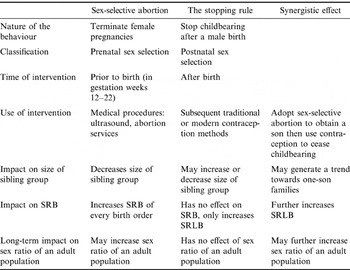
Sex-selective abortion involves the identification and termination of female pregnancies to a greater extent than male pregnancies. This behaviour is classified as prenatal sex selection, adopted prior to birth, often in gestation weeks 12–22. Sex-selective abortion relies on medical techniques such as ultrasound and abortion services. It results in decreasing the family size and increasing the proportion of sons in a family. Sex-selective abortion increases SRB and has the potential to increase the sex ratio of an adult population in the long-term. Although both sex-selective abortion and the stopping rule share the same root of son preference, these two mechanisms can operate separately or collaboratively to create synergistic effects on the sex ratio of children.
Table 1 compares sex-selective abortion and the stopping rule, and shows possible synergistic effects between these mechanisms. The impacts of the stopping rule on size of sibling group in families, sex ratio at birth and sex ratio of an adult population are different from that of sex-selective abortion. The impact of the stopping rule on the distribution of the size of the sibling group may take two opposite directions. In the context of high fertility, the stopping rule tends to increase the proportion of larger sibling groups in the population as women are more likely to progress to higher parities in order to obtain a son. By contrast, in the context of low fertility and strong son preference, under the stopping rule a considerable proportion of couples may prefer a single child if this is a son. In this context, the rule could therefore lead to a shift towards smaller sibling groups as many women could cease their childbearing immediately after their first male birth.
Impacts of sex-selective abortion and the stopping rule on sex ratio

The stopping rule has no influence on the SRB because the decision of progress to the next parity or to stop childbearing is made after the child is born (after birth). This rule can be considered as postnatal sex selection, based on the sex outcome of the last child. This rule, therefore, only impacts on the sex ratio of last births. This mechanism distinguishes its impact from the influence of the sex-selective abortion, which impacts on SRB regardless of birth order. The stopping rule is unlikely to cause an imbalance in the sex ratio of the adult population (if the population size is large enough). Unlike the stopping rule, abortion of female fetuses can lead to a high sex ratio of the adult population in the long-term because it increases the SRB. However, the imbalance in sex ratio of the adult population also largely depends on other demographic factors such as age and sex-specific mortality, and in particular, migration of the working-age population.
There is the potential for synergistic effects between sex-selective abortion and the stopping rule in the context of low fertility, particularly when it reaches or is below the replacement level of 2.1 children per women of reproductive age. For example, couples can adopt sex-selective abortion to obtain a son at parity 1, and then use contraception methods to stop childbearing at that parity. In these cases, the first male births are also the last births. This can lead to a faster decline in fertility and generate one-son families in the society. This will contribute further to the imbalance in the sex ratio of an adult population in the long-term.
Distinguishing the impact of the stopping rule and sex-selective abortion on SRLB
It is a challenge to distinguish the impact of the stopping rule and the influence of sex-selective abortion on the SRLB in a setting like Vietnam, where both of these behaviours can exist at the same time. This section develops an analytical method that distinguishes the impact of the stopping rule and sex-selective abortion on the SRLB, by defining a measure of the sex-specific Parity Stop Ratio (PSR).
Defining the PSR
The concept of the PSR is built on the basis of the demographic concept of the Parity Progression Ratio (PPR), proposed by Louis Henry and Norman Ryder in 1953, and referring to the conditional probability of the ith birth given that a woman has had the (i−1)th birth (Feeney, Reference Feeney1991). In other words, PPR refers to the proportion of women who progress to the next parity, among the total number of women giving birth at that parity.
The PSR is defined as the proportion of women with a given number of children who cease their childbearing at that parity. The PSR is therefore equal to 1 minus the PPR. The PSR is expressed as:

.
Calculating the sex-specific PSR
The sex-specific PSR is denoted as PSRim or PSRif for the proportion of women who stop having children at parity i for male and female births, respectively. The sex-specific PSR is calculated as the number of women who stop childbearing after a male (or female) birth at parity i divided by the number of women who have a male (or female) birth at that parity.
The male-specific PSRim is calculated as in the formula:

.
Similarly, the female-specific PSRif is calculated as:

.
In a society where the sex of the child is not a factor entering the couples' fertility decision, the values of sex-specific PSR should be the same, regardless the birth sex. But in the context of son preference, the proportion of women stopping childbearing after a male birth is greater than that after a female birth at the same parity. This means the value of the PSRim would be greater than that of the PSRif, and the value of the ratio PSRim/PSRif would be greater than 1. The stronger the influence of the stopping rule on fertility behaviour of a population, the higher the value of the ratio PSRim/PSRif will be; hence, the value of the ratio PSRim/PSRif reflects the intensity of son preference in that population.
Relating the sex-specific PSR, SRB and SRLB
Based on the above theoretical framework, it is assumed that the SRLB at parity i can be separated into two components. The first is the SRB (of all births) and the second is the ratio PSRim/PSRif. In other words, the SRLB is the product of two components as shown in the formula:
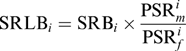
.
These two components are independent of each other. The first component, SRBi, reflects a wide range of factors influencing the survival of a fetus during pregnancy, i.e. sex-selective abortion. The second component, PSRim/PSRif, demonstrates the impact of the stopping rule on the SRLB. It reflects whether or not the sex of child born in the previous birth is a factor influencing the decision to stop childbearing. Both of these components can be calculated directly from an appropriate dataset such as the Population Change Survey (PCS) 2006.
Using the formula, two separate estimations of SRLB can be undertaken. First, the formula can be used as a approximation, in which SRB is controlled by hypothesizing that it is at the normal level of 105 in a homogenous population, where the SRB is consistent for all couples and across all parities, and there is no gender-based discriminatory behaviour, including sex-selective abortion. In this hypothetical situation, any variation in the SRLB from the normal level depends solely on the ratio PSRim/PSRif and the high SRLB reflects the net impact of the stopping rule on it.
In the second estimation of SRLB, the SRB is calculated from actual data. This means that the SRLB is not controlled by a set level of SRB, but instead varying levels of the SRB. The SRLB is therefore influenced by two factors: the SRB and the ratio PSRim/PSRif. In other words, the actual SRLB can be influenced by both sex-selective abortion and the stopping rule.
Comparing the two SRLB estimates in hypothetical and actual situations with a controlled and uncontrolled SRB, the impact of the stopping rule on the SRLB can be distinguished from the influence of sex-selective abortion. In other words, the sex-specific PSR method can be used as a proxy to quantify the net contribution of the stopping rule to the increase of SRLB in a context of son preference.
Demonstration of the stopping rule in Vietnam
The data from the PCS 2006, conducted by the General Statistics Office of Vietnam, were used to demonstrate the stopping rule and analyse the SRLB, using the sex-specific PSR. The assessment of data quality available in Vietnam for SRB analysis has identified this dataset as the most comprehensive dataset with a range of variables suitable for in-depth analysis of SRB, and particularly for the stopping rule analysis. The PCS 2006 provides a large birth cohort for analysing the SRLB and the stopping rule in Vietnam. The PCS 2006 had proven advantageous in this analysis as it is nationally representative and has a sufficient sample size to provide reliable estimates of SRLB. The availability of birth data over the period 1970–2006 has enabled the analysis of SRLB because the data cover the birth history of the entire reproductive lives of the cohort of women aged 40–49 in 2006. For instance, a woman aged 49 in 2006 was 13 years old in 1970 as she entered her reproductive age. The use of entire birth data also means a larger sample size, an important aspect in SRB analysis providing reliable SRLB estimates.
Variables used included age of women, year of birth and sex of child of most recent births, numbers of female births, male births and total births, sex and year of birth from parity 1 to 5. A total of 296,845 most recent births were recorded over the period 1970–2006. Conditions were applied to maternal age and year of birth to select last births from most recent births. Two sub-samples of last births were identified and analysed separately. The first sub-sample included most recent births born in the period 1986–1995. This sub-sample was selected on the ground that women of these births would have ceased their reproduction after 10 year of birth spacing, regardless of their age at the survey time. Most recent births born in the period 1996–2006 were not included in this sub-sample because they are unlikely to be the last births.
Although most recent births born in the period 1970–1985 were effectively the last births, they were not included in this sub-sample for time trend analysis because the data on these births had potential bias due to the effects of small sample size and young maternal age. Very few Vietnamese women ceased their childbearing at the age of 29 twenty years ago. Furthermore, the proportion of women aged 15–49 in the surveyed sample decreases in those earlier years. Consequently, the cohort of last births born in this period recorded in the surveyed data was very small. Since SRLB estimation is sensitive to sample size, a small sample produces unreliable results that are reflected in wide 95% CIs. For these reasons, last births born in the period 1970–1985 were excluded in this sub-sample and time trend analysis of SRLB was not conducted for the period 1970–1985.
This sub-sample provides an opportunity to demonstrate the net impact of the stopping rule on SRLB in the period 1986–1995, given that sex-selective abortion was supposedly not available in Vietnam at that time. It was used for analyses of the time trend of SRLB over the period 1986–1995 and the differentials in SRLB by rural–urban sector, between the Red River Delta and the Mekong River Delta. The Red River Delta and the Mekong River Delta are considered as representative of the north and the south of the country, respectively. These two regions have the largest populations (approximately 17 million and 18 million, respectively) and accounted for 42% of the total population of 84 million of the country in 2006. These regions are also comparable in terms of rural–urban ratios, and total fertility rates (2.2 compared with 2.1 in 2006, respectively; General Statistics Office, 1999, 2007), but have divergent cultural and socio-political histories.
The second sub-sample included most recent births born to women aged 40–49 by the survey time over the period 1970–2006. This cohort was selected based on the assumption that these births would be born to women who would have finished their reproduction, as the age-specific fertility rate for Vietnamese women aged 40–49 is below 20 per thousand women (General Statistics Office, 2007). By contrast, most recent births born to women aged 15–39 were excluded in this sub-sample because women of this age are likely to continue their childbearing. The nature of this sub-sample is different from the first sub-sample that was used for time trend analysis. Sample size and young maternal age are unlikely potential sources of biases in this second sub-sample. Hence, these sub-sample data were used for demonstration of the operation of the stopping rule and for analysis of the associations between the SRLB levels, family sizes and sex composition of children over the period 1970–2006. This sub-sample was finally used to quantify the impact of the stopping rule on the SRLB. The results of these analyses are presented in weighted data, using sample weight.
Results
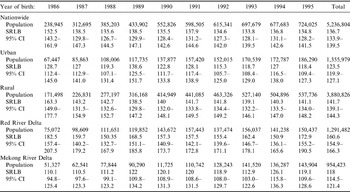
Table 2 shows the SRLB by urban–rural residence and by region for the period 1986–1995. The SRLB was consistently above the level of 130 across every year nationwide, and around the 120 level in urban areas and 140 level in rural areas during the period. High SRLB values were observed in both the Red River Delta and the Mekong River Delta. The SRLB of the Red River Delta was very high, being consistently above the level of 150, while that of the Mekong River Delta fluctuated around 110.
Sex ratio of last birth by family size, regions and year of birth, Vietnam, 1986–1995

Impact of the stopping rule on family size, sex composition and SRLB
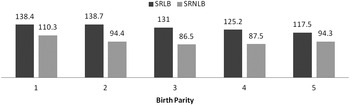
To demonstrate the impact of the stopping rule, the SRLB was compared with the sex ratio of non-last births (SRNLB) by parity. This analysis provides evidence of disparity between decisions to stop or to continue childbearing, based on the sex outcome of the previous birth. The SRNLB was 110.3 at parity 1, but well below 100 at higher parities, reaching as low as 86.5 at parity 3. In contrast, the SRLB was consistently above the level of 117.5 across all parities, from 1 to 5. The substantial differentials between the SRLB and the SRNLB by parity are presented in Fig. 1.
Sex ratio of last births vs sex ratio of non-last births, Vietnam, 1970–2006.

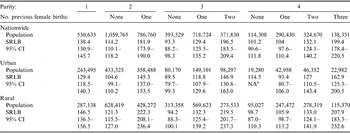
Table 3 shows the impact of the stopping rule on the sex composition of children and the SRLB in the period 1970–2006. The analysis of the association between the SRLB level and family size and number of previous female births shows that the SRLB level is significantly associated with the sex composition of the children born in previous births. The SRLB has increased in accordance with the number of previous female births. Where all previous births were female, the SRLB is extremely high, increasing from 181.9 at parity 2, to 196.5 at parity 3 and 199.4 at parity 4. In contrast, the SRLB is far lower when no previous births were female: 114.2 at parity 2, 93.3 at parity 3 and 101.2 at parity 4. (This analysis was conducted from parity 1 to 4 because the numbers of births at parity 5 and above are small.)
Sex ratios of last births by parity, number of previous female births and rural–urban sector, Vietnam, 1970–2006

a Non-applicable due to small sample size.
High SRLB values were evident in both rural and urban areas and consistently across all parities, but the SRLB was considerably higher in rural areas than in urban areas. For parity 1, the SRLB in rural areas was 146.5, compared with 129.4 in urban areas. Furthermore, the SRLB increased at a higher rate in rural than urban areas. In rural areas where all previous births were female, the SRLB was extremely high, above the level of 200 at each parity, though for urban areas the same measure was no higher than the level of 162.9.
Distinguishing the impact of the stopping rule and sex-selective abortion on SRLB
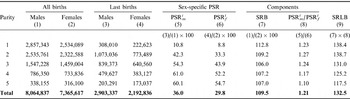
Table 4 shows the impact of the stopping rule on SRLB, using the sex-specific PSR measures. The PSR of male last births was consistently higher than that of female last births across all parities. For example, at parity 3, 54.3% of women stopped childbearing following a male birth compared with 43.9% for a female birth. As a result, the ratio PSRim/PSRif was consistently above the value of 1 at each parity, and 1.21 for all parities. The highest value was 1.27 at parity 2, meaning that families are 27% more likely to stop childbearing if the last birth was male compared with female. Even at parity 5, the ratio PSRim/PSRif was 1.10. The value of the ratio PSRim/PSRif provides quantitative evidence of son preference in fertility decision-making of Vietnamese couples. In other words, that value reflects the extent of the impact of the stopping rule on the SRLB in the population of Vietnam over the period 1970–2006.
Measuring the impact of the stopping rule and sex-selective abortion, using the sex-specific parity stop ratio (PSR), Vietnam, 1970–2006

The SRLB was very high at 132.5 for all parities, and especially for parities 1 (138.4) and parity 2 (138.7). These estimates were calculated using the actual SRB, which was slightly high at 109.5 for all parities, and highest at parity 1 (112.8), but close to the normal level at higher parities, from 3 to 5. The high SRB at parity 1 could be due to the effect of sex-selective abortion being adopted right from the first birth.
Discussion
The stopping rule in fertility decision-making of Vietnamese couples
Three factors have been identified as underlying the high SRB observed in Asia: sex-selective abortion of female fetuses (Mason & Bennett, Reference Mason and Bennett1977; Arnold et al., Reference Arnold, Kishor and Roy2002; Belanger, 2002b), under-reporting of female births in population data (Lai, Reference Lai2005), and excess female neonatal deaths (Fuse & Crenshaw, Reference Fuse and Crenshaw2006; Wu et al., Reference Wu, Viisainen and Hemminki2006). A previous study has suggested that the under-reporting of female births and excess female neonatal mortality are less likely to be the sources of biases skewing the SRB upwards in Vietnam (Vietnam's Commission for Population Family and Children & ORC Macro, 2002). The significantly high SRB of 109.5 observed in this study suggests that sex-selective abortion could have been a driver of the high SRB in Vietnam. This finding is consistent with that reported in previous studies, using different analytical methods and data sources (Guilmoto et al., Reference Guilmoto, Xuyen and Toan2009; Pham et al., Reference Pham, Adair and Hill2010). However, sex-selective abortion is not the only factor contributing to the imbalance in the sex ratio.
Using the sex-specific PSR analytical method, the study has revealed the role of the stopping rule as another important mechanism influencing the SRLB in Vietnam. The high SRLB and low SRNLB show a clear pattern of stop childbearing after a male birth and continue childbearing after a female birth. The high SRLB levels observed in the period 1970–2006, particularly in the birth cohort born in the period 1986–1995, when sex-selective abortion was supposedly not available, strongly suggest the operation of the stopping rule, not only in the past, but also at present.
Values of the PSRim/PSRif ratio consistently above 1 across every parity and of 1.21 for all parities are strong evidence of the stopping rule in the fertility decision-making of Vietnamese couples, as 21% of them are more likely to stop childbearing if their last child was a son compared with a daughter. This also suggests that the SRLB can be used as a proxy indicator for measuring the magnitude of son preference that has been qualitatively reported in Vietnam (Haughton & Haughton, Reference Haughton and Haughton1995; Belanger, Reference Belanger2006; Pham et al., Reference Pham, Hall, Hill and Rao2008).
With the SRLB reaching almost 200 at parity 3 when both previous births were female, this observation is striking, particularly when it is consistent in both rural and urban areas, and across all parities. This level is even higher than China's value of 120 (Poston et al., Reference Poston, Gu, Liu and McDaniel1997). The SRLB is higher in rural than in urban areas (140 compared with 120, respectively) and also increases faster, suggesting a stronger manifestation of son preference in rural areas. Indeed, the last births are more than twice as likely to be male than female in rural areas when all previous births were female. This can be justified on various grounds, but most significant could be the economic need for manual labour in agriculture, inheritance of property and social support in old age (Pham et al., Reference Pham, Hall, Hill and Rao2008).
The high SRLB observed in both the Red River Delta and Mekong River Delta reconfirms the widespread nature of the rule in Vietnamese fertility behaviour. The result demonstrates a stronger manifestation of son preference in the Red River Delta than in the Mekong River Delta. A previous study suggested strong son preference in the northern rural areas of Vietnam (Belanger, 2002a). It is noted that Vietnam has experienced a large volume of migration from the north to the south over the last three decades, but the main flow of rural-to-rural migration was from the Red River Delta to the Central Highlands (Pham & Hill, Reference Pham and Hill2008), not the Mekong River Delta.
Synergistic effects between the stopping rule and sex-selective abortion
A high level of SRLB has been found in other Asian countries. In Korea in the mid-1970s the SRLB was 114.4 for one-child families, 133.4 for two-child families and 145.5 for three-child families (Park, Reference Park1983). These levels are equivalent to the SRLB level of Vietnam, determined by using the sex-specific PSR analytical method. However, the pattern of high SRLB by parity was inverted in the data of Vietnam.
Given the open access to sex-selective abortion in Vietnam, the greatest concern is the synergic effect between the stopping rule and sex-selective abortion, particularly at a time when the country's fertility rate has declined to below replacement level. Widmer et al. (Reference Widmer, McClelland and Nickerson1981) suggests that the stopping rule can be used to predict sex selection. The highest SRB observed at lower parities suggests that sex-selective abortion could have become an alternative to the stopping rule, adopted by a number of couples at early parities in order to obtain a son and maintain a small family size.
The higher SRLB at lower parities also suggests that Vietnamese couples want fewer children, but also prefer a son. As fertility declines, one would expect a growing proportion of women ceasing childbirth after their first male births. The synergistic effect between sex-selective abortion and the stopping rule has the potential to exacerbate the trend of one-son families in Vietnamese society. Indeed, the proportion of one-child families among all families sizes has increased from 7.4% in 1986 to 10.8% in 2005 and the SRLB of one-child families has increased to the level of 140 over this period (see Tables 2 and 3).
Limitations of the method
The study has reinforced the view that both the stopping rule and sex-selective abortion would have contributed to the high SRLB. The proposed method attempts to remove the influence of sex-selective abortion while using the sex-specific PSR to quantify the impact of the stopping rule on the SRLB. Theoretically, the net impact of the stopping rule on the SRLB can be measured in a hypothetical scenario, where there is no sex-selective abortion in the population with a defaulted SRB at 105. However, the probabilities of male and female births are not absolutely equal and independent within and across each parity (James, Reference James2009). In contemporary Vietnam, the high SRLB could have been biased by the influence of both the stopping rule and sex-selective abortion, particularly for the birth cohort born in the 2000s. The method, therefore, cannot measure precisely the net impact of the stopping rule or separate it totally from the influence of sex-selective abortion because a male last birth could be the result of sex-selective abortion, adopted at a parity that subsequently becomes the final birth.
Conclusion
Using the theoretical framework of the stopping rule, the study has shown that the stopping rule is an important mechanism in fertility decision-making of Vietnamese couples. The stopping rule has been demonstrated by the high SRLB of 130 over the period 1970–2006. The proportion of women stopping childbearing after a male birth is 21% higher than after a female birth. The SRLB was highest at parity 2 (138.7), particularly in rural areas (153.5), and extremely high (181.9) when the previous birth was female. Given the declining fertility in Vietnam, the stopping rule has a potential synergistic effect with sex-selective abortion to accentuate the trend towards one-son families in Vietnamese society, further contributing to an imbalance in the sex ratio of the adult population in the long-term. This demographic trend needs to be monitored closely. The study has clearly demonstrated that the stopping rule not only determines family size and constructs sex composition of children, but also increases the SRLB. This method has the potential for use in similar settings in Asia, where son preference is common. The SRLB itself may be used to indirectly estimate the magnitude of son preference in a population with or without the presence of prenatal sex-selection practices, but further study of the method is required.
Acknowledgments
The research was funded by the Australian Leadership Awards (ALA) Programme and the Australian Agency for International Development (AusAID). The cost of data collection was partially covered by the project Evidence for Health Policy Development in Vietnam, funded by the Atlantic Philanthropies. There was no influence from these donors on the data analysis and report writing. The authors take full responsibility for the views expressed in this paper. The authors thank the General Statistics Office of Vietnam for access to the data from the PCS 2006, the University of Queensland, Australia, for technical support in development of this paper and the United Nations Population Fund for related information and materials.