Primary seed dispersal has long been credited with facilitating survival in plants (Howe & Smallwood Reference HOWE and SMALLWOOD1982, Janzen Reference JANZEN1970, Wenny & Levey Reference WENNY and LEVEY1998), thereby shaping the spatial structure of plant communities and enhancing gene flow among populations (Herrera et al. Reference HERRERA, JORDANO, LOPEZ-SORIA and AMAT1994, Nathan & Muller-Landau Reference NATHAN and MULLER-LANDAU2000). However, the final fate of dispersed seeds might be a template generated by primary dispersal and subsequently rearranged by secondary seed removal (Nathan & Muller-Landau Reference NATHAN and MULLER-LANDAU2000). Thus, understanding the consequences of secondary seed removal is crucial as it directly influences plant population dynamics (Crawley Reference CRAWLEY and Feener2000), specifically in tropical tree species which overwhelmingly depend on animal-rendered services (Howe & Smallwood Reference HOWE and SMALLWOOD1982), have specialized habitat needs and limited microsites for recruitment (Clark et al. Reference CLARK, POULSEN, LEVEY and OSENBERG2007, Dalling et al. Reference DALLING, MULLER-LANDAU, WRIGHT and HUBBELL2002).
Seeds experience contrasting fates following secondary removal. For example, seeds removed by rodents are predominantly consumed, but some seeds may escape predation via hoarding (Forget Reference FORGET1996, Forget et al. Reference FORGET, MERCIER and COLLINET1999). Challenges involved in tracking seeds after secondary removal hampers the exact determination of seed fates. Therefore, many studies have considered secondary removal a proxy for predation, although it can also result in dispersal and establishment (Vander Wall et al. Reference VANDER WALL, KUHN and BECK2005). In addition to rodents, secondary seed removers include diverse groups such as ants, beetles, armadillos and coatis (reviewed in Chambers & MacMahon Reference CHAMBERS and MACMAHON1994). However, the role of some agents such as crabs (Capistrán-Barradas & Moreno-Casasola Reference CAPISTRÁN-BARRADAS and MORENO-CASASOLA2006, Sherman Reference SHERMAN2002, Smith Reference SMITH1987) remains poorly understood. Some studies have elucidated the role of crabs as key players in the recruitment of plants in coastal, mangrove and island ecosystems (Lee Reference LEE1985, Louda & Zedler Reference LOUDA and ZEDLER1985, Lindquist et al. Reference LINDQUIST, KRAUSS, GREEN, O’DOWD, SHERMAN and SMITH2009, O’Dowd & Lake Reference O’DOWD and LAKE1991, Osborne & Smith Reference OSBORNE and SMITH1990). In this study, we evaluate the importance of crabs in secondary seed removal of an endangered tree species, Myristica fatua var. magnifica (Bedd.) Sinclair (Myristicaceae) (IUCN 2000) that occurs exclusively in the Myristica swamp forests of the Western Ghats in India (Champion & Seth Reference CHAMPION and SETH1968). These freshwater swamps are dominated by the Myristicaceae, and exist as small fragments due to special abiotic requirements and added anthropogenic impacts (Chandran & Mesta Reference CHANDRAN, MESTA, Uma Shaanker, Ganeshaiah and Bawa2001). In this study system, we test the hypothesis that crabs are major secondary removers of Myristica fatua seeds in a small fragmented and a large contiguous site.
This study was conducted from June to October 2013 within the Kulathupuzha reserve forest (8°51′N, 77°5′E), southern Western Ghats of India. A small, fragmented swamp (Marappalam; hereafter fragMP; area 1.5 ha) and a large contiguous swamp (Munnamchal; hereafter contMC; area > 20 ha) were chosen as study sites. Myristica fatua trees are dioecious and fruit from May to October (unpubl. data). Capsules enclose a single large seed, which is covered by a bright yellowish-orange lacy aril. Freshly collected arillate seeds weigh 24.8 ± 2.98 g (n = 10, Mean ± SD), while seeds alone weigh 20.9 ± 2.93 g (n = 10). Primary frugivores include Ocyceros griseus Latham (Malabar grey hornbill), Buceros bicornis Linnaeus (great hornbill), Macaca radiata Geoffroy (bonnet macaque), Ratufa indica Erxleben (Malabar giant squirrel), Macaca silenus Linnaeus (lion-tailed macaque) and Presbytis johnii Fischer (Nilgiri langur). Entire dehisced capsules can also passively drop from trees. Two common freshwater crab species (burrow densities in fragMP = 0.27 m−2 and contMC = 0.12 m−2), Barytelphusa guerini (H. Milne-Edwards) and Travancoriana schirnerae Bott, secondarily remove seeds in the Myristica swamp forests.
To determine the identity of secondary removers, aril-intact (passively dropped) and aril-removed seeds (dropped by frugivores) were tethered to 2-m long fishing lines (Experiment A). Three aril-intact and three aril-removed seeds were placed under each of 10 trees in both sites. The fate of these seeds was monitored on days 1–5, 7, 9, 14 and weekly thereafter until week 14. The displacement distance was measured for recovered seeds from the location of placement to the seed-end of the tether. Depending on location of recovery, seeds were categorized as (1) crab-removed (line recovered from crab burrow), (2) rodent-removed (line recovered 2–10 m above ground), (3) unknown (line detached and seed removed), (4) infected or (5) not removed. Ten of these crab burrows with recovered fishing lines were excavated to check the fate of seeds.
To check whether crabs were seed predators or dispersers, simultaneous choice experiments were performed using tethered and waterproof-paint-marked seeds and arils (Experiment B). In both cases, an aril-intact seed, an aril-removed seed and an aril alone were placed at a distance of 0.5 m from the entrance of burrows (n = 15 burrows in each case). Experiment B was monitored using infrared surveillance cameras and direct observations (18h00–23h00) until complete removal. Tethered seeds (15 aril-intact + 15 aril-removed) and marked seeds (15 aril-intact + 15 aril-removed) that were carried by crabs into burrows were monitored weekly for signs of predation or germination. All statistical analyses were performed using R software (version 3.0.2) and the SURVIVAL package was used for analysing seed removal rates (R Foundation for Statistical Computing, Vienna, Austria).
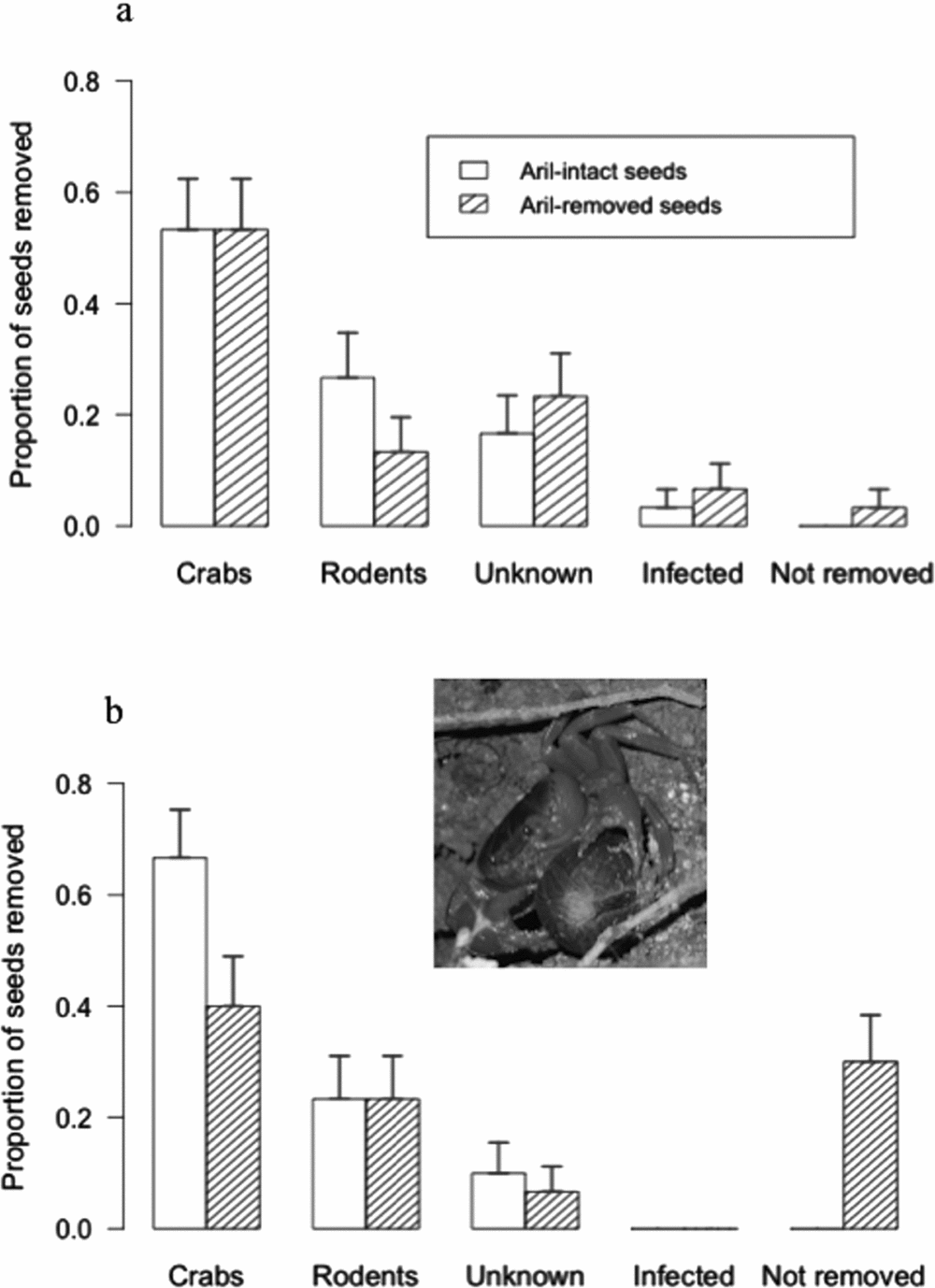
In Experiment A, there was no difference between sites in the removal of tethered aril-intact (χ2 = 0.63, df = 1, P = 0.429) and aril-removed seeds (χ2 = 0.60, df = 1, P = 0.437), so the data were pooled for further analysis. Compared with rodents, crabs removed significantly higher proportions of aril-intact (χ2 = 7.84, df = 1, P < 0.05) as well as aril-removed seeds (χ2 = 6.56, df = 1, P < 0.05) (Figure 1). The distance of seed removal varied significantly between crabs and rodents (Wilcoxon rank sum test, W = 40, P < 0.0001; Crabs = 1.48 ± 1.74 m, n = 23, maximum = 8 m; Rodents = 3.56 ± 4.06 m, n = 23, maximum = 20 m).
Secondary seed removal of Myristica fatua in Myristica swamp forests in the southern Western Ghats in India. Mean (+ SE) proportions of seeds removed in a fragmented swamp, fragMP (a) and a contiguous swamp, contMC (b) following differential seed fate i.e. crab-removed, rodent-removed, infected seeds, unknown (specific group of removers could not be identified) and seeds not removed by the 98th day are shown. Thirty tethered aril-intact and aril-removed seeds were placed in each study site (Experiment A). Inset shows the freshwater crab, Barytelphusa guerini holding a seed of Myristica fatua.

Simultaneous choice experiments (Experiment B) indicated that removal rates of arils were higher than aril-intact and aril-removed seeds (Kruskal–Wallis test, tethered seed, χ2 = 39.5, df = 2, P < 0.0001; marked-seed, χ2 = 40.7, df = 2, P < 0.0001). Direct observations showed that arils covering seeds were partially eaten at the placement location and the rest was carried into burrows (Supplementary material). Excavations of burrows revealed no signs of seed predation (fragments of seeds) or intact seeds. However, 13.3% of the 60 seeds monitored at crab burrows germinated successfully at a depth of approximately 15 cm within burrows. The mean height of seedlings, which emerged from burrows, was 35.3 ± 12.1 cm (n = 8).
The proportions of aril-intact and aril-removed seeds removed by crabs did not differ significantly in fragMP (χ2 = 0, df = 1, P = 1) and contMC (χ2 = 3.28, df = 1, P = 0.070) (Figure 1; 32 seeds each were removed by crabs in fragMP and contMC). However, aril-intact seeds were removed at much faster rates (< 3 d, mean = 1.89 ± 0.94 d) than aril-removed seeds (up to 98th day, mean = 32.6 ± 27.0 d) in both sites (Gehan-Wilcoxon test, fragMP χ2 = 23.5, df = 1, P < 0.001; contMC χ2 = 11.9, df = 1, P < 0.001).
Crabs removed a greater proportion of M. fatua seeds compared with rodents and unknown agents, which could include Sus scrofa Linnaeus (wild boar), Viverricula indica Geoffroy Saint-Hilaire (small Indian civet), Moschiola indica Gray (mouse deer) and Muntiacus muntjak Zimmerman (barking deer). Rodents were the major seed predators of Myristica hypargyraea in lowland rain forests of Tonga, Western Polynesia (Meehan et al. Reference MEEHAN, MCCONKEY and DRAKE2005). Similarly, rodents such as Platacanthomys lasiurus (Malabar spiny dormouse), Rattus rattus wroughtoni (white-bellied wood rat) and Funambulus sublineatus (dusky striped squirrel) are major predators of Myristica beddomei seeds in the Western Ghats, India (Chetana & Ganesh Reference CHETANA and GANESH2013). In addition to these species, rodent species in our study area include Bandicota indica Bechstein (greater bandicoot rat) and Rattus rattus Linnaeus (black rat) (Nair et al. unpubl. data, pers. obs.). We did not find any signs of hoarding by rodents in the swamps. Remains of 20 seeds (fragMP + contMC) were found close to cut tethered lines that ended up on trees, suggesting predation by rodents. Crabs have been shown to cause high levels of seed predation in mangrove species such as Avicennia marina and Bruguiera exaristata (Smith Reference SMITH1987) and sea grasses such as Zostera marina and Phyllospadix torreyi (Fishman & Orth Reference FISHMAN and ORTH1996, Holbrook et al. Reference HOLBROOK, REED, HANSEN and BLANCHETTE2000). We found no direct or indirect evidence for seed predation by crabs, though arils were highly preferred, possibly for their high nutritive value. Arils of Myristicaceae are lipid-rich compared with many other fruits (Howe & Vande Kerckhove Reference HOWE and VANDE KERCKHOVE1981). A few crabs were seen to push out intact seeds from within their burrows, suggesting that they consume arils but not seeds of M. fatua. The removal patterns in fragmented swamp and large contiguous swamp were similar; suggesting that removal of M. fatua seeds by crabs was not a site-specific phenomenon.
Secondary removal by crabs and rodents was highly localized within swamps. Tethering indicated that crabs carry seeds over short distances from under tree crowns to burrows (Experiment A). Fruit removal over short distances was previously reported in Pandanus tectorius by the crab Cardisoma carnifex in a Central Pacific island (Lee Reference LEE1985). Territoriality and risk-averse behaviour in crabs (Dunham & Gilchrist Reference DUNHAM, GILCHRIST, Burggren and McMahon1988) could result in localized seed transport, thereby retaining seeds within swamps. Female M. fatua trees produce large-seeded fruits in small numbers (range = 50–300, unpubl. data), so even a small proportion of these seeds that escape predation from rodents and pathogens could have substantial impacts on recruitment.
Regeneration microsites for M. fatua are contained within the swamps exclusively (Chandran et al. Reference CHANDRAN, MESTA and NAIK1999, Ramesh et al. Reference RAMESH, MENON and BAWA1997). Primary dispersers such as hornbills often drop seeds within the swamp forests or in the surrounding matrix. Seeds dropped within the swamp forests may either undergo predation or germinate, while those dropped outside the swamps do not survive, given the unsuitable abiotic conditions. On the other hand, secondary seed transport by crabs is confined to the swamps where conditions for survival are suitable. Additionally, crab burrows can function as refugia for seeds by facilitating spatial and temporal escape from predation in this highly endangered tree species.
ACKNOWLEDGEMENTS
We thank the Kerala Forest Department for support and research permits. We thank Gopi G for field assistance, Biju Kumar for crab identification and Ajay Desai and Peter Sherman for useful comments on earlier drafts. The study was supported by intramural funds from IISER Thiruvananthapuram.
SUPPLEMENTARY MATERIAL
For supplementary material for this article, please visit http://dx.doi.org/10.1017/S0266467414000091
Video showing a freshwater crab feeding on the aril of Myristica fatua seed and carrying the seed into the burrow. Shivani&Somanathan_supplementaryvideo.mp4