


Introduction
Mental and physical disorders are among the leading causes of disability worldwide, accounting for a substantial share of years lived with disability across regions and age groups (GBD 2019 Diseases and Injuries Collaborators, 2020; GBD 2019 Mental Disorders Collaborators, 2022). Beyond mortality and health service use, these conditions exert a profound impact on how individuals perceive their health, function in daily life and experience overall well-being. Global measures of self-rated health, including visual analogue scales (VASs), capture an integrated assessment of physical, psychological, and social functioning and consistently predict future morbidity, functional decline, and premature mortality (DeSalvo et al., Reference DeSalvo, Bloser, Reynolds, He and Muntner2006; Wu et al., Reference Wu, Wang, Zhao, Ma, Wu, Yan and He2013).
A growing literature suggests that mental disorders – particularly anxiety and mood disorders – are associated with health-related burden comparable to, or exceeding, that of many chronic physical conditions (Scott et al., Reference Scott, Lim, Al-hamzawi, Alonso, Bruffaerts, Caldas-de-almeida, Florescu, de Girolamo, Hu, de Jonge, Kawakami, Medina-Mora, Moskalewicz, Navarro-mateu, O’neill, Piazza, Posada-Villa, Torres and Kessler2016; Vigo et al., Reference Vigo, Thornicroft and Atun2016). However, most existing estimates are derived from analytic approaches that implicitly adopt a single-disorder framework, comparing individuals with a given condition to those without it or adjusting for co-occurring disorders under additive assumptions. Such approaches inadequately reflect the reality that comorbidity is pervasive and structured, rather than incidental, in both mental and physical health.
Multimorbidity is increasingly common, especially among individuals with mental disorders, who often experience multiple psychiatric conditions alongside chronic physical diseases (Kessler et al., Reference Kessler, Ormel, Petukhova, McLaughlin, Green, Russo, Stein, Zaslavsky, Aguilar-gaxiola, Alonso, Andrade, Benjet, de Girolamo, de Graaf, Demyttenaere, Fayyad, Haro, Hu, Karam, Lee, Lepine, Matchsinger, Mihaescu-pintia, Posada-Villa, Sagar and Ustun2011; Scott et al., Reference Scott, Lim, Al-hamzawi, Alonso, Bruffaerts, Caldas-de-almeida, Florescu, de Girolamo, Hu, de Jonge, Kawakami, Medina-Mora, Moskalewicz, Navarro-mateu, O’neill, Piazza, Posada-Villa, Torres and Kessler2016; Plana-Ripoll et al., Reference Plana-Ripoll, Pedersen, Holtz, Benros, Dalsgaard, de Jonge, Fan, Degenhardt, Ganna, Greve, Gunn, Iburg, Kessing, Lee, Lim, Mors, Nordentoft, Prior, Roest, Saha, Schork, Scott, Scott, Stedman, Sorensen, Werge, Whiteford, Laursen, Agerbo, Kessler, Mortensen and McGrath2019). In this context, observed associations between individual disorders and impaired health may conflate the intrinsic burden of the disorder with the cumulative and interactive effects of co-occurring conditions. As a result, conventional estimates risk systematically overstating disorder-specific health burden and obscuring meaningful comparisons between mental and physical conditions (Scott et al., Reference Scott, Lim, Al-hamzawi, Alonso, Bruffaerts, Caldas-de-almeida, Florescu, de Girolamo, Hu, de Jonge, Kawakami, Medina-Mora, Moskalewicz, Navarro-mateu, O’neill, Piazza, Posada-Villa, Torres and Kessler2016; Vigo et al., Reference Vigo, Thornicroft and Atun2016).
Disentangling health-related burden in the presence of comorbidity requires addressing three interrelated but conceptually distinct components. First, different disorders vary in their intrinsic impact on perceived health. Second, the accumulation of multiple conditions is associated with a graded deterioration in health-related outcomes, often interpreted as a dose–response effect of multimorbidity (Garin et al., Reference Garin, Koyanagi, Chatterji, Tyrovolas, Olaya, Leonardi, Lara, Koskinen, Tobiasz-adamczyk, Ayuso-mateos and Haro2016; Makovski et al., Reference Makovski, Schmitz, Zeegers, Stranges and van den Akker2019). Third, the marginal burden of a specific disorder may change as comorbidity increases, giving rise to non-additive and interactive effects that are rarely examined explicitly. Most prior studies capture only one or two of these dimensions, limiting their ability to characterize health-related burden under real-world patterns of comorbidity.
These limitations are particularly salient in low- and middle-income countries, where evidence remains sparse despite a rapidly growing burden of both mental and physical disorders. China represents a critical setting in which to advance this field. With a large and ageing population, China faces a dual challenge of rising chronic non-communicable diseases and a substantial, historically under-recognized burden of mental disorders (Zhou et al., Reference Zhou, Wang, Zhu, Chen, Wang, Liu, Li, Wang, Liu, Yin, Liu, Yu, Tan, Barber, Coates, Dicker, Fraser, Gonzalez-medina, Hamavid, Hao, Hu, Jiang, Kan, Lopez, Phillips, She, Vos, Wan, Xu, Yan, Yu, Zhao, Zheng, Zou, Naghavi, Wang, Murray, Yang and Liang2016; Huang et al., Reference Huang, Wang, Wang, Liu, Yu, Yan, Yu, Kou, Xu, Lu, Wang, He, Xu, He, Li, Guo, Tian, Xu, Xu, Ma, Wang, Wang, Yan, Wang, Xiao, Zhou, Li, Tan, Zhang, Ma, Li, Ding, Geng, Jia, Shi, Wang, Zhang, Du, Du and Wu2019). Although comorbidity between mental and physical conditions is common, few nationally representative studies have systematically evaluated how different disorders contribute to health-related burden once this pervasive comorbidity structure is taken into account.
Using data from the China Mental Health Survey (CMHS), a nationally representative epidemiological survey of adults, associations between a wide array of mental and physical disorders and self-rated health were examined. The current study went beyond crude associations by employing a counterfactual framework to isolate the independent contribution of each disorder to self-rated health, net of comorbidity. By quantifying both individual-level and population-level burdens, it aimed to provide a more accurate evidence base for prioritizing mental health and chronic disease interventions in the Chinese population.
Methods
Study design and sample
Data were drawn from the CMHS, the first nationally representative epidemiological survey of mental disorders in China. The CMHS employed a multistage, stratified probability sampling design covering all 31 provincial-level administrative regions of mainland China. Details of the sampling design and field procedures have been described elsewhere (Liu et al., Reference Liu, Huang, Lv, Zhang, Wang, Li, Yan, Yu, Kou, Xu, Lu, Wang, Qiu, Xu, He, Li, Guo, Tian, Xu, Xu, Ma, Wang, Wang, Yan, Wang, Xiao, Zhou, Li, Tan, Chen and Ma2016). In brief, adults aged 18 years and older living in community households were eligible to participate. The survey achieved a high response rate, and post-stratification weights were applied to account for differential sampling probabilities and non-response, ensuring national representativeness.
All participants provided written informed consent, and the study protocol was approved by the relevant institutional review boards.
Assessment of mental and physical disorders
Mental disorders were assessed using the Chinese version of the Composite International Diagnostic Interview (CIDI) Version 3.0, administered by trained lay interviewers under standardized training, supervision and quality control procedures. Diagnoses were generated according to DSM-IV criteria, including mood disorder, anxiety disorder and other mental disorders, yielding 12-month prevalence. The Chinese version of the CIDI 3.0 has demonstrated good reliability and acceptable to excellent concordance with clinician diagnoses in previous validation studies (Lu et al., Reference Lu, Huang, Liu and Cao2015).
Physical disorders were evaluated through structured self-report questionnaires that inquired of respondents whether they had encountered or received a diagnosed for a series of chronic physical conditions within the past 12 months, including cardiovascular disorders, arthritis, cancer, respiratory disorders, insomnia symptoms and other common non-communicable conditions. The selection and grouping of physical disorders were guided by well-established burden-of-disease frameworks and widely utilized self-report approaches in large-scale epidemiological surveys (Scott et al., Reference Scott, Hwang, Chiu, Kessler, Sampson, Angermeyer, Beautrais, Borges, Bruffaerts, de Graaf, Florescu, Fukao, Haro, Hu, Kovess, Levinson, Posada-Villa, Scocco and Nock2010).
In the current analysis, insomnia symptoms were classified as a physical disorder. This categorization reflected the nature of the CIDI 3.0 assessment, which captured symptoms and prevalence rather than the full diagnostic criteria required for a specific mental disorder classification. This approach was consistent with methodologies employed in previous World Mental Health Surveys (WMHS), where insomnia symptoms were similarly grouped with physical disorders (Kessler and Ustun, Reference Kessler and Ustun2004; Gadermann et al., Reference Gadermann, Alonso, Vilagut, Zaslavsky and Kessler2012).
Outcome measure
Health-related burden was assessed using a VAS of self-rated health, ranging from 0 (worst imaginable health) to 100 (best imaginable health). Participants provided a unified rating of their overall health over the past 30 days. This time frame was intentionally selected to capture the influence of both current and recently resolved conditions that may continue to affect self-perceived health, despite differing from the 12-month recall period used for disorder assessment. The VAS provides a concise and comparable measure of overall health and has been shown to correlate with morbidity, functional impairment, and subsequent mortality in population-based studies (de Boer et al., Reference de Boer, van Lanschot, Stalmeier, van Sandick, Hulscher, de Haes and Sprangers2004; Jylha, Reference Jylha2009).
Statistical analysis
The prevalence estimates presented in Table 1 were based on the full original sample (N = 28,140), consistent with previously published findings (Huang et al., Reference Huang, Wang, Wang, Liu, Yu, Yan, Yu, Kou, Xu, Lu, Wang, He, Xu, He, Li, Guo, Tian, Xu, Xu, Ma, Wang, Wang, Yan, Wang, Xiao, Zhou, Li, Tan, Zhang, Ma, Li, Ding, Geng, Jia, Shi, Wang, Zhang, Du, Du and Wu2019). For the subsequent multivariate analyses, respondents with missing data on the VAS outcome or key covariates were excluded, yielding a final complete-case analytic sample of 27,505. Given that the excluded cases accounted for only 2.3% of the original sample, the original survey weights were retained for all analyses.
Twelve-month prevalence estimates of physical and mental disorders in CMHS

Table 1 Long description
Twelve month prevalence is listed for each disorder as percent and standard error for all population, individuals with any physical disorders, and individuals with any mental disorders. For each disorder, the table also reports percent with at least one other disorder and the mean number of other disorders among those with any, each with standard error. Physical disorders: arthritis 15.82 percent overall, cancer 0.43, cardiovascular disorders 11.21, diabetes 2.22, digestive disorders 2.53, headaches or migraines 4.13, chronic pain conditions 12.18, respiratory disorders 2.85; insomnia is 21.92 percent overall. For physical disorders, percent with at least one other disorder ranges from 69.09 for insomnia to 89.70 for headaches or migraines, and mean number of other disorders ranges from 1.47 for insomnia to 2.61 for headaches or migraines. Mental disorders: major depressive disorder 2.10 percent overall, dysthymia 1.03, bipolar disorder 0.46, panic disorder 0.26, agoraphobia 0.24, specific phobia 2.00, social phobia 0.39, ocd 1.63, generalized anxiety disorder 0.20, alcohol use disorder 1.84, drug use disorder 0.11. For mental disorders, percent with at least one other disorder ranges from 54.26 for alcohol use disorder to 99.47 for drug use disorder, and mean number of other disorders ranges from 1.18 for alcohol use disorder to 4.15 for panic disorder.
The subsequent multivariate analyses were conducted in several stages. Initially, Model 0 (crude associations) was employed to estimate the bivariate association between each mental and physical disorder and self-rated health using linear regression models. Given the computational infeasibility of modelling all possible multivariate disorder profiles in large population-based samples, a sequence of nested regression models was developed, each making distinct simplifying assumptions about the structure of comorbidity. The first model (Model 1: Type-Only) included each of the 20 disorder types as a separate predictor without interaction terms, assuming additive and independent effects. The second model (Model 2: Number-Only) disregarded specific disorder types and captured the overall burden of multimorbidity using categorical predictors for the total count of disorders (1, 2, 3 or ≥4). The third model (Model 3: Type + Number) integrated both disorder-specific and general comorbidity effects by including predictors for the 20 disorder types alongside the categorical count of disorders. Model 3 estimates the effect of a ‘pure’ disorder in the absence of comorbidity. The final model (Model 4: Model 3 + Interaction) extended Model 3 by incorporating interaction terms between each disorder type and a continuous measure of the number of other disorders, allowing disorder-specific effects to vary linearly with increasing comorbidity burden. Crucially, all models (Model 0 through Model 4) were consistently adjusted for age, sex and urban–rural residence.
Building on Model 4, an interaction-based modelling framework combined with counterfactual simulation was used to estimate disorder-specific health burden while explicitly accounting for comorbidity. In these simulations, all observed characteristics – including sociodemographic factors and co-occurring disorders – were held constant, and only the presence of the index disorder was counterfactually set to zero. Individual-level burden was defined as the mean difference in predicted VAS scores attributable to each disorder, and population-level burden was estimated by weighting individual-level burden by disorder prevalence, yielding an approximation of net disorder-specific burden independent of comorbidity structure.
All analyses incorporated sampling weights and design variables to account for the complex survey design. Sensitivity analyses included alternative weighting specifications, exclusion of extreme VAS values, and stratified analyses by sex, age group, and urban–rural residence. Additionally, a leave-one-out analysis was performed by iteratively omitting individual diseases from the total count to detect any driving condition. All analyses were conducted in SAS software, version 9.4.
Results
Analysis of original data from the 28,140 respondents in the CMHS, applying sampling weights to ensure national representativeness, revealed the 12-month prevalence and comorbidity patterns summarized in Table 1. The weighted 12-month prevalence was 40.47% for physical disorders and 7.21% for mental disorders, with 57.50% of the sample reporting neither.
Among physical disorders, insomnia symptoms (21.92%) were the most frequently reported, followed by arthritis (15.82%) and chronic pain conditions (12.18%). Within the spectrum of mental disorders, major depressive disorder (MDD) (2.10%) exhibited the highest prevalence, followed by specific phobia (2.00%) and alcohol use disorder (1.84%). In the subset of individuals with at least one physical disorder (N = 13,498), the most prevalent comorbid mental disorders were MDD (4.59%), followed by specific phobia (3.89%) and obsessive-compulsive disorder (OCD) (2.96%). Conversely, among those with any mental disorder (N = 1,958), comorbidities were led by insomnia symptoms (53.67%), arthritis (30.22%) and chronic pain conditions (27.81%). Comorbidity was pervasive, with individuals with mental disorders exhibiting a higher mean number of co-occurring conditions (1.18–4.15) than those with physical disorders (1.47–2.61) (Table 1). Stratified analyses confirmed that the prevalence of physical disorders significantly differed by mental disorder status, with the notable exception of cancer, and mental disorder prevalence similarly varied by physical disorder status (Supplementary Table S1).
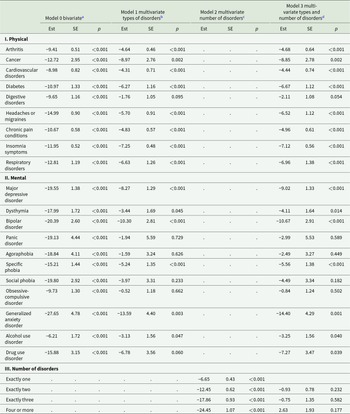
Four nested regression models were compared to assess the impact of comorbidity on health burden (Table 2). Model 3, integrating specific disorder types and total counts, achieved the best model fit (adjusted R 2 = 0.2090; Supplementary Table S3). Consequently, parameter estimates from Model 3 were utilized to represent independent associations. Subsequently, Model 4 employed an interactive framework for counterfactual simulations to capture non-additive interactions among comorbidities.
Bivariate and multivariate associations of types and number of disorders with VAS scores (N = 27,505)

Table 2 Long description
Three forest plots comparing estimates for various disorders. Each plot has a horizontal axis labeled ′Estimate′ ranging from negative 40 to positive 40, with a reference line at 0. The vertical axis lists disorders such as panic, cancer, headaches or migraines and respiratory disorders. Each disorder is represented by a point estimate and a horizontal line indicating the confidence interval. The first plot, titled ′Myocardium,′ shows estimates for disorders affecting the myocardium. Notable findings include panic with a positive estimate and cancer with a negative estimate. Most confidence intervals cross zero, indicating variability in estimates. The second plot, ′Subsets with any physical disorders,′ displays estimates for disorders within physical conditions. Panic shows a positive estimate, while cancer remains negative. Confidence intervals are similar to the myocardium plot, with many crossing zero. The third plot, ′Subsets with any mental disorders,′ presents estimates for disorders within mental conditions. Panic again shows a positive estimate and cancer is negative. Patterns are consistent with the other plots, with confidence intervals crossing zero. The plots collectively highlight the variability and overlap in estimates across different disorder subsets.
a 20 models were estimated with one condition at a time.
b A separate dummy variable predictor for each of 20 conditions.
c A separate dummy variable predictor for having exactly 1 of 20 conditions, exactly 2 of 20 conditions, etc.
d The predictors in Model 3 include all those in Model 1 and Model 2 with the exception that the predictor for having exactly one disorder is omitted. As a result of this omission, the 20 coefficients associated with types of disorders should be interpreted as applying to pure disorders (i.e. respondents with exactly one disorder compared to those with no disorders).
In Model 0, after adjusting for age, sex and urban–rural residence, each disorder was significantly associated with lower VAS scores. While most conditions resulted in a decrement exceeding 10 points, the most profound impairments were consistently observed in mental disorders – specifically generalized anxiety disorder (GAD), bipolar disorder, social phobia and MDD – with VAS reductions reaching up to 27.65 points.
As illustrated in Figure 1, among individuals with physical comorbidities, GAD (–24.11), agoraphobia (–19.30) and social phobia (–18.96) emerged as the strongest predictors of health decline, whereas headaches or migraines and respiratory disorders were the most impairing physical conditions. In the subset with mental disorders, cancer (–24.51) and GAD (–15.81) caused the largest health decrements. Conversely, OCD and alcohol use disorder exhibited paradoxical positive associations, a pattern that remained robust across both Model 0 (Figure 1) and unadjusted model (Supplementary Table S2).
Association of mental and physical disorders with self-rated health (VAS) scores across different population profiles (Model 0).

Figure 1 Long description
Estimates, standard errors, and p values are reported for VAS scores across four columns labeled Model 0 bivariate, Model 1 multivariate types of disorders, Model 2 multivariate number of disorders, and Model 3 multivariate types and number of disorders. Physical disorders in Model 0 range from minus 8.98 for cardiovascular disorders to minus 14.99 for headaches or migraines, with p less than 0.001 for each listed physical condition. In Model 1 for physical disorders, estimates include arthritis minus 4.64, cancer minus 8.97 with p 0.002, digestive disorders minus 1.76 with p 0.095, and insomnia symptoms minus 7.25, with most p values less than 0.001. Mental disorders in Model 0 include major depressive disorder minus 19.55, bipolar disorder minus 20.39, and generalized anxiety disorder minus 27.65, each with p less than 0.001, while alcohol use disorder is minus 6.21 with p less than 0.001. In Model 1 for mental disorders, generalized anxiety disorder is minus 13.59 with p 0.003, major depressive disorder is minus 8.27 with p less than 0.001, and several conditions have non significant p values including panic disorder p 0.729, agoraphobia p 0.626, social phobia p 0.233, and obsessive compulsive disorder p 0.662. Model 2 reports number of disorders only, with estimates of minus 6.65 for exactly one, minus 12.45 for exactly two, minus 17.86 for exactly three, and minus 24.45 for four or more, all with p less than 0.001. Model 3 reports both types and number, with physical condition estimates such as arthritis minus 4.68 and respiratory disorders minus 6.96, and mental condition estimates such as major depressive disorder minus 9.02 and generalized anxiety disorder minus 14.40, each with p less than 0.001. In Model 3 for number of disorders, exactly two is minus 0.93 with p 0.232, exactly three is minus 0.75 with p 0.582, and four or more is 2.63 with p 0.177, while the row for exactly one has no values shown in Model 3.
Upon simultaneous adjustment for all 20 disorder types (Model 1), the coefficients were substantially attenuated, suggesting potential underlying interactions or overlapping contributions among these disorders. The most pronounced associations persisted for GAD (–13.59), bipolar disorder (–10.30) and cancer (–8.97). Notably, several mental disorders that were significant in bivariate analyses, including panic disorder, agoraphobia, social phobia, OCD and drug use disorder, no longer reached statistical significance in Model 1. This marked attenuation indicates that the crude burden observed initially largely reflects disorder clustering rather than independent effects.
A clear dose-response relationship was observed between the number of disorders and health-related burden (Model 2). Compared to individuals with no disorders, those with exactly one, two, three, and four or more disorders exhibited VAS decrements of −6.65, −12.45, −17.86, and −24.45 points, respectively (p < 0.001). The proportional decline in health burden in the single disease count suggested a cumulative effect of multimorbidity. These findings appeared to support the conventional interpretation that increasing multimorbidity is associated with progressively poorer health status.
After adjusting for the specific types of disorders present, the independent associations of individual conditions were further attenuated but remained significant for most (Model 3). The largest independent effects were observed for GAD (β = −14.40), bipolar disorder (–10.67), MDD (–9.02), cancer (–8.85) and insomnia symptoms (–7.12). Notably, while most conditions maintained statistical significance, panic disorder, agoraphobia, social phobia and OCD became non-significant, suggesting that their health burden is largely captured by other comorbid configurations. Conversely, drug use disorder emerged as significant (p = 0.039) in this integrated framework.
When adjusting for specific disorder types, the independent burden of disease counts became non-significant. The coefficients for two, three and four or more disorders were negligible, indicating that the steep multimorbidity gradient seen in Model 2 is primarily driven by the accumulation of specific high-burden conditions rather than an additive effect of disease counts. Consequently, much of the health deterioration typically attributed to multimorbidity is better explained by the specific disorders comprising these profiles.
To elucidate why the comorbidity dose–response relationship attenuates, we conducted a leave-one-out sensitivity analysis by sequentially omitting each of the 20 disorders from Model 3 (Supplementary Table S4). The comorbidity count effect was restored to statistical significance only when specific condition clusters were removed. Specifically, excluding highly prevalent physical conditions – such as arthritis, chronic pain conditions or insomnia symptoms – fully restored the significance of disease counts across all levels. In contrast, omitting MDD, specific phobia or diabetes only restored significance for the lowest comorbidity tier, leaving higher-order clustering non-significant. These findings indicate that the observed attenuation in Model 3 is not uniform; rather, it is parsimoniously explained by highly prevalent chronic physical disorders that independently absorb the generic variance typically attributed to heavy multimorbidity.
Additionally, the findings from Model 3 were robust across various specifications. Subgroup analyses revealed modest heterogeneity in the magnitude of disorder-specific associations across sex, age group and residence, with the independent effect of comorbidity count remaining non-significant. In contrast, several mental disorders exhibited differential associations with VAS scores by demographic characteristics. For example, the burden associated with specific phobia and MDD tended to be larger among males and younger adults, whereas alcohol use disorder showed more pronounced negative associations in older age groups. Physical disorders demonstrated comparatively stable effect estimates across subgroups. (Supplementary Table S5).
In the interactive model (Model 4), only a limited number of statistically significant interactions between specific disorders and comorbidity count were identified (Supplementary Table S6). Notably, agoraphobia exhibited a negative interaction (β = – 2.72), indicating that its health burden intensifies with additional disorders. Conversely, OCD (β = 2.04), arthritis (β = 1.13) and respiratory disorders (β = 1.52) showed positive interactions, meaning that these conditions impose a less pronounced marginal burden in complex comorbidity profiles. Given the relative scarcity of significant interactions, widespread synergistic effects among co-occurring disorders appear uncommon.
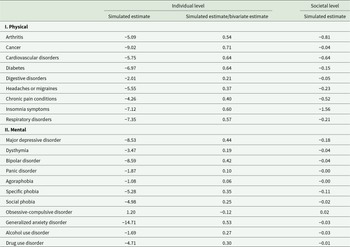
Based on the best-fitting interactive model (Model 4), counterfactual simulations yielded net burden estimates for each condition, adjusted for comorbidity interactions. The largest net decrements, reflecting the individual burden of disease, were observed for GAD (–14.71), cancer (–9.02), bipolar disorder (–8.59), MDD (–8.53) and respiratory disorders (–7.35). The ratio of the simulated net effect to the bivariate (Model 0) effect ranged from 0.06 (agoraphobia) to 0.71 (cancer). This ratio was inversely correlated with the impact of comorbidity, underscoring how comorbidity inflated crude associations (Table 3).
Simulated individual-level and population-level condition-specific burden estimates (N = 27,505)

Table 3 Long description
Condition-specific burden estimates are listed for individual level and societal level, with columns for individual-level simulated estimate, individual-level simulated estimate over bivariate estimate, and societal-level simulated estimate. Physical conditions show individual-level simulated estimates from minus 9.02 for cancer to minus 2.01 for digestive disorders, with ratios from 0.21 for digestive disorders to 0.71 for cancer. Physical societal-level simulated estimates range from minus 1.56 for insomnia symptoms to minus 0.04 for cancer. Mental conditions show individual-level simulated estimates from minus 14.71 for generalized anxiety disorder to minus 1.08 for agoraphobia, plus 1.20 for obsessive-compulsive disorder. Mental ratios range from minus 0.12 for obsessive-compulsive disorder to 0.53 for generalized anxiety disorder. Mental societal-level simulated estimates range from minus 0.18 for major depressive disorder to 0.02 for obsessive-compulsive disorder, with panic disorder and agoraphobia shown as minus 0.00.
When accounting for prevalence, reflecting the societal burden of disease, the ranking of conditions shifted significantly. Insomnia symptoms, despite a moderate individual-level impact, accounted for the largest population-level burden (–1.56) due to their high prevalence, followed by arthritis (–0.81) and cardiovascular disorders (–0.64). Although mental disorders such as GAD and bipolar disorder imposed the most severe individual-level burdens, their relatively low prevalence resulted in a more modest population-level impact (ranging from −0.03 to −0.18), with MDD ranking seventh overall (–0.18), between respiratory disorders and diabetes (Table 3).
Discussion
Using nationally representative data from China (Huang et al., Reference Huang, Wang, Wang, Liu, Yu, Yan, Yu, Kou, Xu, Lu, Wang, He, Xu, He, Li, Guo, Tian, Xu, Xu, Ma, Wang, Wang, Yan, Wang, Xiao, Zhou, Li, Tan, Zhang, Ma, Li, Ding, Geng, Jia, Shi, Wang, Zhang, Du, Du and Wu2019), this study disentangled the intrinsic burden of specific mental and physical disorders from comorbidity effects, revealing a striking divergence between individual-level and population-level impacts. While mental disorders, particularly GAD and bipolar disorder, exerted the most severe detriment to individual self-rated health, widely prevalent physical conditions such as insomnia symptoms and arthritis dominated the aggregate societal burden (Vigo et al., Reference Vigo, Thornicroft and Atun2016). By quantifying this divergence, this study extends traditional disease burden research, which typically evaluates single disorders in isolation, towards a broader comorbidity network framework that accounts for disorder composition, population and prevalence.
Crucially, this analysis challenged the conventional ‘dose–response’ view of multimorbidity, which traditionally relies on simple aggregate metrics of disease counts. However, the health decline associated with disease count is substantially attenuated when accounting for disorder composition, suggesting that population health deterioration is actually driven by the accumulation of specific high-impact disorders rather than a generic cumulative effect of disease load (Barnett et al., Reference Barnett, Mercer, Norbury, Watt, Wyke and Guthrie2012). Consequently, multimorbidity should not be conceptualized as a uniform determinant of health status. Instead, its impact on perceived health is contingent on the specific configuration of co-occurring disorders (Whitty et al., Reference Whitty, MacEwen, Goddard, Alderson, Marshall, Calderwood, Atherton, McBride, Atherton, Stokes-lampard, Reid, Powis and Marx2020). Importantly, these findings indicate that focusing on disease counts alone may provide a misleading representation of health burden.
To elucidate the statistical mechanisms underlying this attenuation, this study demonstrated that a substantial proportion of the health-related burden commonly attributed to individual disorders reflects their patterned co-occurrence with other conditions rather than independent effects. Models omitting this correlation structure overstate the harm of disorders that frequently cluster with other high-burden conditions. However, once disorder type and disorder count are modelled simultaneously, the apparent effect of disease counts is greatly diminished, or even rendered non-significant. Sensitivity analysis further reveals that the core driver of this phenomenon lies in specific high-prevalence conditions, such as arthritis, chronic pain conditions and insomnia symptoms, which act as primary sources of health variance and effectively absorb the impact typically attributed to total disease load. Accounting for these conditions eliminates the association between cumulative counts and health status, aligning with evidence that disease clusters predict adverse outcomes better than simple counts (Fortin et al., Reference Fortin, Lapointe, Hudon and Vanasse2005; Palladino et al., Reference Palladino, Pennino, Finbarr, Millett and Triassi2019; Ho et al., Reference Ho, Azcoaga-lorenzo, Akbari, Black, Davies, Hodgins, Khunti, Kadam, Lyons, McCowan, Mercer, Nirantharakumar and Guthrie2021). Therefore, relying on generic count-based metrics in clinical or survey data may obscure the true drivers of health impairment and misguide resource allocation. Future integrated care strategies should therefore prioritize specific disease compositions over simple counts to better target interventions.
These results also help to clarify ongoing debates about the relative burden of mental versus physical disorders. At the individual level, several mental disorders, particularly anxiety and mood disorders, remained the most impairing conditions even after accounting for comorbidity. Crucially, subgroup analyses reveal that mental burden is not uniform but shaped by demographic context, in contrast to the stable impact of physical disorders. This heterogeneity reflects the intersection of life-stage vulnerabilities and social circumstances across population subgroups. For instance, the burden of MDD and phobias among younger males may be related to the unique psychological and social challenges encountered during the transition to adulthood, a period characterized by heightened vulnerability to emotional distress and functional impairment (Potterton et al., Reference Potterton, Austin, Robinson, Webb, Allen and Schmidt2022). Furthermore, the increased impact of alcohol use disorders among older adults underscores geriatric challenges, such as social isolation (Nicholson et al., Reference Nicholson, McCormack, Seaman, Bell, Duffy and Gilhooly2017) and the management of chronic pain (Behrendt et al., Reference Behrendt, Kuerbis, Becker, Mejldal, Andersen, Sogaard Nielsen, Tolstrup and Holm Eliasen2021). These variations argue against a one-size-fits-all approach to mental health, highlighting the need for demographic-sensitive screening frameworks that target population-specific vulnerabilities.
At the population level, however, highly prevalent physical conditions such as insomnia symptoms, arthritis and cardiovascular disorders accounted for a larger share of overall health-related burden despite more modest individual-level effects. This divergence reconciles seemingly conflicting perspectives in the literature by distinguishing clinical severity from population impact (Whiteford et al., Reference Whiteford, Degenhardt, Rehm, Baxter, Ferrari, Erskine, Charlson, Norman, Flaxman, Johns, Burstein, Murray and Vos2013). Mental disorders impose profound suffering on affected individuals, whereas population-level burden is strongly shaped by prevalence as well as severity. The marked divergence observed aligns with and provides a mechanistic, individual-level explanation for patterns consistently reported in global macro-scale studies. The Global Burden of Disease (GBD) studies have persistently identified depressive disorders as leading causes of disability, highlighting their profound individual impact (GBD 2021 Diseases Injuries Collaborators, 2024), while also documenting that the aggregate health loss attributed to chronic physical conditions is driven largely by their sheer prevalence (GBD 2021 Diseases Injuries Collaborators, 2024). This analysis quantifies this fundamental tension between conditions of ‘high severity-low prevalence’ and those of ‘moderate severity-high prevalence’. This reinforces the methodological principle underlying comprehensive burden of disease studies, which integrate measures of individual disability severity with population prevalence to arrive at a complete picture of health loss (Wittchen et al., Reference Wittchen, Jacobi, Rehm, Gustavsson, Svensson, Jonsson, Olesen, Allgulander, Alonso, Faravelli, Fratiglioni, Jennum, Lieb, Maercker, van Os, Preisig, Salvador-carulla, Simon and Steinhausen2011; Salomon et al., Reference Salomon, Haagsma, Davis, de Noordhout, Polinder, Havelaar, Cassini, Devleesschauwer, Kretzschmar, Speybroeck, Murray and Vos2015). Furthermore, the finding that insomnia symptoms accounted for the largest population-level burden supports the growing recognition of its independent and significant public health impact, as emphasized in epidemiological studies linking it to substantial functional impairment (Morin et al., Reference Morin, Bélanger, LeBlanc, Ivers, Savard, Espie, Mérette, Baillargeon and Grégoire2009; Cao et al., Reference Cao, Wang, Zhong, Zhang, Ungvari, Ng, Li, Chiu, Lok, Lu, Jia and Xiang2017).
The interactions observed in the model are not uniformly synergistic but instead follow distinct compounding or buffering patterns. Agoraphobia exhibits a negative interaction where its adverse impact on health intensifies as the number of comorbidities increases, likely due to the collapse of coping mechanisms in environmentally restricted individuals (White et al., Reference White, Brown, Somers and Barlow2006). Conversely, conditions such as OCD, arthritis and respiratory disorders show positive interactions, suggesting a buffering effect where marginal health loss diminishes as multimorbidity complexity rises, reflecting a functional lower bound in subjective health. These findings challenge the additive burden assumption and indicate that clinical care must move beyond single-diagnosis management (Van Wilder et al., Reference Van Wilder, Devleesschauwer, Clays, De Buyser, der Heyden, Charafeddine, Boeckxstaens, De Bacquer, Vandepitte and De Smedt2022). As highlighted by Coventry et al., effective clinical pathways should prioritize intensive interventions for compounding clusters while focusing on baseline functional maintenance for buffering conditions (Coventry et al., Reference Coventry, Lovell, Dickens, Bower, Chew-graham, McElvenny, Hann, Cherrington, Garrett, Gibbons, Baguley, Roughley, Adeyemi, Reeves, Waheed and Gask2015). This study proposes a comorbidity-informed strategy that specifically targets these non-additive, high-risk disease configurations.
The use of interaction-based counterfactual simulation allowed the current study to estimate disorder-specific burden net of comorbidity without relying on unrealistic assumptions of independence or full additivity. This framework provides a robust method to disentangle the ‘net’ burden of mental disorders, avoiding the bias inherent in simple summation approaches often used in burden of disease studies (Whitty et al., Reference Whitty, MacEwen, Goddard, Alderson, Marshall, Calderwood, Atherton, McBride, Atherton, Stokes-lampard, Reid, Powis and Marx2020). This approach provides a methodological pathway to transcend the traditional count-based paradigm, echoing calls in the field for more nuanced models that capture the ‘syndemic’ nature of co-occurring conditions, i.e. biological and social interactions exacerbate health consequences (Singer et al., Reference Singer, Bulled, Ostrach and Mendenhall2017).
This finding has important methodological implications. Much of the inflation observed in crude burden estimates appears to arise from patterned co-occurrence among disorders rather than pervasive synergistic interactions. In other words, failing to account for who develops which combinations of disorders may introduce greater bias than assuming modest departures from additivity. This may explain why simple disease-count approaches often overestimate the burden attributable to individual disorders while simultaneously obscuring the contribution of specific multimorbidity profiles.
The Chinese context of this study is both a strength and a point of broader relevance. China is undergoing a rapid epidemiological transition characterized by population ageing and a rising prevalence of chronic physical diseases (Zhou et al., Reference Zhou, Wang, Zeng, Yin, Zhu, Chen, Li, Wang, Wang, Liu, Liu, Zhang, Qi, Yu, Afshin, Gakidou, Glenn, Krish, Miller-petrie, Mountjoy-venning, Mullany, Redford, Liu, Naghavi, Hay, Wang, Murray and Liang2019), alongside a substantial but historically under-recognized burden of mental disorders (Huang et al., Reference Huang, Wang, Wang, Liu, Yu, Yan, Yu, Kou, Xu, Lu, Wang, He, Xu, He, Li, Guo, Tian, Xu, Xu, Ma, Wang, Wang, Yan, Wang, Xiao, Zhou, Li, Tan, Zhang, Ma, Li, Ding, Geng, Jia, Shi, Wang, Zhang, Du, Du and Wu2019). The high levels of mental–physical comorbidity observed in this setting are unlikely to be unique and are increasingly characteristic of populations in other low-income and middle-income countries (LMICs) (Moussavi et al., Reference Moussavi, Chatterji, Verdes, Tandon, Patel and Ustun2007; Patel et al., Reference Patel, Saxena, Lund, Thornicroft, Baingana, Bolton, Chisholm, Collins, Cooper, Eaton, Herrman, Herzallah, Huang, Jordans, Kleinman, Medina-Mora, Morgan, Niaz, Omigbodun, Prince, Rahman, Saraceno, Sarkar, De Silva, Singh, Stein, Sunkel and UnUtzer2018). These findings therefore have implications beyond China, suggesting that burden estimates derived from single-disorder frameworks may be similarly biased in other global settings where multimorbidity is becoming the norm. This underscores the necessity of integrated care models and highlights that the distortion caused by ignoring comorbid structures may be even more pronounced in health systems with less specialized care (Patel et al., Reference Patel, Saxena, Lund, Thornicroft, Baingana, Bolton, Chisholm, Collins, Cooper, Eaton, Herrman, Herzallah, Huang, Jordans, Kleinman, Medina-Mora, Morgan, Niaz, Omigbodun, Prince, Rahman, Saraceno, Sarkar, De Silva, Singh, Stein, Sunkel and UnUtzer2018).
These results carry important clinical and policy implications. Clinically, they underscore the limitations of single-diagnosis approaches to assessment and management, particularly for individuals with mental disorders who frequently experience physical comorbidities. Interventions that address clusters of conditions, rather than isolated diagnoses, may more accurately target the sources of impaired perceived health (Coventry et al., Reference Coventry, Lovell, Dickens, Bower, Chew-graham, McElvenny, Hann, Cherrington, Garrett, Gibbons, Baguley, Roughley, Adeyemi, Reeves, Waheed and Gask2015). From a policy perspective, prioritization strategies based solely on crude disorder-specific associations may misallocate resources by overlooking the distinction between individual-level severity and population-level impact. A more nuanced approach that explicitly accounts for comorbidity is essential to inform decisions about resource allocation for mental health services and integrated care models (Lund et al., Reference Lund, Brooke-sumner, Baingana, Baron, Breuer, Chandra, Haushofer, Herrman, Jordans, Kieling, Medina-Mora, Morgan, Omigbodun, Tol, Patel and Saxena2018).
Several limitations should be considered when interpreting these findings. First, self-rated health is a subjective measure, although it remains a well-validated predictor of objective morbidity and mortality (Idler and Benyamini, Reference Idler and Benyamini1997). Second, physical disorders were assessed by self-report rather than clinical examination, which may introduce misclassification bias. Third, the cross-sectional design precludes causal inference regarding the directionality between disorders and perceived health. In addition, the interaction terms specified in Model 4 assumed linear modification by comorbidity count and therefore may not fully capture more complex or higher-order interaction structures. Finally, although a wide range of conditions was included, the possibility of residual bias due to unmeasured or unidentified interaction effects among rare conditions cannot be ruled out.
Conclusion
In conclusion, this study demonstrates that explicit consideration of comorbidity structure substantially alters estimates of the health-related burden of mental and physical disorders. By disentangling disorder type effects, disorder count effects and their interactions, it shows that much of the apparent burden attributed to individual disorders reflects shared comorbidity rather than independent effects. These findings underscore the need for comorbidity-informed approaches to burden estimation and provide a more realistic basis for comparing mental and physical disorders in both clinical and public health contexts.
Supplementary material
The supplementary material for this article can be found at https://doi.org/10.1017/S2045796026101036.
Availability of data and materials
The data used in this study were obtained from the China Mental Health Survey (CMHS). The CMHS dataset is not publicly shared and is not available to external researchers due to ethical and confidentiality restrictions imposed by the survey protocol and relevant institutional review boards. No access to the data can be provided.
Acknowledgements
We are grateful to all field investigators, data management staff, local collaborating institutions and administrative departments for their dedication and support.
Author contributions
All authors contributed to the collection and interpretation of data, and all authors had final responsibility for the decision to submit for publication. Y.H. is the principal investigator and is responsible to CMHS. Y.X., T.L., Xiu.X., Y. Yu, S.X., L.L., Y.Ya., Xia.X. and Z.W. are co-principal investigators who contributed to the design and implementation of the study. Z.L. and T.Z. assisted the co-principal investigators in the design, implementation and data analysis. L.W., J.Y. and G.X. contributed to the study design and implementation of fieldwork, and quality control of collected data. T.Z. and Z.L. performed data cleaning, checking and coding. T.Z. and J.H. analysed the data for the study. J.H. wrote the initial draft. Y.H., Z.L., T.Z. and S.X. supervised the analysis and amended the manuscript. All authors have read and approved the final manuscript. The corresponding author attests that all listed authors meet authorship criteria and that no others meeting the criteria have been omitted. J.H. and T.Z. contributed equally to this work and are joint first authors. Z.L., S.X. and Y.H. are co-corresponding authors.
Financial support
The National Twelfth Five-Year Plan for Science and Technology Support from the Chinese Ministry of Science and Technology (2012BAI01B01 and 2015BAI13B00), and Capital’s Funds for Health Improvement and Research (CFH2024-2G-4113). The sponsors had no role in study design, data collection, analysis, interpretation or writing of the report.
Competing interests
The authors have declared no competing interests.
Ethical standards
The study protocol was approved by the institutional review boards of Peking University Sixth Hospital and all collaborating institutions. All participants provided written informed consent.




 Open access

