Introduction
Age-related hearing loss is the most common sensory deficit in the elderly, affecting approximately 20 per cent of individuals over 50 years of age (Viljanen et al. Reference Viljanen, Törmäkangas, Vestergaard and Andersen-Ranberg2014). With changing population demographics in the developed world, the societal impact of hearing loss is likely to increase in coming years (Carson Reference Carson2005; Ciorba et al. Reference Ciorba, Bianchini, Pelucchi and Pastore2012). Hearing difficulties hinder access to environmental information and may also become an obstacle to communication and social activity, jeopardising independence and overall wellbeing (Heine and Browning Reference Heine and Browning2004; Viljanen et al. Reference Viljanen, Törmäkangas, Vestergaard and Andersen-Ranberg2014). However, literature on the effects of hearing loss is still scarce, and studies on the relationship between hearing loss and depression and between hearing loss and social activity have shown inconsistent results. Those inconsistencies may be due to different evaluation methods and to different study population characteristics (Harada et al. Reference Harada, Nishiwaki, Michikawa, Kikuchi, Iwasawa, Nakano, Ishigami, Saito and Takebayashi2008; Wallhagen et al. Reference Wallhagen, Strawbridge, Shema, Kurata and Kaplan2001). Moreover, research has paid little attention to the psychological processes underlying the impact of this sensory difficulty.
A better understanding of how hearing loss influences functioning and wellbeing may enhance our ability to develop creative approaches to minimise its impact (Wallhagen et al. Reference Wallhagen, Strawbridge, Shema, Kurata and Kaplan2001). Based on longitudinal data from the Survey of Health, Ageing and Retirement in Europe (SHARE), the research presented in this paper was undertaken to investigate how hearing loss difficulties are related to depression and social activities using a sample of ten countries. Specifically, we tested if one way through which perceived hearing loss is associated with depression is through social activity restriction. In other words, we examined whether social inactivity mediates the relationship between hearing loss and depression. In addition, we compared this hypothetical model with another one proposing the opposite effect: that people with hearing loss will be less socially active because they have developed more depression.
Effects of hearing loss on depression and social activity
During the psychological adjustment to hearing loss, people are at risk of psychological problems such as depression (Chen et al. Reference Chen, Liang, Ou and Cai2013). Varying degrees of depression are commonly associated with living with age-related hearing loss (for a literature review, see Millán-Calenti et al. Reference Millán-Calenti, Maseda, Rochette and García-Monasterio2011), but some studies show no such effect. For example, Carabellese et al. (Reference Carabellese, Appollonio, Rozzini, Bianchetti, Frisoni, Frattola and Trabucchi1993) assessed 1,191 non-institutionalised elders aged 70–75 years and found that hearing impairment was associated with increased risk of depression. Although not significant, Crews and Campbell (Reference Crews and Campbell2004) also found that those with hearing loss reported slightly higher rates of depression (8.0% versus 5.8%) than did people without sensory loss. However, cross-sectional designs are unlikely to provide information about the direction of the relationships between hearing loss and depression symptoms. In order to overcome this shortcoming in the studies on the hearing loss effect, Wallhagen et al. (Reference Wallhagen, Strawbridge, Shema, Kurata and Kaplan2001) used a longitudinal design and measured hearing loss at one point in time and mental health one year later in 2,504 subjects aged 50 years and older. They found that older people with moderate or more hearing impairment were more likely to feel depressed and to report fair or poor mental health. In another study, Chou (Reference Chou2008) examined the relationship between dual sensory loss and depression in older adults. Results showed that hearing loss only was not a predictor for the onset and persistence of depression. Still, this study evaluated individuals at only two time-points, 24 months apart, which is not enough to shed light on whether the hearing loss effect on depression occurred throughout an indirect pathway. Recently, a 13-year-long study has shown longitudinal relationships between functional health (e.g. hearing impairment) and subsequent levels of positive affect, as an affective dimension of subjective wellbeing, in older people (Gana et al. Reference Gana, Saada, Broc, Quintard, Amieva and Dartigues2016).
Hearing loss has been characteristically associated with disrupted interaction with others. Patients seeking a hearing aid for the first time were sent an open-ended questionnaire asking them to ‘list the difficulties which [they] have as a result of hearing loss’ (Stephens Reference Stephens1980: 207). The three most commonly reported problems were difficulties in hearing the television and/or radio, general conversation and hearing the doorbell. From these, difficulties in general conversation were consistently rated as being of greater importance than other problems. Similarly, Gussekloo et al. (Reference Gussekloo, De Bont, Von Faber, Eekhof, De Laat, Hulshof, Van Dongen and Westendorp2003) found that 40 per cent of older people with untreated severe hearing loss had difficulties in following a group conversation, and that the social isolation caused by this disability was mentioned as the most important reason for obtaining a hearing aid in the future, especially the possibility of having difficulties in communicating with loved ones, such as children and grandchildren.
Helvik, Jacobsen and Hallberg (Reference Helvik, Jacobsen and Hallberg2006) describe the documented consequences of hearing loss in terms of perceived activity limitation and participation restriction. Negative auditory consequences are difficulties such as determining the location of sound, in perception of speech, in discriminating speech from background sound and in hearing non-verbal sounds, which may be expressed as activity limitations. Moreover, negative non-auditory consequences are, for instance, social withdrawal, reduced participation in social activities outside the family and limited prospects of promotion in employment. Such consequences refer to difficulties in engagement in everyday life situations and might be classified as participation restrictions. These authors found that the perceived severity of hearing loss predicted both activity limitation and participation restriction, which is consistent with further evidence showing that hearing impairment has an impact on social functioning, with persons reporting even a mild hearing impairment being more likely to feel lonely, remote or left out, and have more difficulty paying attention (Wallhagen et al. Reference Wallhagen, Strawbridge, Shema, Kurata and Kaplan2001).
More specifically, older people with hearing loss have reported greater difficulties with activities and social roles than did people without sensory problems (Crews and Campbell Reference Crews and Campbell2004). They were as likely as those without sensory impairment to eat out at a restaurant, get exercise and visit relatives, but less likely to visit friends, phone friends, phone relatives, attend church and go to movies. About one-quarter (25.1%) of older people with hearing loss reported having too little social activity, and that they would like to do more, compared to one-fifth (21.6%) of older people without sensory loss. Based on the 2004 data of the SHARE, comprising 27,536 men and women aged 50 years and older, Viljanen et al. (Reference Viljanen, Törmäkangas, Vestergaard and Andersen-Ranberg2014) confirmed that participants who reported hearing difficulties had 1.23 (95% confidence interval (CI) = 1.10–1.37) times higher unadjusted odds for social inactivity compared to persons without hearing or vision difficulties.
Given the importance of social contacts and relationships to wellbeing in old age (Cornwell and Waite Reference Cornwell and Waite2009), the consequences of hearing loss are cause for concern. However, there have also been incongruent findings. Studies have found that hearing loss was associated with increased risk of poor functioning in daily living activities, but not with fewer social relationships (Carabellese et al. Reference Carabellese, Appollonio, Rozzini, Bianchetti, Frisoni, Frattola and Trabucchi1993; Yamada et al. Reference Yamada, Nishiwaki, Michikawa and Takebayashi2012). In the same way, Harada et al. (Reference Harada, Nishiwaki, Michikawa, Kikuchi, Iwasawa, Nakano, Ishigami, Saito and Takebayashi2008) found no relationship between hearing loss and reduced functional activity (i.e. instrumental self-maintenance, intellectual and social role activities).
Again, these studies report cross-sectional data in that no information about the direction of the causal chain is provided. But there is an additional factor preventing us from more definitive conclusions about the specific role of hearing loss, which is the confounding relation between hearing loss and poorer physical functioning in older adults (e.g. Bess, Lichtenstein and Logan Reference Bess, Lichtenstein and Logan1990; Bess et al. Reference Bess, Lichtenstein, Logan, Burger and Nelson1989; Chen et al. Reference Chen, Genther, Betz and Lin2014). For example, Crews and Campbell (Reference Crews and Campbell2004) found that people with hearing loss were more likely to report difficulty walking, getting outside, getting into and out of a bed or chair, and managing medication, than were people without sensory problems. Moreover, those with hearing loss were also more likely to have experienced falls, to report heart disease and to report stroke, as well as less likely to perceive health as excellent or very good. A number of studies have also shown a correlation between hearing loss and cognitive decline (for a review, see Arlinger Reference Arlinger2003). Taken together, these results show that people with hearing loss report higher rates of comorbid and secondary conditions than did people who did not have any sensory loss, indicating that hearing loss might occur in the context of other age-related physiological and psycho-social changes (see also Dalton et al. Reference Dalton, Cruickshanks, Klein, Klein, Wiley and Nondahl2003).
For example, Chou and Chi (Reference Chou and Chi2004) found that hearing loss was significantly associated with depression, but the inclusion of self-rated health made this relationship diminish to an insignificant level. In another study, adjusting for physical disability, the association between hearing difficulty and depression was still consistent but not significant (Jones, Victor and Vetter Reference Jones, Victor and Vetter1984). Research has shown that perceived hearing loss as measured by self-report has an impact on depression, either through cross-sectional studies, or through studies that collect data at two points in time. However, this body of evidence does not elucidate the direction of the relationship, nor how that process relates to the decrease in social activities.
How does hearing loss affect depression and social activities? The importance of the temporal order
To our knowledge, no studies have addressed the psychological processes through which hearing loss may affect depression and frequency of social activities. It is plausible that hearing loss, being the cause of reduced communicative relationships, as well as reduced social and emotional interactions, would be a source of loneliness, isolation and depression (Millán-Calenti et al. Reference Millán-Calenti, Maseda, Rochette and García-Monasterio2011). As some studies have suggested, hearing impairments can disrupt interpersonal relations and limit participation in desired roles, both of which would negatively affect the emotional wellbeing of older persons (Wallhagen et al. Reference Wallhagen, Strawbridge, Shema, Kurata and Kaplan2001). For example, Hallberg, Påsse and Jansson (Reference Hallberg, Påsse and Jansson1999) examined the impact of self-reported disability and handicap on psychological general wellbeing among women with noise-induced hearing loss. They found that interpersonal distress (i.e. feeling restrictions in social life, being tense and tired, lack of self-confidence, feelings of being cut off, being avoided by other people and impact of hearing loss on close relationships) was the strongest predictor, and that difficulties in hearing speech had also a negative impact on the sense of general wellbeing.
There is a long research history linking social relationships and health. Social support is a valuable and effective means by which a person can reduce the effects of stressful experiences, and greater social integration is associated with better psychological wellbeing and more positive affective states (Cohen Reference Cohen2004). If people with hearing loss find it harder to benefit from their usual sources of social support, or disengage from social roles and relationships, increasing levels of isolation will have a negative impact on health. Moreover, meaningful activities and social integration are associated with positive outcomes in later life and are prerequisites for successful ageing (Silverstein and Parker Reference Silverstein and Parker2002). Thus, social inactivity may have considerable negative psychological effects, particularly when withdrawal from activities due to sensory impairment is involuntary.
Another possibility is that hearing loss may first cause depression, which in turn may lead to a decrease in social activities (e.g. Wilkie et al. Reference Wilkie, Peat, Thomas and Croft2007). Research suggests that depression is often a response to declining health and functional impairment in the older adult. On the other hand, from a psychopathological perspective, a decreased interest or pleasure in all or most activities is a symptom of depression (American Psychiatric Association 2013), which means that depression as a major disorder can diminish individual's motivation to enroll in action, and engage in social activities. Accordingly, hearing loss could contribute to worsen a depressive disorder, which consequently would lead to a reduced involvement in activities.
Overall, research suggests that hearing loss consequences in terms of emotional wellbeing and social engagement are complex, and most likely multi-directional. Depression can negatively affect social relationships, but eventually a cycle of increasingly restricted activities may limit social contacts, which may also contribute to isolation and poor mental health (Viljanen et al. Reference Viljanen, Törmäkangas, Vestergaard and Andersen-Ranberg2014). Nevertheless, interventions to prevent hearing-loss negative consequences from the onset may be critical and, for that, the ability to identify the specific effect of hearing loss on depression and social activity and the causal sequencing involved in this psychological process is paramount. Therefore, this study examines different possibilities: that hearing loss may cause depression because it leads to less social activity, that hearing loss may cause less social activity because it leads to depression or that the effects are reciprocal and all variables mutually influence each other.
Method
Participants
This study is based on the 2004 (Wave 1), 2006 (Wave 2) and 2010 (Wave 4) data collection of the SHARE (Wave 3, SHARELIFE, was not included because it focused on people's life histories). Waves 1, 2 and 4 comprised 30,816, 36,730 and 58,489 men and women aged 50 years or older, respectively.
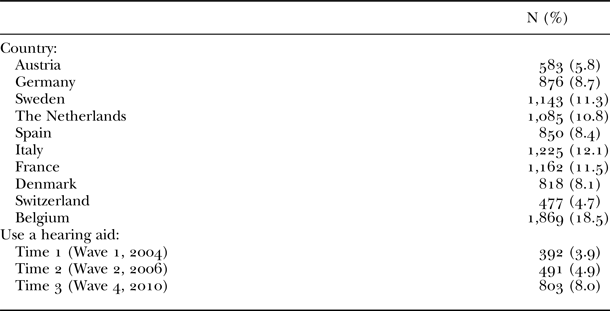
SHARE includes a great variety of information about health, socio-economics and social networks, and is based on 2004, 2006 and 2010 representative samples from 11 European countries (Sweden, Denmark, Germany, the Netherlands, Belgium, France, Switzerland, Austria, Italy, Spain and Greece). Three countries joined SHARE in 2006 – Czech Republic, Poland and Ireland – and four countries joined SHARE in 2010 – Estonia, Hungary, Portugal and Slovenia. Because the present study is based on longitudinal data at three time-points, we only used data from ten countries, i.e. those that have contributed data to the 2004 SHARE baseline study and that have remained in Waves 3 and 4 (Greece was not part of Wave 4). From these ten countries, of the 30,816 participants in Wave 1, 10,697 form a longitudinal sample who answered to the three waves. Thus, in the final sample there were 5,681 (56.3%) women and 4,407 (43.7%) men, who at Wave 4 (2010) had an average age of 69 years (standard deviation (SD) = 9.02 years). Descriptive analysis showed that participants increased the use of a hearing aid from one wave to another, which indicates an increase of hearing loss with age (for more characteristics of the sample, see Table 1).
Participants’ characteristics

Procedure
Data were collected using computer-assisted personal interviews by trained interviewers at participants’ homes (Jürges Reference Jürges, Börsch-Supan and Jürges2005). Ethical approval for the SHARE was obtained from the University of Mannheim's internal review board, Germany, and all the participants gave their informed consent before the interview (Börsch-Supan and Jürges Reference Börsch-Supan and Jürges2005).
Measures
Several comparative studies support the validity of self-reported data of sensory impairment (Wallhagen et al. Reference Wallhagen, Strawbridge, Shema, Kurata and Kaplan2001). Hearing loss was assessed with the question ‘Is your hearing (using a hearing aid as usual) excellent/very good/good/fair/poor?’ (from 1 ‘excellent’ to 5 ‘poor’). To measure depressive symptoms, the Euro-depression scale (EURO-D; Prince et al. Reference Prince, Reischies, Beekman, Fuhrer, Jonker, Kivela, Lawlor, Lobo, Magnusson, Fichter, van Oyen, Roelands, Skoog, Turrina and Copeland1999) was used. The EURO-D scale is the number of depressive symptoms reported by a person and comprises the following 12 items: depression, pessimism, suicidality (death wish), guilt, sleep, interest, irritability, appetite, fatigue, concentration, enjoyment and tearfulness, with higher numbers reflecting more depression symptoms. Finally, the frequency of social activity was assessed through six items: ‘Done voluntary or charity work’; ‘Attended an educational or training course’; ‘Gone to a sport, social or other kind of club’; ‘Taken part in activities of a religious organisation’; ‘Taken part in a political or community-related organisation’; and ‘Look after children [grandchild/grandchildren] without the presence of the parents’, which were common across the three waves. The response categories on the rating scale were standardised to: ‘never’ (0), ‘less often than every week’ (1), ‘every week’ (2), ‘daily’ (3).
Statistical analyses
First, we excluded the individuals who had not answered one of the variables in all the three waves included in the analyses. This resulted in a final sample of 10,088 individuals. To analyse longitudinal mean changes, we conducted structural equation modelling with latent variable to estimate Latent Growth Curve Analysis (Duncan, Duncan and Stryker Reference Duncan, Duncan and Stryker2006). Then a well-suited statistical approach for the longitudinal analysis of alternative causal models was performed – the auto-regressive cross-lagged analysis (Finkel Reference Finkel1995). The auto-regressive cross-lagged analysis is widely used to shed light on the nature of the causal associations between variables in non-experimental, longitudinal research designs (Selig and Little Reference Selig, Little, Laursen, Little and Card2012). In each analysis, hearing loss, depression and social activity were specified as continuous variables.
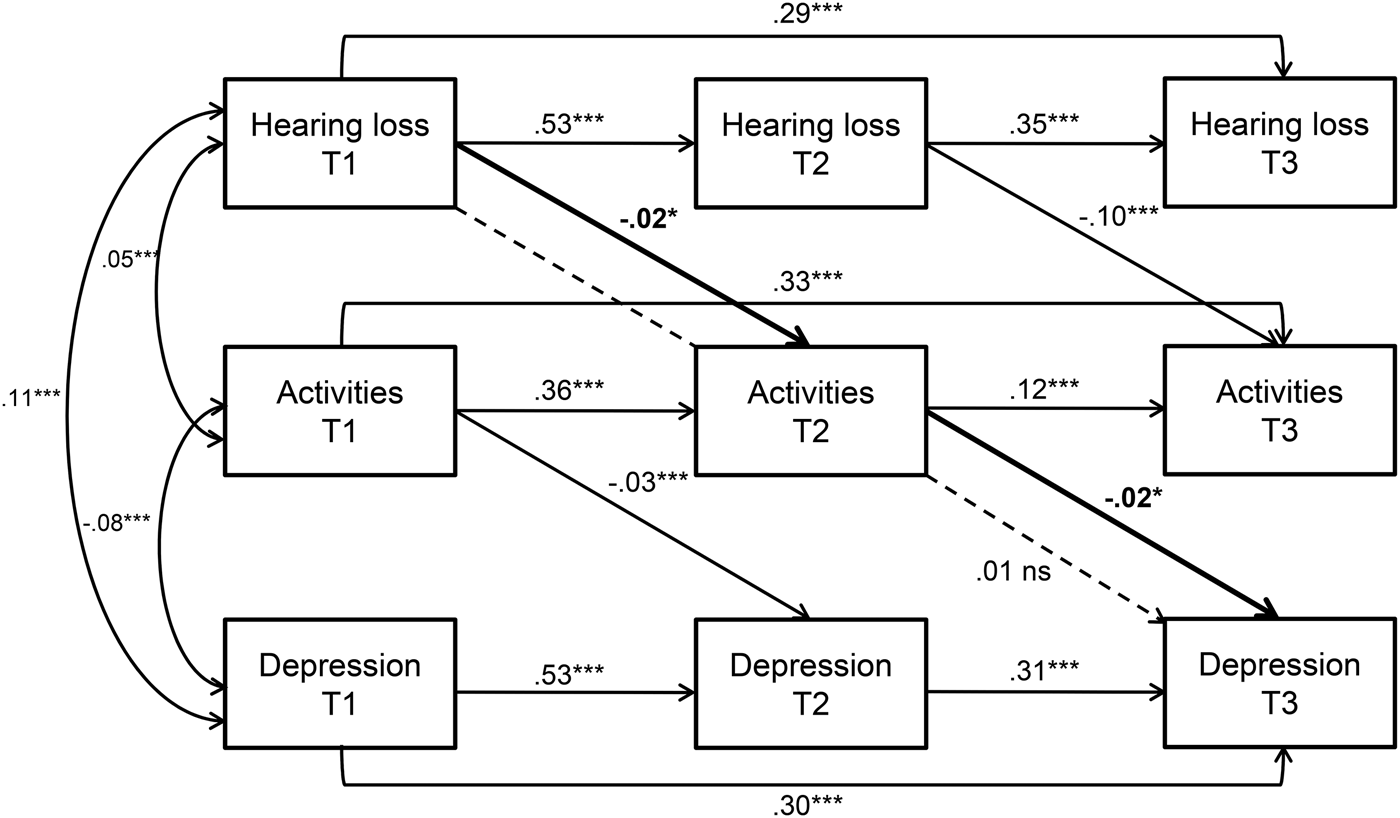
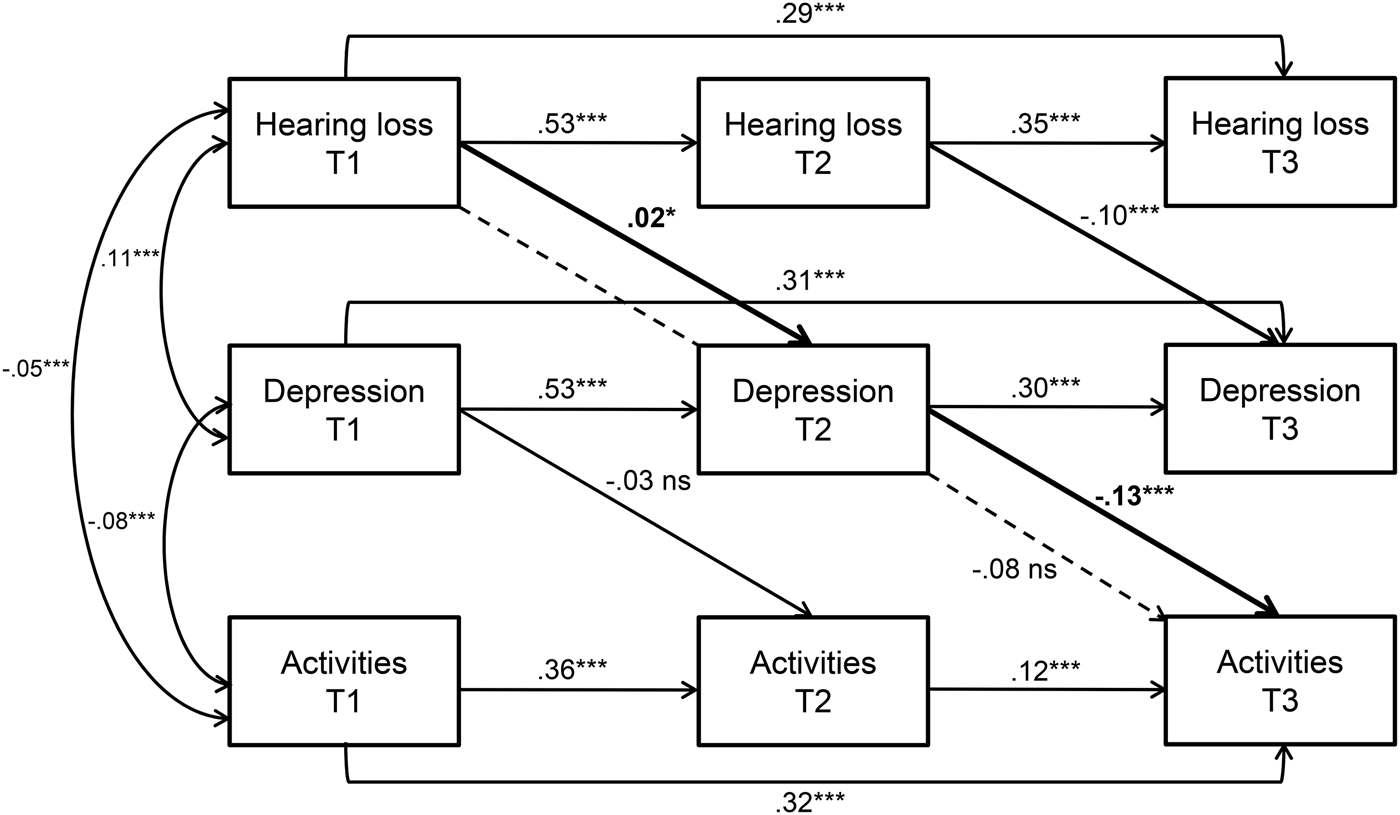
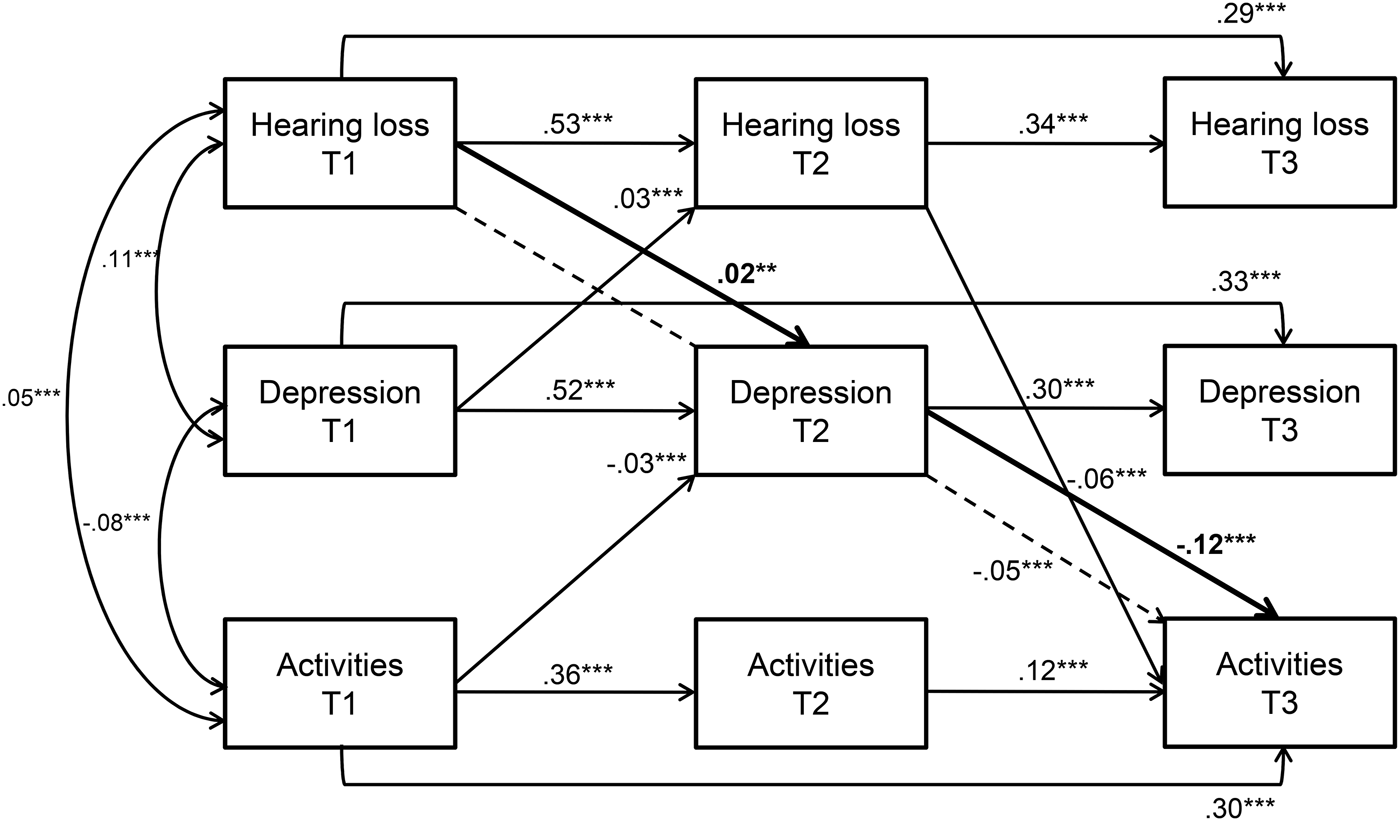
First we estimated a stability model (Model 1 (M1)), which includes the auto-regressive effects between time 1 (T1, Wave 1), time 2 (T2, Wave 2) and time 3 (T3, Wave 4) for each variable, as well as the correlations between the variables at T1 (see online Supplementary Figure 1). In this model, and in the subsequent models, each of the variables at T1 – hearing loss, social activities and depression – were linked to the same variables at T2 and T3. Secondly, the model representing the hypothesis that hearing loss produces depression through a reduction in social activities (M2) was tested, in which the direct causality relations were added to M1 (see Figure 1). Then we estimated the reverse causality model (M3), proposing the reverse effects. In other words, depression at T1 predicts social activities at T2, and social activities at T2 predict hearing loss at T3 (see online Supplementary Figure 2). M4 represents the hypothesis that hearing loss leads to reduction in social activities through depression (see Figure 2), and M5 tested the reverse effects, with social activities at T1 predicting depression at T2, and depression at T2 predicting hearing loss at T3 (see online Supplementary Figure 3). Finally, we estimated a reciprocal causality model (M6), which combines M1, M2, M3, M4 and M5 (see Figure 3). This model allows assessment all together of the various possibilities by which perceived hearing loss has an impact on depression and practice of social activities and is mutually influenced by these.
Estimated parameters of the model proposing activities as the mediator between hearing loss and depression (Model 2). T1: time 1 (Wave 1, 2004). T2: time 2 (Wave 2, 2006). T3: time 3 (Wave 4, 2010). Curved arrows represent correlation effects; solid straight arrows represent direct effects; dashed straight arrow represents direct effect controlling for the effect of the mediator.

Estimated parameters of the model proposing depression as the mediator between hearing loss and activities (Model 4). T1: time 1 (Wave 1, 2004). T2: time 2 (Wave 2, 2006). T3: time 3 (Wave 4, 2010). Curved arrows represent correlation effects; solid straight arrows represent direct effects; dashed straight arrow represents direct effect controlling for the effect of the mediator.

Estimated parameters of the reciprocal causality model (Model 6). T1: time 1 (Wave 1, 2004). T2: time 2 (Wave 2, 2006). T3: time 3 (Wave 4, 2010). Curved arrows represent correlation effects; solid straight arrows represent direct effects; dashed straight arrow represents direct effect controlling for the effect of the mediator.

To evaluate the global adjustment of the models, we considered the Comparative Fit Index (CFI) and Goodness-of-Fit Index (GFI) above 0.90, and the Root Mean Square Error of Approximation (RMSEA) below 0.05 as indicating a good fit of the model to the data (e.g. Schumacker and Lomax Reference Schumacker and Lomax1996). In addition, we used the chi-square difference test and the Bayesian Information Criterion (BIC) to compare the goodness of fit of the models. The best models are those with lower chi-square and BIC values (Byrne Reference Byrne2009).
Results
Preliminary analyses
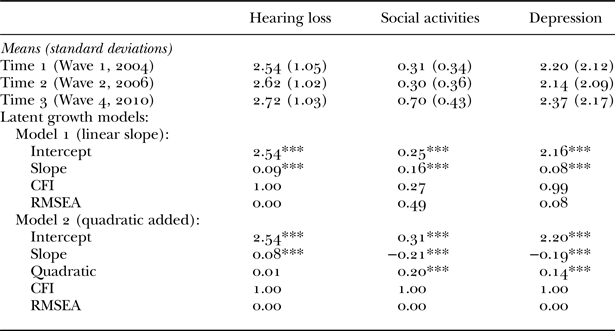
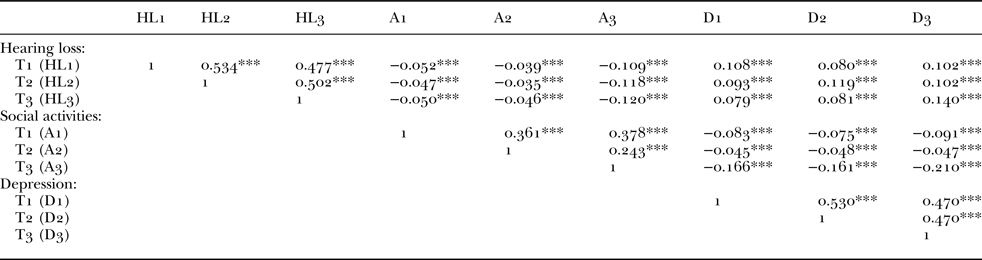
Tables 2 and 3 present, respectively, the descriptive statistics and the correlation matrix for the model variables. We started by conducting a dropout analysis comparing the longitudinal sample (N = 10,088) to the participants who were interviewed at T1 but did not participate in all three waves (N = 20,728). We found differences in the three variables. Individuals who did not participate in the three rounds exhibited higher scores in both hearing loss (mean = 2.85, SD = 1.06 versus mean = 2.54, SD = 1.05; t = 7.08, p < 0.001) and depression (mean = 2.92, SD = 2.50 versus mean = 2.20, SD = 2.12; t = 7.34, p < 0.001), and showed lower scores of social activities (mean = 0.22, SD = 0.35 versus mean = 0.31, SD = 0.34; t = −6.11, p < 0.001). This pattern of results suggests that depression is associated with less involvement in social activities and more hearing loss, and that the dropout sample apparently had lower psychological and functional health.
Means and standard deviations of the variables at each point in time, and estimated parameters from the Latent Growth Curve Analyses

Notes: CFI: Comparative Fit Index. RMSEA: Root Mean Square Error of Approximation. Hearing loss: minimum = 1, maximum = 5. Social activities: minimum = 0, maximum = 3. Depression: minimum = 0, maximum = 12.
Significance level: ***p < 0.001.
Correlation matrix of the variables at each point in time

Notes: T1: time 1 (Wave 1, 2004). T2: time 2 (Wave 2, 2006). T3: time 3 (Wave 4, 2010). HL1, HL2 and HL3: hearing loss at T1, T2 and T3, respectively. A1, A2 and A3: activities at T1, T2 and T3, respectively. D1, D2 and D3: depression at T1, T2 and T3, respectively.
Significance level: ***p < 0.001.
To compare the two samples further, and of the most importance for our proposal, we inspected the correlation matrices between the three variables at T1, T2 and T3. These results showed that, in both samples, the correlations between hearing loss and frequency of social activities are negative (meaning that the greater the hearing loss, the lower the frequency of social activities), that the correlations between hearing loss and level of depression are weak and positive (indicating that the greater the hearing loss, the higher the level of depression), and that the correlations between social activities and depression are weak and negative (meaning that the higher the frequency of activities, the lower the level of depression). This pattern of results also occurred when we analysed the interrelationship between the three variables in the cross-sectional sample of 30,816 individuals from Wave 1, with all correlations being significant both in the final and in the dropout sample (p < 0.001). Thus, this dropout analysis suggests that the longitudinal sample is similar to the total sample at T1.
Focusing now only on the final sample, we analysed longitudinal mean changes by using Latent Growth Curve Analysis (Duncan, Duncan and Stryker Reference Duncan, Duncan and Stryker2006). We specified two models, one assuming a linear trend model and one saturated model predicting a quadratic change. As one can see in Table 2, the linear model fits better for hearing loss, while the quadratic models fit better for depression and social activities changes. Indeed, results show that hearing loss increases linearly from T1 (mean = 2.54, SD = 1.05) to T2 (mean = 2.62, SD = 1.02) and from T2 to T3 (mean = 2.72, SD = 1.03). Regarding depression, there are also differences over time, but the changing trend follows a quadratic trend in that the level of depression decreased from T1 (mean = 2.20, SD = 2.12) to T2 (mean = 2.14, SD = 2.09), but increased at T3 (mean = 2.37, SD = 2.17). For the frequency of social activities, the quadratic effect occurred because there were no changes from T1 (mean = 0.31, SD = 0.34) to T2 (mean = 0.30, SD = 0.36), but it increased at T3 (mean = 0.70, SD = 0.43).
Cross-lagged analyses
Table 4 presents the goodness-of-fit for each tested model.
Goodness-of-fit indices of the estimated models

Notes: df: degrees of freedom. CFI: Comparative Fit Index. GFI: Goodness-of-Fit Index. RMSEA: Root Mean Square Error of Approximation. p-close (p-value for the closeness of RMSEA). BIC: Bayesian Information Criterion.
Significance level: ***p < 0.001.
We started by testing the stability model (M1, see online Supplementary Figure 1) which estimates the auto-regressive effects between T1, T2 and T3 for each variable. This model fitted very well to the data and it is useful to provide information about the stability of the measures over time and helps to control for third variables that might account for effects predicted by our hypotheses. Stability estimates for hearing loss were 0.50 from T1 to T2, and 0.52 from T2 to T3. Stability for social activities was less strong: 0.36 from T1 to T2, and 0.24 from T2 to T3. Stability for depression was strong from T1 to T2 (0.53), and from T2 to T3 (0.47). As could be expected, at T1 there were within-time positive correlations between hearing loss and depression, and a negative association between depression and social activities, as well as between hearing loss and social activities.
M2, proposing the frequency of social activities as mediator between hearing loss and depression, showed a good fit to the data (see Figure 1), that is, significantly better than the fit of the stability model (Δχ2 = 3043.066, Δdf (degrees of freedom) = 8, p < 0.001). Estimated parameters indicated that hearing loss at T1 implies fewer social activities at T2 and fewer social activities at T2 predict more depression symptoms at T3, but these effect are not reliable at p < 0.01. Also, this model provides us with initial information on how hearing loss influences depression: there is a direct reliable effect from hearing loss at T1 to depression at T3, but this effect is not due to lower involvement in social activities at T2.
The reverse causality model (M3, see online Supplementary Figure 2) also showed a good fit to the data, significantly better than the stability model (Δχ2 = 3102.389, Δdf = 8, p < 0.001), and better than M2 according to the BIC estimates. Estimated parameters of M3 showed that depression at T1 did not predict social activity at T2, but more social activities at T2 implies less perceived hearing loss at T3. Estimating this model is important because, apart from being an alternative to M2, it can elucidate about the direction of causality between the target variables. M3 shows that social activities at T3 are predicted by depression at T2, which suggests the possibility that depression is a mediator of the influence of hearing loss in social activities, as tested by M4.
M4 proposes depression as a mediator between hearing loss and reduction in social activities (see Figure 2). Results showed a very good fit to the data, significantly better than the stability model (Δχ2 = 3186.805, Δdf = 8, p < 0.001), and better than M2 and M3 according to BIC estimates. Estimated parameters indicate that hearing loss at T1 implies more depression at T2, and greater depression at T2 leads to less activity at T3 (p < 0.001). Importantly, the indirect effect (mediated by depression at T2) was reliable with bootstrapping procedures using 5,000 bias-corrected resamples (indirect effect = −0.0010, 90% CI = −0.0020 to −0.0001). The fact that M4 fits the data better than M2 provides additional evidence that it is more likely that hearing loss has an impact on social activities through depression, than that it has an effect on depression by means of reducing social activities.
M5 tests another reversed causality process (M5, see online Supplementary Figure 3). Results showed that this model fitted well to the data, significantly better than the stability model (Δχ2 = 2922.99, Δdf = 8, p < 0.001), but worse than all the others. It is important to estimate this model because it allows verification that it is less likely that the process occurs from social activities reduction to hearing loss through depression than the other way around.
The reciprocal causality model (M6, see Figure 3) fits better to the data than all the previous ones. In terms of reciprocal relations between the three variables, estimated parameters indicate that greater hearing loss at T1 implies more depression at T2, but depression at T2 does not predict more hearing loss at T3, which supports the idea that the process starts with hearing loss and not the opposite. On the other hand, hearing loss and social activities show no reciprocal relations between them. Finally, the relationship between depression and social activities is reciprocal: more social activities at T1 predict less depression at T2, and more depression at T2 implies less involvement in social activities at T3.
More importantly, M6 allows identification of the processes through which hearing loss at T1 predicts depression and social activity at T3. In fact, previous results had already shown that M4, which proposes depression as mediator, is better than M2, which tests social activities as mediator. Finally, M6 confirms that depression mediates the effect of hearing loss on social activities and that this mediation is reliable with bootstrapping procedures using 5,000 bias-corrected resamples (indirect effect = −0.015, 90% CI = −0.019 to −0.011). In fact, hearing loss at T1 leads to greater depression at T2 (b = 0.02, p = 0.01), and more depression at T2 leads to less involvement in social activities at T3 (b = −0.12, p < 0.001). Moreover, M6 shows that the path leading from depression at T2 to social activities at T3 is reliable, while the path leading from social activities at T2 to depression at T3 is not. Overall, these results reinforce evidence that the process starts with perceived hearing loss, which has an impact on social activity reduction over time; and that this influence occurs because hearing loss has an effect on depression. Moreover, M6 has very good fit indices when estimated only with male participants (X2(8) = 109.936, p < 0.001; CFI = 0.975; GFI = 0.990; RMSEA = 0.072; p-close (p-value for the closeness of RMSEA) < 0.001; BIC = 500.402) and only with female participants (X2(8) = 269.998, p < 0.001; CFI = 0.974; GFI = 0.989; RMSEA = 0.076; p-close < 0.001; BIC = 589.859). This is important because it shows that the processes by which hearing loss predicts social activity, being this effect mediated by depression, is the same for men and women.
Supplementary analyses
A series of complementary analyses were performed in order to test the adequacy of M6 in each of the countries in the sample (see online Supplementary Table 1). Although the model seems to be less good in Austria and Switzerland, with CFI values of 0.95 and 0.94, respectively, in general, the model fit is excellent in all countries, with all adjustment indices well above the recommended values. These results are important because they give further empirical support to M6, the reciprocal causality model, as the best model representing the psychological processes linking perceived hearing loss to depression and restrictions in social activities.
Discussion
Drawing upon cross-national multi-wave panel data from ten different European countries, the purpose of this study was to investigate the effects over time of hearing loss on older adults’ depression and social engagement from a longitudinal perspective. Using data from three points in time, we investigated the mutual relationship between hearing loss, depression and social activities. For doing so, we examined the empirical adequacy of different theoretical models. These models proposed either that perceived hearing loss predicts fewer social activities, and that activity restriction predicts depression; or that perceived hearing loss predicts depression, which leads to fewer social activities; the reversed causalities; or presumed reciprocal causal relations between all the variables.
Results showed that the reciprocal causality model fits best to the data. This model shows that there are reciprocal relations between depression and social activities: namely more social activities at T1 predict less depression at T2, and more depression at T2 implies fewer social activities at T3. In terms of the underlying psychological mechanisms that best describe the consequences of hearing loss, it was found that depression mediates the impact of hearing loss on reduced social activity. In other words, people who feel they have hearing problems may over time develop depression, which then may reduce their participation in social activities. The fact that the final model fits well for men and women, and across countries, shows the generalisation of these reciprocal causal effects. These results are in line with findings from Freedman et al. (Reference Freedman, Stafford, Schwarz, Conrad and Cornman2012), who found that, counter to their expectations, differences in participation did not account for disability's relationship with subjective wellbeing.
Although hearing loss is a common sensory deficit at older age, few studies can be found that focus on its specific consequences to emotional and social functioning. To our knowledge, this is the first study to test the unique role of perceived hearing loss and to address the processes through which it affects depression and social activity. This study found that hearing loss has the capacity to restrict older people's social activities, since it can generate depression. As social relationships and social support are important for health (Cohen Reference Cohen2004), hearing loss most likely motivates a cycle of increasingly disrupted communicative social and emotional interactions that make it hard to benefit from usual social support. As this study showed a reciprocal relationship between depression and social activities, this then may lead to reduced wellbeing and, again, to the disengagement from interpersonal relations and social activities.
Regardless of its silent impact, people tend to underestimate hearing loss and few seek medical help. Some common reasons that elderly people do not seek help are the lack of awareness of the problem and/or its consequences, or that that they perceive the symptoms, especially mild chronic ones, as part of the ageing process that cannot be helped (see e.g. Carson Reference Carson2005; Ciorba et al. Reference Ciorba, Bianchini, Pelucchi and Pastore2012). Also, another reason relates to the perceived stigma associated with hearing loss and the use of a hearing aid (St Claire and He Reference St Claire and He2009; Wallhagen Reference Wallhagen2009). Knowing the impact of hearing loss, and the mechanisms that explain these restrictions, may lead the development of public health detection and rehabilitation interventions that prevent the negative consequences of this sensory impairment. For example, increased depression symptoms may be one of the first signs that an older person is losing their hearing, which can help early diagnoses.
In fact, adequate and timely screening may be essential for the recovery of sensory function and to improve the communicational condition, but also to ameliorate mental health and quality of life, active ageing and social integration, which also contribute to a better overall state of health (Silva Reference Silva2014). Interestingly, depression at T1 also predicted perceived hearing loss at T2, which shows that the perceptions of hearing loss may also be worsened by people's poor mental state, and that the greater the depression, the worse the perception of the hearing problems.
Despite contributing to the literature on the role of hearing loss in depression and social engagement, the present study has some limitations. First, as we used the databases from the SHARE, our analyses were based on the available questions for assessing perceived hearing loss, depression and social activities. For example, we could not use the SHARE's items ‘caring for a sick or disabled adult’ and ‘provide help to family, friends or neighbours’ to assess social activity (e.g. Viljanen et al. Reference Viljanen, Törmäkangas, Vestergaard and Andersen-Ranberg2014) because these were only used in Waves 1 and 2, not Wave 4. Instead, we adapted and included a measure on ‘looking after grandchildren’ that was common across the three waves. A second limitation relates to the fact that hearing loss was assessed based solely on self-report. Although several researchers have pointed to the validity of self-reported health indicators (e.g. Idler and Benyamini Reference Idler and Benyamini1997), objectively measured hearing loss would have strengthened the analyses and should be incorporated in future studies. Also, it is important to note that we did not consider whether participants did or did not use a hearing aid because our focus was on the perceived ability to hear, regardless of hearing aid usage (in fact, the SHARE question explicitly refers to that: ‘Is your hearing (using a hearing aid as usual) excellent/very good/good/fair/poor?’). To check whether there were overall differences on depression levels between participants who wore a hearing aid and those who did not, we compared the two groups in all waves, and no differences were found (meanT1 = 2.21, SD = 2.00, N = 392 versus meanT1 = 2.20, SD = 2.12, N = 9,696; meanT2 = 2.23, SD = 2.00, N = 491 versus meanT2 = 2.14, SD = 2.09, N = 9,597; meanT3 = 2.41, SD = 2.14, N = 803 versus meanT3 = 2.36, SD = 2.17, N = 9,285, respectively). However, it is important that future longitudinal studies investigate whether using a hearing aid can prevent or minimise the negative consequences of hearing loss in terms of depression and social activity (e.g. Mulrow, Tuley and Aguilar Reference Mulrow, Tuley and Aguilar1992).
Although we have used a cross-lagged longitudinal design that is robust to the effect of confounding variables by taking into account the auto-regressive effect, it does not overcome the limitations in the measurement of hearing loss, depression and social activities. In other words, it is important to consider that the depression and the less involvement in social activities resulting from hearing loss may also be due to other factors not controlled in this study, such as comorbidities or the decrease of physical or cognitive abilities. Finally, we did not have control of the temporal gap between the three waves, meaning it is possible that the two-year versus four-year gap may have influenced the results. Even if these limitations can mitigate the strength of conclusions that can be drawn from the results, the strengths of this study include the use of longitudinal data that involved a representative sample of elderly people from ten different countries.
The current research represents an important contribution to the study of hearing loss because it overcomes a limitation of previous cross-sectional studies by enabling us to examine the sequence of effects resulting from hearing loss at older age but more studies are needed to confirm these conclusions. The auto-regressive cross-lagged models allow not only verification of how much change across time in one construct is likely to be related to another construct in a temporal sequence but also allow attenuation of the confounding of other variables not present in the study design. In fact, one of the most important benefits of the cross-lagged longitudinal analysis is the opportunity to control for confounding third variables by taking into account prior levels of the dependent variable, being this control carried out in the auto-regressive effect (Cole and Maxwell Reference Cole and Maxwell2003), because this effect minimizes the possibility of the cross-lagged effect be due to a third variable correlated with both the predictor and outcome variables.
Important possible confounding covariates are physical and cognitive functioning. In particular, although there is no clear evidence whether hearing loss is the cause of reduced cognitive performance or if both are parts of a common process, strong correlations have been found between hearing loss and loss of cognitive functions, independent of age and educational level (Arlinger Reference Arlinger2003). More research is needed to clarify these relationships.
The perceived stigma associated with hearing loss may affect the initial acceptance of the disability and the rejection of hearing assessment and treatment (Wallhagen Reference Wallhagen2009). This study has confirmed its impact on depression and consequent deterioration of social functioning. It will be of great importance to value hearing loss by enhancing methods of assessment and treatment, and by helping older adults to maintain self-esteem and participation in social situations.
Supplementary Material
To view supplementary material for this article, please visit https://doi.org/10.1017/S0144686X17000708
Acknowledgements
This work, which was part of the wider research programme – ‘Age-related Hearing Loss: Genetic Risk Factors and Social Impact’ – was supported by the Portuguese Foundation for Science and Technology (PTDC/NEU-BEN/1192/2012). Preparation of the paper was also supported by two postdoctoral grants from the Portuguese Foundation for Science and Technology awarded to the first (SFRH/BPD/98385/2013) and third (SFRH/BPD/92242/2013) authors.