Introduction
Injuries to the upper aerodigestive tract are uncommon but have potentially fatal consequences.Reference Thevasagayam and Pracy1 During the war in Croatia (1990–1991), the incidence of neck injuries in patients presenting to one hospital was 2.5 per cent, and 37 per cent of these had associated head injuries. The majority of these injuries were inflicted by shrapnel.Reference Danic, Prgomet, Milicic, Leovic and Puntaric2 A large, retrospective study carried out in 2005 found mortality rates for laryngotracheal trauma of 26.8 per cent, with blunt trauma resulting in a significantly higher mortality rate than penetrating injury.Reference Bhojani, Rosenbaum, Dikmen, Paul, Atkins and Zonies3 Another study examined the difference between peacetime and wartime injuries; it showed that wartime injuries were more likely to be penetrating and associated with higher mortality than peacetime injuries. Furthermore, wartime laryngeal injuries were more likely to be found in conjunction with other injuries.Reference Danic, Prgomet, Sekelj, Jakovina and Danic4
The evolving nature of combat body armour has led to a decline in injuries to the trunk, but head and neck wounds are still common.Reference Rustemeyer, Kranz and Bremerich5 In the UK, serving military personnel are issued with the Osprey Improved Combat Body Armour, which includes removable neck and arm protectors. However, these are not always worn, as some soldiers feels they impair their mobility and ability to fire.
We present the case of a 26-year-old soldier who suffered a penetrating laryngeal injury and underwent delayed reconstruction, with a good functional result. Although not the first case of its kind, it highlights the different aspects of care these patients must receive in order to make a good recovery.
Case report
A 26-year-old, previously fit and well Royal Marine was travelling in a vehicle that was hit by an explosive device whilst on duty in Afghanistan. He sustained a shrapnel injury to his right neck and was transferred to the nearest field hospital. He was stridulous on arrival. Endotracheal intubation was attempted but failed due to inability to visualise the larynx. An emergency cricothyroidotomy was performed. A piece of shrapnel was palpable in the right posterior triangle. The patient was taken straight to theatre where a neck exploration was carried out. There was no major vascular injury but there was obvious damage to the thyroid cartilage. A defect was seen in the right lateral wall of the pharynx, which was repaired in two layers. A tracheostomy was performed and the patient subsequently transferred to the UK for further management.
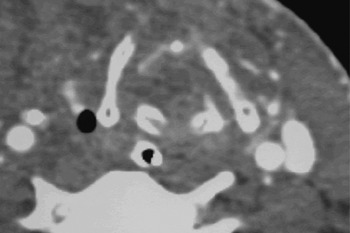
Nasendoscopic examination showed a swollen supraglottic region. Computed tomography (CT) scanning confirmed significant soft tissue swelling and disruption of the laryngeal cartilage with multiple small fragments (Figure 1). Gastrografin placed down the nasogastric tube showed a satisfactory position, with no leak from the pharyngeal repair.
Axial computed tomography scan of the neck, demonstrating laryngeal injury.

Rigid laryngoscopy showed an oedematous supraglottis with no mucosal laryngeal features evident. Oesophagoscopy was normal, and a fine bore feeding tube was passed.
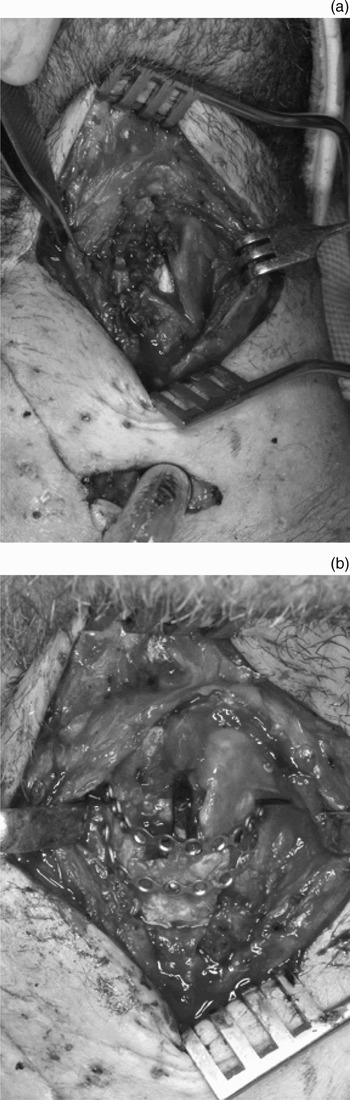
The neck was explored. The left thyroid cartilage was more or less intact, but multiple displaced fragments of the right thyroid cartilage were found (Figure 2a). There was complete disruption of the anterior commissure and no identifiable mucosal structures on the right side of the endolarynx. A laryngofissure was carried out. The fragments were repaired with two miniplates (Figure 2b). The left true vocal fold was sutured to the perichondrium of the left thyroid cartilage. A laryngeal stent was inserted and secured with a non-absorbable stitch. The strap muscles were sutured over the remaining defect to provide a seal.
Intra-operative photographs demonstrating (a) the laryngeal injury and (b) miniplate fixation.

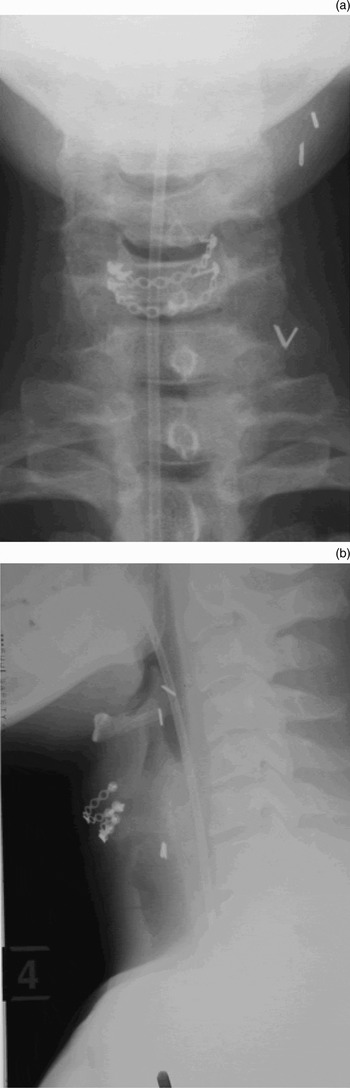
Post-operative feeding was via the nasogastric tube, and intravenous antibiotics were administered for seven days. The endolaryngeal stent was removed on the seventh day. At this stage, nasendoscopy showed the left vocal fold to be mobile with no evidence of aspiration or pooling of saliva. Over the next few days, an oral diet was introduced. The patient was decannulated on the 10th post-operative day without complication. His nasogastric tube was removed and his diet was increased steadily. He was able to tolerate a normal diet on discharge. Post-operative radiographs showed the position of the two plates (Figures 3a and 3b) to be satisfactory.
Post-operative (a) antero-posterior and (b) lateral radiographs, demonstrating good position of miniplates.

The miniplates were removed after three months. The patient underwent extensive post-operative speech and language therapy and made excellent progress. He was given Stemple vocal function exercises which required twice daily practice for a period of three months. Following this, his maximum phonation increased from 7.8 to 19.8 seconds in a variety of pitches. He could maintain a level of 60 dB easily, but his voice quality decreased when forcibly using his voice. Follow-up nasendocopic examination showed good abduction and closure of the vocal folds.
Discussion
Our patient's clinical course highlights several important aspects of the management of laryngotracheal injuries. It should be noted that the treatment of penetrating injuries may be more urgent than the treatment of blunt injuries. Also, the facilities available at a field hospital will differ from those at a trauma centre; therefore, surgical management may be altered to suit the circumstances.
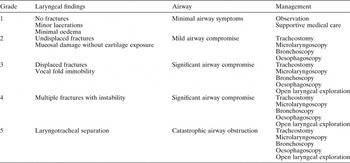
Schaefer classified laryngeal injuries into four grades,Reference Schaefer6 to which Fuhrman et al. added a fifth and also suggested what the management of each grade should involve (Table I).Reference Fuhrman, Stieg and Buerk7 The injury described here met the criteria for grade four.
Classification and management of laryngeal injuriesReference Schaefer6, Reference Fuhrman, Stieg and Buerk7
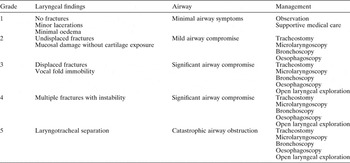
After an initial failed intubation, our patient received a cricothyroidotomy. Cricothyroidotomy is a safe, rapid technique of obtaining an airway in such circumstances.Reference Salvino, Dries, Gamelli, Murphy-Macabobby and Marshall8 Although a tracheostomy was performed at the time of initial surgery, it has been shown that, in patients with minor laryngotracheal injuries, a tracheostomy can be safely withheld.Reference Grewal, Rao, Mukerji and Ivatury9 In our case, diagnosis was made during surgery, given the urgent need to operate. However, in situations in which investigation is possible (for example, in a case of blunt trauma with little respiratory distress), CT has been shown to be more sensitive than flexible laryngoscopy for identifying laryngeal injury (100 vs 75 per cent).Reference Francis, Gaspard, Rogers and Stain10 In addition, three-dimensional CT scanning is more specific than two-dimensional scanning.Reference Meglin, Biedlingmaier and Mirvis11
The best method of diagnosing and managing laryngeal injuries has been debated for many years. With regards to the choice and timing of surgery, Stassen et al., in a retrospective study, found that the most frequent operative intervention for both blunt and penetrating injury was a primary airway repair within eight hours of the original injury.Reference Stassen, Hoth, Scott, Day, Lukan, Rodriguez and Richardson12 Danic et al. suggested that acute laryngeal trauma should undergo definitive repair as the primary treatment within 24 hours.Reference Danic, Milicic, Prgomet and Leovic13 As his injury occurred in Afghanistan, our patient fell outside this window for the timing of his primary repair. He was, however, assessed by a head and neck surgeon on day two. Surgery was intentionally delayed to allow the oedema to settle, resulting in an increased blood supply to the area and less chance of wound breakdown.Reference Jonsson, Jensen, Goodson, Scheusenstuhl, West and Hopf14
• Laryngeal injuries require prompt assessment of the airway, with stabilisation as required
• Surgical reconstruction can be delayed to allow stabilisation of the patient and transfer to an appropriate hospital
• Appropriate surgery and full use of the multidisciplinary team will lead to the best functional result for the patient
The choice of repair in our case was miniplate fixation. A cadaveric study has demonstrated that the miniplate provided a stronger repair than wire-tube batton fixation, which in turn provided more strength than wire fixation alone.Reference Lykins and Pinczower15 The miniplate was used to distract the fragments and subsequently to maintain their position. The cervical fascia can also be used for immediate reconstruction of the larynx, with good resulting phonation.Reference Danic, Milicic, Prgomet and Leovic16 Our patient's decannulation on the 10th day post-repair fits within the average range of 7 to 60 days post-repair.Reference Gussack, Jurkovich and Luterman17
The need for multidisciplinary care is important during rehabilitation of these patients. Regular speech and language therapy, together with dietician input, will enable the patient to develop as much phonatory and swallowing ability as possible, while ensuring they do not become malnourished.Reference Brunicardi, Andersoen, Bullen, Dunn, Hunter and Pollock18, Reference Freeman and Fauzus19 In such cases of military injuries, the Royal Marines Trauma Risk Management team work to ensure patients' psychological care, to help prevent post-traumatic stress disorder.Reference Jones, Roberts and Greenberg20
The good functional outcome in our patient was almost certainly the result of his high level of fitness prior to his injury, coupled with his high degree of motivation. The speech and language therapy exercises he was given demanded regular practice and a significant level of commitment. He showed extraordinary compliance with his speech therapy regime and made extremely rapid progress through the levels of phonating exercises.
Conclusion
Although laryngotracheal injuries are potentially fatal, the best chance of recovery is through appropriate management of the airway as a first line measure. The need for and timing of surgical reconstruction is best determined by an experienced head and neck surgeon where time permits. Surgery itself may be delayed in certain cases without adverse effect.