


Introduction
Dysfunctional perfectionism has been suggested to play an important role in the aetiology and maintenance of a number of specific psychological disorders including eating disorders, anxiety, and obsessive-compulsive disorder (Bieling, Summerfeldt, Israeli and Antony, Reference Bieling, Summerfeldt, Israeli and Antony2004; Flett and Hewitt, Reference Flett and Hewitt2002; Moretz and McKay, Reference Moretz, McKay and 2009; Wu and Cortesi, Reference Wu and Cortesi2009), and is the focus of the current research. For example, perfectionism has been found to increase and maintain the psychopathology of eating disorders (Bardone-Cone et al., Reference Bardone-Cone, Wonderlich, Frost, Bulik, Mitchell, Uppala and Simonich2007). Not only has research consistently demonstrated a pattern of higher levels of perfectionism amongst individuals with eating disorders (e.g. Halmi et al., Reference Halmi, Sunday, Strober, Kaplan, Woodside, Fichter, Treasure, Berrettini and Kaye2000; Kaye, Bulik, Thornton, Barbarich and Masters, Reference Kaye, Bulik, Thornton, Barbarich and Masters2004), it has also been highlighted as a risk factor in the development of an eating disorder (Fairburn, Welch, Doll, Davies and O'Connor, Reference Fairburn, Welch, Doll, Davies and O'Connor1997; Fairburn, Cooper, Doll and Welch, Reference Fairburn, Cooper, Doll and Welch1999; Striegel-Moore et al., Reference Striegel-Moore, Fairburn, Wilfley, Pike, Dohm and Kraemer2005), and treatment that includes a focus on the perfectionism itself has recently been found to reduce eating disorder psychopathology (Fairburn et al., Reference Fairburn, Cooper, Doll, O'Connor, Bohn, Hawker, Wales and Palmer2009; Steele and Wade, Reference Steele, Wade and 2008). Perfectionism may also have a negative impact on treatment outcome in anorexia nervosa (Sutandar-Pinnock, Woodside, Carter, Olmsted and Kaplan. Reference Sutandar-Pinnock, Woodside, Carter, Olmsted and Kaplan2003).
High levels of perfectionism have also been found to be associated with elevated symptoms of anxiety and depression following a distressing event (Flett, Madorsky, Hewitt and Heisel, Reference Flett, Madorsky, Hewitt and Heisel2002) and those higher in perfectionism also engage more in rumination about perceived imperfections (Flett et al., Reference Flett, Madorsky, Hewitt and Heisel2002). Additionally, it may impede treatment of depression. For example, research has indicated that high levels of dysfunctional perfectionism predict higher depression and greater impaired adjustment at the end of treatment for depression (Blatt, Quinlan, Pilkonis and Shea, Reference Blatt, Quinlan, Pilkonis and Shea1995), and this may be in part due to the impact of elevated levels of perfectionism on the development of a poor therapeutic alliance (Zuroff et al., Reference Zuroff, Blatt, Sotsky, Krupnick, Marrtin, Sanislow and Simmens2000).
Within the anxiety disorders, perfectionism plays a particularly important role in cognitive approaches to OCD. For example, the role of perfectionist thinking has been highlighted in specific types of obsessions (doubts about whether a task was completed correctly) and compulsions (washing until it “feels right”; Moretz and McKay, Reference Moretz, McKay and 2009), and the Obsessive Compulsive Cognitions Working Group (1997) view perfectionism as one of six key areas of central importance to OCD. Perfectionism is elevated within this clinical group compared to non-clinical controls (e.g. Antony, Purdon, Huta and Swinson, Reference Antony, Purdon, Huta and Swinson1998; Sassaroli et al., Reference Sassaroli, Lauro, Ruggiero, Mauri, Vinai and Frost2008), and elevated when compared with other anxious samples, including those with generalized anxiety disorder (Bardone-Cone et al., Reference Bardone-Cone, Wonderlich, Frost, Bulik, Mitchell, Uppala and Simonich2007). It has also been suggested that perfectionism may impede the treatment of OCD by impacting on the ability of patients to engage in exposure and response prevention (ERP; Frost, Novara and Rhéaume, Reference Frost, Novara, Rhéaume, Frost and Steketee2002).
Despite the importance of dysfunctional perfectionism across mental health problems and an extensive literature on the construct and its measurement (e.g. Shafran and Mansell, Reference Shafran and Mansell2001), relatively little is known about the phenomenon. In addition, studies that have highlighted the association between perfectionism and psychopathology are not always explicit in terms of the nature of the perfectionism that they assess. For example, a distinction between functional/adaptive perfectionism (i.e. simply striving for high standards in a way that does not cause any difficulties) versus dysfunctional or clinical perfectionism (which is unhelpful or detrimental to one's functioning) is not always made. The aims of the current research were first to examine the behavioural expressions of dysfunctional perfectionism and, second, to examine the nature of intrusive mental imagery associated with dysfunctional perfectionism. The behavioural expressions of perfectionism were of particular interest, considering the importance placed in cognitive-behavioural theories and treatments of psychopathology on the role of such behaviour in the maintenance of psychopathology. Intrusive mental images were also of particular interest given the prominence they play across anxiety disorders, including social phobia and PTSD (Hirsch, Clark, Matthews and Williams Reference Hirsch, Clark, Mathews and Williams2003; Ehlers, Clark, Hackmann, McManus and Fennell Reference Ehlers, Clark, Hackmann, McManus and Fennell2005). Indeed, the presence of intrusive thoughts or images is included as one of the diagnostic criteria for both OCD and PTSD. Understanding and modifying such images are becoming important components of cognitive behavioural treatments; for example, in social phobia, updating the negative meanings of self-relevant imagery leads to a reduction in both core negative self-beliefs as well as social phobia cognitions (Wild, Hackmann and Clark, Reference Wild, Hackmann and Clark2007, Reference Wild, Hackmann, Clark and 2008). Given the importance of distorted imagery in psychopathology (in particular, anxiety), the impact of manipulating imagery as a therapeutic tool, and the implications of perfectionism for multiple clinical disorders, it is clearly important to also examine the nature of intrusive mental imagery in perfectionism, both at the clinical and non-clinical level.
In summary, the current study aimed to explore in more detail both the behavioural expressions of perfectionism (using a newly developed assessment tool) and mental imagery associated with high levels of perfectionism (using a revised interview) in a non-clinical sample. The behavioural expressions of perfectionism were explored across five key life domains: house work/maintenance; work; social life; hobbies; and appearance. A standardized self-report questionnaire, the Behavioural Domains Questionnaire (BDQ), was developed for this purpose and the relationship between the severity of perfectionism, its behavioural expressions and other psychopathology was explored. A multidimensional measure of perfectionism, Frost's Multidimensional Perfectionism Scale (MPS-F, Frost, Marten, Lahart and Rosenblate, Reference Frost, Marten, Lahart and Rosenblate1990) was used to assess perfectionism as a non-clinical sample was being assessed. An existing interview-based measure was adapted to explore the nature of mental imagery in people with varying levels of perfectionism.
It was predicted that there would be a relationship between level of perfectionism and behavioural expressions, and between level of perfectionism and perfectionism-related intrusive images, specifically, that those with higher levels of perfectionism would report more perfectionist behaviour (i.e. experience it more frequently) and experience more frequent, more intense, and more distressing intrusive mental imagery, and that such images would have more impact on behaviour, and be harder to dismiss. It was also predicted that these new measures of behaviour and imagery would have greater power in predicting levels of general psychopathology than demographic data or general dysfunctional perfectionism scores alone.
Method
Participants
The non-clinical sample was recruited via a psychology student research panel (n = 20) and poster advertisements (n = 19). Posters indicated that research was being conducted into perfectionism, but did not specifically advertise for people with high levels of perfectionism.
The sample comprised 49 students and 10 non-students (78% female, mean age = 23.71 yrs, SD = 8.31). Participants either received a course credit, or were reimbursed £10 for their time. Thirteen of the 59 participants had previously consulted a GP for problems relating to anxiety, depression or eating disorders, and 31 considered themselves perfectionists when directly asked “do you consider yourself to be a perfectionist?”
Measures
The Brief Symptom Inventory (BSI; Derogatis, Reference Derogatis1993). This is a 53-item, self-report measure of general psychopathology. It examines problems over the past 4 weeks, rated on a scale of 0 (not at all) to 4 (extremely), with scores ranging from 0–212. It explores 9 primary symptom dimensions with 3 further global severity indices. It takes approximately 10 minutes to complete. The BSI is a reliable and valid measure of symptoms and their intensity at a specific point in time (Derogatis, Reference Derogatis1993). It was used in the current study in order to control for general level of psychiatric functioning. Scores of 63 or over are considered to be indicative of clinical severity.
The Multidimensional Perfectionism Scale (MPS-F; Frost et al., Reference Frost, Marten, Lahart and Rosenblate1990). This is a 35-item self-report multidimensional perfectionism questionnaire, with ratings from 1 (strongly disagree) to 5 (strongly agree), with six subscales, each assessing a different aspect of perfectionism. The total score does not include “Organization” as it does not correlate highly with other subscales or total perfectionism. Scores with “Organization” omitted can range from 29–145. It has good overall internal consistency (α = 0.77 to 0.93) and good construct validity (r = 0.42 to 0.87) (Riley, Lee, Cooper, Fairburn and Shafran, Reference Riley, Lee, Cooper, Fairburn and Shafran2007). It is a reliable and valid measure of perfectionism and overall scores have significantly correlated with other perfectionism measures (Frost et al., Reference Frost, Marten, Lahart and Rosenblate1990). Rather than the Hewitt and Flett's MPS-H Scale (Reference Hewitt and Flett1988), the MPS-F was used as it looks more at personal rather than general aspects of perfectionism.
The Behavioural Domains Questionnaire (BDQ). This measure was designed by the present authors to assess the behavioural expression of clinical perfectionism across various life domains. It consists of 37 items, with three additional open-ended questions that are not included in the overall score. Items are rated according to frequency of behaviour over the past 4 weeks from 1 (never) to 5 (always). Life domains are as follows: housework (e.g. “how often have you found it difficult to stop cleaning the house because you have been striving to complete it to your personal standards?”), work (e.g. “How often have you checked your work over and over for mistakes?”), social (e.g. “How often have you thought about past social interactions to check to see if your behaviour met your personal standards?”), hobbies (e.g. “How often have you avoided group activities because you wanted to achieve the best and were afraid of being compared”), and appearance (e.g. “How often have you brushed your teeth for longer than 5 minutes?”). There are seven behaviours that are assessed within the questionnaire which were selected after considering which traits in the literature are commonly associated with high levels of perfectionism and also by using the clinical experience of those presenting with high levels of perfectionism in a randomized controlled trial (Riley and Shafran, Reference Riley and Shafran2005); they are: taking excessive time over tasks; being over thorough; inability to stop a task once started; checking for mistakes; difficulties in task completion; safety behaviour; and avoidance. Each behaviour is scored by summing all relevant items and dividing by the number of items in that category; therefore all behaviours may be scored between 1 and 5.
The Images Interview (II; adapted from Hackmann, Clark and McManus, Reference Hackmann, Clark and McManus2000). This 48-item, semi-structured interview examines intrusive mental thoughts, images and sensations related to a specific memory. Standardized questions are asked by the experimenter in a fixed order, taking approximately 10–60 minutes depending on the participant. Twelve questions are rated on a scale of 0–10, with a maximum score of 120. Forty-three additional questions are open ended, scored as 1 if answered, 0 if not, with a maximum score of 43. The original schedule (Hackmann et al., Reference Hackmann, Clark and McManus2000) was modified to assess images and early memories linked specifically to perfectionism. Subscales were created by pairing individual questions from the imagery (II-I) and memory (II-M) sections of the interview. Subscales included: Intensity of image (“How intense is this image/memory on a scale from 0–10 where 0 = not strong and 10 = very strong?”); Distress caused by the image (e.g. “How distressing is this image/intrusive thought to you on a scale from 0–10 where 0 = not distressing and 10 = very distressing”); Difficulty in dismissing the image (“How difficult do you find it to get the image out of your head on a scale from 0–10/How difficult to dismiss is the remembered event once you have started thinking about it on a scale from 0–10 where 0 = not difficult and 10 = very difficult”); Impact of imagery on day to day behaviour (“How much does the intrusion of this image affect your day to day activities on a scale from 0–10 where 0 = not at all and 10 = it affects them greatly”); and Frequency of imagery (e.g. “How often would you say that you experience this image or related ones on a scale from 0–10 where 0 = not often and 10 = very often”). Each interview was also categorized by its main theme for analysis (see results section). The overall II was found to have excellent internal consistency (α = 0.843), confirming it is a valid and reliable measure. Prior to the II, participants were provided with a definition of mental imagery as follows: “Mental images are remembered or invented events you can imagine, that you can picture in your mind's eye, but can also involve smells, sounds and feelings”.
BDQ development
Piloting. The Behavioural Domains Questionnaire (BDQ) was piloted twice to check the comprehensibility of the questions and the scale. Participants involved in this initial piloting phase were sampled opportunistically by experimenters and did not participate in the main study. In the first phase of piloting, 11 participants (6 males, 5 females; 2 students, 9 non-students; mean age 34, SD = 19.68) answered 39 rated and 4 open questions. Participants were asked to give feedback regarding the clarity and layout of the questionnaire. Following this first phase of piloting, a time frame of “the last 4 weeks” was added. In the second phase of piloting, 10 participants, (3 males, 7 females; 4 students, 6 non-students; mean age = 22, SD = 18.45) answered 37 rated and 3 open questions using the new time–frame for answering the questions. Participants gave feedback, and the questionnaire was adjusted to the final state, with 37 rated, and three open questions. Further details about the BDQ are provided in the materials section.
Procedure
Participants read an information sheet and were asked to sign a consent form if they were willing to participate. They were asked to complete a demographics sheet, and all three questionnaires (BSI, MPS-F, and BDQ). They then completed the Images Interview. Interviews were recorded using a digital audio recorder, but participants were also invited to draw their mental images if that was easier for them. Participants were thanked and debriefed, and provided with contact details in case of further questions. Ethical approval for the study was sought for and granted by the University of Reading's Research Ethics Committee.
Results
Reliability of the Behavioural Domain Questionnaire
Cronbach's alpha was calculated to assess the reliability of total BDQ scores as well as specific question groups within the questionnaire. This indicated excellent overall internal consistency (α = 0.918) for all 37 items. Four of the seven behaviours had highly reliable internal consistency (spending excessive time on tasks: α = 0.756; checking: α = 0.737; difficulties completing tasks: α = 0.732; avoiding tasks: α = 0.729), while a further two were only slightly less reliable (difficulty stopping a task once started: α = 0.657; safety behaviours: α = 0.678). Only one behaviour within the questionnaire was not internally consistent – being overly thorough (α = 0.459).
Perfectionism and general psychopathology
MPS-F scores and BSI scores were correlated to assess the relationship between perfectionism and general psychopathology. As expected, there was a highly significant correlation between these two variables (r = .43, p<.001); therefore, in subsequent analyses, the effects of general psychopathology are statistically controlled for using ANCOVAs.
Behavioural expressions of perfectionism
Across the whole sample, the most common behavioural expression of perfectionism was safety behaviours (M = 2.73, SD = 0.77), followed by checking (M = 2.65, SD = 0.74), trouble completing tasks (M = 2.31, SD = 0.95), difficulty stopping a task once started (M = 2.25, SD = 0.88), spending excessive time on tasks (M = 2.18, SD = 0.74), avoiding tasks (M = 1.99, SD = 0.72), and being over thorough (M = 1.58, SD = 0.58). In terms of domain, perfectionist expressions were greatest for work (M = 2.82, SD = 0.95), and social areas (M = 2.51, SD = 0.61, followed by hobbies (M = 2.26, SD = 0.88), appearance (M = 2.02, SD = 0.72), and housework (M = 2.00, SD = 0.77).
Comparison of those with high versus low levels of perfectionism
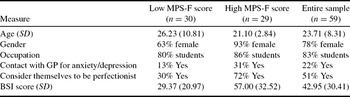
The sample was split into two groups on the basis of scores on the MPS-F (a median split). Those in the low perfectionism group had a mean MPS-F score of 61.03 (SD = 11.22) and those in the high perfectionism group had a significantly higher mean score of 90.10 (SD = 9.17) (t(57) = 10.88, p<.001). Demographics of both groups are presented in Table 1. Across the whole sample, 24% had BSI scores that fell within the clinical range (i.e. were 63 or above). This included 13% of those with “low” perfectionism scores and 34% of those with “high” perfectionism scores.
Comparison of those with high and low scores on the MPS-F on demographic variables and general psychopathology

Level of perfectionism and behavioural expressions
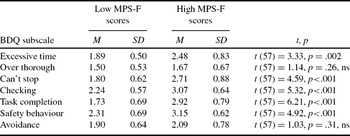
An Independent measures MANOVA was conducted to analyze the effect of perfectionism level on the seven behavioural expressions of the BDQ (spending excessive time, being over thorough, not being able to stop once started, checking, trouble with task completion, safety behaviour, and avoidance). The MANOVA was significant (F (7, 51) = 7.84, p<.001, Pillai's Trace = 0.518), therefore separate t-tests could be conducted. Mean scores across both groups on all BDQ scales are presented in Table 2.
Comparison of those with high and low levels of perfectionism on BDQ scales (MPS-F median split)

Follow up t-tests indicated that those with high MPS-F scores demonstrated more excessive behaviour, found it harder to stop tasks once started, checked their actions more, were more concerned with task completion, and engaged more in safety behaviours than those with low MPS-F scores. Groups did not differ from each other in terms of being over-thorough and avoidance. Those with higher MPS-F scores also had significantly higher BSI scores (57.00 versus 29.37, t(57) = 3.89, p < .001). In order to rule out whether elevated BDQ scores were due to these higher BSI scores, analyses were repeated controlling for BSI scores. All group differences remained when BSI scores were controlled.
Level of perfectionism and intrusive mental imagery
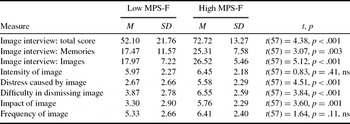
T-tests were used to compare image interview scores in those with high and low levels of perfectionism, and mean scores are presented in Table 3. It can be seen that overall scores on the image interview were higher in those with higher levels of perfectionism. This was also true for the images and memory section of the interview individually. In addition, those with higher levels of perfectionism experienced more distress from perfectionism-related imagery, found it harder to dismiss the images, and experienced more negative impact as a result of the imagery. However, they did not differ from those with lower levels of perfectionism in terms of frequency or intensity of imagery.
Means and standard deviations from the Image Interview for those with high and low levels of perfectionism (MPS-F median split)

Themes of imagery
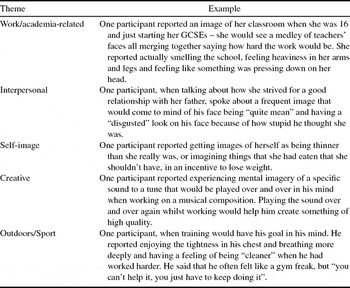
Each interview was categorized into one of five themes of the main image, and frequencies of each across the whole sample were as follows: work related (n = 32), interpersonal (n = 8), creative (n = 6), outdoors-related/sport (n = 9) and self-image (n = 4). Table 4 provides an example from each of these different theme categories. A Chi-square test was performed to examine if there was an association between level of perfectionism and type of theme presenting. No association was found (χ2 = 5.98, df = 5, p = .31).
Examples of images discussed

Relationship between behavioural expressions of perfectionism and perfectionism-related imagery
There was a significant positive relationship between scores on the Imagery Interview and total scores on the behavioural domains questionnaire, controlling for BSI scores (r = .33, p = .011, one-tailed). Specifically, higher imagery scores were significantly associated with higher checking and safety behaviours (r = .35 and .31 respectively) and greater difficulty in completing a task (r = .28), all ps < .05.
Ability of the BDQ and Imagery Interview to predict general psychopathology
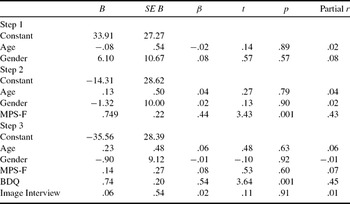
In order to further explore the association of the newly developed behavioural domains questionnaire and the revised imagery interview with general psychopathology (BSI scores), hierarchical linear multiple regression analyses were conducted with BSI scores as the dependent variable. In a first step, age and gender were entered to control for demographic factors. Scores on the MPS-F were entered in a second step, and scores on the Behavioural Domains Questionnaire and Imagery Interview were entered into the regression equation in a third step in order to determine the amount of variance in general psychopathology that could be uniquely explained by these new measures, independently of demographics and level of perfectionism. Results are presented in Table 5. Tolerance statistics for analyses were acceptable. Age and gender accounted for less than 1% of the variance in BSI scores (F(2, 56) = 0.25, p = .78). Adding MPS-F scores to the equation accounted for a further 14% of the variance (F(3, 55) = 4.12, p = .01), and adding BDQ scores and Imagery Interview scores accounted for a further 29% of the variance in BSI scores (F(5, 53) = 5.73, p < .001). It can be seen from Table 5 that this additional variance was best accounted for by the DBQ rather than the Imagery Interview.
Predictors of Brief Symptom Inventory scores (BSI) in the linear regression models

Discussion
The first aim of this study was to explore the behavioural expression of perfectionism in a non-clinical sample, using a new assessment tool. The measure designed for this purpose had excellent overall internal consistency and indicated that individuals with higher levels of perfectionism reported behaviours that took more time, were harder to stop, had more problems completing tasks, and engaged more in checking and safety behaviours. This is consistent with and extends previous research indicating that people with dysfunctional perfectionism take longer to complete tasks, doubt their decisions, and report more negative consequences of their behaviours (Rhéaume et al., Reference Rhéaume, Freeston, Ladouceur, Bouchard, Gallant and Talbot2000). The results from this study support our clinical observation that the behavioural expressions of perfectionism are prominent and warrant inclusion in any cognitive behavioural analysis.
However, contrary to prediction, those with higher levels of perfectionism do not show more avoidance behaviours, and are not more overly-thorough. This may suggest that in a non-clinical sample at least, “over thorough” behaviours could also come from being conscientious, a normal behaviour that has been correlated with healthy perfectionism (Stumpf and Parker, Reference Stumpf and Parker2000), and that “avoidance” can be both functional and dysfunctional (Hamachek, Reference Hamachek1978). It would be important in future research to examine this issue in a clinical sample. It may, on the other hand, be that these behaviours are simply not associated with dysfunctional perfectionism. This should be investigated in future work and, if this is the case, these items should be removed from the BDQ.
The current research also investigated the phenomenology of intrusive mental imagery in multidimensional perfectionism. This study found that those with higher levels of perfectionism experienced more distress as a result of this intrusive mental imagery, found it harder to dismiss the imagery, and experienced more negative impact as compared with those with lower levels of perfectionism. This is consistent with the view that perfectionism is “a form of psychopathology maintained by specific cognitions and behaviour” (Riley et al., Reference Riley, Lee, Cooper, Fairburn and Shafran2007, p. 229) and these findings present evidence explicitly associating perfectionism with mental imagery. The finding that those with higher levels of perfectionism experience mental images with more adverse consequences than those low in perfectionism should inform any cognitive-behavioural account and treatment of perfectionism. Those higher in perfectionism demonstrated cognitive disruption, in the form of intrusive images, and these findings may be important for those with pathological forms of perfectionism (Shafran, Cooper and Fairburn, Reference Shafran, Cooper and Fairburn2002). These findings warrant replication in a clinical sample in order to examine the treatment implications. Future research may also wish to specifically examine behavioural expressions and intrusive imagery associated with clinical perfectionism (Shafran et al., Reference Shafran, Cooper and Fairburn2002). If the findings are replicated, it implies that, as the images associated with perfectionism appear to be distressing and difficult to dismiss, part of the CBT protocol to address perfectionism could effectively include imagery restructuring techniques.
This study also found that general psychopathology was significantly higher in those with higher perfectionism scores, and a greater percentage of those with higher levels of perfectionism had seen their GP for problems relating to anxiety and/or depression. However, the association noted between the MPS-F and the BDQ was not simply a function of increased psychopathology as it remained when BSI scores were statistically controlled for. It may be that the behaviour associated with perfectionism is causing significant distress for some people, and may be contributing to difficulties with mood and anxiety. Indeed, the behavioural expressions of perfectionism as measured by the BDQ were able to predict general levels of psychopathology over and above demographic variables and MPS-F scores.
In conclusion, this research provides an initial exploration of the intrusive mental images and specific behaviours associated with perfectionism. The results offer scope for fleshing out the details of the cognitive-behavioural model of perfectionism, as both mental imagery and intrusive thoughts were found to be closely associated with the stringent pursuit of personally demanding standards. The new behavioural measure of perfectionism could prove useful clinically in the assessment of perfectionism, and an adaption of the existing Imagery Interview might also have clinical utility However, it should be noted that this research was largely exploratory in nature, and replicating findings in a clinical population are essential in order to determine their reliability, and to shed further light on clinically relevant perfectionist behaviours and mental images.
Acknowledgements
The authors would like to thank staff from the Charlie Waller Institute and the University of Reading for their support in this research. The authors would also like to give thanks to all the participants who took part and an anonymous reviewer for helpful comments on an earlier version of this manuscript.



Comments
No Comments have been published for this article.