Large-scale catastrophic events typically result in a scarcity of essential medical resources and accordingly necessitate the implementation of triage management policies to ensure that all available resources are used to maximally benefit the affected population.Reference Bell1 Unfortunately, many current disaster triage guidelines share a similar conceptual shortcoming: the definition of triage as a comparatively isolated process that occurs only at a single point of contact between patients and the health care system (eg, at the levels of prehospital care, the emergency department, or intensive care). This narrowly focused conceptualization fails to consider the inherent interrelations between all aspects of patient care within the health system that must be considered when responding to catastrophic events. This article alternatively advocates for a systemic approach to disaster-specific triage management that integrates care at all points of interaction between potential patients and the health care system.
Resource Stewardship in Disaster Preparedness
Large-scale catastrophic events—such as the recent earthquakes in China, the cyclone in Myanmar, the Indian Ocean tsunami, and Hurricane Katrina in the United States—as well as the specter of a 1918-like pandemic influenza represent public health emergencies that create significant health system disruptions that drastically elevate risks of morbidity and mortality. In addition, the consequences of such disruptions often create temporary shortages of essential medical resources, including supplies, equipment, facilities, and personnel.2 As resources become depleted, the allocation of available resources and essential services within a comprehensive triage management framework becomes critical to ensuring that all affected individuals are afforded the best possible opportunity for survival while sustaining overall societal function and stability.Reference Burkle3
Disaster management officials are therefore ethically and legally obligated to act as responsible stewards of scarce public resources.Reference Larkin and Arnold4 In essence, a tacit contract exists between the public health preparedness community and the population it serves. Citizens have not only offered their participation and donated material resources in support of preparedness activities but they also have given their collective consent to be fairly and equitably triaged when health rationing is necessary. To maintain this fiduciary relationship, it is incumbent on the public health preparedness community to undertake all reasonable measures to protect the health and well-being of the populace.
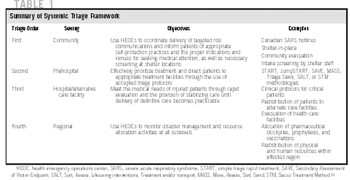
The promotion of public health security under emergency circumstances requires that the disaster response community modify its conceptualization of disaster-specific triage management to embrace a multitiered, systems-based process. Such a systemic conceptualization will have, at a minimum, a first-order triage at the community level; a second-order triage at the prehospital level; a third-order triage at the hospital or alternative care facility level; and a fourth-order triage that provides appropriate coordination and oversight at the regional level. Adoption of this systems-based approach is essential to ensure that all casualties (injury and illness) are afforded an equal opportunity of survival, in accordance with applicable statutory mandates.Reference Domres, Koch and Manger5 Equal opportunity of survival means that all affected individuals are afforded equity in triage and the receipt of medical care that is consistent with their injuries and projected survivability, as well as prevailing resource constraints. This notion of equal opportunity in triage does not, however, guarantee either treatment or survival for all patients potentially affected by a catastrophic event.Reference Burkle3
This revised understanding of disaster triage management as a systemic process recognizes all potential points of contact between affected individuals and the available health care system. Such a triage process is inherently dynamic, with casualty prioritization remaining subject to change based upon situational factors, the availability of accessible resources, and the accuracy and timeliness of situational awareness, as well as the efficacy of risk communication. The interoperability and interface of these 4 distinct stages of triage management are significant in that the mitigation of overall mortality is interdependent on the adequacy of triage management expertise at each given phase.
Disaster-specific Triage As an Interconnected Framework
Effective triage management at the community level requires individuals to be properly informed about how they may reduce their own risk exposure while also understanding how and where to access care should they be among those affected by disaster hazards.Reference Domres, Koch and Manger5 At the time of a crisis, the disaster management community must deliver targeted risk communications to inform affected individuals of potential risks, appropriate self-protection practices, and the proper indications and venues for seeking medical attention.Reference Eisenman, Cordasco and Asch6 The Canadian experience with containment of the severe acute respiratory syndrome outbreak improved first-order triage by enhancing existing telephone hotlines to assist the population in determining the potential exposure risks, the need for medical attention, and the best places to seek care, and most important, in assuring people of the benefits of social distancing through remaining at home when clinical treatment was unnecessary.Reference Beard and Clark7 This method was effective in that it informed the public and reduced unnecessary mixing and crowding at health care facilities, thereby reducing viral transmission and fulfilling the primary operational goal of triage management.Reference Burkle3 Ultimately, it proved to be an essential service in systemic outbreak control, investigation, and identification of best practices for triage management.
If citizens are advised to seek shelter under disaster circumstances, then community-based triage activities must undertake prudent measures to direct individuals to the appropriate venues. Specifically, shelter staff must rapidly assess individuals as they arrive to ensure that the facility has the capacity to meet the specific needs of those presenting.Reference McGuire, Ford and Okoro8 This assessment process is particularly important among those who are old, disabled, mentally ill, or stricken with communicable diseases that could place other shelter occupants at risk for infection. Individuals whose medical needs cannot be adequately met within a given facility should be promptly relocated to appropriate alternative care sites.Reference Laditka, Laditka and Xirasagar9
A second-order focus of disaster response is increased population survival through the optimization of prehospital triage management policies. At this stage, the equitable and appropriate distribution of patients throughout the health system can occur through the implementation of valid field triage protocols and the effective coordination of response services. Common mechanisms of mass triage casualty management include simple triage rapid treatment (START),10 JumpSTART,Reference Romig11 Secondary Assessment of Victim Endpoint (SAVE),Reference Benson, Koenig and Schultz12 Triage Sieve,Reference Hogetts and Mackway-Jones13 and the Sacco Treatment Method,Reference Sacco, Navin and Fiedler14 among others. With these frameworks, the primary goal of second-order triage is to prioritize patients for purposes of transportation to appropriate facilities and the ultimate treatment for their medical needs. Effective prehospital screening also is imperative to ensure that only individuals with the most urgent need for attention are delivered to hospitals or alternate care facilities to prevent overwhelming these institutions.Reference Frickberg15
Once individuals have been sorted according to treatment prioritization at the prehospital level, third-order triage practices will become necessary to meet the medical needs of injured patients as they arrive at hospitals or alternative care facilities. Principles of casualty salvage require that patients be evaluated quickly then provided with stabilizing care until they can be provided with definitive care.Reference Almogy, Belzberg and Mintz16 All third-order triage management endeavors must seek to reduce barriers that would cause delay or denial of necessary medical care. This duty can most appropriately be met through enhancing the patient care capacity of each facility in times of crisis.Reference Rubinson, Hick and Hanfling17 This can be accomplished by increasing the number of patients that can be treated at a given facility through a systemwide designation of disaster-specific hospitals (eg, influenza hospitals), discharge of stable patients,Reference Davis, Post and Hicks18 redistribution of hospital equipment,Reference Hick, Hanfling and Burstein19 and/or evacuation of hospital patients to alternative sites of care.Reference Shultz, Koenig and Lewis20 Once patients access care, it is crucial that health care providers engender trust by adhering to predetermined disaster response policies, health rationing guidelines, and protocols, and by ensuring that available medical services are delivered in an effective, just, and equitable fashion.Reference Winslow21, Reference Powell, Christ and Birkhead22
Finally, fourth-order triage must take place at the regional level. Large-scale events, such as pandemics, will require resource allocation at a regional level by means of a system that supports individual state requirements and serves as the liaison to national authorities.Reference Burkle, Hsu and Loehr23 Regional-level intervention also is intended to monitor disaster management at all sub-levels to ensure that resources are effectively and fairly used to increase casualty population survival in a large-scale catastrophe. Most important, regional disaster management efforts must continually reevaluate resource needs and allocation strategies as situations progress and new information becomes available.24 These oversight duties are most appropriately discharged by regional health emergency operations centers (HEOCs).
In the aggregate, this multitiered holistic triage management practice creates an essential framework for a systemic response to large-scale catastrophic events. Such a process will consequently improve efficiency by providing the full benefit of preventive and responsive care at each point of contact. By doing so, disaster response activities will take place in a comprehensive fashion that minimizes the patient care burden at each subsequent order of intervention and reduces the overall need to ration care. Furthermore, this system will promote fairness across response activities by ensuring that individuals are given the opportunity for survival in the face of catastrophic events (Table 1).
Summary of Systemic Triage Framework

Using Regional HEOCs to Promote Justice and Efficacy
In response to the above proposals, the public health preparedness community may question how and where systemwide triage management is to be operationalized. It is recommended that such responsibility be appropriately vested within HEOCs, which traditionally are charged with ensuring community- and regionwide situational awareness, disseminating risk communication, and deciding when resource capacity requires the implementation of triage management through the HEOC's jurisdiction.Reference Burkle, Hsu and Loehr23 The HEOC model is compatible with and remains functionally part of the established incident command system framework. In addition to promoting real-time analysis, the efforts of HEOCs should focus on pre-event planning exercises. These exercises must seek to fulfill the disaster communities' key ethical and legal obligations to the population under their charge. These include the mitigation of potential risks and the preparation of response protocols that will effectively minimize the need for treatment rationing in the event of a large-scale disaster.Reference Domres, Koch and Manger5 One means of accomplishing this is to engage communities in precrisis efforts to minimize potential risk exposure so that the population feels safe and confident. Disaster response planners must be able to properly identify vulnerable populations and incorporate them into predisaster planning activities. Accordingly, community-level preparations should include fortification of the local health and public health infrastructure, including primary and alternate care facilities, as well as shelters for those who may become displaced as a result of a disaster. The predisaster process also should seek to educate vulnerable communities as to how individual citizens may best promote their own well-being, including the potential stockpiling of essential goods; with knowledge of established evacuation protocols; and with awareness of basic public health concepts, such as the social distancing necessary during infectious disease outbreaks.
The HEOC also must promote justice in emergency response efforts by assuring the efficacy and fairness of response guidelines before a large-scale catastrophic event.Reference Rubinson, Hick and Hanfling25 To promote fairness and establish the legitimacy of sorting practices, HEOCs should establish evidence-based foundations for triage protocols at all levels to the extent possible and have the capacity to adapt and improve the triage management yield based on new data and information.Reference Auf der Heide26 Ongoing research is necessary to establish that the criteria used to sort patients into given triage-management categories are clinically meaningful and are adequately predictive of survivability.Reference Jenkins, McCarthy and Sauer27 Although great benefits would be derived from a better understanding of previous events, such data are sparse.Reference Rubinson, Hick and Hanfling25 Planners and decision makers are forced to extrapolate sorting criteria from modeling studies, retrospective analysis of previous disasters, and other validated clinical research to establish sorting thresholds that are appropriate to the populations and cultures affected by a disaster.
Moreover, HEOCs also must ensure that justice is upheld through triage-management efforts that are consistently implemented in a reasonable and equitable manner.Reference Gostin and Powers28 Patients cannot be expected to willingly consent to the priority segmentation process mandated by triage management unless they can reasonably expect that any impediments to their individual self-interest (eg, receipt of immediate medical treatment) would translate into tangible benefits to the population (eg, promoting the survival of as many patients as possible).Reference Trotter29 If such an assurance is provided through education and training in advance of a mass casualty incident, it can be presumed that rational community members will support the implementation of these policies to maximize the likelihood of their own survival under emergency situations. Although such an unqualified assurance is not realistic, public support for triage protocols can be maintained if a cogent demonstration of expected efficacy can be demonstrated.
Finally, HEOCs can promote integrity within the disaster planning and response process by establishing a forum for the interaction of experts and community members at all stages of intervention. In addition to relying upon the expertise of traditional disaster management personnel, HEOCs should incorporate ethicists, attorneys, epidemiologists, public health professionals, relevant medical specialists, and community liaisons to act as consultants during the planning, response, and evaluation processes.Reference Burkle, Hsu and Loehr23 The interaction of all of these parties is essential to ensure that triage policies not only conform to relevant ethical standards but also incorporate the values of the community that may be affected.Reference Gostin and Powers28, Reference Clabresi and Bobbit30 Furthermore, transparency within this process will aid in legitimizing resulting guidelines in the public's view.Reference Gostin31
Conclusions
Large-scale catastrophic events typically result in a scarcity of essential medical resources and therefore require the implementation of triage management policies to minimize preventable morbidity and mortality. Consequently, the public health preparedness community must reconceptualize disaster triage as a population-based systemic process that addresses all potential points of contact between individuals and the health care system. Accordingly, first-order triage initially occurs at the community level to reduce risk exposure; second-order triage at the prehospital level to sort casualties for treatment and transport; third-order triage at the hospital level to maximize patient care within the constraints of available resources; and fourth-order triage at the regional level, with systemwide oversight of the public health response process. Seamless integration of this systems-based model of disaster-specific triage, coordinated through HEOCs, can ensure that public health security measures are undertaken in a manner that is effective, just, and equitable. As such, large-scale disaster management protocols may best meet their ethical and legal obligations to ensure that all victims are afforded the best possible opportunity of survival following a catastrophic event.
Authors' Disclosures
The authors report no conflicts of interest.