Introduction
Despite representing more than one third of the total grain production of Brazil (www.ibge.gov.br), the Cerrado region copes with several biophysical constraints to crop production that are typical of tropical environments. Fifty per cent of the Cerrado is covered by highly weathered ferralitic soils that are generally poor in calcium, magnesium and potassium, and have high aluminium saturation due to their low effective cation exchange capacity (Reatto et al., Reference Reatto, Correia, Spera, Matiko and Pedrosa de Almeida1998; Yamada, Reference Yamada2005). Precipitation in the Cerrado often occurs through high-intensity storms generally causing surface water run-off and soil erosion (Wantzen et al., Reference Wantzen, Siqueira, da Cunha and de Sá2006). Soil cover is, therefore, a key factor in controlling soil degradation and sustaining crop productivity (Zuazo and Pleguezuelo, Reference Zuazo and Pleguezuelo2008). The growth cycle of annual crops in the region does, however, not encompass the entire rainy season period of 6–8 months, exposing the soil to high risks of erosion at both the start and end of the cropping season.
Whereas large entrepreneurial farms effectively control these crop production challenges using mechanized no-tillage (NT) systems with cover crops in combination with chemical fertilizer and lime applications (Bollinger et al., Reference Bolliger, Magid, Amado, Neto, dos Santos Ribeiro, Calegari, Ralisch and de Neergaard2006; Crusciol et al., Reference Crusciol, Marques, Filho, Soratto, Costa, Neto, Castro, Pariz and de Castilhos2016), practical and affordable solutions designed for small-scale farmers are lacking. The latter represent more than 30% of the farmers in the Cerrado but occupy only 2.5% of the total agricultural land area, with individual farm sizes that are commonly less than 10 ha (www.ibge.gov.br). Their fields are located in the valleys that are the most marginal areas for crop production, left aside by the mechanized large-scale farms that are situated on the vast plateaus of the region. Small-scale farmers commonly practise tillage-based agriculture that often causes accelerated soil degradation, which in part explains the low crop productivity on their farms.
NT systems with cover crops have been reported to have positive effects on soil fertility through increased soil carbon storage (Carvalho et al., Reference Carvalho, Cerri, Feigl, Piccolo, Herpin and Cerri2009; Corbeels et al., Reference Corbeels, Marchão, Neto, Ferreira, Madari, Scopel and Brito2016) and better soil structure (Green et al., Reference Green, Stott, Cruz and Curi2007). Moreover, the mulch of crop residues in the NT systems protects the soil and acts as a barrier to water run-off and soil erosion, which can lead to more sustained crop productivity (e.g. Ranaivoson et al., Reference Ranaivoson, Naudin, Ripoche, Affholder, Rabeharisoa and Corbeels2017). However, under the sub-humid tropical climate of the Cerrado, the resulting increase in water infiltration enhances water drainage below the rooting zone (Da Silva et al., Reference Da Silva, Naudin, Corbeels, Scopel and Affholder2019; Scopel et al., Reference Scopel, da Silva, Corbeels, Affholder and Maraux2004). This leads to significant losses of nutrients. Therefore, it is recommended that a cover crop is sown immediately after the commercial crop as a way of recycling nutrients from the lower parts of the rooting zone. This recommendation has proved to have merits for the intensive, mechanized soybean (Glycine max) and maize (Zea mays) cropping systems practised by large-scale farmers in the Cerrado (Bolliger et al., Reference Bolliger, Magid, Amado, Neto, dos Santos Ribeiro, Calegari, Ralisch and de Neergaard2006; Maltas et al., Reference Maltas, Corbeels, Scopel, Wery and da Silva2009). However, the water holding capacity of the (shallow) soils of small-scale farms in the Cerrado is generally too low for such crop succession. An alternative is to sow the cover crop before the main crop is harvested, i.e. in a relay intercropping system. After harvest of the main crop, the intercropped cover crop can continue and complete its growth, and in this way cover the soil surface until the end of the rainy season. With this intercropping system, benefits from NT systems may amplify.
Small-scale farms that are situated close to urban centres in the Cerrado have been evolving rapidly from subsistence-oriented and diversified farms towards more specialized and intensified market-oriented dairy farms. With continued dairy specialization in the study region, a decrease in the contribution of maize cropping to net farm income occurred. For the small-scale farmers in the region, it became more efficient to purchase protein-rich concentrates for dairy cattle feeding. However, with recent increases in the price of feed concentrates, the general trend now is to decrease the use of feed concentrates and intensify maize production, including the use of silage. This means that there is an increased economic attractiveness of relay intercropping systems of maize with fodder crops. Information on the performance of these systems is thus highly relevant. For the dairy-oriented farms, fodder crops provide feed for the cows, whilst protecting the soil against degradation (e.g. Borghi et al., Reference Borghi, Crusciol, Nascente, Mateus, Martins and Costa2012). Promising fodder crops are Brachiaria (Brachiaria ruziziensis) and pigeon pea (Cajanus cajan). Brachiaria ruziziensis is known for its high plant vigour with the potential of producing bulky biomass of good fodder quality even on low fertile and acidic soils. Pigeon pea is known to be drought tolerant providing protein-rich fodder through its leaves and pods.
The objective of this study was to evaluate the performance of relay intercropping systems of maize with these two fodder crops under farmers’ conditions in the central Cerrado region of Brazil, and to determine the range of conditions under which these new cropping systems offer promising results. We thus analysed how the diversity of farm management and agro-environmental conditions affects the performance of the proposed relay intercropping systems. To do so, on-farm trials managed by farmers were established in the municipal of Unaí on 26 farmers’ fields. They covered the wide range of soil conditions and farmers’ crop management practices in the study region. Productivity of relay intercropping with the two fodder crops was compared with sole maize cropping during two growing seasons, both under conventional tillage (CT) and NT practices.
Materials and Methods
Study sites
Intercropping experiments were conducted during two growing seasons (2007/08 and 2008/09) in farmers’ fields at three locations, i.e. ‘assentamentos’ or rural settlements, in the municipality of Unaí (16°21′50″ S, 46°54′15″ W), Minas Gerais, Brazil, namely Santa Clara, Paraiso and Jiboia. The three ‘assentamentos’ were installed under the Brazilian agrarian reform programme (Santa Clara in 1995, Paraiso in 1997 and Jiboia in 1998). They comprise, respectively, 42, 55 and 78 farming families that are increasingly specializing in dairy production. The local climate is tropical sub-humid, typical of the Brazilian central Cerrado region, with an annual mean temperature of 21 °C and annual rainfall of 1300 mm, occurring between October and April. The dominant soil types in the study area are Latossolos (Brazilian soil classification) or Ferralsols (FAO classification), Areias quartzosas (Arenosols), known in vernacular language as ‘Terra de campo’, and Podzolicos (Acrisols or Luvisols) that are located along the river banks and are locally known as ‘Terra de cultura’ (Adámoli et al., Reference Adámoli, Macedo, Azevedo, Madeira Netto and Goedert1986). ‘Terra de cultura’ have a loamy texture and are the most favourable soils for crop production at the study sites. Average organic matter (OM) content in the 0–20 cm topsoil layer of this soil type at the study sites was 2.9%. Latossolos are red ferralitic soils with a clayey texture that had an average OM content of 1.3%. ‘Terra de cultura’ and Latossolos are dominant in Santa Clara and Paraiso. ‘Terra de campo’ are ferralitic soils with sandy texture that are characterized by low OM content (0.9%). This soil type is mainly present in Jiboia.
The major crop grown on the farms is maize, principally used as feed for poultry and pigs, and to a lesser extent for dairy cattle and for household consumption. Cows are fed on pastures during the rainy season and on sugarcane (Saccharum officinarum) and maize straw during the dry season.
Experimental design
Twenty-six farmer fields (nine fields in 2007/08 and 17 fields in 2008/09) were identified for this study, representing the diversity of soil conditions and farmers’ crop management practices in the study region. On each field, three plots of 70 m2 were randomly selected for the intercropping experiment, with the following treatments: sole maize crop cropping (MS) as the control, maize-Brachiaria intercropping (MB) and maize-pigeon pea intercropping (MP). Maize was sown at a target density of 5–6 plant m−2. The associated fodder crops were sown manually at a target density of 19 and 28 plants m−2 for pigeon pea in 2007/08 and 2008/09, respectively, and around 100 plants m−2 for Brachiaria in both seasons. The fodder crops were sown in one row between two maize rows. Farmers implemented the proposed relay intercropping systems using their own resources, by choosing the soil tillage management, date of sowing and fertilization.
The selected farmer fields covered the heterogeneity of soils. In 2007/08, four fields were on ‘Terra de cultura,’ three on ‘Latossolo’ and two on ‘Terra de campo’. In 2008/09, the number of fields per soil type was respectively six, seven and four (see Supplementary Table S1).
Crop management
The fields were managed by the respective farmers. Each farmer had the choice of practising CT using hired tractor equipment, or NT using an animal-drawn no-till seeder that was provided by the Brazilian Agricultural Research Corporation (Embrapa). NT was chosen by six farmers in 2007/08 and nine farmers in 2008/09 (Table S1). With NT, farmers used herbicides to control weeds, and crop residues were left on the soil surface.
Farmers decided when to plant maize, mainly depending on the availability of the tillage and sowing equipment. Maize sowing dates ranged from 22 November to 15 December in 2007 and from 17 November to 15 December in 2008 (Table S2). At maize sowing, the experimental intercropping plots were installed, with the treatments as described above. Fodder crops were sown manually on the experimental plots after maize emergence, i.e. between 9 and 22 DAS (days after sowing) in 2007/08 and between 4 and 44 DAS in 2008/09 (Table S2). About 35% of farmers did not apply any organic or mineral fertilizer on their fields. Those farmers who used mineral fertilizer applied either baseline N-P-K fertilizer in a single application at sowing or combined with topdressing using urea (between 36 and 47 DAS). Amounts of baseline fertilizer varied between 2 and 23 kg N ha−1, 1 and 12 kg P ha−1, and 2 and 32 kg K ha−1 in 2007/08; and between 2 and 18 kg N ha−1, 1 and 16 kg P ha−1, and 2 and 34 kg K ha−1 in 2008/09. Urea was applied by only two farmers at an average rate of 24 kg N ha−1 in 2007/08 and 20 kg N ha−1 in 2008/09.
Measurements
Daily rainfall was monitored by the farmers between September and April in each cropping season using manual rain gauges that were placed nearby the fields. Maize aboveground biomass (including grains) and grain yield, aboveground biomass of the fodder crops and weeds were measured at maize harvest on the experimental plots. Two replicated small subplots of two crop rows of 5 m length were sampled for each treatment in each field. Maize straw, maize ears, and aboveground biomass of the fodder crops and weeds were weighed in the field, and subsamples were taken as follows: four maize plants, 10 maize ears, and 500–1000 g of fodder crop and weed biomass. Ears were separated into grains and stalks with husks. The subsamples were dried at 65 °C for 3 days to determine dry matter contents. Results were expressed on a dry matter per hectare basis. Subsamples of maize (straw, stalks and husks, and grains) and biomass of cover crops were ground to pass through a 0.5-mm sieve and analysed to determine total N, P and K contents. Total N was determined by the Kjeldahl method followed by steam distillation; total P by colorimetry using the vanado-molybdate procedure and total K by flame photometry after dry ashing the plant sample and dissolution of the ash in nitric acid (De Santana do Carmo et al., Reference De Santana do Carmo, de Araujo, de Campos Bernardi and Saldanha2000). Crop N, P and K uptake were calculated by multiplying maize grain yield and maize and fodder crop aboveground dry matter with the corresponding N, P and K contents.
Statistical analyses
When evaluating the effects of the relay intercropping systems under farmers’ conditions, on-farm factors (e.g. the timing and form of agronomic practices, such as tillage, sowing time and fertilization) interact with the imposed treatments. We used a general linear mixed model, considering several other sources of variation (than the experimental treatment) and their interactions with the treatment, to analyse maize grain yield, maize and fodder crop aboveground biomass, and N, P and K crop uptake. The effects of cropping treatment (MS, MB and MP), season (2007/08 and 2008/09), soil tillage system (CT and NT), soil type (Tera de cultura, Latossolo, and Terra de campo) and fertilization (yes or no) were considered as fixed. Date of fodder crop sowing after maize sowing (DAS) as covariate and ‘field’ as random effect nested in the interaction soil type × season. The least significant difference (LSD) test was used to compare the means.
Results
Rainfall
The total amount of rainfall was similar during the two growing seasons and at the three ‘assentamentos’ (898–1084 mm) but with differences in seasonal distributions (see Supplementary Figure S1). Rainfall started later in 2007/08 than 2008/09 and in Paraiso than in Santa-Clara and Jiboia.
Maize grain yield and biomass
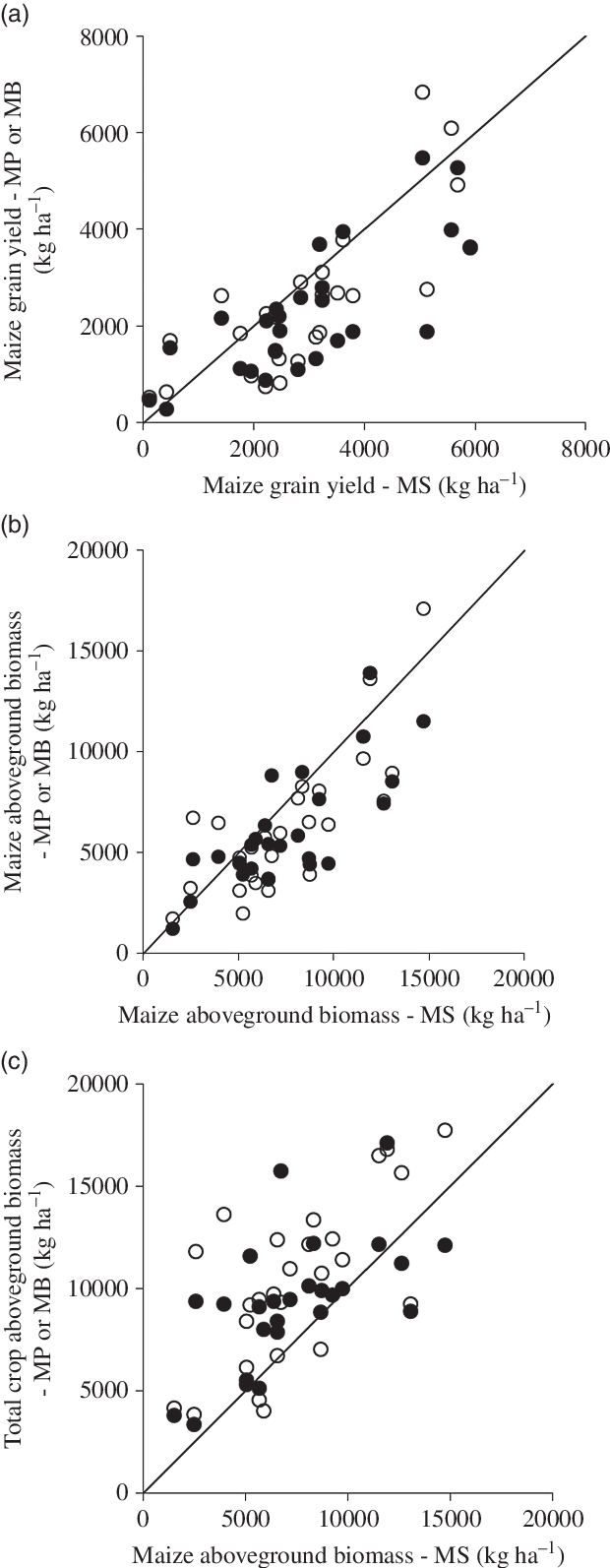
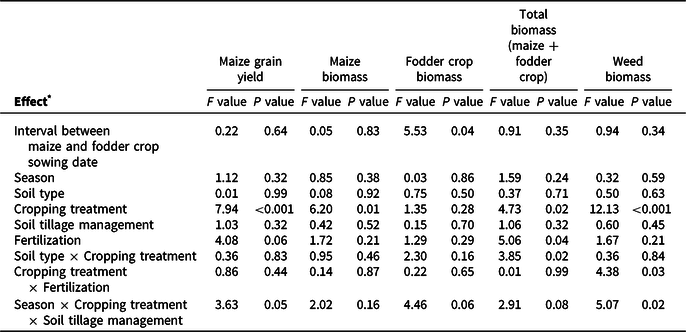
Maize grain yield varied strongly across the farmers’ fields in the two growing seasons – from about 100 to 5900 kg ha−1 in the MS treatment, 500 to 6900 kg ha−1 in MP and 300 to 5500 kg ha−1 in MB (Figure 1a). In 21 of the 26 experimental plots maize yield was smaller in MB than in MS. In the case of MP, 16 plots showed smaller intercropped maize yields. The cropping treatment (P < 0.01) and its three-way interaction with season and soil tillage system (P < 0.05) had significant effects on maize grain yield (Table 1). No significant differences (P > 0.05) were observed between the intercropped and sole maize grain yields under NT during the two seasons (Table 2). However, under CT maize grain yield was significantly (P < 0.05) higher in MS (3400 kg ha−1 on average) than in MB (1400 kg ha−1) and MP (1300 kg ha−1) in 2007/08, whilst no significant differences (P> 0.05) were observed in 2008/09. The cropping treatment had also a significant (P < 0.01) effect on the aboveground maize biomass, with the highest productivity under MS (7100 kg ha−1) and the lowest under MB and MP (5100 and 5800 kg ha−1) (Figure 1b, Table 1). No other factors or their interactions had a significant effect on maize aboveground biomass.
Comparison of (a) maize grain yield, (b) maize aboveground biomass and (c) total aboveground biomass (maize + fodder crop) between the MS and relay intercropping systems (MP, open circles, or MB, closed circles). MB: maize-Brachiaria intercropping; MP: maize-pigeon pea intercropping; and MS: maize sole cropping.

Results of the general linear mixed model analysis for maize grain yield, maize aboveground biomass, fodder crop aboveground biomass, total aboveground biomass (maize + fodder crop) and weed biomass

* Only interactions with a signification effect are shown.
Mean maize grain yields in the different cropping treatments, following CT and NT in the two seasons of the experiment

CT: Conventional tillage; NT: no-tillage; MB: maize-Brachiaria intercropping; MP: maize-pigeon pea intercropping; and MS: maize sole cropping.
Within a soil tillage management system, means in the same row with different superscript letters indicate significant differences (P < 0.05) between cropping treatments, and no letters indicate no significant differences (P > 0.05). LSD test was used to compare means.
Fodder crop biomass
Aboveground biomass of the fodder crops contributed less than half of the total aboveground biomass of the intercropped systems, except for some plots (seven in MP and five in MB treatments) where fodder crops represented between 50 and 75% of the total crop biomass produced (Figure 2). Aboveground biomass of pigeon pea (3200 kg ha−1 on average) was not significantly (P > 0.05) different from that of Brachiaria (2600 kg ha−1). Instead, the interval between maize and the fodder crop sowing affected significantly (P < 0.05) the productivity of the fodder crop (Table 1). On average, a delay of one day in sowing decreased biomass by 220 kg dry matter ha−1. Other factors and their interactions had no significant (P > 0.05) effect.
Ratio of the fodder crop biomass to the total biomass (maize + fodder) in relation to the interval between maize and fodder crop sowing dates. Open circles and dashed linear regression line represent MP intercropping and closed circles and solid linear regression line represent MB intercropping. MB: maize-Brachiaria intercropping; and MP: maize-pigeon pea intercropping.

Total crop biomass
Total aboveground biomass productivity (maize + fodder crop) was highly variable across the fields (Figure 1c). Total biomass in the intercropped treatments (MB and MP) was in most cases higher than that of MS, with only four MP and four MB plots showing the opposite. These latter cases were characterized by low fodder crop biomass productivity associated with a relatively late sowing date of the fodder crop (>20 DAS).
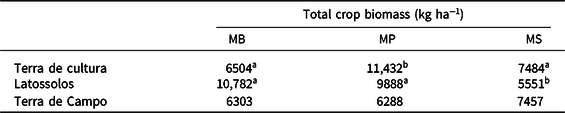
Cropping treatment, its two-way interactions with soil type and N fertilization had a significant effect (P < 0.05) on total aboveground biomass (Table 1). On ‘Terra de cultura’, total biomass was significantly higher in MP (11,400 kg ha−1 on average) than in MS (7500 kg ha−1) and MB (6500 kg ha−1); on ‘Latossolo’ total biomass was significantly higher in MP (9900 kg ha−1 on average) and MB (10,700 kg ha−1) than in MS (5600 kg ha−1); there were no significant (P > 0.05) differences between cropping treatments on ‘Terra de campo’ (Table 3). Total biomass was significantly (P < 0.05) higher with fertilizer N application (9900 kg ha−1 on average) than without (6000 kg ha−1). All other factors and their interactions did not significantly (P > 0.05) affect total aboveground crop biomass.
Mean total aboveground biomass (maize plus fodder crop) in the different cropping treatments, according to the soil types in the study region

MB: maize-Brachiaria intercropping; MP: maize-pigeon pea intercropping; and MS: maize sole cropping.
Means in the same row with different superscript letters indicate significant differences (P < 0.05) between cropping treatments, and no letters indicate no significant differences (P > 0.05). LSD test was used to compare means.
Weed biomass
Cropping treatment (P < 0.01) and its three-way interaction with season and soil tillage system (P < 0.05) and its two-way interaction with fertilization (P < 0.05) significantly affected weed biomass at harvest (Table 1). Weed biomass was significantly higher in MS (1600 kg ha−1 on average) than in the intercropped maize-fodder systems (MB, 980 kg ha−1, and MP, 420 kg ha−1) in the fields under NT in 2007/08, and in the fields under CT in 2008/09 (1610 kg ha−1 in MS versus 180 kg ha−1 in MB and MP) (Table 4). In 2008/09, in unfertilized fields, weed biomass was significantly higher in MS (1800 kg ha−1 on average) than in the intercropped systems (300 kg ha−1 for MB and 700 kg ha−1 for MP). In fertilized fields, there was no significant (P > 0.05) difference between cropping treatments.
Mean weed biomass in the different cropping treatments, following CT and NT in the two seasons of the experiment

MB: maize-Brachiaria intercropping; MP: maize-pigeon pea intercropping; and MS: maize sole cropping.
Within a soil tillage management system, means in the same row with different superscript letters indicate significant differences (P < 0.05) between cropping treatments, and no letters indicate no significant differences (P > 0.05). LSD test was used to compare means.
Crop N, P and K uptake
Total (maize plus fodder crop) N uptake was significantly affected by cropping treatment (P < 0.0001) and its four-way interaction with season, soil type and soil tillage system (P < 0.01). Overall, total N uptake was significantly higher in MP than in MB and MS; the latter were not significantly different (Table S3). In 2007/08, N uptake differed significantly between MS (63 kg N ha−1 on average) and MP (118 kg N ha−1) but the difference between MS and MB was not significant. The trend was similar in 2008/09; 40 kg N ha−1 for MS, 60 kg N ha−1 for MB and 100 kg N ha−1 for MP. The interval between maize and fodder crop sowing also affected significantly (P < 0.05) total crop N uptake; a delay of one day in the sowing date of the fodder crop decreased N uptake by 1.7 kg N ha−1.
Fertilizer application affected significantly (P < 0.05) total crop P uptake. P uptake was significantly higher in fertilized fields (19 kg P ha−1 on average) than on unfertilized fields (8.4 kg P ha−1). All other factors and their interactions did not significantly (P > 0.05) affect P uptake.
Total crop K uptake was significantly (P < 0.05) larger in intercropped treatments (MP and MB) compared to MS (Table S3). Fertilizer application had also a significant (P < 0.05) effect on K uptake (Table S3). It was higher in fertilized fields (89 kg K ha−1 on average) than in unfertilized fields (54 kg K ha−1). Finally, total K uptake was significantly (P < 0.05) influenced by the interaction between season and cropping treatment. It was significantly lower for MS in 2008/09 (28 kg K ha−1) than in 2007/08 (68 kg K ha−1); no significant (P > 0.05) differences were observed in the other treatments (MP and MB).
Discussion
We choose to conduct the study on farmers’ fields with experiments that were managed by farmers. In the on-farm trials, farmers implemented the proposed relay intercropping systems using their own resources, and the objective was to understand how much yield benefit relay intercropping provides when this is practised under these conditions.
Looking at the productivity levels of the maize and fodder crops, four specific cases can be distinguished for the relay intercropped maize-fodder cropping systems (Figure 3) as follows. (a) Low productivity of the intercropped fodder crop (<2000 kg dry matter biomass ha−1) and intercropped maize yield that is lower than that of sole maize. This occurred in situation of low soil fertility. (b) Productivity of the fodder crop is high (up to 9000 kg ha−1), with intercropped maize yield that is lower than that of sole maize, suggesting interspecific crop competition. (c) Higher maize grain yield in the intercropping system than in the sole maize system, but with low productivity of the fodder crop. This was in several instances a result of the low productivity of maize as a sole crop due to problems with plant density and weed infestation. (d) Higher maize grain yield in the intercropping system than in the sole maize system with high fodder crop productivity suggesting interspecific facilitation. The largest maize yield gains in the intercropping systems were observed with pigeon pea, which can be explained by the symbiotic N2 fixation by the legume crop enriching the soil–plant system in N (e.g. Amossé et al., Reference Amossé, Jeuffroy, Mary and David2014).
Difference in maize grain yield between the intercropping systems (MP, open circles, or MB, closed circles) and the MS system in relation to the fodder crop aboveground biomass productivity. See text for explanation. MB: maize-Brachiaria intercropping; MP: maize-pigeon pea intercropping; and MS: maize sole cropping.

Intercropping and soil tillage effects on maize yield
Relay intercropping with a fodder crop (pigeon pea or Brachiaria) did not significantly affect maize grain yields under NT (Table 2), thus confirming results from earlier studies in the Cerrado region that were conducted on research stations (Baldé et al., Reference Baldé, Scopel, Affholder, Corbeels, da Silva, Xavier and Wery2011; Coser et al., Reference Coser, Ramos, Célio De Figueiredo, Urquiaga, Moreira De Carvalho, Barros and Mendonça2016). This finding may seem unexpected since competition between maize and fodder crops is likely to be more severe in on-farm trials because of the commonly poorer soil conditions and lower fertilizer inputs (i.e. only 65% of the farmers applied N fertilizer at an average rate of 9–10 kg N ha−1 (Table S2), whilst 69–100 kg N ha−1 was applied in the on-station trials). On the other hand, under CT maize yields were negatively affected by relay intercropping in one out of the two experimental seasons (Table 2). Maize yields in the intercropped systems were also generally higher under NT compared to CT. The contrasting results between NT and CT may to a certain extent be explained by soil moisture conservation under NT, as a result of increased soil water infiltration and reduced evaporation and run-off from crop residue mulching in NT systems (Ranaivoson et al., Reference Ranaivoson, Naudin, Ripoche, Affholder, Rabeharisoa and Corbeels2017). This can reduce the competition for water between the intercrops in the relay intercropping systems, especially during dry spells. The higher maize yields under NT occurred despite the generally higher weed infestation compared to CT (Table 4). Intercrops may provide yield advantages without suppressing weed growth if intercrops use resources that are not exploitable by weeds (Liebman and Dyck, Reference Liebman and Dyck1993). It has been argued that weed pressure in NT cropping systems increases as a result of eliminating soil tillage (Chauhan et al., Reference Chauhan, Singh and Mahajan2012). Farmers employ soil tillage as a management tool to control weeds. Tillage physically removes weeds and may bury some weed seeds into deeper soil layers, thereby limiting their exposure to favourable germination conditions (Nakamoto et al., Reference Nakamoto, Yamagishi and Miura2006). On the other hand, depending on the season intercropping reduced weed infestation in our study (Table 4). It has been suggested that (relay) intercrops may be more effective than sole crops in competing for resources with weeds (Vrignon-Brenas et al., Reference Vrignon-Brenas, Celette, Piquet-Pissaloux, Jeuffroy and David2016). The degree of competition between intercrops and weeds depends to a great extent on the plant species and the environment.
The cases in which fodder intercrops reduce maize yield occurred generally in conditions of poor soil fertility, and especially when no or small amounts of fertilizer were applied, inducing a strong competition for nutrients between maize and the fodder crop (Figure 3, Ghosh et al., Reference Ghosh, Tripathi, Bandyopadhyay and Manna2009). For intercropping systems with legumes, it has been observed that under low soil N conditions, the competitiveness of the maize is reduced and the legume gains in relative competitiveness (Kermah et al., Reference Kermah, Franke, Adjei-Nsiah, Ahiabor, Abaidoo and Giller2017). An adverse effect of the intercrop on the yield of the main cereal crop can also occur when the growth of the intercrop is rapid early in the season (Carof et al., Reference Carof, de Tourdonnet, Saulas, Le Floch and Roger-Estrade2007; Shili-Touzietal, 2010). In our study, this occurred in some fields, when the fodder crop was sown less than 3 weeks after the maize crop.
Effect of crop management practices
In 85% of the experimental fields, total biomass productivity was higher in the maize-fodder crop relay intercropping than in the sole maize cropping system (Figure 1c), which was a statistically significant result (Table 1). This corroborates the results of various previous studies (e.g. Baldé et al., Reference Baldé, Scopel, Affholder, Corbeels, da Silva, Xavier and Wery2011; Hauggaard-Nielsen et al., Reference Hauggaard-Nielsen, Ambus and Jensen2003) and can be explained by the better use of resources (radiation, water and nutrients) in intercropping systems, as shown by, e.g., Willey et al. (Reference Willey1979) and Jensen (Reference Jensen1996). Importantly, in our study the relay intercropping extended the crop growing period, thereby increasing the total amount of radiation, water and nutrients captured by the crops.
The performance of the maize-fodder crop relay intercropping systems was, however, highly variable across farmers’ fields (Figure 1), which was related to the diversity of the crop management practices implemented by farmers (e.g. fertilizer use and tillage) and the interacting effects of soil conditions. Farmers’ management was to a large extent determined by their ability to purchase fertilizers and pesticides, or to rent equipment for land preparation and sowing (Gastal et al., Reference Gastal, Xavier, Zoby, de Rocha, da Silva, de Fatima dos Santos Ribeiro and Couo2003). For example, untimely or poor-quality sowing and weeding are important factors that explain the low maize productivity in the region (Affholder et al., Reference Affholder, Scopel, Madeira Neto and Capillon2003). Another factor of the low and variable productivity is the inherent low soil fertility of the farmers’ fields which causes increased competition for nutrient resources between the intercrops (e.g. Seran and Brintha, Reference Seran and Brintha2010). However, in our study we only found a significant soil effect for the maize-pigeon pea intercropping systems that showed lower total biomass productivity on the less fertile ‘Terra de campo’ and ‘Latossolo’ than on the more fertile ‘Terra de cultura’ (Table 3). On low-fertility soils external nutrient inputs are required with intercropping to reduce interspecific crop competition (e.g. Blaise et al., Reference Blaise, Bonde and Chaudhary2005; De Almeida et al., Reference De Almeida, Favarin, Otto, Junior, de Oliveira, Tezotto and Lago2017). As expected, fertilization had a significant effect on the total crop biomass productivity (Table 1) and crop N, P and K uptake (Table S3), suggesting that nutrients were a limiting factor in the farmers’ fields.
In general, crop species in intercropping systems must be selected and managed in a way to minimize interspecific competition and enhance overall resource use, especially in resource-poor conditions (Brooker et al., Reference Brooker, Bennett, Cong, Daniell, George, Hallett, Hawes, Iannetta, Jones, Karley, Li, McKenzie, Pakeman, Paterson, Schöb, Shen, Squire, Watson, Zhang, Zhang, Zhang and White2015; Seran and Brintha, Reference Seran and Brintha2010). A crucial management factor is the sowing date of the fodder crop. Early sowing of the intercrop increases overall radiation interception (Baldé et al., Reference Baldé, Scopel, Affholder, Corbeels, da Silva, Xavier and Wery2011). It can also reduce the development of weeds by covering the space between maize lines early in the cropping season (Bilalis et al., Reference Bilalis, Papastylianou, Konstantas, Patsiali, Karkanis and Efthimiadou2010; Liebman and Dyck, Reference Liebman and Dyck1993; Seran and Brintha, Reference Seran and Brintha2010). For example, in our study total biomass productivity in the intercropped systems was particularly low in fields where the maize plant density was low, and the sowing of the fodder crop was late. The low stand densities were due to the lack of farmers’ experience in using the no-till seeders. These low densities may favour weed infestation, and late sowing of fodder crops in this context may restrain the fodder crop compared to maize or weeds in the acquisition of radiation and soil resources (Baldé et al., Reference Baldé, Scopel, Affholder, Corbeels, da Silva, Xavier and Wery2011; Hauggaard-Nielsen et al., Reference Hauggaard-Nielsen, Ambus and Jensen2001).
Importance of maize-fodder crop relay intercropping for small-scale farms
The fodder crop biomass produced in the intercropping systems is an additional feed source for the dairy cattle on the farms in the study region. Based on results from whole-farm model simulations, Alary et al. (Reference Alary, Corbeels, Affholder, Alvarez, Soria, Valadares Xavier, da Silva and Scopel2016) suggested that the production of protein-rich fodder crops is a more cost-effective option for feeding dairy cattle on small farms in the region than the purchase of feed concentrates. In addition, with the specialization and intensification of dairy production and the increase in the price of feed concentrates, farmers are also increasingly using maize as feed for dairy cows, meaning that maize is becoming an even more important crop on these farms. Finally, the higher profitability from dairy intensification and the presence of a dairy cooperative in the region can further encourage small-scale farmers to produce milk and grow fodder crops for feeding their dairy cattle. However, it should be noted that the management of fodder crops in a relay intercropping system may also increase competition for labour and other scarce resources on the farm, which can limit the adoption of this type of cropping systems. Another aspect that must be considered is the possible long-term impacts of substantial removals of crop biomass from the fields for feeding (Naudin et al., Reference Naudin, Bruelle, Salgado, Penot, Scopel, Lubbers, de Ridder and Giller2014). Continuous biomass removals may lead to depletion of soil OM and to negative soil nutrient balances, which, however, can partially be compensated by returning the produced manure from the cattle to the fields. Therefore, good manure management (storage and handling) must be put in place, which is currently not the case on the farms from the rural settlements in the central Cerrado region.
Conclusions
Maize productivity on small-scale farms in the central region of Brazil is commonly low, because of poor soil fertility and inadequate crop management. Farms in the rural settlement areas have been evolving rapidly from subsistence-oriented, diversified farms towards more specialized, market-oriented dairy farms. Relay intercropping of maize with fodder crops, such as pigeon pea and Brachiaria, is a promising option for the sustainable intensification of these farms, allowing to increase the use efficiency of available resources. In 85% of the on-farm experimental fields in our study, total crop biomass productivity (maize + fodder crop) was higher in the relay intercropping systems than in the sole maize cropping system. Productivity of the intercrops was, however, highly variable across the farmers’ fields, depending on soil conditions and farmers’ management. The practice of NT enhanced the benefits from relay intercropping.
The productivity of relay intercropping systems of maize with fodder crops on small-scale farms can be enhanced through adequate crop management practices that minimize interspecific competition between maize and the fodder crop (i.e. optimal choice of sowing date, plant density and fodder crop species), and increase the availability of water and nutrients (i.e. NT with mulching, fertilizer application and weed control).
Intercropping with fodder crops provides the farmers with an additional feed source for their dairy cattle. There are, however, possible long-term negative impacts of substantial removals of crop biomass from the fields for feeding, especially in situations of low-external-input farming. Long-term benefits from intercropping are, therefore, expected to be higher with pigeon pea than with Brachiaria because of N inputs through symbiotic N2 fixation by the legume crop.
Acknowledgements
This work was supported by funds from the French National Research Agency through the SYSTERRA Program: ANR-08-STRA-10. M.C. is grateful for the support from the CGIAR Research Programs on Maize.
Supplementary material
To view supplementary material for this article, please visit https://doi.org/10.1017/S0014479720000150