During the past decade, new studies have increased our understanding of the epidemiology of Clostridium difficile. This new literature includes topics such as asymptomatic C. difficile colonization, community-associated C. difficile infection (CA-CDI), environmental contamination in the community setting, animal colonization, and the interactions between C. difficile and the gut microbiome. In this review, we summarize some of this literature while appraising it from a different perspective, linking it to the new advances in high-throughput sequencing and proposing potential implications for the field of prevention.
CLOSTRIDIUM DIFFICILE COLONIZATION
The literature on C. difficile colonized patients (asymptomatic carriers) for the past decade shows heterogeneous prevalence and clinical significance across various countries, patient populations, and hospitals. In 2006–2007, Canadian investigators evaluated 4,143 patients for C. difficile colonization upon hospitalization, weekly while hospitalized, and upon hospital discharge.Reference Loo, Bourgault and Poirier 1 The authors found that 184 (4%) patients were colonized upon hospitalization and 123 (3%) acquired C. difficile during hospitalization.Reference Loo, Bourgault and Poirier 1 Alasmari et alReference Alasmari, Seiler, Hink, Burnham and Dubberke 2 tested 259 patients on admission to a tertiary-care hospital in the St Louis, Missouri area. They found 15% and 5% of these patients to be colonized with toxigenic and nontoxigenic C. difficile, respectively. Another study performed in Australia conducted 6 cross-sectional surveillances at 2 hospitals from 2012 to 2014. Of 1,380 patients tested, 104 (8%) were colonized with C. difficile.Reference Furuya-Kanamori, Clements and Foster 3 Colonization was highest during the first surveillance performed in 2012 (11%) and appeared to be seasonal (higher in summer months: 9% vs 6%). In a relatively small study at Geneva University Hospitals, only 2% of the geriatric patients analyzed (n=100) were identified as asymptomatic carriers.Reference Pires, Prendki and Renzi 4
Regarding the clinical implications of asymptomatic C. difficile carriage, in 2017 Danish investigators published a study with consecutive patients admitted to 8 medical wards in 2 university hospitals from 2012 to 2013.Reference Blixt, Gradel and Homann 5 Of the 3,501 patients admitted during the study, 3,251 (93%) were noncarriers and 213 (6%) were detected as C. difficile carriers. The risk of developing CDI was higher among C. difficile carriers (20 of 213, 9%) than noncarriers (76 of 3,251, 2%; odds ratio, 4.64). Similar results were obtained in a 2015 meta-analysis investigating the clinical implications of asymptomatic colonization.Reference Zacharioudakis, Zervou, Pliakos, Ziakas and Mylonakis 6 This paper included 19 studies in the final analysis, totaling 8,725 patients with a pooled prevalence of C. difficile colonization of 8.1%. The authors found that 22% of patients colonized with C. difficile on admission developed CDI compared to 3% of noncolonized patients (relative risk, 5.86).
The increased risk of CDI seems to be higher among hematopoietic stem cell transplant (HSCT) recipients. Investigators at Sloan Kettering Cancer Center in New York evaluated 264 HSCT patients for asymptomatic carriage, finding 69 patients (26%) to be colonized with C. difficile. Of these 69 carriers, 52 (75%) were later diagnosed with CDI (using polymerase chain reaction [PCR] methods).Reference Kamboj, Sheahan and Sun 7 A different group evaluated 150 adult patients for asymptomatic C. difficile colonization upon admission for HSCT at a tertiary-care hospital in Philadelphia, Pennsylvania.Reference Bruminhent, Wang and Hu 8 Overall, 16 patients (11%) were found to be colonized with toxigenic C. difficile, and 14 of these patients (88%) ended up developing CDI. This high incidence of CDI among colonized HSCT patients has been described by other investigators in Detroit, Michigan,Reference Jain, Croswell and Urday-Cornejo 9 and Madison, Wisconsin.Reference Cannon, Musuuza and Barker 10 It is unclear whether this higher incidence of CDI in HSCT asymptomatic carriers is due to higher risk of conversion to active disease or higher frequency of testing in a colonized population with high incidence of diarrhea.
Interestingly, colonization with nontoxigenic strains might be protective. In 2015, Gerding et alReference Gerding, Meyer and Lee 11 published a randomized trial evaluating the impact of 3 different dosages of nontoxigenic C. difficile spores versus placebo on 173 patients after treatment of and recovery from CDI. The authors showed that patients who received nontoxigenic spores had lower recurrence of C. difficile than placebo (11% vs 30%, respectively; odds ratio, 0.28), suggesting a protective effect.
A 2016 single-center quasi-experimental study by Longtin et alReference Longtin, Paquet-Bolduc and Gilca 12 showed that isolating C. difficile asymptomatic carriers detected upon hospital admission decreased the incidence of hospital-associated CDI (HA-CDI). These results suggest that a proportion of C. difficile–colonized patients are admitted already colonized from the community and spread C. difficile to others during their hospitalization. This finding is consistent with data from Eyre et al,Reference Eyre, Griffiths and Vaughan 13 , Reference Eyre, Fawley and Best 14 which showed that multiple C. difficile strains were circulating in a hospital, suggesting community acquisition of the strains; however, some of these HA-CDI strains were related, suggesting a degree of horizontal transmission within the hospital setting.
RELATEDNESS OF HOSPITAL STRAINS
Various recent studies in England show that hospital strains of C. difficile are polyclonal. In 2012, Didelot published the genomic typing of 486 strains corresponding to CDI cases identified from 2006 to 2011.Reference Didelot, Eyre and Cule 15 The authors reconstructed the time-scaled genealogies of all C. difficile strains to determine their relatedness and the possibility of direct transmission across patients, finding that for all but 1 cluster, only 19% of strains had a common shared ancestor.Reference Didelot, Eyre and Cule 15 In an extension of this study, the same investigators evaluated single-nucleotide variants (SNVs) between C. difficile strains, finding only 35% of strains to be closely related (ie, <2 SNVs of difference) and 45% of strains being unrelated (ie, >10 SNVs of difference).Reference Eyre, Cule and Wilson 16 As stated in the previous section, these findings suggest that exposures to and transmissions of C. difficile are occurring outside hospitals, with the bulk of patients simply becoming symptomatic during their hospitalization as opposed to acquiring C. difficile strains while hospitalized.
COMMUNITY-ACQUIRED C. DIFFICILE
Various studies describe the epidemiology of CA-CDI (CDI diagnosed within 3 days of hospitalization or in the outpatient setting) not only in the United States but in other countries, with some of these papers depicting increasing CA-CDI rates during the past few years. A population-based study performed in Minnesota between 1995 and 2005 showed increased rates of CA-CDI from 2.8 to 14.9 per 100,000 person year from 1991–1993 to 2003–2005, respectively.Reference Khanna, Pardi and Aronson 17 In this study, patients with CA-CDI were younger, more frequently female, and healthier than patients diagnosed with HA-CDI.Reference Khanna, Pardi and Aronson 17 Lessa et alReference Lessa, Winston and McDonald 18 published a 2011 population-based study that encompassed 10 geographic areas within the United States. The authors found an adjusted national incidence of CA-CDI of 51.9 per 100,000 persons and an HA-CDI rate of 95.3 per 100,000 persons. Based on these estimates, the number of patients in the United States with CA-CDI in 2011 was 159,700. A 2010 population-based surveillance in 7 US states revealed that the proportion of CA-CDI varied by region, ranging from 21% to 53% of all CDI cases.Reference Lessa, Mu and Winston 19 In this study, the incidence of CA-CDI was highest among patients older than 65, whites, and females.Reference Lessa, Mu and Winston 19 Increasing CA-CDI rates have been described outside the United States, such as in Finland and Australia.Reference Kotila, Mentula, Ollgren, Virolainen-Julkunen and Lyytikainen 20 – Reference Eyre, Tracey and Elliott 22 In England, investigators looked at C. difficile strains submitted voluntarily by regional laboratories.Reference Fawley, Davies, Morris, Parnell, Howe and Wilcox 23 They found similar ribotypes among CA-CDI and HA-CDI, which suggests that patients with HA-CDI and CA-CDI might have had similar C. difficile exposures (eg, community-based exposures).
Studies have also evaluated risk factors for CA-CDI. An increased risk of CA-CDI has been associated with antibiotics,Reference Naggie, Miller and Zuzak 24 – Reference Wilcox, Mooney, Bendall, Settle and Fawley 26 acid-suppressant exposure,Reference Kuntz, Chrischilles, Pendergast, Herwaldt and Polgreen 25 recent previous hospitalizations,Reference Naggie, Miller and Zuzak 24 , Reference Wilcox, Mooney, Bendall, Settle and Fawley 26 and contacts with infants.Reference Wilcox, Mooney, Bendall, Settle and Fawley 26 A meta-analysis found that antibiotic exposures, particularly clindamycin and fluoroquinolones, were associated with higher risk for CA-CDI.Reference Deshpande, Pasupuleti and Thota 27
In 2013, another population-based study done by Chitnis et alReference Chitnis, Holzbauer and Belflower 28 evaluated 984 patients with CA-CDI across 8 states. These authors found that 64% of all CA-CDI patients had antibiotic exposures within the preceding 12 weeks. Of the remaining patients without antibiotic exposures, 31% had been exposured to proton-pump inhibitors. Of all 984 patients, 40.7% had a low level of outpatient healthcare exposure, and 18% had had no exposure. Interestingly CA-CDI patients with low outpatient healthcare exposure were more likely to have exposure to infants or family members with CDI.Reference Chitnis, Holzbauer and Belflower 28
Household Contacts and Infants
Patients can shed C. difficile for weeks after antibiotic treatment, and C. difficile spores can persist on surfaces for months; thus, the concern for increased transmissibility within households is warranted.Reference Kim, Fekety and Batts 29 – Reference Sethi, Al-Nassir, Nerandzic and Donskey 31 Unfortunately, studies evaluating this transmission are limited.
In 2012, Pepin et alReference Pepin, Gonzales and Valiquette 32 retrospectively evaluated risk of household transmission in Quebec, Canada, where only 1 laboratory performs testing for C. difficile. The authors reviewed 2,222 cases of CDI diagnosed between 1998 and 2009, identifying cases from the same household occurring within a year of each other. In total, 8 cases were considered to have been transmitted by household contacts, although strain typing was not done making true transmissibility difficult to establish. A prospective study by Loo et alReference Loo, Brassard and Miller 33 published in 2016 evaluated household transmission of C. difficile by collecting stool or rectal swabs from household contacts of index CDI patients at baseline and monthly for 4 months. Overall, 51 patients diagnosed with CDI and 67 household contacts were evaluated; 9 contacts (13.4%) had stool cultures positive for C. difficile, and only 1 developed CDI.
Approximately 30%–40% of children <1 year of age demonstrate colonization with C. difficile and could serve as reservoirs for transmission.Reference Stoesser, Eyre and Quan 34 A 2008 prospective case-control study by Wilcox et alReference Wilcox, Mooney, Bendall, Settle and Fawley 26 found CDI cases were significantly more likely to be exposed to an infant under 3 years of age than controls, 4% versus 1% (P=.02). While the data are not robust, the published literature does seem to suggest a risk of C. difficile transmission within households.
Animals, Farms, and CA-CDI
A 2017 paper by Anderson et alReference Anderson, Rojas and Watson 35 elegantly characterizes the associations between home address and CA-CDI. The authors found geographical clusters of CA-CDI, and increasing rates of CA-CDI were independently associated with proximity to livestock farms and to facilities that handle raw farming materials. This finding is compatible with various studies showing the presence of C. difficile colonization in animals, both farm and domestic. A 2012 study performed in North Carolina and Ohio evaluated 183 piglets and 39 sows and found 73% and 47% to be positive for C. difficile, respectively.Reference Fry, Thakur, Abley and Gebreyes 36 Colonization varied by state, with a higher prevalence of colonization present in Ohio than in North Carolina (88% vs 64%, respectively); 85% of the isolates tested were toxigenic. In the Netherlands, C. difficile strains from 12 dyads of farmers (colonized with C. difficile) and their corresponding pigs underwent whole-genome sequencing.Reference Knetsch, Connor and Mutreja 37 All pairs were found to have identical or nearly identical genotypes (078 ribotype). In a 2013 Dutch study, 128 people living on farms were enrolled: 48 with daily contact with pigs, 22 with weekly contact, and 36 with rare contact.Reference Keessen, Harmanus, Dohmen, Kuijper and Lipman 38 The rates of C. difficile positivity were 25% (12 of 48) and 14% (3 of 22) among people with daily and weekly contact, respectively. Additionally, C. difficile was found in manure from all farms in 10%–80% of samples per farm.Reference Keessen, Harmanus, Dohmen, Kuijper and Lipman 38 Clostridium difficile has also been detected colonizing the stool of farm chickens,Reference Zidaric, Zemljic, Janezic, Kocuvan and Rupnik 39 calves,Reference Rodriguez-Palacios, Stampfli and Duffield 40 and retail ground meat.Reference Rodriguez-Palacios, Staempfli, Duffield and Weese 41 Companion animals are not spared from C. difficile colonization. In 2016 in Flagstaff, Arizona, investigators sampled 216 pet dogs, of which 37 (17%) were culture positive for C. difficile (21 were toxigenic strains).Reference Stone, Sidak-Loftis and Sahl 42 Another study published in 2016 cultured 15 companion pets belonging to CDI patients, and 4 of them tested positive for toxigenic C. difficile (2 dogs and 2 cats).Reference Loo, Brassard and Miller 33 A study published in 2017 evaluated sand samples from dog sandboxes and children sandboxes for C. difficile in Spain.Reference Orden, Neila and Blanco 43 Of 20 dog sandboxes, 12 (60%) were C. difficile positive and 9 of 20 (45%) children’s sandboxes were also positive for C. difficile. Of the 20 isolates available for testing, 8 (40%) were toxigenic.
Vegetables and Water
In addition to C. difficile presence in farms and animals, studies have also reported the identification of C. difficile in vegetables and water.Reference Chitnis, Holzbauer and Belflower 28 It is hypothesized that the presence of C. difficile on vegetables comes either from the use of organic fertilizer or from water used for irrigation.Reference Rodriguez, Taminiau, van, Delmee and Daube 44 Rodriguez-Palacios et alReference Rodriguez-Palacios, Ilic and LeJeune 45 conducted a meta-analysis in 2014 that included 6 studies and found a 2% prevalence of C. difficile in vegetables.Reference Rodriguez-Palacios, Ilic and LeJeune 45 In addition, this group evaluated 125 vegetable products from retail settings and found 3 samples (2%) to be positive for C. difficile, 2 of which demonstrated resistance to clindamycin and moxifloxacin. While vegetables remain a likely vector for C. difficile transmission, to our knowledge, there have been no published reports of transmission from vegetables to humans.
Clostridium difficile has been isolated from various water supplies including tap water, swimming pools, rivers, lakes, and seas.Reference al and Brazier 46 One study conducted in Finland evaluated C. difficile ribotypes from contaminated tap water and patient samples.Reference Kotila, Pitkanen and Brazier 47 One patient was found to have an identical ribotype to water samples, suggesting the potential for waterborne transmission of C. difficile.
The Microbiome and Clostridium difficile
Many recent reviews highlight the relevance of the intestinal microbiome on the development of C. difficile, and readers interested in more granular details on this topic are encouraged to obtain the full articles referenced in this section.Reference Britton and Young 48 – Reference Young 52 In general, higher microbiome diversity is associated with a healthy state, and abnormalities in microbiome structure and function have been described in CDI.Reference Schubert, Rogers and Ring 53 , Reference Zhang, Dong, Jiang, Li, Wang and Peng 54 The ability of the intestinal microbiome to prevent colonization by pathogenic organisms, including C. difficile, is known as colonization resistance. Mechanisms by which colonization resistance against C. difficile might be conferred by the indigenous flora are postulated to include (1) competition for nutrients between the indigenous flora and C. difficile, (2) development of a physical protective barrier for the intestinal mucosa, (3) production of inhibitory substances such as secondary bile acids or bacteriocins, and (4) stimulation of the host’s immune defenses.
The presence of specific types of organisms, likely acting through these mechanisms, has also been associated with colonization resistance against C. difficile. An example of this occurs with C. scindens, which has the ability to transform primary into secondary bile acids through 7-alpha dehydroxylation.Reference Buffie, Bucci and Stein 55 Primary bile acids promote sporulation of C. difficile to its vegetative form. Primary bile acids are then transformed by the indigenous flora (eg, C. scindens, C. hylemonae) into secondary bile acids. Secondary bile acids inhibit the growth of vegetative C. difficile forms in the colon. Impairing the transformation of primary into secondary bile acids (eg, antibiotics) results into a net increase of vegetative forms of C. difficile and thus higher incidence of CDI. Not surprisingly, restoration of C. scindens has been shown to reinstate colonization resistance against C. difficile in animal models.Reference Buffie, Bucci and Stein 55 , Reference Studer, Desharnais and Beutler 56
Antibiotics are believed to impact colonization resistance by their effect on both the structure and the function (metabolome) of the microbiome.Reference Schubert, Rogers and Ring 53 , Reference Chang, Antonopoulos and Kalra 57 , Reference Knecht, Neulinger and Heinsen 58 Notably, not only do β-lactams and fluoroquinolones impact the microbiome; other antibiotics, such as oral vancomycin, have been implicated as well. Despite oral vancomycin being the main treatment option for CDI, it has a profound impact on the intestinal microbiota leading to prolonged loss of colonization resistance against C. difficile.Reference Lewis, Buffie and Carter 59 , Reference Abujamel, Cadnum and Jury 60 Thus, vancomycin use should not be taken lightly, especially in patients such as bone-marrow transplant recipients in whom microbiome disruptions might be associated with higher mortality.Reference Taur, Jenq and Perales 61
The composition of the microbiome can be measured by either performing 16S ribosomal RNA (rRNA) or shotgun metagenomics. The costs of these sequencing techniques have markedly decreased over the past few years; however, 16S sequencing is still significantly less expensive than shotgun sequencing. Another major difference between these 2 methods is that 16S sequencing is only able to differentiate organisms down to communities, but shotgun sequencing can differentiate down to the species level and even among strains. Shotgun sequencing has also the capacity to capture other organisms beyond bacteria, such as fungi, viruses, and archae.
The metabolome (metabolites produced by the microbiome) is measured using mass spectrometry directly on stool samples. Concentrations of different biliary acids, sugars, amino acids, and lipids are believed to play a role on colonization resistanceReference Ross, Spinler and Savidge 62 shown in animal models,Reference Theriot, Koenigsknecht and Carlson 63 in patients with recurrent CDI,Reference Allegretti, Kearney and Li 65 and after fecal microbiota transplantation.Reference Weingarden, Chen and Bobr 66 , Reference Seekatz, Aas and Gessert 67 Interestingly, the concentrations of these metabolites might be more important than the structural characteristics of the microbiota.Reference Theriot, Koenigsknecht and Carlson 63 We already described the effect of bile acids. Another example is short-chain fatty acids (eg, butyrate), which inhibit C. difficile growth in vitro and impact the immunological activity of the intestinal mucosa; they have been associated with colonization resistance against C. difficile. Also, decreased levels of microbial-derived tryptophan have also been associated with a loss of colonization resistance.Reference Jump, Polinkovsky and Hurless 64 Despite this not yet being done in practice, measuring the metabolome in a patient’s stool sample could quantify colonization resistance bypassing the need for sequencing. Finally, the transcriptome and the resistome are concepts that might become more relevant in the future; the transcriptome measures the genes that are being expressed by the microbiota.Reference Perez-Cobas, Gosalbes and Friedrichs 68 This finding is important because many intestinal organisms although present, might not be metabolically active and thus might not be contributing to colonization resistance. The resistome describes the collection of resistant genes harbored by the intestinal microbiome (both pathogenic and not pathogenic bacteria) but not necessarily expressed.Reference Crofts, Gasparrini and Dantas 69 For obvious reasons, the resistome, which is not fully detectable by culture methods, has special implications in our field.
Despite all of these technological advances, we still do not have a biological marker capable of quantifying the likelihood of an individual patient to progress from a noncolonized state to a C. difficile colonized state or from a C. difficile colonized state to CDI. The use of a microbiome disruption index as a predictor of CDI has been postulated, although not yet developed, by authorities in the field.Reference Halpin, de Man and Kraft 70 Research laboratories such as that of Donskey et al in Cleveland are attempting to measure colonization resistance in stool samples with relatively simple assays by challenging stool against a known concentration of C. difficile and measuring the new C. difficile concentration after 24 hours of incubation.Reference Abujamel, Cadnum and Jury 60 , Reference Jump, Polinkovsky and Hurless 64 , Reference Borriello and Barclay 71 In the future, we might be able to use urinary metabolites as a proxy for the intestinal metabolome.Reference Obrenovich, Tima, Polinkovsky, Zhang, Emancipator and Donskey 72
FUTURE IMPLICATIONS FOR PREVENTION
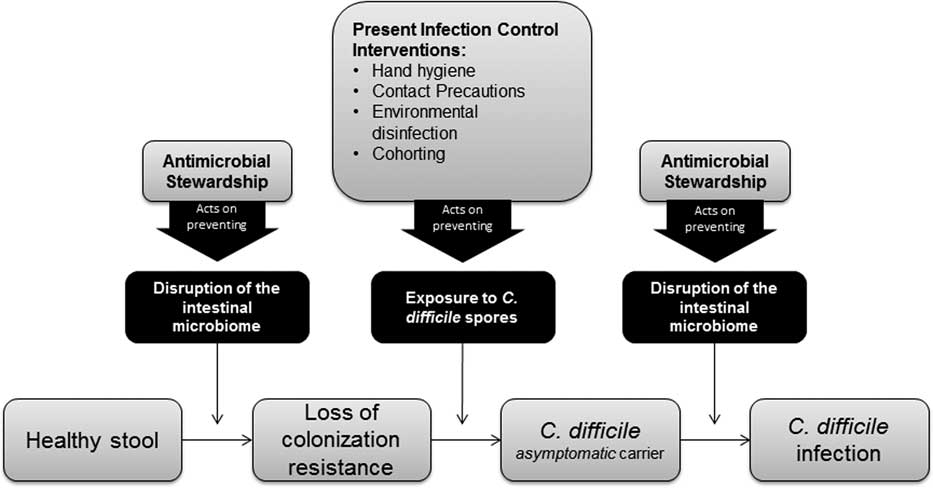
For the past few decades, the infection control field has focused its efforts on limiting exposure to pathogenic organisms by promotion of hand hygiene, implementation of contact precautions, and heightened environmental disinfection (Figure 1). These infection control interventions are aimed at decreasing exposures to C. difficile spores. More recently, great emphasis has been given to antimicrobial stewardship to decrease the selection of resistant organisms and to ameliorate the disruption of the microbiome.Reference Lawes, Lopez-Lozano and Nebot 73 , Reference Dingle, Didelot and Quan 74 However, we still do not have biological markers that reflect the degree of impairment of the microbiota on individual patients.
Present infection control and antimicrobial stewardship interventions aimed at decreasing exposures to spores among patients. A patient admitted to the hospital as a C. difficile asymptomatic carrier will not benefit from infection control interventions. In the future, we should aim at measuring colonization resistance against pathogens directly from the stool and figure out ways to restore it.

The cost of sequencing is decreasing rapidly, and in the future, we might be able to perform microbiome sequencing for all high-risk patients or to measure metabolites as a proxy of microbiome disruptions. We should strive to leverage these new techniques to identify patients at higher risk of becoming colonized after fecal–oral exposures to pathogenic organisms regardless of the setting of exposure (eg, home).
Additionally, we should consider exploring ways to restore colonization resistance in our patients tailored to their individual needs (eg, prebiotics, enteric cocktails) based on their microbiome, metabolomic, or transcriptomic profiles. This would allow us to move our field from preventing CDI (by decreasing exposure to spores) to preventing C. difficile colonization when exposure occurs (by reinstituting colonization resistance or reversing C. difficile colonization). In the meantime, vertical antimicrobial stewardship (ie, reducing exposures to antibiotics and gastric-acid suppressants) should be considered among patients found to be colonized with C. difficile.Reference Revolinski, Wainaina, Graham and Munoz-Price 75
The epidemiology of C. difficile in our inpatient and outpatient populations is complex and still not fully understood. Regardless of the location of acquisition, in the future we might be capable of shifting prevention interventions from avoidance of exposures to identification and active modification of earlier biological steps. These advances will provide infection control and antimicrobial stewardship leaders the opportunity to expand our field and transform our specialty.
ACKNOWLEDGMENTS
Financial support: No financial support was provided relevant to this article.
Potential conflicts of interest: All authors report no conflicts of interest relevant to this article.