1 Aim
In the literature root possibilityFootnote 2 is generally categorized into permission, ability and ‘other’.Footnote 3 The latter category subsumes what is left of root possibility once the clear cases of ability and permission are set aside. Various labels have been used to refer to it: neutral possibility (e.g. Palmer Reference Palmer1990), circumstantial possibility (e.g. Palmer Reference Palmer1990), theoretical possibility (e.g. Coates Reference Coates1983; Leech Reference Leech2004), dynamic possibility (e.g. Huddleston & Pullum et al. Reference Huddleston and Pullum2002), or sometimes just ‘root possibility’ (e.g. Coates Reference Coates1983).
If we take a closer look at existing descriptions of the subclasses of root possibility, it is noticeable that it is rare to find a description which uses a single set of criteria for all subclasses.Footnote 4 For instance, while in the case of ability, it is often pointed out that the possibility is predicated of the subject referent, who or what the modal meaning is predicated of is a question that is not systematically addressed. Similarly, very few attempts have been made to define permission explicitly on the basis of clear criteria. Indeed, permission is not uncommonly defined as referring to situations in which permission is granted or refused (e.g. Coates Reference Coates1983). The reason for this sort of circularity is, of course, that it is intuitively clear what is meant by ‘permission’. However, we would argue that a more explicit definition is needed if we are to arrive at a clear description of the entire set of root possibility meanings in English. There is a tendency to define by example and it is generally impossible to tell what, if anything, apart from the expression of root possibility, any two categories have in common and what exactly distinguishes them.
While ability and permission are reasonably clearly defined categories – even if only intuitively so in the latter case – the same cannot be said of the ‘other’ category, i.e. the category into which all non-ability, non-permission examples are placed by most descriptions of root possibility. As Huddleston & Pullum et al. (Reference Huddleston and Pullum2002: 184) note, this large subsection of root possibility is decidedly heterogeneous in nature. The question arises whether we are justified in treating it as a single category of meaning alongside ability and permission.
In sum, there is a need for a more explicit taxonomy of root possibility that addresses the problem areas identified above. In order to achieve this, three steps are necessary:
1. We need, if possible, to give a more explicit and fine-grained description of the meaning that is not ability and not permission. Can all these instances be subsumed under one and the same denominator or not? I.e. is it sufficient to class all non-ability, non-permission root possibility as a single category?
2. We need to determine what criteria are necessary to define the subclasses of meaning and they need to be formulated as clearly as possible.
3. We need to arrive at more coherent definitions that bring out the similarities and dissimilarities between the different classes. This presupposes the systematic application of the same set of criteria.
We will argue that there are three criteria which are necessary and sufficient to distinguish five subclasses of root possibility meaning. The three criteria are: (a) the scope of the modal meaning, (b) the source of the modality and (c) the notion of potential barrier; the five meanings are: (a) ability, (b) opportunity, (c) permission, (d) general situation possibility (GSP) and (e) situation permissibility.Footnote 5
We will first define the criteria and illustrate them with examples involving can; we will then discuss in more detail the meanings that can be distinguished on the basis of the criteria. It will become clear that the application of a minimal number of clearly defined criteria in a consistent manner enables us to see in what ways our different classes of root possibility differ from each other and what features they share, thus producing a more transparent, explicit and motivated taxonomy of root possibility.
2 Defining criteria
Before we start the discussion, it may be useful to recall the basic distinction between two kinds of modal meaning: epistemic modality (epistemic possibility and epistemic necessity) and non-epistemic or root modality (root possibility and root necessity). In the case of epistemic possibility (You may be wrong; it's possible that your conclusion is based on incorrect data) or epistemic necessity (He must be very tired; he has worked non-stop since 6 a.m. this morning) ‘the speaker asserts that a proposition is possibly or necessarily true, relative to some information or knowledge. If the proposition is only possibly true, the propositional attitude is that of uncertainty; if it is necessarily true, the propositional attitude is that of a high degree of certainty’ (Van der Auwera & Ammann Reference Van Der Auwera and Ammann2008b). Root modality does not express the speaker's judgement on the likelihood of a situation being the case; it merely indicates whether there is possibility (You can find the details on the Internet) or necessity (Seasnakes have to surface to breathe) of actualization or not. As will be pointed out again in section 2.1.5, root modality is concerned with an either/or question (is actualization possible/necessary or not?), while epistemic modality is concerned with a matter of degree (how likely is it that the proposition is true?). In this article, the focus is on root possibility, can, may, could and might being the auxiliaries that can be used to express root possibility meanings.
2.1 Scope of the modal meaning
2.1.1 Definition
A first criterion that we need to define subclasses of root possibility – and one that is largely absent in other taxonomies of modal possibility meaning – is that of ‘scope of the modal meaning’. In the case of possibility, this means ‘what it is that is possible’. Put informally, there is narrow scope if we are concerned with whether something is possible for the subject referent to do, i.e. ‘what is possible’ relates to the VP. There is wide scope if we are concerned with the possibility (or conceivability) of an entire situation, i.e. ‘what is possible’ relates to the clause.
2.1.2 Narrow-scope possibility
The paraphrases of the following examples illustrate the narrow scope of the possibility:
(1) Secondly, and crucially, Professor Griff is no great shakes as a rapper. Sure he can talk pretty quickly, but his somewhat dispassionate delivery affords no comparison with the fury and rage (and, yes, occasional wit and pain) so characteristic of P.E.'s Chuck D. (BNC)Footnote 6
Paraphrase to illustrate scope: {to talk quickly} is possible {for him} (to do) (ability)
(2) Already there are sawmills that cannot operate at full ability because of wood shortages. (BNC)
Paraphrase to illustrate scope: {to operate at full ability} is impossible {for some sawmills} (to do) (opportunity)
(3) So they gave Congress the power of the purse or part of it. Congress can levy taxes, and spend the proceeds unless the president vetoes its plans. The president can draft a budget. But if Congress doesn't approve it, the presidential proposal becomes nothing more than a wish list. (Cobuild)
Paraphrase to illustrate scope: {to draft a budget} is possible {for the president} (to do) (permission)
In these examples, ‘what is possible’ is the action, activity, etc. referred to in the VP. At issue is whether that action etc. is possible for the subject referent. That is, these sorts of root possibility refer to whether or not it is possible for the subject referent to perform the action, carry out the activity, be in the state, etc., referred to in the VP.Footnote 7 They can be paraphrased as ‘to Y is possible for X (to do)’ where ‘X’ represents the subject-referent and Y the situation-type referred to in the VP.Footnote 8 The three types of narrow-scope root possibility that we identify are ability, opportunity and permission (illustrated by (1), (2) and (3) respectively).Footnote 9
2.1.3 Wide-scope possibility
There is wide scope if we are concerned with the possibility (or conceivability) of an entire situation: ‘it is possible for situation Z to actualize/for situation Z to actualize is possible’. Since a situation involves a subject NP and a VP, this can also be represented as ‘X's doing Y is conceivable’ or ‘for X to Y is possible’ (again, where X is the subject referent and Y is the situation type referred to in the VP). It will be noticed from the first of these paraphrases that wide-scope root possibility shares with narrow-scope root possibility the general pattern of paraphrase ‘it is possible for. . . to. . .’.Footnote 10 The difference between the two, of course, is that whereas with narrow-scope root possibility, we are concerned with whether what is referred to in the VP is possible for the subject referent to do, with wide-scope root possibility we are concerned with whether it is possible for the situation as a whole to actualize.Footnote 11 Examples (4) and (5), as the paraphrases make explicit, illustrate the way in which root possibility may concern the possibility of actualization of the whole situation referred to by a clause rather than just concerning whether the situation type referred to in the VP is possible for the subject referent.
(4) Somewhat less obviously, it has been argued that in certain circumstances States can be treated as parties to the Court's exercise of its advisory jurisdiction. (BNC)
Paraphrase to illustrate scope: {States being treated as parties to the Court's exercise of its advisory jurisdiction} is possible (situation permissibility)
(5) While existing muscle cells can grow there is little evidence to suggest that the number of cells can increase. (Cobuild)
Paraphrase to illustrate scope: {the number of cells increasing} is possible (general situation possibility)
We would not want to say that in example (4), being treated as parties to the Court's exercise of its jurisdiction is something that is possible for States to do. Rather, the example says that it is possible for the situation to occur in which States are treated as parties, etc. Similarly, in example (5), the meaning is not that there is little evidence to suggest that increasing is possible for the number of cells to do. The meaning is, rather, that there is little evidence to suggest that it is possible for the situation to occur in which the number of cells increases.
These examples show that not all root possibility is narrow scope. If we ignore the existence of wide-scope root possibility, we cannot accurately describe the meaning of certain root possibility sentences where the modality does not concern whether an action is possible for the subject referent. (Furthermore, as we shall see in the discussion of examples (10) and (11), unless we recognize the existence of wide-scope root possibility, we are at risk of classifying as epistemic certain cases of possibility meaning which are in fact root.)
As may be evident from example (4), the impossibility of analysing all root possibility modals as expressing narrow-scope modality becomes particularly evident when we consider passive clauses. While there is an unexpressed, or even explicit, agentFootnote 12 in such cases, the possibility concerns neither the link between the verb phrase and that agent nor the link between the verb phrase and the subject referent, but the actualization of the whole situation expressed by the clause.
(6) . . . seals, island foxes, elk, deer and over 195 species of birds are some of the many surprises awaiting your discovery as you explore Santa Rosa Island. Your time ashore can be spent on a nature hike (led by a National Park Service ranger), exploring the shoreline, or simply relaxing in the serenity of this distant isle. (Cobuild) (general situation possibility)
(7) Officials and diplomats in Jordan hope that all Bangladeshis currently in the camps can be repatriated within the next two or three days. (Cobuild) (general situation possibility)
In (6) and (7) the passive construction means that the agent is no longer in subject position and as a result the potential link between subject referent and the action referred to in the verb phrase is removed. In (6) the agent is clearly the addressee, but what is possible is the whole situation referred to in the clause. The appropriate paraphrase is something like: ‘(the actualization of) the situation of your time ashore being spent on a nature hike is possible’ – or more plausibly: ‘your time ashore's being spent on a nature hike is one possibility (its being spent exploring the shoreline is another possibility and its being spent simply relaxing is a third possibility)’. In a similar way, in (7) it is the entire situation of all Bangladeshis in the camps being repatriated which is (hoped to be) possible.
The following examples similarly do not allow a reading in which the root possibility concerns the performance of an action by the subject referent.
(8) When the soil dries out, strain is put on the house structure and cracks can appear overnight. (www.theaustralian.news.com.au, accessed 18 November 2009) (general situation possibility)
(9) As a military option it would be counter-productive. There can be little doubt that bombing Serbia would drive thousands more to take up arms. (Cobuild) (general situation possibility)
While the paraphrase ‘appearing is possible for cracks to do’ is compatible with (8), such a paraphrase clearly fails to capture the meaning that is intended. We are here not concerned with what it is that cracks have the power or the opportunity to do. We are concerned with the fact that cracks appearing overnight is a situation which is possible. That is, the use of can here does not evoke a (lack of a) constraint on a subject referent, but refers to whether a situation is possible or not. In (9), clearly the only reading possible is ‘there being much doubt is not possible’, i.e. we have a situational – wide-scope – interpretation of the root possibility conveyed by can in this context.
2.1.4 Scope of modality as a defining criterion in previous research
Scope distinctions have mainly been appealed to in order to distinguish between epistemic modality and root modality. The distinction between wide-scope (epistemic) modal meaning and narrow-scope (root) modal meanings appears to have originated with Ross (Reference Ross and Todd1969). Ross refers to the difference in scope between modals that are one-place predicates, i.e. that take an entire proposition as their complement (e.g. must when it has epistemic meaning: must (John be at home at six o'clock)) and modals that are two-place predicates, i.e. that involve relations between the subject and the rest of the clause (e.g. must when it communicates root meaning: must (John, be at home at six o'clock)) (see, for example, Barbiers Reference Barbiers, Barbiers, Beukema and van der Wurff2002: 2). Bybee (Reference Bybee1985: 166) suggests that markers of obligation, permission, ability, desire and intention – ‘agent-oriented’ modalities – ‘express conditions pertaining to the agent that are in effect with respect to the main predication’, as opposed to markers of ‘mood’, including epistemic modalizers, which ‘have the whole proposition in their scope’. Thus, like Ross, Bybee argues that there is a difference in scope between markers of root modality and epistemic modalizers. However, neither Ross nor Bybee allow for wide-scope root modality.
Bybee, Perkins & Pagliuca (Reference Bybee, Perkins and Pagliuca1994) refer to cases of root possibility in which ‘the hearer is entitled to infer a sense of epistemic possibility along with the literally expressed root possibility sense’ (Reference Bybee, Perkins and Pagliuca1994: 198), but they do not analyse these cases as involving wide-scope root possibility. The existence of wide-scope root necessity is highlighted by Nordlinger & Traugott (Reference Nordlinger and Traugott1997), who argue that the development of ‘wide-scope deontic’ modality as a phase in the evolution of epistemic modal meanings from what they refer to as ‘deontic’ modal meanings has been overlooked. Similarly, Traugott & Dasher (Reference Traugott and Dasher2002: 141) refer to ‘[t]he wide scope associated with general participant-external root/deontic necessity’. We do not know of other authors who explicitly refer to the distinction between narrow-scope and wide-scope root modality, but as shown in the previous sections, we believe it has an important role to play when it comes to distinguishing subclasses of root possibility that are ‘not clearly ability’ and ‘not clearly permission’.Footnote 13
2.1.5 A note on wide-scope root hypothetical could
Nordlinger & Traugott (Reference Nordlinger and Traugott1997) argue for the importance of wide-scope root modality in the evolution of epistemic meanings from root modal meanings on the basis of occurrences with ought to. From a synchronic point of view, recognizing that wide-scope readings exist for root possibility modals in English has two advantages. First, it has been established in sections 2.1.2 and 2.1.3 that taking account of the scope of the modality helps us to define and to separate more clearly those root possibility meanings which are neither ability nor permission and which are sometimes, rather confusingly, lumped together under the term ‘root possibility’. The second advantage of recognizing the existence of wide-scope root possibility is that it enables us to explain why certain examples which express root possibility appear, at first sight, to be epistemic. The type which we have in mind are examples with could that refer to hypothetical situations, such as
(10) We could all be sent to prison if we didn't keep this secret. (general situation possibility)
The fact that examples like this, despite having (wide-scope) root meaning (i.e. the situation of ‘us being sent to prison’ is theoretically possible), have ‘something epistemic’ about them is connected to the diachronic point made by Nordlinger & Traugott (see section 2.1.4), which suggests that wide-scope root possibility is something of a middle way between narrow-scope root possibility and epistemic possibility. On the one hand, the example in (10) clearly refers to what is theoretically possible and therefore the nature of the modality is root. On the other hand, the sentence shares with epistemic possibility the property of being concerned with the possibility of actualization of a whole situation. In other words, the scope of the modality in (10) is similar to the scope of modality in epistemic sentences. Obviously, while the scope of the modality is the same (clausal scope), the nature of the modality is not: in the case of epistemic possibility the speaker makes a judgement about the degree of likelihood that exists regarding the actualization of a situation (or regarding the truth of a proposition); that is, the speaker locates the actualization (or the truth of the proposition) on a scale of likelihood. In the case of wide-scope root possibility, the concern is with whether the actualization of the situation is theoretically possible or not. This, like narrow-scope root possibility, is an either/or question, not a matter of degree (see above, p. 3).
The ‘middle way’ nature of wide-scope root possibility explains why some examples cannot satisfactorily be analysed as epistemic and yet nevertheless seem somehow ‘epistemic-y’. The fact that the possibility concerns the actualization of a whole situation rings strong epistemic bells, and with good reason. In everyday terms there is often little difference between a claim that it would in theory be possible for a situation to actualize and a claim that it is possible that the situation will actualize.Footnote 14
In example (11), could pay may appear at first sight to be epistemic.
(11) [to] prevent any inheritance tax problems, syndicate members must all agree that any winnings will be distributed by the winning ticketholder among all the members who have contributed to purchasing the tickets . . . Without such an agreement, every syndicate member could pay inheritance tax if their share of the pot is more than £154,000. (Cobuild) (general situation possibility)
However, there is a problem with such an analysis. It seems that could cannot both create a hypothetical world and express epistemic meaning in that hypothetical world. Put differently, the subject NP refers to ‘the syndicate, should such a syndicate exist’; the reference is not to any actual syndicate. Therefore, ‘every syndicate member’ does not refer to any actual syndicate members. This in turn means that the following, epistemic, paraphrase does not make sense: ‘It is possible that every member of the syndicate will pay inheritance tax’; we can only talk of how possible it is that every syndicate member will pay inheritance tax if the syndicate members are presupposed to exist (in some world or another). It is thus impossible to analyse could pay as referring to epistemic possibility.
On the other hand, while an epistemic ‘possible that. . .’ paraphrase is not acceptable, nor is a root ‘possible (for). . .to’ paraphrase, so long as the scope of the possibility is narrow. An example of a narrow-scope root possibility paraphrase is: ‘to pay inheritance tax would be (something that is) possible for each member of the syndicate to do’. This is clearly not the meaning that is intended: the text is not concerned with what it is that is in the power of each syndicate member (whether through internal or external enablement). Rather, the meaning is: ‘every syndicate member's paying inheritance tax is a possible scenario’ or ‘it would be possible for the situation of every syndicate member paying inheritance tax to actualize’.
The following example is similar:
(12) Professor Golding said: There are now two studies with very similar findings, but we have to be absolutely sure before we start changing policy. The ramifications could be enormous. People are now looking at the biological side to see if it is feasible. (Cobuild) (general situation possibility)
An analysis of (12) as expressing epistemic possibility does not work: we cannot say that the meaning is ‘It is possible that the ramifications [of changing policy] will be enormous’, because, as the context makes clear, it has not been established that there will be a change of policy, and thus that there will be any ramifications, about which predictions can be made. Again, could cannot both establish a hypothetical world and express epistemic meaning in that world. Rather, the sentence must be analysed as meaning ‘It would be possible for the situation to arise in which the ramifications of changing policy are enormous.’ That is, the sentence expresses wide-scope root possibility.
2.2 Source
The second question to be answered in distinguishing root possibility meanings concerns the source of the possibility; more precisely, ‘Is the source of the possibility internal to the subject-referent or external to the subject-referent?’ (see, for example, Depraetere & Verhulst Reference Depraetere and Verhulst2007; Van der Auwera & Plungian Reference Van Der Auwera and Plungian1998).Footnote 15 This criterion distinguishes between, on the one hand, ability and, on the other hand, all the other root possibility meanings: it is only in the case of ability that the possibility originates in innate capacities or acquired skills intrinsic to the subject referent.
Source of the possibility is nearly always – implicitly or explicitly – referred to in discussions of ability interpretations (e.g. Coates Reference Coates1983; Declerck Reference Declerck1991; Huddleston & Pullum et al. Reference Huddleston and Pullum2002; Palmer Reference Palmer1990). That is, it is normal to remark that ability meanings involve some power, capacity, etc. internal to the subject-referent, but very rarely is explicit mention made of the source of possibility in other sorts of root possibility. However, if we wish to be clear about what it is that different root possibility interpretations share and what distinguishes them from one another, we need to apply our basic criteria consistently.
We shall, therefore, distinguish between (13) and (14) on the basis of the fact that the former has a subject-internal source and the latter a subject-external source. Below we will call the sort of possibility illustrated in (14) ‘opportunity’.Footnote 16
(13) Cats have good night vision but can't see colour very well. (BNC)
Paraphrase for source: the physical make-up of cats is such that it is not possible for them to see colour very well. (ability)
(14) Here the visitor can wander around without hindrance, as most of the antique area is now a pedestrian zone. (BNC)
Paraphrase for source: the pedestrianization of the area makes it possible for the visitor to wander around without hindrance. (opportunity)
As described in detail in Depraetere & Verhulst (Reference Depraetere and Verhulst2007),Footnote 17 subject-external sources can be of different types. In the case of permission, the source of the possibility (or lack of possibility) may be an authority (see (15)), a rule or set of rules (see (16) and (17)) or circumstances (see (18)).
(15) ‘Eve's fine,’ Benny said. ‘I'm going to see her at lunch time.’
‘Can I come too?’
Benny paused. Eve was often so prickly even when she was in the whole of her health. Would she like seeing this golden college belle at her bedside?
‘I don't know,’ she said at last. (BNC)
paraphrase for source: Benny is the source which makes it possible or impossible for the person who asks the question to come.Footnote 18 (authority) (permission)
(16) Substitute a new Rule 15 as follows: 15. Transfer of Investment. A member may transfer a Permanent Investment and may, subject to the terms of issue and the prior permission of the Society, transfer any other investment, to another person. (Cobuild)
Paraphrase for source: it is the rules of a financial institution that make it possible for a member of the Society to transfer investment.Footnote 19 (rule) (permission)
(17) Only the jumper is allowed to move for the ball with either his inside arm or with two arms. Supporting players in the lineout can only move when the jumper has touched or caught the ball. (BNC)
Paraphrase for source: the rules (of rugby) make it impossible for the players to move other than when the jumper has touched or caught the ball. (rules of a game) (permission)
In (18), it is circumstances, in particular the fact that in the letter of introduction Kawaguchi is referred to as a monk, that make it impossible for us to surmise anything other than that Kawaguchi was already in disguise:
(18) It is unfortunate that he does not tell us just how or under what circumstances this meeting took place, for the outcome was a letter of introduction to a close friend of Jibbahadur's. We can only surmise that Kawaguchi was already in disguise, since it would seem that the letter referred to him as what he would now claim to be for several years: a Chinese monk who had long resided in Lhasa and was presently on his way home. (Cobuild) (permission)
With opportunity meaning, the possibility (or lack of it) is dependent on enabling circumstances, which may be more or less specific and more or less explicit. We follow Depraetere & Verhulst (Reference Depraetere and Verhulst2007) in assuming that circumstances should not only be thought of in terms of a very specific context that is explicitly mentioned; they can also be very broad in the sense of ‘the world as it is’ constituting the factor that makes a situation possible or that makes it possible for a subject to do something: ‘circumstances may be of different types: they may refer to: (i) (one-off) arrangements or particular situations . . . that necessitate the actualization of a particular situation, but they may also relate to (ii) “the nature of things”. The latter label covers (a) the literal interpretation in the sense of the necessities resulting from the “laws of nature” . . ., but also (b) a broader interpretation in the sense of the only logically possible outcome given by the “state of the world”’ (Reference Depraetere and Verhulst2007: 6).
In (19) the circumstance which restricts the opportunity is both specific and explicit: what prevents Guttierez from being in a position to talk is his ‘being at work’.
(19) Mr Guttierez was found at the new factory one recent afternoon in a striped T-shirt and jeans. When asked about his employment practices, he ducked up a flight of stairs.
Guttierez: I can't talk to you right now. I'm working. (Cobuild) (opportunity)
However, the circumstance which provides the opportunity in (20) is not explicitly mentioned: the hearer may be intended to assume something like ‘our organization makes it possible for you to request a fact sheet. . .’, but the meaning may be simply ‘the possibility exists for you to request a fact sheet’, in which case the source of the possibility is not a specific circumstance, but simply ‘the way the world is’.
(20) . . ., in addition to hearing your comments, the Commission will present information to help inform you about the universal service proposal and explain how these changes may affect you. WANT TO LEARN MORE? For more information, you can request a fact sheet about the CPUC's proposal by writing to the address below. If you cannot attend one of the hearings and would like to submit written comments, please write to: The Public Advisor California Public Utilities Commission. (Cobuild) (opportunity)
There are two further types of root possibility in which the source of the possibility is always subject-external. The first is general situation possibility (GSP). In this type of possibility, rather than saying that an action is possible (or not) for a particular entity, the speaker refers to whether or not it is possible for a situation as a whole to actualize; the scope of the modality is wide (see section 2.1.3). Again, the source of the possibility may be more or less explicit and more or less specific:
(21) Even sellers at Sotogrande on the Costa del Sol, an upmarket development with three courses, are accepting reduced offers. There you can get a two-bedroom villa for £80,000 – but check whether golf club membership is included in the package. (Cobuild) (explicit and specific circumstantial source) (general situation possibility)
In this example, the context provides evidence for the origin of the possibility: it is the economic situation of the area in question which makes acquiring a two-bedroom villa for £80,000 possible.
In the next example, the source is specific, but inexplicit: the assumption must be that the origin of the possibility of optical technology being carried out in similar ways to the (maintenance of) wires is something like the nature of the physical, technical and operational system currently in place.
(22) But British Telecom thinks that not only has it beaten the equipment cost barrier, but also that installation and maintenance of optical technology can be carried out in similar ways to wires. They're testing out these convictions in the town of Bishop's Stortford, about 50km North of London. There several different optical systems are being installed, ranging from fibres to single individual telephones in people's homes and cable-TV systems through small business connexions, ten phone lines say, up to direct high-speed high-capacity links for powerful computer systems. (BNC) (implicit and specific circumstantial source) (general situation possibility)
The following example shows that, among external circumstances, the state of the world, or ‘what we know about the world’, ‘the way things are’, can also serve as a subject-external source of root possibility:
(23) George belonged to things. He liked to boast that, in central London, he was never more than a couple of hundred yards from some club, institution or association of which he was a member and which could provide, at the very least, a roof in a rainstorm. ‘You can't lose a club, the way you can an umbrella,’ he once told Agnes. She had replied that it still seemed an expensive policy compared with even the dearest of umbrellas, and George had thought about that and said: ‘You can't piss into an umbrella, either. Not without attracting unfavourable comment anyway.’ (implicit and non-specific circumstantial source) (general situation possibility) (BNC)
We can paraphrase (23) along the following lines: ‘given the world as we know it, losing a club is not possible’, or ‘the way the world works causes losing a club to be impossible’.
Finally, the source is also external in wide-scope examples that we will classify as situation permissibility.Footnote 20 In (24), it is something like ‘accepted moral norms’ that make it impossible for television to be a side-activity. The message is: if television is your job, it is not morally acceptable (because of your duty to your medium and to your audience) for it to be treated as something you look at in odd moments, rather than as something you are committed to.
(24) Well, how dare they, how bloody dare they, dismiss and insult their medium and their audience, the people who pay them, with this steaming tripe lite. If television is your job then it can't just be something you catch bits of in hotel suites while you're slipping on the black tie to pick up a personality award in lieu of a personality. (Cobuild) (situation permissibility)
In (25), it is regulations that make it impossible for anyone who does not have a licence to grow a poppy crop. The scope of the modality possibility meaning is wide and the source is external:
(25) A poppy crop can only be grown in Tasmania by a farmer who has a contract with a manufacturing company and a licence from the Tasmanian Government. (www.justice.tas.gov.au/poppy/the_industry/Who_Can_Grow_Poppies, accessed 18 November 2009) (situation permissibility)
In (26), the source is a treaty:
(26) The accord is a pledge by the four countries to adhere to the START treaty signed by the defunct Soviet Union and the United States. The treaty drastically cuts nuclear arsenals, but it does not impose any control on where the missiles can be relocated. (Cobuild) (situation permissibility)
In the next example, the source is a human authority:
(27) The Pope last streamlined the beatification and canonisation process in 1983, when he decreed that martyrs – those killed for their faith – could be beatified without the need for a certifiable miracle. (The Times, 22 December 2004) (situation permissibility)
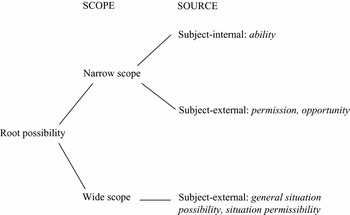
In the tree diagram below (figure 1), we can see that using just the two criteria ‘scope’ and ‘source’, we arrive at three subgroups of possibility meaning.
Scope and source as defining criteria

The first criterion we introduced distinguishes between narrow-scope possibility meaning and wide-scope possibility meaning. This results in a distinction between ability, permission and opportunity, on the one hand, and general situation possibility and situation permissibility, on the other. The criterion of source sets ability apart from the other narrow-scope meanings. In order to distinguish between narrow-scope opportunity and narrow-scope permission and between wide-scope GSP and wide-scope situation permissibility, we need one more criterion, that of potential barrier.
2.3 Potential barrier
In some root possibility interpretations, the source of the possibility (or lack of possibility) owes its status as source to the fact it is capable of imposing a barrier to the subject referent's performing a particular action or to the actualization of the situation. We abbreviate the presence of this property as [+potential barrier] and the lack of it to [-potential barrier]. When there is an understanding that the source of the possibility is capable of imposing a barrier but does not do so, we get a positive permission (or situation permissibility, when the scope is wide) interpretation; when the source is capable of imposing a barrier and does so, we get a lack of permission (or situation permissibility) reading.Footnote 21 However, it should be noted that in both these cases we have the feature [+potential barrier]. That is, to say that the source is understood as having the potential to impose a barrier to action or to actualization of a situation is not to say that the barrier is necessarily imposed.
(28) ‘We do still find they get overfamiliar, but then again I've set out to make them feel that they can take liberties with me,’ she says. ‘And I'd rather they do that than have them terribly nervous and shy.’ (Cobuild) (permission)
Here the speaker is presented as being in a position to block the taking of liberties ([+ potential barrier]), but not imposing that barrier, so the interpretation is ‘permission’. Note that the speaker is seen as the source of the possibility purely by virtue of the fact that the speaker has this potential to impose a barrier to actualization. It is likely that the fact that the speaker has ‘set out to make them feel that they can take liberties with me’ has to some extent enabled ‘them’ (the participants in a ‘dating game’ TV show) to take liberties with her. (For example, she has helped them to feel relaxed with her.) However, it is not by virtue of her enabling role that the speaker is understood to be the source of the possibility expressed by this use of can. It is only because the speaker is understood to have the power to place or to remove a block to the action of taking liberties that she is understood to be the source of the possibility in this instance.
From (3), for example, repeated below, we understand that the rules of the US system of government have the potential to block various actions, and drafting a budget is an action that they could block, but that in fact they do not preclude the president from drafting a budget (they permit the president to do so):
(3) So they gave Congress the power of the purse or part of it. Congress can levy taxes, and spend the proceeds unless the president vetoes its plans. The president can draft a budget. But if Congress doesn't approve it, the presidential proposal becomes nothing more than a wish list. (Cobuild) (permission)
In (18), repeated below, the paraphrase is: ‘circumstances give rise to a barrier to our surmising anything other than that Kawaguchi was already in disguise’. The source is specific circumstances which can (and do) constitute a potential barrier to our surmising anything other than that Kawaguchi was already in disguise:
(18) It is unfortunate that he does not tell us just how or under what circumstances this meeting took place, for the outcome was a letter of introduction to a close friend of Jibbahadur's. We can only surmise that Kawaguchi was already in disguise, since it would seem that the letter referred to him as what he would now claim to be for several years: a Chinese monk who had long resided in Lhasa and was presently on his way home. (Cobuild) (permission)
From (29), we understand that the situation (of any part of the world's being proclaimed a sphere of vital American interests) is possible because those spheres of influence that could potentially block such a situation (various US moral and political structures, say) do not do so. That is, Carter is presented in the Soviet broadcast as claiming that the moral and political context which has influence on his administration has the power to block the proclaiming of any part of the world as a sphere of vital American interests and does not do so. Therefore, the action is possible thanks to being allowed by that moral and political context:
(29) This is apparent from a Soviet broadcast a couple of days after Brezhnev's Delhi speech. The commentator claimed that ‘most British papers agree that the Soviet peace plan deserves due consideration’. He expressed disquiet, however, over strong British government support for the ‘Carter Doctrine under which any part of the world can be proclaimed a sphere of vital American interests’ including ‘the oil-rich Persian Gulf region’. (BNC) (situation permissibility)
It is important to note that the feature ‘potential barrier’ entails that both the placing of the barrier and the not-placing of the barrier are in theory possible for the source. In many cases of root possibility the source blocks an action by the subject or the actualization of some situation. However, it is only when it is in theory possible for the source either to impose a barrier or not to impose it that we have permission or situation permissibility meaning (see section 3.6). This ‘potential barrier’ element of meaning is absent from opportunity and general situation possibility interpretations, which respectively mean simply ‘circumstances make it possible for X to do Y’ and ‘circumstances make the actualization of a situation possible’. In other words, opportunity and general situation possibility are [– potential barrier] interpretations.
Our approach is in line with an idea put forward by Huddleston & Pullum et al. (Reference Huddleston and Pullum2002), who discuss permission in the context of modal auxiliaries and when dealing with the communicative effect of imperative sentences. They write: ‘Giving permission implies the power to withhold permission and hence to impose a barrier to actualization’ (Reference Huddleston and Pullum2002: 183). Within the discussion of modality, only two examples are given in connection with the notion of barrier:
(30) You may help her.
(31) You may have one of these cakes.
Huddleston & Pullum et al. also refer to permission when discussing the communicative effect of the imperative. They argue that ‘giving permission promotes compliance in the rather weak sense of not exercising power to stop it or, to put it more positively, removing a potential obstacle’:
(32) Take as many as you'd like. (Reference Huddleston and Pullum2002: 931)
In other words, in Huddleston & Pullum et al.'s discussion of modality, the idea of barrier is not explicitly linked to that of source. On the basis of their examples, the source of the potential barrier originates with the speaker. In our account, unlike in Huddleston & Pullum et al.’s, ‘barrier’ is explicitly linked to ‘source’ in the (broad) sense in which we have defined it. In addition, we believe that any source, including specific circumstances or ‘the world as it is’, could in theory impose a potential barrier. Most importantly, in our definition of permission and situation permissibility, it is not simply that the source is capable of imposing a barrier to actualization; in addition, the source only qualifies as source by virtue of this capacity.
3 Taxonomy of meanings
3.1 Survey
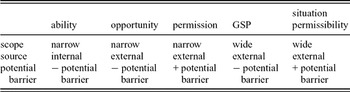
From table 1 it will be evident that with values assigned for each of the three semantic criteria described above – scope of the modality (wide scope or narrow scope), source of the modality (subject-internal or subject-external) and potential barrier ([+ potential barrier] or [− potential barrier]) – we can distinguish between all the interpretations of root possibility that we have identified as basic.Footnote 22
A more explicit taxonomy of root possibility

In sum, as far as English goes, the three criteria, scope, source and potential barrier, enable us to distinguish between five root possibility interpretations: ability, opportunity, permission, general situation possibility (GSP) and situation permissibility. In the next section, we will look at each of these interpretations as they are expressed by clauses involving modal auxiliaries like can, could, may and might. As pointed out at the beginning of the article (footnote 3), we have chosen not to explicitly address the question to what extent it is (the potential of) the lexical semantics of the modals or the context that determines meaning distinctions, since the first step seems to be a description of the meanings. However, it will be clear that a polysemous approach to root meaning with an important input of the linguistic and extra-linguistic context is inherent in the approach we are arguing for.
3.2 Ability
Ability refers to modal possibility utterances in which the source is subject-internal and there is no idea of the source being source by virtue of being in a position to impose a barrier. Furthermore, the scope is narrow:
(33) Manoeuvring his aircraft like a fighter, Noel hurtled through the great cleft in that dark green wilderness. Barbara and I concentrated on filming, but the gravitational forces on some of the turns were such that my arms felt like lead and I could hardly lift the camera. (Cobuild)
It is the physical condition of the subject referent that constitutes the source of the possibility. The (im)possibility of lifting the camera is predicated of the subject referent. The narrow scope of the possibility can be seen from the fact that we can paraphrase this example as: ‘lifting the camera was something that it was hardly possible for me to do’. We cannot paraphrase it as: ‘the situation of my lifting a camera was hardly possible/conceivable’.
The following examples are also typical ability examples, the source in each of these cases being skills acquired by the subject referents:
(34) We have to have the belief that we can beat France. We will be playing in-your-face rugby. We have to pressurise the French. (Cobuild)
(35) Michael is a bit of a pain over games as he wants to join in with everything the others do. Emily catches on very quickly but I don't think she could play chess or whist yet, but there are a lot of games she can manage. (Cobuild)
We also include in the category of ability narrow-scope examples with inanimate subject referents or subject referents that are non-intentional Agents (see footnote 12).
(36) The Minerva stage is 24 feet in width and can seat 283 patrons. (www.cft.org.uk/content.asp?CategoryID=1106, accessed 4 December 2009)
(37) Sometimes during the process of viral replication, mutations occur. If the mutation is harmful, the new virus particle might no longer be functional (infectious). However, because a given virus can generate many, many copies of itself, even if 200,000 particles are no good, 100 might still be just fine. Further, some mutations don't lead to harm to the virus, but instead lead to a functional but now brand-new strain of virus (Influenza virus can do this; consequently, there are several different strains of this virus which have to be identified each year in order to make a vaccine against the particular strain which might cause the flu). (http://people.ku.edu/~jbrown/virus.html, accessed 4 December 2009)
Consider example (36): the possibility of seating 283 patrons is something which is attributed to the Minerva stage. While it may be practically equivalent to assert that it is in theory possible for the situation to arise in which the Minerva stage seats 283 patrons (a case of wide-scope possibility), this is not what the speaker of (36) asserts. The possibility is thus narrow scope. At the same time, the source of this possibility is internal to the Minerva stage itself – it is the physical make-up of the stage which makes the action referred to in the VP possible. Within the framework that we suggest, then, (36) is a case of ability, despite the fact that the subject referent does not – and cannot – intentionally make use of a skill to produce the possibility.
Similarly, in (37), what is at issue is the fact that ‘doing this’ (developing mutations which lead to a brand-new strain of virus) is possible for the subject referent to do. We are therefore dealing with narrow scope. The subject referent is not capable of intentionality, but the source of the possibility lies within the subject referent, and this narrow-scope possibility is thus classifiable as ability.
3.3 Opportunity
Opportunity is the class of root possibility utterances in which the source is subject-external, the scope is narrow and there is no ‘potential barrier’ meaning.Footnote 23 In other words, opportunity is like ability and permission in that the scope of the possibility is narrow; it is unlike ability in that the source is subject-external; but it is clearly not permission.Footnote 24 The circumstances which make the action possible range in generality from the very general (e.g. ‘the way the world is’) to the very specific (e.g. a particular tool). The source may be explicitly referred to but it may also be implicit.
In all of the examples that follow, the scope is narrow and there is no ‘potential barrier’ meaning. The source is subject-external. In (38) (example (2), repeated), the source of the impossibility is explicitly mentioned: it is the wood shortage that makes it impossible for sawmills to operate at full ability.
(38) Already there are sawmills that cannot operate at full ability because of wood shortages.
In (39) and (40), the source is also explicitly mentioned: in (39), the source that makes it possible for the addressee to increase their bargaining power is the specific loan on offer.
(39) As you can see from the comparison table in the enclosed leaflet, our loans are at rates you'll find hard to beat. This could save you hundreds of pounds. Increase your bargaining power as well. Whatever your plans, you could increase your bargaining power by arranging your Direct Line Personal Loan in advance. Knowing you have the funds available gives you all the advantages of a cash buyer and may enable you to negotiate a discount or special price for your purchase. (Cobuild)
In (40), it is the opening hours of the church. There is a subclause of purpose in example (40), ‘so that visitors may enjoy our lovely parish church and visit the bone crypt’. The purpose of keeping the church open is so that visitors have the opportunity to visit it. (40) can be paraphrased: ‘. . . the opening hours mean that enjoying our lovely Parish Church and visiting the Bone Crypt are (things which are) possible for visitors to do’.
(40) Between Easter and September we endeavour to have the Church open from 2–4pm on Sundays so that visitors may enjoy our lovely Parish Church and visit the Bone Crypt. (www.rothwellholytrinity.co.uk/Notices.htm, accessed 3 June 2007)
In (41), the source is the context of the conversation between Ruiz and Marlette, but it is not explicitly named: Ruiz’ behaviour is such that in the context, it is only possible for Marlette to interpret his gesture as one of nervousness.
(41) It was then I discovered the real reason why I'd been abducted. And as I said earlier, it had nothing to do with Bob Kinnard, the girl, or the missing videotape. ‘Go on,’ Marlette prompted. Ruiz rubbed his hands together in a gesture that Marlette could only interpret as being one of nervousness. ‘I didn't hear everything they said, but I got the gist of it.’ (Cobuild)
It is important to add that in none of these examples is the source understood to be the source by virtue of being capable of imposing a barrier to action or actualization. For example, in (38), there is no sense that wood shortages are in a position to impose a barrier to fully efficient operating by the sawmills (and indeed do so). Rather, the wood shortages are simply the cause in themselves of the lack of possibility. In (39) the hypothetical loan (or arranging of the loan) simply in itself results in the possibility of increasing bargaining power. The loan is not seen as capable of blocking such an action (but not doing so). Similarly, in (40), the (arrangement of) opening hours is not, of course, understood as having the capacity (not exercised) to prevent visitors from visiting the church and crypt. It is simply that the nature of the opening hours causes the possibility to exist.
3.4 Permission
Permission refers to modal possibility utterances in which the source is subject-external, the scope is narrow and the source has source status by virtue of the fact that it is capable of imposing a barrier to actualization.
(42) Much preferred for those who are banting is the Chopstick Diet. Eat whatever you like, but with chopsticks. You can drink only water. No cheating and using fingers. (Cobuild)
(43) But, he said, once you had possession of the goods, in this case walking possession, you were entitled to come back and resume that possession and if you were debarred from entering by the act of the debtor, then you could break in to get that which, by definition, was now yours. It was easier to perceive that principle from the cases in which the debtor had actually used force to keep the sheriff out. (Cobuild)
The modality has narrow scope in these examples because in both of them, the possibility is predicated of the subject referent with respect to the situation in the VP:
– In (42): it is possible for you to drink water (not: the actualization of the situation of your drinking water is possible).
– In (43): it was possible for you to break in and get access to your goods (not: the actualization of the situation of your breaking in and getting access to your goods was possible).
The source is external to the subject referent and is constituted by the rules of a diet in (42) and by the law in force in (43). The source actually functions as a barrier in (42) in the sense that the rules of the diet prevent you from drinking anything but water (there is no permission). In (43), the law could in theory prevent you from getting access to your goods; in other words it has potential barrier status, but in this case, it does not impose a barrier: there is permission.
The following example illustrates permission with might, a use restricted to formal contexts:
(44) Mr St John Stevens asked whether he might just take instructions from his client – and was allowed to do so. (www.privy-council.org.uk/files/other/Kurt%20F%20Ebanks.rtf, accessed 22 March 2010)
3.5 General situation possibility (GSP)
In the case of general situation possibility (GSP) and situation permissibility the possibility concerns the existence of a situation and in this way these classes are different from those that have been illustrated so far.Footnote 25 The paraphrase that captures GSP meaning is: ‘for situation Z to actualize is possible/conceivable’.
In (45), it is the Training Trust appeal's structures (source) that make the situation of funds being donated via Access, etc. possible (wide scope):
(45) To support the Training Trust appeal, send a cheque with the coupon on this page . . . Donations can also be made via Access, Visa, American Express or Diners Club on 0483 461000. (Cobuild)
Example (46) is similar. The scope is wide, in that the meaning is not ‘going out and seeing troops. . . is not possible for you to do’ but ‘anyone's going out and seeing troops without seeing them cleaning their rifles is just not possible’ – i.e. ‘the situation of going out and seeing troops that are not cleaning the sand from their rifles isn't conceivable’. The source of the (im)possibility is not clearly specified, but could be something like ‘the sandy conditions in Saudi Arabia’.
(46) And in Saudi Arabia, the problems US forces are encountering with heat and sand. Molly Moore, Washington Post: You can't go out and see troops without seeing them with their toothbrushes cleaning their rifles and cleaning their machine guns. One thing the sand does, it gets inside the weapons and acts as an abrasive. (Cobuild)
The meaning of the example in (47) (example (11), repeated) is that the possibility exists of every member's paying inheritance tax. In other words, the scope is wide. The source is quite clearly the agreement, and it does not have the potential of barring the actualization of the situation.
(47) [to] prevent any inheritance tax problems, syndicate members must all agree that any winnings will be distributed by the winning ticketholder among all the members who have contributed to purchasing the tickets . . . Without such an agreement, every syndicate member could pay inheritance tax if their share of the pot is more than £154,000. (Cobuild)
The example in (48) also communicates GSP. That is, the meaning is ‘the river being crossed was only possible via a ford. . .’. The source of the possibility is the geography of the area. Whilst the geography of the area may actually be seen as being capable of imposing a barrier to the crossing of the river elsewhere than via the ford, this example does not have permission or situation permissibility meaning: it is not by virtue of the capacity to impose a barrier to actualization that the geography is the source of the possibility, it is the source by virtue of what it offers or lacks in terms of enablement.
(48) The responsibilities of Roger of Poitou extended beyond the Bay to what is now Cumbria, and you can see why he chose the site of the Roman fort as the administrative centre of his military command. In the 11th Century, the River Lune could only be crossed by a ford some 300 yards downstream of the present railway bridge. (Cobuild)
May can also express GSP meaning. The fact that may can communicate root possibility meaning is an observation that is made in most accounts focused on the distribution of may and can, with may said to characteristically occur in a more formal register (see, for example, Coates Reference Coates1983: 103; Huddleston & Pullum et al. Reference Huddleston and Pullum2002: 184). However, it needs to be added that our analysis sheds new light on examples in which can and may are interchangeable, in that it highlights the difference between narrow-scope (opportunity) examples with may and wide-scope (GSP or situation permissibility; see below) examples with may. Example (49) may be paraphrased: ‘the situation of accidents happening due to collisions . . . and other circumstances is possible’. The source of this possibility is something like a combination of the way the world is and the way people use boats: ‘collisions with fixed objects or moving vessels are at the source of the possibility of accidents happening’. Note that a narrow-scope reading is not appropriate: the meaning is not that happening is something that it is possible for accidents to do. Nor is a (necessarily wide-scope) epistemic reading appropriate: the speaker is not evaluating the likelihood that accidents will happen at some future time due to these various causes, but simply saying that their happening is conceivable.
(49) Boating accidents involving open motorboats, personal watercrafts (PWCs) or cabin motorboats are commonly reported cases. Accidents may happen due to collisions with fixed objects or moving vessels, capsizing or sinking, fire or explosion, falls or ejection overboard and other circumstances. Often, negligence resulting from operator inattention is the foremost contributing factor in a case of accidents on boats, according to the Boating Accident Report Database (BARD) system. (www.streetdirectory.com/travel_guide/164025/car_accidents/injuries_sustained_from_accidents_on_boats.html, accessed 18 November 2009)Footnote 26
Example (50) can be paraphrased: ‘(even if) the current situation in the world of theatre (source) is such that for a particular play to be seen in a theatre is possible. . .’. Similarly, example (51) roughly means: ‘The situation of its being more organized would perhaps have been possible’ or ‘For it to be more organized would perhaps have been possible’.
(50) Let us admit, by the way, that some plays, whatever the intentions of their authors, are destined to be read more often than they are acted . . . Perhaps too rich in talk to please an audience or too sparse in opportunities for actors to use their bodies, such works nevertheless may lead long, respectable lives on their own, solely as literature. But even if a play may be seen in a theater, sometimes to read it in print may be our way of knowing it as the author wrote it in its entirety. (Cobuild)
(51) and it's a question of she's using her experience to battle through the term – Yeah – Is this proving a real problem for all for you as students – Well it's been less organized than perhaps it might have been – Did you go to it last year – No. (Cobuild)
In all the above examples, (45)–(51), then, we can see that reference is to the possibility of actualization of an entire situation, not to whether an action is possible for the subject referent.
3.6 Situation permissibility
The final meaning is that of situation permissibility: this is similar to GSP in that the scope of the modality is wide, but unlike in the case of GSP, the source has source status by virtue of its potential to impose a barrier to the possibility:
(52) I've been to court, I've got to have proof and I just can't get the proof . . . You know I've never had anyone here other than my family and they can't be involved because they're family, you see. (Cobuild)
The root possibility is wide in scope, since the appropriate paraphrase of the sentence is ‘Their being involved is not possible because they are family’, ‘For them to be involved is not possible’. The source is subject-external: although the source is not specified, we can take it to be the law of the land. The source is seen as capable of imposing (and, indeed, as imposing) a barrier to the actualization of the situation. Furthermore, the source has source status not because it offers or lacks positive features to enable (or disable) the situation, but simply by virtue of its capacity to impose a barrier to actualization.
The following example is similar:
(53) All vehicles rented in Ireland may only be driven in Northern Ireland and the Republic of Ireland. (www.alamo.co.uk/rentalpolicies/740/uk/AUT/, accessed 18 November 2009)
Again, the root possibility is wide in scope: ‘For vehicles rented in Ireland to be driven elsewhere than in Northern Ireland and the Republic of Ireland is not possible’. We are concerned with whether or not a whole situation (the driving of vehicles which have been rented in Ireland outside Northern Ireland or the Republic of Ireland) is possible. There is a subject-external source, i.e. the rental policy regulations. Note that the source of the possibility is the source not simply because it happens to make a situation possible or impossible, but because it is seen as the ‘gatekeeper’ to the actualization of the situation.
Compare (53) with (48): in the latter case, the source of the impossibility of crossing the River Lune other than by a ford 300 yards downstream of the current bridge is the geography of the area. The geography is the source of the (restriction on the) possibility, but it does not owe its existence as source to its having the potential to impose a barrier to the crossing of the river. As we noted in section 2.3, it is only when it is in theory possible for the source either to impose a barrier or not to impose it that we can talk of permission or situation permissibility meaning. Here, we do not have to do with a potential (to block the action) that may or may not be exercised (and in this case is). Rather, we have to do with a simple fact: the geography simply does prevent the crossing of the river.
The following are some further situation permissibility examples with could and may:
(54) I think you would have been a very bitter and unhappy woman being brought up in an all-white household, especially in those days. It isn't like today. Today, I mean, people think it's so easy and they don't know, you're stared at on the street, remarks are thrown at you and you're just ostracized so much. Or you were in those days. You couldn't cross those lines. The only place those lines were ever crossed that I know of is in show business. And it wasn't done. (www.pbs.org/wgbh/pages/frontline/shows/secret/oral/rat08.html, accessed 11 February 2010)
(55) If a hand is shown in the washtub it means the article must be hand-washed. [SYMBOL] The bleach symbol containing the letters CI indicates that the garment may be treated with chlorine bleach. (Cobuild)
Example (54) (spoken by a white mother to the black daughter that she eventually placed in a black foster family) can be paraphrased: ‘(anyone's) crossing the lines wasn't permitted (by society)’. Example (55) is paraphrasable as follows: ‘The garment's being treated with chlorine bleach is possible’. The source of the possibility is the manufacturer's instructions, which are capable of imposing, but do not impose, a barrier to the actualization of the garment being treated with chlorine bleach.
4 Conclusion
The criteria discussed, ‘scope’, ‘source’ and ‘potential barrier’, are necessary and sufficient to define five subcategories of root possibility meaning:
– We can distinguish between, on the one hand ability, opportunity and permission, which are ‘narrow-scope’ modal meanings, and, on the other hand, general situation possibility and situation permissibility, which are ‘wide-scope’ modal meanings.
– The criterion of ‘source’ makes it possible to distinguish between the narrow-scope category ability, on the one hand, and the narrow-scope categories opportunity and permission, on the other hand.
– Finally, ‘potential barrier’ distinguishes between the narrow-scope, subject-external source categories permission and opportunity and between the wide-scope, subject-external source categories situation permissibility and general situation possibility (GSP).
The advantage of this approach, in which systematic use is made of a set of three criteria, is that it brings out very clearly the similarity and the dissimilarity between the different classes of root possibility. It is particularly useful in teasing out the main strands of meaning that make up that region of root possibility meaning that is neither permission nor ability.
We have not been able, for reasons of space, to examine the linguistic correlates of each subclass of meaning, but it will have become clear in the discussion that such correlates exist: as pointed out on p. 5, passive examples are, for example, necessarily wide in scope. The (non-)generic interpretation of the subject pronoun impacts on scope, but it must immediately be added that there is no straightforward equation between generic subject NPs and wide scope, on the one hand, and non-generic subject NPs and narrow scope, on the other. The question of how particular linguistic markers affect the classification will be addressed in further research.
Appendix: additional sets of examples for each of the classes
1. Ability: can, could
(1) Nature decrees that men can conceive children through to old age, giving them plenty of time to get round to fatherhood. But the ideal time for women to procreate is their twenties. (Cobuild)
(2) What can you tell me about Roland La Starza, who challenged Rocky Marciano for the world heavyweight title? (Cobuild)
(3) Faldo, who lost a play-off for the 1988 US Open, is clearly anticipating becoming the first British winner since Tony Jacklin in 1970 and few would argue that he can do it after seeing him negotiate the Killarney lakes with ease. (Cobuild)
(4) . . . you will need a pretty hot PC set-up to enable Aces to fly and fight as smoothly as it should. We are talking of at least a 386 running around 33mhz. But if you have the hardware, this is the game to show what it can do. (Cobuild)
(5) Without the knowledge that the defence is secure, the Scottish midfield and three-quarters cannot have the confidence to take risks. The question marks are: can he pose a consistent attacking threat and should he be working on line-kicking from penalties and free kicks if Chalmers proves not to be the long-term bet for stand-off. (Cobuild)
(6) Tom said: ‘I can store away thousands of facts and figures.’ And a Coca-Cola spokesman said: ‘What Tom can do is truly Olympian in itself.’ (Cobuild)
(7) By midday it was clear that Foreign Minister Dumas wasn't welcome in Baghdad although politicians were still arguing the case for a longer term solution to the Gulf crisis than military conflict could provide. (ICE-GB)
2. Opportunity: can, could, might
(8) This is an indication that perhaps things are loosening up, perhaps Saddam is thinking about bringing his army out now. We're talking to people who have had a country destroyed, and for them anything that means that they can go home is good news. (Cobuild)
(9) As a result of the fault, the only way people can obtain data from the thematic mapper will be via the US. (BNC)
(10) She kissed Leo lightly on the lips. ‘Didn't think you were coming tonight,’ Katherine heard her murmur. ‘I tried to ring you, Claudia. Didn't get you.’
‘Can't stay. I'm meeting Pete.’ Leo held on to her hand. ‘Tomorrow then?’ ‘Maybe, ring me.’ (BNC)
(11) You can find out the balances on your Saver Plus and Current Account simply by using your Saver Plus Card at our Self-Service machines. (BNC)
(12) Could you buy me 5 blank cassettes – TDK AD 90? (ICE-GB)
(13) What you could do though would be for instance to keep the receipts for the children's clothing. (ICE-GB)
(14) But, said Dr Hardling, I think there is hardly more than nothing we can do – Hence the tests. – Yet, with all this lack of knowledge, how could she be sure of an accurate diagnosis? (ICE-GB)
(15) Could you explain in plain English exactly what the Visiting Management is being asked to insure itself against in section j? (ICE-GB)
(16) Could you repeat the question? (ICE-GB)
3. Permission: can, may, could, might
(17) ‘We are here with my best friend. Can she come with us?’ Molly asked. ‘Well, let's see, it's going to be pretty crowded but, I guess so,’ Ben said. (www.kidsonthenet.org.uk/create/archive/bullis/bullis3.htm, accessed 7 February 2010)
(18) Sorry can I interrupt you? (ICE-GB)
(19) 32. My district would like to implement a research-based program to help students stay drug free. May we use grant funds to purchase the program and train teachers in its implementation?
No, funds may not be used to purchase prevention curricula, materials, or training. (www2.ed.gov/programs/drugtesting/faq.html#park, accessed 7 February 2010)
(20) Well let's go on if we may to the other sort of legacy of Harold Wilson's Prime Ministership. (ICE-GB)
(21) Could I show this to him? (ICE-GB)
(22) Make sure it still resonates . . . They're too breathy. And now you lean over that on the high notes . . . Could I do that little high bit a little bit slower? (ICE-GB)
(23) I wonder if I might use your columns to appeal for information concerning a car I have recently acquired. (Cobuild)
4. General situation possibility: can, may, could, might
(24) Alkenes can be prepared by dehydration of the appropriate alcohol, e.g. ethene can be prepared by heating ethanol with twice its volume of concentrated sulphuric acid at 180. (BNC)
(25) Sara's story made sense; it made sense in the context of Alfred's bizarre existence. Matthew Glynn had been strangled by his brother Alfred because. . . Alfred Glynn had killed himself because. . . And Sara's story explained her own ambivalent behaviour. . . Tidy. Convincing. He had no doubt that the case could be wound up on the strength of it. No trial; you can't try a dead man. The facts were accounted for and Sara's evidence at the inquest would clinch it. . . But there were other facts: Inez Glynn had disappeared: but that was seventeen years ago. Maurice Glynn had quarrelled with his brother: obviously a coincidence. There was the unexplained presence of a nineteenth-century journal in Matthew's safe: nothing to do with the case. (BNC)
(26) Still to come on Central News, the fruits of mass production. Can farmers cut spraying and still make a living? (BNC)
(27) Was World War I avoidable?
Answer
I don't think it could have been avoided . . .
Answer
Well the assassination could have been prevented . . .
(http://wiki.answers.com/Q/Was_World_War_1_avoidable, accessed 7 February 2010)
(28) I should've known being me that fate could never be so kind. (ICE-GB)
(29) The U.S. president's word – ‘verifiable’ – has set the 65-nation Conference on Disarmament on a possible course toward negotiating a treaty after years of deadlock, most recently because the Bush administration argued that a pact couldn't be verified by inspections and monitoring. (www.vuw.ac.nz/~caplabtb/dprk/US_world09.htm, accessed 7 February 2010)
(30) Pneumococcal disease is a bacterial infection caused by the bacteria Streptococcus pneumoniae, also called pneumococcus. It may cause middle ear infection, pneumonia, meningitis (inflammation of the coverings of the brain and spinal column) or bacteremia (a bloodstream infection). (www.health.state.ny.us/diseases/communicable/pneumococcal/fact_sheet.htm, accessed 1 December 2009)
(31) Alpine species may only be grown in temperate zones where cold winters, plentiful rainfall, and long summer days are assured. (http://books.google.be, accessed 1 December 2009)
(32) Now in terms of how you measure quality that becomes that's a very interesting issue. But well worth trying to get hold of copies of the model contracts that have been put out so far. Where might you get one of those? (Cobuild)
(33) How Schwann Cells Might Be Altered So That They Might Be Better Candidates For Myelin Transplantation. (www.myelin.org/en/art/90/, accessed 25 January 2010)
(34) It could have gone badly wrong: a larger proportion of our audience (and our peer group) might have considered our interpretation strategy as dumbing-down or a demonstration of the museum's curatorial ignorance. Or our visitors might have become bored and we could have lost that valued connection before the exhibition ended. But in reality, the exhibition format really worked, both for the participating visitors and for the future shape of Worcester City Art Gallery & Museum. (http://museumtwo.blogspot.com/2009/11/guest-post-top-40-countdown-at.html, accessed 2 February 2010)
(35) After a considerable pause Portal said that the matter might be looked into, and that he would discuss it at length with the captain of the flying-boat and go into weather prospects with the meteorological authorities. I left it at that.
Two hours later they both returned, and Portal said that he thought it might be done. The aircraft could certainly accomplish the task under reasonable conditions; . . . (From ‘The Grand Alliance’, vol. 3, Winston Churchill) (http://books.google.nl/books, accessed 2 February 2010)
5. Situation permissibility: can, may, could, might
(36) The period for inter-library lending is 4 weeks and can be prolonged by the library lending the materials on application submitted by the reader through the Library of UITM in Rzeszów before the time-limit for returning the materials is due. (http://portal.wsiz.rzeszow.pl/plik.aspx?id=9102, accessed 25 January 2010)
(37) Here is the new vacation/sick policy as approved by the board last night. There are two changes: There is a higher vacation rate for those employed 10.1 years or more and the policy is now explicitly that one can only take sick leave earned to date. (http://albystaff.pbworks.com/New+Vacation+Sick+Policy, accessed 7 February 2010)
(38) Festival Cities Rovers cover the area between North Berwick, Bathgate, Edinburgh, Glasgow, Stirling, Cardenden., Kirkcaldy, Falkirk and intermediate stations. Tickets may be used on most trains, but are not valid before 0915 Mondays to Fridays; on trains timed to depart Glasgow, Edinburgh or Haymarket between 1625 and 1740 Mondays to Fridays. (Cobuild)
(39) 29. Can our program offer incentives to students who test negative for drugs?
No, grant funds may not be used to provide incentives for students to participate in the drug-testing program. (www2.ed.gov/programs/drugtesting/faq.html#park, accessed 7 February 2010)
(40) Free subjects of Rome could not legally be made slaves. (ICE-GB)
(41) By 1852 the general order describing uniforms says (page 4):
‘The hair of all persons belonging to the Navy, when in actual service, is to be kept short. No part of the beard is to be worn long, and the whiskers shall not descend more than two inches below the top of the ear, – except at sea, in high latitudes, when the Regulation may, for the time, be dispensed with by order of the Commander of a Squadron, or of a vessel acting under separate orders. Mustaches and imperials are not to be worn by officers or men on any pretence whatever.’
Mustaches and imperials had been absolutely prohibited under the regulations but Secretary Dobbin took a more liberal view and said the beard might be worn at the leisure of the individual, but when worn to be clipped short and neatly trimmed.
(www.history.navy.mil/library/online/uniform_personal.htm, accessed 7 February 2010)
(42) Since the first marriage was monogamous in the eyes of English law a charge of bigamy might be brought if the husband later returned to England. (ICE-GB)