


Introduction
Sleep problems (e.g. poor sleep quality, short/long sleep duration, sleepiness, insomnia symptoms, etc.) are increasingly recognised as critical risk factors for older adults' health and wellbeing (Crowley, Reference Crowley2011; Smagula et al., Reference Smagula, Stone, Fabio and Cauley2016; Miner and Kryger, Reference Miner and Kryger2020). As sleep is socially dependent and highly reactive to stress (Irish et al., Reference Irish, Kline, Gunn, Buysse and Hall2015), a growing body of research in Western countries has shown that stressful life events (SLEs) are significantly associated with sleep problems. The existing literature usually focuses on one or two stressors (e.g. death of loved ones and discrimination) (Bierman et al., Reference Bierman, Lee and Schieman2018; Lancel et al., Reference Lancel, Stroebe and Eisma2020). Indeed, due to life transitions, older adults are particularly vulnerable to experiencing multiple SLEs simultaneously, such as bereavement, retirement from work, serious health problems and financial strain (Schwarzer and Schulz, Reference Schwarzer, Schulz, Nezu, Nezu and Geller2002; Leggett et al., Reference Leggett, Burgard and Zivin2016; Chukwuorji et al., Reference Chukwuorji, Nwoke and Ebere2017). As such, there is a continued need to investigate how accumulative SLEs are associated with older adults' sleep, especially in non-Western settings like China. Compared to their Western counterparts, older Chinese adults may be more vulnerable to the detrimental health effects of SLEs, because of the underdeveloped pension, medical care and formal social support systems (Chen and Liu, Reference Chen, Liu and Uhlenberg2009; Du, Reference Du2013).
Moreover, given that many SLEs are hard to prevent or inevitable in old age, it is especially meaningful to identify mechanisms that influence the process by which stressful conditions are translated into subsequent sleep problems. Among this line of research, studies mainly focused on interpersonal factors such as social support from diverse social networks and older adults' (or the lack of) social involvement (Chukwuorji et al., Reference Chukwuorji, Nwoke and Ebere2017; Bierman et al., Reference Bierman, Lee and Schieman2018; Liang et al., Reference Liang, Aranda and Lloyd2020). Yet, the extent to which older adults' intrapersonal factors may play in the stress–sleep linkage still lacks empirical clarity. The present study focuses specifically on attitudes towards ageing as an intrapersonal factor that may impact sleep quality during later adulthood. Ageing attitudes is the way individuals think about their ageing process and perceive age-related changes (Levy et al., Reference Levy, Slade and Kasl2002), which can be divided into two independent constructs: positive and negative ageing attitudes (Turner et al., Reference Turner, Hooker and Geldhof2021). A substantial literature demonstrates that positive ageing attitudes have protective effects on health and longevity; in contrast, negative ageing attitudes can lead to health deficits (Levy et al., Reference Levy, Slade and Kasl2002; Bryant et al., Reference Bryant, Bei, Gilson, Komiti, Jackson and Judd2012; Diehl et al., Reference Diehl, Wahl, Barrett, Brothers, Miche, Montepare, Westerhof and Wurm2014; Westerhof et al., Reference Westerhof, Miche, Brothers, Barrett, Diehl, Montepare, Wahl and Wurm2014; Wurm et al., Reference Wurm, Diehl, Kornadt, Westerhof and Wahl2017; Liu et al., Reference Liu, Guo and Fengin press). Nonetheless, sleep has received little attention as an outcome in the research area, and to our knowledge, no study has explored the role of ageing attitudes in the SLEs–sleep quality linkage.
Drawing on data from the China Longitudinal Ageing Social Survey (CLASS), we aim to explore the interplay between SLEs, ageing attitudes and subjectively rated sleep quality among older Chinese adults. In China, a recent meta-analysis found that over one-third (36%) of older Chinese adults experience sleep disturbances (measured by the Pittsburgh Sleep Quality Assessment) (Lu et al., Reference Lu, Wang, Rao, Zhang, Ungvari, Ng, Kou, Jia and Xiang2019). Another population-based study indicates that 27 per cent of older adults in China experienced at least one SLE in the past 12 months (Z Wang et al., Reference Wang, Yang, Zheng, Liu, Guo, Geng and Hong2020). In light of the high prevalence of both sleep problems and SLEs, investigating whether and how the SLEs are associated with subjectively rated sleep quality in older Chinese adults is of timely importance. Specifically, we address the following research questions:
(1) Do SLEs have accumulative adverse effects on subjectively rated sleep quality?
(2) Do positive and negative ageing attitudes have independent effects on subjectively rated sleep quality?
(3) Do positive and negative ageing attitudes mediate the relationship between SLEs and subjectively rated sleep quality?
(4) Do positive and negative ageing attitudes moderate the relationship between SLEs and subjectively rated sleep quality?
This study contributes to the literature in two key ways. First, we focus on older adults' sleep quality, a potentially significant but understudied health outcome of SLEs. Understanding how cumulatively stressful experiences are associated with sleep quality is essential for effective and targeted interventions and, in turn, improve the overall health of the ageing population. Second, this study provides important insights into the psychological mechanisms (i.e. positive and negative ageing attitudes) behind the link between SLEs and sleep quality in later life. Identifying the psychological mechanisms of the SLEs–sleep association can provide opportunities for novel non-pharmacological ways to promote sleep among older adults in China and other low- and middle-income countries (LMICs), where the medical resources and formal social support are still underdeveloped.
Literature review
Stressful life events and sleep
From the sleep health perspective, Sleep health is not simply the absence of sleep disorders. Instead, it is a multi-dimensional pattern and co-ordinated changes to promote physical and mental wellbeing (Buysse, Reference Buysse2014). Sleep health can be measured by multiple indicators, such as adequate duration, appropriate timing, high efficiency, subjective satisfaction and sustained alertness during waking hours (Buysse, Reference Buysse2014). Among various sleep measures, the subjective reporting of sleep could provide reliable estimates of sleep quality, restfulness and sufficiency (Kutner et al., Reference Kutner, Bliwise and Zhang2004). This study focuses on subjectively rated sleep quality and explores the association between SLEs and subjectively rated sleep quality among older adults in China. The stress process model (Pearlin and Bierman, Reference Pearlin, Bierman, Aneshensel, Phelan and Bierman2013) provides helpful insights for understanding how SLEs affect individuals' wellbeing. According to the stress process model, SLEs are primary stressors during the lifetime and have detrimental consequences on health and wellbeing (Schwarzer and Schulz, Reference Schwarzer, Schulz, Nezu, Nezu and Geller2002). The cumulative exposure to SLEs in a given period, which is called ‘cumulative stress burden’, may have particularly adverse effects on health (Thoits, Reference Thoits2010). In terms of sleep, stressors can lead to acute or chronic physiological responses (e.g. elevated cortisol levels, metabolic activation and increased hypothalamus–pituitary–adrenal axis) and psychological responses (e.g. anxiousness, vigilance), as well as cognitive arousal (e.g. worry), which in turn result in sleep problems (e.g. sleep deprivation and sleep disturbances) (Kahn et al., Reference Kahn, Sheppes and Sadeh2013; Levenson et al., Reference Levenson, Nusslock and Frank2013). As such, SLEs are likely to have additive adverse effects on older adults' sleep.
So far, empirical research has found the detrimental effects of typical stressful life experiences, such as losing loved ones, on individuals' sleep (e.g. poor sleep quality, shorter sleep duration and sleep disturbance). For example, a recent review of 85 papers, mainly in Western countries, finds that bereavement is adversely associated with a set of sleep problems (Lancel et al., Reference Lancel, Stroebe and Eisma2020). Aside from bereavement, a few studies in Western countries indicate that some other SLEs, such as the severe illness of significant others and financial difficulties, also have detrimental effects on sleep among the general population as well as older adults (Vahtera et al., Reference Vahtera, Kivimäki, Hublin, Korkeila, Suominen, Paunio and Koskenvuo2007; Leggett et al., Reference Leggett, Burgard and Zivin2016; Bierman, Reference Bierman2021). In addition, one study among midlife women in the United States of America (USA) reveals the cumulative adverse effects of SLEs on sleep disturbance, with the impacts increasing as stressors multiply (Hall et al., Reference Hall, Casement, Troxel, Matthews, Bromberger, Kravitz, Krafty and Buysse2015).
Ageing attitudes and sleep
Scholars increasingly recognise that ageing attitudes can be both positive and negative (Levy, Reference Levy2009), which are two separate constructs that have distinct impacts on health and wellbeing in later life (Hooker et al., Reference Hooker, Mejía, Phibbs, Tan and Stevens2019; Turner et al., Reference Turner, Hooker and Geldhof2021). Positive ageing attitudes refer to individuals' positive feelings and experiences of old age and can be considered an adaptive cognitive strategy (Laidlaw et al., Reference Laidlaw, Power and Schmidt2007). In contrast, negative ageing attitudes reflect the negative feelings and experiences of ageing (Levy, Reference Levy2003). A substantial literature finds the protective effects of positive ageing attitudes and, conversely, the detrimental impacts of negative ageing attitudes on various physical and mental health outcomes (for reviews, see Westerhof et al., Reference Westerhof, Miche, Brothers, Barrett, Diehl, Montepare, Wahl and Wurm2014; Wurm et al., Reference Wurm, Diehl, Kornadt, Westerhof and Wahl2017). Moreover, longitudinal research demonstrates that ageing attitudes have greater impacts on health than vice versa (Wurm et al., Reference Wurm, Tesch-Römer and Tomasik2007). Despite rich research in the field, there is scant evidence on the ageing attitudes–sleep association.
While direct research is limited, previous studies have provided some evidence that ageing attitudes can significantly affect sleep quality during later life. On the one hand, individuals with positive ageing attitudes are inclined to engage in task-oriented coping strategies and perform health-promotion behaviours, such as controlling smoking and alcohol consumption, exercising and eating a balanced diet (Levy and Myers, Reference Levy and Myers2004; Westerhof et al., Reference Westerhof, Miche, Brothers, Barrett, Diehl, Montepare, Wahl and Wurm2014), all of which can contribute to better sleep quality (Smagula et al., Reference Smagula, Stone, Fabio and Cauley2016; Miner and Kryger, Reference Miner and Kryger2020). On the other hand, negative ageing attitudes can harm sleep through multiple pathways that range from psychological impairments to physiological dysfunction. It is well documented that negative ageing attitudes are associated with higher levels of depression (Han and Richardson, Reference Han and Richardson2015; Liu et al., Reference Liu, Guo and Fengin press) and loneliness (Chen et al., Reference Chen, Guo and Perez2021), and more physical illness (Wurm et al., Reference Wurm, Tesch-Römer and Tomasik2007), which are all known risk factors for older adults' sleep (Crowley, Reference Crowley2011; Smagula et al., Reference Smagula, Stone, Fabio and Cauley2016; Zhang et al., Reference Zhang, Lin, Chen and Li2022). Furthermore, a trivial volume of studies in the USA and Taiwan directly examine negative ageing attitudes' association with late-life sleep and find evidence to support an inverse association (Lin, Reference Lin2016; Stephan et al., Reference Stephan, Sutin, Bayard and Terracciano2017). Yet, whether positive and/or negative ageing attitudes affect sleep quality among older adults in China is still understudied. Such exploration is needed to provide an opportunity to understand whether modifiable psychological factors can improve older adults' sleep in China as well as other LMICs, and help enlighten future intervention efforts.
Ageing attitudes as mediators and moderators in the SLEs–sleep association
Despite direct influence, ageing attitudes could be possible mediating mechanisms linking SLEs to sleep. According to stereotype embodiment theory (Levy, Reference Levy2009), ageing attitudes are the result of individuals' responses to internal or external stimuli regarding the ageing process and grow more self-relevant with increased age. Older adults who experienced SLEs are more likely to internalise negative perceptions about the ageing process (e.g. old age is a time of loss and feelings of exclusion), resulting in higher levels of negative ageing attitudes (Hooker et al., Reference Hooker, Mejía, Phibbs, Tan and Stevens2019; Bordone et al., Reference Bordone, Arpino and Rosina2020; Li et al., Reference Li, Chan, Chen and Ran2022). Similarly, experiencing SLEs may also lead to lower levels of positive attitudes towards ageing. Meanwhile, a separate body of research identifies that positive and negative ageing attitudes can have protective and detrimental effects on older adults' health, respectively, including sleep (Lin, Reference Lin2016; Stephan et al., Reference Stephan, Sutin, Bayard and Terracciano2017). In combination, these findings suggest that ageing attitudes may be among psychosocial pathways linking SLEs and sleep quality in later life. Regarding empirical evidence, although there is little research on sleep quality, prior studies have found the mediating effects of ageing attitudes on the association between SLEs (e.g. death of a spouse, discrimination) and depressive symptoms (Han and Richardson, Reference Han and Richardson2015; Li et al., Reference Li, Chan, Chen and Ran2022).
Aside from mediating effects, ageing attitudes may also play moderating roles in the association between SLEs and sleep quality. The stress-buffering perspective posits that resources could weaken the influences of stressors on health, a process known as ‘buffering’ (Pearlin and Bierman, Reference Pearlin, Bierman, Aneshensel, Phelan and Bierman2013). SLEs may not necessarily lead to poorer health if individuals have sufficient compensatory resources (Schwarzer and Schulz, Reference Schwarzer, Schulz, Nezu, Nezu and Geller2002). Positive ageing attitudes may act as psychosocial coping resources to protect individuals from adverse reactions to stressful situations (Bellingtier and Neupert, Reference Bellingtier and Neupert2018). Indeed, positive ageing attitudes are considered psychosocial resources to protect against stressors on health outcomes, such as negative affect (Bellingtier and Neupert, Reference Bellingtier and Neupert2018) and cognitive interference (O'Brien et al., Reference O'Brien, Torres and Neupert2021). On the contrary, negative ageing attitudes may aggravate the detrimental impact of SLEs on sleep. Negative ageing attitudes can act as a stress-diathesis, which may increase emotional reactivity and generate a heightened response to stress (Levy, Reference Levy2003). These factors, in turn, may lead to higher odds of poorer sleep quality. Mounting evidence shows that negative ageing attitudes strengthen the harmful effects of stressors on older adults' health, including emotional reactivity and depressive symptoms (Bellingtier and Neupert, Reference Bellingtier and Neupert2018; Han, Reference Han2018; Li et al., Reference Li, Chan, Chen and Ran2022).
Research hypotheses
In summary, guided by the stress process model, stereotype embodiment theory as well as previous empirical findings, we test the following hypotheses:
• Hypothesis 1: SLEs have adverse effects on older adults' subjectively rated sleep quality.
• Hypothesis 2: Positive ageing attitudes are associated with better subjectively rated sleep quality, whereas negative ageing attitudes are associated with poorer subjectively rated sleep quality.
• Hypothesis 3: Positive ageing attitudes and negative ageing attitudes have mediating effects on the association between SLEs and subjectively rated sleep quality.
• Hypothesis 4: Positive ageing attitudes and negative ageing attitudes have moderating effects on the association between SLEs and subjectively rated sleep quality.
Method
Sample
Data for this study were drawn from the 2014 CLASS, a nationally representative survey about older adults aged 60 and above conducted by the Renmin University of China. The CLASS used a multi-stage stratified sampling strategy, with counties as primary sampling units and rural villages or urban communities in each county randomly drawn as secondary sampling units. The CLASS covered 134 counties, 462 rural villages or urban communities across 28 provinces (autonomous regions/municipalities). Households in each village or community unit were randomly selected using a mapping sampling method, and one older adult was selected from each household for a face-to-face interview (for details about the sampling design and data collection procedures, see http://class.ruc.edu.cn). As far as we know, compared with other nationally representative data among older adults in China (e.g. China Longitudinal Healthy Longevity Survey; China Health and Retirement Longitudinal Study), the CLASS has the unique advantage that it contains the measures of positive and negative attitudes towards ageing. Because the measurement of ageing attitudes was only available in 2014, the 2014 baseline data were used in the current study. The 2014 data included 11,511 older adults aged 60 and older. We excluded respondents who failed to provide at least three correct answers to cognition-related questions as they were assumed to be cognitively impaired and unsuitable to answer self-reported questions (N = 2,604, 22.6%) and those with missing values for subjectively rated sleep quality (N = 361, 3.1%). We also deleted observations with missing values on other analytical variables (N = 766, 6.7%), resulting in a final sample of 7,780.
Measures
Subjectively rated sleep quality
Subjectively rated sleep quality was measured by the item: ‘Did you find it hard to sleep well during the last week?’, which was an item used in the Center for Epidemiologic Studies Depression Scale (Radloff, Reference Radloff1977). Response categories include ‘no’, ‘sometimes’ and ‘always’. Following prior research among Chinese older adults (H Wang et al., Reference Wang, Kim, Burr and Wu2020; Zhang et al., Reference Zhang, Lin, Chen and Li2022), a binary variable was created by combining ‘no’ or ‘sometimes’ to indicate good quality of sleep as opposed to ‘always’ to indicate poor subjectively rated sleep quality.
Stressful life events
SLEs were measured by asking whether the respondents experienced the following events during the past 12 months: natural disaster, life-threatening illness, family members having a life-threatening illness, death of a spouse, death of a child, death of other family members, financial loss and accident. Preliminary analyses indicated that each SLE was significantly adversely correlated with sleep quality. A cumulative score was constructed and further categorised as follows: 0 = not exposed to any SLE (reference category), 1 = exposed to one SLE or 2 = exposed to two or more SLEs.Footnote 1
Ageing attitudes
Ageing attitudes were measured using seven items from the Attitudes to Ageing Questionnaire (Laidlaw et al., Reference Laidlaw, Power and Schmidt2007). The scale measured two dimensions of ageing attitudes: positive and negative ageing attitudes. Following previous studies (Chen et al., Reference Chen, Guo and Perez2021; Li et al., Reference Li, Chan, Chen and Ran2022; Liu et al., Reference Liu, Guo and Fengin press), positive ageing attitudes were measured by the following three items: ‘As people get older, they are better able to cope with life’, ‘Wisdom grows with age’ and ‘There are many pleasant things about getting older’. The remaining four items were used to assess negative ageing attitudes: ‘I feel old’, ‘I see old age mainly as a time of loss’, ‘As I get old, I find it more difficult to make new friends’ and ‘I feel excluded because of my age’. Responses were assessed on a five-point scale ranging from 0 (totally disagree) to 4 (totally agree). These scores were summed to create two continuous scores of positive ageing attitudes (range = 0–12; Cronbach's alpha = 0.60) and negative ageing attitudes (range = 0–16; Cronbach's alpha = 0.68).
Control variables
Based on previous studies investigating factors related to sleep outcomes among older adults in China (Gu et al., Reference Gu, Sautter, Pipkin and Zeng2010; H Wang et al., Reference Wang, Kim, Burr and Wu2020; Zhang et al., Reference Zhang, Lin, Chen and Li2022), we included older adults' socio-demographic characteristics, socio-economic status (SES) and health status as control variables. Socio-demographic characteristics included age (in years), gender, marital status, rural/urban residence, living arrangements and the number of children (range = 0–12). SES controls included education and annual personal income (log-transformed). The health status control variables were measured by functional limitations and chronic diseases. Functional limitations were an indicator by summing the number of limitations in activities of daily living (ADLs; six items to measure whether the respondent has difficulty doing the following: dressing, bathing, eating, toileting, going to bed and walking; 0 = on my own, 1 = with help, 2 = unable) (Katz et al., Reference Katz, Ford, Moskowitz, Jackson and Jaffe1963) and limitations in instrumental activities of daily living (IADLs; nine items to measure whether the respondent has difficulty doing the following: making a phone call, climbing one flight of stairs, walking outdoors, taking public transportation, shopping, managing money, lifting a five-kilogram bag of rice, preparing meals and doing housework; 0 = on my own, 1 = with help, 2 = unable) (Lawton and Brody, Reference Lawton and Brody1969), with higher final sum scores representing higher levels of functional limitations (range = 0–30; Cronbach's alpha = 0.88). Chronic diseases were measured by respondents' report of whether they have been diagnosed with the following diseases, including hypertension, diabetes, heart disease, stroke, cataracts or glaucoma, cancer or malignant tumour, bronchitis or other respiratory ailment, arthritis, rheumatism, stomach ailment such as ulcer, osteoporosis, liver or gall bladder disease, kidney disease, memory-related disease (such as dementia and Parkinson's disease), cervical or lumbar spondylosis, and nervous system diseases. We summed up all the self-reported diagnoses of chronic diseases (range = 0–16). The chronic diseases measure has been validated for studies of older adults in China (Zhang et al., Reference Zhang, Lin, Chen and Li2022; Liu et al., Reference Liu, Guo and Fengin press).
Analytic strategy
We first provided descriptive statistics for the total sample and subsamples by subjectively rated sleep quality. Next, given the binary nature of the dependent variable, we used logistic regression models to examine the associations among SLEs, ageing attitudes and older adults' sleep quality. All models controlled socio-demographic characteristics, SES and health status. The analysis proceeded in three steps. The first set of regression analyses included three analytic models to examine the main effects of SLEs and ageing attitudes on sleep quality. Specifically, Model 1 examined the association between SLEs and sleep quality. Models 2 and 3 tested the effects of positive and negative ageing attitudes on sleep quality, respectively.
The second set of analyses investigated the potential mediating roles of positive and negative ageing attitudes on the relationship between SLEs and sleep quality. In order to examine whether the association between SLEs and sleep quality attenuates with ageing attitudes variables added, we included SLEs and positive ageing attitudes in Model 4. Similarly, we included SLEs and negative ageing attitudes in Model 5. We also performed formal mediation analyses using the Karlson–Holm–Breen (KHB) method to examine the extent to which positive and negative ageing attitudes account for the association between SLEs and sleep quality. The KHB method decomposes the total effect into direct and indirect effects and allows for calculating the mediated percentage (Karlson et al., Reference Karlson, Holm and Breen2012; Breen et al., Reference Breen, Karlson and Holm2013).
Finally, to test the potential moderating effects of positive and negative ageing attitudes, we added interaction terms between SLEs and positive/negative ageing attitudes in Models 6 and 7, respectively. We examined variance inflation factors (VIF) for each regression coefficient to test the potential for multicollinearity, and throughout the analyses, all VIFs were below 2.
Results
Table 1 presents descriptive statistics for the total sample and subsamples by subjectively rated sleep quality. In the total sample, more than one-fifth (22%) of respondents reported that they experienced one SLE during the past year, and 5 per cent of respondents experienced two or more SLEs. As for subsample characteristics, those who had poor sleep quality were more likely to experience one or more SLEs than those who did not (36% versus 25%). Regarding attitudes towards ageing, those who reported poor sleep quality had significantly lower positive ageing attitudes (4.59 versus 5.28) and higher negative ageing attitudes (9.71 versus 8.48) than those with good sleep quality. In addition, the likelihood of having poor sleep quality was higher among older adults who were women, illiterate, had lower levels of income, rural residence, solo-living and had a larger number of children, as well as those who had more functional limitations and a higher number of chronic diseases.
Descriptive statistics of analytic variables by subjectively rated sleep quality, China Longitudinal Ageing Social Survey, 2014
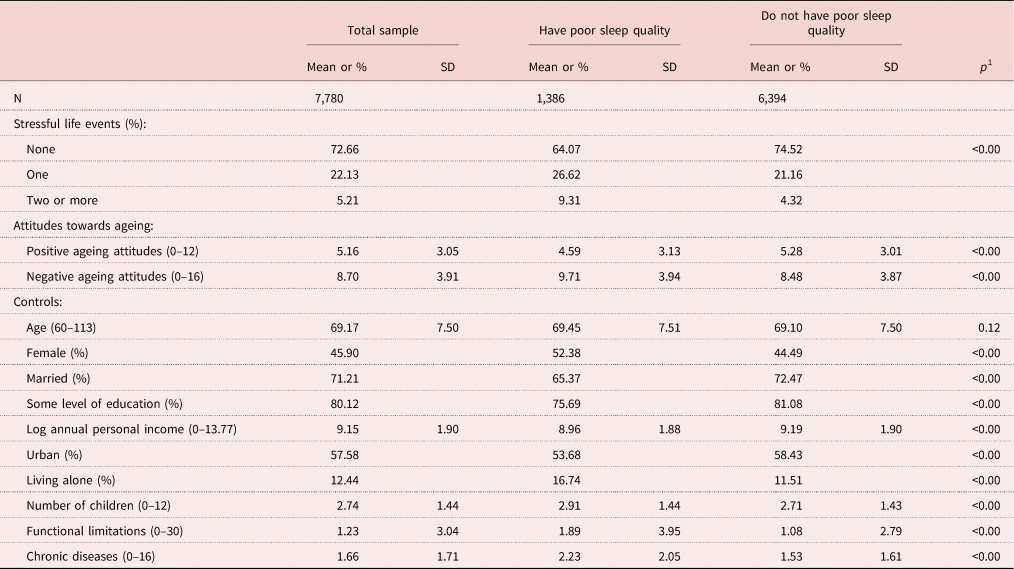
Notes: Values for categorical variables are percentages; mean values with standard deviations (SD) are presented for all other variables. 1. Significance tests of differences between older adults who have poor sleep quality and those who do not have poor sleep quality using chi-square test or t-test.
Next, we used logistic regression modelsFootnote 2 to examine the associations among SLEs, ageing attitudes and subjectively rated sleep quality in Table 2. Results in Model 1 indicated that SLEs were significantly related to higher odds of poor sleep quality. Specifically, compared to those who did not experience any SLE, those who experienced one SLE were 22 per cent more likely to report poor sleep quality (odds ratio (OR) = 1.22, 95% confidence interval (CI) = 1.06–1.40, p = 0.006), and those who experienced two or more SLEs were 76 per cent more likely to report poor sleep quality (OR = 1.76, 95% CI = 1.39–2.24, p = 0.000). These results suggested that SLEs had cumulative adverse effects on older adults' sleep quality. Then, we examined the associations between positive and negative ageing attitudes and sleep quality, respectively. As shown in Models 2 and 3, holding control variables constant, positive ageing attitudes (OR = 0.95, 95% CI = 0.93–0.97, p = 0.000) were significantly related to a lower risk of poor sleep quality. In contrast, negative ageing attitudes (OR = 1.05, 95% CI = 1.03–1.07, p = 0.000) were linked to a higher risk of experiencing poor sleep quality.
Logistic regressions estimating associations between stressful life events (SLEs), ageing attitudes and subjectively rated sleep quality, China Longitudinal Ageing Social Survey, 2014
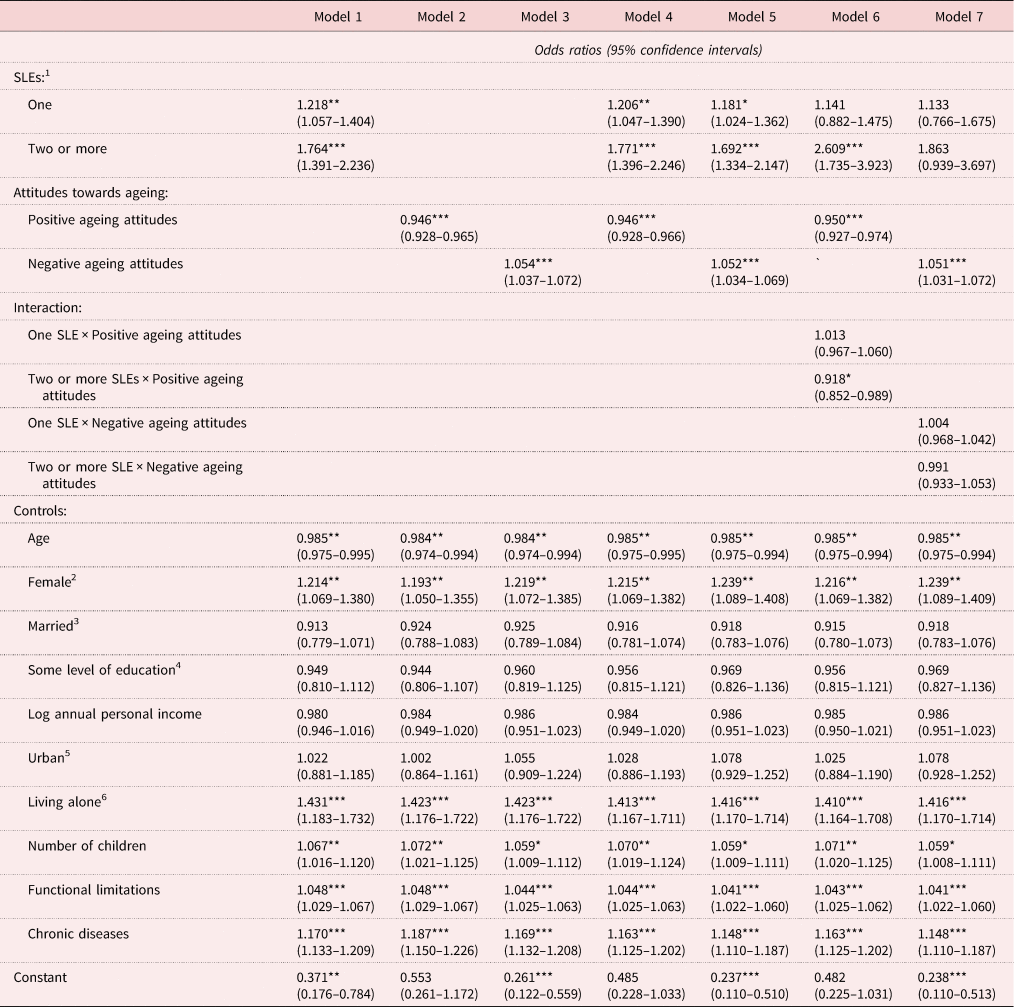
Notes: N = 7,780. 1. 0 = not exposed to any SLE, 1 = exposed to one SLE, 2 = exposed to two or more SLEs. 2. 0 = male, 1 = female. 3. 0 = not married, 1 = married. 4. 0 = illiterate, 1 = some level of education. 5. 0 = rural, 1 = urban. 6. 0 = living with others, 1 = living alone.
Significance levels: * p < 0.05, ** p < 0.01, *** p < 0.001 (two-tailed test).
Regarding the linkage between control variables and subjectively rated sleep quality, results were largely consistent across models. The results in Model 1 indicated that age was significantly related to a lower risk of poor sleep quality. As expected, older women, living alone, a larger number of children, higher functional limitations and more chronic diseases were associated with higher odds of poor sleep quality.
Models 4 and 5 were used to test the potential mediating effects of ageing attitudes on the association between SLEs and subjectively rated sleep quality. Model 4 showed that adjusting for positive ageing attitudes barely changed the estimated coefficient of SLEs in Model 1. However, the results in Model 5 suggested that controlling for negative ageing attitudes, the magnitude of the coefficients of SLEs became attenuated but remained statistically significant compared to Model 1. Because for nonlinear probability models such as logistic regression models, coefficients can differ between reduced and full models both due to mediation and rescaling, we cannot directly compare coefficients across nested models (Breen et al., Reference Breen, Karlson and Holm2013). We conducted formal KHB tests to examine the mediating effects of positive and negative ageing attitudes in Table 3.
Karlson–Holm–Breen mediation analyses results of positive and negative ageing attitudes, China Longitudinal Ageing Social Survey, 2014
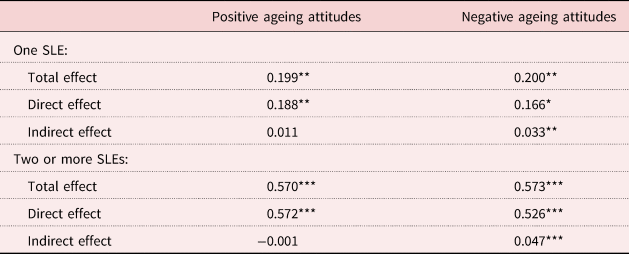
Notes: N = 7,780. SLEs: stressful life events.
Significance levels: * p < 0.05, ** p < 0.01, *** p < 0.001 (two-tailed test).
The results in Table 3 indicated that negative ageing attitudes mediated a significant share of the relationship between SLEs and sleep quality. More specifically, negative ageing attitudes explained 16.5 per cent (0.033/0.200) of the association between one SLE and poor sleep quality, and 8.2 per cent (0.047/0.573) of the association between two or more SLEs and poor sleep quality. Nevertheless, positive ageing attitudes did not significantly mediate the link between SLEs and sleep quality.
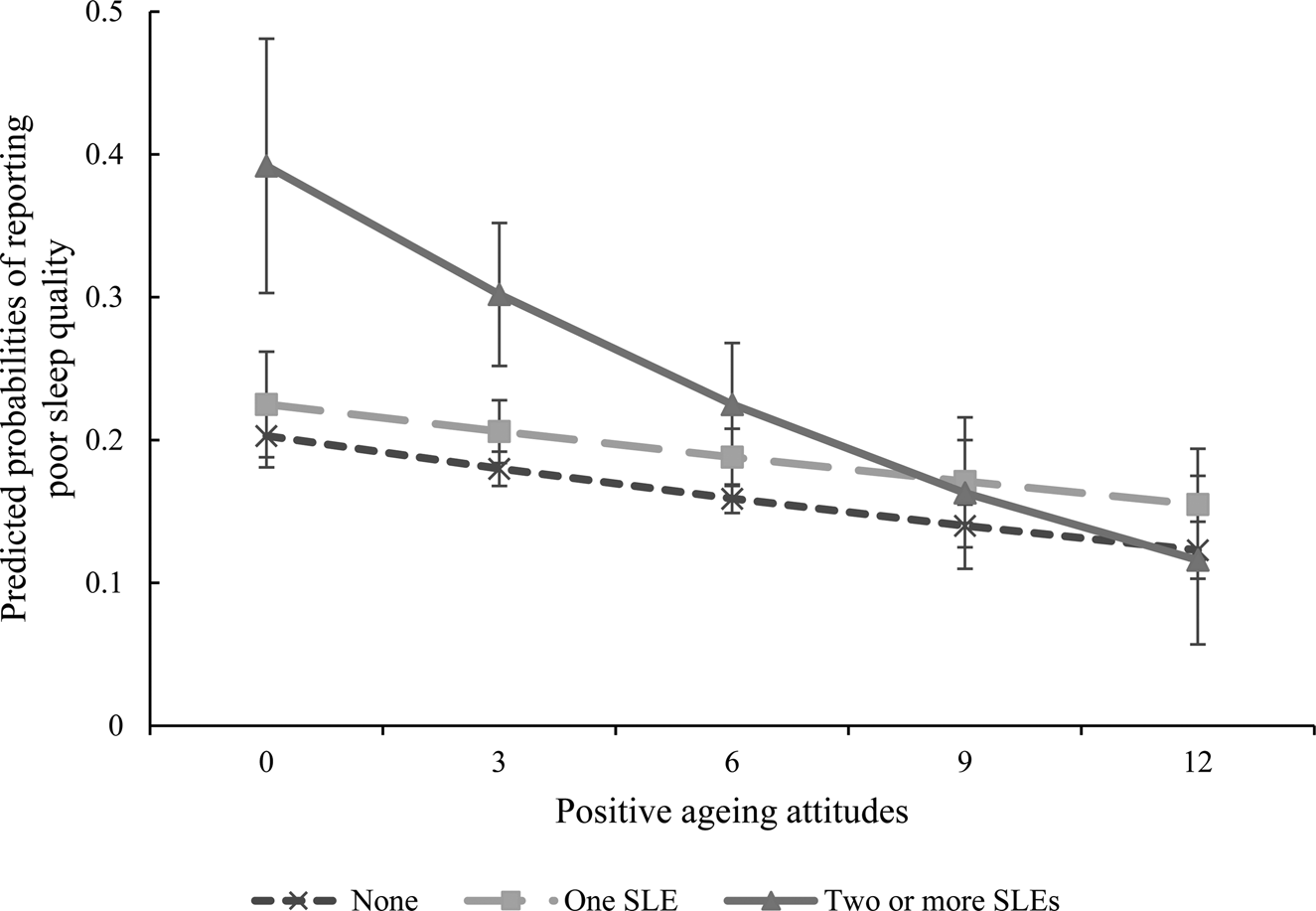
Finally, to assess whether positive and negative ageing attitudes were significant moderators, we added interaction termsFootnote 3 between SLEs and positive/negative ageing attitudes in Models 6 and 7 (Table 2). We found a significant interaction effect between two or more SLEs and positive ageing attitudes. We calculated predicted probabilities from the equation to show variation in the likelihood of reporting poor sleep quality based on characteristics that comprised the interaction, holding other controls constant at their mean values. To aid interpretation, Figure 1 shows the interaction result in a graphic form. The predicted probabilities illustrated that among those who experienced two or more SLEs, higher positive ageing attitudes significantly mitigated the health-detracting influence of SLEs. In other words, even when older adults experienced two or more SLEs, they were not at particular risk of poor sleep quality unless they also had low levels of positive ageing attitudes. However, the interaction coefficient was not statistically significant between negative ageing attitudes and SLEs, suggesting that negative ageing attitudes did not aggravate the adverse link between SLEs and sleep quality later in life.
Predicted probabilities of poor subjectively rated sleep quality (with 95% confidence intervals) by stressful life events (SLEs) and positive ageing attitudes.
Discussion
Using a nationally representative sample of Chinese older adults, this study investigated the relationships among SLEs, ageing attitudes and subjectively rated sleep quality in later life. Findings revealed that SLEs were significantly associated with higher odds of poorer sleep quality, particularly for those who experienced two or more SLEs. Moreover, our findings demonstrated the unique roles of positive and negative ageing attitudes, not just as independent predictors of sleep quality but also as mediating and moderating mechanisms in the SLEs–sleep quality association. More detailed discussions follow.
First, we found that those who experienced SLEs had a significantly higher probability of poor subjectively rated sleep quality than those who did not experience any SLEs. When older adults experienced two or more SLEs, they were at particular risk of poor sleep quality, leading support to Hypothesis 1. These findings are consistent with the stress process model (Pearlin and Bierman, Reference Pearlin, Bierman, Aneshensel, Phelan and Bierman2013) and the broader literature that report the negative physical and mental health impact of life stressors (Schwarzer and Schulz, Reference Schwarzer, Schulz, Nezu, Nezu and Geller2002; Levenson et al., Reference Levenson, Nusslock and Frank2013; Leggett et al., Reference Leggett, Burgard and Zivin2016; Chukwuorji et al., Reference Chukwuorji, Nwoke and Ebere2017). Our study extends the research by indicating that SLEs are accumulatively associated with poor sleep quality in a large, nationally representative sample of older adults in China.
Regarding Hypothesis 2, our findings demonstrated that positive and negative ageing attitudes were independently related to subjectively rated sleep quality. Specifically, positive ageing attitudes were associated with higher odds of good sleep quality and, conversely, negative ageing attitudes were related to a higher risk of poor sleep quality. Previous studies have found empirical evidence that positive ageing attitudes are associated with favourable physical and mental health outcomes, and negative ageing attitudes can undermine health (Bryant et al., Reference Bryant, Bei, Gilson, Komiti, Jackson and Judd2012; Westerhof et al., Reference Westerhof, Miche, Brothers, Barrett, Diehl, Montepare, Wahl and Wurm2014; Stephan et al., Reference Stephan, Sutin, Bayard and Terracciano2017; Wurm et al., Reference Wurm, Diehl, Kornadt, Westerhof and Wahl2017), which is in line with our study findings from the perspective of sleep quality. We join and extend an emerging body of work by showing that positive ageing attitudes are protective while negative ageing attitudes could damage sleep.
Hypothesis 3, that positive and negative ageing attitudes would mediate the relationship between SLEs and subjectively rated sleep quality, was partially supported. Specifically, SLEs can increase the level of negative ageing attitudes, which in turn lead to a higher risk of poor sleep quality. In other words, the impact of SLEs on sleep was partly through the resulting increase in negative ageing attitudes. Stereotype embodiment theory (Levy, Reference Levy2009) provides relevant theoretical grounds to understand such results. Stereotype embodiment theory posits that stereotypes become internalised across the lifespan and gain salience from self-relevance (Levy, Reference Levy2009). When older adults experience SLEs (e.g. the loss of loved ones and have a life-threatening illness), they may internalise negative stereotypes about ageing, which leads to increased negative attitudes towards ageing. Additionally, the finding appears consistent with the stress process model (Pearlin and Bierman, Reference Pearlin, Bierman, Aneshensel, Phelan and Bierman2013), which posits that a stressful condition in and of itself does not explain adverse health outcomes. Instead, the effects of stress on health are mediated by its negative impact on psychological processes, resulting in greater stress reactivity and cumulative physiological burden, both of which contribute to sleep problems. Although there was no existing evidence with which to validate this specific pathway to subjectively rated sleep quality, other studies have reported the mediating role of negative ageing attitudes in associations between specific stressors (e.g. discrimination and widowhood) and adverse health outcomes in older people (Han and Richardson, Reference Han and Richardson2015; Li et al., Reference Li, Chan, Chen and Ran2022).
However, we did not find any mediating role of positive ageing attitudes. A possible explanation could be that positive and negative ageing attitudes are context-based characteristics, which can be influenced by different life domains or contexts (Kornadt and Rothermund, Reference Kornadt and Rothermund2011). It may be plausible that experiencing adverse life events, such as the death of loved ones, is more apt to trigger older adults' negative attitudes towards ageing directly (e.g. old age is a time of loss) rather than affecting positive ageing attitudes. Although little research specifically tested ageing attitudes as pathways linking SLEs and sleep, our result is consistent with a recent study which finds that positive ageing attitudes do not mediate the effects of widowhood on older adults' depressive symptoms, whereas negative ageing attitudes have such mediating effects (Li et al., Reference Li, Chan, Chen and Ran2022).
In terms of moderating effects, our results demonstrated that positive ageing attitudes could significantly buffer against the adverse impact of SLEs on subjectively rated sleep quality, leading to Hypothesis 4. For those who experienced two or more SLEs, it is possible that holding positive attitudes towards ageing can compensate for the harmful effects of SLEs. As such, the result aligns with extensive literature that indicates positive ageing attitudes can alleviate the negative physical and mental consequences in the face of acute or chronic stressors (Bellingtier and Neupert, Reference Bellingtier and Neupert2018; O'Brien et al., Reference O'Brien, Torres and Neupert2021). Our findings also confirm the view that positive ageing attitudes are important psychosocial resources that can aid individuals against stress (Bellingtier and Neupert, Reference Bellingtier and Neupert2018). Understanding the buffering role of positive ageing attitudes is critically important, given that although the onset of some SLEs is unavoidable, it is possible to improve individuals' positive attitudes towards ageing, which are modifiable in old ages (Hooker et al., Reference Hooker, Mejía, Phibbs, Tan and Stevens2019).
Finally, associations with covariates were in line with previous research, with women, living alone, having higher levels of functional limitations and more chronic diseases showing significantly higher odds of poor subjectively rated sleep quality (Gu et al., Reference Gu, Sautter, Pipkin and Zeng2010; Smagula et al., Reference Smagula, Stone, Fabio and Cauley2016; Zhang et al., Reference Zhang, Lin, Chen and Li2022). In addition, although it is beyond the scope of this paper, future research should explore how the covariates mentioned above are associated with older Chinese adults' positive and negative ageing attitudes.
This study is not without limitations. First, due to the cross-sectional design, the causal interpretation among SLEs, ageing attitudes and subjectively rated sleep quality should be cautious. Second, given the secondary nature of the data, this study used one-item measure of sleep. Although not fine-grained, the one-item sleep measure has been widely used among older populations in China (H Wang et al., Reference Wang, Kim, Burr and Wu2020; Zhang et al., Reference Zhang, Lin, Chen and Li2022). Using both subjective and objective sleep measures (e.g. the Pittsburgh Sleep Quality Index, polysomnography, trouble falling asleep, low sleep efficiency, etc.), prior studies (Hall et al., Reference Hall, Casement, Troxel, Matthews, Bromberger, Kravitz, Krafty and Buysse2015; Lancel et al., Reference Lancel, Stroebe and Eisma2020) also indicated the detrimental effects of SLEs on sleep outcomes, which is in line with the findings from the current study. We suggest that future research continues to assess the validity of the one-item sleep measure. Future research would also be improved by using more comprehensive measures of sleep. For example, researchers can use actigraphy to measure total sleep time, nighttime awakenings and sleep onset latency, and can also use the Pittsburgh Sleep Quality Index to measure sleep quality. Likewise, the measure of SLEs is relatively coarse. The CLASS did not capture detailed measures of SLEs (e.g. intensity, duration and frequency), which limits our understanding of the complex relationships between SLEs and sleep health. Also, the categorical measure of SLEs is a limitation in this study. Indeed, SLEs are varied, and further study could look at how different types of SLEs are related to sleep. Another concern applies to our measure of ageing attitudes. The Attitudes to Ageing Questionnaire seems to have relatively low Cronbach's alpha values. We encourage more future studies using robust measures of SLEs, ageing attitudes and sleep outcomes. Finally, although we consider ageing attitudes as potential mechanisms linking SLEs and sleep quality, data limitations prohibit us from including other psychosocial factors such as self-esteem, sense of control and psychological resilience in the analysis. Future research that focuses on these potential channels through which SLEs affect sleep outcomes of older people would be highly valuable.
Notwithstanding limitations, the current study contributes to our understanding of stress–health linkage in later life and adds cross-cultural knowledge in the research field. This study is among the first to test whether and how accumulative SLEs affect the sleep quality of older Chinese adults. Our observation of the detrimental effects of SLEs on subjectively rated sleep quality is in line with findings from Western societies, and further extends existing research by demonstrating a cascading effect: the more SLEs older adults experience, the higher odds of poor sleep quality they suffer from. Moreover, this study presents novel findings highlighting the importance of modifiable psychological factors – positive and negative ageing attitudes – that not only have direct effects on older adults' subjectively rated sleep quality but also can partially mediate and moderate the SLEs–sleep association. Given the traditional Chinese culture (i.e. collectivistic culture) context, older people may receive more value, deference and respect than their Western counterparts in the individualistic culture (Chu et al., Reference Chu, Lay, Tsang and Fung2020), which could be more conducive to higher levels of positive attitudes towards ageing (Lai, Reference Lai2009). Such findings also carry important policy implications. As public safety nets (e.g. formal social support systems, pensions and medical care) may not be easily obtained among older adults in China and other LMICs, interventions that aim to promote older adults' positive ageing attitudes and prevent negative ageing attitudes may compensate for the insufficiency of external resources, and thus act as effective interventions aimed at older adults' sleep improvement.
Acknowledgements
We would like to thank the Institute of Gerontology and National Survey Research Center at Renmin University of China for providing the China Longitudinal Ageing Social Survey (CLASS) data.
Financial support
This work was supported by the National Natural Science Foundation of China (grant number 72074177); China Scholarship Council (grant number 202006280098); and a Major Project of the National Social Science Foundation of China (grant number 21ZDA103).
Conflict of interest
The authors declare no conflicts of interest.



