


Introduction
Cognitive behavioural therapy (CBT) is a psychological intervention that seeks to reduce the distress associated with, and impact of, emotional disorders including anxiety and depression. There is evidence that CBT can be used successfully with children and young people with a range of diagnoses (Stallard, Reference Stallard2002a; Fuggle et al., Reference Fuggle, Dunsmuir and Curry2012) and it is recommended by the National Institute for Health and Care Excellence (NICE) for a number of mental health difficulties. However, despite treatment advances since CBT was first developed, some elements of the model that were proposed in Beck's original publication (Beck, Reference Beck1979), have remained uninvestigated.
In CBT, the aim is ultimately to help the client become their own therapist. From the outset of therapy the CBT client, in collaboration with the therapist, is helped to recognize the connection between thoughts, feelings and behaviour and gains an understanding of how this applies to their individual circumstances. This is the process of ‘socialization to the model’ which a Delphi study (Roos and Wearden, Reference Roos and Wearden2009) has defined as:
‘. . . the process by which a service user and clinician negotiate a shared understanding of the presenting difficulty. During the process, the clinician presents hypotheses and a formulation of the service-user's symptoms and experience in terms of the model to be used for intervention. The therapist provides information concerning the practical implications of the chosen model of therapeutic intervention, to allow the service-user to fully engage with and understand both the therapeutic process and the rationale for intervention.’ [p.343, emphasis added]
This process of socialization has historically been considered crucial to therapy in order to collaboratively share understanding between therapist and client, and is a recommendation made in the majority of CBT textbooks and treatment models (e.g. Beck, Reference Beck2011), yet it is based on no direct clinical evidence.
This process of socialization has several elements as outlined above, including the negotiation of a shared understanding, formulation, information giving and presenting a clear rationale for therapy. The aim of this research is not to disentangle all these separate elements, although this would be interesting, but focus on young people's understanding of therapy concepts. Few studies have investigated socialization directly, and those that have generally investigate therapist behaviours rather than young people's understanding of the concepts. It is therefore possible that despite therapists ‘socializing’ the young people they were not ‘socialized’ so if socialization is to be understood it is important to investigate whether the intended outcome, such as a shared understanding, is achieved.
The concept of socialization is theoretically similar to the ‘task’ element of Bordin's tripartite model of working alliance (Bordin, Reference Bordin1979), which is thought to be related to clinical improvement (Shirk et al., Reference Shirk, Karver and Brown2011). For example, the task element is described as the agreement between therapist and client about what needs to be done by each party to achieve their goals (Bordin, Reference Bordin1979). This is also an element of socializing a person to the model, although according to the definition by Roos and Wearden (Reference Roos and Wearden2009), socialization also involves the negotiation of a shared understanding of the issues and sharing of a formulation. Crucially it also suggests that there needs to be agreement between the therapist and client about what would help.
In one of the few published studies to measure socialization directly, Daniels and Wearden (Reference Daniels and Wearden2011) investigated socialization to the model in 50 adults engaged in ‘pragmatic rehabilitation’ for chronic fatigue syndrome (CFS), a collaborative therapy based in CBT with the aim of developing and engaging in a graded return to activity. They extracted all utterances about CFS and its management that were made during the final therapy session from therapy tapes. These were then rated on each of the key socialization dimensions identified in Roos and Wearden (Reference Roos and Wearden2009), namely concordance, explicit understanding, making active plans and evidence of applying the principles congruent with the treatment model. They also rated resistance (evidence of applying principles incongruent with the model, resistance and avoidance). The number of utterances related to socialization and avoidance was then totalled. They found that the ratings had good internal consistency but reported the associations between socialization and working alliance dimensions rather than total socialization and resistance scores.
There is evidence that therapist socialization behaviours are associated with better working alliance in youth CBT. Karver et al. (Reference Karver, Shirk, Handelsman, Fields, Crisp, Gudmundsen and McMakin2008) investigated which specific therapist behaviours during the first two sessions of therapy contributed to working alliance at the third in young people between 13 and 17 years of age attending therapy for depression. The authors describe therapist ‘socialization’ behaviours as presenting a treatment model, presenting a collaborative approach and formulating goals. To measure this, and other possible variables, they developed a rating scale to evaluate two 10-minute segments of sessions 1 and 2 of therapy. They then investigated which therapist behaviours were associated with better alliance at the third session. They found some support for behaviours that form part of the socialization phase of CBT being related to better working alliance. The extent to which the therapist engaged in socialization behaviours at sessions 1 and 2 correlated with reported therapeutic alliance at session 3 (.33 and .41, respectively) but this did not quite reach significance (p = 0.12). However, this was a pilot study using 23 participants and the authors acknowledge that it was probably under-powered. A similar study found that presenting CBT treatment as collaborative, which is part of the socialization process, improved alliance (Creed and Kendall, Reference Creed and Kendall2005).
It is important that such fundamental elements of the CBT model have empirical foundation. Clinical intuition suggests that it is important that clients understand and agree with the CBT model but this is difficult to verify because there are no scales or measures that can be used to assess whether someone is ‘socialized’. In order to evaluate whether socialization is related to outcome, or even a useful therapeutic construct, it is important to be able to measure whether a client is socialized as opposed to whether the therapist conducted the socialization skills and behaviours.
The aim of this study, therefore, is to develop and pilot tools designed to measure socialization in young people. The primary hypothesis is that the tools will be capable of measuring socialization to the CBT model. This will be assessed by identifying relationships between the tools and a proxy measure of socialization (namely participants’ therapists rating of socialization, although limits to this will be discussed further). Their validity will be discussed.
Method
Participants
Sixteen young people aged 12–17 years were recruited from local child and adolescent mental health services (CAMHS). Researchers notified appropriate clinicians (clinical psychologists, CBT therapists or other clinicians offering CBT to young people) of the research and asked them to identify anyone on their caseload between the age of 11 and 18 years who had received CBT in the previous year. These received a letter directly inviting them to participate. The researchers also left flyers in CAMHS waiting rooms and asked clinicians to invite potential participants verbally whose therapy was ongoing as they were nearing completion of CBT. It was stressed to clinicians that we were interested in recruiting anyone who had completed a course of CBT whether they had responded well to it or not.
A total of 75 young people were invited to take part, resulting in a response rate of 21.3%. All participants had either completed or almost completed CBT for depression or anxiety in the previous 12 months. Young people with learning disabilities or a current episode of psychosis were not recruited. Young people with autism were not invited to take part as they were eligible for a similar project running concurrently (C. Roberts-Collins et al., unpublished data).
Ethical permission was granted by the South-East Scotland NHS Research Ethics Committee (reference 15-SS-0131) and the University of Bath Psychology Ethics Committee (reference 16-001). The authors assert that all procedures contributing to this work comply with the ethical standards of the relevant national and institutional committees on human experimentation and with the Helsinki Declaration of 1975, and its most recent revision. The authors have no conflicts of interest with respect to this publication.
An a priori power calculation was not possible due to the lack of research on which to base estimated effect sizes. The pilot nature of the study means that the authors recognize the likelihood that the sample is likely to be underpowered.
Measures
Socialization was measured via semi-structured interview, a pilot written measure of socialization, and therapist subjective ratings of socialization.
Socialization interview
The semi-structured interview, designed by the authors, consisted of questions about participants’ experience of receiving CBT, what they found useful about CBT, what skills they learned from CBT and what they were asked to do between sessions. Participants were also given the opportunity to add any relevant information about their CBT. The interview was co-designed by young people with experience of receiving CBT. They assisted with the introductory explanation, wording and ordering of questions and suggested alternative ways participants could opt not to answer a question.
Questions were designed to target the socialization dimensions outlined by Daniels and Wearden (Reference Daniels and Wearden2011) without leading the participant to certain responses. Participants were informed that they were being asked about their CBT sessions overall and not the reasons they were attending therapy, and therefore they did not need to share private information. The interview was piloted by clinical psychologists role-playing young people that they had worked with, and with young people known to the researchers. No changes were made after piloting the interview.
The interview was recorded and each utterance relevant to CBT was extracted and transcribed by the interviewer. The interview transcript was then scored independently by one of the authors who did not conduct the interview in an attempt to limit bias. All authors are experienced in CBT, having either a teaching post or being taught on the Doctorate in Clinical Psychology course at the University of Bath, which is approved by the British Association for Behavioural and Cognitive Psychotherapies (BABCP) as an accredited course in CBT. The interview was scored using criteria based on the socialization dimensions outlined by Daniels and Wearden (Reference Daniels and Wearden2011). See Table 1 for details about the dimensions that were scored. Scoring criteria are available from the authors on request.
Overview of the socialization dimensions and when a score would be awarded
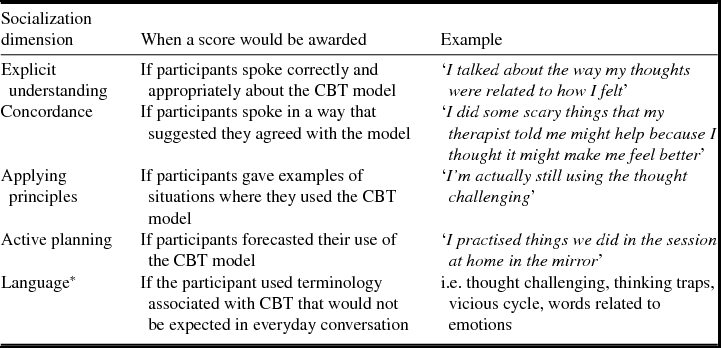
*A table of example words that could be included in the scoring of this was compiled and used as a reference for this dimension. These words were gathered from terminology used in commonly used child CBT texts such as Think Good – Feel Good (Stallard, Reference Stallard2002b) and from discussions with clinicians.
Each utterance could be awarded a maximum of five points (one for each socialization dimension) but as there was no limit on the number of utterances extracted, there was no maximum score achievable. If a participant did not make any utterances relevant to socialization then they would be scored zero. For the language dimension, participants scored one point for every word relevant to the CBT model they used, although each word could only be awarded a point once. For example, if someone said ‘I had been really low and I didn't understand why so my therapist helped me figure out what unhelpful thinking styles I tend to use and how this made me want to stay at home’, they would score two for language (low, unhelpful thinking styles), one for explicit understanding of the model (looking at thinking styles and its influence on behaviour) and zero for the other dimensions for a total of three points for that utterance. If the participant used the word ‘low’ again, for example, they would not score another point for use of language.
It is expected that higher scores on the interview will relate to better socialization.
The CBT understanding task
A novel CBT understanding task was designed for this study in collaboration with a young person's participation group (YPPG). Participants read a short story about a boy with generalized anxiety and answered four questions: (1) what thoughts, feelings and behaviours might Alex have? (score range 0–9); (2) draw arrows to show how the circles above could be connected (score range 0–6); (3) what needs to change for Alex to get better? (score range 0–2); and (4) design an activity to help with Alex's worry and tell us why it might help him (score range 0–3). The YPPG gave advice on the design to ensure it was pitched at the appropriate developmental level, therefore enhancing ecological validity. They assisted with the introductory explanation, wording and ordering of questions and suggested alternative ways participants could opt not to answer a question.
The scoring criteria were developed in relation to socialization: (1) explicit understanding (e.g. identifying and linking thoughts, feelings and behaviours), (2) making active plans (e.g. homework tasks), and (3) evidence of applying principles congruent with the model (e.g. identifying what needs to change) (Roos and Wearden, Reference Roos and Wearden2009; Daniels and Wearden, Reference Daniels and Wearden2011). Concordance could not be scored as this relates to agreement between the therapist and the client. The scoring criteria identifies the range of possible answers and scores, allowing a total score out of 20.
The CBT understanding task was piloted with 14 clinicians trained in CBT: (1) to check the task could be understood by CBT experts who were expected to achieve high or ceiling level scores; (2) as a training exercise in scoring the task for the researchers; and (3) to check inter-rater reliability between the researchers for the task scoring. Clinicians scored an average of 17.43, with a number reaching ceiling level, as expected. The scoring criteria for question 3 was altered because no CBT experts achieved the maximum score on this question. A high degree of reliability was found between researchers scoring the measures with an average intraclass correlation of 0.91 [F (15) = 20.2, p < 0.001].
Therapist rating
The participant's therapist was contacted via email, telephone or letter and asked to rate their subjective impression of how socialized to the model the participant was. They were given an adapted version of the definition by Roos and Wearden (Reference Roos and Wearden2009) intended to convey the observable features of their socialization (‘understood the basic CBT model, the connection between thoughts, feelings and behaviours and the general principles of CBT such as collaborative working, homework’) and asked to rate on a scale of 0 to 10 (not at all socialized to very socialized, with 5 being somewhat socialized).
Other considerations
It is important to note that we attempted to control for therapeutic alliance by asking clinicians to provide us with participants’ rating of alliance via questionnaire data that is often used routinely, such as the Session Rating Scale (Duncan et al., Reference Duncan, Miller, Sparks, Claud, Reynolds, Brown and Johnson2003). However, so few clinicians could provide us with this information (n = 3) it was not possible to use it in this study. We also attempted to evaluate how socialization was related to clinical outcomes but the data we received were varied and difficult to work with. It would also be significantly underpowered so the rest of this paper focuses on the concept of socialization and what can be learned from this small pilot study.
Procedure
Participants contacted the researchers after being informed about the study by their clinician. They were screened by telephone or email to ensure they met eligibility criteria, then were seen at their home for the appointment, at which point the research assessments were administered. Participants gave informed consent, then completed the semi-structured interview and the CBT understanding task. The appointments lasted around 30 minutes in total. After the study they were debriefed and given a £5 voucher for their time. Their CAMHS therapist was contacted, with the participant's permission, and asked to provide their subjective opinion of how socialized to the model the participant was during therapy. Despite several attempts to collect data from clinicians, this was not possible for all participants due to clinicians moving services, being on maternity leave or not responding to emails or telephone calls.
Data analysis
Descriptive data were used to examine the structure of the CBT understanding task and socialization interview. To address the primary hypothesis that it is possible to measure socialization, the CBT understanding task score was entered into a correlation analysis with the clinician's subjective rating of the participant's socialization. This analysis was based on the presumption that the clinician's rating of socialization is an accurate estimation of actual socialization, although the limitations to this are considered in the discussion.
Results
Participants had a mean age of 14.9 years (SD 1.7) and were mostly female (75%).
CBT understanding task
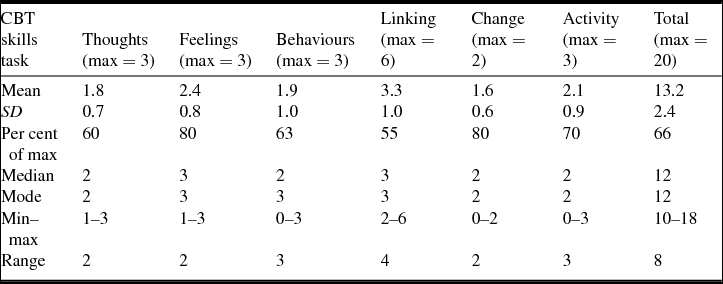
Descriptive data are presented fully in Table 2. Overall, participants scored over 60% on the identification of thoughts, feelings and behaviours. Moreover, they were able to identify feelings 80% correctly on average. They were able to link these three concepts and all participants were able to make at least two connections between items (out of a maximum of six; three concepts bi-directionally). Participants successfully suggested changes that needed to be made in Alex's life and scored an average of 80% of the total available on this question. Overall, participants scored 66% on average.
Descriptive data for the CBT skills task

Socialization interview
Participants made most utterances relating to their language (mean = 6.2, SD = 3.0), explicit understanding (mean = 3.6, SD = 2.3) and concordance (mean = 3.6, SD = 2.2). On average, there were fewer utterances related to active planning (mean = 1.0, SD = 0.9) and applying principles (mean = 1.3, SD = 1.1).
Given this difference, it is unsurprising that Cronbach's alpha suggested the socialization interview does not have internal consistency (alpha = 0.39), although reasons for this are explored in the discussion.
Clinician rating of socialization
Overall, 14 clinician ratings were available. The mean rating was 7.9 out of 10 (SD 1.3). The scores ranged from 5 to 10.
Results of three Shapiro–Wilk tests suggest that normality can be assumed for clinician rating of socialization (0.90, p = 0.20), the socialization interview (0.98, p = 0.96) and CBT understanding task (0.96, p = 0.68). Scatterplots did not reveal any significant outliers.
Correlation analyses
A Pearson correlation found a non-significant, moderate positive relationship between the CBT understanding task and clinician rating of socialization (r (12) = .37, p = 0.19). No correlation between socialization interview and clinician rating of socialization was conducted due to the former's poor internal consistency.
Validity assessment
Socialization interview
Whilst not formally measured, there were no concerns about the socialization interview's face validity from the researchers, the young person participation group or clinicians who piloted the measure. It was designed using the definition of socialization presented above so is likely to have content validity. However, the socialization construct is not well known or described in this population so the interview may be assessing content validity against an unknown construct. As the measure did not have internal consistency, no assessments of criterion-related validity were conducted.
CBT understanding task
Similar to the interview, there are no reasons to suspect the task does not have face validity. It is also likely to have content validity considering the caveat above. Furthermore, it is correlated, although non-significantly, with the clinician rating of socialization so it may possibly have predictive validity although this did not meet significance and it is unclear whether the clinician rating of socialization is reliable and valid also. There were no tests of concurrent validity and there are no suitable measures to compare against for convergent or discriminant validity. The high degree of reliability between researchers suggests it may be a reliable measure, but as it was only given to participants at a single time point it is not clear whether there is test–retest reliability.
Discussion
This study investigated socialization to the CBT model in a sample of young people. There was a non-significant, moderate positive relationship between a task measuring young people's understanding of CBT and how socialized their therapists perceived them. The study suffered from a small sample size and therefore lack of power, meaning that conclusions about whether socialization is important are difficult to make. The study procedure, however, was able to highlight some needs for this under-researched area that would be useful for researchers in the future.
Socialization interview
When designing the study, it was predicted that assessing socialization based on rating spontaneous utterances during therapy would be inappropriate in a sample of young people. The interview, therefore, was designed to specifically ask about socialization whilst keeping the questions open-ended so not to be leading. It seems that this direct but open-ended questioning may be unsuitable as participants generally responded with a sentence or two, meaning that the interviews were generally around 5–10 minutes in duration. Some interviews were even less than this. It is difficult to know whether interviews this length are reliable enough to draw conclusions from. Questions in the interview were designed to specifically target the dimensions of socialization outlined in the definition by Roos and Wearden (Reference Roos and Wearden2009) and it still seems useful to limit variation in such a new research area.
The interview lacked internal consistency and this may be due to several reasons. It is possible that the questions did not allow participants to adequately convey the degree to which they were socialized, meaning that certain categories were more often represented than others. This would particularly be the case for the language category, as being a verbal task, participants may have scored in the language category several times per question. Conversely, the scoring may have been too strict on certain categories or the concept may be difficult to assess in a retrospective interview and may suit rating of concurrent information better. It may be that the method of scoring the interview lacked internal consistency rather than the interview itself. It is also possible, however, that a measure of a construct such as socialization may not have internal consistency because the distinct categories that are being measured may not be represented equally.
It is possible the interview is simply measuring verbal skills rather than understanding of socialization. The method of scoring utterances may have privileged quantity of responses over quality, and future research may wish to score how someone has integrated this information. This would be reflected in the ‘applying principles’ and ‘active planning’ sub-categories of socialization, which were the least frequent utterances. It seems that in this sample, either due to the understanding of participants or the design of the questions, people were more likely to describe than explain their experience of CBT. Verbal ability was not controlled for in this study but would be advantageous in future studies. This would help capture younger children's socialization, for example if they expressed an appropriate level of understanding at a different level of complexity to older participants.
Future research may wish to ask a wider variety of questions. These could include open-ended and multiple choice questions, as well as questions that are more able to explore the participant's explicit understanding and ability to apply the principles. These could involve explicitly asking the young person to explain what they understand about thoughts, feelings and behaviours and how they are connected, how these might be important and how they could use this knowledge to help when they or someone else feels sad or upset. This would allow the young person to show their understanding of CBT theory and their ability to apply the principles of therapy to real life. At this early stage in socialization research it may be useful to adopt a qualitative approach to understanding therapy.
CBT understanding task
The young people in the sample responded well to the CBT understanding task and found it accessible. It is possible that the separate elements of the task, the identification of thoughts, feelings and behaviours, identifying the connection between these and the application of this knowledge to an individual difficulty, would be more appropriately scored independently of one another. This would allow more specific understanding of the young person's socialization. For example, if this were used in routine clinical practice and it was clear that the young person could identify thoughts, feelings and behaviours but not connect them or apply them to a difficulty, then the clinician could recap psychoeducation or use this as a discussion tool.
To be useful as a research tool it would be beneficial to develop more vignettes to apply to a wider range of clinical presentations. A generalized anxiety presentation was thought to be most accessible and recognizable to young people so was chosen for this study, but it would be useful to develop vignettes describing other anxiety presentations and depression so that the young person had several opportunities to apply their knowledge. Similarly to the above, if a consistent pattern was shown if this was used in routine clinical practice then it could potentially guide an intervention.
Other considerations
It is unclear whether the clinicians’ rating of socialization is a true representation of a young person's socialization, but as there is currently no alternative method this was the best estimate available. The clinicians did not report this figure blindly and were aware of the young person's treatment response. It is possible that clinicians tended to recruit people who responded well to treatment, despite the research team being clear that this was not an inclusion criterion. Recruiting people prior to starting therapy would help with this, as would actively recruiting people who did not respond to therapy.
The sample ranged from 12 to 17 years of age, and therefore probably captured a wide variation in cognitive abilities as well as ability to comprehend questions about an abstract concept such as socialization. Participants between 11 and 18 years were eligible to participate and this age range was selected due to an expectation that, despite natural variation, young people over 11 years old are likely to be able to communicate understanding of complex information. By age 11 there is evidence that maturation of executive functioning is slowing after rapid development during early and middle childhood (Anderson et al., Reference Anderson, Anderson, Northam, Jacobs and Catroppa2001). Other evidence, however, suggests that working memory, including verbal working memory, probably most pertinent to the interview task, develops gradually during adolescence (Conklin et al., Reference Conklin, Luciana, Hooper and Yarger2007). This variation in abilities is inevitable without limiting the sample to a specific age or ability range. Future research may wish to collect a sample large enough to control for one or both of these.
Aside from the considerations above, there are several other limitations to this study. This study is underpowered to detect anything but large findings. The sample is also possibly biased towards those who responded well to CBT, given the high rating of socialization by the clinicians. This was despite researchers clearly explaining this was not an inclusion criterion. This could reflect clinicians’ anxieties about their own performance or it could be that people who did well in CBT were more likely to agree to take part. Recruiting people at the beginning of therapy may assist in limiting this in future studies. Despite these limitations, this study contributes novel information to the CBT literature by introducing the concept of measuring socialization and identifying issues that future researchers may find beneficial.
A strength of this study is that the measures were designed in collaboration with young people who have experience of CBT, so they were likely to be accessible to this group. They were based on a formal definition of socialization (Roos and Wearden, Reference Roos and Wearden2009). It also captured a wide range of ages.
Future research
Socialization is a new research area and as such has many interesting unanswered questions. What is the causal relationship between socialization and engagement in CBT, engagement in exposure tasks and clinical outcomes? What is the pattern of socialization over the course of therapy? What do therapists do that encourages socialization? In child CBT is parents’ socialization important? Is socialization different in people presenting with depression compared with anxiety? Is it different in psychosis or physical health conditions?
It will be important for future researchers to be clear about whether they are measuring a therapist behaviour or an outcome in young people. It would be interesting to explore whether these things are related. It may be that a clinician engages in all the ‘socialization behaviours’, like presenting a shared formulation and giving information, but a young person does not seem ‘socialized’. There is likely to be significant variation between young people, and it will be important to understand more about what specific therapist behaviours are important in young people ‘being socialized’. There has been some examination of therapist behaviours associated with working alliance (Creed and Kendall, Reference Creed and Kendall2005; Karver et al., Reference Karver, Shirk, Handelsman, Fields, Crisp, Gudmundsen and McMakin2008) but not socialization. Working alliance is likely to be related to socialization as the definition of the task element, as outlined above, overlaps with the definition of socialization. Future research would benefit from controlling for working alliance so that conclusions can be made about the specific effect of socialization on outcomes. We attempted this but as data were all collected retrospectively there were limited alliance measures completed so this was not possible. Future research would benefit from recruiting participants at or prior to the beginning of therapy rather than the end, so that participants can complete specific measures of alliance at key sessions.
There is a long way to go before it is possible to answer these questions. For this to be possible, it is necessary to be able to measure socialization. A written task would be most appropriate considering the large samples that are required to answer many of these questions. The written task used in this study seems accessible to young people and has potential to be developed and refined further with the considerations outlined above.
Conclusions
This study examined the role of socialization to the model in young people experienced in cognitive behavioural therapy. A moderate but non-significant relationship was found between a task measuring young people's understanding of CBT and their therapist's rating of how socialized they appeared. Socialization as a concept, however, is poorly understood and in the early stages of investigation. This study has several limitations but still provides an important contribution to the literature by raising awareness and curiosity about socialization and the challenges of assessing this concept.
Main points
-
(1) It is plausible that socialization to the CBT model is measureable; however, measurement of this construct presents challenges and requires further examination.
-
(2) Socialization as a concept is poorly understood and would benefit from further investigation.
-
(3) Future research may wish to consider expanding the measures used in this study to capture a wider range of responses.
Acknowledgements
We would like to thank the young people who participated in the study and who helped in the design of the study. We would also like to thank the clinicians who referred people to take part.
Conflicts of interest
The authors have no conflicts of interest with respect to this publication.
Ethical statements
The authors assert that all procedures contributing to this work comply with the ethical standards of the relevant national and institutional committees on human experimentation and with the Helsinki Declaration of 1975, and its most recent revision.
Financial support
This work was undertaken as part of the first author's Doctorate in Clinical Psychology at the University of Bath. The research received no specific grant from any funding agency, commercial or not-for-profit sectors. M.L. is funded by the National Institute for Health Research (Doctoral Research Fellowship, DRF-2016-09-021). This report is independent research. The views expressed in this publication are those of the authors and not necessarily those of the NHS, The National Institute for Health Research or the Department of Health.
It is hoped that at the end of this paper the reader will be aware that:
-
(1) The term socialization is poorly understood but is presumed to be a useful and distinct process in therapy.
-
(2) The validity of the concept of socialization is yet to be fully established.
-
(3) It seems plausible that socialization is measureable in adolescents.
-
(4) Future research will need to focus on using more detailed questioning using a wider range of measures and should consider the wider implications and variables relevant to socialization.




Comments
No Comments have been published for this article.