


A dominant narrative in Anglo-American Enlightenment studies holds that France was not the fountainhead of the siècle des Lumières, but rather the beneficiary of a philosophical, political, and scientific revolution that began in England in the late seventeenth century.Footnote 1 The philosophe often chosen to illustrate this narrative is Voltaire, who spent thirty-three months (May 1726–spring 1729) in self-imposed exile in England, when he was in his early thirties. This extended visit is often seen as a key episode in his transformation from a somewhat foppish poet and playwright into a philosophe.Footnote 2 Buttressing this account of Voltaire's development is the publication, after his return to France, of the Letters Concerning the English Nation, first in English translation, and in Voltaire's own name, in 1733; and then, the following year, anonymously, as the Lettres écrites de Londres sur les Anglais, or (to use the title posterity has remembered) the Lettres philosophiques.Footnote 3 In spite of (or perhaps thanks to) its condemnation by the Parlement de Paris, an estimated twenty thousand copies of the work were sold.Footnote 4 The success of this work, among other reasons, has led many Voltaire scholars to hold that “without the English experience, the Voltaire we know, the Voltaire admired or despised by the literate people throughout Europe, would have never emerged at all.”Footnote 5
One reason why this narrative is so powerful is that it is woven into the text of the Lettres themselves. In the very first letter, the narrator visits a Quaker who greets him pleasantly, if plainly, without bowing or removing his hat; the Frenchman doubles over with excessive courtesy and showers his host with “unseasonable ceremonies.”Footnote 6 When the Quaker tells him that his coreligionists do not practice baptism, the visitor exclaims, “Zouns . . . you're not Christians, then?” But soon the visitor sheds his small-minded views. By the fourth letter on the Quakers, he is celebrating William Penn for having brought “the golden age to earth” in Pennsylvania.Footnote 7 Subsequent letters salute the religious toleration, political liberty, commerce, and especially those twin deities of English thought, Locke and Newton. The final letter, on Pascal's Pensées (which only appeared in the French edition) abandons the premise of the observant traveler commenting on a strange land, to adopt a newly empowered authorial persona, daring to lash out at his own native idols. From a provincial Frenchman at sea in English common sense, the narrator has become a philosophe willing to defend “the party of humanity.”Footnote 8
Now, some critics have suggested that this Bildungsroman was perhaps a bit too neat, and we will also be challenging it, albeit from a new angle. It is fairly evident that Voltaire was already knowledgeable about English ways before visiting the island, in part thanks to his friendship with the Tory politician and philosopher Lord Bolingbroke, then living in French exile. Through him (along with other sources, notably books), Voltaire had known enough to celebrate English politics and religious toleration in La Henriade, the epic poem he had written before setting foot in London; one of the reasons he went to England was to find a publisher for his poem, having failed to do so in France or Holland.Footnote 9 Nor did Voltaire need to cross the Channel to discover religious toleration: already during a trip to The Hague six years earlier (1722) he had experienced an environment in which “Calvinist, Arminian, and Socinian pastors, rabbis, and Anabaptists . . . all talk at great length and in fact all speak true.”Footnote 10 Toleration, along with the converse horrors of religious war, was a major theme of La Henriade as well.Footnote 11 Finally, it is also worth recalling that models for what would be recognized, mid-century, as the philosophe-type could already be found in Louisquatorzian France, most notably in Fontenelle's 1686 Entretiens sur la pluralité des mondes (Conversations on the Plurality of Worlds), making astronomical science accessible to laymen (and -women), or the very galant philosophe of Montesquieu's 1723 Persian Letters (Letter 38), pleasantly conversing on the equality of the sexes.Footnote 12
But these objections do not fundamentally challenge the claim that Voltaire's stay in England was transformative, and had lasting effects. His admiration of Locke and Newton would persist for the rest of his very extensive life; many of his contes—such as Les oreilles du comte de Chesterfield (The Ears of Lord Chesterfield), or the Histoire de Jenni (The Story of Jenni)—depict enlightened Englishmen who embody the values of toleration and sound judgment that Voltaire championed; and his appreciation of Englishness was not isolated, but existed within a broader current of French Enlightenment Anglophilia—a current that swelled with Montesquieu's De l'esprit des lois, the Encyclopédie (with its celebration of a Baconian epistemology), Condillac's Lockean epistemology, his brother Mably's republican political thought, and Jean-Louis de Lolme's Constitution de l'Angleterre (1771), to name but the most prominent examples.
It was with this backdrop in mind that we first examined the map of Voltaire's correspondence network that our research group produced (see Fig. 1).Footnote 13 This map uses data provided to us by the Electronic Enlightenment Project in Oxford. Our Oxford colleagues had digitized the published correspondences of major French, English, and Scottish Enlightenment authors; in the process, they produced a trove of metadata for each letter (such as sender and recipient names, dates, and places), which they graciously shared with us.Footnote 14
Voltaire's correspondence network, visualized in Palladio. Data courtesy of the Electronic Enlightenment Project. Only letters with location data are pictured. For a dynamic version of this visualization see http://republicofletters.stanford.edu/publications/voltaire.
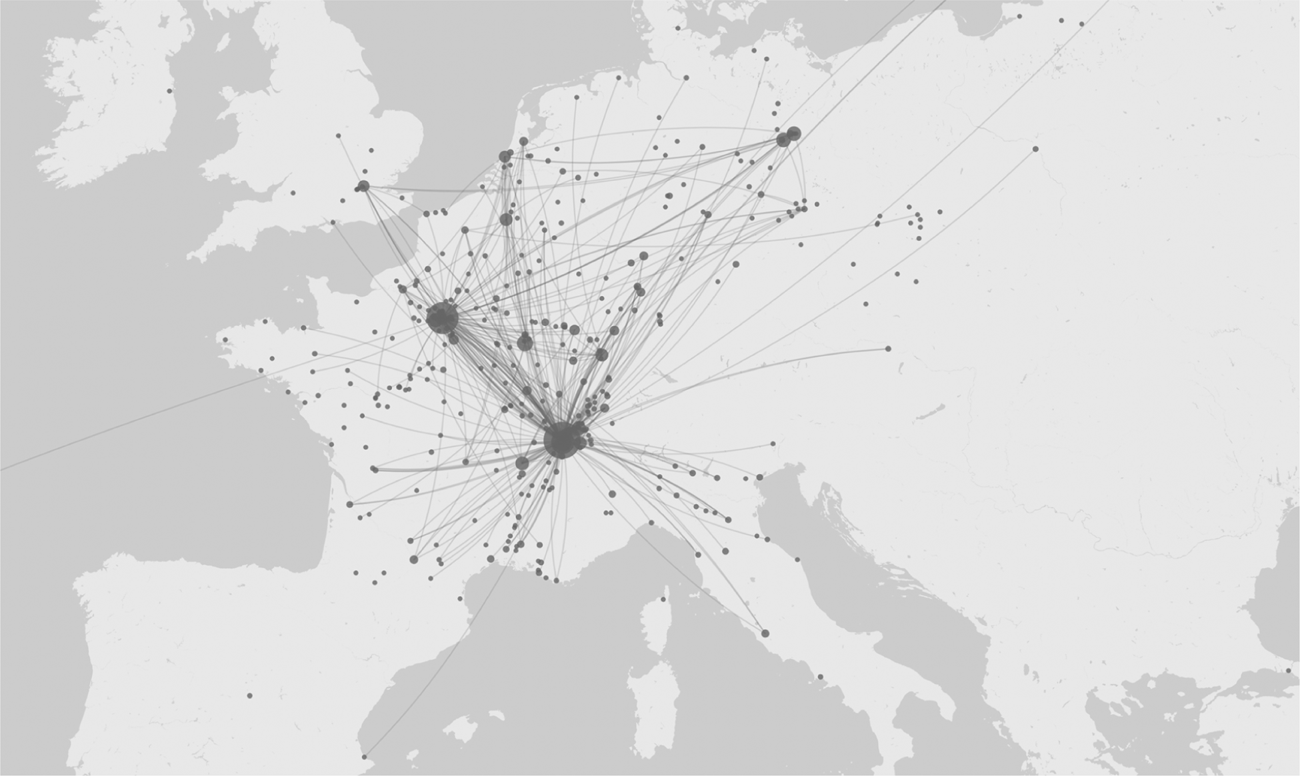
What exactly do we see here? The map shows Voltaire's correspondence network over the full extent of his life (hence different centers correspond to different moments in time). The size of the places reflects the volume of correspondence: note the “information superhighway” between Ferney, where Voltaire spent the last third of his life, and Paris. Directionality is expressed by the clockwise rotation of the lines; points represent letters for which we have only the place of the sender or the recipient (e.g. Madrid or Naples). We designed this map in part as a visual browser of the correspondence: selecting a temporal or geographical subset of these letters brings up their metadata, and lets you click back to an actual letter in the Electronic Enlightenment database. In this way, the visualization serves a very practical purpose, letting users explore a correspondence in a manner driven by geography, chronology, or correspondents.
Much on this map matches expectations. Predictably, Paris looms large over the rest of Europe, though Potsdam (where Frederick the Great resided) and Saint Petersburg (home to Catherine the Great) are important hubs; and Voltaire had correspondents scattered across the rest of France, northern Italy, the Netherlands, and the German states, in a radial structure that is typical of intellectual networks. Predictably, there's almost no contact with Spain, Portugal, and most of Eastern Europe—and there's almost no correspondence with the New World, the Caribbean colonies, or India, which is not entirely surprising (we find a very different pattern for contemporary English figures, such as John Locke or Jeremy Bentham).
What did surprise us, however, was the meager showing of England on this map—it would appear that only a few letters were sent to or from London, and even fewer from the rest of the island. Given the pivotal role England is thought to have played in Voltaire's development, this seemed very odd. If he was so interested in English authors and philosophy, shouldn't there have been more letters? To riff on the title of his famous book: where are Voltaire's letters to the English nation?
A healthy first reaction to a surprise of this sort is to wonder if it is not a mistake. There could be problems with the data, or with the visualization itself. In our case, there are in fact serious issues with the data, which is to be expected when dealing with historical archives. We lack the complete location information (i.e. both the place of the sender and the place of the recipient) for over a third of the letters (6,888 out of 18,040); roughly half (8,434 letters) are missing sender location; and close to 80 percent (14,346 letters) do not have their recipient's location. England could, then, just be underrepresented on our map because Voltaire's letters to and from there are among those that we are unable to display.
Compounding this data issue is an even more daunting problem, which is that a great deal of Voltaire's correspondence has probably been lost for good. The editor of his correspondence estimated that up to half of his letters may have disappeared, or been swallowed up in private collections.Footnote 15 This is not an outlandish estimate, given that Voltaire's correspondence currently contains 14,945 letters sent by Voltaire, compared to only 3,102 received; it is reasonable to assume that he received as many letters as he sent, if not more (and simply disposed of them).Footnote 16 We have also no doubt lost a sizable chunk of the letters that he sent, particularly from before 1730 (see Fig. 2). It could just be that England is a “cold spot” in Voltaire's network because his English letters have vanished.
Histogram of Voltaire's correspondence, by year, sorted by nationality, visualized in Palladio. See http://republicofletters.stanford.edu/publications/voltaire. Data courtesy of the Electronic Enlightenment Project.

Finally, in addition to these empirical issues, there are some theoretical ones we can add to the mix: so what if Voltaire did not exchange many letters with English correspondents? There are other ways of staying informed about England. Between 1754 and 1777, for instance, at least a 150 British visitors stopped by Ferney.Footnote 17 Voltaire was also a voracious reader, and owned many English titles.Footnote 18
Given all this uncertainty, what can we actually glean from the map? There are some ways we can try to control this uncertainty, or at least move it from the category of (what Donald Rumsfeld famously called) “unknown unknowns” to “known unknowns.” With respect to the lack of complete location data, we were able to draw on another source of information. Researchers at the Electronic Enlightenment Project had attributed a “nationality” to all correspondents. To be sure, there are some problems with applying this category uncritically to eighteenth-century individuals: citizens of Geneva, for instance, are identified as Swiss, when the Republic of Geneva only joined the Swiss Confederation in 1815 (similarly, correspondents in Venice, Florence, and Naples area all labeled “Italians”). But nationality can be a fairly good proxy for location, at least in continental Europe, where most people lived in the country where they were born. With respect to Voltaire's correspondents, we were also less interested, ultimately, in where they lived than in who they were; and so we were already using physical location as a kind of proxy for cultural identity. Precise location can even be a red herring: we were excited to find a letter to Voltaire from Panama, but it turned out that it was from his friend the geographer La Condamine, writing to say that his companions and he had recited La Henriade on their trip across the Atlantic (but not to say much at all about the New World).Footnote 19
We thus proceeded to tag each letter visually with the nationality of its recipient. In this way, even if we did not know where the letter was sent to, we could still get a sense of the “national networks” into which Voltaire was plugged (see Fig. 2). We then incorporated these data into our visualization: by hovering the mouse over the histogram, the letters now light up according to the nationality of the recipient or sender.
These results largely confirm the picture that we see in the visualization: about two-thirds of Voltaire's letters were exchanged with French correspondents, followed by a much smaller proportion of Swiss (16 percent), Germans (8 percent), and then Italians.Footnote 20 These figures are quite interesting, since (a) they highlight the strongly national makeup of Voltaire's correspondence network (thereby challenging the more cosmopolitan self-image of the philosophe himself, often taken at face value); and (b) they suggest that physical proximity was the most important factor in determining the likelihood or intensity of correspondence. For instance, Voltaire's exchanges with Swiss correspondents only take off after he moves there in the early 1750s; he also spent three years at Frederick's court, ultimately exchanging over seven hundred letters with the king. But this second point does not really hold for England, as letters exchanged with the English account for less than 1 percent of his correspondence, and hardly register on the histogram (see Fig. 3; note that the y axis has been adjusted). Adding up all the nationalities of the British Isles (Scottish, Welsh, and Irish), that percentage rises to a meager 1 percent. If we count all the letters to or from British correspondents, we find 179 letters. So, if fewer letters appear on the map, it is because there are indeed fewer letters to or from England in Voltaire's correspondence.
Histogram of Voltaire's English (light gray), Irish (gray), Scottish (dark gray), and Welsh (black) correspondence, visualized in Palladio. Data courtesy of the Electronic Enlightenment Project.

But what about the more daunting problem that we simply lost more letters to or from England? That is obviously a trickier question to resolve: one cannot rule out the possibility that someone may someday stumble upon a trove of letters from Voltaire hidden in an English attic. But such an occurrence seems unlikely. After all, there is no good reason why Voltaire's English letters should have been lost at a higher rate than his correspondence with other nationals. There is no indication that letters were more commonly lost at sea than on land, and Voltaire was no less famous in England than, say, in Prussia or Venice. As is evident from the letters themselves, his English contacts were very proud to have such a celebrated author as a correspondent. While it is true that letters exchanged before 1730 are more likely to have been lost than later ones—meaning that we certainly lost many of the letters Voltaire sent and received when he was living in England—the striking fact about Voltaire's English correspondence is that it remained very low throughout the course of his life, never rising above a high of 2.5 percent of his yearly volume (and often coming in far below). So England always remained marginal compared to other places, a point that would not necessarily change even if we found all his missing letters, assuming they were lost at a comparable rate across national groups.
A second argument comes from the data themselves. In terms of individuals, Voltaire corresponded with a similar number of English-speaking, German-speaking, and Italian-speaking correspondents (see Fig. 4).Footnote 21 British correspondents make up a full 5 percent of Voltaire's social network. What this means is that, according to our data, Voltaire exchanged far fewer letters with his British correspondents than with other nationals—indeed, twelve times fewer letters than with German correspondents, for instance. Of course, this lower ratio could be taken as a sign that a larger proportion of British letters have been lost. This may be true in part, notably for chronological reasons, but, as we saw, there is no compelling reason why more British letters should be missing from later years.
Chart of Voltaire's English, Irish, Scottish, and Welsh correspondents, visualized in Palladio. Data courtesy of the Electronic Enlightenment Project.

If England's status as cold spot on the map of Voltaire's correspondence is not a data problem, then what might it mean? It is an ambiguous finding, to be sure, and could have many different explanations. The bigger point here is that the visualization cannot answer this question; all it can to do is reveal a discrepancy between what the historiography tells us and what is actually in this correspondence. To understand the meaning of this discrepancy, we have to move beyond the map, and need to draw upon more sophisticated methods than the digital humanities have to offer, methods like reading, analyzing, and synthesizing different strands of evidence.
A good place to start reading is the British letters themselves. As there are only 179 of them, this is not very taxing. Before getting into the detail of the letters themselves, it is interesting to note to whom Voltaire was writing (see Fig. 5). Few accounts of his correspondence fail to mention the handful of bold-faced names it includes: in the case of his British correspondents that would start with Jonathan Swift and Alexander Pope. But Voltaire only sent three and two letters to each respectively. And they are not particularly memorable, either: in his first letter to Pope (D301), for instance, Voltaire sends his regrets about the poet's accident, in which he broke his wrist; his letters to Swift contain some “unseasonable ceremonies” and ask the Irishman if he could help find subscribers for La Henriade (D323). To be sure, these letters do not represent the fullness of Voltaire's relations with these authors (Voltaire was once a guest at Pope's country estate, though the dinner is rumored to have ended badly).Footnote 22 But what is striking is that he does not seem to have kept up a correspondence with the authors he met in England: no letters to either man dating from after Voltaire's return to France have survived. This absence was not due to a lack of opportunity: Pope died in 1744, Swift the year after. In fact, following Voltaire's return to France, he did not correspond with any major British authors for another thirty years. Whatever intellectual ties he formed during his two years in exile, they disintegrated quickly.
Histogram showing Voltaire's English correspondence, with letters to notable figures shaded. Data courtesy of the Electronic Enlightenment Project.

When he did take up correspondence with other English or Scottish authors of renown, these letters were similarly few in number and for the most part insubstantial. His letters exchanged with Horace Walpole (sent: D15063, D15140; received: D15089, D15161) are among the few that concerns literary or cultural matters, but these letters largely gravitate around the English author's history of Richard III (and, as often in his English correspondence, Voltaire's distaste for Shakespeare). Aside from this exchange, the philosophe rarely engaged with his British peers in much philosophical or literary discussion. In his long letter to Hume (D13623), whom he elsewhere recognized as a “true philosopher” (D8881), Voltaire's sole concern lay in proving that he had no part in the notorious quarrel between the Scot and Jean-Jacques Rousseau. Boswell, who visited Voltaire as a young man, attempted to engage him in discussions of politics and religion (D12326, D12525, D14072), but Voltaire did not take these topics up in his reply (D12397). The politician John Wilkes, who sent Voltaire one of his works, received a one-line response (D12209), while Bentham fared worse: having enclosed a copy of his Theory of Punishment in a letter to Voltaire (D20405), he does not appear to have received a reply (and one imagines he would have kept it, had one been sent).
If Voltaire wasn't writing much to notable British men of letters, then to whom was he writing? Curiously, about a third (30 percent) of his English correspondence is composed of letters to and from two men of much lesser renown (see Fig. 6). The first is Sir Everard Fawkener, a friend since before Voltaire's English years, to whom the poet dedicated the tragedy Zaïre;Footnote 23 the second is the poet George Keate, with whom Voltaire exchanged thirty-eight letters over twenty-one years.Footnote 24 This correspondence is more voluminous, though here as well we find little of the intellectual curiosity that defined the Lettres philosophiques. Only rarely does Voltaire demonstrate any interest in English affairs—political, scientific, cultural or philosophical. Again, the opportunity was there: Fawkener was considerably involved in the political life of his country, becoming ambassador to Constantinople in 1736, and remaining active in English politics until his death, while Keate was a poet and painter, concerned with matters dear to Voltaire's heart, including religion and superstition, as well as the politics of Geneva.Footnote 25 Despite this, there are precious few conversations on the state of affairs in England in both Fawkener's and Keate's correspondence with Voltaire. Voltaire's appreciation for his friends’ country surfaces mostly in rare pronouncements, such as “Certainly England is the only country where commerce and virtue are to be rewarded with such an honor” (a reference to Fawkener's appointment as ambassador to the Ottoman Empire) (22 Februaruy 1736, D1020). Other references to the state of England, however, are more pessimistic, suggesting a certain disenchantment: “I am sorry that England is sunk into romances, the time of Newton, Loke [sic], Pope, Adisson, Steele, Swift, is gone. It seems all the world is degenerated,” Voltaire wrote on 27 March 1752 (D4851). What chiefly interest Voltaire in his later correspondence with Fawkener, or “my English friend,” as he calls him, are the ways in which his Siècle de Louis XIV can be published in London. Fawkener's role in Voltaire's network was thus similar to those of Damilaville (in Paris) and Cideville (in Rouen): he was a well-located correspondent for overseeing the publication of Voltaire's clandestine French books.
Histogram showing Voltaire's correspondence with Sir Everard Fawkener (black) and George Keate (gray). Data courtesy of the Electronic Enlightenment Project.

The imperative of having his “man in London” might explain why Voltaire began his epistolary exchange with George Keate right after his correspondence with Fawkener ceased, with the latter's death.Footnote 26 Keate had shown up on Voltaire's doorstep at a fortuitous time, in 1756. Keate was also a poet, and much of his correspondence with Voltaire is concerned with verse (and how terrible a writer Shakespeare is: see D8858); again, there is little concern with “English” matters. Voltaire does mention (D7162) his disapproval of the execution of Admiral John Byng (whose life he had earlier attempted to save (D7109), and who would feature in a famous episode in Candide, to which we will return shortly). But only rarely in his letters to Keate does Voltaire express his thoughts on England in any developed manner. In one instance, he begins with great praise, celebrating English freedom, describing himself “these thirty years the disciple of [the English] way of thinking,” and calling the English “a people of warriours and of philosophers.”Footnote 27 But the letter does not end on such a high note: “You are now at the pitch of glory [a reference to English victories during the Seven Years War], in regard to pùblick affairs; but j know not wether you have preserv'd the reputation yr island enjoyd in point of litterature when Adisson, Congreve, Pope, Suift were alive.” This statement echoes the disenchanted viewpoint expressed eight years before to Fawkener. So here we find, in the letters themselves, a possible explanation for why Voltaire did not maintain a more active correspondence with the British: in his view, the sun had already set on England's empire of the mind.
Voltaire's real letters concerning the English nation thus sketch a picture very different from the one in his fictional letters—a picture that reflects the marginal place of England on his correspondence map. The pessimistic views he communicated to his English friends also found expression in his literary works of this time: a character in Candide (1759), the Venetian senator Pococuranté, shares Voltaire's observations by saying that he “would be content with the freedom which inspires these English men of genius if their passion for party interest didn't spoil all the estimable things that would flow from this precious freedom.”Footnote 28 Voltaire's overly optimistic Candide even refuses to set foot on English soil during his peregrinations, so horrified is he by the execution of Admiral John Byng, sentenced to death “pour encourager les autres” (he had failed to engage the French at Minorca).Footnote 29 By the time of the Seven Years War, England seems to have been associated more with warriors than with philosophers.
But these opinions date from after 1750, when, some scholars suggest, he had a change of heart.Footnote 30 What about the years he actually spent there? Even if he eventually fell out of love with England, Voltaire's initial stay might still have been impassioned. To get to the bottom of this question, it helps to ask what Voltaire actually did in England—and what he did not do. Given that he did not speak English when he arrived, it is unsurprising that a large part of his time was in fact spent with other Frenchmen, from the large Huguenot refugee community.Footnote 31 While he also found time to hobnob with English high society and important English literary figures, he had extensive dealings with these expatriates: one of the reasons he had come to London in the first place was to publish La Henriade, which would ultimately be brought out by Huguenot printers. These publishing needs may partially explain why Voltaire was not that concerned with the major political or cultural events of the day. He was, in fact, in England during a critical moment of political transition: George I died in 1727, leaving the fate of his first minister Sir Robert Walpole hanging; the minister's career would ultimately be saved by Queen Caroline. Despite his possible acquaintance with the young queen, Voltaire hardly addresses any of these affairs in the Letters Concerning the English Nation (Walpole goes unmentioned).Footnote 32 Nor is he particularly attuned to cultural activities, such as the presence of Handel at the Royal Academy of Music.Footnote 33 These blind spots led Nicholas Cronk to point out that the England featured in Voltaire's Letters could have been pieced together from books.Footnote 34
But questioning the impact of Voltaire's trip to England raises another question: assuming that Voltaire was not swept off his feet by the political freedom and cultural brilliance of the English, why did he go to such lengths to praise them? Some scholars have suggested that Voltaire celebrated a “mythical” England in order to propose a better state for France.Footnote 35 This interpretation assumes that the implied reader for the work was French—but for once that is a questionable assumption. Recall that the work first came out in English, under Voltaire's own name, and without any indication that it was a translation—a most unusual proceeding, which would not be repeated. It is also worth noting that Voltaire wrote a first draft of the Letters while in England, where he showed the manuscript to his English friends; it was therefore not a work that he only conceived after his return to France.Footnote 36 These details suggest the interesting hypothesis, proposed by Cronk, that Voltaire actually composed the Letters for an English audience, rather than a French one.Footnote 37 Instead of a model toward which France should aspire, the Letters may have been crafted as a mirror in which the English could admire their own embellished reflection. And if the English were the intended readers of the work, this could substantially diminish the degree of Anglomania genuinely held by the author.
But this reading of the Letters raises yet another question: why would Voltaire write such a flattering send-off to his English hosts? While it is possible that the Letters simply expressed genuine sentiments of admiration, there are some indications that less noble goals were at play. Thanks to Nicholas Cronk again, we know that “Francis Voltaire” had received a gift of £200 from George I, a month before the king's death in 1727.Footnote 38 “Francis” may have owed this gift to Caroline, then still the Princess of Wales. Nine months later, Voltaire dedicated his Henriade “To the Queen,” penning his dedication to Caroline in English, and comparing her to both Queen Elizabeth and Princess Elisabeth of the Palatinate (to whom Descartes had dedicated his Principes de la philosophie). One of the two only extant letters that Voltaire wrote back to England the year after his return to France was to Lady Sundon, whom he addresses as “a friend, of the most truly great queen in the world” (she was Queen Caroline's favorite).Footnote 39 And after his departure, Voltaire kept up his relationship with Lord Hervey, another very close friend of Caroline's;Footnote 40 he even cited a long poem by Hervey in the twentieth of the Lettres philosophiques, offering only his French translation in the English edition of the Letters, as an homage.Footnote 41 Finally, he also celebrated Caroline in the eleventh of the Letters Concerning the English Nation, on smallpox vaccinations, showering her with more “unseasonable ceremonies.”Footnote 42 These indications all suggest that Voltaire's effusive praise of the English was not entirely disinterested, and that he may have hoped to gain financially from Caroline's accession to the throne.Footnote 43
To be sure, there is nothing in the Letters that leaps out as blatantly hypocritical; Voltaire no doubt admired the features of England that he celebrated. But a more skeptical interpretation of his intentions can help explain why England, which occupies such a small place on the map of his correspondence, may have also been marginal on the map of his mind. Voltaire no doubt rejoiced at the sight of English religious toleration, depicted in the first seven of the Letters, but as we saw, it did not take a trip of England to discover this virtue. As the comment by Pococuranté in Candide (quoted above) suggests, Voltaire remained under few illusions about the political constitution he had celebrated in the Letters Concerning the English Nation; and despite his repeated praise of English authors (Pope, Addison, Steele, and Swift in particular), their writings—with the possible exception of Pope's—do not appear to have left many visible marks on his own.Footnote 44
Now, there would seem to be one great exception to this overall assessment, and that is Newton.Footnote 45 Four (out of twenty-five) of the Letters deal with Newton, and Voltaire made the study of Newton one of his primary occupations after his return to France. Newton's philosophy seems to constitute one of those “English truths” that Voltaire praised in his letters.Footnote 46 But just how “English” was Newton's truth? Interestingly, by the time his Élémens de la philosophie de Newton appeared (in 1738), Voltaire was making a concerted effort to distance the English philosopher from England: “Is it only those who are born in France who are embarrassed to learn the truth from an Englishman? That would be a most unsuitable sentiment for a Philosopher. For thinkers, there are no French, no English: whoever instructs us is our compatriot.”Footnote 47 Voltaire goes to great lengths in this work to de-anglicize Newton, presenting him as the beneficiary of a cosmopolitan Republic of Letters, a node in a pan-European network that included the Italians Aselli, Galileo, and Torricelli; the German Kepler; and the Dutch Huygens and Boerhaave. If Descartes's physics was inferior, Voltaire claimed, it was in part because he neglected to consult the work of his colleagues sufficiently.Footnote 48 Voltaire's fascination with Newton can therefore not be chalked up to an unqualified admiration of all things English, as the Englishman is instead a citizen of the world.
The marginal place of England on the map of Voltaire's correspondence is not, therefore, anomalous. Closer attention to the conditions under which he wrote and published the Letters Concerning the English Nation suggests that we should read his panegyric of Englishness with a grain of salt. But there is one thing that his correspondence network cannot inform us about, and that is the historical importance of England in Voltaire's thought. Locke died over twenty years before Voltaire came to England; Voltaire was famously present in London for Newton's funeral. Since, unlike Petrarch, Voltaire did not write letters to the dead, mapping his correspondence sheds little light on his thoughts about the past. So it could simply be that Voltaire's Anglophilia was primarily directed toward an England that no longer was, as his nostalgic letters to Fawkener and Keate suggested. The fact that his admiration was directed toward the past, however, would not necessarily diminish or transform it. If anything, this chronological resituating of England's importance could confirm the arguments (addressed in the introduction) by historians of the Enlightenment who claimed that the birthplace of the European Enlightenment was England in 1689.
We take this thesis up in conclusion, and argue that it is only partially correct. We do so by looking at another source for Voltaire's English thoughts, his historical writings.Footnote 49 Here we find not only that Voltaire indeed valued an earlier period of English history (curiously not the post-Revolutionary period), but also that he adopted a model of historical progress that credited past English glories to an unlikely source—namely France.
Voltaire's historical thought has its roots in the quarrel of the ancients and the moderns, a fin de siècle debate about the relative merits of modern France and ancient Greece and Rome.Footnote 50 Voltaire took his cue from the Abbé Jean-Baptiste Dubos, who synthesized the views of both camps by showing that cultural progress was often irregular, and that modern achievements were due just as much to chance, as to the slow accumulation of knowledge (which is what defenders of the moderns, such as Charles Perrault, claimed).Footnote 51 Voltaire's debt to Dubos is most visible in the opening chapter of his 1751 Siècle de Louis XIV (which Fawkener helped him publish in London), where he argues that the age of the Sun King is comparable only to those of Pericles, Augustus, and the Medici—precisely the four ages that Dubos had cited before him.Footnote 52 In this historical panorama, peaks of cultural greatness stand out among long, desolate plains of mediocrity.
But complementing this cyclical vision of the rise and fall of ages was a modern belief in the possibility of progressive improvement. Not for nothing was Louisquatorzian France the age which “came closest of all four to perfection”: it had been “enriched by the discoveries of the other three” and benefited from their achievements.Footnote 53 As this example suggests, Voltaire perpetuated the traditional historiographical trope of translatio studii et imperii, the idea that the cultural and political greatness of one nation is due to its assimilation of another, older nation's achievements. Hence, for example, the age of Augustus was so splendid because the Romans had learned from the Greeks. Voltaire explicitly adopts this model when recounting the rise of the Italian Renaissance: after the fall of Constantinople, he writes, the arts were “transplanted from Greece into Italy.” As in the vegetative world, however, transplantation was not always successful, and the other European powers failed at that time to nurture these new arts properly.
It is in line with this same model that Voltaire described the age of Louis XIV, which produced a “general revolution . . . in our arts, our minds, our mores, as in our government.” This time, other nations were successfully affected by this “revolution”: “it brought good taste to Germany, the sciences to Russia; it even revived a languishing Italy.” And tellingly, Voltaire included England in this list: “This welcome influence . . . extended to England; it triggered the emulation that this witty and hardy nation then needed.”Footnote 54
Now, this is a rather surprising claim: was Voltaire really suggesting that French greatness was responsible for the glory days of English philosophy? In a subsequent chapter, he backpedals this assertion, praising the Royal Society (of which he had been a member since 1743) to such heights that he suggests that the siècle de Louis XIV might well be called the siècle des anglais.Footnote 55 But in his slightly later Essai sur les moeurs (1756), a history of the world starting with ancient India, Voltaire revisits the importance of England in philosophical, scientific, and cultural matters, and this time leaves no doubt that the English moment in the sun was fleeting, corresponding only to the reign of Charles II: “Progress was made swiftly and considerably in the space of twenty years [after the Restoration, in 1660], creating a value, a glory that will never pass . . . The spirit that the nation acquired under Charles II left it with an immortal reputation.”Footnote 56
So did the European Enlightenment, for Voltaire, indeed begin in England, but in 1660 rather than 1689? Not quite: there was a critical, French twist to this flattering portrait. Restoration England is repeatedly described as a pale copy of Louisquatorzian France: “A French esprit was then favored at the court [of Charles II], bringing gaiety and brilliance . . . A French mistress [a reference to Louise de Kérouaille], a French esprit, and especially French money, dominated the court.”Footnote 57 Charles, Louis XIV's first cousin (both were grandsons of Henry IV), had adopted this esprit when living in France during the Civil War and Commonwealth; and he then transplanted it to England, “like the fruits [productions] of the French climate.”Footnote 58 This time, the transplantation took hold: but the literary and scientific flowering that subsequently blossomed in England stemmed from French seeds.
Voltaire's portrayal of Charles's dependence on Louis XIV is not without truth: Steve Pincus, for instance, has shown the extent to which Charles and his brother James were beholden to, and influenced by, the French monarch.Footnote 59 And while this narrative may fit a little too neatly with Voltaire's own, recent celebration of Louis's time, this was also how Voltaire thought about historical progress in general.Footnote 60 Just as France had been a late beneficiary of the Italian Renaissance, so too England owed its fifteen minutes of world-historical fame to France. Voltaire was not alone in this view: his friend and admirer d'Alembert had similarly argued, in the preliminary Discourse to the Encyclopédie, “England is indebted to us [the French] for the birth of philosophy there, which we have since imported back here.”Footnote 61
Reconstructing Voltaire's thoughts and arguments about England through his letters, fiction, and historical works thus leads to a very different conclusion about his appreciation of England than the standard narrative about the centrality of his “English experience.” Much of what he discovered in England was either idiosyncratic, and thus not “transplantable” back into France (most notably the English system of government, or even its commercial society);Footnote 62 or else it was admirable, but not new (such was the case with religious toleration, which he also witnessed in Holland). What's more, English cultural glory did not fully belong to the English. The true “revolution” in seventeenth-century Europe had occurred in France, whereas England had merely absorbed and amplified its shockwaves. Finally, this historical perspective underscores the fact that the England Voltaire truly admired could indeed be found in books, as it had disappeared by the time he arrived: by extension, it did not take a two-and-a-half year stay there to discover it.
One closing thought: the historical works we have been discussing date from a later period than the Lettres philosophiques. Might he have thought differently when he visited in the 1720s? In fact, buried in the Letters themselves, we find this exact same account of England's debt to France. At the end of his letter on “Mr. Pope and some other famous poets” (letter 22), Voltaire writes,
The English have reap'd very great Benefit from the Writers of our Nation, and therefore we ought, (since they have not scrupled to be in our Debt,) to borrow from them. Both the English and we came after the Italians, who have been our Instructors in all the Arts, and whom we have surpass'd in some. I cannot determine which of the three Nations ought to be honour'd with the Palm; but happy the Writer who could display their various Merits.Footnote 63
Hidden in plain view, we find here the same account of cultural progress that Voltaire developed in his later works. It is an easy comment to miss amidst the paeans to England that fill the rest of the book. But that is one of the advantages that digital humanities offer scholars. Maps and other data visualizations can be powerful heuristic tools because they defamiliarize us: we think we know what a book is about, who is in a network, and so on, but presenting this knowledge visually can reveal surprises. We still need to read around and into a visualization to ensure its faithfulness to our data (or text), and we are not suggesting that one can get away with just counting data points or words. But once we have satisfied ourselves that what we see corresponds to a real phenomenon, then the visualization can make us better readers, allowing us to notice or reinterpret comments that lie buried beneath layers of idées reçues.



