Over much of New England, evidence for domesticated maize (Zea mays) appeared on archaeological sites dating only after approximately 1000 BP. Around that same time, major settlement and social organization shifts culminated in the formation of the sedentary villages that Europeans observed at contact. However, the reasons for this change in organization, and the creation of these observed villages, are still unidentified in this region, prompting a robust debate about what role maize proliferation might have played (Bragdon Reference Bragdon1996; Ceci Reference Ceci1990; Chilton Reference Chilton and Hart1999, Reference Chilton, Pauketat and Loren2004, Reference Chilton and Hart2008; Dewar and McBride Reference Dewar, McBride, Rossignol and Wandsnider1992; Hart and Lovis Reference Hart and Lovis2013; McBride and Dewar Reference McBride, Dewar and Keegan1987). Traditional, accepted models about the social and cultural effects of maize horticultural adoption and practice anticipate that its introduction to a region resulted in increased sedentism, incipient social inequality, expanding population, and a variety of tasks being completed at the same site as opposed to in dispersed locations. In the present study, we evaluate the nature of maize's impact on a culture and an economy at the scale of the individual dwelling, an archaeological feature that is both ubiquitous and free of the many burdensome analytical constraints of the village.
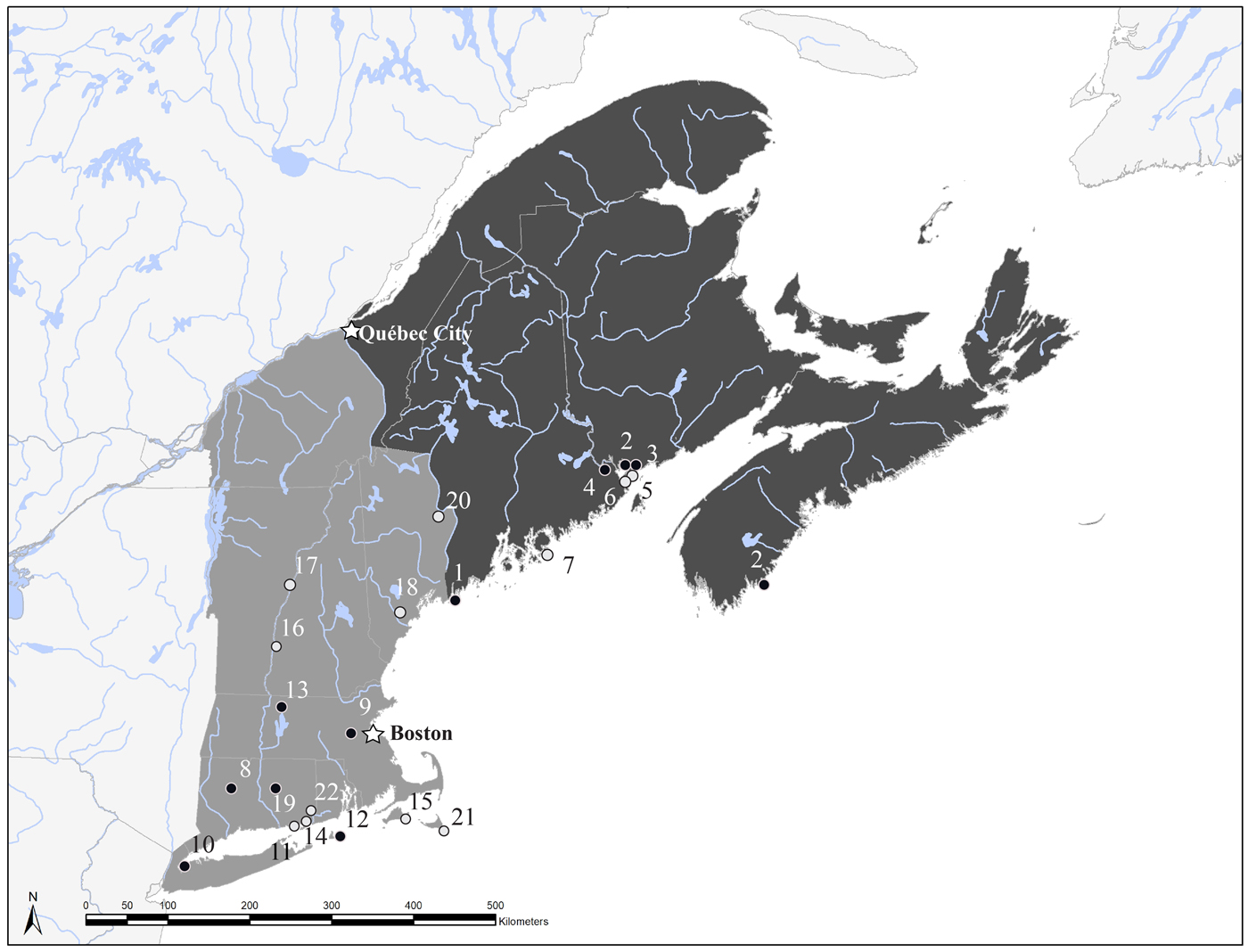
We address this question using a quantitative dwelling-scale approach comparing a region we call “archaeological New England”—which we define as including portions of New York and excluding most of Maine, based upon the geographic spread of maize in the Algonquian homeland—with coeval developments on the Maritime Peninsula, which includes the Gaspé Peninsula, as well as parts of Maine, and the Canadian Maritime Provinces (Figure 1), where maize was not adopted until after European contact. We compare dwelling size and shape because, cross-culturally, these factors tend to correspond to changes in sedentism and social organization. Examples from around the globe show that the adoption of horticulture has specific local effects on house size (Binford Reference Binford1990; Carleton et al. Reference Carleton, Connolly and Collard2013; Coupland and Banning Reference Coupland, Banning, Coupland and Banning1996; Ember Reference Ember and Ember2014; Hassan Reference Hassan1981; McGuire and Schiffer Reference McGuire and Schiffer1983; Robbins Reference Robbins1968; Ryan Reference Ryan2012; Steadman Reference Steadman2015; Warrick Reference Warrick2000; Whiting and Ayres Reference Whiting, Ayres and Chang1968; Wilk and Rathje Reference Wilk and Rathje1982; Wolff Reference Wolff2008:200–223). The present experimental design tests for correlation between dwelling size and maize horticulture in New England using the Maritime Peninsula as a control for environmental, temporal, cultural, and other variables, allowing us to eliminate their possible effects.
Map of study region discussed in this paper. The New England archaeological region is shown in light gray, and the Maritime Peninsula is shown in dark gray. The dividing line between the regions is the Kennebec River region of Maine, which approximately corresponds to the likely northern expanse of maize horticulture prior to European contact. Dots represent sites included in our analysis and correspond to Table 1. Black dots are sites from before 1000 BP, and gray dots are sites from after 1000 BP. Map prepared by the authors and Noah Fellman.

Problem Orientation: The Impact of Maize in Prehistoric New England
Despite recent critiques, an implicitly evolutionary notion of Woodland culture periods (sensu Griffin Reference Griffin1952, Reference Griffin1967; McKern Reference McKern1939) has retained potency in the archaeology of eastern North America (Chilton Reference Chilton, Pauketat and Loren2004; Leonard Reference Leonard1995; McBride and Dewar Reference McBride, Dewar and Keegan1987; Ritchie and Funk Reference Ritchie and Funk1973; Wiseman Reference Wiseman2005). In this formulation, the Woodland period in New England is marked by ceramic vessels, elaborated burials, economic intensification leading to horticulture, population growth, and increasingly sedentary lifeways. Social changes, such as a shift from patrilineal bands to matrilineal tribes, have also been proposed (Bendremer Reference Bendremer and Hart1999; Chilton Reference Chilton, Pauketat and Loren2004; Flannery Reference Flannery2002; Lavin Reference Lavin2013; McBride and Dewar Reference McBride, Dewar and Keegan1987). In New England, these developments are ultimately posited to lead to the establishment of “villages” modeled after Europe's Neolithic (see McBride and Dewar Reference McBride, Dewar and Keegan1987). The criteria offered for a village vary in detail, but they are usually modeled to exhibit at least near-year-round settlement of multiple families in close proximity and represent a broad range of activities (McBride Reference McBride1984:228–229). In New England and the Maritime Peninsula, the appearance of multiple multi-seasonally occupied, coterminous domestic features would be broadly interpreted to be a “village” by most archaeologists.
The constellation of traits that define the Woodland period did not occur synchronously in New England. Accumulated archaeological research is elucidating the interrelationship between these changes, encouraging new analyses of this period that implicate social factors in the development of the Woodland and changes within it (e.g., Chilton Reference Chilton and Hart1999; Hart and Lovis Reference Hart and Lovis2013; Hart and Means Reference Hart, Means, Hart and Rieth2002; Leveillee et al. Reference Leveillee, Waller and Ingham2006; Taché and Craig Reference Taché and Craig2015; Waller Reference Waller2000). Furthermore, despite early European settler reports of sedentary horticultural villages along the New England coast, these settlements have not been conclusively identified in the regional prehistoric archaeological record. Because of this paucity of data, there remain considerable questions about what the social and subsistence implications of maize horticulture were in New England.
It is generally accepted that although maize horticulture has a complicated history of domestication (Hart and Lovis Reference Hart and Lovis2013), substantive maize horticulture likely proliferated in the lower Connecticut River Valley, arriving from the southwest sometime in the Late Woodland Period (1300–500 BP), around 1000 BP (see Chilton Reference Chilton, Pauketat and Loren2004). There is some evidence to suggest that local native people may have been actively cultivating wild or, possibly, semidomesticated varieties of goosefoot (Chenopodium spp.; George and Dewar Reference George, Dewar and Hart1999; Gremillion Reference Gremillion1993). The earliest recorded example of charred Chenopodium dates to the Late Archaic, but it is absent from that period until the Late Woodland period, where it is found alongside maize (Zea mays) at several sites in Connecticut (George and Dewar Reference George, Dewar and Hart1999:125–131). Many Late Woodland sites in New England have yielded preserved maize and other evidence of maize horticulture (e.g., Bendremer Reference Bendremer and Hart1999:134; Cowie and Peterson Reference Cowie and Peterson1990; Currie Reference Currie1994; Hasenstab Reference Hasenstab, Levine, Sassaman and Nassaney1999:148–149; Heckenberger et al. Reference Heckenberger, Peterson and Sidell1992; Lavin Reference Lavin2013:222–223; Petersen and Cowie Reference Petersen, Cowie, Hart and Rieth2002). Indigenous people in New England maintained a broad-spectrum diet, even after the emergence of horticulture, with maize becoming a true staple crop only after the arrival of European settlers in the seventeenth century (Bragdon Reference Bragdon1996; Cronon Reference Cronon2013).
There has been less consensus about the cultural and economic significance of maize in prehistory. The central confounding factor in this debate is that Late Woodland horticultural villages have not been confidently identified in prehistoric New England, a phenomenon that has eluded confident explanation. Some scholars, notably Ceci (Reference Ceci1982, Reference Ceci1990), have suggested that there simply were no Late Woodland villages. This is consistent with some views of the Woodland that downplay the socioeconomic impact of maize. These models suggest that maize may simply have been treated as another more-or-less predictable botanical resource of comparable import to wild plants (see Bendremer Reference Bendremer and Hart1999; Bragdon Reference Bragdon1996; Chilton Reference Chilton and Hart2008) with Late Woodland people in New England continuing to be broad-spectrum foragers to the degree that they were effectively “mobile farmers” (Chilton Reference Chilton and Hart1999). Scholars have noted the continued relevance of such “wild” plant and animal species at archaeological sites both before and after the appearance of maize, as well as related domesticates such as beans and squash, and they have surmised that horticulture did not have the massive impact on subsistence, settlement, and social hierarchy that it did in regions to the west and south (Bendremer Reference Bendremer and Hart1999; Chilton Reference Chilton and Hart1999, Reference Chilton and Hart2008; McBride Reference McBride1984; McBride and Dewar Reference McBride, Dewar and Keegan1987).
Other scholars have suggested that the absence of prehistoric horticultural villages is an archaeological illusion, likely due to sampling bias, low archaeological visibility (e.g., Petersen and Cowie Reference Petersen, Cowie, Hart and Rieth2002:268), or sites’ destruction when Euro-American towns and cities were built (Hasenstab Reference Hasenstab, Levine, Sassaman and Nassaney1999:140–142). Bendremer (Reference Bendremer and Hart1999:143) argues that “large, essentially nonhorticultural, sedentary villages of logistically organized foragers were established in the lower Connecticut River valley and coastal region by the late Middle Woodland period” (also McBride Reference McBride1984). He goes on to argue that this may represent regional variation, in which inland peoples were more likely to aggregate, whereas coastal peoples remained largely mobile to exploit shellfish. Bragdon (Reference Bragdon1996) viewed similar regional variation in the Late Woodland not as indicative of separate populations but of the same groups of people practicing seasonal relocation to maintain the use of long-standing traditions of hunting and gathering alongside newly available horticultural resources.
Leveillee and colleagues (Reference Leveillee, Waller and Ingham2006) propose an intermediate hypothesis—a “dispersed” model for New England villages within which the activities of village life might be spread over a larger area than that which previous models appreciated, while at the same time retaining village sociality:
[T]he social landscape included collective communities, each characterized by a series of cooperative households within dispersed villages…characterized by domestic dwellings where nuclear and extended families lived and carried out activities primarily in support of their own household [Leveillee et al. Reference Leveillee, Waller and Ingham2006:85]
While more research is required at the landscape level to better evaluate this model, Leveillee and colleagues offer two Late Woodland sites as potential central places: RI-110 on Point Judith Pond, Rhode Island; and RI-2280 on Quonchontaug Pond (see Waller Reference Waller2000). They envision these sites and surrounding landscapes as likely corresponding to a dispersed village model, characterized by a variety of feature types and represented activities, plausibly associated with a political community consisting of core aggregations surrounded by residential “hamlets.”
A Comparative Approach Using Dwelling Features
Unlike villages, domestic architectural features are fairly prevalent in the archaeological record starting around 3400 BP during the Terminal Archaic in New England, and around 3000 BP at the beginning of the Woodland on the Maritime Peninsula. Although archaeologists have long been interested in Indigenous architecture in the greater Northeast (e.g., Matthew Reference Matthew1884; Sturtevant Reference Sturtevant1975), the landscape and “village” levels of settlement have received more archaeological and ethnographic attention in New England. (Notable exceptions are included in a 1984 issue of Man in the Northeast, which focused on New England households, both historic and prehistoric [Kerber Reference Kerber1988; Luedtke Reference Luedtke1988; Thorbahn Reference Thorbahn1988].) Throughout the Northeast, prehistoric dwelling construction is inferred via direct-historic analogy (Sanger Reference Sanger2010). On the Maritime Peninsula and in New England, early European accounts described small, oval, bark- or hide-covered wigwams with bent poles, fairly straight sides, and smoke holes (e.g., Heath Reference Heath1986:28–29; Le Clercq Reference Le Clercq1910:100–101; Sturtevant Reference Sturtevant1975; Thwaites Reference Thwaites1898:40–41; Wood Reference Wood1865:105–106; Wroth Reference Wroth1970:139; see Glick Reference Glick2013).
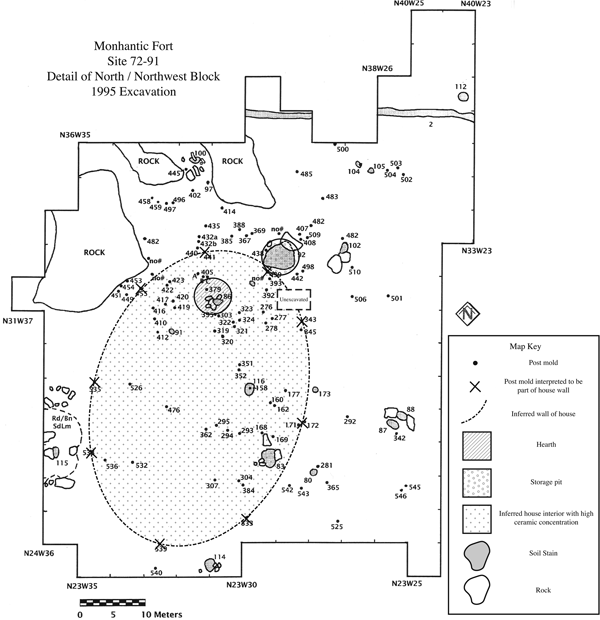
Here, we use the term “dwelling feature” to impart and subsume the excavators’ and our own inferences of features that represent past dwellings and correspond to the ethnographic accounts described above. Combined, these inferences are based on shape, minimum size, and activities represented within the features. In the Northeast, the categories of dwelling or house feature have developed inferentially and iteratively such that they must be treated as polythetic sets (sensu Clarke Reference Clarke1978:35–37). Accordingly, our analyses check reported features for defined dwelling attributes described elsewhere (e.g., Glick Reference Glick2013; Hrynick Reference Hrynick2018; Sanger Reference Sanger2010) while excluding suites of attributes for other structures such as sweathouses (e.g., Hrynick and Betts Reference Hrynick and Betts2014) or storage pits (e.g., Black and Whitehead Reference Black and Whitehead1988). Figure 2 provides an example of an archaeologically investigated dwelling feature from the site of Monhantic Fort in Mashantucket, Connecticut. This feature is included in the statistical analyses of this paper and is presented here as one example of how the houses in our dataset were originally interpreted as such. The Monhantic Fort feature was identified by several diagnostic archaeological signatures. As Figure 2 reveals, the archaeological block contained many post molds. Archaeologists isolated an ovoid pattern of posts within the palimpsest. That proposed feature was further delineated by the presence of an internal hearth and external storage pits as well as artifact concentrations that were strongly grouped on the interior and exterior of the house feature suggesting a dwelling wall, including an abrupt increase in the concentration of ceramics found on the inside of the inferred house (see Benard Reference Benard2005:27–40).
Plan drawing of an excavated domestic feature from the site of Monhantic Fort (CT 72–91) in Mashantucket, Connecticut. The dashed line represents the boundary of the house interpreted from post molds, internal and external features, and artifact concentrations. Numbers on plan drawing reference original feature numbers. Plan map is adapted from one provided by the Mashantucket Pequot Museum and Research Center, Akeia Benard, and Kevin McBride. Additions to map made by authors.

Dwelling features are a valuable scale of analysis because changes to their size and shape through time suggest shifts in settlement and subsistence strategies. Such changes are often similar to those that would be implicated in Woodland villages. Cross-culturally, dwellings tend to covary in form and size with changes in mobility, kinship, gender dynamics, and cosmology (Binford Reference Binford1990; Hrynick and Betts Reference Hrynick and Betts2017; Robbins Reference Robbins1968; Steadman Reference Steadman2015). In addition, dwelling features are more accessible proxies than whole villages for identifying changes in these factors due to their size and structural simplicity. Dwelling features are particularly comparable because they are ubiquitous and spatially bounded. Establishing the contemporaneity of dwelling features at a single site or in a dispersed area is difficult due to problems of archaeological scale, especially given the presently available radiocarbon inventory for New England (Dewar and McBride Reference Dewar, McBride, Rossignol and Wandsnider1992:227–252).
The Maritime Peninsula provides a close culturally related (i.e., Algonquian; Snow Reference Snow and Trigger1978) and environmentally similar hunter-gatherer case to control for other factors that could instigate changes in New England dwelling feature size. The Maritime Peninsula exhibits many Woodland traits also seen in New England in the last 3,400 years, including increases in burial ceremonialism, an increased reliance on shellfish as a food resource, decreasing mobility, and new technologies such as ceramics, bows, and watercraft (e.g., Betts et al. Reference Betts, Burchell and Schöne2017; Black Reference Black, Hart and Rieth2002; Bourque Reference Bourque1971; Bourque and Cox Reference Bourque and Cox1981; Leonard Reference Leonard1995; Petersen and Sanger Reference Petersen, Sanger, Deal and Blair1993; Turnbull Reference Turnbull1976). The notable and essential exception for this study is that while there is some evidence for the occasional gardening of groundnut (Apios americana; Leonard Reference Leonard1995) as well as the influence of traded domesticates or the occasional gourd (Cucurbita spp.; Petersen and Cowie Reference Petersen, Cowie, Hart and Rieth2002), all evidence suggests that domesticated plant species did not contribute substantively to diet on the Maritime Peninsula. People on the Maritime Peninsula did not adopt maize horticulture in any substantial way until after European colonization, despite an environment that would have permitted it (Leonard Reference Leonard1995). The Maritime Peninsula also provides a small but reasonably high-resolution dataset of dwelling features spanning the Middle and Late Woodland periods (Hrynick Reference Hrynick2018; Hrynick and Black Reference Hrynick and Black2016; Hrynick et al. Reference Hrynick, Betts and Black2012; Sanger Reference Sanger2010). As in New England, survey bias and issues of archaeological visibility have resulted in a Woodland period architectural dataset that is primarily coastal (Sanger Reference Sanger2010).
Methods
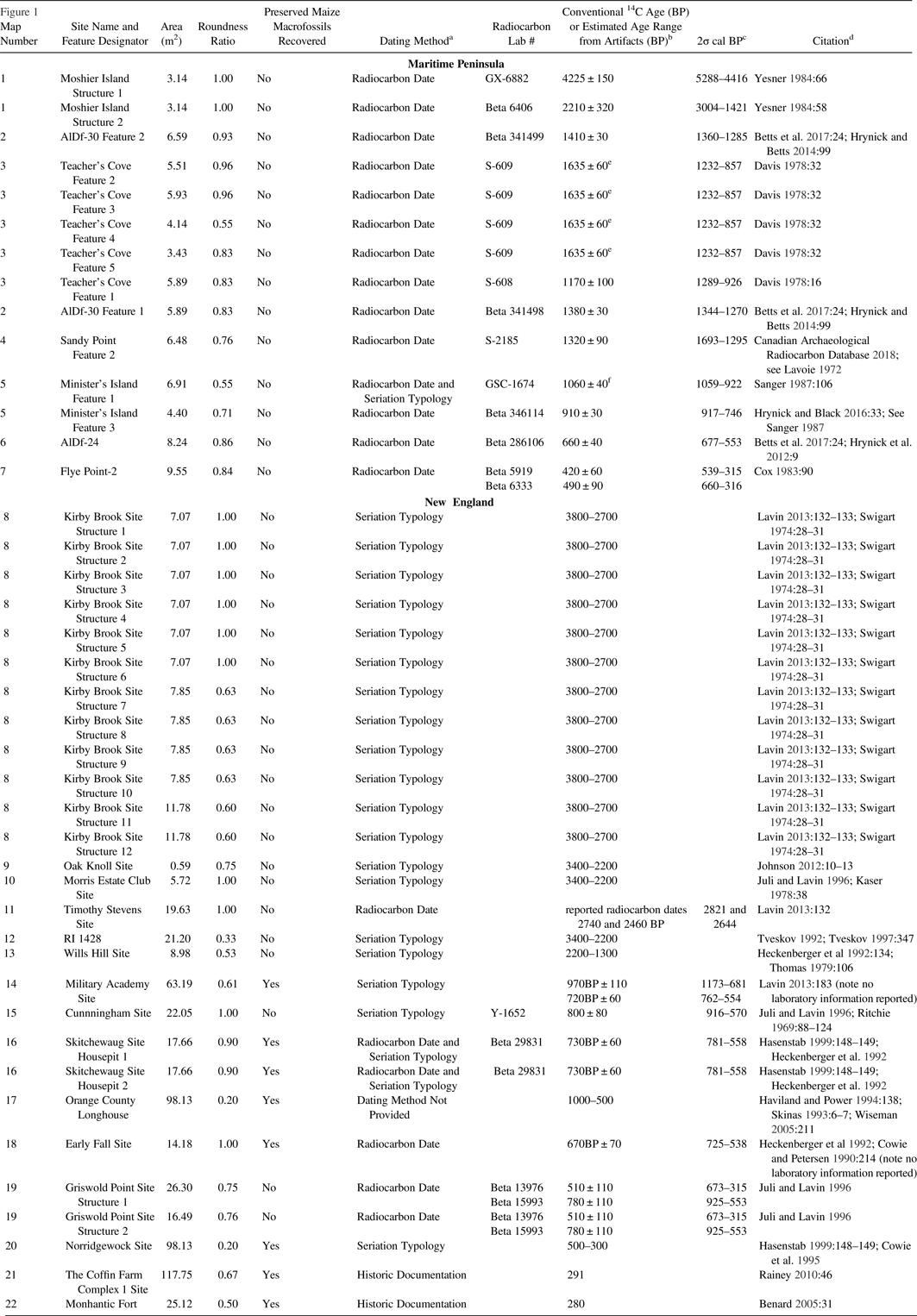
The authors compiled a database of dwelling features from New England and the Maritime Peninsula consisting of previously reported structures from published sources, “grey” literature, and original excavations (Table 1). These dwelling features were then sorted by date of occupation and region. In many cases, researchers provided associated uncalibrated radiocarbon dates, which we calibrated. For features without radiocarbon dates, we calculated the date of occupation using diagnostic projectile points, ceramic vessels or, in some cases, historical records. To make the data as comparable as possible, we relied exclusively on archaeological findings, excluding ethnohistorical sources that describe Indigenous houses in the contact period (see Glick Reference Glick2013). The addition of these sources would have skewed our analysis toward the latter periods and introduced a series of potential biases.
Fully or Nearly Fully Excavated Dwelling Features Considered in This Study, Including Derived Feature Area and Roundness Ratio. The map number indicates site location on Figure 1. Also reported is whether preserved maize macrofossils were found in association with each feature, a phenomenon that only occurred at New England sites after 1000 BP. Dating method, radiocarbon lab number, conventional and calibrated radiocarbon dates, estimated date ranges from artifacts, and citations are also reported.

aReported method used to date features. These dates have all been previously published. Some features were dated using radiocarbon dates, some by seriation typologies of diagnostic artifacts such as lithics or ceramics, some by a combination of the two, and others were dated using historic documentation. Note that, in some cases, only partial information was provided by previous researchers regarding radiocarbon dates.
bConventional radiocarbon age (± 1σ error) reported in radiocarbon years before AD 1950 (BP). All radiocarbon dates were previously published, and none were newly taken for the analysis in this paper. Non-radiocarbon dates in this column are derived from seriation typologies of diagnostic artifacts such as lithics or ceramics found in feature contexts or from historic documents.
cCalibrated with OxCal version 4.3 (Ramsey Reference Ramsey2009) using IntCal13 calibration curve from Reimer et al. Reference Reimer, Bard, Bayliss, Warren Beck, Blackwell, Bronk Ramsey and Buck2013.
dReference to original publication of each feature. Page numbers indicate the specific reference to radiocarbon dates.
eThis radiocarbon date was approximated by using the Marine13 curve (Reimer et al. Reference Reimer, Bard, Bayliss, Warren Beck, Blackwell, Bronk Ramsey and Buck2013) with a localized marine reservoir correction of 160 ± 60 BP from St. Andrews, New Brunswick (McNeely et al. Reference McNeely, Dyke and Southon2006) in order to make the shell date commensurate with charcoal and terrestrial bone dates.
fWe interpret this feature (following Sanger Reference Sanger1987) as Middle Woodland based on this radiocarbon date and the association with dentate motif ceramics (see Petersen and Sanger Reference Petersen, Sanger, Deal and Blair1993).
In order to approximately represent the widespread appearance of maize on sites in New England, the dwelling features were then categorized by date, splitting the dataset at 1000 BP. Prehorticultural period dwellings form the majority of the dataset and are thus used as the control group against which to compare dwelling features constructed after horticulture appears in New England. Because published information on dwelling feature size is unstandardized over 50 years of archaeological practice, both size variables have been derived strictly from two measures of dwelling diameter alone: length and width.
Next, the authors measured dwelling feature area and roundness by treating each dwelling feature shape as though it were an ellipse, using its length and width to calculate the semimajor and semiminor axes, respectively. Our assumption of elliptical shape thus calibrates all published literature, rendering our results comparable across the region. We calculated dwelling feature area by multiplying both radii together, then by π (Table 1). However, this measure does not accommodate the possibility of rounded rectangle-like houses with parallel sides. Consequently, it underrepresents nonelliptical dwellings at a scale exponential to increasing house area, a noted source of possible error.
In order to study shape, the authors created a “roundness ratio” by dividing the dwelling features’ semiminor axis by their semimajor axis. The closer the ratio is to 1.0, the more circular the feature, and the closer the ratio is to 0.0, the more elongated. These two dependent variables are subject to nonparametric (Table 2) statistical tests versus the independent variable of categorical time.
Summary of Prehorticultural Dwelling Shapes Shapiro-Wilk Test of Normality.

Before the introduction of horticulture to New England, neither dwelling area nor roundness values are normally distributed in this region (α = 0.05), regulating the present analysis. Maritime Peninsula dwelling feature area values show weak unimodal distribution in comparison, although not to a truly convincing degree.
Results
Before 1000 BP, the range of dwelling feature sizes in New England and on the Maritime Peninsula overlapped, but New England dwelling feature size was more variable. Overall, dwelling features in New England were larger (Mann-Whitney rank sum, p = 0.0003197) and size was more varied (Kruskal-Wallis χ2 = 13.122, p = 0.0002918). Dwelling feature size on the Maritime Peninsula was consistently smaller and more uniform.
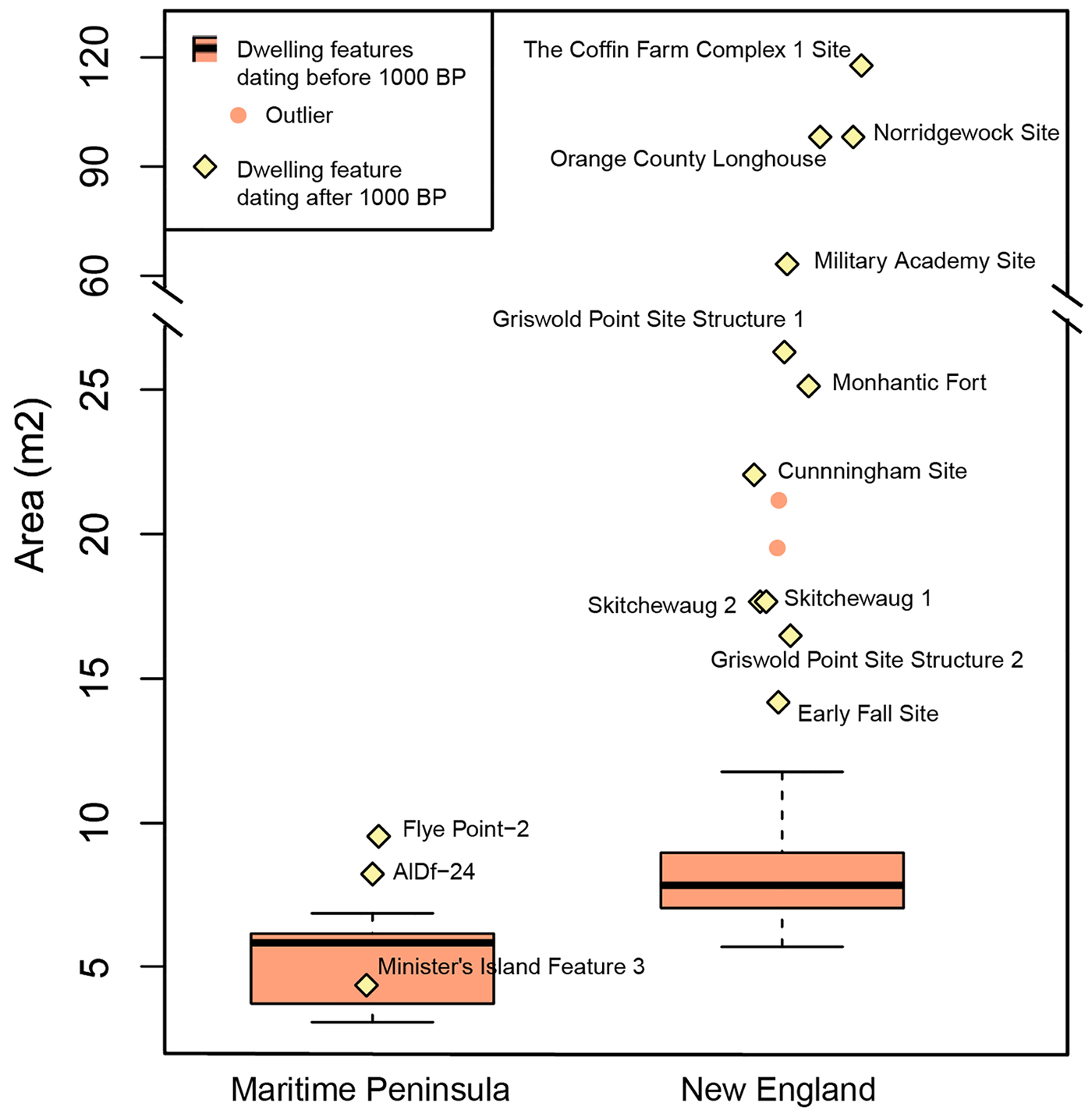
Figure 3 shows the results of a quartile analysis of dwelling size that compares the earlier and later temporal periods. This analysis navigates differing sample sizes between both the two temporal groups and two geographic regions. To begin, the assemblage of prehorticultural dwelling features is divided into quartiles and represented with a box-and-whisker plot with an interquartile range (IQR) calibrated to customary 1.5 IQR in order to determine outliers.
Sorted by region, dwelling features dating after the advent of horticulture in New England are plotted in comparison to area quartile ranges of dwelling features dating before it.

On the Maritime Peninsula, all dwelling feature areas fall within the designated 1.5 IQR with no outliers. In New England, two large dwelling features (Timothy Stevens, 19.63 m 2;RI 1428, 21.20 m 2) are considered outliers. The quartile analysis continues by plotting the location of dwelling feature areas atop this model, visualizing their relationship to the control group in order to determine which houses are within the established range and which would count as outliers.
On the Maritime Peninsula, there are only three dwelling features that date after 1000 BP at the time maize is present in New England. None of these were associated with recovered macrobotanical evidence of maize. This differs from the New England dataset, in which eight of the 11 post-1000 BP dwellings had evidence of maize macrobotanicals. Two of the Maritime Peninsula dwelling features are larger than any of those before this period (Figure 3: AlDf-24, 8.24 m 2; Flye Point-2,9.55 m 2). The size distribution here demonstrates a weak trend of increasing dwelling feature size into the Late Woodland period in both the Maritimes and in New England, although more excavation of whole dwelling features is needed to rigorously parse this phenomenon. Based on presently available data, a slight dwelling feature size increase in the Late Woodland period in the Maritime Peninsula was not correlated to the advent of horticulture, but rather occurred independently of it. Moreover, although we do not formally consider the ethnohistoric record here, we note that ethnographic accounts of dwellings on the Maritime Peninsula suggest that the average size of post-contact dwellings was consistent with prehistoric features dating back to 1000 BP (see Hrynick and Black Reference Hrynick and Black2016).
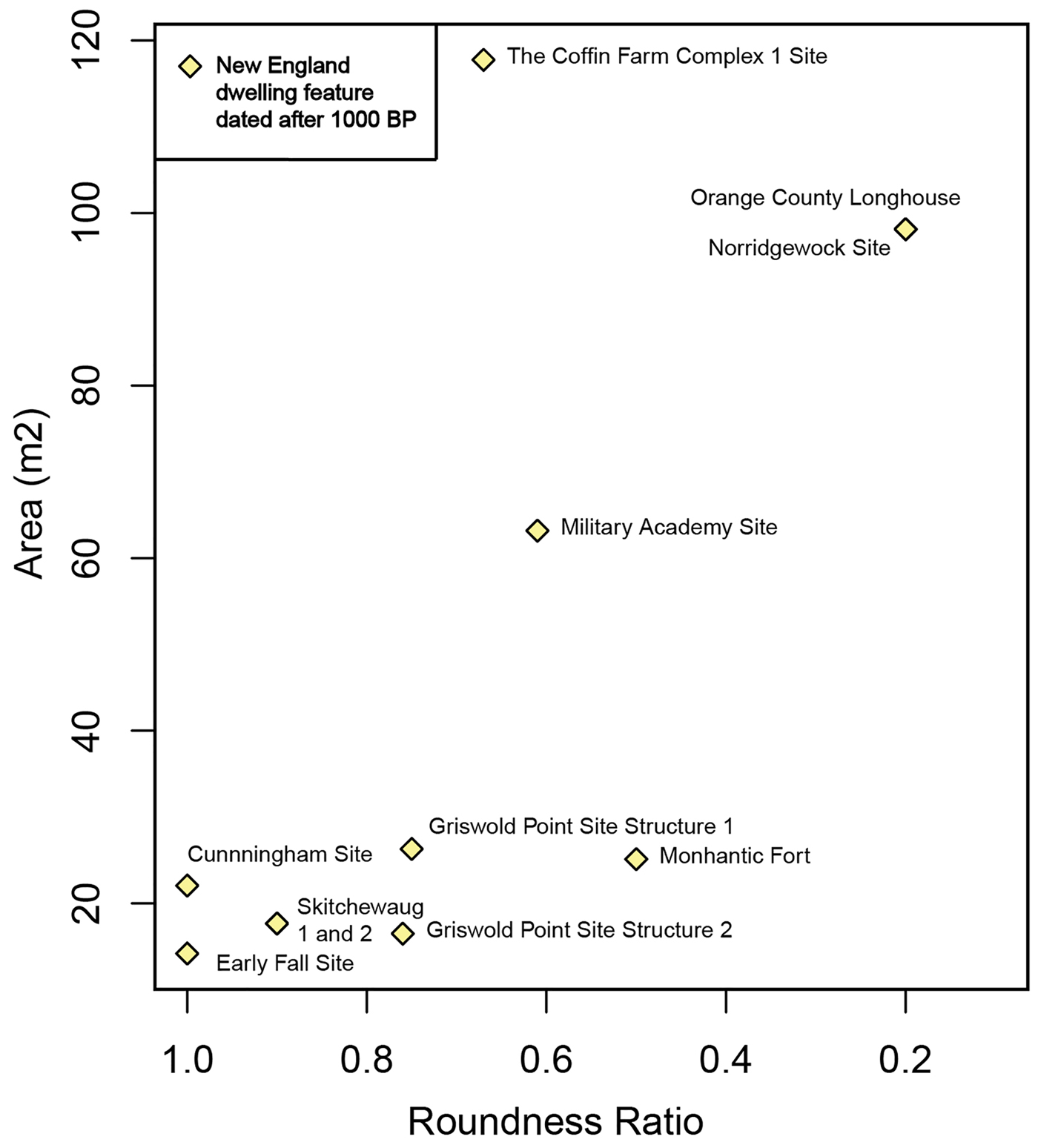
In New England, seven of the 11 dwelling feature sizes cluster around the two outliers from the period before the adoption of horticulture (Figure 3: Early Fall Site,14.18 m 2; Griswold Point Site Structure 1, 26.30 m 2; and 2, 16.49 m 2; Skitchewaug 1, 17.66 m 2,and 2,17.66 m 2; Cunningham Site, 22.05 m 2; Mohantic Fort, 25.12 m 2). The remaining four (Figure 3: Military Academy Site, 63.19 m 2; Norridgewock Site, 98.13 m 2; Orange County Longhouse, 98.13 m 2; The Coffin Farm Complex Site 1,117.75 m 2) are extreme outliers in this model. All dwelling features during this time are larger than any that were built in the Maritime Peninsula during the Woodland period. After 1000 BP, size ranges no longer overlapped between the two regions, even as they became larger on the Maritime Peninsula. Thus, a bimodal distribution of dwelling feature size emerges in New England with two distinct size-groups of dwellings: those that most closely resemble the largest of the dwelling features before the advent of horticulture and those that were much larger.
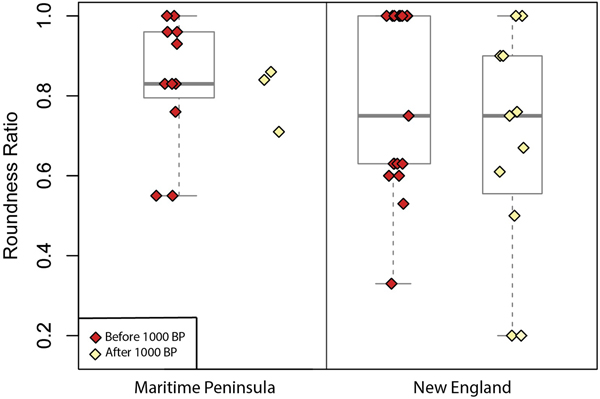
Dwelling feature shape is uncorrelated with region overall. As can be observed in Figure 4, it may appear that dwelling features in the Maritime Peninsula were consistently rounder, but this is not a statistically significant observation, and it may be attributed to an overall smaller sample size than in New England (Kruskal-Wallis χ2 = 0.3696, p = 0.5432).
Distribution of dwelling feature circularity by study region and temporal category, including a box plot of each dataset's quartile ranges when possible. As the dwelling's roundness ratio approaches 1, overall roundness increases. A dwelling with a ratio of 1 would be shaped like a circle. Dwelling features understood to be longhouses would have a low roundness ratio.

However, in New England, dwelling feature shape and size vary allometrically, with the four large dwellings among the most elongated (Figure 5). After the introduction of horticulture in New England, two of the four large dwelling features observed above have the lowest roundness ratios overall, being five times as long as they are wide and distinctly longhouse shaped (Figure 5: Orange County Longhouse and Norridgewock Site). The other two of the four largest dwelling features have roundness ratios below 0.7, making them among the most elongated of the total assemblage. Taken together, these four large dwellings are the size outliers defined above, and they are consistently more elongated than the other dwellings. The size and shape of dwellings covaried according to architectural and functional concerns: as dwelling size increased, the shape of the circular dwellings lengthened. This allometric relationship between shape and size of larger dwellings does not represent merely a larger version of a smaller phenomenon; it would have required a restructuring of interior space. It may have been based on architectural and structural needs, functional needs, or both, but the result is the same: a more fixed tradition of size and shape in the Maritime Peninsula than in New England.
Area and roundness are compared for New England dwelling features dating after 1000 BP.

Discussion
In New England, the two categories (large and small) of dwelling features we have parsed in our analysis act as a proxy for two significant modes of spatial organization and thus mobility. That the larger dwellings only occur after the adoption of horticulture indicates a correlative relationship but not necessarily a causal one. Results of this change in dwelling size include a marked difference in the scope of social and task potential associated with the act of practicing horticulture both within the dwelling and across the changed New England regional landscape.
The proliferation of maize horticulture in New England around 1000 BP coincides with increasing variability in dwelling size and shape in that region: some dwellings become larger and longer, while others remain smaller and rounder. These changes suggest, minimally, socioeconomic shifts coincident with the proliferation of maize. While the implications of these shifts in house shape and size require further examination, they are suggestive of some specific changes when considered in light of local context and cross-cultural studies of domestic architecture. In contrast, dwelling features on the Maritime Peninsula do not display an increasing range of variability at any point during our study window and were, by contrast, less prone to variations in form overall. In a region where horticultural practice was not adopted until after the arrival of Europeans, traditions associated with dwelling building were continuous.
Changes in the shapes and sizes of individual houses tend to correlate to changes in social and economic strategies. The changes we have identified have the potential to address open questions about the effects of maize on socioeconomic life in New England and the nature of village aggregation in that region. Cross-cultural ethnographic evidence provides some avenues to explore this specific regional context. In general, large and elongated houses are associated with socioeconomic factors consistent with horticultural villages, whereas small, oval structures tend to be associated with high mobility (Ember Reference Ember and Ember2014; Robbins Reference Robbins1968; Whiting and Ayers Reference Whiting, Ayres and Chang1968). When compared to oval house forms, elongated houses require more work and material to manufacture, but they require less maintenance than oval structures do (McGuire and Schiffer Reference McGuire and Schiffer1983; Ryan Reference Ryan2012:185–186). As a result, change from small oval structures to big, longer ones is usually, but not universally, associated with increasing sedentism. Moreover, large structures permit either multiple indoor tasks to be conducted concurrently, or for multiple people to be devoted to a single task at once. The latter scenario would occur annually during a short and intensive maize harvest as may have come to be practiced in New England. These internal differences extend into the larger regional social landscape surrounding the dwelling as well (Coupland and Banning Reference Coupland, Banning, Coupland and Banning1996:2–3; Groover Reference Groover2004; Ingold Reference Ingold1993; O'Sullivan and Nicholl Reference O'Sullivan and Nicholl2011; Wilk and Rathje Reference Wilk and Rathje1982). Importantly here, dwelling size affects people's tacit knowledge of the dwelling space in singular ways relative to their own experience, movement patterns, and social memory (Butler Reference Butler2011:71). Architectural variability—such as between large and small houses—may also correlate to social inequality (McGuire and Schiffer Reference McGuire and Schiffer1983:282), but it can be difficult to distinguish from task-specific features without careful consideration of associated artifact assemblages. It is notable that there are examples of complex hunter-gatherer cultures sometimes building very large houses meant for extended families (see Ames Reference Ames, Coupland and Banning1996), but houses of that type do not appear on the Maritime Peninsula. The presence of these houses in areas without agriculture implies that, at least in some cases, house growth can occur due to economic intensification and labor needs associated with, for instance, large-scale fishing enterprises (Ames Reference Ames, Coupland and Banning1996:145; Coupland Reference Coupland, Coupland and Banning1996:129).
The architecture of Iroquoian longhouses in New York and Ontario has been well documented. Studies from this region reveal intriguing parallels and contrasts to the New England and Maritime Peninsula datasets presented here. Warrick (Reference Warrick, Coupland and Banning1996:13–14) posits that “the adoption of corn horticulture by Middle Woodland people in Ontario and New York State about AD 700 did not appreciably alter the organization of households or communities.” Instead, it appears that house sizes grew gradually over time, with very large longhouses emerging in the region centuries after the adoption of maize agriculture.
Although two of the house features described herein (Orange County Longhouse and Norridgewock) are shaped like Iroquoian longhouses, they seem to share little resemblance otherwise. Typical contemporary Iroquoian longhouses had undivided interiors, storage pits at one end, and several internal hearths arranged along the center of the house (Warrick Reference Warrick, Coupland and Banning1996:11). The houses at Orange County and Norridgewock also lacked internal divisions. Beyond this, though, they bear little resemblance. Orange County had only one internal hearth, but Norridgewock had none. Orange County had no internal storage pits, while Norridgewock had three, which were spread throughout the house (Cowie et al Reference Cowie, Peterson and Bourque1995:30–31; Haviland and Power Reference Haviland and Power1994:138; Skinas Reference Skinas1993:6–7). Haviland and Power (Reference Haviland and Power1994:138) state that “on the basis of their unusual length…these [Orange County and Norridgewock] may have been longhouses….However, these features are quite unlike the remains of Iroquoian longhouses known elsewhere in the Northeast.” Warrick (Reference Warrick, Coupland and Banning1996:12) argues that the presence of multiple internal hearths is evidence of larger family households in Late Woodland and contact-period Iroquoian longhouses. The smaller number of internal hearths at Norridgewock and Orange County could imply that household family size remained low at these sites despite the overall increase of house area. There is no direct evidence at these sites that the houses were used to store large amounts of horticultural product, although evidence of maize was found at both.
A variety of possible interpretations could explain the shifts outlined above, including increasing political complexity, increasing social or economic stratification, changes in systems of kinship, and/or the emergence of true year-round sedentism, at least in some localities. The diversity of dwelling size and intrasite variability may be most consistent with a dispersed village model, in which large structures represent places of intensive, year-round activity and habitation, versus smaller structures, which may correspond to specific seasonal tasks associated with, for instance, maize harvesting or processing (Leveillee et al. Reference Leveillee, Waller and Ingham2006:82–83). Others have argued that the Late Woodland period in New England saw the emergence of an economic seasonal round (see Bragdon Reference Bragdon1996). A pattern within the data that may support either the dispersed village or seasonal round theories is that, despite the bimodal distribution of house sizes in post-maize New England, no site includes both large and small houses. It is possible that the sites within the dataset, being arbitrarily bounded in space, are capturing only portions of a dispersed village or part of a seasonal round where only large or small houses appear.
On the Maritime Peninsula, a case has been made for increasing sedentism and year-round occupation at some sites despite the lack of maize horticulture prior to European settlement (Betts et al. Reference Betts, Burchell and Schöne2017; Black Reference Black, Hart and Rieth2002; Nash and Stewart Reference Nash and Stewart1990). This trend suggests that maize was not the only social and economic driver of sedentism. The absence of dwelling growth and dwelling-size bifurcation in the Maritimes strengthens the assertion that maize horticulture played an important role in these processes in New England.
Conclusion
The proliferation of maize horticulture in New England occurred contemporaneously with quantifiable changes in architectural size and shape. This pattern contrasts with a lack of change in the dwelling features of the nonhorticultural Maritime Peninsula, suggesting that horticulture may have played a part in driving the substantial social changes archaeologists associate with village formation in New England, such as increased sedentism, year-round occupation, and diversification of task-specific structures.
More broadly, this research emphasizes the utility of examining dwelling features, a ubiquitous and comparable feature class that is more easily accessed archaeologically than villages. Moreover, comparing dwelling features to similar ones on different, coterminous sites as we have in this study avoids the issues of archaeological scale that have historically plagued attempts to study entire villages.
Acknowledgements
Funding for this research was provided in part by the National Science Foundation, the Harrison McCain Foundation, and the University of Connecticut. We thank Daniel Adler, Akeia Benard, Françoise Dussart, Brian Jones, Katherine Patton, Kevin McBride, Alexia Smith, Jay Waller and Megan Willison for comments on earlier versions of this paper and helpful discussions about the Late Woodland. Lauren Schroeder provided advice on our statistical approaches, while all final analytic choices remain our own. We thank Roberta Charpentier, Noah Fellman, and Allison Malloy of the Mashantucket Pequot Museum and Research Center for aiding in the production of some figures. We also thank the four anonymous reviewers and the editor for their comments and advice. Finally, we thank Alexandre Pelletier-Michaud for translating our abstract into French.
Data Availability Statement
An expanded dataset that includes partially excavated structures from these regions can be found online on tDAR at https://core.tdar.org/collection/69178/a-quantitative-dwelling-scale-approach-to-the-social-implications-of-maize-horticulture-in-new-england (tDAR id: 447016; doi:10.6067/XCV8447016).