Introduction
Many animals such as horses, primates and pigs spend a large portion of their daily activity budget in the search for and consumption of food in their natural habitats (Herbers, Reference Herbers1981). In captivity, food is generally offered to these animals and foraging opportunities are often restricted. As a consequence, captive animals spend less time feeding than their free-ranging counterparts. The reduction of the time spent foraging was associated with the emergence of stereotypies and abnormal behaviour in many species such as horses (McGreevy et al., Reference McGreevy, Cripps, French, Green and Nicol1995), pigs (Appleby and Lawrence, Reference Appleby and Lawrence1987), primates (Marriner and Drickamer, Reference Marriner and Drickamer1994), captive giraffe and okapi (Bashaw et al., Reference Bashaw, Tarou, Maki and Maple2001). Conversely, enrichment through devices where animals spend more time searching for food is associated with an increase of foraging time and a decrease of abnormal behaviour in porcine, equine and primates (Young et al., Reference Young, Carruthers and Lawrence1994; Goodwin et al., Reference Goodwin, Davidson and Harris2002). Data such as these made the increase of time spent foraging one of the main goals of environmental enrichment for several captive species.
This aspect is even more important in species such as horses which have evolved specific digestive physiology and anatomy around their natural diet and feeding behaviour of trickle feeding for long periods (Harris, Reference Harris1999). In the wild, the horse would spend up to 16 to 18 h a day foraging a high fibre and low starch diet and they rarely fast voluntarily for more than 2 to 4 h at a time (Harris, Reference Harris2005). The stomach volume of an adult horse is relatively small (9 to 15 l) and inelastic. Ingested food remains there for about 20 mn. The rate of gastric emptying is dependent on the square root of the volume. Large meals may therefore result in an increased rate of gastric emptying, an increased gut transit time and a decrease in the digestion of the available starch within the small intestine. This increases the risk of gastrointestinal disturbances due to changes such as the lysis of certain bacteria which release endotoxins that may be absorbed, increasing the risk of colic, diarrhoea and laminitis (Harris, Reference Harris1999).
All these arguments cited above support the hypothesis that reduced opportunities for foraging in captivity may be a source of stress and poor welfare for domestic horses. In a recent paper (Benhajali et al., Reference Benhajali, Richard-Yris, Leroux, Ezzaouia, Charfi and Hausberger2008), we drew up the behavioural repertoire and time budget of a dense group of Arab breeding mares (200 mares/ha) housed in individual boxes but allowed outside 6 h a day in a bare paddock where water and shelter were available. The study showed that in potentially inappropriate conditions of extreme social density and lack of foraging opportunities, the behavioural repertoire, the time budget and the social behaviour of the mares might be affected suggesting a state of a poor welfare. Here we test the possibility that these aspects can be improved by the increase of foraging opportunities.
Material and methods
Animals and study site
The experiment was conducted between the 1st April and 11th June 2006 at the national breeding facility of Sidi Thabet, located 20 km from Tunis, Tunisia. Mares are brought to this facility every year in order to be bred with the stallions housed there. They were housed in individual boxes at night where they received barley grain (4 kg per day) and hay (10 kg per day) every morning and evening (or evening only, see further). They were released every day from 0900 to 1500 h in a paddock where free access to water and limited shelter (five trees) were provided. No food was available then, but some freshly cut grass was left on the ground around 1400 h every day. It was generally entirely consumed by the mares in the following hour. Temperatures ranged from 7°C to 40°C during the experiment.
We used 100 purebred Arab mares, aged 4 to 21 years ( = 8.49 ± 4.96) among which 29 were maiden (had never been bred before) and the rest were barren (were not pregnant the previous season). They had been present at the stud for 1 week at least and 3 weeks at most. They were housed all the time in individual boxes before the experiment. None had been bred for the ongoing season on 1st April 2006. A plastic name tag attached to a collar was used for the identification of each mare.
Experimental procedure
The 100 mares were randomly divided into two groups:
• In the experimental group (N = 50), 50 haynets were hung in the paddock and filled with 5 kg of hay every morning before the arrival of the mares. Haynets were placed 3 m apart.
• In the control group (N = 50), no hay was provided in the paddock.
Some horses were familiar to each other before coming in these groups (six pairs in the experimental group and eight pairs in the control one). Both groups were kept in two similar bare paddocks (4350 m2) at the same density (115 mares/ha). As we were limited by the number of available paddocks for this experiment in the facility, it was not possible for us to replicate animal groups. All the mares were kept in individual boxes for the night under the same management conditions. However, the experimental mares received hay only in the evening while in the box, so that both control and experimental animals had the same total amount of food and differed only in their temporal distribution.
Data collection
Behavioural observations
Observations were made between 0900 and 1500 h and were performed for each mare using both focal and scan samplings (Altman, Reference Altman1974). Each mare was observed in three sessions of 20 min each, using focal sampling to record all social interactions and rare behaviour like rolling, eliminating and vocalisations. Scan sampling was carried out every 2 min (total = 33 scans per mare) to record the activity of the focused mare, the distance and identity of the closest neighbour. The distance of closest neighbour was measured in ‘horse lengths’ (contact, 0.5, 1, 2, 3 horse length from any part of the body of the focal animal). When this distance was greater than 3, the mare was considered as ‘isolated’. Preferred social partners were identified as the most frequently closest neighbours (more often than expected by chance) using chi-square tests (P < 0.05). Observations were additionally performed for 20 min twice a day (total = 31 sessions per group), during which all social interactions and rare behaviour were recorded (behavioural sampling). The ethogram used was that of McDonnell (Reference McDonnell2003). Locomotion includes exploratory, active walk, trot and gallop. We distinguished agonistic (avoidance, retreat, flight, head threat, kick threat, bite threat, bite and kick) and positive social (nose–nose contact, nose–body contact and allogrooming) interactions. The occurrence of pawing and interaction with the observer were coded as ‘other behaviour’.
Ethical point
The high animal density in this study was usual in this facility but this was not designed for research purposes.
Statistical analysis
Behavioural observations were recorded using Microsoft Office Excel 2003 software. Statistical analyses were conducted using the Statistica (v. 6.1; Statsoft, Tulsa, Oklahoma, USA) statistical program. All values are given as mean ± s.e. All the behavioural data were checked for normality and homoscedasticity, employing Kolmogorov–Smirnov and Levene Median tests. Kolmogorov–Smirnov tests indicated that even after data transformation only time spent feeding and time spent locomoting were normally distributed (P-values > 0.15 and 0.2 respectively) while homoscedasticity was not observed in all the samples (all P-values <0.01) which did not allow the parametric analysis of variance to be used in order to analyse the data (Sokal and Rohlf, Reference Sokal and Rohlf1995). Thus, the Mann–Whitney non-parametric (U) and chi-square (χ 2) tests were used to compare the groups. The confidence interval was 95% (P < 0.05). The bonferroni’s correction was used to correct for multiple comparison effects.
Results
A total of 300 focal sampling (6000 h), 3300 individual scan sampling (6000 h) and 62 group observations (1240 min) corresponding to 100 mares were recorded.
Repertoire and time budget
Behavioural repertoires tended to differ between both groups as some behaviours (allogrooming and lying down either lateral or sternal) were absent from the repertoire of all the control mares but present in the experimental group. Lying down was observed only four times (two times in lateral position and two times in sternal position) during the focal samplings and only in three experimental mares. Positive social interactions seen were allogrooming (only in the experimental group), nose–nose and nose–body contact (in the two groups). Six out of the seven allogroomings observed during the focal samplings in the experimental group occurred between preferred social partners.
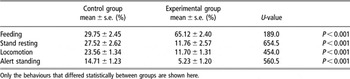
Individual scan samplings revealed significant differences in time budgets between the experimental and control mares (Table 1). Experimental mares spent three times more time feeding, twice less time in locomotion, stand resting and alert standing than the control mares (Mann–Whitney test, all P-values <0.001, Table 1).
Time budget of observed mares: mean percentage of scans spent in the different activities ± s.e.

Only the behaviours that differed statistically between groups are shown here.
Except for lying down which was observed only in the experimental group (0.08 ± 0.42), there was no significant difference between the two groups in the occurrence of drinking (0.40 ± 1.20 in control group v. 0.49 ± 1.10 in experimental group), defecating (0.40 ± 1.20 in control group v. 0.30 ± 0.91 in experimental group), urinating (0.10 ± 0.50 in control group v. 0.18 ± 0.70 in experimental group) and rolling (0.18 ± 0.70 in control group v. 0.10 ± 0.63 in experimental group) (all P-values >0.05).
Social behaviour
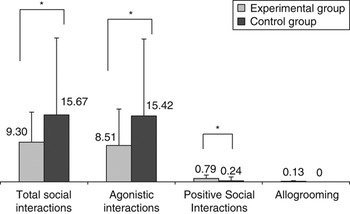
The frequency of social interactions observed during individual focal samplings was significantly higher in the control group (Figure 1). Experimental mares performed fewer social interactions per hour per mare than the control mares and while positive social interactions were relatively scarce in the two groups, they were significantly more frequent in the experimental one (P < 0.01, Figure 1). On the contrary, social interactions observed in the control group were primarily agonistic (Figure 1). Results obtained showed that there was significantly more bonding (between peers) in the experimental group than in the control one. Twenty-six experimental mares v. only 14 in the control group had a preferred social partner (χ 2 = 5.54, P < 0.05). The experimental mares showed allogrooming 0.13 ± 0.62 times per mare per hour on average while control mares were never seen allogrooming.
Frequencies per mare per hour of social interactions, agonistic interactions, positive social interactions and allogrooming observed during focal samplings (columns show mean ± s.e., significant differences (P < 0.05) are indicated by the symbol *).

Discussion
The present study where one densely housed group of mares was given the opportunity to forage ad libitum on hay in a bare paddock shows that this simple procedure had important consequences on their behaviour and welfare as compared to control mares which lacked this opportunity. Thus, the experimental group spent more time feeding, less time alert standing, stand resting and locomotion and had less agonistic interactions, more positive social interactions and bonding between mares.
The increase of the time spent foraging in the experimental group can of course be explained by the availability of hay in the experimental paddock and may explain the observed decrease of the time spent stand resting as also observed by Duncan (Reference Duncan1980) and Boyd and Bandi (Reference Boyd and Bandi2002). The lower time spent in locomotion and in alert standing in the experimental group could be a sign of a lowered level of stress in this group. Indeed, locomotion increases in stressful conditions (Houpt and Houpt, Reference Houpt and Houpt1989) and vigilance behaviour such as alert standing may be an indicator of acute (Morgan and Tromborg, Reference Morgan and Tromborg2007) or chronic stress (Carlstead et al., Reference Carlstead, Brown and Strawn1993) and are used to assess emotionality in horses (Wolff et al., Reference Wolff, Hausberger and Le Scolan1997).
In addition, the increase of foraging opportunities in this study had led to a decrease in the level of agonistic behaviour bringing it closer to that found in pastured and free-ranging horses (Clutton-Brock et al., Reference Clutton-Brock, Greenwood and Powell1976; Wells and von Goldschmidt-Rotschild, Reference Wells and von Goldschmidt-Rotschild1979; Boyd, Reference Boyd1988) which also may be a sign of better welfare (Waring, Reference Waring2003). Similar results were found in primates (Chamove et al., Reference Chamove, Anderson, Morgan-Jones and Jones1982), pigs (Beattie et al., Reference Beattie, O’Connell and Moss2000), rats (Johnson et al., Reference Johnson, Patterson-Kane and Niel2004) and laying hens (Huber-Eicher and Wechsler, Reference Huber-Eicher and Wechsler1998). Giving mares the possibility to forage also led to an increase in the level of positive social behaviour. Data on environmental enrichment effects on positive social behaviour are scarce and conflicting. Feeding enrichment for primates increased positive social interactions in some trials (e.g. Ludes and Anderson, Reference Ludes and Anderson1996) but decreased them in other trials (e.g. Byrne and Suomi, Reference Byrne and Suomi1991). The provision of a nest box increased fighting and plasma corticosterone in mice, but also improved immune system function and increased the frequency of positive social behaviour (Marashi et al., Reference Marashi, Barnekow, Ossendorf and Sachser2003).
The low level of positive social behaviour in the control group and in particular the absence of allogrooming, a very general characteristic of horse groups (e.g. Sigurjónsdóttir et al., Reference Sigurjónsdóttir, van Dierendonck, Snorrason and Thórhallsdóttir2003) may be explained by the rarity of bonding as it is generally performed by preferred social partners (e.g. van Dierendonck et al., Reference van Dierendonck, Sigurjonsdottir, Colenbrander and Thorhallsdottir2004). Here, while distance between haynets may have favoured closer proximity between mares, it does not explain by itself the preferences for social partners, clearly enhanced in the experimental group. Even though the time spent allogrooming in the experimental group remains lower than those reported in domestic (Sweeting and Houpt, Reference Sweeting and Houpt1987; 2%) and Przewalski horses (Boyd et al., Reference Boyd, Carbonaro and Houpt1988; 2.2%), it may reveal, in addition to the higher level of bonding, a stronger social structure in the experimental groups (van Dierendonck et al., Reference van Dierendonck, Sigurjonsdottir, Colenbrander and Thorhallsdottir2004) which is now being recognized, in horse behaviour research, as important for the well-being of domestic horses (Feh, Reference Feh2005).
Group replication, which was not possible in this study, is certainly important to dissociate the effect of the treatment from that of the group composition. However, this does not preclude the fact that this study can be a source of important reflection as some previous studies (Cockram et al., Reference Cockram, Kent and Goddard1996). As mares were randomly assigned into groups, it is unlikely that the initial composition of the groups plays an important role in the differences observed in this study.
Conclusion
This study in a densely housed group of mares shows that the increase of time spent foraging affects the behavioural repertoire, time budget and social behaviour of mares, bringing them closer to their natural state. Behavioural changes generated by the increase of foraging opportunities seem to indicate a better welfare in the treated mares. To our knowledge, this is the first study showing the effect of foraging opportunities on social behaviour of domestic horses and to suggest that the amount and quality of social interactions may be a useful behavioural indicator of welfare assessment in this species.
Acknowledgements
The authors wish to thank all the staff of FNARC (Fédération Nationale d’Amélioration de la Race Chevaline, Tunisia) for providing the facilities to complete this study. They are also grateful to Miss Alice Deboyer des Roches for her help in doing this experiment and to Mrs Jane Hall for correcting English.