


1. INTRODUCCIÓN
Los investigadores en historia económica han prestado atención a la economía argentina de fines del siglo XIX y principios del XX. Período que, dado el gran crecimiento económico, algunos historiadores denominan «La Gran Expansión»Footnote 1 . En este proceso, uno de los momentos más críticos fue la crisis de 1890, también llamada «Crisis Baring». El debate sobre esta ha sido fructífero y se han brindado sólidas argumentaciones acerca de las causas, el boom de la economía argentina en la década de 1880 y la recuperación en la década siguiente, especialmente hacia 1900Footnote 2 . La crisis de 1890 se investigó para comprender algunas de las características de la gran transformación, así como para analizar el impacto que tuvo sobre los diferentes sectores sociales y productivosFootnote 3 . Además, en muchos sentidos, se percibió como una divisoria de aguas, por lo que se han abierto varios debates historiográficos entre los que destaca, por su impacto en la situación de la clase obrera, el de la evolución de los precios y los salarios.
La historiografía sobre el movimiento obrero remarca que la crisis habría generado una profunda caída en las condiciones de vida de los obreros, por el descenso en los salarios reales y el incremento del desempleo. Estas argumentaciones se sostienen en las observaciones de los contemporáneos, así como en algunos indicadores macroeconómicos. Por otro lado, parte de la historiografía económica ha interpretado, con los datos de precios y salarios, que los historiadores del movimiento obrero sobredimensionaron el impacto de la crisis. En el marco de estas discusiones, se debatió acerca de la evolución de los salarios reales y los flujos migratorios. Otro tema, no menor, gira en torno a la posibilidad de proyectar los datos y el análisis de la economía de Buenos Aires a la totalidad de la República Argentina. Además, en los últimos años, se asiste a una renovación historiográfica en los estudios de precios y salarios en Latinoamérica, en particular los referidos al siglo XIXFootnote 4 .
Teniendo en consideración lo anteriormente mencionado, en este trabajo se realiza una revisión de la evolución de los precios y los salarios entre 1882 y 1900. Para ello, el punto de partida es una revisión y discusión de las series y fuentes utilizadas por la historiografíaFootnote 5 : al disponer de nuevas fuentes, se presentan series de precios y salarios. Esto permite avanzar en la discusión sobre el tema, así como aportar una nueva perspectiva sobre la evolución de esos indicadores y su comportamiento durante la crisis de 1890. Como hipótesis central, se propone que los salarios reales no sufrieron en gran medida los efectos de la «Crisis Baring», y que los cambios en el mercado de trabajo podrían explicarse por la evolución de otras variables.
2. DEBATES, PERSPECTIVAS Y FUENTES DE PRECIOS Y SALARIOS EN LA CIUDAD DE BUENOS AIRES A FINALES DEL SIGLO XIX
La disponibilidad de estadísticas oficiales que tengan continuidad a lo largo de los años es posterior al inicio del proceso de transformación estructural de la economía argentinaFootnote 6 . Recién con la creación del Departamento Nacional del Trabajo en 1904 (en adelante DNT) se dispone de estadísticas oficiales y continuas acerca de los patrones de consumo de los sectores obreros y las consiguientes series de precios y salariosFootnote 7 . Cabe remarcar que el DNT tenía jurisdicción sólo sobre la Ciudad de Buenos Aires y los territorios nacionalesFootnote 8 .
Es por lo anterior que las primeras investigaciones sobre precios y salarios en Buenos Aires durante la gran expansión debieron hacer uso de las informaciones de las fuentes contemporáneasFootnote 9 . Estos esfuerzos son los que se observan en los trabajos de Williams (Reference Williams1920), Dorfman (Reference Dorfman1942), Pannetieri (Reference Panettieri1966) y Spalding (Reference Spalding1970), entre otros. Se puede observar que estos acercamientos, predominantemente desde la historia social, tienen como foco de interés comprender y analizar la situación de los trabajadores y del movimiento obrero durante el periodo. La visión resultante —tanto desde estos datos dispersos como desde fuentes cualitativas— muestra un profundo y duro impacto de la crisis en los sectores trabajadores de la Ciudad de Buenos Aires.
En la década de 1970, Cortés Conde (Reference Cortés Conde1979) publicó series de precios y salarios para el periodo 1880-1914 sobre la base de fuentes sólidas y continuasFootnote 10 . Recopiló los precios de fuentes oficiales, en gran parte de la Municipalidad de la Ciudad de Buenos Aires. Para el periodo entre 1880 y 1904, trabajó con los salarios de empleados (peones) municipales y de obreros de la empresa Bagley. Desde ese año en adelante, empalmó sus series con las elaboradas por la División de Estadística del DNT. Este trabajo aportó una nueva perspectiva acerca del periodo. Con un enfoque desde la historia económica, en el marco de los análisis económicos neoclásicos, Cortés Conde entiende que la visión de los contemporáneos es exageradaFootnote 11 . Si bien la crisis tuvo impacto en la economía, el autor observa que el mercado de trabajo funcionó de manera libre y tuvo una rápida recuperación.
Estas series las utilizan tanto investigadores argentinos como extranjeros para analizar la economía del periodo. Como ejemplo, véanse los trabajos de Camou (Reference Camou1996), Maddison (Reference Maddison1997), Taylor (Reference Taylor1997), WilliamsonFootnote 12 (Reference Williamson1999), Della Paolera y Taylor (Reference Della Paolera and Taylor2003), Galiani y Gerchunoff (Reference Galiani and Gerchunoff2003), Bertola (Reference Bértola2005), Godio (Reference Godio2005), Iñigo Carrera (Reference Iñigo Carrera2007) y Ferreres (Reference Ferreres2010), entre muchos otrosFootnote 13 .
Los trabajos de Cortés Conde renovaron varios debates e iniciaron otros. Uno de los debates originados es acerca de las causas y consecuencias de la crisisFootnote 14 . En segundo lugar, se reabrió la discusión en torno al impacto de la crisis en el nivel de vida de los trabajadores. A grandes rasgos, se observa que hay dos posiciones historiográficas: por un lado, una serie de investigaciones sobre los trabajadores y el movimiento obrero, desde la historia social, que presentan una perspectiva «pesimista»; por otro lado, los trabajos de Cortés Conde y los que continúan la misma línea, en el marco de la historia económica, con una perspectiva «optimista»Footnote 15 .
Un punto no menor en esta discusión es el uso de las cifras sobre inmigración en la Argentina, ya que en 1891, por única vez en el periodo, hubo saldo migratorio negativo. Al contar con las series de Cortés Conde, se realizaron trabajos que fundamentaron parte de su argumentación sobre el comportamiento de las migraciones sobre la base de los salarios reales en Buenos Aires y en los lugares de origenFootnote 16 .
Por otra parte, se renovó el interés en calcular los salarios reales de los trabajadores durante los años de la crisis. Las posiciones «optimistas» y «pesimistas» buscaron interpretar si la situación de los obreros fue tan grave como sugieren las fuentes contemporáneas o si más bien hubo una recuperación de los salarios reales (tanto por la recuperación de la economía como por la caída en el ingreso de inmigrantes y el ascenso de la emigración).
Así, algunos entienden que hubo un rápido ajuste del mercado de trabajo, siguiendo los datos de Cortés CondeFootnote 17 . De manera contraria, otros investigadores observan una caída severa en el nivel de vida, que alcanzó hasta finales del siglo. Esta segunda interpretación, que también utiliza las series de Cortés Conde, se apoya más en las fuentes contemporáneas como Buchanan (Reference Buchanan1965), Patroni (Reference Patroni1897) y Palacios (Reference Palacios1988), en conjunción con la evolución de la conflictividad obrera expresada en medidas de protesta como paros y huelgas, y el crecimiento de la desocupación (Suriano, Reference Suriano2003)Footnote 18 . Más recientemente, los trabajos de Salvatore (Reference Salvatore2007) han mostrado resultados sobre la evolución de los indicadores de estatura de la población en Buenos Aires a fines del siglo XIX. Se observa que la población carcelaria habría disminuido de estatura con motivo de la crisis de 1890, así como por los problemas agrícolas de 1892-1893Footnote 19 .
Para complicar aún más los debates, se deben tener en cuenta las falencias en las fuentes y series de precios y salarios para la Argentina a finales del siglo XIX, entre las que cabe señalar la escasez de información sobre las provinciasFootnote 20 y la falta de información seriada, continua y homogénea sobre precios y salarios rurales. Con respecto a la primera dificultad, varios trabajos que utilizan series de precios y salarios de la Ciudad de Buenos Aires las consideran representativas de la situación de la totalidad del territorio argentinoFootnote 21 . Cabe preguntarse, entonces, si se puede interpretar que los precios y salarios de Buenos Aires pueden considerarse como representativos y relevantes de la totalidad del territorio de la Argentina a finales del siglo XIX.
Los argumentos justificativos para extender el análisis de precios de Buenos Aires como representativos de la totalidad del país se pueden basar tanto en características económicas y políticas como de factibilidad y abundancia de fuentes. Desde el punto de vista económico, se podría argumentar que la Ciudad de Buenos Aires, por sus características económicas y su «peso» relativo en la economía agroexportadora, así como su contribución al producto bruto interno del país, podría ser representativa de casi la mayor parte de la actividad económica nacional. Por otro lado, se podrían considerar las características de la ciudad (en tanto centro consumidor) y la distribución de la población con respecto al resto del país. En este último aspecto, se ponderaría la relación entre la población porteña con respecto al total de la población del país, en especial con respecto al caudal inmigratorio en algunos periodos. En el mismo sentido también se podría considerar que, en gran parte, la historiografía toma los datos de industrias y organizaciones obreras de la Ciudad de Buenos Aires para la historia industrial y del movimiento obrero.
Desde el punto de vista del consumo, la Ciudad de Buenos Aires era el mercado donde afluían muchos productos regionales. Por lo tanto, sería posible considerar que los precios de dichos productos en Buenos Aires serían, en cierta medida, representativos de los precios en las provincias. Podrían considerarse dos casos: el del vino mendocino (al oeste de la Argentina) y el del azúcar del norte del país. Hay que considerar también que de la Ciudad de Buenos Aires se han conservado más registros estatales y privados que de otras ciudades, lo que permite acceder a más cantidad de fuentes para la elaboración de series de precios y salariosFootnote 22 .
Podría parecer que algunos de los argumentos expuestos en los párrafos anteriores son más consistentes que otros; sin embargo, hay que tener en cuenta otros elementos. Con respecto a los salarios, para tomar los sueldos en Buenos Aires como representativos de la totalidad del país, un argumento que se debe considerar es que los sueldos de los empleados del Estado nacional en las oficinas que tiene éste en las provincias fueron, en principio, los mismosFootnote 23 .
No obstante, en un amplio territorio como el de la República Argentina existían diferentes realidades macro y microeconómicas, obviamente asentadas sobre diferencias en matrices económicas de lo que se denomina «economías regionales», que se sustentan en las diferencias de producción y comercialización. En pleno periodo de expansión de las redes de transporte, estas no cubrían todo el territorio; además, cada región tenía una matriz productiva y producciones diferentes, así como patrones de consumo propios.
Aunque desde fines del siglo XIX se consolida un proceso de construcción de un mercado nacional, esto no implica la equiparación o igualación de todos los mercados y las realidades económicas, no solo en términos de distancia sino también de distintas productividades. De ahí que se pueda observar una diferencia de precios entre Buenos Aires y otras ciudades del país, tanto en los productos locales, como en los de otras provincias y en los productos importados. Esta diferencia estaría determinada por la distancia entre el lugar de producción y los mercados de comercialización y consumo. En segundo lugar, estaría determinada por las diferencias de productividad y de costos, y en relación con la distancia y la logística (Cuesta, Reference Cuesta2014b).
Por otro lado, un elemento que hay que tener en cuenta es la presencia de distintas canastas de consumo, según las características particulares de cada espacio, originadas en raíces culturales, climáticas, etcétera, entre las diferentes regiones y ciudades. Podría pensarse que estas diferencias en las canastas de consumo habrían tendido a reducirse, en tanto se avanzaba en la conformación de un mercado nacional y en la consolidación del Estado, y que implicarían ciertos patrones de homogenización de los consumos. Aun así, se podría revisar la tendencia a interpretar las canastas de consumo de la Ciudad de Buenos Aires como de alcance «argentino»Footnote 24 .
3. FUENTES Y METODOLOGÍA
Para este trabajo, se construyó una serie de salarios nominales a partir de los salarios de los peones ferroviarios —categoría que corresponde a obreros no cualificados— que trabajaban en la Ciudad de Buenos Aires. Los datos se recopilaron de los libros de sueldos y las fichas de trabajo disponibles en el Archivo de Ferrocarriles Argentinos (en adelante, AFFCCA)Footnote 25 . Los ferrocarriles eran las empresas más grandes de la Argentina en el periodo, tanto por su capital como por la cantidad de empleados. Durante la década de 1880, gran parte de ellos, que eran de propiedad o gestión estatal, se privatizaron. Los salarios pagados por estas empresas, comparativamente, eran superiores a los de otras y a los estatales. En parte porque algunas categorías de obreros tenían un alto nivel de sindicalización, sobre todo entre los conductores y entre los obreros de los talleres. Por otro lado, prestaban un servicio de centralidad evidente en el crecimiento de la economía.
Para este trabajo se recopilaron los salarios de los peones ferroviarios, obreros no cualificados, que no estaban sindicalizados, en el momento de ingreso (level entry)Footnote 26 . Estos salarios de ingreso son inferiores a los de los trabajadores con cierta permanencia laboral. Si bien, el nivel de sindicalización impactaba en los salarios de los obreros ferroviarios en general, el nivel del salario de ingreso de los peones, y sus fluctuaciones, estaban más relacionados con las condiciones del mercado de trabajo y, en especial, de la evolución de la demanda de peones por parte de los ferrocarriles. Por ello, se considera que los datos presentados aquí son significativos y representativos de las condiciones del mercado de trabajo no cualificado en la Ciudad de Buenos Aires.
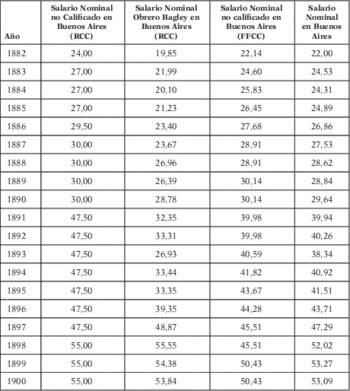
Los datos anuales recopilados poseían cierta dispersión, por lo cual se calculó la media simple sobre el 70% de los datos anuales, eliminando los datos que estaban en el 15% superior e inferior de cada muestra anual. Cuando se comparan los salarios nominales recopilados en el AFFCCA con los presentados por Cortés Conde (Reference Cortés Conde1979)Footnote 27 , se observa que los primeros son menores que los segundos (véase Tabla 1 en el Apéndice). Esto se explica porque se trabaja con salarios de peones ferroviarios al ingreso. Con los datos de salarios de Cortés Conde (Reference Cortés Conde1979) y las nuevas series de salarios trabajadas aquí, se presenta más adelante una nueva serie de salarios nominales para la Ciudad de Buenos Aires, que fue construida con la media simple de los datos de peones municipales, de los datos de obreros de Bagley y de peones del ferrocarrilFootnote 28 . Esta nueva serie de salarios, que integra salarios estatales, de obreros de la alimentación (Bagley) y de obreros del ferrocarril, posibilita una imagen más completa y representativa, puesto que permite observar tres sectores importantes de la economía: transporte, industria y Estado.
Las series de precios se recopilaron de diferentes fuentes. Las series del pan, la carne y la leche se construyeron con la información de las compras de estos productos que realizó la Municipalidad de la Ciudad de Buenos Aires para abastecer a los hospitales municipales. Aunque son series de precios al por mayor, se entiende que deben seguir de manera estrecha la evolución de los precios minoristasFootnote 29 . La serie de precios de la ropa se recopiló de los datos sobre compras de vestuario realizadas por la municipalidad de la Ciudad de Buenos Aires, para su personal uniformado. Hay que tener en cuenta que se trata de compras al por mayor, de carácter gubernamental y de vestimenta estandarizada. Sin embargo, es más que razonable suponer que la evolución de estos precios seguía los mismos patrones y se comportaba igual, en sus costos y nivel, que la ropa habitual o de uso común, a precios de minorista.
La construcción de la serie de costo de alquiler de vivienda posee complicaciones adicionales. En los documentos de la municipalidad de la Ciudad de Buenos Aires se conservan registros del costo de los alquileres en la ciudad, para diferentes tipos de viviendas-habitación en diferentes sectores de la urbe. Esto dificulta la confección de una serie del costo de vivienda, dado que los registros son numerosos pero heterogéneos, tanto sobre sus características como sobre la ubicaciónFootnote 30 . Al respecto, un promedio simple de los registros no es significativo, ya que la muestra no es lo suficientemente homogénea. Por eso, se utilizó el libro de alquileres del convento de Santo Domingo, entidad religiosa que alquilaba habitaciones, construidas ad hoc, en las inmediaciones de su edificio principal. Los alquileres percibidos por la organización religiosa correspondieron a habitaciones que mantuvieron sus características a lo largo del periodo, más allá de mejoras menores y reparaciones.
De los registros de esta misma entidad, en relación a los gastos cotidianos, se recopiló la información sobre el precio del vino. Esta última serie se comprobó comparándola con los precios del vino en Mendoza (principal lugar de producción), disponibles en diferentes fuentes (Cuesta, Reference Cuesta2014b). Esto demostró que la serie tenía consistencia, entre el precio en el lugar de producción y el precio en la Ciudad de Buenos Aires.
Las series de precios del pan y la carne se compararon con las disponibles para los precios del trigo y la carne para exportación, en particular las publicadas por Álvarez (Reference Álvarez1929). De esta comparación resulta una evolución similar de ambas, con lo que se observa que los precios domésticos estaban estrechamente vinculados con los precios internacionales, lo cual se justifica dada la apertura de la economía argentina a los mercados mundiales. En ambos casos, la diferencia entre los precios locales y los de exportación estarían dados por el diferente impacto y aporte de mano de obra, capital y costo de intermediación entre las exportaciones y la venta en el mercado local. Los precios del pan en la ciudad, entre 1891 y 1900, se compararon con la serie publicada por el Departamento Nacional del Trabajo, lo que confirmó su consistencia en cuanto a nivel y tendencia (DNT, 1912). También se contrastaron las series del pan y la carne con los datos proporcionados por Chueco (Reference Chueco1891).
La serie de costo de alquiler de vivienda se comparó con el precio promedio de las propiedades que trabajó Cortés Conde (Reference Cortés Conde1979). En este caso, las diferencias son significativas, lo que podría explicarse por ser mercados vinculados, pero diferentes, en los que el precio de las propiedades no siempre se corresponde con la renta potencialFootnote 31 . La serie de costo de la vestimenta se contrastó con la elaborada por Cortés Conde (Reference Cortés Conde1979), y se observó un comportamiento casi idéntico.
Las series de precios se utilizaron para elaborar un índice de precios de la Ciudad de Buenos Aires. Para ello, se calculó una canasta de consumo que, teniendo en cuenta lo mencionado en párrafos anteriores, tuviera la mayor representatividad posible en el universo de los trabajadores de la ciudad.
La elaboración de una canasta de consumo representativa de la población de Buenos Aires de finales del siglo XIX no es un tema sencillo. Las canastas de consumo, en principio tomadas de lo que sería una familia «tipo» obrera, poseen cierto nivel de complejidad. Si se considera al obrero de la Ciudad de Buenos Aires hay que tener en cuenta que, por las características del periodo final del siglo XIX, es posible que el consumo del obrero recopiló hacia 1910 no sea representativo de una realidad compleja y diversa, en la cual el patrón de consumo (en particular, de los inmigrantes) podía ser muy heterogéneo.
La pregunta es si estas canastas de consumo reflejan las diferentes realidades de los patrones de consumo en la época. Estas debieron ser diversas, teniendo en cuenta que gran parte de la población trabajadora era «flotante»; es decir, tomaba ocupaciones tanto en la zona urbana como la rural. Otro elemento a tener en cuenta es que resulta difícil considerar hasta qué punto es un «consumo familiar», dado que la mayor parte de la inmigración arribada fue de varones en edad activa. Asimismo, si bien algunos de ellos se asentaron y formaron núcleos familiares, otros regresaron a sus lugares de origen, y otros no hicieron ni lo uno ni lo otro.
Del mismo modo, se debe tener en cuenta que una parte de los trabajadores, con cierta cualificación, poseía beneficios salariales no monetarios; como, por ejemplo, uniformes. Existen numerosos testimonios sobre el uso de uniforme fuera del lugar de trabajo por parte de los inmigrantes. En este caso, la ponderación de la categoría «vestimenta» podría revisarse.
Por otro lado, el consumo no solo es económico, sino también cultural. Desde este punto de vista, el aporte de los patrones de consumo de la Europa mediterránea no fue menor con respecto a los patrones de consumo «criollos» existentes (Vence Conti y Cuesta, Reference Vence Conti and Cuesta2010). Esta situación incorpora una complejidad adicional, ya que los trabajadores nativos e inmigrantes pudieron haber tenido patrones alimentarios diferentes, que habrían tendido a converger a principios del siglo XX.
Teniendo en cuenta lo anterior, que es sólo una muestra de lo diverso de las condiciones de vida en un periodo de rápida y profunda transformación, resulta en extremo difícil la construcción de una canasta de consumo «representativa». Además, es evidente que una parte importante del ingreso se destinaba al ahorro. Las fuentes cualitativas coinciden en señalar que gran parte de los trabajadores buscaba reducir su consumo al nivel mínimo de subsistencia, con el objetivo de incrementar sus ahorros al máximo (sea para acumulación o para enviarlo a sus lugares de origen). Entonces, podría considerarse que, como sociedad en proceso de transformación (en muchos sentidos), quizá sea un ejercicio útil a futuro construir un canasta de bare bones, tal como se ha propuesto para otros espacios con objetivos comparativos (Allen et al., Reference Allen2011), o una canasta según cantidad de proteínas o calorías. Sin embargo, estas canastas para el caso de Buenos Aires también muestran dificultades. Se podría suponer que el principal problema del trabajador en la ciudad no era la alimentación, sino el alojamiento y la capacidad de ahorro. También puede resultar útil observar los salarios no tanto en su capacidad de compra, sino en su capacidad de ahorro; esto es, sus fluctuaciones con respecto al precio del oro, como capacidad de ahorro en moneda internacional.
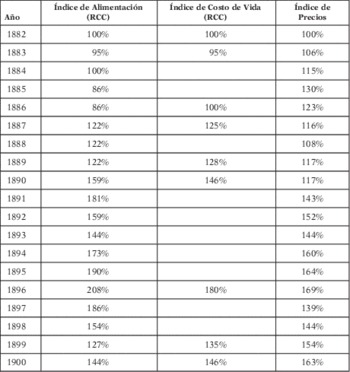
Siguiendo los trabajos de Cortés Conde (Reference Cortés Conde1979), Gutiérrez (Reference Gutiérrez1981), Godio (2005) y las consideraciones previas, se calculó un índice de precios en la Ciudad de Buenos Aires con la siguiente ponderación: alimentación (70%), alquiler (20%), vestimenta (10%). El cálculo se realizó tomando como muestra las compilaciones del Departamento Nacional del Trabajo, para obreros solos o casados sin hijosFootnote 32 . Esta canasta parece más adecuada que la utilizada por otros investigadores, o incluso la del mismo Departamento Nacional del Trabajo, en la que se promedian los consumos de situaciones de viviendas unifamiliares con parejas y familias de 1 a 5 hijosFootnote 33 . El DNT observó a fines de la década de 1910 con detalle a los trabajadores y a sus familias, que —obviamente— tienen cierto carácter de permanencia y asentamiento en la ciudad, en contraste con la alta movilidad ultramarina de la mano de obra en el periodo 1880-1900. Por otro lado, la canasta de consumo que utiliza Cortés Conde, un promedio de varias canastas, se compone de un 50% de alimentos, un 20% de alquiler, un 15% de vestimenta y un 15% de otros elementos (Cortés Conde, Reference Cortés Conde1979: 210)Footnote 34 .
4. LOS PRECIOS, LOS SALARIOS Y LA CRISIS DE 1890 EN BUENOS AIRES
La expansión y transformación estructural de la economía argentina a finales del siglo XIX generó un incremento en la producción agropecuaria, así como en la demanda de mano de obra. Este profundo cambio en la economía afectó la evolución de los precios. Estos últimos se vieron condicionados por el incremento en la demanda local, por el ingreso de la inmigración y por el sustantivo aumento en la oferta de bienes (tanto de producción doméstica, como importados), debido al crecimiento de la economía. El ingreso de mano de obra condicionó la oferta de ésta, afectando el nivel de evolución de los salarios.
Con la disponibilidad de nuevas fuentes, teniendo en cuenta los antecedentes historiográficos, y sobre la base de la metodología mencionada, se analizarán a continuación las series de precios y salarios. Tal como se observa en el Gráfico 1, en la década de 1880 la demanda de mano de obra impulsó el aumento en salarios nominales de manera sostenida hasta 1890. La evolución de los precios acompañó esa tendencia hasta 1885, superando el crecimiento de los salarios nominales. Entre 1885 y 1890 la tendencia de los precios fue descendente.
ÍNDICES DE PRECIOS Y SALARIO NOMINAL DEL OBRERO NO CUALIFICADO DEL FERROCARRIL EN BUENOS AIRES 1882-1900 (BASE 100=1882) Fuentes: Salarios nominales: AFFCCA, fichas de empleados y libros de sueldos y jornales. Precios: véase texto.

Los salarios nominales y los precios muestran un incremento entre 1890 y 1891. Entre 1891 y 1896, la tendencia de los precios fue al alza de manera continua, con la excepción de la leve caída en 1893. Se observa una nueva caída de los precios en 1897, año a partir del cual estos retomaron la tendencia alcista hasta 1900, pero desde un nivel menor que el de 1891.
A grandes rasgos, se observan cuatro periodos en los precios: alza entre 1882 y 1885, caída entre 1885 y 1888, alza entre 1888 y 1896, y otro periodo alcista entre 1897 y 1900. En cambio, la evolución de los salarios nominales parece mostrar dos etapas. Una primera de tendencia alcista entre 1882 y 1890; y la segunda, entre 1891 y 1900, también tiene una tendencia positiva, pero después de un gran aumento en 1891.
En la visión de conjunto, los salarios nominales acompañaron el alza de los precios entre 1882 y 1885, y continuaron con su tendencia aun cuando los precios descendieron entre 1885 y 1888. El salto en los precios entre 1890 y 1891 se vio acompañado por una suba de los salarios nominales. Desde ese momento y hasta 1896, los salarios y los precios compartieron la tendencia positiva (con excepción de 1893, en que los precios bajaron). La caída en el nivel de los precios de 1896 no se reflejó en los salarios, que continuaron su ascenso con un salto entre 1898 y 1899.
En parte, se podría entender el comportamiento de los precios en relación con los cambios en la demanda, esto es, el crecimiento de la población y la evolución de las exportaciones. Desde la oferta, en este periodo se produjo un incremento en la producción agrícola y ganadera, en especial en la década de 1890Footnote 35 . El comportamiento de los precios de los productos de consumo dependía en gran medida de los precios internacionalesFootnote 36 . Asimismo, hay que tener en cuenta que la producción local de trigo y carnes se incrementó sustantivamente durante esos años.
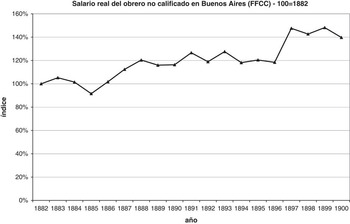
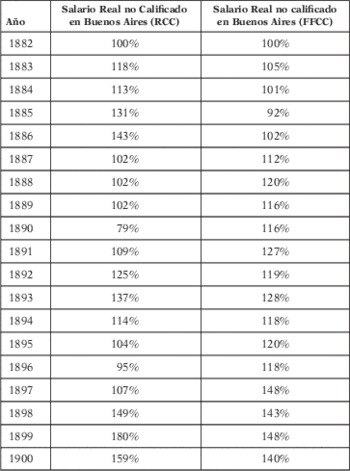
Si bien la evolución de los salarios nominales se podría suponer conectada con la de los precios, la correlación no es directa. Es posible entender la presencia de otros factores que inciden en los salarios nominales, que se presentarán más adelante. Al conocer la evolución de los salarios nominales y los precios es posible observar la evolución del poder de compra de los salarios, o «salario real». La evolución de este indicador se presenta en el Gráfico 2.
ÍNDICE DEL SALARIO REAL DEL OBRERO NO CUALIFICADO DEL FERROCARRIL EN BUENOS AIRES 1882-1900 (BASE 100=1882) Fuentes: Calculado con los datos del Gráfico 1.

En la década de 1880 la evolución de los salarios reales es, en cierta medida, errática. A la leve alza en 1883 le siguió un descenso hasta 1885, cambiando la tendencia hacia el alza entre 1885 y 1888. Esto se explica porque el incremento de los precios en 1885 superó el de los salarios nominales, aunque después los precios descendieron hasta 1888. Es interesante señalar que en este periodo (1885-1888) coincide la devaluación de la moneda, con un aumento de los salarios reales (y que la devaluación no tuvo un impacto sustantivo en los precios y hubo un aumento de salarios nominales). En 1889 y 1890, los salarios reales descendieron y se mantuvieron debajo del valor de 1888. En 1891, la recuperación del salario real se debió, principalmente, a la fuerte alza del salario nominal (véase el Gráfico 1).
Desde entonces, los salarios reales tuvieron una evolución errática entre 1892 y 1896, con alzas y descensos anuales. Solo se observa un alza significativa en 1897, resultado del aumento de los salarios nominales y del descenso en los precios. Desde ese año, hasta el fin de la serie, los salarios reales mantuvieron un comportamiento de alzas y descensos año a año, aunque en la visión general del periodo se observa un crecimiento de los salarios realesFootnote 37 .
Para comprender el comportamiento de los salarios, es fundamental tener en consideración que el crecimiento de la economía incrementó la demanda de mano de obra, generando una tendencia alcista de los salarios (en valores nominales y reales). Desde el comportamiento de la oferta de trabajo, hay consenso acerca de que la oferta de mano de obra local estaba constreñida por el crecimiento demográfico, por lo cual era escasa frente a la demanda. En este punto es donde la mayoría de los trabajos incorporan como variable explicativa los movimientos migratorios hacia Argentina, en especial desde la Europa mediterránea. Los gobiernos argentinos, por diferentes motivos, llevaron adelante políticas de inmigración que alentaron este proceso. Por ejemplo, durante la presidencia de Miguel Juárez Celman (1886-1890), se subsidiaron los pasajes para los inmigrantesFootnote 38 . Según algunos trabajos, el ingreso de mano de obra habría logrado satisfacer a la demanda en cierta medida, con lo cual los salarios —tanto nominales como reales— habrían aumentado a un ritmo menor que si no hubiera ocurrido el proceso inmigratorioFootnote 39 .
Ahora bien, entender el impacto de la inmigración es útil para analizar la evolución de los salarios reales, así como la evolución de los salarios es una herramienta que colabora en la explicación del motivo por el cual tuvieron lugar estos grandes flujos migratorios. Por ejemplo, Cortés Conde (Reference Cortés Conde1979 y 2008) explica los flujos migratorios, en parte, a partir de comparar las diferencias en los salarios reales entre los obreros en Argentina y en Italia. La diferencia entre los salarios en ambos países (entendiendo esto como la perspectiva de un ingreso con mayor poder de compra) debió de ser un componente importante a la hora de tomar la decisión de migrar a través del océano Atlántico. Los trabajos sobre la inmigración en Argentina han señalado este fenómeno relacionado, así como la permanencia de vínculos, tanto afectivos como económicos, entre los migrantes y sus lugares de origenFootnote 40 . Si nos centramos en el vínculo económico, aún queda por cuantificar en qué medida colaboraron en el crecimiento de las economías europeas esas remesas que los trabajadores extranjeros enviaban a sus lugares de origen.
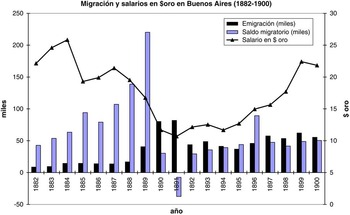
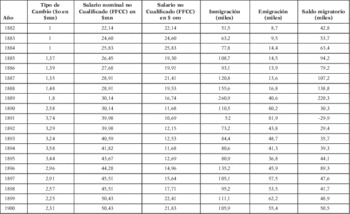
Si se considera lo anterior, es posible que dentro de las informaciones claves a la hora de migrar hacia o continuar trabajando en la Argentina, una de las principales hubiera sido el valor del salario en moneda internacional, esto es, el salario en oro. En el Gráfico 3 se presenta la evolución de la emigración, el saldo migratorio y el salario en pesos oro en Argentina. Dicho gráfico muestra una fuerte correlación inversa entre emigración y evolución del salario en oro. Como se ha esbozado, esto podría explicarse porque los trabajadores extranjeros no estaban quizá tan interesados en el consumo como en la reducción de este al nivel de subsistencia para lograr la mayor capacidad de ahorro posible en pesos oro. Los ahorros en pesos oro no solo serían para su propia acumulación, sino también —y según algunos casos en proporciones nada despreciables— para transferirlos hacia sus familias en sus lugares de origen.
EMIGRACIÓN, SALDO MIGRATORIO Y SALARIOS EN PESOS ORO EN BUENOS AIRES, 1882-1900 Fuentes: Salarios en pesos oro: salarios nominales del Gráfico 1 y tipo de cambio de Álvarez (Reference Álvarez1929). Datos migratorios en Vázquez Presedo (Reference Vázquez-Presedo1971) y Cortés Conde (Reference Cortés Conde2008).

En consecuencia, es posible que, en igual medida, fueran determinantes de la emigración una caída en los salarios medidos en oro (que hacían descender la capacidad de ahorro), y una devaluación de la moneda (que hacía descender el valor del ahorro y las remesas al exterior). La sensibilidad de los flujos migratorios al salario en pesos oro permite explicar las huelgas de 1885 y 1888 de los empleados del ferrocarril, en las cuales la principal demanda era el pago de los salarios y jornales en pesos oro. En ambos años se produjo una caída en los salarios en pesos oro, así como un incremento en la emigración.
La evolución del saldo migratorio muestra tres etapas: una entre 1882 y 1889 (alza constante), otra entre 1890 y 1891 (caída) y otra entre 1892 y 1900, relativamente estable (con excepción del año 1896, en que aumenta considerablemente). La emigración muestra una gran correlación inversa con el salario en pesos oro, en especial entre 1888 y 1892. Por su parte, la evolución del salario en oro permite observar cuatro periodos. Uno entre 1882 y 1884, momento en que el aumento de los salarios nominales, bajo el régimen de convertibilidad y tipo de cambio fijo, produjo un aumento de los salarios en oro. Otro periodo, de aumento después de la caída de nivel, entre 1885 y 1887. La caída se explica por la devaluación de la moneda, desde 1885 en adelante, que en parte fue compensada por el aumento en los salarios nominales (Gráfico 1) como para continuar un nuevo ascenso hasta 1887.
Desde 1887 hasta 1891 la devaluación de la moneda fue superior al aumento de los salarios nominales. Los salarios en oro se redujeron a menos de la mitad. Aun con el aumento en los salarios nominales (Gráfico 1) y la estabilidad de los salarios reales (Gráfico 2) aumentó la emigración (Gráfico 3). El aumento de salarios nominales de 1891 (Gráfico 1) fue significativo, pero no permitió un aumento relevante de los salarios en oro por el nivel de la devaluación de la moneda local. La emigración se incrementó sustantivamente entre 1890 y 1891, en los años en que la devaluación de la moneda argentina produjo la mayor caída en los salarios en oro. De ahí que, en el año 1891, el saldo migratorio, por única vez en el periodo, fuera negativo (Tabla 4, Apéndice).
El último periodo de los salarios en oro se observa entre 1892 y 1900, con tendencia al alza y una leve caída en este último año. Si bien el tipo de cambio se estabiliza, el aumento de los salarios nominales permitió el ascenso sostenido en términos de pesos oro, aunque solo en 1899 superan los valores de 1887, aunque sin alcanzar los valores de 1884 (el máximo del periodo).
La comprensión y el análisis en conjunto de las diferentes variables en los años finales del siglo XIX podría ofrecer algunas hipótesis de la supuesta paradoja resultante de observar una gran crisis, pero sin un descenso de los salarios reales. La historiografía ha señalado, sobre la base de las fuentes contemporáneas, las pésimas condiciones de vida de los trabajadores como consecuencia de la crisis. Al mismo tiempo, el descenso en el gasto público y la suspensión de las obras públicas (y muchas privadas) generó desempleo. El descenso en la demanda de trabajo urbano (tanto privado como estatal), en conjunción con el desempleo, frenó la tendencia alcista de los salarios nominales entre 1889 y 1890 (Gráfico 1)Footnote 41 .
Sin embargo, actuaron otros factores que permitieron que se sostuvieran los salarios reales. Por un lado, como ha analizado Cortés Conde (Reference Cortés Conde2008), la oferta de trabajo urbana se podría haber desplazado para cubrir la demanda de trabajo rural. Las cifras de producción agropecuaria de esos años críticos, en crecimiento, justifican este análisisFootnote 42 . Por otro lado, los precios descendieron en 1890 y, cuando se incrementaron en 1891, lo hicieron en menor medida que los salarios nominales (Gráfico 1). Al mismo tiempo, aumentó la emigración, hasta alcanzarse un saldo migratorio negativo en 1891 (Gráfico 3). Así, se podría entender que se descomprimiese la oferta de mano de obra por movimiento interno y por reflujo de migrantes hacia sus lugares de origen. En este último proceso, es posible que la caída jugara un papel importante en los salarios en oro (Gráfico 3). En consecuencia, los salarios reales se sostuvieron, con leves oscilaciones, entre 1889 y 1896 (Gráfico 2). El efecto de la crisis sobre los asalariados que conservaron sus empleos podría no haber sido tan fuerte como pudiera parecer.
La política monetaria y fiscal de los primeros años de la década de 1890, así como el potencial productivo, permitió a la economía superar la crisisFootnote 43 . Esto estabilizó el valor de la moneda en el medio plazo, logrando retornar a un régimen de convertibilidad y de tipo de cambio fijo en los primeros años del siglo XX. Simultáneamente, el crecimiento de la economía incrementó la demanda de mano de obra. De allí que descendiera la emigración y aumentara el saldo migratorio por una mayor entrada de inmigrantes. Puede que el ascenso en los salarios en oro jugara un papel importante entre 1894 y 1899 (véase Gráfico 3). Aunque también debe considerarse que la política de promoción de la inmigración de la década de 1880 ya no estaba vigente.
Finalmente, es posible que el estancamiento de los salarios nominales (Gráfico 1) y la caída de los salarios reales (Gráfico 2) y en oro (Gráfico 3) en 1900, preanunciaran los conflictos laborales que estallaron en la gran huelga de 1902.
5. CONSIDERACIONES FINALES
A lo largo de este trabajo se ha analizado la evolución de los precios y los salarios en Buenos Aires durante el periodo denominado «La Gran Expansión». El punto de inicio fue recopilar los principales aportes historiográficos disponibles, así como sus fuentes. El «caso argentino» despierta el interés de los investigadores y da lugar a un debate tanto sobre las causas de la crisis de 1890 como sobre sus efectos sobre la economía y la población.
La propuesta presentada trabaja con nuevas fuentes y nuevos datos para construir series de precios y salarios para el periodo 1882-1900. De esta manera, se revisa y reinterpreta la evolución de los precios y salarios en las últimas décadas del siglo XIX.
En el marco de los debates historiográficos, entre posiciones «pesimistas» y «optimistas», se propuso incorporar de manera central en la argumentación las características particulares de la oferta de mano de obra en Buenos Aires en dicho periodo. A partir de ello, se conjugó con las series de precios y salarios, y los salarios reales, la evolución del salario en pesos oro y los movimientos migratorios. En consecuencia, se formuló como hipótesis central que la situación y evolución de los salarios reales durante la década de 1890 no fue tan crítica como ha observado parte de la historiografía. Ni tampoco fue tan propicia. Los datos señalan que con la crisis no hubo un descenso importante en los salarios reales (caen levemente en 1889 y 1890). De ahí que lo observado se posiciona en un punto intermedio entre aquellos vigentes en los debates historiográficos.
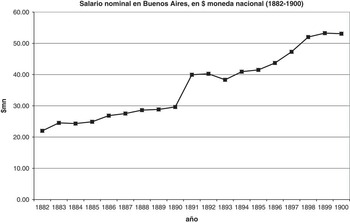
Si se consideran todos los datos disponibles de salarios nominales, de empleados públicos, obreros de Bagley y del ferrocarril (Gráfico 4), hasta 1890 los salarios nominales muestran una tendencia alcista, y se observa un incremento importante en ellos en 1891. Desde allí en adelante, con variaciones, la tendencia al alza se hace más pronunciada.
SALARIOS NOMINALES EN BUENOS AIRES (1882-1900) (Pesos moneda nacional) Fuentes: Calculado a partir de Cortés Conde (Reference Cortés Conde1979, pp. 226 y 230) y AFFCCA (véase texto).

Si los salarios reales no reflejan en su totalidad este incremento, es debido al crecimiento de los precios, presentados en el Gráfico 1. Aun así, no se puede dejar de advertir el impacto de la crisis sobre la economía y la población. Aunque la evidencia sugiere un veloz reacomodamiento del mercado de trabajo así como una rápida recuperación de la economía, sin embargo, se ha observado una caída en los salarios en términos de moneda internacional (para el caso argentino, pesos oro). En este sentido, la evolución de los salarios en oro guarda correlación con los movimientos migratorios y es coherente con la probable situación del mercado de trabajo; quizá en mayor medida que los cambios en los salarios reales.
El análisis historiográfico y los debates metodológicos, además del aporte de nuevas series de precios y salarios, permiten reabrir el debate acerca las condiciones de la economía argentina a finales del siglo XIX, y en particular sobre el mercado de trabajo. El renovado interés en la construcción y el análisis de series de precios y salarios resulta interesante. Entre los temas pendientes para una posible agenda futura, es posible retomar las comparaciones regionales e internacionales, así como avanzar hacia los nuevos tópicos en la historiografía de precios y salarios, como nivel de subsistencia, condiciones de vida y desigualdad.
APÉNDICE
SALARIOS NOMINALES 1880-1900 (En pesos moneda nacional)

ÍNDICES DE PRECIOS 1882-1900 (BASE 100=1882)

ÍNDICE DE SALARIOS REALES 1882-1900 (BASE 100=1882)

TIPO DE CAMBIO (PESOS MONEDA NACIONAL A PESOS ORO), SALARIOS NOMINALES OBRERO NO CUALIFICADOS Y SALARIOS OBREROS NO CUALIFICADOS EN PESOS ORO Y EVOLUCIÓN DE LA INMIGRACIÓN Y EMIGRACION, 1882-1900