


1. INTRODUCTION
The evolution of low-cost, low-power single-board computers is transforming the creation of media artworks. The WiFi-enabled Raspberry Pi Zero W costs around $10 and drives various combinations of lights, screens, speakers, outputs and sensors. Additionally, having a complete computer architecture (rather than a simpler microprocessor), it can utilise any software capable of running on the Linux operating system, including multiple parallel processes. Assembling quantities of these devices that are networked over high-bandwidth WiFi invites novel ways of working and thinking.
SquidsoupFootnote 1 is a media arts collective that has been creating media architectures using variants of such technology, leading the trend towards the use of internet of things (IoT) systems to advance the possibilities of creativity in this field. Media architecture refers to the embellishment of the built environment with digital media technology, perhaps most prominent in the subdomain of media facades – the covering of building with light arrays, and sometimes their transformation into high-resolution screens. Squidsoup’s work consists of site-specific light and sound installations that can be ‘stepped inside’ in some way. Audiences may experience the work as an object, seen from outside, approached and then entered into to be experienced as an immersive space, itself consisting of the tangible objects of lights and speakers (Rowe Reference Rowe2012). Generally, the notion of creating ‘screens’ is eschewed in Squidsoup’s creative philosophy. Instead, their works create abstract illuminated, animated and sonically composed spaces, certainly rendering shape and movement, but drawing attention to the physicality of the ‘pixel’ objects performing the rendering. This exploration into the fluid experiential nature of the complex networked media they work with – as inhabitable illuminated spaces, discrete objects and substrates for rendering shape and motion – has been an important part of Squidsoup’s appeal.
In the lighting domain, media architectures are a well-explored conceptual space (Haeusler Reference Haeusler2009; Zigelbaum and Coelho Reference Zigelbaum and Coelho2011; Caldwell and Foth Reference Caldwell and Foth2014; Hu, Funk, Zhang, and Wang Reference Hu, Funk, Zhang and Wang2014; Hallam, Zheng, Posner, Ericson, Swarts and Do Reference Hallam, Zheng, Posner, Ericson, Swarts and Do2017). It is now common to see cities cloaked in rich tapestries of media that play with our interaction with the urban environment through scale and the management of proxemics (Hall Reference Hall1966). Sound has been less intensively explored, possibly due to the challenges of rendering sound in massive arrays of speakers, and possibly because of a more muted need for new sound solutions in our environment. Both sound and light can be seen to ‘pollute’ our spaces, but conventionally urban designers take great care to limit unwanted sound, as adding sound detracts from other sounds in our environment, whereas adding light may illuminate our experience. Of course, one may wish to argue with this perspective; indeed, the masking of poor sonic environments with designed sound is a growing area of interest, and clever highly distributed sound design can be made highly localised and richly spatialised.
1.1. Media Multiplicities
We henceforth refer to media multiplicities to describe large, scalable arrays of lights and speakers and other outputs such as screens or moving elements (Bown and Ferguson Reference Bown and Ferguson2017, Reference Bown and Ferguson2018), and we refer to the multiplicitous media design space as the space of all possible architectures, technologies, configurations and creative concepts that may be involved in the creation of media multiplicities. Our work focuses on developing these solutions (we are collaborators with Squidsoup on a new generation of IoT-based media multiplicities technologies), and more generally building an understanding, from both a design and practice-based research perspective, of how various points in this solution space interrelate in the establishment of creative affordances, decision making, flexibility, risk and conceptual thinking – more generally, ways of working that invite different creative possibilities and tendencies. For the creative practitioner, we contend, the network cannot be subsumed beneath an artistic vision during the creative process – they must work carefully within the network’s confines, co-evolving aesthetic decisions in step with their emerging understanding of what such systems afford.
More complex still, modern distributed computational systems consist of hierarchies of architectural layers: hardware networks with physical distributions of devices, operating systems, platforms, specific development tools and specific end-user (direct manipulation) tools. Each of these layers presents constraints and affordances that influence the way we work with them. However, each can also be modified, and in doing so we can shape the medium, in turn altering how we are influenced in the creation of work.
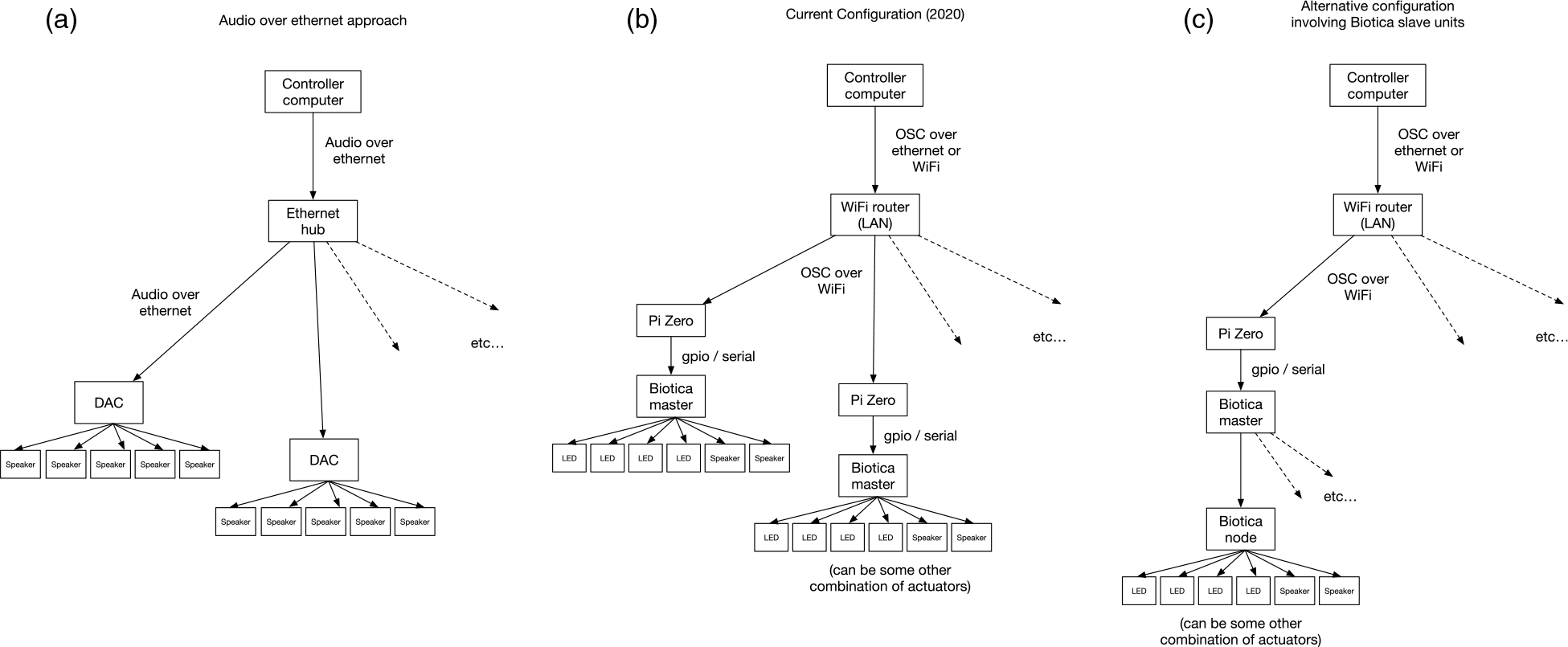
One established approach to working with massive speaker arrays is to use an audio-over-ethernet platform that enables streaming a vast number of audio channels over an ethernet connection. Using switches and digital-to-analogue converters, one can route this massively multichannel stream of audio, generated from a single, powerful computer, to multiple distributed speakers (Figure 1a). This solution is very robust and is also a natural fit to the work of the sound designer, musician or film composer using multichannel audio, who can simply scale up their existing DAW or generative audio projects to work with more channels. On the downside, such an approach is potentially costly and poorly scalable (in terms of equipment cost as well as the central processing unit (CPU) resources available when working on a single computer) and can be inflexible in installation. In the part of the solution space that we are currently exploring, we use a large number of cheap, low-power microprocessors or microcomputers that communicate over wireless connections (Figure 1b and c). This solution improves scalability into thousands of channels since each new unit adds its own additional computing resources, and it can be significantly less costly and more flexible in installation possibilities, requiring only power, as all communication is wireless (Ferguson, Rowe, Bown, Birtles, and Bennewith Reference Ferguson, Rowe, Bown, Birtles and Bennewith2017a, Reference Ferguson, Rowe, Bown, Birtles and Bennewith2017b). This solution, however, forces the creator to give up the convenience of working with a digital audio workstation (DAW), and for the more challenging context of a distributed computing system, an immediate step up in complexity is required – but once this leap is made, the system scales very well.
(a) Ethernet provides a reliable approach to distributing audio over many speakers. (b) Our current system distributes computation over multiple devices each utilising a custom master board (named Biotica, made by Bitscope Designs) and communicating over WiFi. (c) An alternative design involves further ‘federalising’ of the system, where each device coordinates multiple Biotica nodes that each control multiple outputs.

Our approach relates to other existing work in this space. In Bown and Ferguson (Reference Bown and Ferguson2018), the first two authors presented a broad overview and categorisation of media multiplicities work. Along with work in the media architecture space such as Squidsoup’s and our own, we included coordinated drone and robot swarm systems (Hörtner, Gardiner, Haring, Lindinger and Berger Reference Hörtner, Gardiner, Haring, Lindinger and Berger2012), interactive sensor networks operating across small tactile devices and live performance using mobile phones (Merrill, Kalanithi and Maes Reference Merrill, Kalanithi and Maes2007). In each of these cases wireless communication is inherent to the given media space. These areas have continued to develop apace. Creative swarm drone formations are now appearing in the thousands. Live mobile phone performances increasingly use incredibly fluid web application programming interfaces (APIs) that support rapid creative coding, as in recent performance work separately by Ben Houge (Night Rain) and Garth Paine (Future Perfect) as well as a large number of laptop and mobile phone orchestras (e.g., see Smallwood, Trueman, Cook and Wang Reference Smallwood, Trueman, Cook and Wang2008).
Such wireless networked systems are also transforming tangible interactive experience design where they offer new collective interactive affordances (e.g., Bin, Bui, Genchel, Sali, Magerko and Freeman Reference Bin, Bui, Genchel, Sali, Magerko and Freeman2019). The default inclusion of WiFi networking in a system also allows fluid audience participation via their own personal networked devices, which has been explored extensively. For example, the previously cited mobile phone performances by Houge and Paine are examples of music performances utilising audiences’ own devices. Another example of audience device interaction is in the creation of responsive spaces such as in Vogtenhuber (Reference Vogtenhuber2019). In summary, the literature on and applications of wirelessly networked, multidevice creative work is diverse and growing rapidly. Within this space this article is focused on media architecture installation work that is built on wireless IoT foundations and the question of how it can be used effectively as a creative medium.
This preamble sets up our discussion of experiences working with distributed-computing-based media multiplicities, which attempts to holistically examine the interrelations between technology, creative practices and outcomes. Our focus is on the creator’s (rather than the audience’s) experience: their interaction with a creative space of possibilities and their ability to configure this creative space, transforming the medium and their relationship to it. Arguably, as users of DAWs become more expert, the tools’ underlying concepts become engrained in habit and hence somewhat embodied, even if they are complex to the beginner. We adeptly tweak dials, drag sound files, draw notes and audition instantaneously, through largely ‘direct manipulation’ interfaces (Bell Reference Bell2018). Distributed computing systems, by contrast, require more explicit thought, planning and problem solving, and thinking through the implications of different network architectures may be less creatively spontaneous than commonly used workflows. Yet as with all emerging media technologies, we may expect the natural co-evolution of technology frameworks and communities of practice towards a point where working in this area exhibits more of the ease of a DAW process. Existing DAW systems after all do embody complex modular architectures, with complex networks of connected devices, and these systems are just extremely well honed and understood by their associated practitioners, who gain this understanding through their communities of practice, and are still often only narrow experts in their own personal creative niche.
In the distributed architectures we are experimenting with, using communication over WiFi, some of the DAW practices may carry, while others may require reconsideration. It can be both technically infeasible to send individual commands to individual devices, as you might in a musical interface digital interface (MIDI) studio, and an impractical way of working: large arrays of devices invite ‘meta’ approaches, freeing the creator to design for a holistic system instead of individual devices.
2. ARCHITECTURAL CONSIDERATIONS
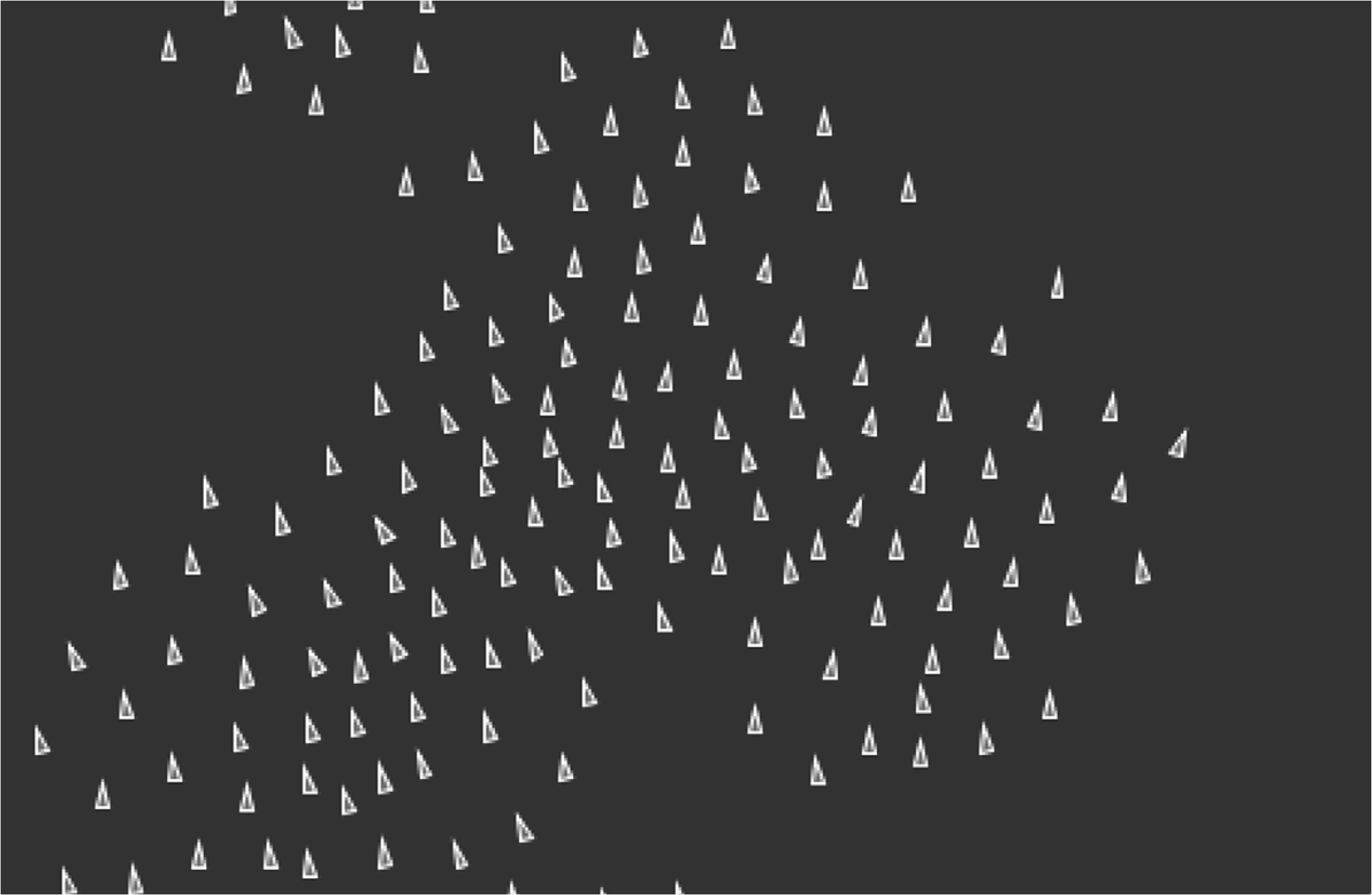
Our experience can be illustrated by a simple demonstrative objective: to take a standard flocking model and visualise and sonify it across a large array of lights and speakers. The original ‘boids’ model of flock and swarm behaviour showed how three rules of local interaction – separation, alignment and cohesion – produce complex emergent patterns exhibited naturally in some bird and fish species (Reynolds Reference Reynolds1987) (Figure 2). There are different ways you might render a flock of boids on a static system of lights or speakers, the most obvious being to illuminate any light or play sound through a speaker that is located near a boid (assuming that the boids model is superimposed onto the spatial configuration of the lights and speakers). The sound and light might further display specific aspects of the boid’s behaviour such as its speed (e.g., faster boids are redder in hue or brighter in tone). In a typical multichannel approach, focusing only on audio for the moment, one might use a real-time audio development environment to run the boids model and calculate the audio for each speaker.
A two-dimensional flocking simulation (Reynolds Reference Reynolds1987), where each nearby ‘boid’ is an agent that moves according to Newtonian forces with three basic flocking principles: align velocity with nearby, keep distance from nearby boids and move towards centre of nearby boids. This model is an example of complex systems dynamics, with rich global patterns emerging from these simple low-level rules of interaction.

By contrast, imagine that each of your speakers does not just receive audio from a central computer but also incorporates a MIDI (or open sound control (OSC)) controlled synthesizer or sampler, and you can only communicate to these devices via MIDI (or OSC). This is essentially the technical constraint of a distributed IoT system – we cannot stream separate real-time audio signals to each speaker. We can, however, pre-program each synthesiser to respond to incoming messages to effect real-time control of multiple audio devices.
The boids example is interesting from a distributed computing point of view in highlighting some technical constraints. First, as a deterministic complex system its state may be determined by any number of steps into the future, but it cannot be computed without running through all of the steps in the model. This means that if each device were to run the whole model to save bandwidth, then every device must remain synchronised, and if any device needs to catch up, it must either run the required updates in the time given or receive an update of the entire system state over the network in sufficient time. It is also a model that requires a lot of data to represent its state compared with other models that produce rich patterns (such as a composite of sinewaves), and sharing that data across a network at a high framerate imposes a potential bandwidth constraint (though much lower than the bandwidth of streaming each speaker’s audio). Lastly, although the model is a multiagent model, we don’t benefit from having each boid’s state computed on a separate processor, because the boids generally must know the state of all other boids at each time step to compute their next step.
These factors show how a creative goal is tightly interdependent with a network architecture solution. An artist declares ‘I would like to render a simulated flock of birds above people’s heads’, and the constraints and affordances of the system dictate how they might go about achieving that. They may even drop the idea in place of something more simple, given the cost and associated risk of having to build framework code that works for this task.
Working through examples such as this, we are building a set of tools to reduce these risks, while retaining as many creative possibilities as we can. This is a practical task to do with creating tools for a new creative domain, but in such an open-ended space as this the solutions to such problems can contribute to the definition of the medium itself. In McLuhan’s terms, cited in this special issue’s editorial, media organise in layers, ‘the content of a medium is always another medium’ (McCluhan Reference McLuhan1964), and within the rich space of multiplicitous media systems there are multiple points where we (any artist setting out the architecture with which they work) can creatively redefine a medium.
We can consider the case of the flocking model further. Given that our hardware configuration includes a large number of devices capable of computation, we could seek to parallelise the model, but will always be constrained by the bandwidth and speed of delivery of data needed to compute the next step of the model. Failing that, we could consider running the entire flocking model on each device. This makes massively redundant use of CPU resources, with many CPUs calculating the same thing, but potentially minimises the reliance on sending data around over the network. If the CPUs are not busy doing something else, then there is only an extra energy cost in doing this. The problem with this approach is what happens if a device is interrupted and falls behind. Since we cannot jump ahead in the model – we have to calculate each consecutive step – the device would either need to catch up, or other devices would have to share the current state of the model, and do so quickly enough that the lagging device would then be back in step with the others. Evidently these computation-on-device approaches, if they are to be robust against interruptions, still intermittently pose similar bandwidth requirements as if we were sending the state every timestep.
We are left with a solution where a central computer computes the model and sends the state, at every timestep, to every other device, which interprets it to create light and sound. In our experience, this also happens to be conceptually and practically a manageable approach. The trade-off in this approach is a constraint on the number of boids in the model, given the bandwidth and latency of the network sent from the central computer. But importantly, what works best for a boids model is not necessarily a good general solution for networked devices. Other models might be parallelisable by allowing the division of computation between devices, while others might be computable ahead of time making it easier to keep multiple devices in sync, with each model requiring a specific approach to distribute the computation. (Another caveat here is that, naturally, we can also embrace a glitch approach, where what has been described here as failure – a message not getting through in time, a device falling behind – is recontextualised as something that might be creatively fruitful.)
Through this example we have hopefully illustrated how the medium of multiple networked devices presents a rich space of design decisions that interrelate with our aesthetic decisions. The core issue in our research is that the task of making these ideas is influenced by more detailed design decisions, not just the hardware but also the platform that is at hand to work with: all of these ideas require time and involve risk, as software development is notoriously unpredictable. Even if clearly tractable, they pull the creator away from creatively fluent work such as more open-ended exploration. How does one free the creator from the technical work of designing software and network architectures so as to offer a fluent and richly creative workspace?
Are there simplifying architectures or working paradigms that simplify the technical work of realising any particular creative goal, while managing to remain open to the diversity of possible things one might wish to do? A holistic view of creative practice might recognise that such systems need not necessarily cater for every possible creative idea, and may in fact be most usable if they actually offer constraints (Simonton Reference Simonton2003; Stokes and Fisher Reference Stokes and Fisher2005; Dalsgaard and Halskov Reference Dalsgaard and Halskov2010; Stokes and Gibbert Reference Stokes and Gibbert2020). From our experience we suggest as a starting point that, considering the following three different attitudes with which a creative practitioner may engage in a technology-based project, the third is a more realistic account of how we see creative practitioners adopting and responding to the technologies they have to hand. We entertain the way in which this attitude influences how we approach a general system design for networked devices:
-
1. ‘I have a creative goal, find me a system that can realise it.’
-
2. ‘Show me the conceivable limits of what this system can do and I will find my creative space.’
-
3. ‘Show me some things that this system can do, and I will create something within that space.’
The first attitude represents a kind of artistic ideal, which assumes that the given goal is realisable. It is overtly goal-based. The second is a kind of platform ideal that may imply that the most creatively powerful platform is desirable. The third, we claim, may be considered closer to what artists actually do, familiarising themselves with certain narrow spaces of possibilities and adopting those that inspire them to develop ideas. Entertaining the third attitude points not to seeking the most versatile system designs but to seeking the designs that are most fruitful in opening up some space of creative possibilities. You can do anything in MaxMSP (or PD, or Supercollider), but what also makes these tools powerful in the hands of their most practised users is the specific possibilities they place close to hand.
3. DESIGN REQUIREMENTS
With this in mind, we draw on literature from creativity support tool and creativity studies, as well as our own experience, to list broad requirements for a successful creative process that we believe a well-designed system should exhibit, despite its constraints.
-
Integration of modular compositional elements. The creator should be able to work in a modular way and be able to create their own modules, with modules that are appropriate to the domain (Resnick et al. Reference Resnick, Myers, Nakakoji, Shneiderman, Pausch, Selker and Eisenberg2005). In a DAW, tracks are common modules. A creator can make as many independent tracks as they like via direct manipulation of the DAW interface. They can copy and paste tracks from one project to another. The act of mixing tracks is effortless. In some DAWs, segments of MIDI or audio elements and signal chains of effects are also common modular elements that can be effortlessly arranged. However, integrating two entire project documents may be less trivial. For example, a live performer working with Ableton Live has no way of seamlessly mixing two Live Sets. In programming environments such as Processing or MaxMSP, sketches (Processing) or patches (MaxMSP) can be considered modules (as are classes and objects in text-based programming languages), but the integration of these is less trivial. A coder who has made three different animated visual sketches in Processing has no easy way of layering or mixing between them. In general, more open-ended and unconstrained tools can make it challenging to manipulate modular materials effortlessly.
-
Reducing the cost to prototype. Rapidly prototyping a new technical idea (usually involving programming in some capacity) should be as painless as possible (e.g., see cognitive considerations in Blackwell and Green Reference Blackwell, Green and Carroll2003). If no out-of-the-box device exists for your needs, then the engineering work of building systems that do what you want to do is unavoidable, but can be made less burdensome with great programming languages, libraries and developer tools, as well as clear design patterns. Creative development environments employ many techniques to improve the relationship between engineering and doing creative work and sometimes blur that distinction entirely. For example, MaxMSP is designed in such a way as to allow you to real-time audition algorithms as you build them. This has the interesting effect that even in the midst of solving some technical design problem with a specific goal in mind, you may be more receptive and alert to new unforeseen creative possibilities as you go, including discovery by accident.
-
Extensibility, evolvability and hackability. Once a system is made it should be easy to extend it to be used effectively in multiple works. This is a conspicuous challenge for many creative technology platforms, where it is common for an artist to create a system for a specific work or composition and later hack that system to create different variations of the work. Professional development environments provide powerful ‘refactoring’ tools that allow you to rearrange program designs without impacting functionality, but these are still hard to use and do not necessarily give insights into how a design should be refactored to improve it. Often it makes sense to extrapolate reusable libraries from one’s initial sketches, but this introduces the challenge of distinguishing and maintaining a working reusable API as well as the immediate project. This may not be feasible, even though it would in theory support greater extensibility.
-
Direct manipulation. Interaction with the devices in the network via direct manipulation should be readily accessible in many different ways and at as many different stages as possible. Testing, probing and exploring creative spaces is arguably more easily done via immediate ‘direct manipulation’ interfaces and sliders, dials and other non-programming widgets (Shneiderman Reference Shneiderman1983, Reference Shneiderman2010). However, making direct manipulation interfaces interoperate with programming activity is not straightforward.
-
Recall/all-in-one-place-ness. It should be possible to save all the work in a creative project so that it can easily be stored and recalled from a single archive. Assuming a fully virtual studio, a DAW typically enables you to save a composition in a single project folder, which can be perfectly recalled. Typically, all the audio files and presets are collected in the project folder. System configurations and third-party plug-ins may not be, but system alerts will generally help resolve anything that is not set up correctly. In an analogue or MIDI hardware studio, this is typically not something that can be perfectly automated in a system design, though typically USB connected devices, and MIDI devices more generally, can be centrally managed.
4. A CANDIDATE ARCHITECTURE
Building on our approach to implementing a flocking model, and considering how generally applicable this approach is to other circumstances, we have narrowed our focus on a high temporal granularity architecture that we feel facilitates a suitably broad range of designs while remaining conceptually simple and practically manageable. Essentially, this design is loosely similar to a MIDI studio, with a number of remote devices being orchestrated from a central scheduler device, typically a DAW. Our architecture requires programming the devices by defining a renderer, which can be thought of as akin to a programmable synthesiser, and then additionally creating a device sketch that loads the renderers and manages the job of interpreting incoming control data.
Renderers, like MIDI instruments, are reusable and versatile low-level modules that can be played directly as if they were an instrument. They are equivalent in scope to modular synthesiser oscillators: monophonic, state-based machines with a rudimentary interface that directly controls the oscillator parameters. In our work, we have built a generic renderer for both light and sound in which the user can choose between sample playback, granular sample playback and FM synthesis, and similarly different modes for pulsing or shimmering LED colours. They can set many parameters including the ability to loop sounds in time with a globally synchronised clock. More complex envelopes and sequences, if needed, require additional programming (as with a modular oscillator). This renderer is reusable in a vast number of contexts, with the aim of minimising the need for the creator to think about low-level control detail, while remaining hackable for users to program variations or start their own renderer from scratch.
In the device sketch, the user declares which renderer is being used, and the device then loads an instance of renderer for each output (light or speaker) that it has control over. The user then adds additional code to sequence the renderers. Typically, this would involve call-back functions that respond to incoming OSC broadcast messages. The function can interpret the OSC message to control each output, and when doing so can query the output’s physical position (stored in a spreadsheet), if any spatial calculation is necessary. For example, the sketch function may receive periodic updates of the state of an entire flocking model, then calculate the light and sound intensity for each of its outputs based on the relative positions of outputs and boids.
Unlike the renderer, the device sketch code is likely to be composition-specific, and we have developed an API with many functions that help keep the code relatively short. It is expected that while the renderer would be commonly reused, the sketch code is short enough and specific enough in purpose that it can be throwaway, and simple enough that specific functions can easily be copy-pasted to other compositions.
The final component is a central sequencer. We use Ableton Live, but anything that can send OSC can be used. Ableton’s MaxForLive extension enables sending custom OSC messages via small Max patches embedded in tracks within Ableton. This in turn taps into Ableton’s strong framework for managing automation lanes, manually recording in automation data and switching between automation control sources, in particular overriding and reinstating arrangement control rapidly. Having written a device sketch that responds to specific OSC parameters and setting up those parameters in Live, the creative process can fall back into a more familiar DAW workflow, arranging or live performing a reduced number of control parameters. Again, this does not preclude making interesting non-linear, interactive or emergent processes to control the system, alongside more traditional timelines.
5. CREATIVE CASE STUDY: THE MIND AT WORK
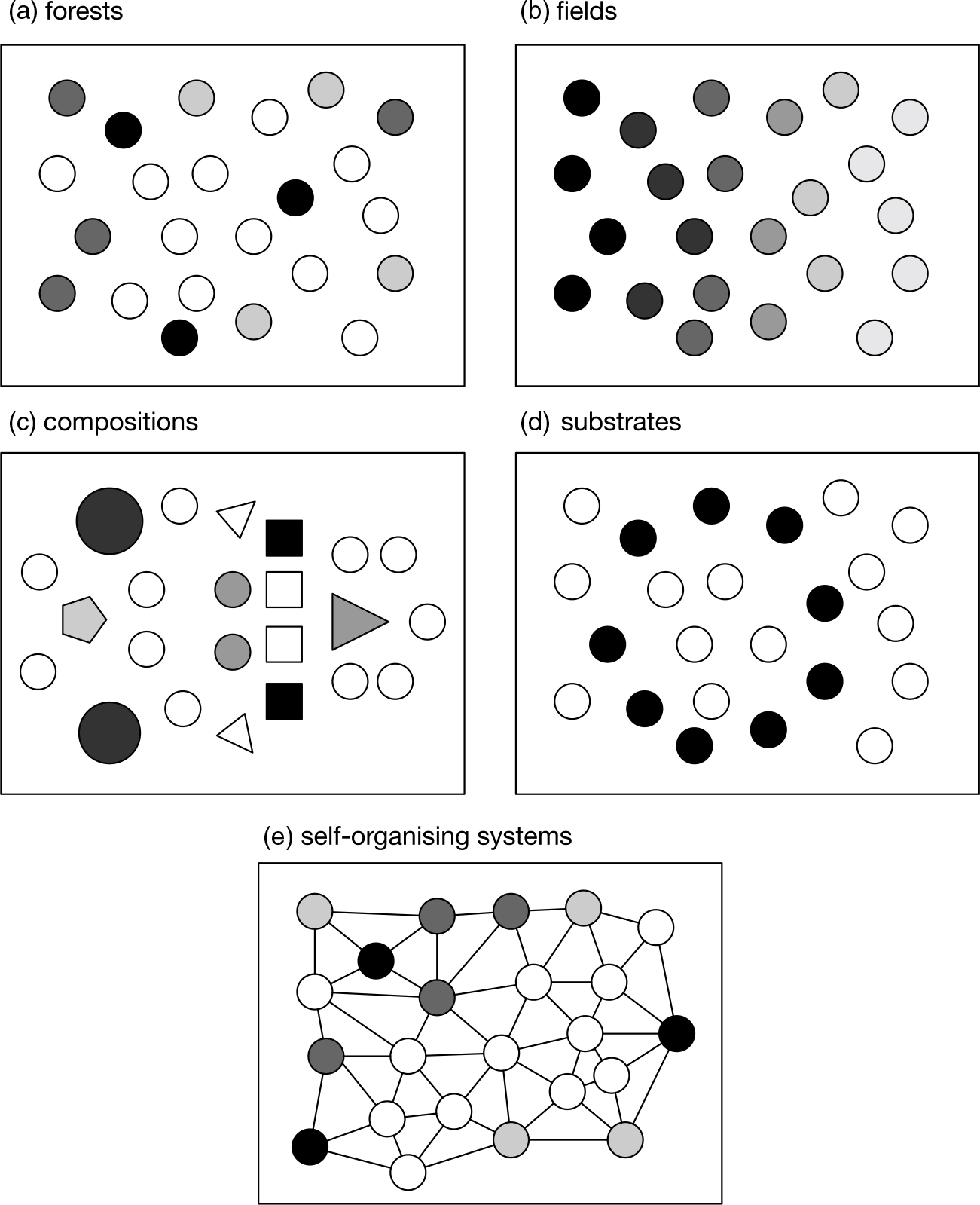
We now consider some more types of content we might create beyond flocking models. In previous papers we have attempted to define basic classes of relationships between output elements in a large network based on the kind of content we might wish to put on them (by output elements we mean specific lights or speakers – we do not say ‘device’ as in our architecture a device may control multiple of these output elements, and it is the output elements that we want to specifically orchestrate). In Bown, Fraietta, Ferguson and Tillman (Reference Bown, Fraietta, Ferguson and Tillman2020) we proposed that four useful concepts to describe types of content were forests, fields, compositions and substrates. In Bown and Ferguson (Reference Bown and Ferguson2018) we also discussed self-organised systems, which we present here as a fifth concept.
In forests (Figure 3a), outputs are all executing the same behaviour and there is no systematic variation between them. For example, the behaviour may take the form of randomly occurring clicks and timed pulses, and the overall effect would be a natural cacophony. Even without any coordination between devices, this blending of the same behaviours may take on new properties at scale: the random clicks may form a granular wash of sound. Technically forests are the simplest type of content to put onto a multiplicitous media system. They are also the most robust in the face of network failures since they do not rely on network interaction. Our system already provides programs with a global clock to synchronise to, and we can send well-synchronised broadcast messages to all devices, so it is possible to incorporate some coordination between devices (clock synch) without having to explicitly code this in our programs. Such designs would no longer be strict forests. (We acknowledge that this name may misrepresent real forests, which actually do involve much interaction!)
(a) Forests run the same program without systematic relations between the elements. Any variation must therefore be random. (b) Fields run the same program with the additional possibility of introducing variation through spatial relations. (c) In compositions, the elements may be heterogeneous, running different programs which are related. (d) Substrates run programs that primarily serve to render images. (e) We can also consider self-organised behaviours where the elements interact with each other over the network.

In fields (Figure 3b), outputs are all executing the same behaviour, but they vary systematically according to their spatial relations; for example, through gradients and waves. Consider a colour gradient, fading from blue to red across one spatial dimension of a physical installation. To achieve this we write a single program, as with forests, but that program utilises the spatial position data of outputs (which is accessible in our system via a database of output locations for any given installation configuration, pre-loaded onto the devices).
In compositions (Figure 3c), outputs are assigned different roles that are coordinated in a top-down manner. In this case we may write different programs for different classes of output, orchestrating different behaviours that complement each other. In terms of implementation details, though, we may not need to write different programs, instead writing a single program that directs different behaviours in response to factors such as position or at random. Compositions are just forests or fields with more discrete heterogeneity of behaviour.
In substrates (Figure 3d), outputs work together to render an image. This involves a conceptual shift from forests and fields towards a virtual canvas where things can be drawn. Each output is not an independent entity but serves to render the virtual image. Outputs collectively form a substrate through which images are rendered. This is what the pixels that make up a screen do, and the speakers in a surround audio system. A single boid flies through the space of the installation, rendered as a blob of light and a localised sound. This mapping requires a creator to write a program for each device that knows how to render the given content, as well as a separate (centralised or distributed) sketch that provides the content for the device.
In self-organising systems (Figure 3e), a single program or multiple different programs are run on devices, including some inter-device communication that significantly influences the unfolding of events. For example, we may build a cellular automata model with each light or speaker updating its state periodically in response to the state of its nearest neighbours.
5.1. Content examples
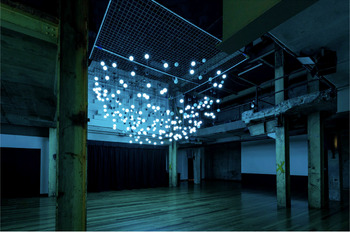
We now present four types of content that were used in the installation artwork The Mind at Work (Figure 4), which launched at the Casula Powerhouse Arts Centre in Western Sydney in November 2020. These were chosen to constitute four movements in a continuously looping 14-minute composition. They were not chosen to neatly represent the different preceding content types, but derived from creative composerly thinking about an exploration of the aesthetic possibilities with the given materials and their spatial contiguity as networked devices.
The Mind at Work installation at the Casula Powerhouse Art Centre, Western Sydney. The installation has 200 LED globes and 100 speakers. Available at: https://tinyurl.com/y599zaf2. Image courtesy Casula Powerhouse. Photographer: Chantel Bann.

The piece commences with scattered bursts of light and sound in the form of localised bubbles, small gestural flickers with no rhythmic pulse, typical of the brooding beginnings of a live improvisation (Movement 1). Gradually these bursts crescendo until a single shimmering form expands to fill the entire space, sounded as a flood of noise. From the structural flatness of the noise, small regular pulses start to emerge. One by one each light begins to enter into a regular flashing sequence, with each speaker doing the same with gentle plucks or pops, until there is a cacophony of flashes (Movement 2). Initially these seem chaotic, but they are actually only out of phase by a few milliseconds. Gradually the phase difference reduces and a spatially systematic rhythmic phase pattern comes into view. Pulses of light and sound start to sweep across the space. Eventually, the lights and sounds become tightly synchronised in a single periodic burst, before drifting off out of phase again, as layers of tiny bell chimes mix into the rhythmscape. Once again, the cacophony of rhythms smears into another blanket noisescape out of which gradually emerges smooth floating ripples of light and sound, relatively flat in structure except for its calm drifting around the space (Movement 3). The sonics become centred around gently shifting drones. The movement again gently evolves into a bright lava-lamp-like gradient of hues that slowly rotate through the structure, accompanied by droning sonics (Movement 4). The piece stops unexpectedly and suddenly and immediately loops to the beginning, as if the improvised bursts of Movement 1 had interrupted the calm.
One of the great challenges of creating this work lay in achieving seamless transitions between the phases described previously. Each of the phases themselves requires programming different system behaviour. With resource-limited devices, in so far as audio processes go, simply crossfading between concurrent model processes was not feasible. In much the same way multiple projects in a DAW cannot be seamlessly mixed, a method to switch between movements without a visible transition point was needed. To do this, an architecture was required that allowed specific models to be made that can be easily switched during the performance.
Movement 1: this was implemented by sending specific event data similar to a combination of MIDI note and continuous controller data. Each event would specify the coordinates of the centre of a shape plus its diameter, followed by a series of other parameters including what sound file to trigger and what colour. These events would be updated continuously so that gestural control of shape colour, size, position and sound could be achieved. Because we were able to send controller data over WiFi at 50fps, a smooth gestural control was achieved. It was also possible to directly record or draw in gestures into the controller computer running Ableton Live. Gestures were defined in automation lanes, and the value of each automation parameter was sent as part of an OSC message. Some global parameters were then configured to enable the transitions. A low frequency oscillator (LFO) modulation depth parameter was used to control how much a noise oscillator was fed into a ring modulation effect on the audio output. This LFO depth parameter was also mapped to a ‘sparkle’ value that dictated how much random shimmer the lights produced. At maximum noise level, the original samples were inaudible, creating a cloak for switching to a different movement playing different sounds. A final shape grew to envelop the entire installation, at which point this noise transition took place, filling the entire system with sparkling light and white noise.
Movement 2: upon receipt of a global message to start Movement 2, each device set a random timer up to 10s, at which point it would switch to playing a loop with a phase offset proportional to its x-axis location, multiplied by a global phase-spread parameter. After this 10s duration, all devices had entered their ‘Movement 2’ state, playing a phase loop, and the global LFO modulation was gradually brought down to reveal the new soundscape of acoustic guitar plucks and handclaps, playing phase-offset rhythms. The global phase parameter was then slowly brought down over a few minutes, during which time the rhythmic output of the entire system constantly morphed. The same LFO mod variable was later increased again to use the same effect to morph out of this movement. The global phase and LFO depth parameters could be directly edited (or controlled directly from a slider or input device) to fine tune the composition.
Movement 3: a flocking model was run in MaxMSP from within the Ableton Live project. The state of the model was sent at the 50fps control rate over the network. Each device responded to the incoming flocking model state by illuminating lights and playing sound based on the positions of 10 boids moving in a flock. A separate global parameter dictated the dynamic variation in the light and sound levels: at zero, all lights were at a constant brightness and all sounds were at a constant volume, uninfluenced by the flock. At its maximum level, the brightness and volume of each device was entirely dictated by the flock. Starting and ending this movement with the global dynamic value set to zero enabled a smooth transition into and out of this movement. At the end of the movement, all lights and sounds were again constant.
Movement 4: one global parameter controlled the base hue value. Another global parameter controlled the extent of the variation in hue across the x-axis of the device’s renderers. To start, the base value was set to the same value as the hue of the preceding movement and the variation parameter was set to zero. Again this meant that we could switch to this movement without anything visibly or audibly changing, and gradually introduce a varying spectrum to the hue across the installation.
Following our preceding categorisation, Movement 1 can be thought of as a substrate-based content design: each gesture sent over the network must be rendered as a spatial graphic and sonic object. Movements 2 and 4 are field-based: the content takes the form of a set of identical rendering processes, controlled globally and individually varied according to the device position. Movement 3 is again substrate-based: an ‘image’ (the content of the flocking model) is broadcast to devices and rendered by the devices interpreting the model state. No movement satisfied the ‘forest’ category, which is natural since we were always interested in working with coordinated relations between the devices: forests are technically the easiest systems to program but with our architecture set up to enable the real-time sharing of global parameters we always opted to build in mappings between global controls and spatial positions. Aspects of the composition category were present in Movement 2: the devices were randomly allocated different sounds to play to make up a rich instrumentation.
In reality, all these movements are implemented as specific actions that are applied to a set of simple state-based audio-visual rendering machines, by writing a composition sketch that interprets incoming OSC commands from the master controller program (Ableton Live broadcasting OSC messages). A central movement parameter tells the system when a new movement has commenced, which sets about further state changes (such as turning on and off looping, changing which samples are being played, and other playback settings). In Movement 1, we also have an event-based code that recognises when a new object has been created and attaches specific sound files to that event. In addition to these discrete events, the entire system is continuously controlled and once the sketch code has been written and installed, a large amount of real-time exploration of the composition space can be undertaken to finesse the system from the relative ease of the Ableton Live arrangement and device parameters. In particular, Movement 1 could be composed in fine detail through the creation of live gestures that are recorded as Ableton control parameters to give an organic feel and precise control of events.
6. CONCLUSION
While the four movements of The Mind at Work may be conceptualised as quite different forms of content regarding their code architecture, we built the artwork not by designing four different frameworks but instead creating a single integrated sketch, specific to this composition, which described the movements as mappings from OSC. This enabled the design of certain global parameters to allow seamless bridging between the movements specific to the composition. This is still a long way from the more intuitive workflow of composing in a DAW, where the concepts of tracks and processor chains provide a common framework for composition. With complex multidevice systems, the power to create and seamlessly mix together a diverse array of content types is traded-off against the ease of use that comes with more constrained but more intuitive content-specific architectures.
Our work with these systems so far suggests that there is no framework that is as intuitive as a DAW while enabling these diverse content types. The general architecture (described in Section 4) that has emerged from our practice-based explorations provides a good middle ground in satisfying the abstract design requirements that have been identified to best support a creatively productive process (Section 3). Specifically:
-
Integration of modular compositional elements. In our approach to movements, we were able to write multiple responders to OSC messages and have them operate a single renderer entity while being relatively modular and separable: each movement being a module. In a revised iteration, we will make this modularisation better serve the requirement of ‘compositionality’, the ability to blend different variables and behaviours.
-
Reducing the cost to prototype. Powerful APIs are one part of this but are not always failsafe: it takes time to learn and test the workings of an API. A strong design workflow and overall design pattern should offer a clear framework for implementing a design idea with known constraints, without explicitly offering examples to cover every eventuality. Central to this is the idea of ensuring that the device sketch properly conforms to the concept of sketch coding – short, fast, throwaway and easily copy-and-pasteable – and then aiming to ensure that architecture prototyping can be done quickly in the sketch context.
-
Extensibility, evolvability and hackability. In our architecture, renderers are robust reusable entities, while sketch code is more throwaway. However, it should be possible for creators to accumulate useful code and extend it rather than starting again. This is not compatible with the ‘throwaway’ nature of sketch code, but the way we have modularised OSC interpreters means that we can quite easily hack and blend existing sketches. Ultimately, there may be points where extracting some common principles into API features may be necessary.
-
Direct manipulation. This is manifest in our architecture in the fact that we can step into a direct manipulation DAW at the point we want to either arrange things on a timeline or set up inputs. Again, the writing of code is minimised in place of creating via exploration of parameters and configurations.
-
Recall/all-in-one-place-ness. Currently all our device code fits into a couple of Java classes and can easily be tracked in a version control system such as Git. It can be deployed to all devices on a network with one click or be set up to run at boot time on devices. Our Ableton project is stored separately. In short, we have everything stored in two places.
Addressing these creative tool design goals in the creation of a platform in turn, we believe, shapes the medium and its message that is being put forward as a platform for creation.
Acknowledgements
This article has been supported by ARC Linkage Grant LP180100151. The partners on this project have been essential to the production of this research: Squidsoup (in particular Anthony Rowe and Liam Birtles), Bitscope (Bruce Tulloch and Norman Jackson), ArtworksRActive (Linda Candy) and the Casula Powerhouse Arts Centre (in particular Craig Donarski and Cayn Rosmarin). We also thank Angelo Fraietta, Garth Paine and his students at ASU for their additional involvement in this work.