Implications
Under the conditions simulated in this study, including breed-cross, production system, use of implants and/or β-agonists, carcass suspension and ageing time in a single study has been able to explain more than 70% of the variability in beef tenderness. Therefore, a large amount of the inconsistency in beef tenderness at the consumer level could be controlled by manipulating these factors. Moreover, the large amount of variability already explained and the possibility of quantifying the impact of each factor on the final tenderness opens the door to a new way of approaching beef quality manipulation. Besides the potential use of this information for breeding programs or development of new production systems, understanding the effect and interactions of the different factors present in the production chain is the first step in developing palatability assurance critical control point systems.
Introduction
Tenderness is one of the most important quality attributes in beef (Jayasooriya et al., Reference Jayasooriya, Torley, D'Arcy and Bhandari2007). Consistency in beef tenderness at the consumer level has been one of the main challenges in meat quality research for at least five decades (Koohmaraie, Reference Koohmaraie1994). However, recent reports still consider it a current and long-term goal for beef producers (Flowers, Reference Flowers2011). The relative lack of success to date in controlling tenderness is due to the complex interactions influencing this trait. In this context, grading systems such as Meat Standards Australia beef-grading scheme (Polkinghorne et al., Reference Polkinghorne, Philpott, Gee, Doljanin and Innes2008) have included several production and processing factors in order to provide a guaranteed satisfaction to the consumer by reducing the potential variability in beef tenderness.
Numerous factors, either ante-mortem, such as genotype, production system, age or live weight, growth promotants, or post-mortem, such as carcass suspension or ageing time, have been shown to affect tenderness (Ferguson et al., Reference Ferguson, Bruce, Thompson, Egan, Perry and Shorthose2001). Meat texture of different beef breeds and genotypes has been reported to vary in numerous studies (Mandell et al., Reference Mandell, Gullett, Wilton, Kemp and Allen1997; Dikeman et al., Reference Dikeman, Pollak, Zhang, Moser, Gill and Dressler2005; Christensen et al., Reference Christensen, Ertbjerg, Failla, Sañudo, Richardson, Nute, Olleta, Panea, Albertí, Juárez, Hocquette and Williams2011). Alternative beef production systems, including reducing age at slaughter, may result in younger, higher marbled beef, but with lower carcass weights and smaller steak portion size (Schoonmaker et al., Reference Schoonmaker, Loerch, Fluharty, Zerby and Turner2002). However, the effects on meat tenderness have been inconsistent (Klopfenstein et al., Reference Klopfenstein, Cooper, Jordon, Shain, Milton, Calkins and Rossi2000; Schoonmaker et al., Reference Schoonmaker, Loerch, Fluharty, Zerby and Turner2002; Meyer et al., Reference Meyer, Kerley, Walker, Keisler, Pierce, Schmidt, Stahl, Linville and Berg2005). Anabolic implants are used in the beef industry to improve growth rates and feed efficiency during finishing. However, the side effects of using implants may include reduced marbling scores, increased incidence of dark cutting and decreased tenderness (Foutz et al., Reference Foutz, Dolezal, Gardner, Gill, Hensley and Morgan1997; Roeber et al., Reference Roeber, Cannell, Belk, Miller, Tatum and Smith2000; Reiling and Johnson, Reference Reiling and Johnson2003). Regarding post-mortem factors, alternative carcass suspension methods such as aitch bone suspension, pelvic suspension or Tenderstretch have been reported to improve beef tenderness compared with traditional Achilles tendon suspension (Aalhus et al., Reference Aalhus, Best, Costello and Jeremiah1999). Finally, ageing of beef is universally thought to improve tenderness (Johnston et al., Reference Johnston, Reverter, Robinson and Ferguson2001) as a result of the proteolysis of myofibrillar proteins (Koohmaraie, Reference Koohmaraie1996).
Knowledge of the quantitative significance of each factor is important to assess their economic value, as well as to choose the correct selection traits to improve the profitability and quality of animal products and to develop efficient integrated management strategies (Juárez et al., Reference Juárez, Horcada, Alcalde, Valera, Mullen and Molina2008). The approach used in this study evaluates the relative importance of the several (cross-breed, production system, implant, β-agonist, suspension, ageing time) factors and their interactions to quantify their relative contribution to variation in beef texture.
Material and methods
Animal management
In order to evaluate the relative contribution of ante-mortem factors, 112 steers from four breed-crosses: >75% Continental, 50% to 75% Continental, 50% to 75% British and >75% British were arranged in a 2 × 2 × 2 factorial experimental at the Agriculture and Agri-Food Canada Lacombe Research Centre (Lacombe, Alberta, Canada). The experimental design included production system (12 to 13 months, calf-fed v. 18 to 20 months, yearling-fed), implant (not implanted v. implanted with 200 mg progesterone and 20 mg estradiol benzoate at weaning followed by 120 mg of trenbolone acetate and 24 mg estradiol 83 days after first implantation and every 80 to 90 days before receiving their last implant of trenbolone acetate/estradiol) and β-adrenergic agonist (no ractopamine v. 200 mg ractopamine per head per day for 28 days). Steer calves were allocated to production systems and implant groups based on breed-cross, birth date and calf weight. The production systems were described in detail by Basarab et al. (Reference Basarab, McCartney, Okine and Baron2007 and Reference Basarab, Colazo, Ambrose, Novak, McCartney and Baron2011). Briefly, calf-fed steers were placed into a feedlot pen fitted with eight GrowSafe® feeding stations (GrowSafe® System Inc., Airdrie, Alberta, Canada) where they were fed twice daily ad libitum and adjusted from a high forage-based diet to a high grain finishing diet over 27 to 42 days. The adjustment period was followed by an 80 to 86 days test period where the steers were fed twice daily ad libitum a finishing diet. The average ingredient composition of the diet (as fed basis) fed during the finishing phase was 57.5% rolled barley grain, 35.0% barley silage and 7.5% protein supplement and premix. Yearling-fed steers, following weaning, were placed on meadow-brome grass (Bromus riparius Rehm.) alfalfa (Medicago sativa L.) pasture where they rotationally grazed for 52 days. Then, a backgrounding diet consisting of 64.0% barley silage, 26.1% hay and 9.9% grain was fed for 192 days. After the backgrounding period, the steers grazed meadow-brome alfalfa pastures for 90 days. Yearling-fed steers were then placed into a feedlot pen fitted with eight GrowSafe® feeding stations where they were fed twice daily ad libitum and adjusted from a high forage-based diet to a high grain finishing diet over 21 to 23 days. The 3-week adjustment period was followed by an 86 days test period where the steers were fed twice daily ad libitum a finishing diet. The average ingredient composition of the diet (as fed basis) fed during the finishing phase was 60.46% rolled barley grain, 35.18% barley silage and 4.36% protein supplement and premix. All dietary treatments and experimental procedures were approved by the Lacombe Research Centre Animal Care Committee and animals were cared for in accordance with guidelines established by the Canadian Council on Animal Care (CCAC, 1993).
Carcass handling and sampling
Steers were targeted for slaughtered at a constant backfat thickness of 8 to 9 mm as determined by ultrasound taken 1 to 2 months before harvest. Steers were stunned, exsanguinated and dressed in a simulated commercial manner at the federally inspected abattoir of the Lacombe Research Centre. For all the animals, alternate sides of the carcass were used such that the left side served as the control (traditional Achilles’ tendon carcass suspension) and the right side as the altered suspension (aitch bone or pelvic bone suspension). The carcasses were then chilled at 2°C overnight for 24 h. At 24 h after slaughter, the longissimus and semimembranosus muscles from both carcass sides were removed and trimmed of subcutaneous fat and overlying muscles for subsequent meat quality analyses.
Each longissimus muscle was fabricated into 11 steaks (2.54 cm thickness). The first and second steaks were used for sarcomere length and drip-loss measurements in fresh meat. The next five steaks were aged for 2, 6, 13, 21 or 27 days post mortem, in order to analyze instrumental texture in fresh meat. The eighth and ninth steaks were aged for 2 or 27 days and frozen for subsequent sensory analysis. Finally, the last two steaks were also aged for 2 or 27 days and used to determine proximate composition in fresh meat. The semimembranosus muscle was fabricated into three pairs of steaks (six in total), which were aged for 2 or 27 days and used for instrumental texture, sensory analysis and proximate composition determination. All samples were labeled, individually vacuum packaged (Ultravac Model UV2100; Koch Instruments, Kansas City, MO, USA) and placed in a cooler at 2°C. Steak locations within each muscle and type of analysis were rotated to ensure equal representation of muscle location within each ageing time.
Meat quality analyses
Sarcomere length was measured as described by Aalhus et al. (Reference Aalhus, Best, Costello and Jeremiah1999). Briefly, 2 g of muscle freed of fat and connective tissues were removed, scissor-minced and mixed in 20 ml of a 0.02 M ethylene glycol tetraacetic acid/0.25 M sucrose solution in a 50 ml centrifuge tube. Samples were homogenized for 10 s at 6000 r.p.m. using a Polytron Homogenizer PT3100 and a 2 cm generator (Brinkmann Instruments Inc., Mississauga, ON, Canada). One drop of each sample was placed on a slide with a cover slip for observation with an Axioscope (Zeiss, Munich, Germany) equipped with a Sony DXC 930 Color Video Camera (Sony Corporation, Tokyo, Japan). Three sarcomere lengths were measured per image with Image Pro-Plus software V4.0 (Mediacybernetics, Silver Spring, MD, USA) and 10 images were analyzed per muscle sample. Lengths were averaged and expressed in micrometers.
To determine drip-loss, one steak was weighed and placed into a polystyrene tray with a dri-loc pad (UZ Soaker Ultra Zap Pads, Paper Pak Industries, Washington, GA, USA), over-wrapped with oxygen permeable film (8000 ml/m2 per 24 h vitafilm choice wrap; Goodyear Canada Inc., Toronto, ON, Canada) and displayed in retail case at 1°C for 6 days, as described by Nassu et al. (Reference Nassu, Dugan, Juárez, Basarab, Baron and Aalhus2011). A final steak weight was then recorded and drip-loss percentage was calculated.
Following the ageing time, proximate analysis, shear force determinations and sensory evaluations were conducted on both muscles (longissimus and semimembranosus muscle). The steaks for proximate analysis were trimmed of all subcutaneous fat and finely comminuted (Robot Coupe Blixir BX3; Robot Coupe USA Inc., Ridgeland, MS, USA). Moisture content was then determined as the weight lost during heating 100 g of ground tissue at 102°C for 24 h until constant weight was achieved (VWR Scientific Model 1370FM; Mississauga, ON, Canada). After drying, samples were analyzed for CP (Association of Official Analytical Chemists (AOAC), 1995; Official Method 981.10) and crude intramuscular fat extracted with petroleum ether (AOAC, 1995; Official Method 991.36).
Steaks for shear force determination were kept in a cooler at 2°C until the time of cooking. Before cooking for shear force determinations, spear point temperature probes (10 cm) were inserted into the mid-point of all steaks. They were then placed on a grill (Garland Grill ED30B, Condon Barr Food Equipment Ltd., Edmonton, AB, Canada) preheated to ∼210°C. Steaks were grilled to an internal temperature of 35°C, turned and cooked to a final temperature of 71°C. Steaks were placed into polyethylene bags, sealed and immediately immersed in an ice/water bath to prevent further cooking. They were then transferred to a 1°C cooler to allow standing for a 24 h period. Six cores, 1.9 cm in diameter, were removed parallel to the fiber grain and peak shear force determined on each core perpendicular to the fiber grain using a TA-XT Plus Texture Analyzer equipped with a Warner–Bratzler shear head at a crosshead speed of 20 cm/min using a 30 kg load cell and Texture Exponent 32 Software (Texture Technologies Corp., Hamilton, MA, USA). Peak shear force was expressed as the average of the six cores (Juárez et al., Reference Juárez, Dugan, Aldai, Basarab, Baron, McAllister and Aalhus2011). On each subsequent testing day, trays of steaks were removed from the cooler and shear force determined as described.
Taste panel steaks were removed from the freezer (freezing time 3 to 6 months) and placed in a refrigerator to thaw for 24 h. Samples were blocked by treatment and ageing time. Implant, β-agonist, carcass suspension and biotype were balanced across the sessions (two sets of four samples per session). Steaks were grilled and prepared for sensory analysis as described for shear force determinations. Attribute ratings from panelists (eight members) were electronically collected with Compusense 5, release 4.6 computer software (Compusense Inc., Guelph, ON, Canada) using an 8-point descriptive scale for initial and overall tenderness (8 = extremely tender; 1 = extremely tough) and initial and sustainable juiciness (8 = extremely juicy; 1 = extremely dry). Panelist training was based on published standards and guidelines (American Meat Science Association (AMSA), 1995; ASTM-International, 2009) with panelists previously extensively trained for evaluation of meat.
Statistical analyses
Statistical analyses for all the studied traits were developed using the MIXED model Covtest procedure of SAS (SAS, 2003), including the individual ante- (cross-breed, finishing, implant, β-agonist) and post-mortem (suspension, ageing time) factors and their interactions as fixed effects. The degree of fatness, nested within implant, β-agonist and finishing, was used as a covariate. The individual animal, nested within implant, β-agonist and finishing, was included as a random factor. The adjusted multiple R 2 (representing the overall fit of the proposed model or the variability of trait explained for the analyzed factors) was calculated for the full model (Edwards et al., Reference Edwards, Muller, Wolfinger, Qaqish and Schabenberger2008). Alternative models, removing non-significant interactions, were tested to achieve the highest accuracy. Individual factors were then removed from the model and the decrease in the R 2 value was used to calculate the relative contribution of that given factor on the variability observed for each measured trait. An F-statistic test based on the extra sum of squared residuals in a reduced model over a full model was used to assess the significance of the relative contribution of each factor, as described by Juárez et al. (Reference Juárez, Horcada, Alcalde, Valera, Mullen and Molina2008). Treatment means were determined using the least square means option and separated using an F-test protected Latin square design (P ⩽ 0.05). The analyses were then repeated in a model excluding the effect of carcass suspension and the data from the carcass sides suspended by the aitch bone in order to evaluate the relative contribution of the rest of the factors in a system using conventional Achilles’ tendon suspension only. Only the significant interactions (P > 0.05) or those absorbing >5% of the variability for any trait were presented in the tables.
Results and discussion
Drip-loss and sarcomere length
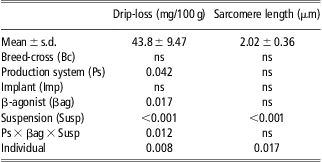
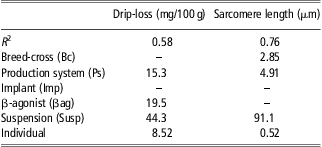
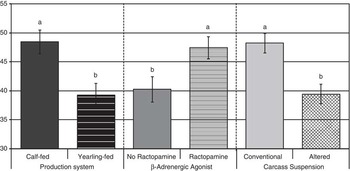
The effects of the main factors and the significant interactions on drip-loss and sarcomere length in longissimus muscle are presented in Table 1. Although production system, β-adrenergic agonist strategy, carcass suspension and their three-way interaction had an effect (P < 0.05) on drip-loss value, carcass suspension was the only factor influencing (P < 0.001) the length of the sarcomere in longissimus muscle. Breed-cross and implant strategy had no effect (P > 0.05) on drip-loss and sarcomere length. The effect of the individual animal variation was significant (P < 0.05) for both traits. Thus, the variability in sarcomere length explained by the model (R 2 = 0.76) was mainly due (91.1%) to differences between suspension methods (Table 2). This factor was also responsible for 44.3% of the variability in drip-loss. Moreover, drip-loss was also highly affected by production system (15.3%) and β-agonist strategy (19.5%). The individual animal variation explained 8.5% of the variability in drip-loss, but <1% in sarcomere length. Lower drip-loss values were observed in meat from yearling-fed steers, without β-adrenergic agonist and in carcass sides suspended by the aitch bone, compared with meat from calf-fed steers, with β-agonists and suspended by the Achilles’ tendon (Figure 1). Thus, although these three factors were responsible for >79% of the variability explained by the model (R 2 = 0.58), their interactions did not explain >5% of the variability in drip-loss.
Least square means (±s.d.) and factors (P-value) affecting beef drip-loss values and sarcomere length
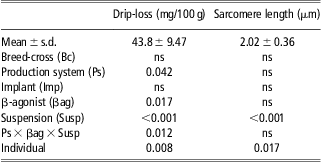
Only significant interactions (P > 0.05) are reported.
ns: P < 0.05.
Full model adjustment (R 2) and relative contribution (% within model) of individual factors to the final variation in beef drip-loss values and sarcomere length
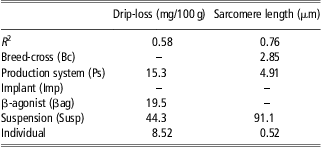
Only interactions explaining >5% for any trait are reported.
Effects of production system, β-adrenergic agonist and carcass suspension on beef drip-loss values. Different letters indicate statistical difference (P ⩽ 0.05).

Pelvic suspension has been shown to dramatically increase sarcomere length in muscles such as longissimus lumborum and semimembranosus (Park et al., Reference Park, Hwang, Cho, Yoo, Kim, Lee, Polkinghorne and Thompson2008). In this study, carcass sides suspended by the Achilles’ tendon also presented much lower sarcomere length values (1.73 ± 0.05 μm) than those suspended by the aitch bone (2.30 ± 0.05 μm). These values are similar to those reported in previous studies (Eikelenboom et al., Reference Eikelenboom, Barnier, Hoving-Bolink, Smulders and Culioli1998; Sørheim et al., Reference Sørheim, Idland, Halvorsen, Frøystein, Lea and Hildrum2001; Park et al., Reference Park, Hwang, Cho, Yoo, Kim, Lee, Polkinghorne and Thompson2008) confirming the strong influence of pelvic suspension on the length of the sarcomere in longissimus muscle, which may have an important effect on beef tenderness and branding programs wishing to assure tenderness of their beef products. According to previous studies that stretching also results in a decrease in drip-loss values in beef (Aalhus et al., Reference Aalhus, Larsen, Dubeski and Jeremiah2000) due to increased carcass shrink losses, and subsequent reduced purge losses, and it can have an interactive effect with the beef production system and slaughter age (Ahnström et al., Reference Ahnström, Hessle, Johansson, Hunt and Lundström2009). Dubeski et al. (Reference Dubeski, Aalhus, Jones, Robertson and Dyck1997) also found lower drip-loss values in yearling-fed animals, which could be due to different carcass cooling rates. Higher drip-loss values have also been reported for meat from animals with β-agonist treatments (Strydom et al., Reference Strydom, Frylinck, Montgomery and Smith2009). However, the effects seem to be associated to dose and duration of treatment, as well as type of β-agonist.
Proximate analysis
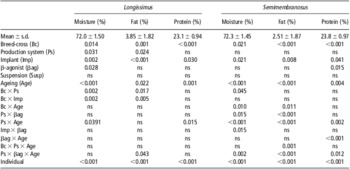
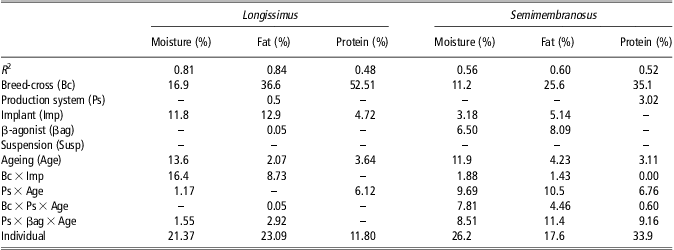
The effects of breed-cross, implant strategy and ageing time were significant (P < 0.05) for moisture, fat and protein content in both longissimus and semimembranosus muscles (Table 3). Moisture and fat content in longissimus muscle were also affected (P < 0.05) by the production system, whereas the use of β-agonists influenced (P < 0.05) the moisture content in longissimus and the protein content in semimembranosus muscles. Several two- and three-way interactions were also statistically significant (P < 0.05). Carcass suspension had no effect (P > 0.05) on meat composition. Thus, the model was able to explain a large proportion (R 2 = 0.80) of the variability for moisture and fat content, but a smaller proportion (R 2 = 0.48) of the variability in protein content in longissimus muscle (Table 4). For semimembranosus muscle, more than half (R 2 = 0.50 to 0.60) of the variability in meat composition was explained by the model. Breed-cross and implant were responsible for 45.1% and 58.2% of the variability explained by the model in moisture and fat content in longissimus muscle, respectively, whereas breed-cross, ageing time and the interaction between the production system and ageing time were, in general, the most influential factors for the composition of semimembranosus muscle.
Least square means (±s.d.) and factors (P-value) affecting beef (longissimus and semimembranosus muscles) proximate composition

Only significant interactions (P > 0.05) are reported.
ns: P < 0.05.
Full model adjustment (R 2) and relative contribution (% within model) of individual factors to the final variation in beef (longissimus and semimembranosus muscles) proximate composition
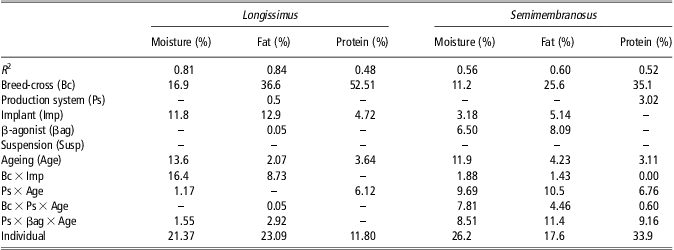
Only interactions explaining >5% for any trait are reported.
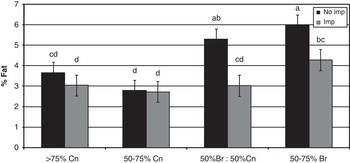
Beef cattle breeds present different growth rates, resulting in different maturity levels and, therefore, different fat tissue development at similar ages (Mirzaei et al., Reference Mirzaei, Verbyla and Pitchford2011). Moreover, the impact of implants on fat content has been widely discussed (Thompson et al., Reference Thompson, McIntyre, Tudor, Pethick, Polkinghorne and Watson2008). Figure 2 shows the interaction between breed-cross and implant strategy for fat content. Interestingly, although no difference was observed when using implants on Continental beef cattle, the increase in fat content obtained with the increasing contribution of British breeds was reduced or eliminated by the use of hormonal implants. Therefore, although the decrease in fat content when implants are used in beef cattle is a well-known effect (Hunter, Reference Hunter2010), it may be breed dependant, resulting in greater changes in breeds with higher genetic potential for fat deposition. Intramuscular fat content has also been reported to increase with slaughter age and can be manipulated by dietary treatments (Ahnström et al., Reference Ahnström, Hessle, Johansson, Hunt and Lundström2009). Nevertheless, in this study the production system accounted for <1% of its variability. Finally, the loss in moisture over time during the ageing period (Juárez et al., Reference Juárez, Larsen, Gibson, Robertson, Dugan, Aldai and Aalhus2010) was likely responsible for the effect of ageing on meat composition.
Effect of implant strategy on beef fat content (longissimus muscle). Different letters within factor indicate statistical difference (P ⩽ 0.05).

Instrumental and sensory tenderness
Although extensive research has been developed during the last 20 years to understand the factors affecting beef tenderness, most studies only focus on a limited number of effects. This approach leads to small variability within the studies, whereas the variability observed under commercial conditions may be quite large (Butchers et al., Reference Butchers, Ferguson, Devine and Thompson1998; Ferguson et al., Reference Ferguson, Bruce, Thompson, Egan, Perry and Shorthose2001). Including numerous factors in order to increase this variability would lead to more applicable results. Moreover, to evaluate the contribution of the interactions among factors to the final variability, these need to be included in a single study. Thus, in this study, in which ante- and post-mortem factors potentially present in the commercial beef production chain were included, the standard deviation observed for shear force in longissimus muscle was relatively large (2.02 kg). This large variability, similar to a commercial situation but under controlled conditions, allows a more accurate evaluation of the relative importance of each contributing factor, as well as their interactions.
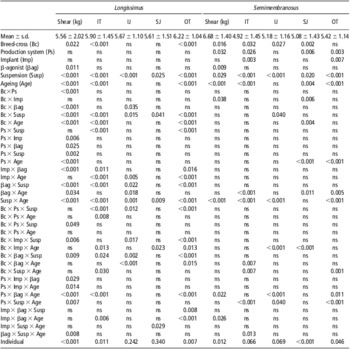
The advantage of the approach used in this study that analyzes the relative contribution of the factors instead of multiple comparisons of means and their significance is evident when studying traits such as shear force. For the longissimus muscle, the effects of breed-cross, β-agonist strategy, carcass suspension and ageing time were significant (P < 0.05), but so were the effects of 20 two- and three-way interactions (Table 5). Interpreting these results might become an impossible task if the relative importance of each of these factors could not be estimated.
Least square means (±s.d.) and factors (P-value) affecting beef (longissimus and semimembranosus muscles) shear force and sensory traits

IT = initial tenderness; IJ = initial juiciness; SJ = sustained juiciness; OT = overall tenderness.
Only significant interactions (P > 0.05) are reported.
ns: P < 0.05.
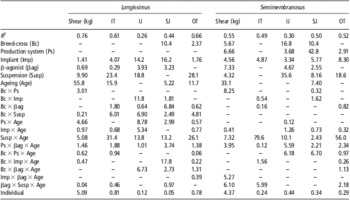
The data presented in Table 6 show how the suspension method and ageing time, as well as their interaction, explained ∼70% of the variability in shear force explained by the model (R 2 = 0.76). Besides the individual animal variation (5.09%), no other factor explained >5% of the variability in shear force. Breed-cross, production system, β-agonist strategy, carcass suspension and ageing time affected (P < 0.05) shear force in semimembranosus muscle (Table 5). In this case, only a few interactions had an effect (P < 0.05) on shear force values. Looking at the relative contribution of these factors (Table 6), although the variance explained by the model was lower than for longissimus muscle (R 2 = 0.55), the suspension method and ageing time as well as their interaction absorbed ∼45% of this variability. Other factors such as breed-cross, finishing treatment and their interaction explained ∼20% of the variability. Suspension method, ageing time and their interaction were also the main factors influencing sensory initial and overall tenderness in both muscles. In longissimus muscle, these factors accounted for 70.7% and 65.9% of the variability in initial (R 2 = 0.61) and overall (R 2 = 0.66) tenderness, respectively, and 79.6% and 74.6%, respectively, in semimembranosus muscle (R 2 = 0.49 and 0.52, respectively).
Full model adjustment (R 2) and relative contribution (% within model) of individual factors to the final variation in beef (longissimus and semimembranosus muscles) shear force and sensory traits

IT = initial tenderness; IJ = initial juiciness; SJ = sustained juiciness; OT = overall tenderness.
Only interactions explaining >5% for any trait are reported.
On the other hand, a small proportion of the variability observed in initial juiciness was explained by the model (R 2 = 0.26 and 0.30 for longissimus and semimembranosus muscles, respectively). Moreover, although the variability explained in sustained juiciness in longissimus muscle (R 2 = 0.44) was mainly due to breed-cross, implant and several interactions, production system accounted for almost 43% of the variability in sustained juiciness in semimembranosus muscle (R 2 = 0.50). Therefore, the factors included in this study were more effective in explaining the variability in texture than in juiciness in beef. This may be due to the large effect of other factors not included in the model, such as animal stress, carcass chilling regime or meat cookery have on beef juiciness (Juárez et al., Reference Juárez, Aldai, López-Campos, Dugan, Uttaro and Aalhus2012).
Ultimate meat tenderness is highly dependent on the degree of alteration and weakening of myofibrillar structures, resulting in an increase in tenderness in aged compared with unaged meat (Koohmaraie and Geesink, Reference Koohmaraie and Geesink2006). Moreover, several authors have reported changes in both instrumental and sensory texture of beef from pelvic suspended compared with Achilles-suspended carcasses (Eikelenboom et al., Reference Eikelenboom, Barnier, Hoving-Bolink, Smulders and Culioli1998; Aalhus et al., Reference Aalhus, Best, Costello and Jeremiah1999; Ahnström et al., Reference Ahnström, Hessle, Johansson, Hunt and Lundström2009). Therefore, as indicated by our results, the greatest variation in shear force values is due to post-mortem changes. According to previous studies, tenderness can be affected by breed, age and production system (Christensen et al., Reference Christensen, Ertbjerg, Failla, Sañudo, Richardson, Nute, Olleta, Panea, Albertí, Juárez, Hocquette and Williams2011). Implant strategies have also been reported to decrease tenderness in beef (Thompson et al., Reference Thompson, McIntyre, Tudor, Pethick, Polkinghorne and Watson2008). In this study, although some ante-mortem factors had an effect on beef texture, the total contribution of all of them was minimal compared with the effect of post-mortem factors. The individual animal variation was also relatively small compared with other factors. In fact, the genetic variance in shear force for the type of breeds included in this study has been reported to be ∼8% (Robinson et al., Reference Robinson, Ferguson, Oddy, Perry and Thompson2001). However, as stated by Ferguson et al. (Reference Ferguson, Bruce, Thompson, Egan, Perry and Shorthose2001), the effect of the post-mortem conditions can negate any genetic advantage in tenderness an animal may have. Our results confirm that an appropriate post-mortem handling of the carcasses may be much more effective in controlling beef tenderness than pre-mortem strategies.
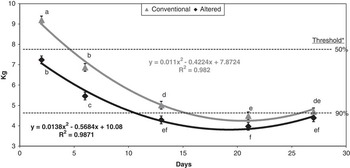
Due to the high relative importance of these factors, the interaction between carcass suspension and ageing time in longissimus muscle is presented in Figure 3. The large difference in shear force values (1.96 kg) between carcass suspension treatments observed at day 2 (P < 0.001) decreased over time until day 27 when shear force values were similar between both carcass sides (P > 0.05). Similar results, with decreases in shear force values >20% after using pelvic suspension, have been previously reported by several authors (Hostetler et al., Reference Hostetler, Link, Landmann and Fitzhugh1972). In this study, 50% of the steaks (longissimus muscle) from carcasses suspended by the aitch bone would be considered tender immediately after slaughter (0.05 day post mortem) according to the consumer thresholds for beef developed by Aalhus et al. (Reference Aalhus, Jeremiah, Dugan, Larsen and Gibson2004). Steaks from conventional Achilles’ tendon suspension would need to be aged for 4.39 days to obtain the same level of acceptability. In the same way, pelvic or aitch bone suspension would result in a 90% acceptability after 10.5 days of ageing, whereas conventional suspension would require 15.1 days of ageing to achieve similar results. Previous studies have shown how pelvic suspension reduces the need for longer ageing periods and significantly reduces the variation in tenderness (Ahnström et al., Reference Ahnström, Hessle, Johansson, Hunt and Lundström2009). Rigor sarcomere shortening is the cause of 24 h post-mortem toughening, and proteolysis is responsible for the decline in shear force during post-mortem storage (Wheeler and Koohmaraie, Reference Wheeler and Koohmaraie1994).
Interactive effect of carcass suspension and ageing time on beef shear force (longissimus muscle). Different letters indicate statistical difference (P ⩽ 0.05). *Percentage of consumers considering meat as tender at that shear force value according to Aalhus et al. (Reference Aalhus, Jeremiah, Dugan, Larsen and Gibson2004).

The decrease in sarcomere shortening observed in carcasses suspended by the aitch bone resulted in smaller improvements due to proteolysis (Koohmaraie et al., Reference Koohmaraie, Doumit and Wheeler1996). Moreover, the quadratic trend observed in both suspension treatments, showing a slight increase in shear force after extended ageing, has been previously reported and is related to increasing moisture losses over time and its interaction with cooking treatments (Juárez et al., Reference Juárez, Larsen, Gibson, Robertson, Dugan, Aldai and Aalhus2010). These two effects could explain the reduction in the differences in beef texture between conventional and altered carcass suspension.
Relative contributions excluding carcass suspension
Although pelvic suspension may be a relatively common practice in many countries, its implementation in Canada is still scarce. Therefore, in order to evaluate the relative contribution of the rest of the factors included in the study, the statistical analyses were repeated excluding the values of the right carcass sides (aitch bone suspension) and the effect of carcass suspension, as well as all its interactions. Thus, for traits such as drip-loss, the R 2 increased up to 0.96. However, >68% of this variability was linked to individual animal variation and ∼24% to β-agonist strategy. On the other hand, a small proportion of the variability in sarcomere length (R 2 = 0.27) was explained by the model, from which 35.0% was due to differences among breed-crosses and 55.6% to differences between production system. Although ageing had the largest contribution (54.8%, 45.9% and 47.1%, respectively) on the explained variability in shear force (R 2 = 0.79) and initial (R 2 = 0.64) and overall (R 2 = 0.68) tenderness, the relative contribution of breed-cross increased compared with the full model (16.1%, 17.5% and 12.7%, respectively). Similar results were observed for semimembranosus muscle.
Numerous studies make evident the high variability in shear force values from different beef breeds (Monsón et al., Reference Monsón, Sañudo and Sierra2005; Pereira et al., Reference Pereira, Pinto, de Abreu and de Lara2009; Christensen et al., Reference Christensen, Ertbjerg, Failla, Sañudo, Richardson, Nute, Olleta, Panea, Albertí, Juárez, Hocquette and Williams2011). Differences in carcass fatness and cooling rate, collagen and lipid content, fiber type, sarcomere length or enzymatic activity may be responsible for differences observed among genotypes (Juárez et al., Reference Juárez, Aldai, López-Campos, Dugan, Uttaro and Aalhus2012). However, even after excluding the effect of carcass suspension from the model, the relative contribution of any ante-mortem factor to the final variability in instrumental or sensory tenderness was always lower than that of the remaining post-mortem factor (e.g. ageing time).
Conclusions
Although numerous factors can potentially influence the final tenderness in beef, the relative importance of each of them may be very different. Among all the factors included in this study, post-mortem treatments (carcass suspension and ageing time) were responsible for the largest changes in instrumental and sensory tenderness values. Although the contribution of breed-cross was larger in a model without altered carcass suspension, ageing time remained as the most important factor influencing beef tenderness. Therefore, under the conditions simulated in this study, controlling or manipulating beef tenderness by carcass ageing and altered carcass suspension would be more effective in controlling beef tenderness than manipulating in vivo factors, such as implant or β-agonist strategies or production system. In this context, a correct ageing strategy would be the most important factor to control in a system aiming to guarantee tenderness. Moreover, if carcass suspension could be modified, this would be the second most important factor to take into consideration when trying to predict, manipulate or guarantee tenderness. If only traditional Achilles’ tendon suspension could be used, the genotype understood as the breed-cross or percentage of Continental and British breeds, would gain importance as an influencing factor on tenderness, although always at a lower level than ageing time.
Acknowledgments
Financial support was received from the Alberta Livestock and Meat Agency Ltd., Alberta Agriculture and Rural Development (ARD), Agriculture and Agri-Food Canada (AAFC) Matching Initiatives Program, Alberta Environment and Elanco Animal Health. The authors gratefully acknowledge the in-kind contribution in animals, facilities and people received from AAFC-Lacombe, with special thanks to Cletus Sehn, Ken Grimson and their staff for animal care and management, Chuck Pimm and the meat processing staff for slaughter and the meat technical staff, including Ivy Larsen, Lorna Gibson, Rhona Thacker, Fran Costello, Christine Burbidge-Boyd and Glynnis Croken for all meat quality analyses. Special thanks are also extended to Cathy Bryant and Sheldon Johnston of ARD for project coordination, data collection and data base management.