INTRODUCTION
Sea cucumbers live on rocky substrate, soft sediments and phanerogam seagrass beds, in depths that vary between 0 and 100 m (Fischer et al., Reference Fischer, Schneider and Bauchot1987). Sea cucumbers have potential to be commercialized in the field of modern treatment and have good therapeutic value. They have been nominated as poly-anion reach food due to the presence of glycosaminoglycans that have influence in many physiologically active functions including wound healing activities (Liu et al., Reference Liu, Koand and Hu2002). Since there is an expansive coastal area in Iran, most coastal cities include some sea cucumber species. In Iran, sea cucumbers are not well known and they are not consumed as food, although they have been consumed in many countries for hundreds of years (Afkhami et al., Reference Afkhami, Ehsanpour, Khazaali, Dabbagh and Maziar2012a). Otherwise in recent years some more studies have been done in Parisian Gulf sea cucumbers including body wall composition (Salarzadeh et al., Reference Salarzadeh, Afkhami, Bastami, Ehsanpour, Khazaali and Mokhlesi2012), fatty acid profile (Yahyavi et al., Reference Yahyavi, Afkhami, Mokhleci, Ehsanpour, Khazaali, Khoshnood and Jvadi2012), antibacterial, antifungal and cytotoxic effects (Mohammadizadeh et al. in press) and some new species were recorded (Afkhami et al., Reference Afkhami, Ehsanpour, Khazaali, Dabbagh and Maziar2012a, Reference Afkhami, Maryam, Forouzan and Bahrib, Reference Afkhami, Ehsanpour, Dabbagh, Sarhadizadeh and Mirzadehc; Darvish Bastami et al., 2012; Ehsanpour et al., 2012). In this paper sea cucumber species around the Hengam Island (Persian Gulf) were identified.
MATERIALS AND METHODS
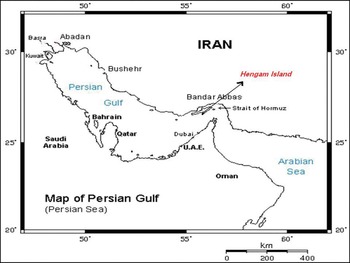
Sea cucumber samples were caught around Hengam Island in March–July 2012 by SCUBA diving at depths of 5–15 m (Figure 1). The samples were transferred to the laboratory in order to photograph them and extract their ossicles. It is well-known that ossicles are the main taxonomic character in holothuroids (Thandar & Samyn, Reference Thandar, Samyn, Heizeller and Nebelsick2004). The ossicles were measured on transect across a slide prepared from the mid-dorsal region of each specimen. For this purpose, samples were anaesthetized using magnesium chloride (MgCl2) 5% which is easily available from pharmacies in our region (Jiaxin, Reference Jiaxin2003). In order to extract the ossicles a small piece made of dorsal and abdominal skin of the samples was placed into the commercial bleaching liquid for almost 30 minutes (Hickman, Reference Hickman1998). White sediments accumulated at the end of the test tube. One drop of liquid was spread on the glass side, and photographs were taken to help identify the species from valid identification keys (Conand, Reference Conand1993; Samyn et al., Reference Samyn, VandenSpiegel and Massin2006). Also, for the correct identification some specimens were sent to Professor Gustave Paulay at the National Museum of Florida, United States.
Sampling site of sea cucumbers around Hengam Island (Persian Gulf).

RESULTS
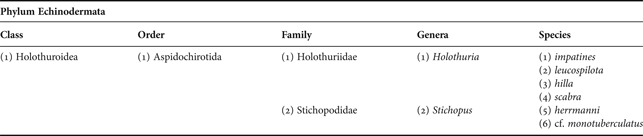
In this study we report 6 species of sea cucumber from Hengam Island which is located on the south coast of Qeshm Island (the biggest Island in the Persian Gulf). Hengam Island lies between 55°51′43″N and 26°40′86″E. This island has an area of 90 km2 and is 2 km away from the southern part of Qeshm Island. It is a coral island with fringing reefs. Six species of sea cucumber (four species belong to the genus Holothuria and another two species belong to the genus Stichopus) were identified on the sub-tidal zone of Hengam Island (Table 1).
Sea cucumber species identified around Hengam Island.

Description
HOLOTHURIA LEUCOSPILOTA
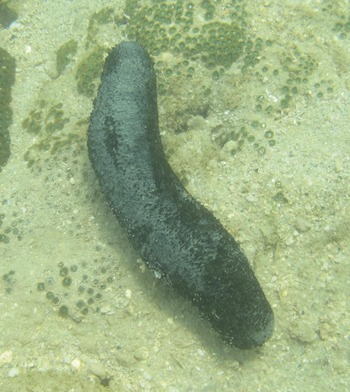
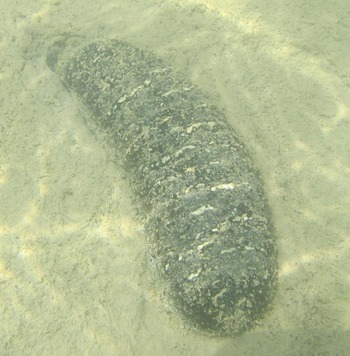
Body very elongate, narrower anteriorly than posteriorly. Mouth ventral, surrounded by 20 black tentacles. Anus subdorsal. Calcareous ring with large radial pieces and triangular interradials. Cuvierian tubules very thin and long. Colour entirely black. Spicules: dorsal and ventral tegument with tables and buttons; tables with circular large disc, having 8 holes (or more), spire with 4 pillars, and ending in a crown with a large central hole; buttons regularly, with 6 or 8 holes, or irregular; plates large in ventral podia, with many holes; dorsal podia also with long rods; tentacles containing few rods (Figure 2).
Holothuria leucospilota.

HOLOTHURIA (THYMIOSYCIA) IMPATIENS
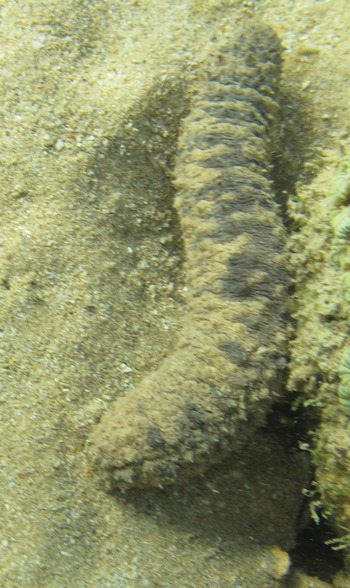
Ventral mouth surrounded by 20 tentacles which are in turn surrounded by a ring of very small conical papillae; anus terminal with five conical papillae. Thick Cuvierian tubules present but not readily ejected. Body wall only few mm thick and relatively smooth. In this species the body is bottle shaped with a long neck and rough surface, sandy to touch. It is covered with conical warts from which filamentous appendages emerge. It is light brown in colour with 4–5 dark brown transverse bands on the upper side near the anterior end. Background colour beige with brown dorsal spots more or less dark. Spicules, are uniform layer of tables with almost squarish disc with eight large lllarginal holes and squat spire with numerous teeth on top, and an inner layer of buttons with three pairs of large holes (Figure 3).
Holothuria impatients.

HOLOTHURIA (METRIATYLA) HILLA LESSON, 1830
Mouth ventral surrounded by 20 small yellowish tentacles, anus terminal. Ventral podia arranged in 3–4 rows in each ambulacra area. Dorsal papillae, large and conical, scattered in no particular order on the bivium. The spicules of the papillae were buttons with three or five pairs of holes (60–100 mm) and tables (80 mm across). The spicules of the body wall were tables (80 mm across) and buttons (100 mm). The spicules of tentacles were 130–200 mm long; the body wall included tables and buttons, as well as distinct papillae. The background colour was reddish-brown and it is still characterized by the presence of numerous white spots marking the base of creamy white buds (Figure 4).
Holothuria hilla.

HOLOTHURIA (METRIATYLA) SCABRA
Bivium is characterized by wrinkles and small papillae within black dots that are covered by sediment when the animal is coming out of the bottom. Mouth is ventral and surrounded by a collar of papillae and 20 grey, short and stout tentacles. Anus is terminal and surrounded by a circle of 5 radial papillae groups. Spicules of H. scabra are very numerous; ventral tegument with tables and buttons, the tables having a moderately small disc, perforated by a varying number of holes of variable size, the spire with 4 pillars and a cross-like bridge, ending in a spiny crown with a hole in the middle; small rods and denticulate plates also present; tables and buttons in dorsal tegument are with a nodose disc, much larger than in ventral tegument (Figure 5).
Holothuria scabra.

STICHOPUS HERMANNI (SEMPER, 1868)
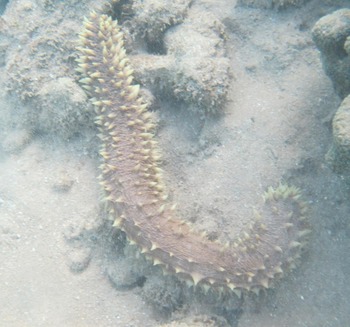
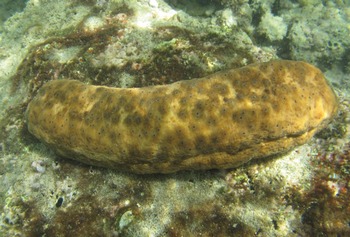
The entire body has different shades of beige to brown with irregular brown patches and fleshy tubercles projecting along the sides without cuts or small cuts across the mouth. Tentacles usually are twenty in number (non-retractile). The body is broad, considerably flattened ventrally, and the dorsal side is slightly arched and the lateral sides are almost vertical; the body wall is very thick and soft; mouth sub-terminal; anus central; and tentacles usually 20 in number of moderate length and leaf-shaped. Calcareous ring slender but variable in development, with the radial plates approximately half of the length of the inter radials. Ossicles numerous, consisting of tables with large discs having usually 7 to 15 peripheral holes, but they are often irregular or incomplete, and the spire is of moderate height ending with a group of spineless (sometimes in the form of a cross) about as wide as the disc, rosettes of variable development, and rods (sometimes very little), some of which may be C-shaped or have several branches. Colour of live specimens variable, it is usually brownish yellow and often mottled and with darker papillae giving a spotted appearance (Figure 6).
Stichopus cf. monotuberculatus.

STICHOPUS CF. MONOTUBERCULATUS (QUOY & GAIMARD, 1833)
Dorsal side from grey-green to orange-brown to dark green to black patches, ventral side grey-green with numerous small dark patches. In alcohol the colours fade to light green with patches of light brown. Ventral side flattened, dorsal side swollen, giving the animal a squamish view in cross-section. Mouth ventral surrounded by 20 large tentacles surrounded in turn by a circle of large papillae. Anus terminal, without anal teeth or papillae. Large cylindrical, yellowish brown tube feet in trivium in ambulacra areas only. Skin rather rough compared to the other Stichopus species found in the region (Figure 7).
Stichopus hermanni.

DISCUSSION
Heding (Reference Heding1940) recorded 17 species of holothurians found in the waters around Iran. Since there is an expansive coastal area off Iran, most coastal cities include some species of holothurians (Shakouri et al., Reference Shakouri, Aimorirad, Nabavi, Kochanian, Savari and Safahyie2009). Therefore, only a few authors dealt with their taxonomy, biology and culture (Amini Rad, Reference Amini Rad2004; Shakouri et al., Reference Shakouri, Aimorirad, Nabavi, Kochanian, Savari and Safahyie2009; Dabagh et al., 2011b; Afkhami et al., Reference Afkhami, Ehsanpour, Khazaali, Dabbagh and Maziar2012a, Reference Afkhami, Maryam, Forouzan and Bahrib, Reference Afkhami, Ehsanpour, Dabbagh, Sarhadizadeh and Mirzadehc, Reference Afkhami, Ehsanpour, Khazaali, Kamrani, Mokhlesi and Darvish Bastamid; Darvish Bastami et al., 2012; Ehsanpour et al., 2012).
Holothuria leucospilota is a common shallow-water species in the area, rarely found in depths of more than 10 m; mostly on outer and inner reef flats, back reefs, and shallow coastal lagoons. Inshore, shallow-water populations are denser, composed of smaller individuals and reproduce mostly by transversal fission, while in deeper or outer reef populations the individuals are more scattered, larger, and reproduce sexually (Massin, Reference Massin1996). The first report of successful H. leucospilota larval development in Iran was conducted by Dabbagh et al. (Reference Dabbagh, Sedaghat, Rameshi and Kamrani2011). It seems that H. leucospilota is the dominant sea cucumber species in the Persian Gulf (Afkhami et al., Reference Afkhami, Ehsanpour, Dabbagh, Sarhadizadeh and Mirzadeh2012c).
Holothuria impatiens has a long shape similar to that of H. surinamensis but is more warty and rougher to the touch. When touched or disturbed, the animal very quickly contracts in size, an adaptive response to escape from predators and living in confined spaces. Colour is various shades of grey and brown with size being up to 15 to 20 cm long (Clark, Reference Clark1942). At present it is not used for processing because it is a secretive form found under dead coral stones (James, Reference James2001). A few specimens have been taken at low tide but apparently most specimens live concealed among the rocks, a little deeper than most collectors are able to reach. At night it extends the anterior end of its hole to feed on nearby sediment. Holothuria impatiens was previously recorded from the Persian Gulf (Farour Island) by Heding (Reference Heding1940) and Larak Island by Afkhami et al. (Reference Afkhami, Ehsanpour, Khazaali, Dabbagh and Maziar2012a) but this is a first record of this species around Hengam Island.
Holothuria hilla has a body which is long and cylindrical with blunt ends. It reaches a length of 200 mm. This sea cucumber is primarily found under rocks on the bottom of coarse sand, generally between 0 and 20 m, but also to over 200 m (Lane et al., Reference Lane, Marsh, Vandenspiegel and Rowe2000). Some authors have described H. hilla previously (Massin, Reference Massin1996; Samyn, Reference Samyn2003). Although H. hilla was reported in general from the Persian Gulf (Heding, Reference Heding1940) and in particular at Farour Island (Dabagh & Kamrani, Reference Dabagh and Kamrani2011) and Larak Island (Afkhami et al., Reference Afkhami, Maryam, Forouzan and Bahri2012b), this is a new observation of this species around Hengam Island.
In Iran, the sandfish, H. scabra is the most exploited sea cucumber species which are harvested at Qeshm Island because of the high demand from India and Bangladeshi traders (Afkhami et al., Reference Afkhami, Ehsanpour, Khazaali, Kamrani, Mokhlesi and Darvish Bastami2012d). In our specimens, the morphological aspect and ossicles were substantially similar to those described by Cherbonnier (Reference Cherbonnier1988) in specimens from Madagascar, by Massin (Reference Massin1996) in specimens from Ambon, by Massin (Reference Massin1999) in specimens from Indonesia, and by Samyn (Reference Samyn2003) in specimens from Kenya and Pemba Island, Tanzania. Data on the behaviour of H. scabra also show that this species attempts to conceal itself in the mud early in the morning. Hence, that is the best time to collect the animals. However, this species also has been observed half-buried in the mud (Macnae & Kalk, Reference Macnae and Kalk1962). Holothuria scabra was reported from Qeshm Island by Darvish Bastami et al. (Reference Darvish Bastami, Afkhami, Ehsanpour, Khazaali and Soltani2012).
Curry sea cucumber (Stichopus hermanni) is considered to be of low value in the export market because of the tendency of the body wall to disintegrate easily, while exposed to air after harvesting and during boiling. It is reported that in the Pacific region, the intestine and gonad from this species are considered to be a delicacy among the locals and are eaten raw on the spot or squeezed into bottles and sold. Until 1995 it is almost always mentioned in the literature under the name S. variegatus. Since S. variegatus was replaced by S. herrmanni and S. monotuberculatus (Quoy & Gaimard, 1833) (Samyn et al., Reference Samyn, VandenSpiegel and Massin2006), S. hermanni was recorded previously from Qeshm Island (Darvish Bastami et al., 2012) and Abu Musa Island (Afkhami et al., Reference Afkhami, Ehsanpour, Dabbagh, Sarhadizadeh and Mirzadeh2012c) in the Persian Gulf.
The sea cucumber Stichopus cf. monotuberculatus has a wide Indo-Pacific distribution and high commercial value due to its medicinal and edible properties (Massin, Reference Massin1996; Liao, Reference Liao1997). It is however an expected species since, Massin's (1996, map 3, p. 174) distribution map shows an Indo-Pacific distribution from the Red Sea and Madagascar to the Easter Islands, and from Japan to Australia. It has been demonstrated that S. monotuberculatus can be reared in captivity, thus the farming of this species would provide an alternative to fisheries (Hu et al., Reference Hu, Xu, Wen, Zhang, Fan and Su2010). The spicules match the descriptions given by Cherbonnier (Reference Cherbonnier1952) and Massin (Reference Massin1996) but more specimens of different sizes from different localities are needed to clarify the identity of our specimens. Stichopus cf. monotuberculatus recently have been recorded in the Persian Gulf (Hengam Island) by Ehsanpour et al. (Reference Ehsanpour, Afkhami, Houshang and Abdolrasoul2012).
ACKNOWLEDGEMENTS
We thank Professor Gustave Pauly, the Chairman of the Invertebrate Department of Florida University, for species identification. We also acknowledge the Bandar Abass branch Islamic Azad University for financial support and cooperation in this project.