1 Introduction
A common reason for the deletion of a segment is phonotactic well-formedness. Illicit combinations of consonants or vowels are avoided through deletion of one or more members of such an illicit cluster. Far more unusual, but still attested, are cases of morphologically triggered segment deletion, where a morpheme is expressed through subtraction or truncation (Alber & Arndt-Lappe Reference Alber, Arndt-Lappe and Trommer2012). In Yine, a process can be observed in which phonological and morphological factors interact in an interesting way with processes of segment deletion.Footnote 1 Certain suffixes have the peculiar property of causing the deletion of a preceding vowel, as can be seen in (1), where suffixes triggering deletion are underlined.Footnote 2
(1)

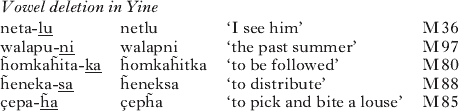
On the surface, there is no phonological property distinguishing these suffixes from suffixes that do not trigger vowel deletion in Yine. This is shown by the existence of pairs of homophonous suffixes where one triggers deletion and the other does not, as in (2). The data in (2a) is particularly striking, since not only are the two suffixes homonyms, but the two stems to which the different affixes attach are phonologically quite similar as well. Only the nominalising suffix /-nu/ triggers deletion; the homophonous anticipatory suffix does not.
(2)
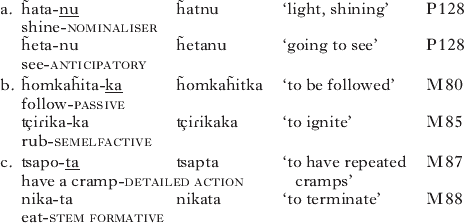
Given the facts in (2), we can conclude that vowel deletion is not a general phonological rule, but is triggered by an arbitrary class of morphemes. This morpheme-specificity is particularly interesting from a theoretical perspective. Pater (Reference Pater and Parker2009) takes it to be a strong argument for morphologically indexed optimality-theoretic constraints. His analysis assumes that different (classes of) morphemes are sensitive to different constraint rankings. Similarly, the analysis proposed in Lin (Reference Lin1997b) for Yine considers the ‘boundary vowel deletion’ process that deletes the final vowel after each stage of suffixation to be subject to a ‘morphological condition that arbitrarily marks some suffixes as non-triggers’ (Lin Reference Lin1997b: 406). Theories such as these, which allow direct access to morphological information in the phonology, suffer from ‘a severe lack of empirical content and heuristic power’ (Bermúdez-Otero Reference Bermúdez-Otero and Trommer2012: 79), and an analysis is preferable that adopts a version of the ‘Indirect Reference Hypothesis’ (Inkelas Reference Inkelas1990), which restricts the ability of the phonology to refer to morphosyntactic information. The analysis I propose avoids the assumption of morpheme-specific mechanisms such as constraints indexed only for specific morphemes or morphological domains.
I present an analysis of the vowel-deletion process that situates the trigger for the vowel deletion in the phonological representation of the morphemes themselves. More concretely, I will argue that the morphemes that trigger vowel deletion lack a mora underlyingly, and ‘usurp’ the mora of the preceding vowel. Vowel deletion then follows from the general ranking of markedness and faithfulness constraints for Yine, without any reference to specific morphemes at any point. The theory is implemented in a version of containment-based Optimality Theory (OT; Prince & Smolensky Reference Prince and Smolensky1993), and it is shown that the ‘usurpation’ effects that underlie the analysis of Yine are straightforwardly predicted in this framework. This reanalysis of a morpheme-specific process in purely phonological terms is a strong argument for the general claim that there is no direct reference to morphological information in the phonology and that similar reanalyses are possible for all apparently morpheme-specific phonological processes.
Apart from this morpheme-specificity, a second interesting property of vowel deletion in Yine is its interaction with the regular phonological demands of the language. On the one hand, vowel deletion is blocked by phonological demands, and does not apply if a three-consonant cluster would thereby be created, as in (3).
(3)
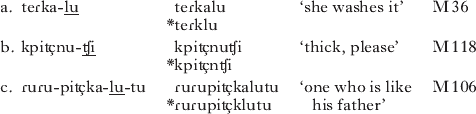
On the other hand, vowel deletion feeds a phonological repair operation, and is accompanied by consonant deletion whenever an illicit obstruent cluster would result after vowel deletion, as shown in (4).
(4)
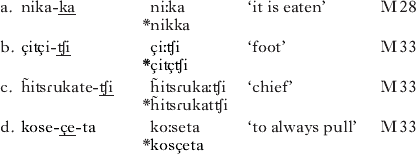
Both marked structures – the three-consonant clusters in (3) and the illicit obstruent sequences in (4) – can in principle be repaired by the same process, consonant deletion. It is therefore at first glance unexpected that this repair applies in one context but not in the other. A detailed understanding of the restrictions on consonant deletion in Yine is therefore necessary for a complete analysis of the vowel-deletion process.
Consonant deletion in Yine is interesting from a theoretical perspective for another reason as well. As can be seen in (4), consonant deletion results in compensatory lengthening of the preceding stem vowel. This lengthening process is opaque, since the deleted consonant would be syllabified as a coda consonant only after vowel deletion. (5) briefly illustrates how the compensatory lengthening falls out in a system with intermediate steps in the phonological derivation. After vowel deletion applies (deleted elements are highlighted), the first /k/ is syllabified as coda consonant and becomes moraic. Consonant deletion then leaves the mora unassociated. Finally, the floating mora associates to the preceding vowel.
(5)
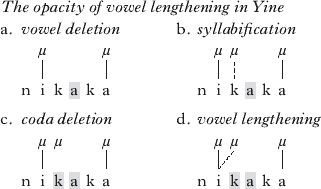
It is clear that such a derivation is highly problematic in standard parallel OT, where any reference to intermediate steps such as (5b) and (5c) is impossible. Compensatory lengthening in Yine is therefore challenging for a parallel model of phonological evaluation. In this paper it is shown how an optimality-theoretic framework based on the assumption of containment is able to solve such opacity problems.
In addition, a phonological account of the morpheme-specific vowel deletion straightforwardly predicts that it interacts with the other regular phonological processes, such as consonant deletion. Under the alternative account, that the morpheme-specific vowel deletion is the result of a morphological (word-formation) rule that modifies the phonological form of the base (Matthews Reference Matthews1974, Anderson Reference Anderson1992, Stump Reference Stump2001), such an interaction cannot be accounted for.
The paper is structured as follows: in §2 I present the theoretical background assumptions of coloured containment and some relevant information about the segmental inventory and phonotactic restrictions of Yine. The ‘mora-usurpation’ analysis of the vowel deletion in Yine is presented in §3. After the basic logic of mora usurpation and vowel deletion is introduced in §3.1, I discuss the behaviour of a third interesting class of suffixes in §3.2, before summarising the general predictions of the usurpation analysis in §3.3. §4 addresses the interaction of morpheme-specific vowel deletion and consonant-cluster restrictions in Yine. In §4.1, some prerequisites for the syllable structure and moraic licensing of consonants in Yine are given, before the interaction of vowel deletion and consonant deletion is discussed in §4.2. The phenomenon of vowel lengthening in the context of vowel deletion and consonant deletion is addressed in §4.3. §5 offers a summary of the analysis and its theoretical implications, and the shortcomings of the alternative approaches to the Yine facts in Lin (Reference Lin, Booij and de Weijer1997a, Reference Linb) and Pater (Reference Pater and Parker2009) are discussed in §6.
2 Theoretical and empirical background
2.1 The segmental inventory of Yine
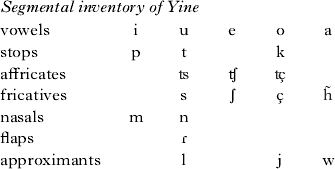
In this section, some relevant phonotactic facts of Yine are discussed. The segmental inventory of the language is given in (6) (Lin Reference Lin, van Oostendorp and de Weijer2005: 126, Urquía Sebastían & Marlett Reference Urquía Sebastían and Marlett2008: 365).Footnote 3
(6)
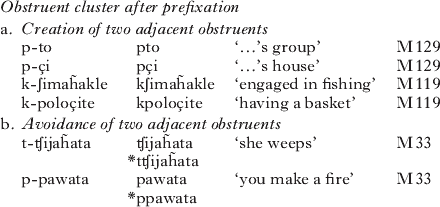
All long vowels in Yine are the result of compensatory lengthening (cf. §4.3), and only stem vowels can be long (Matteson Reference Matteson1965: 31). Vowel-initial words are generally impossible in the language. Three-consonant clusters can result only from the concatenation of monoconsonantal prefixes, and are impossible underlyingly or as the result of other phonological processes (cf. §4.2). One property of syllable structure in Yine is that there are no sonority constraints that govern the combination of consonants in a cluster. In principle, any two consonants can occur in any order, for example [sm] and [ms] are both possible onset clusters (e.g. [smota] ‘blunt point’ (Matteson Reference Matteson1965: 343) vs. [msa] ‘empty corn cob’ (1965: 307)). However, a few two-consonant sequences are illicit, all of them involving obstruents. In (7), contexts are given where prefixes consisting only of a stop attach to a stem with an initial obstruent. The obstruent clusters surface faithfully in (7a), but the expected combinations in (7b) are illicit in Yine, and deletion of the first obstruent takes place to avoid this marked structure.
(7)
The licit and illicit combinations of obstruents in Yine are listed in (8). The ‘–’ marks contexts where an expected cluster is avoided through deletion of the first obstruent (cf. (7b)), and the ‘+’ marks obstruent clusters that surface faithfully in Yine (cf. (7a)). A first rough generalisation is that adjacent obstruents that are ‘too similar’ are impossible in the language. There are no obstruent geminates, or combinations of [t] followed by an affricate. In the context of a /t/ and a following /s/, affrication applies and [ʦ] surfaces.Footnote 4
(8)
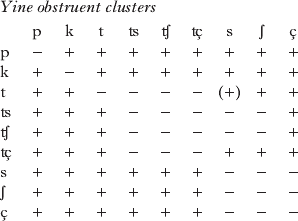
In some contexts, morpheme-specific vowel deletion creates the context for this consonant deletion, as discussed and analysed in §4.2.
2.2 Theoretical framework: coloured containment
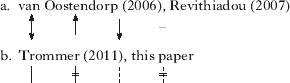
The analysis I propose is implemented in coloured containment, a version of containment-based OT. It integrates the assumption of containment that defined the very first version of OT in Prince & Smolensky (Reference Prince and Smolensky1993) with the assumption of morphological colours (van Oostendorp Reference Oostendorp2003, Reference Oostendorp2006, Reference Oostendorp2007, Reference Oostendorp2008, Revithiadou Reference Revithiadou2007).
The original formulation in (9) of the containment principle demands that the input should be contained in the output. The input is therefore irrelevant for Eval, and, in contrast to correspondence-theoretic OT (McCarthy & Prince Reference McCarthy and Prince1995), constraints only refer to the output.
(9)

This assumption prohibits any literal deletion of phonological information. Rather, phonological elements (segments, features, etc.) may lack a phonetic interpretation, since they are phonetically ‘invisible’. Containment as I assume it here goes even further, and demands that the input must be reconstructable from the output at any time. Consequently, reordering is impossible, and an underlying ordering relation between two elements A≫B must be reconstructable from the output representation.Footnote 5 Given these assumptions, association relations are also subject to containment (Trommer & Zimmermann Reference Trommer and Zimmermann2010, Trommer Reference Trommer2011) and association lines that are present underlyingly can never be deleted, but can only remain uninterpreted if they are marked as phonetically invisible. I assume that there are four possible types of association lines (cf. Trommer Reference Trommer2011): association lines that are present underlyingly and are phonetically visible in the output (notated as solid lines in (10)), underlying association lines that are phonetically invisible (notated as crossed-out solid lines), epenthetic association lines that were not present underlyingly and are phonetically visible (notated as dashed lines) and epenthetic association lines that are phonetically invisible (notated as crossed-out dashed lines).Footnote 6
(10)
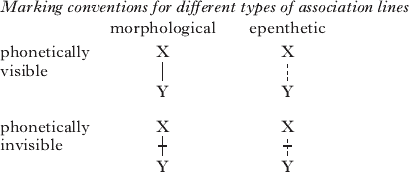
All elements other than association lines (segments, features, tones, etc.) are phonetically invisible if they are not ‘structurally analysed’ (Prince & Smolensky Reference Prince and Smolensky1993: 25), i.e. properly integrated under the highest prosodic node. Throughout the paper, I will often use the term ‘deletion’, for convenience. However, it should be kept in mind that this means phonetic invisibility in containment theory, not literal deletion. Given the assumptions above, a ‘properly integrated’ element that is visible to the phonetics is integrated under the highest prosodic node through phonetically visible association lines. The counterpart to correspondence-theoretic Max is therefore the constraint in (11), specified for consonants.
(11)

Max in this formulation is actually a constraint that subsumes the effect of a class of more local constraints, namely constraints against floating material. A segment, e.g. a vowel, that is properly integrated under the highest prosodic word node results from a structure where this vowel is dominated by a mora through a phonetically visible association line, this mora is dominated by a syllable node through a phonetically visible association line, and so forth. An example of a *Float constraint (Kirchner Reference Kirchner2007) ensuring such a local dominance relation is given in (12), which demands that a mora must be dominated by a segment. The terms ‘phonetic dominance’ and ‘morphological dominance’ in the following refer to the status of the association line between the relevant elements: it is either morphological or phonetically visible (cf. (10)).
(12)
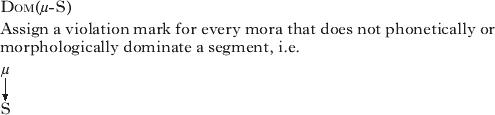
A prediction from the assumption of containment is that phonetically invisible material is still present and has some effect. This prediction is borne out in analyses that crucially rely on the presence and blocking property of ‘deleted’ elements.Footnote 7 From this it follows that there are also constraints referring to phonetically invisible structure.Footnote 8 Dom(μ-S) in (12) is an example of such a constraint: it demands association between a vowel and a mora, but it is not specified whether this association is phonetically visible or not (in contrast to, for example, the constraint Max(C) in (11), which crucially refers to phonetically visible associations). Constraints such as (12), which demand proper integration into the prosodic structure through morphological or phonetic association relations, actually predict usurpation effects in containment theory, as will become evident below.
An assumption that is not bound to containment theory and is actually implicit in many analyses is the assumption of morphological ‘colours’ (van Oostendorp Reference Oostendorp2006). It states that every morpheme has its own specific colour (or index), which allows the identification of all elements belonging to this morpheme. It is therefore an explicit notation for the morphemic affiliation of elements. Given this assumption, the phonology is able to determine whether two phonological elements belong to the same morpheme – it is only able to make this distinction between ‘same’ and ‘different’ colours, but has no access to the specific morphosyntactic meaning associated with a phonological form. Elements without any colour do not belong to any morpheme, and must be epenthetic. The Dep constraints against epenthetic elements are therefore constraints against colourless segments, moras or association lines, for example those in (13).Footnote 9
(13)
Footnote 10
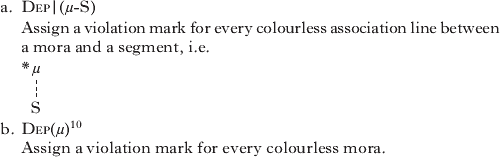
Morphological colours are not only relevant for the identification of epenthetic (i.e. colourless) elements, but also allow us to determine whether two phonological elements belong to the same morpheme. I assume that, apart from the distinction between stem and affix, this is the only morphological information that is accessible to the phonology. In my analysis, this distinction is relevant for the markedness constraint *CαCαCα, which I discuss in §4.2. Finally, the insertion of new association relations in Yine is subject to a directionality restriction, and can only proceed rightwards. Directionality effects are well known from other domains in autosegmental phonology, such as tone (Cassimjee & Kisseberth Reference Cassimjee, Kisseberth, Hyman and Kisseberth1998) and nasality (McCarthy Reference McCarthy2004).
There are some arguments in the literature for a right-to-left default directionality for assimilation processes; cf. for example Hyman (Reference Hyman2000) on vowel harmony and Levelt (Reference Levelt2011) on consonant harmony.Footnote 11 I assume the constraint in (14), ensuring such a right-to-left default directionality for new association lines on the moraic tier.
(14)

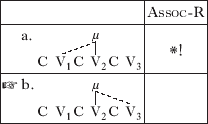
The constraint simply demands that if a mora and a vowel V1 are associated with each other underlyingly, the mora can only associate to a vowel V2 if it follows V1, as illustrated in (15).
(15)
3 Mora usurpation
3.1 D-suffixes
In (16), some more examples of suffixes that trigger vowel deletion are given. I refer to these as ‘d-suffixes’ in the following. It can be seen that the vowel that is predicted to precede such a d-suffix is systematically absent, irrespective of whether this vowel is part of the stem (16a) or a suffix (16b). As argued above, this process is truly morpheme-specific, and cannot be ascribed to any phonological property of these suffixes which distinguishes them on the surface from non-triggering suffixes.
(16)
Footnote 12

I claim that this vowel deletion results from the fact that the triggering morphemes have a defective phonological representation. More specifically, I argue that d-suffix vowels lack a mora underlyingly. Such a representation of a vowel without a mora is a straightforward and expected structure, given the assumption of Richness of the Base (Prince & Smolensky Reference Prince and Smolensky1993), i.e. the fact that in OT the possible inputs are not restricted, but contain all logically possible structures, so that ‘the grammar has to deal with a much wider range of inputs than the analyst might normally consider’ (McCarthy Reference McCarthy2008: 89). A similar argument is found in Kirchner (Reference Kirchner2007), where structures with floating moras are also taken as a necessary consequence of Richness of the Base. More concretely, he interprets them as an example of underspecification (Steriade Reference Steriade and Goldsmith1995). The interesting fact about Yine is that this marked structure is not simply neutralised on the surface, but results in a repair operation with a major influence on the output representation. Since every vowel must be dominated by at least one mora in order to be integrated into the phonological structure, a mora-less vowel ‘searches’ for a mora it can associate to. Its only chance to become associated to a mora in Yine is to associate to the mora of the preceding vowel. This is reminiscent of Yearley's (Reference Yearley1995) analysis of Russian jers. The interesting phenomenon that certain vowels in Slavic languages alternate with zero (Rubach Reference Rubach1986, Spencer Reference Spencer1986, Szpyra Reference Szpyra1992) is assumed to follow from the fact that certain vowels lack a mora underlyingly. The difference between Slavic jers and d-suffixes in Yine is therefore the locus of the deleted vowel: in Slavic it is inside the morpheme that lacks a mora for one of its vowels, and in Yine it is in the morpheme preceding such a mora-less vowel. This difference follows in the analyses from different default strategies that are triggered by the otherwise mora-less vowels: in Yearley's analysis of Russian jer vowels the mora-less vowel associates to an inserted mora, in violation of Dep(μ), while in my analysis, the mora-less vowel can only associate to the mora of a preceding vowel.
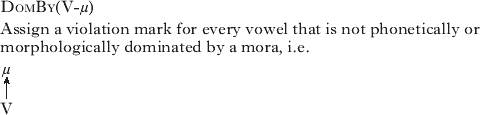
The implementation of this intuition in the containment-based OT-framework adopted here has three main ingredients. First, the vowel is forced to associate to a mora by a high-ranked constraint demanding integration of every vowel into the prosodic structure. The constraint ensuring this is (17), another *Float constraint (cf. (12)).
(17)
Second, the constraint ranking ensures that the mora-less vowel can only associate to the mora of the preceding vowel. Insertion of an epenthetic mora that dominates this suffix vowel is penalised by Dep(μ), which is assumed to be high-ranked in Yine. The otherwise mora-less vowel must therefore associate to an underlying mora. Given that association lines can never cross (Goldsmith Reference Goldsmith1976), the only available mora is now the one dominating the preceding vowel. Third, this association to the preceding mora results in a structure where one mora is linked to two vowels phonetically.Footnote 13 This prosodically marked structure is excluded by the markedness constraint in (18) (cf., for example, NoSharedMora in Broselow et al. Reference Broselow, Chen and Huffman1997).
(18)

A straightforward repair to avoid a violation of (18) involves marking the underlying association of the doubly linked mora as phonetically invisible. Since the vowel preceding the d-suffix now lacks any phonetically visible integration into the prosodic structure, it is not realised, in violation of Max(V) (cf. the formulation of Max(C) in (11)). This is what is termed ‘usurpation’ in the following: a mora-less vowel associates to the mora of a preceding vowel, resulting in non-realisation of the vowel. (19) shows this for an example where the d-suffix /-lu/ ‘him’ triggers deletion of the stem-final vowel in /neta/ ‘to see’. For ease of exposition, phonetically invisible (i.e. not properly integrated) elements are highlighted. The affix vowel /u/ has a different morphological colour, ‘1’, from stem elements, ‘s’, and the inserted mora in candidate (b) has no colour (recall that morphological colours are marked with indices).
(19)

(19a) is the candidate in which the input is realised faithfully and the affix vowel /u/ is not prosodically integrated.Footnote 14 The fatal violation for this candidate is the violation of DomBy(V-μ), since the vowel is not dominated by a mora. In candidate (19b), the affix vowel is associated with an inserted epenthetic mora – but this way of providing the affix vowel with a mora is excluded by high-ranked Dep(μ). The affix vowel therefore can only associate to the preceding stem mora, as in (19c) and (d). However, if the stem mora integrates the affix vowel, it cannot phonetically dominate its original vowel as well, since this results in a structure where one mora is associated to two vowels through phonetically visible association lines (candidate (19c)). (19d) is the winner, as it avoids this illicit doubly linked mora and leaves the stem vowel phonetically invisible.
The comparison between the candidates (19a) and (19d) nicely illustrates the key logic of usurpation, which is only possible in containment theory. In both candidates, Max(V) is violated once, since one vowel remains invisible (the affix vowel /u/ in (19a) and the stem vowel /a/ in (19d)). The crucial difference between the two structures is the integration of material into the prosodic structure. Whereas the unrealised affix vowel in (19a) is truly floating, and not integrated into the structure through any association line, the unparsed stem vowel in (19d) is at least integrated through a phonetically invisible association line. The constraint DomBy(V-μ) therefore prefers the structure (19d), with no vowel which is completely unassociated.
Given a descriptive generalisation like ‘delete the vowel directly preceding a d-suffix’, we would expect multiple deletion of vowels in contexts where multiple d-suffixes are present. However, as can be seen in the data in (20), this is not the case: only one vowel is deleted if multiple monosyllabic d-suffixes are adjacent.Footnote 15 In other words, d-suffixes never trigger deletion of a preceding monosyllabic d-suffix. (Note that candidates (20c) and (20d) also illustrate the interaction of vowel deletion, consonant deletion and vowel lengthening, which will be analysed in §4.2 and §4.3.)
(20)
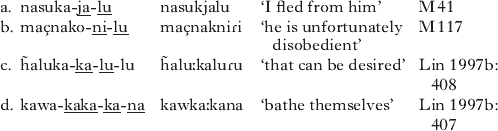
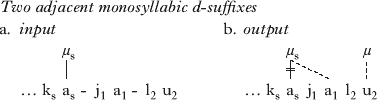
That only one vowel is deleted in the context of multiple d-suffixes (of which the first is monosyllabic) follows straightforwardly from the analysis presented above. Vowel deletion only results if an underlyingly mora-less vowel usurps the mora to which a preceding vowel was underlyingly associated. In a structure like /nasuka-ja-lu/ in (20a), only the first affix vowel, /a/, is preceded by a vowel that is underlyingly associated with a mora. The second affix vowel, /u/, is preceded by a d-suffix, and simply has no chance to associate to any mora that was underlyingly present, so it must be supplied with an inserted mora, as in (21), due to DomBy(V-μ).
(21)
However, in cases where two monosyllabic d-suffixes are followed by a ‘normal’ suffix, as in (20c), / aluka-ka-lu-lu/, multiple vowel deletion would seem to be in principle possible: the second d-suffix /-lu/ could usurp the mora associated to the vowel in /-lu/. However, this usurpation is impossible, given the fact that new associations have to be to the right. This effect of Assoc-R is illustrated in (22).
(22)
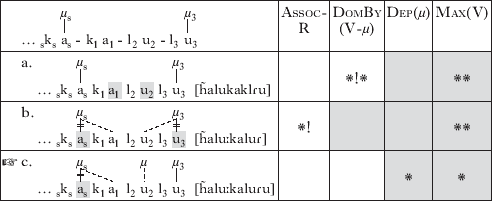
Multiple vowel deletion in candidate (22b) is excluded since μ3 associates to a segmental host, /u2/, which precedes its original segmental host, /u3/. Only the mora-less vowel in /-ka/ is able to associate to an underlying preceding mora.
3.2 An exceptional non-undergoer: /-wa/
Kisseberth (Reference Kisseberth1970) and Pater (Reference Pater and Parker2009) discuss another interesting type of affix with respect to its vowel-deletion properties that is not analysed in any of the papers by Lin. The typology given by Pater (Reference Pater and Parker2009) for affixes in Yine involves the three-way distinction in (23).
(23)

In my analysis, (23a) are the ‘normal’ affixes, with moras dominating all affix vowels underlyingly, and (23b) are the d-suffixes, with a vowel lacking an association to its mora. (23c) is an affix whose vowel is always realised faithfully even if it is followed by a d-suffix. There is only a single example of such an affix, namely /-wa/ ‘yet, still’.
(24)

We know from other contexts that /-lu/ is a d-suffix, and we would therefore expect *[etawlu] and *[nuʃinikawlu] in (24a), which are well-formed strings with respect to all consonant cluster restrictions in Yine. However, /-wa/ resists the vowel-deleting properties of d-suffixes. This exceptional behaviour is predicted from yet another logically possible representation of the moraic specification of vowels, given in (25). /-wa/ is provided not only with a mora that dominates its affix vowel, but with an additional floating mora as well.
(25)

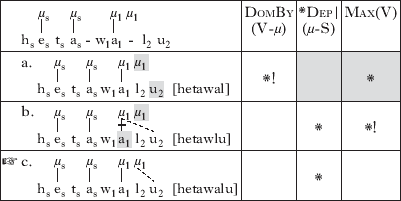
If /-wa/ is followed by a d-suffix, the second floating mora can associate to the underlyingly mora-less vowel of the d-suffix. The demand that all vowels must be dominated by a mora is then satisfied without mora usurpation and the resulting vowel deletion. This is illustrated in (26), where /-wa/ is followed by the d-suffix /-lu/. Mora usurpation, as in (26b), is unnecessary, and the violation of Max(V) can easily be avoided if the additional mora is associated to the mora-less vowel, as in the winning candidate, (26c), which avoids an unrealised vowel, and only violates the Dep constraint in (13a), which penalises colourless associations between a mora and a segment.
(26)
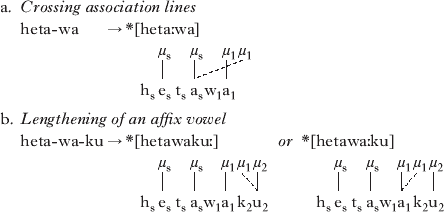
What happens to this additional mora in cases where /-wa/ is not followed by a d-suffix? A floating mora that does not dominate a segment violates the constraint Dom(μ-S) in (12), and we would expect it to attempt to associate to a possible segmental host. Given that the floating mora is ordered after the mora associated with /a/ on the moraic tier, it is impossible to associate it to any segment other than a following mora-less vowel. Association with a vowel preceding /-wa/ is not only excluded by Assoc-R, but would also result in a structure with crossing association lines (27a), which are standardly taken to be excluded (Goldsmith Reference Goldsmith1976). Association of the floating mora of /-wa/ to a following vowel (27b) is impossible as well, since every following vowel is necessarily an affix vowel, which can never become long in Yine. The OT implementation of this stem/affix asymmetry is discussed in §4.3.
(27)
3.3 Summary and discussion
The main claim in the analysis of mora usurpation is that the d-suffixes have a defective input structure that follows from Richness of the Base. To summarise this discussion, (28) gives the most relevant of the numerous possible moraic specifications of CV sequences. I argue that the ranking I have proposed for Yine predicts attested outcomes for all of these representations.
(28)
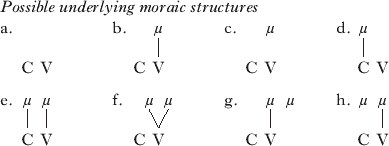
The mora-less structure in (28a) is the representation assumed for the vowel-deletion suffixes: their vowel lacks a mora underlyingly, and usurps the mora of a preceding vowel. These deletion-triggering vowels are only possible in affixes, and are excluded in stems. More concretely, it is impossible in Yine for stems to trigger deletion of a following suffix vowel as in the hypothetical /palika-nu/, which would be realised as *[palikan]. This follows from the requirement that all new moraic association is rightward. As can be seen in (29), a mora-less stem vowel could only trigger deletion of a suffix vowel if the stem vowel associated to a mora underlyingly associated with a following segment, which is excluded by Assoc-R. Association of the mora-less vowel to the mora of the preceding stem vowel /i/ results in deletion of this vowel in all contexts, and lexicon optimisation predicts that a learner will never assume this vowel underlyingly, but will store the stem as /palka/.
(29)
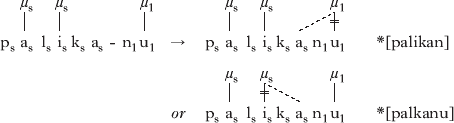
Vowels with the representation in (28b) are ‘normal’ vowels that will simply surface as short vowels (if no deletion-triggering affix follows). A morpheme with a floating mora in its representation, as in (28c), is predicted to result in the same surface effects as the ‘normal’ vowels in (28b). The floating mora simply associates to the otherwise mora-less vowel to satisfy DomBy(V-μ). Prevocalic consonants that are underlyingly moraic, as in (28d, e), are expected to be neutralised to non-moraic consonants if the following vowel is realised faithfully. This follows straightforwardly from syllabification in Yine, especially from the fact that onsets are not moraic (cf. §4.3 for an OT analysis of Yine syllabification). The mora that is underlyingly associated to the consonant will never cause a violation of Dom(μ-S), and a further phonetically visible association of the mora to a vowel and the resulting lengthening is therefore not expected. Long vowels, as in (28f), are only possible as the result of lengthening after consonant loss, and underlyingly long vowels are neutralised to short vowels (cf. §4.3, especially tableau (45), for an OT implementation of these facts). The structure in (28g) is the representation I have assumed for the exceptional suffix /-wa/, whose vowel is always realised faithfully, even if it is followed by a d-suffix. The fact that we only have evidence of one such ‘never-undergoer’ follows from the fact that such structures are hard to learn and are consequently neutralised to ‘normal’ structures without floating moras in most cases. The only evidence that a morpheme like /-wa/ is different from suffixes that do undergo vowel deletion comes from contexts where a d-suffix follows – in contexts where no affix or a non-d-suffix follows, the learner has no reason whatsoever to assume a floating mora in the representation of such a morpheme (since the mora never triggers lengthening). This also explains the absence of any roots that resist vowel deletion: roots with a floating mora in their underlying representation are certainly possible, but the evidence the learner has for such a structure is quite weak, and it is consequently probably not stored as an underlying representation for a morpheme. The mirror image of /-wa/, in (28h), is not expected to result in any surface effect that is not predicted by the structure in (28b) as well: the floating mora cannot associate to any preceding vowel (neither to lengthen it nor to ‘rescue’ an otherwise mora-less vowel), since this would result in an inserted association to the right, which is excluded by a version of Assoc-R in which mora and vowel are related only by morphological colour, not by a morphological association line.
We can conclude this discussion by stating that the possible moraic specifications of the CV sequences given in (28) result in attested surface structures under the ranking I have assumed for Yine. In addition, the mora-usurpation analysis makes some strong predictions about morphemes that are able to trigger deletion of a consonant. The crucial trigger for mora usurpation is (17), DomBy(V-μ), the constraint demanding that vowels must be dominated by a mora. This predicts that only morphemes with a vowel in their representation are able to trigger vowel deletion in Yine. Another prediction of the ranking I have proposed for Yine is the fact that prefixes should generally be unable to trigger deletion. This follows from the fact that Assoc-R prevents any mora usurpation from right to left. Both these predictions are borne out in Yine. All d-suffixes in the language minimally consist of a vowel, and only suffixes can trigger vowel deletion. These predictions do not follow in an analysis that is purely morphological and attributes the vowel deletion to a (word-formation) rule (Matthews Reference Matthews1974, Anderson Reference Anderson1992, Stump Reference Stump2001).
4 Vowel deletion and consonant deletion
4.1 Syllable structure and moraic licensing
Before we turn to the interaction of morpheme-specific vowel deletion, consonant deletion and vowel lengthening, more details about the syllable structure of Yine and its implementation in the OT framework are required. In her analysis of syllable structure in Yine, Lin (Reference Lin1997b) takes CV to be the only possible syllable in the language, and assumes that all other consonants are extrasyllabic but moraic (see Hyman Reference Hyman1985, Zec Reference Zec1988, Bagemihl Reference Bagemihl1991, Hart Reference Hart1991, Buckley Reference Buckley1994 and Denzer-King Reference Denzer-King2009 for other arguments for moraic licensing). This analysis, which rejects the assumptions of codas and assumes moraic licensing for consonants, is based on phonotactic and phonetic facts (Matteson Reference Matteson1965: 24). First, the phonetic closure of syllables is never complete in normal speech. In addition, consonants in a cluster behave as ‘phonetic syllables’. Any consonant that is not in prevocalic position is either syllabic or followed by a transitional vowel, resulting in what Lin (Reference Lin, Fujimura, Joseph and Palek1999) calls a ‘minor syllable’.Footnote 16 These transitional or excrescent vowels are a phonetic phenomenon and are not relevant for the phonology, as is argued convincingly by for example Levin (Reference Levin1987) and Lin (Reference Lin1993). They are not only ‘much shorter and weaker compared to the regular phonemic vowels’ (Lin Reference Lin1993: 337), but are also invisible for the assignment of stress. Primary stress is assigned to the penultimate syllable in Yine, secondary stress to the first syllable and tertiary stress (in words with six or more syllables) to all alternating syllables counting from the first (Matteson Reference Matteson1965). As can be seen in (30), transitional vowels – notated as ə – are irrelevant for this counting.
(30)

The morpheme-specific vowel deletion is blind to these vowels as well. If they were visible in the phonology, the vowel-deletion process would not be blocked in certain contexts to avoid three-consonant clusters (cf. §4.2). Analysing all consonants not directly preceding a vowel as extrasyllabic but moraically licensed is one way to explain this behaviour, i.e. it is ‘a way to accommodate what an older phonetic tradition originating with Sievers … has called ‘semisyllables’, or ‘minor syllables’' (Kiparsky Reference Kiparsky2003: 154). Second, the fact that the phonotactic restriction on initial clusters (maximally three consonants) is the same as the one on medial clusters is another argument against the assumption of codas in the language: ‘the patterns CV, CCV, and CCV occur word-initially and so must be described whether or not closed syllables are also described’ (Matteson Reference Matteson1965: 24). Third, the lack of sonority-sequencing principles in (initial) ‘onset’ consonant clusters follows if we assume that only one consonant is associated to the syllable node.
The OT analysis of syllabification given in Lin (Reference Lin1997b) relies on constraints ensuring strict layering of prosodic licensing (Selkirk Reference Selkirk1995, Ito & Mester Reference Ito, Mester, Honma, Okazaki, Tabata and Tanaka2003) and the assumption that all segments are per default underlyingly moraic (Hyman Reference Hyman1985)Footnote 17 – an assumption that is problematic for Richness of the Base. That strict layering is indeed violable and that weak layering constraints are also necessary are discussed in Kiparsky (Reference Kiparsky2003), for example. I therefore assume that consonants that are not in prevocalic position project a mora as a result of License(seg) in (31). The constraint is the containment-based version of Kiparsky's (Reference Kiparsky2003) License(seg), which ensures that every segment must be licensed by either a syllable or a mora.
(31)

High ranking of the standard markedness constraints in (32) ensures that neither complex onsets nor codas are possible in the language.
(32)
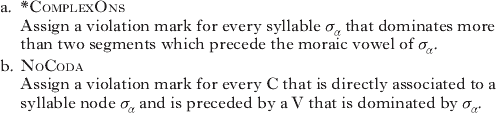
Tableau (34) exemplifies syllabification in Yine with an example where two adjacent consonants surface initially and medially: [tlawa] ‘toad’ (Matteson Reference Matteson1965). At this point it becomes clear why the ranking of standard Dep(μ) given in (13b) was only preliminary (cf. note 10). Epenthetic moras are inserted to license consonants that are not prevocalic, but are only allowed as a last resort, in order to rescue underlyingly mora-less vowels (cf. (19)). This intuitive difference between vocalic and consonantal moras is captured by replacing the standard Dep(μ) constraint with the modified version in (33).
(33)

Dep(μ-σ) penalises all instances of inserted moras which constitute the only mora in a syllable. In other words, it demands that every syllable node should be licensed by at least one morphological mora.
(34)
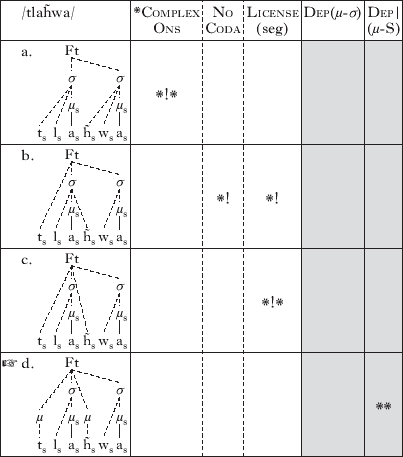
The clusters /tl/ and /w/ in (34) cannot be directly associated to a syllable node, since this would result in either complex onsets (candidate (a)) or at least one coda consonant (candidate (b)), which are excluded by the high-ranked constraints *ComplexOns and NoCoda in (32). Association of a consonant directly to the Ft node (/t/ in (b) and /t/ and // in (c)) leaves the consonant(s) unlicensed, and therefore results in fatal violations of License(seg). Insertion of two moras, as in candidate (d), is the optimal strategy for licensing all consonants in the structure. This candidate only violates low-ranked Dep|(μ-S), the constraint penalising epenthetic association lines between moras and segments.
4.2 Vowel deletion and illicit obstruent clusters
The data in (4) showed that the morpheme-specific vowel-deletion process sometimes feeds consonant deletion, namely in contexts where illicit obstruent clusters would arise (cf. (8)). For example, in the form /çi i-ʧi/, not only is the stem-final vowel deleted, but also the final stem consonant //. The resulting surface form [çiːʧi] avoids the illicit combination of the two adjacent affricates *[ʧ] (the additional lengthening of the stem vowel is discussed in §4.3 and is ignored for the moment). In fact, the restrictions on possible obstruent clusters in Yine summarised in (8) are very interesting, since they show asymmetric behaviour for some sound classes. For instance, the affricates /ʦ/ and /ʧ/ cannot be followed by /s/ or /ʃ/ but can be followed by /ç/, whereas the affricate // can be followed by any of the three fricatives /s ʃ ç/. As argued in Zimmermann (Reference Zimmermann2011), the restrictions on possible obstruent clusters in Yine follow from an analysis which assumes that all clusters of adjacent obstruents are in principle illicit, and are penalised by the OCP constraint in (35a). The fact that by no means all obstruent clusters are repaired through deletion follows from high-ranked faithfulness demands. Deletion of a segment is only possible if some of its features can reassociate to a new phonetically visible host. Such reassociation of a feature to an adjacent segmental root node is necessary, since the high-ranked Max constraint in (35b) preserves certain features. Reassociation, however, is only possible if no illicit feature specification is created, i.e. if the two segments in question are similar enough.Footnote 18
(35)
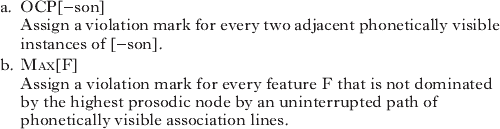
This analysis avoids the assumption of the derivational OT-system which Lin (Reference Lin, van Oostendorp and de Weijer2005) argues for in her analysis of the possible obstruent clusters in Yine. The interaction between morpheme-specific vowel deletion and obstruent deletion is briefly illustrated in (36). In both derivations, vowel deletion would create an obstruent cluster: /kk/ in (a) and /pt/ in (b). Both violate OCP[−son], and deletion of the first obstruent avoids this marked cluster (the (ii) candidates). However, deletion is only possible in (36a): the two adjacent obstruents are too dissimilar in (36b), so that the first one cannot ‘rescue’ its place feature on the second consonant without creating an illicit sequence [labial] [coronal]. Note that the pointing finger in (36a.ii) is in parentheses since the actual winning candidate is [niːka] – I ignore for the moment the lengthening, which is analysed in §4.3.
(36)
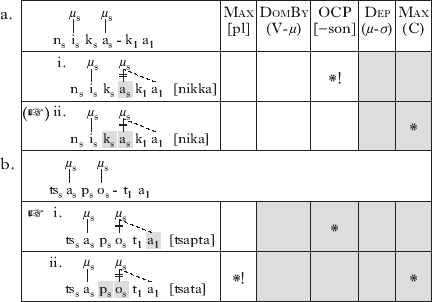
The crucial generalisation concerning consonant deletion in Yine is therefore that only certain consonants are deletable: i.e. obstruents that are followed by sufficiently similar obstruents.
I turn now to the interaction of morpheme-specific vowel deletion with the prohibition on three adjacent consonants. Recall from §2.1 that three-consonant clusters are only allowed in Yine if they are the result of the prefixing of a monoconsonantal morpheme.Footnote 19 In the examples in (3), where a three-consonant cluster would be expected after vowel deletion, deletion of the first consonant is not an available repair, since the three consonants are too dissimilar. For example, in the complex form /teɾka-lu/, deletion of the first consonant /ɾ/ is impossible. Interestingly, vowel deletion is blocked in all those contexts where a three-consonant cluster would be created. This is different from (36b), where a dispreferred cluster of two obstruents is created through vowel deletion. I therefore take the markedness constraint *CCC in (37), which militates against three adjacent consonants, to be fairly high-ranked in Yine, blocking the vowel-deletion process in contexts where three adjacent consonants would result after vowel deletion.
(37)

The tableau in (38) for the example /teɾka-lu/ illustrates this.
(38)
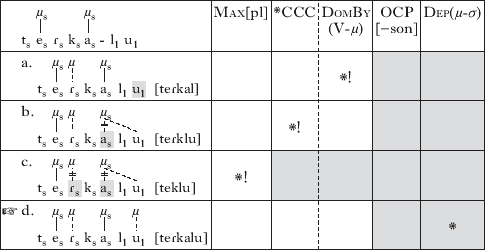
The expected mora usurpation, (38b), creates a three-consonant cluster and is excluded by high-ranked *CCC. Candidate (c) displays one strategy to avoid this illicit consonant cluster, through deletion of the first consonant. However, this repair is impossible, since Max[place] demands that the place feature must reassociate to another phonetically visible host if its segmental root node becomes invisible. The flap /ɾ/ is specified as [coronal] and the voiceless stop /k/ as [dorsal], and these two place features cannot link to one segmental root node without creating an illicit feature combination [coronal, dorsal]. Deletion of the consonant is therefore excluded by higher-ranked constraints, and an alternative strategy must be employed to integrate the vowel into the prosodic structure. The winning candidate, (d), inserts an epenthetic mora, violating Dep(μ-σ). Note that all candidates in (38) license the consonant /ɾ/ through the insertion of an epenthetic mora (cf. the syllabification tableau in (34)).
There is therefore an interesting asymmetry in the behaviour of marked consonant clusters that are created after vowel deletion if consonant deletion is unavailable as a repair: vowel deletion is blocked if it would create an illicit CCC sequence, but it applies, and a marked cluster surfaces, in contexts where two obstruents become adjacent. In the OT system I have sketched, this follows from the different rankings of *CCC and OCP[−son] with respect to DomBy(V-μ). A violation of *CCC cannot be tolerated if it is created through vowel deletion, since the low ranking of Dep(μ-σ) offers an alternative strategy to supply the d-suffix vowel with a mora. But this alternative is excluded in the context of obstruent clusters: OCP[−son] is ranked lower and crucially even below Dep(μ-σ). From this it follows that the violation of OCP[−son] is tolerable if mora usurpation creates a dispreferred obstruent cluster. The effect of this ranking is summarised in (39), where the contexts that were derived in (36b) and (38) are compared.
(39)
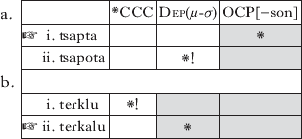
The analysis of obstruent clusters in Yine predicts that d-suffixation should always be able to feed deletion of the first consonant in a newly created cluster if the consonants that become adjacent are similar enough to allow reassociation of features that are protected by Max[F].
A final note on three-consonant combinations is in order. Although *CCC is relatively high-ranked and is responsible for the blocking of vowel deletion in certain contexts, there are indeed contexts where three-consonant clusters surface, namely when they result from affixation of a monoconsonantal prefix.Footnote 20 Some examples are given in (40). Note that deletion of the first consonant is again impossible, since the prefix has a different place specification.
(40)

That consonant deletion does not apply in these contexts follows from the ranking Max[place]≫*CCC. If the two consonants are not sufficiently similar, the three-consonant cluster is tolerated. However, this ranking makes an apparently incorrect prediction for monomorphemic contexts. Richness of the Base allows monomorphemic inputs with three-consonant clusters to exist as well – if consonant deletion is impossible in this cluster (for example in a hypothetical underlying stem form /pknoja/), we would expect this cluster to surface faithfully under the given ranking, parallel to the clusters in (40). One way to derive this preference for unmarked stems is the assumption of strata, i.e. different phonological levels of evaluation for stems and words (Kiparsky Reference Kiparsky, Hulst and Smith1982, Bermúdez-Otero Reference Bermúdez-Otero and van Oostendorp2011, Trommer Reference Trommer2011).
Another option that does not require the introduction of such a complex new mechanism is a more restrictive version of *CCC that is sensitive to the morphological affiliation of the elements involved. The general version of *CCC (37) that was active in various tableaux above is repeated in (41a). The constraint in (41b) is a more restricted version, which is only violated if a triconsonantal cluster is formed by consonants with the same morphological affiliation. Such a reference to morphological affiliation is straightforwardly possible in the coloured containment system I adopt, since the morphological colour of an element will not change in the course of the derivation.
(41)
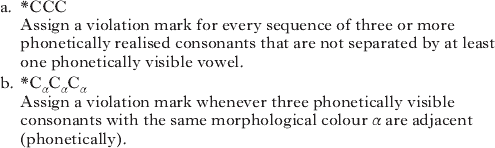
If (41b) is undominated and ranked above Max[F], no triconsonantal cluster will ever surface if it is part of the representation of a single morpheme. This is illustrated in (42) for the cluster /pkn/.
(42)
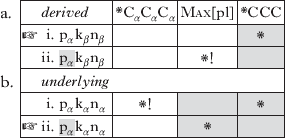
If a CCC cluster is derived and results from prefixation, as in (42a), it violates only the lower-ranked general markedness constraints *CCC. Since deletion of /p/ is excluded by higher-ranked Max[place], this cluster surfaces faithfully (cf. (40)). If, however, this cluster is part of the underlying representation of one morpheme, as in (42b), it violates higher-ranked *CαCαCα and the first consonant must be deleted, even if this violates Max[place]. An underlying stem form /pknoja/ will therefore always be neutralised to [knoja] on the surface.
The introduction of *CαCαCα adds nothing new to the context where a three-consonant cluster would be created after vowel deletion (38) – the cluster is necessarily a derived cluster and violates only the lower-ranked *CCC.
4.3 Compensatory lengthening in Yine
This subsection deals with the vowel lengthening observed in (4). Whenever vowel deletion results in an illicit consonant sequence and deletion of the first consonant is possible to repair this marked structure, lengthening applies. Analyses of the Yine compensatory lengthening can be found in Lin (Reference Lin1997b) and Topintzi (Reference Topintzi2010), where compensatory lengthening results from the preservation of phonological positions.
The assumption about moraic licensing of consonants within a containment-based framework made in §4.1 allows a straightforward account of compensatory lengthening in Yine. Recall that I assumed moraic licensing for all consonants that are not directly followed by a phonetically visible vowel. This followed from the fact that only simple onsets are possible in Yine (*ComplexOns) and codas are not allowed (NoCoda), but licensing is required for every segment, due to License(seg). This constraint was formulated in (31) as applying to any kind of association line. Since no segment can ever be deleted in containment theory, the constraint demands that every consonant – even one that will never be phonetically visible – project a mora if its syllabification would otherwise result in a complex onset or a coda. This moraic licensing of a consonant that is not phonetically visible on the surface is illustrated in (43).
(43)

Candidate (a) is the structure that was the winner on the basis of the partial ranking in (36a): the stem vowel is phonetically invisible, since its mora was usurped by the otherwise mora-less vowel of the following d-suffix, and the stem consonant /k/ is phonetically invisible due to OCP[−son]. In the ranking in (43), which includes License(seg), it is clear why candidate (a) is not optimal: the consonant /k/ is not licensed, since it is associated neither to a mora nor to a syllable node. We know that the syllabification in Yine does not allow complex onsets or coda consonants (cf. tableau (34)), and any strategy to license the /k/ via association to the syllable node, as in candidate (43b), is excluded. Candidate (c) licenses the consonant through the insertion of an epenthetic mora. However, this mora is only associated to a phonetically invisible segment in (c), in violation of Dom(μ-S) (12). The winning candidate under the given ranking is therefore (d), which integrates the mora into the preceding syllable in a phonetically visible way: it is associated to the vowel and lengthens it.Footnote 21 This analysis actually mirrors the essential parts of the analysis which Goldrick (Reference Goldrick2000) gives for compensatory lengthening in Luganda in turbidity theory, and solves the two opacity problems that arise if compensatory lengthening in Yine is analysed in standard correspondence-theoretic parallel OT.
Given the standard view of compensatory lengthening as the preservation of a (coda or vowel) mora (Hayes Reference Hayes1989), lengthening in Yine is mysterious for two reasons. First, as already illustrated in (5), the consonants that are deleted are only preconsonantal (and therefore moraic) after the d-suffix-triggered vowel loss. It is hard to see under what circumstances a mora would ever be assigned to, for example, the stem consonant /k/ in a structure like /nika-ka/ in a parallel model of phonological evaluation. Second, there is a general opacity problem with compensatory lengthening in a parallel model of OT. Two central assumptions in standard OT (Prince & Smolensky Reference Prince and Smolensky1993) are the existence of only one level of evaluation and the principle of Richness of the Base – and they make an implementation of Hayes' insight about compensatory lengthening as preservation of a mora difficult. The preservation of the mora that leads to compensatory lengthening is triggered by faithfulness constraints, and the mora must therefore already be present in the input. However, moras on short vowels or weight by position of coda consonants are non-contrastive, and assigned predictably in the phonological derivation. Various analyses in different OT frameworks have been proposed to account for the opacity of compensatory lengthening in OT: enriched inputs (Sprouse Reference Sprouse1997), sympathy theory (McCarthy Reference McCarthy2003), taking compensatory lengthening to be position preservation via a mora (Topintzi Reference Topintzi2006), OT-CC (Shaw Reference Shaw2009), stratal OT (Kiparsky Reference Kiparsky, Cairns and Raimy2011) and turbidity theory (Goldrick Reference Goldrick2000). In my containment-based account, compensatory lengthening simply follows automatically, since the ‘deleted’ consonant is never literally deleted, but remains present in the structure and requires moraic licensing even if it is not phonetically interpreted. Together with the assumption that moras attempt to dominate some segment phonetically or morphologically, this means that lengthening after consonant deletion is straightforwardly expected.
In §2.1, I stated that all long vowels are derived from compensatory lengthening but are otherwise impossible on the surface. In the following, I show briefly how this asymmetry between derived and underived long vowels follows from my analysis. Long vowels are excluded by the standard markedness constraint in (44a).
(44)
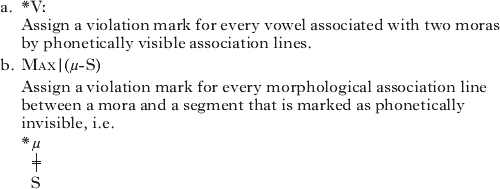
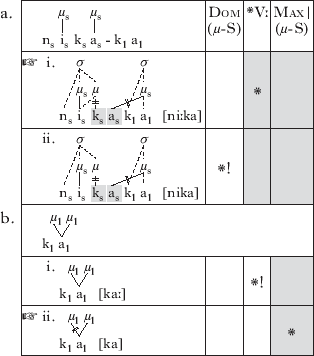
If this constraint is ranked above the constraint in (44b), which penalises phonetically invisible association lines between a mora and a segment, underlyingly long vowels are neutralised to short vowels, as can be seen in (45). In contrast to the compensatory lengthening contexts above (cf. (43)), the constraint Dom(μ-S) does not demand any further association between this mora and a segment – the morphological association that is marked as phonetically invisible is sufficient to satisfy the constraint.
(45)
A second asymmetry in the distribution of long vowels in Yine is the fact that stem vowels may become long, whereas affix vowels never do. The only context where a long affix vowel is expected is a situation where two ‘normal’ suffixes precede a d-suffix, and deletion of the suffix vowel feeds consonant deletion, as in the hypothetical */nika-mi-ku-ka/, which after vowel deletion, consonant deletion and vowel lengthening would result in *[nikamiːka]. This example is hypothetical, since I could not find any such data in Matteson (Reference Matteson1965).Footnote 22 However, if we assume that her generalisation that affix vowels are never long is true, then the resulting form should be *[nikamika], without vowel lengthening. This, I assume, follows from the ranking of Dep constraints against invisible association lines that are sensitive to the status of a morpheme as being an affix or a stem, as in (46).
(46)
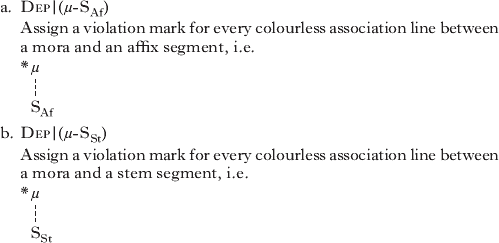
That the phonology is sensitive to this morphological distinction is well established; cf. the overview in Trommer (Reference Trommer2010) for discussion and literature. The partial ranking in (47) ensures that new association relations between a mora and an affix segment are never inserted to avoid violations of Dom(μ-S), but only to avoid violations of DomBy(V-μ) and License(seg).
(47)

5 Summary of the proposal and its theoretical contribution
I have provided an analysis of morpheme-specific vowel deletion in Yine and its interaction with consonant-cluster restrictions. My analysis is based on the claim that the suffixes that trigger vowel deletion have a vowel in their underlying representation which lacks a mora and usurps the mora of a preceding vowel. This preceding vowel then becomes phonetically invisible, since a mora cannot be associated phonetically to two vowels. A summary of the tableaux for all relevant contexts of mora usurpation and its interaction with consonant deletion is given in (48).
(48)
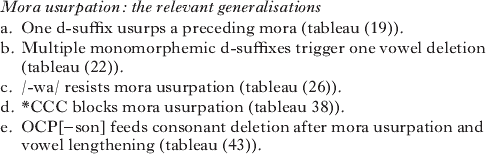
The major advantage of this analysis is that it allows us to derive a morpheme-specific phonological process in purely phonological terms, without any reference to morphological information. This point is elaborated in some detail in §6, where I discuss alternative accounts of the Yine facts. My analysis simply takes the assumption of Richness of the Base to its logical conclusion, and investigates the predictions that can arise from possible defective input representations. The analysis is therefore a contribution supporting the general claim that all morpheme-specific phonological processes follow simply from taking into account all possible (defective) underlying representations. Another example for such an undertaking is Yearley's (Reference Yearley1995) analysis of Russian jer vowels, which are also assumed to be underlyingly mora-less.
The usurpation process that is central to the analysis of Yine vowel deletion has been argued to be a consequence of the containment-based system of Optimality Theory which I have adopted. The assumption of containment also allows a straightforward account of the opaque compensatory lengthening in Yine.
As emphasised in §4.3, there are two levels of opacity of compensatory lengthening in Yine: one can be argued to be specific to Yine, the other illustrates an opacity problem that needs to be dealt with in all parallel OT accounts. For illustration, consider again the example /nika-ka/, together with the hypothetical example /nik-ka/. In both cases, consonant deletion and subsequent compensatory lengthening are expected, the only difference being that additional vowel deletion applies in the first example. The output for both is predicted to be [niːka], and in both cases the deletion of a coda consonant and preservation of its mora ought to be responsible for vowel lengthening. This line of reasoning reveals an opacity problem for both examples: given the assumption of Richness of the Base, the coda consonant in /nik/ could very well be mora-less – since it is not contrastive, its mora is predicted by Weight by Position, for example. On the other hand, the /k/ in /nika/ is not even in a coda position – a mora dominating it is only predicted by Weight by Position after vowel deletion. My analysis easily accounts for this double opacity, since constraints like License(seg) are able to make reference to any association lines. The analysis of the compensatory lengthening for the examples discussed above is given in (49).
(49)
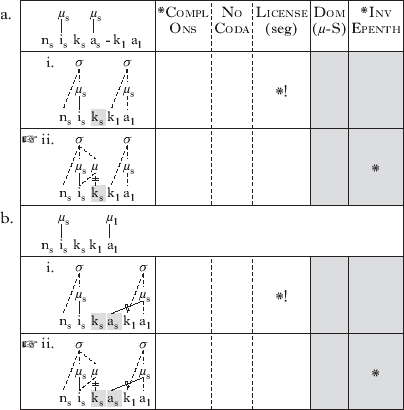
This straightforward solution for a well-known opacity problem in standard parallel OT is therefore a strong independent argument for the assumption of containment.
6 Discussion: previous accounts of the Yine facts
My analysis is implemented in a monostratal OT-model without any morpheme-specific mechanisms. I have already argued that this is an advantage over theories allowing direct reference to morphological information in the phonology – a principle that is crucial for the alternative analyses of the Yine facts presented in Lin (Reference Lin1997b) and Pater (Reference Pater and Parker2009). In this section, I briefly sketch these accounts, and further discuss some of their shortcomings.
6.1 Pater (2009)
In Pater (Reference Pater and Parker2009), the Yine facts are taken as a strong argument for lexically indexed faithfulness and markedness constraints. In this account, morphemes that trigger a process are indexed for specific markedness constraints, and morphemes that fail to undergo a certain process are subject to lexically indexed faithfulness constraints. For Yine, both mechanisms are necessary, since there are exceptional triggers (d-suffixes) and an exceptional blocker (/-wa/). First, the markedness constraint in (50) demands that a suffix must be preceded by a consonant; this constraint is indexed to the syncope-triggering suffixes (here indicated by ‘L1’).
(50)

Second, a lexically indexed faithfulness constraint accounts for the fact that /-wa/ does not undergo syncope: Max(L2) is indexed to /-wa/. (51) briefly summarises how the ranking of lexically indexed and general Align and Max predicts the Yine facts in Pater's system.
(51)
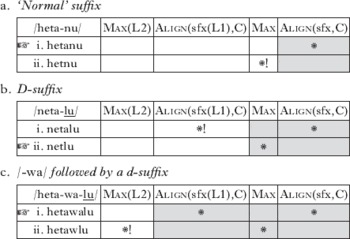
This analysis makes incorrect predictions for contexts with multiple d-suffixes. Consider again the data in (20), and the generalisation that only one vowel is deleted in such contexts. Multiple d-suffixation is not discussed in Pater (Reference Pater and Parker2009), and it is not clear how it can be incorporated into the account. A first, probably minor, problem is the question of the direction of vowel deletion. In an input such as /nasuka-ja-lu/ in (20), only one vowel is deleted. In the system proposed by Pater, this can be easily achieved by ranking *CCC above Align(sfx(L1), C) (2009: 131). However, what determines which vowel is realised faithfully and which is deleted, i.e. what decides between [nasukjalu] and *[nasukajlu] in such a system? A preference for preserving suffix vowels over stem vowels is obviously insufficient, since there are examples like /kawa-kaka-ka-na/, where three d-suffix vowels are adjacent. Some additional faithfulness constraint demanding that a suffix vowel closer to the stem should be preserved would solve this optionality problem – however, given standard accounts of faithfulness, it is not clear how such a constraint could be motivated. An even more serious problem arises in contexts where consonant deletion is triggered by vowel deletion, as for example in /kawakaka-ka-na/, resulting in [kawkaːkana]. The consonant-cluster restrictions are not discussed in Pater's analysis, but it is clear that some high-ranked markedness constraints must ensure that consonant deletion applies to avoid illicit obstruent clusters in Yine (cf. (8)). However, if the first of the two consonants that are adjacent after vowel deletion is deleted for independent reasons, what then blocks the multiple vowel deletion in candidate (52c), which is perfect with respect to the alignment constraints? (The candidate that is incorrectly predicted to win is indicated with a left-pointing finger.)
(52)
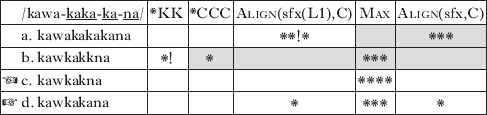
These empirically incorrect predictions arise because Pater's analysis implements the descriptive generalisation that every vowel preceding a d-suffix is expected to be deleted: the lexically indexed alignment constraint demands that every d-suffix is left-adjacent to a consonant. As I have argued above, the slightly different generalisation that every d-suffix searches for a mora and usurps an underlying mora seems empirically correct: d-suffixes never trigger deletion of another d-suffix vowel.
6.2 Lin (Reference Lin, Booij and de Weijer1997a, Reference Linb)
The analysis of Yine vowel deletion in Lin (Reference Lin1997b) is based on three main ingredients. First, Align(Stem-R, C-R) demands that every stem ends in a consonant. Second, a Base-ID constraint demanding faithfulness to existing output forms ensures that vowel deletion proceeds from the stem outwards in contexts with multiple d-suffixes. The difference between normal and d-suffixes is actually not discussed in detail by Lin, who notes only that ‘there is a morphological condition that arbitrarily marks some suffixes as non-triggers’ (1997b: 406). The details of this analysis can be found in Lin (Reference Lin, Booij and de Weijer1997a), where it is argued that there are different morphological domains for constraint evaluation, i.e. constraints are specified as holding in one or another morphological domain. The constraint rankings that Lin (Reference Lin, Booij and de Weijer1997a) gives to account for the difference between suffixes that trigger vowel deletion and those that do not are given in (53). The constraints are indexed for application in the cyclic or the non-cyclic domain, where ‘normal’ affixes that do not trigger vowel deletion are taken to be non-cyclic and d-suffixes are classified as cyclic.
(53)

As in Pater's analysis, this account therefore crucially relies on the assumption that the phonological constraint system has access to specific morphological information. In addition, two empirical aspects remain unexplained. First, the discussion does not mention that there is a third interesting type of suffix that neither triggers nor undergoes vowel deletion. It is hard to see how an analysis of /-wa/ could be integrated in the approach, especially since the details of the triggering vs. non-triggering suffixes are not discussed in Lin (Reference Lin1997b). The Align constraint in Lin (Reference Lin, Booij and de Weijer1997a) demands a final consonant for every stem a certain suffix attaches to – but the fact that /-wa/ is different from other suffixes is only apparent after /-wa/ is affixed, i.e. if a d-suffix is added.
Another problematic fact, also mentioned by Pater (Reference Pater and Parker2009), is the expectation that Align should force all unsuffixed stems to undergo vowel deletion, a prediction that is obviously not borne out in Yine.
To summarise, both alternative analyses for the Yine facts require that the phonology has direct access to specific morphological information. In contrast, in my analysis only the reference to morphological colours and the distinction into stem and affix morphemes is important (cf. the discussion in §4.3 on the constraints in (46)). In addition, I have discussed some empirical shortcomings of both analyses that my analysis avoids.