Introduction
Ecosystem services are an essential component of agricultural productivity. However, many questions remain unanswered as to the exact nature and quality of ecosystem services provided unaided by natural habitat versus the same biological processes provided through management (Klein et al., Reference Klein, Steffan-Dewenter and Tscharntke2003). Pollination is one of the fundamental ecosystem services through which insects contribute to processes that sustain both natural habitats and agriculture (Buchmann and Nabhan, Reference Buchmann and Nabhan1996). As a component of ecosystem services that directly affects the yields of crops, which require or benefit from pollination by wild insects, pollinators are widely considered a crucial component of biodiversity (Klein et al., Reference Klein, Vaissiére, Cane, Steffan-Dewenter, Cunningham, Kremen and Tscharntke2007). About two-thirds of the cultivated crop species in current agricultural systems are thought to require pollination by insects or other animals (Roubik, Reference Roubik1995). Crop pollination by wild insects is therefore a direct ecosystem service of immense value (Allen-Wardell et al., Reference Allen-Wardell, Bernhardt, Bitner, Burquez, Cane, Cox, Dalton, Feinsinger, Ingram, Inouye, Jones, Kennedy, Kevan, Koopowitz, Medellin, Medellin-Morales, Nabhan, Pavlik, Tepedino, Torchio and Walker1998). A number of recent studies have drawn strong links between the diversity of wild bee species and yields on tropical crops such as coffee (Kremen et al., Reference Kremen, Williams and Thorp2002). While the economic importance of wild-pollinating insects is accepted and widely quoted as an important incentive for better agricultural practices, few studies have investigated the specifics of the interactions between natural habitat, pollinators and crop yields, except for a few crops, and these have mainly focused on bees, both wild native species and managed honeybees (Kremen et al., Reference Kremen, Williams, Bugg, Fay and Thorp2004; Steffan-Dewenter et al., Reference Steffan-Dewenter, Klein, Alfert, Gaebele, Tscharntke, Waser and Ollerton2006).
A number of crops are not suited to pollination by managed honeybees, and studies of these are especially lacking in Africa (Rodgers et al., Reference Rodgers, Balkwill and Gemmill2004). Wild insect pollinators include flies, moths, butterflies, wasps, thrips and beetles (Free, Reference Free1993). Many of these insects have evolved specialized relationships with flowers. Examples of complex pollination biology partnerships for successful yield in crops include the pollination of oil palm by the oil palm weevil (Kevan et al., Reference Kevan, Hussein, Hussey and Wahid1986) and the pollination of cocoa by midges (Figueroa and De, Reference Figueroa and De1984).
The need for healthy populations of pollinators other than managed honeybees is gaining wider recognition. Recent studies have strongly demonstrated that native bee species from natural habitats can provide effective pollination services to crops (Kevan et al., Reference Kevan, Clark and Thomas1990). A diversity of pollinators is also being recognized as one way to provide continued and effective pollination services when local climatic and landscape patterns change or fluctuate through time (Torchio, Reference Torchio1990; Kremen et al., Reference Kremen, Williams and Thorp2002). Maintaining a diverse suite of pollinators involves multiple factors relevant to more specialized plant–pollinator interactions. In specialized systems, only a limited number of pollinator species can serve as effective pollinators due to the unique biology of the plants. Therefore, the ecological needs of these specialist pollinator species have to be met both spatially and temporally for effective pollination of the crop (Cane et al., Reference Cane, Minckley, Kervin and Roulston2005).
Natural habitat, both in extensive stands and small fragments, can provide and support a source of wild pollinating insects for crops. Pollinators need to feed from flowers other than the crop being pollinated (especially when the crop is not in flower), they need adequate sites to nest in, hibernate or aestivate, and depending on the species, specific larval food plants. Diversity of most taxa decreases with distance from natural habitat (MacArthur and Wilson, Reference MacArthur and Wilson1967). However, as pollination ecology involves complex animal–plant interactions by highly mobile pollinators, this needs to be considered in a broader context including the specific requirement of the pollinators (Ricketts, Reference Ricketts2004).
Papaya (Carica papaya L. (Caricaceae)), a dioecious species, is a crop that does not have typical bee-pollinated flowers (Allan, Reference Allan1963). Hawkmoths (Sphingidae) have been recorded as visitors to papaya flowers, but information on their role as pollinators is unclear (Free, Reference Free1993). Hawkmoths in the tropics and subtropics are one group of pollinating insects that have multiple requirements for survival and persistence. Adult hawkmoths are primarily crepuscular, and therefore require sites for resting during the day as well as many different sources of nectar due to the energy demands of high-speed flight. They require larval host plants in relatively undisturbed sites where their caterpillars can grow and then pupate (Carcasson, Reference Carcasson1976).
We investigated the role of hawkmoths in the pollination of papaya in Kenya and the role of natural habitat adjacent to farmland as the source of these wild pollinators. Papaya is an important tree crop grown throughout the tropics. It is a valuable local commodity, given that the trees can withstand drought and do not require fertilizers or pesticides. On smallholder farms in Kenya, papaya is typical of all districts with mixed agricultural systems. This kind of farm accounts for the vast majority of rural farming systems in the region (National Atlas of Kenya, 1970; Thom and Martin, Reference Thom and Martin1983). Millions of small-scale farmers in East Africa and worldwide in developing countries rely on papaya as a component of domestic household nutrition needs and for supplementary income through sale of fresh and dried fruit.
Papaya trees are generally considered to be ‘male’ (staminate) or ‘female’ (pistillate), a fact also recognized by rural farmers. The floral biology and fruit development are complicated and variable (Decraene Ronse and Smets, Reference Decraene Ronse and Smets1999). In general, pistillate flowers account for the majority of saleable fruit, while hermaphroditic staminate flowers can self-produce smaller fruits that ripen less readily. Cross-pollination of pistillate flowers produces fruit of high quality. To investigate whether natural habitat influences the fruiting success of cultivated papaya, the following specific questions were developed and tested: (1) is the diversity of hawkmoth visitation, i.e. the pollination rate, linked to the distance from, and the quality of adjacent natural habitat? As natural habitat is a highly variable entity, further questions were developed to assess the structure of natural habitat in relation to hawkmoths as pollinators; (2) what components of natural habitat, specifically alternative sources of nectar and larval host plants, are available for hawkmoth pollinators and what is their distance relative to the crop?; and (3) if wild hawkmoths are providing pollination services to papaya, what aspects of agricultural practice may influence the persistence of this service?
Materials and methods
The study sites
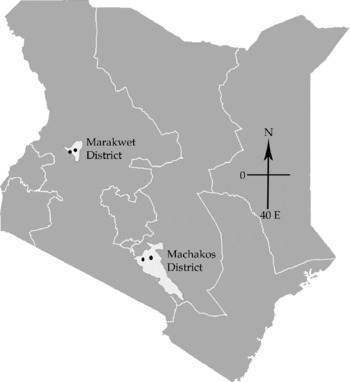
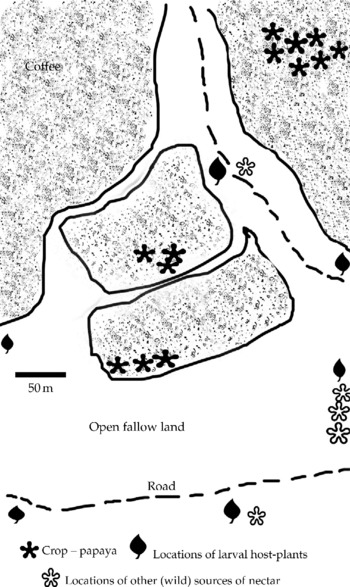
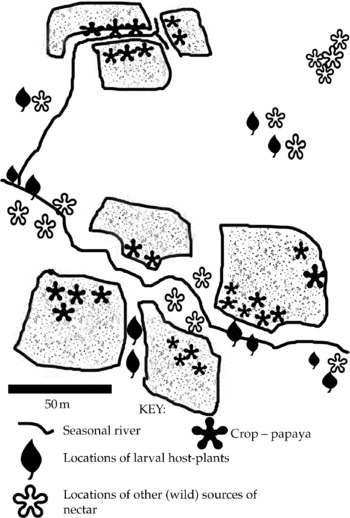
A pilot study of the insects visiting papaya flowers was made in 2003 as part of an assessment of the principal pollinators of African crops (Rodgers et al., Reference Rodgers, Balkwill and Gemmill2004). After this, two sites were chosen for a more focused monitoring. Sites were matched as far as possible in terms of size, rainfall, temperature, altitude and soil characteristics. Research was conducted at two sites in Kenya (Fig. 1): Machakos District (Fig. 2) and the Kerio Valley in Marakwet District (Fig. 3). Papaya trees on 20 different farms at each site were monitored for pollinators in 2004–2005. Fruit set was assessed for five tagged papaya trees at each site and by interviewing farmers in 2004 and again in 2006.
Map of Kenya showing the two districts where research was conducted.

Schematic map showing distribution of larval host plants and wild nectar sources in relation to cultivated papaya at a typical farm in Katheka-Kai, Machakos District of Kenya.

Schematic map showing distribution of larval host plants and wild nectar sources in relationship to cultivated papaya at a typical farm in Kerio Valley, Marakwet District of Kenya.

Landscape characteristics, habitat use and assessment
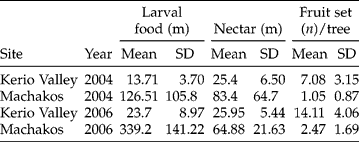
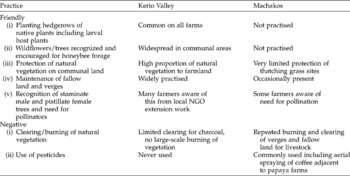
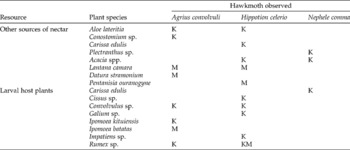
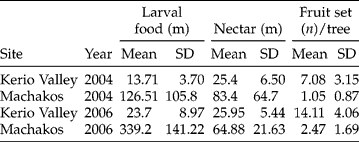
Sites chosen for this study experience seasonal rainfall and have red-lateritic soils. Both sites were assessed for fruit set (Table 1), practices that potentially impact pollinators (Table 2) and their interaction with resources around the farms (Table 3). Sites in Machakos included the Mua Hills and Katheka-Kai Location. A mixture of small-scale subsistence agriculture, mixed farming and commercial farming is carried out in the district. Due to population density of 97–193 people/km2 (National Atlas of Kenya, 1970), subsistence farms are small (c. < 1 ha). Papaya is widely grown as a tree crop associated with individual homesteads, and fruits are primarily consumed by the farmer's household with limited local sale. Commercial farms in the region grow coffee where the climate is suitable. Limited areas of natural vegetation consist primarily of grassy verges (Themeda triandra Forssk., Panicum maximum Jacq. and Dactyloctenium sp. Willd. (all Poaceae)) with invasive shrubs (Lantana camara L. (Verbenaceae) and Datura stramonium L. (Solanaceae)), and fallow land with occasional acacias and fig trees.
Summary statistics of fruit set and distance of papaya trees (n=200) to natural habitat resources in the two districts of Kenya
Pollinator-friendly and potentially negative practices affecting hawkmoth pollinators at the study sites in Kenya

Nectar resources and larval host plant species observed being utilized by hawkmoth pollinators at the Kerio Valley (K) and Machakos (M) sites of Kenya

The Kerio Valley sites were located on the valley floor close to the western wall of the valley. The Kerio Valley is inhabited by peoples practising a mixture of pastoralism and small-scale subsistence agriculture using irrigation. As with the Machakos site, population density in the irrigated agricultural areas is 97–193 people/km2 (National Atlas of Kenya, 1970). Acacia tortilis (Forssk.) Hayne (Fabaceae) forms extensive woodlands across the valley. Ground cover and shrubs are heavily overgrazed, but Aloe lateritia Engl. (Asphodelaceae), Salvadora persica L. (Salvadoraceae) and Balanites sp. (Balanitaceae) are common, as are grasses seasonally (Tragus sp., Chloris roxburghiana Schult. (both Poaceae)). Farmers also plant hedgerows (Euphorbia tirucalli L. (Euphorbiaceae) and A. mellifera Vahl. Benth. (Fabaceae)) to keep out livestock, and these are often covered by creepers from the family Convolvulaceae.
Analysis of floral resources
Individual papaya trees were tagged at each site, and flowering and fruiting patterns recorded. Both male inflorescences and female flowers were monitored. Further information on yields was obtained by interviewing farmers. Nectar was assessed from individually marked and bagged developing buds that developed into normal flowers (n = 10 flowers per site). Samples were taken in the early evening (c. 17.30–18.00 h) using glass microcapillary tubes (5–100 μl), and volumes were recorded and sugar concentration determined using a pocket refractometer (0–50%, Bellingham and Stanley, Turnbridge Wells, UK). All samples were tested for volume and nectar sugar concentration individually.
Hawkmoth activity and pollen loads
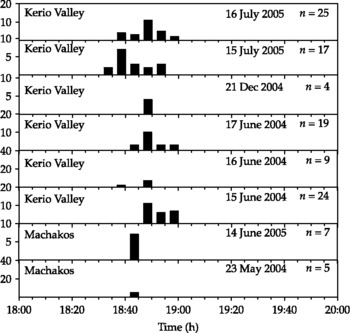
Hawkmoth diversity and foraging patterns were assessed through direct observation. After dusk, hawkmoths were watched using a dimmed torch (by placing masking tape over the glass). The time of each hawkmoth visit was recorded, number of flowers visited and the identity of the visitor. Visitation data were recorded in 1-min intervals. Flowers were watched from c. 18.00 h until about 20–30 min after the last hawkmoth visited (Fig. 4). Dark-coloured clothing was worn during observations, and movements were limited so as not to startle the hawkmoths. Prior experience allowed for easy identification of hawkmoths feeding at flowers (Martins and Johnson, Reference Martins and Johnson2007) and the limited number of species at both sites (Carcasson, Reference Carcasson1976). Hawkmoths were checked for pollen loads using the fuchsin gel method (Beattie, Reference Beattie1971). These fuchsin gel pollen extractions were later melted onto glass slides and observed through a simple monocular light microscope to confirm that the pollen was coming from the papaya flowers. Comparisons were made with pollen taken from bagged papaya flowers.
Total hawkmoth visitation to papaya for representative evenings from Machakos and Kerio Valley in Kenya.

Landscape assessment and ecology
The quality and abundance of natural habitat were assessed by recording distance from alternative nectar sources and larval host plants as a linear unit (m) from the crop. Location and direction of the natural habitat available relative to the cultivated area were also mapped (Figs 2 and 3). Additional information was obtained by interviewing farmers on current management practices, i.e. regular burning, brush clearing or spraying of pesticides (Table 2). Other activities, such as honeybee keeping and pesticide spraying, were also noted through interviews and discussion with farmers and other community members.
Analysis of distance to natural habitat and fruit set
Trees were tagged and matched in terms of total numbers at both sites. Spearman's rank correlation was used to test for association between fruit set and both distance to other nectar resources and larval host plants. A multiple regression was used to compare fruit set to two variables of distance to other nectar sources and larval host plants. Separate two-sample t-tests were used to test for differences between the fruit set, availability of nectar resources and availability of larval host plants between the two study sites. To test for possible differences in fruit set between the two sites due to differential pistillate flower production, a two-sample t-test was used for the data from the trees tracked for fruiting. A similar test was used to compare the total number of visits and the distance of the papaya trees to natural habitat. Tests were conducted separately for the various years, as 2004 was a relatively typical year with distinct dry seasons, while 2006 was a wetter year with an extended rainy season and large numbers of hawkmoths on the wing. The importance of hawkmoth visitation for fruit set was assessed by a basic breeding experiment, tracking yields of 20 marked pistillate flowers on the tagged trees at each site by bagging the pistillate buds, exposing them to hawkmoth visitation for 30 min and then bagging them again as well as through a basic breeding experiment. As a control, 20 pistillate flowers were bagged at each site and not exposed to pollinators.
Results
Hawkmoth visitation rates
During the pilot study, a variety of insects were recorded visiting papaya flowers, including flies, honeybees (Apis mellifera scutellata Lepeletier), hawkmoths, noctuid moths and butterflies. This revealed that many species visit the staminate flowers, but only hawkmoths and skipper butterflies visit both male and female flowers in a legitimate manner (Martins, Reference Martins2007). Over the 3 years of focused research at the Kerio Valley and Machakos sites, a total of 127 individual visits to papaya flowers by five different hawkmoth species and one skipper butterfly were observed. Three common dryland hawkmoth species accounted for the majority of visits to both pistillate and staminate flowers: Hippotion celerio L. (n = 49 visits), Nephele comma Hopffer (n = 41 visits) and Agrius convolvuli L. (n = 20 visits). Three diurnal visitors, consisting of two hawkmoths Macroglossum trochilus Hubner (n = 4 visits) and Leucostrophus hirundo Gerstaecker (n = 6 visits) and one skipper butterfly Coeliades forestan forestan Stoll (n = 7 visits) were also recorded visiting pistillate inflorescences. All these visitors carried papaya pollen on their probosces and heads. The total number of hawkmoth visits to papaya flowers was inversely related to the distance from natural habitat and the overall level of landscape degradation around the farm. Only two hawkmoth species (H. celerio and A. convolvuli) were seen visiting papaya in Machakos District. At the Kerio Valley site, three hawkmoths (H. celerio, N. comma and A. convolvuli) were regular visitors to papaya (Fig. 4).
Nectar rewards
Only staminate flowers contained nectar. Mean nectar volumes were 0.52 μl (SD = 0.189) in Machakos and 0.518 μl (SD = 0.167) in the Kerio Valley. Mean nectar sugar concentration was 16.8% for Machakos and 16.7% in the Kerio Valley. None of the pistillate flowers contained nectar, consistent with previous studies (Decraene Ronse and Smets, Reference Decraene Ronse and Smets1999).
Pollination and fruit set
From 20 pistillate flowers bagged as controls at each site, three developed into inferior quality fruit (two in Machakos and one in Kerio Valley), indicating that papaya has the potential for limited parthenocarpy. Of ten pistillate flowers treated with pollen from staminate flowers (i.e. outcrossed) at each site, most developed into saleable fruit (eight in Machakos and nine in Kerio Valley). Nearly all bagged pistillate flowers that were exposed to hawkmoth visitation set fruit (n = 39/40), and none of the controls that were left bagged throughout the experiment did (n = 0/40). Hermaphroditic male flowers were also seen to develop into small, green fruits occasionally. However, these are not harvested for local trade. Only large, well-formed, well-ripened fruits from female (pistillate flowers) produce saleable fruit. Natural fruit set was assessed at both sites for several trees and the overall yields were discussed with farmers. These discussions further confirmed that the yields at the Machakos site were much lower than those of the Kerio Valley (P < 0.0001 for both 2004 and 2006).
Natural habitat assessment
In the Kerio Valley, areas of natural habitat suitable for hawkmoths were found to be widespread around the farms. Both other sources of nectar and larval host plants of hawkmoths were more abundant and common, close to papaya in the Kerio Valley. In Machakos, all pollinator resources were distant from crops except for cultivated sweet potato (Ipomoea batatas L. (Convolvulaceae)), which serves as an occasional larval host plant for A. convolvuli. Most of the alternative nectar sources at the Machakos site were invasive species (L. camara and D. stramonium). Strong correlations were observed between hawkmoth visitation rates and habitat quality/nectar sources (Tables 2 and 3) at both sites. Results for 2004 and 2006 are presented separately below.
Results for 2004
Differences in distances to nectar resources between the Machakos and Kerio Valley sites were significant (P < 0.0001), as was distance to larval host plants (P < 0.0001). A multiple regression comparison of fruit set to distance to natural habitat and resources was negatively correlated for both larval host plants (r s = − 0.778) and other nectar resources (r s = − 0.771). Therefore, as distance to nectar and larval food resources increases, fruit set on papaya decreases. Testing for potential biases in the fruit set being due to differences in numbers of pistillate flowers produced between the two sites found no significant differences (P < 0.09).
Results for 2006
Differences in distances to nectar resources between the Machakos and Kerio Valley sites were also statistically significant (P < 0.0001), as was distance to the nearest larval host plants (P < 0.0001). A comparison of fruit set and distance to natural habitat resources was strongly negatively correlated for both larval host plants (r s = − 0.848) and other nectar resources (r s = − 0.862). Even with larger numbers of hawkmoths available as pollinators, fruit set remained negatively correlated with distance to natural habitat in this wetter year.
A multiple regression of fruit set against distance to alternative nectar sources and larval host plants had a strong R value (R 2 = 70.9%), in contrast with a regression of fruit set against nectar resources alone (R 2 = 59.8%), suggesting that availability of larval host plants may affect hawkmoth foraging patterns more than alternative nectar sources alone.
Discussion
Are hawkmoths important pollinators of papaya?
Our results demonstrate that hawkmoth visitation to papaya results in cross-pollination and correspondingly higher levels of fruit set than those flowers that are not pollinated by these insects. The variability of insect visitors to papaya flowers has been noted in a number of studies (Free, Reference Free1993; Martins, Reference Martins2007). While a number of different insect taxa are frequent visitors to staminate papaya inflorescences, only a few of these are consistent visitors to female (pistillate) flowers as well: a requirement for fertilization (Allan, Reference Allan1963). In this study, only hawkmoths were observed visiting both staminate and pistillate flowers and made repeated contact with reproductive floral parts.
Observations of nectar secretion, crepuscular scent production and pale colouration of the flowers suggest that papaya is pre-adapted for moth pollination (Grant, Reference Grant1985). Large numbers of skipper butterflies have been recorded visiting the flowers in Jamaica at dusk (Free, Reference Free1993), and our observations suggest that the peak visitation on subsistence farms in Kenya also takes place shortly after sunset (Fig. 4). Given that only hawkmoths were seen visiting both staminate and pistillate flowers, this indicates that they are providing pollination services to papaya groves on these small farms in East Africa. Studies from Australia also indicate that hawkmoths are pollinating papaya (Garrett, Reference Garrett1995).
The variability of nectar volumes and its distribution, and our observation of male trees suggest that hawkmoths are moving around staminate inflorescences in search of nectar, and this presents a further question as to exactly how non-rewarding pistillate flowers attract pollinators. The non-rewarding pistillate flowers are basically pollinated through deception of hawkmoths, a common feature of moth-pollinated flowers (Johnson and Nilsson, Reference Johnson and Nilsson1999), but not clearly documented for papaya previously.
The role of natural habitat in papaya pollination
The majority of studies that have looked at the role of wild pollinators on crops have focused on the role of honeybees and native bee species (Kremen et al., Reference Kremen, Williams and Thorp2002; Ricketts, Reference Ricketts2004; Steffan-Dewenter et al., Reference Steffan-Dewenter, Klein, Alfert, Gaebele, Tscharntke, Waser and Ollerton2006). This study demonstrates that wild insects other than bees, i.e. hawkmoths, also provide useful pollination services. These pollinators, like bees, have requirements that need to be met beyond the crops they visit.
Given that the floral biology of papaya is variable (Decraene Ronse and Smets, Reference Decraene Ronse and Smets1999), but trees with pistillate flowers are known to be more productive than those with staminate or hermaphroditic flowers, suggests strongly the need for pollination in this crop (Free, Reference Free1993). The large difference in fruit set of ‘wild’ pollinated flowers between the two sites suggests that pollinators are an important component of fruit set on papaya. Papaya trees within 20–50 m of natural habitat had higher fruit set than those further away (Table 1 and Fig. 2). Trees further than 250 m from any form of natural habitat had consistently low levels of fruit set of relatively low quality (Tables 1 and 3). This is supported by the results from the breeding experiment by the insignificant levels of fruit set of bagged flowers. In addition to fruit set, hawkmoth visitation could be suggestive of broader landscape-level phenomena that affect yields. For example, farms with hedgerows/fallow areas that have hawkmoth larval host plants are also likely to hold more moisture through shading of soils, reduced run-off and water erosion and improved soil quality through natural leaf fall, all of which have a positive effect on the adjacent papaya trees.
Conserving and restoring pollination services
No clear polices or mechanisms exist for the protection of fragments of natural habitat within agricultural matrices in Kenya, or indeed anywhere in East Africa (Bennun and Njoroge, Reference Bennun and Njoroge1999). Farmers are not encouraged to leave areas of natural habitat such as brush or undergrowth near cultivated plots by government agricultural extension officers. Management/tolerance of fallow land or natural verges varies across the region and is closely tied to population density and the kind of farming system favoured by the local community (Figs 1 and 2). For example, in Machakos, regular spraying of insecticides on coffee and its immediate surroundings, which is broadly detrimental to insect life, takes place. In the Kerio Valley sites, no spraying of insecticides takes place where the papaya is currently being grown.
The rapid flight and dispersal ability of hawkmoths make them ideal pollen transporters in eastern Africa (Martins and Johnson, Reference Martins and Johnson2007). No data exist to test the maximum dispersal distance for hawkmoths, but native bees are known to rarely range more than 1–2 km (Roubik, Reference Roubik1989). The observations from Machakos suggest that hawkmoths can disperse quite widely, as, at this site, larval host plants and wild nectar sources are limited to roadside verges. Even if hawkmoths can disperse widely, they may avoid areas with little to offer them in terms of nectar rewards or sites for ovipositing/larval host plants, resulting in fruiting failure of plants dependent on them for pollination (Johnson et al., Reference Johnson, Neal, Peter and Edwards2004). As all hawkmoths in this region depend on natural habitat for nectar resources and larval food plants, assessing these resources helped to provide a more focused insight into the persistence and availability of hawkmoths at a particular site. However, the persistence of some pollination services in the highly impacted landscape of eastern Machakos does suggest that even very small fragments of relatively poor quality can continue to support pollinating hawkmoths, as has been found with native bees (Cane et al., Reference Cane, Minckley, Kervin and Roulston2005), although fragmentation/habitat destruction is one of the most direct threats to this ecosystem service (Murren, Reference Murren2002; Pauw, Reference Pauw2007).
Conclusion
This study suggests that small patches of natural habitat are an important component for maintaining pollination services in subsistence agriculture where crops rely on wild pollinators. The link between natural habitat and pollination services has been demonstrated in California for watermelons (Kremen et al., Reference Kremen, Williams and Thorp2002) and for coffee in Central America (Roubik, Reference Roubik2002; Ricketts, Reference Ricketts2004). However, no clear indication on any minimal size or distribution of natural habitat has been developed (Ashworth et al., Reference Ashworth, Aguilar, Galetto and Aizen2004). The various pollinator needs of different crop species are likely to require similar general pollinator conservation strategies, in particular farming systems, as most wild insects and other creatures have the same basic needs (Canto-Aguilar and Parra-Tabla, Reference Canto-Aguilar and Parra-Tabla2000; Roubik, Reference Roubik2001). The natural areas adjacent to farmland in the two districts studied support not just hawkmoth pollinators, or pollinators in general, but are also heavily used for communal grazing of livestock, especially by families with small parcels of land (Machakos), keeping of honeybees (Kerio Valley) and collection of firewood, traditional herbal medicines and grasses for thatching roofs (both sites). These patterns suggest that activities centred on pollinator conservation need not conflict with existing landscape management practices.
To adequately conserve pollination services for papaya (and other crops), this study demonstrates that pollinators need larval host plants and places to oviposit, wild sources of nectar and protection from exposure to potentially lethal pesticides. Existing land management strategies could be harnessed to incorporate pollinator conservation strategies. For example, fallow communal land is a widespread feature of subsistence farming in rural Kenya, and these areas tend to be used by families who need to graze livestock but do not have plots of adequate size to support this. This approach can also complement protection of endangered species within protected areas, when there is an overlap of pollinators between crops and wild plants (Martins, Reference Martins2008). Given that in both sites studied it was found that natural areas are considered useful, it would take just small measures and farmer/community awareness to manage these existing areas for continued pollination services.
Pollinator conservation education could take the form of both public education and awareness on the general importance of pollinators and its direct relevance to yields of specific crops, as well as co-ordinated efforts with other agro-ecological land management structures and institutions. Extension officers who provide regular information to farmers need to be adequately informed about pollinators and their importance to agriculture. Other venues for sharing this information are demonstration farms and provincial or district-level agricultural society shows.
Much work remains to be done in assessing the potential for conserving pollination services as part of a larger agro-biodiversity conservation strategy. The need for wild pollinators needs to be further explored and linked to the patterns of crop yield. Species like papaya, with male and female trees, offer an opportunity to further test the effectiveness of hawkmoths at transferring pollen, and by tracking pollen deposition, and the resulting impact on quality of fruit. From a pollinator conservation perspective, protecting fragments and patches of natural habitat adjacent to farmland can be considered an important component of sustainable agriculture.
Acknowledgements
We thank the participating farmers in Machakos and the Kerio Valley, the Mpala Research Centre for logistical support and the National Museums of Kenya for permission to work in their collections. Assistance was provided by J. Ballard, A. Powys, B. Gemmill, I. and A. Robertson, H. and R. Campbell, C. Ngarachu, P. Masinde and S. Miller (Smithsonian Institution). Research support was from a fellowship to Dino J. Martins from the Smithsonian Institution Women's Committee and the Mpala Research Centre, and by the University of KwaZulu Natal's School of Biological and Conservation Sciences. Comments on this manuscript were provided by D. Roberts (RBG-Kew) and two anonymous reviewers, and we thank them for the efforts.