Introduction
It is well known that writers of the Dwivedi circle (circa 1893–1918) deliberately chose to write in a register of Hindi that favoured a Sanskritic lexicon over a Perso-Arabic or Braj lexicon; they preferred tatsam over tadbhav forms (direct loanwords over modified loanwords from Sanskrit), and made frequent use of Sanskrit nominal declensions (for example, yogī/yoginī, tapasvī/tapasvinī).Footnote 1 Hindi verbal forms, with their participial base, were always more resistant to Sanskritization,Footnote 2 but even so, participles gradually became standardized such that they conformed to the rules governing marked adjectives. Syntax and word order became more regularized. In verse, writers of Dwivedi's bent were known to imitate the high style of classical Sanskrit kāvya, sometimes through the use of compounds, and/or the heavy use of ‘ornamented language’ (alaṃkāras). In drama, they frequently incorporated standard Sanskritic elements like an introductory prologue (prastāvnā), benedictory verse (nāndī), and jester character (viduṣak). By the time of the subsequent chāyāvād (‘shadowism’) period (circa 1918–1937) of Hindi poetry, the imprint of śuddh (pure) remained, even as writers turned inwards to express inner, sometimes mystical thoughts, and romantic sentiments more than outward declarations of national unity or national progress. Eventually, Hindi authors experimented with other styles of writing, many favouring a style of literary Hindi closer to the spoken vernacular. But the legacy of the Mahavirprasad Dwivedi (1864–1938), editor of the cultural journal Sarasvatī, and his acolytes, has left a lasting saṃskār (vestige) on Hindi letters up to this day.Footnote 3
Whilst the process of linguistic Sanskritization may be found in other regional languages of South Asia, it has perhaps been most pronounced and enduring in the case of Hindi, first as literary Hindi, and then as sarkārī (governmental) Hindi. Marathi, Gujarati, and especially Bangla, also went through a process of Sanskritization but, as Christopher King argues, the salient difference is that these other three languages lacked an alien rival and ‘became Sanskritized without any campaign of “purification” from Arabic or Persian words’.Footnote 4 The case of Sanskritized Hindi is also unique in that it gradually came to symbolize—at least for a vocal cohort of North Indian Hindu elites—the nearly sacrosanct language of a timeless civilization and, of course, a nation. Vast differences in local varieties of Hindi and affiliated regional dialects were collapsed into a mythical notion of Hindi with direct linkages to Mother Sanskrit. A pleasing and convenient nexus of language, religion and state—the triumvirate of Hindi-Hindu-Hindustan—gradually emerged during the Hindi movement, circa 1860–1947, the campaign to garner official recognition for Khari Boli Hindi. By the late 1920s, as Milind Wakankar states, ‘the identification of the Hindi language with the idea of a homogeneously “Hindu” nation had been decisively established’.Footnote 5 Alok Rai likewise elaborates that only this artificially Sanskritized ‘Hindi’, stripped of local and historical markers, ‘could lay claim to the real (but also mythical) excellences of ancient Indian culture, and could plausibly be considered “national”’.Footnote 6 Some of the major writers of this period such as Maithilisharan Gupt (1886–1964), Ayodhyasingh Upadhyay ‘Hariaudh’ (1865–1947), Narayanprasad Betab (1872–1945), and Radheshyam Kathavachak (né Sharmma, 1890–1963), not only promoted śuddh Khari Boli in their writing, but went further by linking national myth and national language, composing modern renditions of Hindu mythological tales, in many cases, with nationalist undertones.
For many writers in the Hindi-Urdu belt, the decision to write in a Sanskritized register of Khari Boli was not simply a disavowal of Urdu, but was also a rejection of the literary Braj which many poets of the rīti (‘mannerist’) tradition still favoured well into the twentieth century. The glorious tradition of Braj devotional poetry, with its supposed distance from Urdu, was difficult to shake off, for, as Rai notes, in the first phase of the Hindi movement, Braj ‘was seen as a sort of enclave against the contamination of Urdu and its poetic tradition’.Footnote 7 But eventually, even in the field of verse, Braj gradually came to be viewed as old-fashioned, effeminate—even decadent—and certainly not suited to modern particularly bold nationalist sentiments. Dwivedi famously brought the eventual rāṣṭrakavi (national poet) Gupt around to this view. When Gupt, under the penname ‘Rasikendra’, submitted his first poem, ‘Hemant’ in Braj, to Sarasvatī in 1904, Dwivedi exhorted the poet to abandon purānī bhāṣā (old language), that is, Braj Bhasha, and utilize Khari Boli Hindi. ‘We only like to publish poems written in the colloquial language (bolcāl kī bhāṣā) in Sarasvatī,’ he told him.Footnote 8 Like the great chāyāvādī poet Jayshankar Prasad (1889–1937), Gupt made the transition from Braj to Khari Boli Hindi relatively quickly. But others were slower to come around to that view.
This paper takes up the question to what extent the Dwivedi period marks a turning point in the history of literary Hindi and its vexed relationship with Braj and Urdu. That is, was the transition from a mixed register of Hindi-Urdu prose coupled with a Braj-inflected register of Hindi poetry (the linguistic landscape that predominated in writing in the devanāgarī script at the turn of the century) to an artificial register of śuddh Hindi across all forms, largely devoid of Braj and Perso-Arabic influences, a rather sudden or more gradual process? Furthermore, did the Sanskritization of modern standard Hindi lead to a homogenous field of Sanskritized literature by mid-century, or was the situation more heterogeneous?
The case of two Hindi poets, Hariaudh (a giant in Hindi letters), and Kathavachak (formerly a hugely popular commercial writer), with their more complex and protracted literary paths to śuddh Hindi, both point to a more gradual process and also to a more heterogeneous outcome. Both were circumspect in their use of language, and only selectively used a pure style Khari Boli in some (primarily devotional poetry), but not all of their writing. In addition, they only very gradually came to embrace śuddh Hindi. To elaborate, each composed a prabandh kāvya (extended narrative poem) on a Vaishnav theme at the same time in late colonial India. Hariaudh with his Priyapravās (Departure of the Beloved, 1914), and Kathavachak with his Rāmāyaṇ (circa 1908–1924), commonly known as the Radheshyam Ramayan, both re-envisioned and modernized classic Hindu works, the tenth-century Bhāgavata Purāṇa, and Tulsidas's sixteenth-century Rāmcaritmānas, respectively. Both poets also progressively edited and revised their texts over years, if not decades, bringing their language more in line with modern standard Hindi. Consulting editions from 1914, 1921, and 1941, Valerie Ritter has already effectively shown how Hariaudh gradually abandoned Braj and deśī vocabulary and forms, as he revised his text in favour of a more Sanskritized and standardized register of Khari Boli. By the time of the 1941 edition, there are few vestiges of Braj left.Footnote 9 Her analysis of various editions of Priyapravās—‘an “archaeology” of the layered evolution of this text'—she suggests, offers ‘a window into the linguistic terrain of early modern poetic Hindi’.Footnote 10
In this paper I offer another window, one via the progressive editing and Sanskritization of the Radheshyam Ramayan, using printingsFootnote 11 of the text from 1939–1942, 1946–1947, 1959–1960, and 1968–1969. However, it should be noted that Kathavachak's path to śuddh Hindi was somewhat different to that of Hariaudh in several respects. First, whereas early printings of Kathavachak's Ramayan are in a mixed register of Hindi-Urdu with occasional Braj flourishes, the first edition of Hariaudh's Priyapravās contains relatively few words of Perso-Arabic origin, and the 1941 edition, even fewer— (separated), three instances;
 (rose)—one instance; and the conjunctive
 , many instances.Footnote 12 In revising their texts, both sought to minimize the influence of Braj, but Kathavachak also had to contend with Urdu. Ultimately, he made the choice to gradually edit out many, though certainly not all, Persian and Arabic lexical items from his text. Hariaudh's subject matter (Krishna and Radha) with its weighty tradition in literary Braj largely explains Hariaudh's extensive borrowings from this poetic medium in his first edition. Then, too, Braj poetry did not really go out of vogue until well into the twentieth century. Kathavachak, on the other hand, was reinventing a narrative tradition in which Tulsi's Ram spoke literary Avadhi, not Braj. Thus, he was not as encumbered by the Braj tradition even though, ironically, he lived much closer to the traditional centre of vernacular Braj Bhasha.
In contrast to Hariaudh, a revered writer from the eastern reaches of the Hindi-Urdu belt (Nizamabad, near Varanasi), Kathavachak was a popular writer based further west in Bareilly. He earned his name singing his Ramayan and other original devotional works in concerts throughout North India and beyond,Footnote 13 and also by writing dozens of plays for the Parsi theatre—the designation for a style of commercial theatre popular from around the mid-nineteenth century to the mid-twentieth century.Footnote 14 As such, he was inclined to write in a language close to the demotic Hindi spoken in his region. Most of his dramatic fare centred on Hindu mythology—the lives of gods and divine kings. More specifically, many of the storylines dealt with Krishna, Ram, and Shiv (and their wives and devotees who served and revered them).
In the chronicles of Hindi literature Kathavachak is best known for contributing to the development of a professional, albeit commercial, Hindi theatre, and helping to foster a style of literary Hindi suited to the stage. However, even then he is often relegated to the status of a second-tier dramatist, one who wrote simplistic mythologicals for an unsophisticated audience. But such an assessment is not commensurate with his contributions to the field of Hindi drama. His plays, which are both complex and interesting, once drew large crowds who were in their teens, during the 1920s and 1930s, before the emergence of the Hindi cinema, and even today they are still staged in the folk theatre, and also turn up occasionally in professional productions, most notably those by the National School of Drama and the public television station Doordarshan.Footnote 15
Kathavachak did not go back and deliberately revise his plays with Sanskritization in mind, probably because they were more ephemeral pieces written for the stage. But his Ramayan was a text he continually published and performed throughout his lifetime. Evidence from extant printings, published during the author's lifetime at his own press, Rādheśyām Pustakālay, and from interviews with a grandson of the author, and a son of the author's long-time press manager, together indicate that Kathavachak continually edited his poem for many years, essentially rewriting about half of it with a view towards standardizing and Sanskritizing its language, and improving the overall quality of the verse. Apparently, Kathavachak gradually accepted the Sanskritization of Hindi literature, as each (extant) subsequent printing up to 1960 is more Sanskritized than its predecessor. What is more, Kathavachak's slow, staged Sanskritization of his Ramayan adds fuel to Ritter's contention that, taking into account the example of Hariaudh's Priyapravās, we might do well to ‘reassess our assumptions concerning the [supposedly compressed] development of Modern Standard Hindi [in the Dwivedi Era]’ and consider that the standardization of Hindi ‘happened more slowly than often assumed’.Footnote 16 I would add that it also happened unevenly in different kinds of media, and sometimes even within a single piece of literature. Published almost continually over the past century, the Radheshyam Ramayan, offers a unique insight into the progressive lexical and diglossic shifts in one canonical piece of Hindi literature, shifts that, whilst not well documented, may be mirrored in other Hindi works of the same period.
The place of the Radheshyam Ramayan
Before turning to an analysis of the language of the Radheshyam Ramayan, it will be enlightening to say a few words on how the text relates to Tulsi's sixteenth-century Rāmcaritmānas, and also how the Radheshyam Ramayan is still ‘alive’ in contemporary Indian culture.
In the maṅgalācaraṇ (benedictory verse) at the head of the text, Kathavachak boldly refers to his work as a translation (anuvād) of Tulsidas's Rāmcaritmānas, though his is clearly a very different retelling of the Ramayan. Admittedly, its plot mostly adheres to that of the Rāmcaritmānas, as does its basic structure—being divided into similarly titled kāṇḍs,Footnote 17 but it departs from Tulsi's Avadhi Ramayan in important ways, a discussion of which is beyond the scope of this paper. However, we may note in passing that in terms of style, the Radheshyam Ramayan lacks the sophisticated embedded narration of the Rāmcaritmānas, but makes extensive use of some of the same metrical patterns (primarily caupāī and dohā);Footnote 18 in terms of plot, it expands the material describing the build-up to the war, and includes material, that whilst not original, is not found in Rāmcaritmānas, namely, the Ahiravan episode, and the epilogue describing Sita's demise and Ram's reunion with his sons; and in terms of tone, downplays somewhat bhakti bhāv (devotional sentiments) and avoids philosophical digressions. Overall, Kathavachak's retelling is more realistic and linear, in keeping with a simple, modern narrative style. It also is perhaps more egalitarian, as it more frequently incorporates the direct speech of various characters, both large and small. Reflecting prevailing ideologies of its day, it also is less harsh in its treatment of women and the low-born.
Part of Kathavachak's legacy is that it spawned a host of other imitators, kathāvācaks (devotional singer-storytellers) who still perform Vaishnav devotional works in and around the city of Bareilly. There are currently at least 20 of them in Kathavachak's home town (none related to Kathavachak).Footnote 19 Amongst the most requested kathāvācaks are the brothers Atul and Vishnu Sharma. All year, but especially during Dussehra and other holidays they criss-cross Bareilly, performing in programmes that can last all night, as in the case of jāgaraṇs (vigils). Ramgopal Sharma is another contemporary kathāvācak. His own father, Rambahadur Mishra, used to sing, and even played the tabla for Kathavachak himself.Footnote 20 Like Vishnu and Atul Sharma, Ramgopal Sharma (and his son Prakhar Mishra) perpetuate Kathavachak's legacy, singing his Ramayan as well as two of his other major Vaishnav works, Satyānārāyaṇ-kathā and K  ṣṇāyaṇ, with Radheshyam tarz, Kathavachak's own original tune. They also perform Rāmcaritmānas with Tulsi tarz when requested, though they report that Kathavachak's Satyānārāyaṇ-kathā is the most popular, probably because it can easily be completed in two to three hours.Footnote 21
Although it apparently was unintentional on Kathavachak's part, the Radheshyam Ramayan has been likely utilized in Rāmlīlās (dramatic enactments of the story of Lord Ram), from the time it was first available in print. In the Hindi-speaking North, it is still widely used in many Ramlila productions. As Anil Mishra,Footnote 22 a veteran Ramlila actor and local historian told me, ‘All over North India, from Rajasthan to Bihar, you will find some parts (anś) of the Radheshyam Ramayan in Ramlilas’.Footnote 23 Indeed if the eleven Ramlilas I have observed in and around Bareilly in 2006, 2010, 2011, and 2012 are any indication,Footnote 24 both neighbourhood associations (sabhās) and professional troupes (maṇḍalīs) regularly incorporate the occasional song or bit of dialogue from the Radheshyam Ramayan, even when the rest of the dialogue is from another source or just extemporaneous speech. Maṇḍalīs are especially fond of the practice, and professional actors often have the skill to sing the dialogues and songs in Radheshyam tarz, rather than just reciting them, as is often the case with amateur actors.
The dating and formatting of the Radheshyam Ramayan
In his autobiography, Merā nāṭak-kāl, (My theatre years, 1957), Kathavachak says that he began composing his Ramayan at the age of 12, which would have been in 1902 or 1903. He then started publishing individual pieces in 1908 or shortly thereafter, first with local presses, and later exclusively from his own press in Bareilly, Rādheśyām Pustakālay, founded in 1917.Footnote 25 Originally, the Radheshyam Ramayana was published in instalments, culminating in 25 discrete bhāgs (chapters) spread across eight kāṇḍs (books). Until as late as 1969, it was the practice of the press to publish the bhāgs individually, only binding them together on demand.Footnote 26 The last book of the Radheshyam Ramayana was probably not published until 1924 or 1925, as samvat 1981 is the date given in the prefaces to those chapters. If there had been a table of contents for the original, complete text, it would have appeared as follows:
I. Bāl Kāṇḍ (The book of childhood)
1. Janma (Birth)
2. Puṣpa-vātikā (The flower garden)
3. Dhanuṣ-yajña (The bow ritual)
4. Vivāh (Marriage)
II. Ayodhyā Kāṇḍ (The book of Ayodhya)
5. Daśarath kā pratijnā-pālan (Dasharath fulfilling his vow)
6. Kauśalyā Mātā se vidāī (Bidding farewell to Mother Kaushalya)
7. Ban-yātrā (Journey to the forest)
8. Sūnī Ayodhyā (Desolate Ayodhya)
9. Citrakūt me Bharat-milāp (Reunion with Bharat in Chitrakut)
III. Araṇya Kāṇḍ (The book of the forest)
10. Pañcavatī
11. Sītā-haraṇ (The abduction of Sita)
IV. Kiṣkindhā Kāṇḍ
12. Rām-Sugrīv kī mitratā (The friendship of Ram and Sugriv)
V. Sundar Kāṇḍ (The beautiful book)
13. Aśok-vāṭikā (The Ashok grove)
14. Laṅkā-dahan (The burning of Lanka)
15. Vibhīṣaṇ kī śaraṇāgati (Vibhishan taking refuge)
VI. Laṅkā Kāṇḍ (The book of Lanka)
16. Aṅgad-Rāvaṇ kā saṃvād (The discourse of Angad and Ravan)
17. Meghnād kā śakti-prayog (Meghnad's display of prowess)
18. Satī Sulocanā (Dutiful Sulocana)
19. Ahirāvaṇ-vadh (The slaying of Ahiravan)
20. Rāvaṇ-vadh (The slaying of Ravan)
VII. Uttar Kāṇḍ (The final book)
21. Rāj-tilak (Coronation)
VIII. Uttar Rām-carit Kāṇḍ (The final book of Ram's deeds) [between 1960 and 1968, changed to Lav-kuś Kāṇḍ (The book of Lav and Kush)]Footnote 27
22. Sītā-vanvās [between 1942 and 1947, changed to Sītā-banvās] (Sita's forest exile)
23. Rāmāśvamedh (Ram's horse sacrifice)
24. Lav-Kuś kī vīrtā (The heroism of Lav and Kush)
25. Satvantī Sītā kī vijay (The triumph of truthful Sita)
In the beginning Kathavachak did not write and publish the various bhāgs chronologically. In Merā nāṭak-kāl he explains how he started with Sītā-haraṇ (Bareilly: Rāmājña Press) and Bhilnī kī bhakti (The tribal woman's devotion) (Lucknow: Oriental Press). However, in a subsequent printing he incorporated the latter into the former, whilst retaining the title Sītā-haraṇ. Next came Ram-Sugrīv kī mitratā and Sitājī kī khoj (The search for Sita), and here too he later combined the two into one bhāg, retaining the title of the former.Footnote 28
The imprint on the earliest fragment of the text published by Rādheśyām Pustakālay of which I am aware, Kiṣkindhā Kāṇḍ, held by the British Library, indicates that it was printed in 1922 and was the tenth printing by that press. An even earlier incomplete printing of the text in the nastalīq (Perso-Arabic) script, held by the Khuda Bhakhsh Library in Patna, dates to 1919–1920 (Agra: Abu Al'ala'i Press).Footnote 29
Most of the chapters (17/25) ran to 24 pages in print, and a few (6/25), 32 pages in print—manageable lengths, well suited for daily recitation and for use as Rāmlīlā scripts.Footnote 30 However, there is a more likely rationale for the various lengths of the chapters, almost all of which are multiples of eight. That is, Kathavachak probably deliberately composed his poem in segments that most efficiently conformed to the parameters of existing print technologies—an economizing measure which would reduce paper waste.
The original formatting of the Radheshyam Ramayan, with its individual bhāgs and discontinuous pagination, was maintained in all books printed at Rādheśyām Pustakālay until the press closed in 1990.Footnote 31 But after Kathavachak's grandson Girishchandra Sharma sold publishing rights to Raṇdhīr Prakāśan in 1990Footnote 32 the text was released in a new edition, with updated formatting and continuous pagination. One recent printing of the same comprises 736 pages (Haridwar: Raṇdhīr Prakāśan, 2005). With its new format, this edition looks very much to be a modern mythological novel.
The evolution of the Radheshyam Ramayan
In reconstructing the publishing history and linguistic shifts in the Radheshyam Ramayana, I have consulted four different versions of the text, all published by Rādheśyām Pustakālay:
1939–1942, 1962 (held by Kashinath Sharma, Civil Lines, Bareilly)Footnote 33
1946–1947 (held by the Ramlila Association, Subhashnagar, Bareilly)Footnote 34
1959–1960 (held by the University of Wisconsin)
1968–1969 (held by Alīgaṛh University)Footnote 35
If one consults only the 2005 Raṇdhīr Prakāśan edition of the Radheshyam Ramayan as I initially did, the reader would be under the impression that Kathavachak had composed a straightforward, modern version of the Ramayan in a somewhat elevated register of śuddh Hindi. However, a comparison of the various printings shows that, whilst the earliest devanāgarī series from 1939–1942 has a significant amount of Perso-Arabic vocabulary and, to a lesser degree, also archaic Hindi affiliated with Braj, subsequent printings in 1946–1947 and 1959–1960, have progressively less such vocabulary.
Who had meticulously edited the text to this end? Initially I assumed that an unscrupulous editor or editors, must have made the revisions after Kathavachak's death, because Kathavachak had not written his plays in a particularly high register of Hindi, and also because he had made statements that seemed to endorse the use of colloquial speech in literary writing. Two pieces of evidence, however, convinced me that Kathavachak himself had progressively revised his Ramayan. First, both Kashinath Sharma, a grandson of the author, and Vijaysundar Pathak, a son of Kathavachak's press manager, told me that Kathavachak himself had made significant revisions to the text. Pathak even described in detail how the editing process had transpired.Footnote 36 Second, a comparison of various texts published at Kathavachak's own press before and after his death in 1963 provided compelling physical evidence that Kathavachak himself had dramatically edited and revised his Ramayan, possibly throughout much of his adult life.
The majority of the changes in the revised printings are lexical and work towards Sanskritization. Kathavachak's usual strategy was simply to substitute a śuddh Hindi word for one of undesirable provenance, but when a suitable synonym could not be found, or more frequently, when it happened to unfavourably affect the meter or end rhyme, he resorted to the revision of entire feet or lines. In about 75 to 80 per cent of such revisions, the offending vocabulary derived from Persian or Arabic. The rest was largely derived from archaic language that, whilst not non-existent in Khari Boli Hindi, was much more common in archaic Hindi, especially Braj Bhasha.
The net result of such editing was a text with significantly less Urdu vocabulary. By the time of the 1959–1960 printings, not only are many formal Urdu words, for example,  (treasure) (1.2:4),Footnote 37
 (sentence) (2.2:24),
 (autumn) (3.1:13),
 (tyrannical) (4.1:11),
 (fearless) (5.1:6), and
 (negligent) (6.2:14), omitted, but so are a plethora of Perso-Arabic words common in vernacular Hindi—, such as
 (happy),
 (power),
 (regret),
 (direction),
 (oneself), and
 (a little). However, it should be remembered that Kathavachak did not and could not have easily excised all Urdu vocabulary from his revised Ramayan, given the constraints of meter and the pervasiveness of Persian and Arabic loanwords in Hindi. In fact, some rare verses actually contain even more Urdu vocabulary in the revised Radheshyam Ramayan. But in general, there is a marked decline of Perso-Arabic vocabulary, particularly that of a formal nature.
Although Kathavachak was seemingly more concerned about excising vocabulary from Persian and Arabic, he also took pains to minimize vocabulary and especially verbal forms associated with literary Braj. To that end, we are more likely to encounter post-positions like  (up to),
 (at/on), and
 (with), proper nouns like
 and
 , oblique third-person pronouns
 and
 , and verbal forms like
 (comes, came, coming) and
 (having come), in early printings of the text, than in post-independence printings. In the latter, we are more apt to find standard forms in Khari Boli Hindi (
 , etc.). Footnote 38 But this does not mean that there are no Braj elements in the revised Radheshyam Ramayan, only that when used, they often seem to be in the service of preserving the meter and end rhyme. Also, perhaps due to its perceived lyrical and romantic qualities, Braj is more predominant in the periodic songs interspersed every few pages, than in the rest of the narrative. In fact the songs have been subject to the least revision—many being virtually untouched in the later printings. Given that the songs were composed in various meters, and were highly lyrical and prized by the audience, it makes sense that Kathavachak would have been loath to change them.
Kathavachak also strategically edited his text in other subtle ways to make its language more in conformity with modern standard Hindi, suggesting his deep concern for the progressive standardization, and also elevation of written Hindi discourse. This concern is reflected in myriad small changes, particularly those related to spelling, punctuation, and verb agreement. We also find more precision overall such that fewer words are implied (dropped), post-positions are used more precisely, and compound verbs, more frequently. He also was careful to correct a number of defects in meter.
In addition to the lexical changes, a comparison of printings from various periods also reveals that about a quarter of the original Radheshyam Ramayan was not even composed by Kathavachak himself. Rather, Kathavachak's friend and press manager, Ramnarayan Pathak, composed the chapter ‘Ahirāvaṇ-vadh’ in Lankā Kāṇḍ and Kathavachak's younger brother, Madanmohanlal Sharmma, with Kathavachak's blessing, was responsible for the last two books, Uttar Kāṇḍ, and Uttar Rām-caritra. These facts are documented on the relevant front matter in printings prior to 1960, and have been corroborated by interviews with Kashinath Sharma and Vijaysundar Pathak.Footnote 39
Just as Kathavachak did not compose his Ramayan in chronological order, he also did not revise it chronologically. That is, he selectively and progressively revised the text over many years. But amongst those he revised first—represented by about two-thirds of the extant text published in 1946–1947—were those bhāgs he published first (Sītā-haraṇ and  -Sugrīv kī mitratā), and at least seven others.Footnote 40 Kathavachak also may have had a hand in the revisions to Ahirāvaṇ-vadh and Rāj-tilak, as he is credited as their saṃpādak (editor) in printings from 1946–1947. But it is unclear whether he or his brother made the revisions to the four books contained in Uttar Rām-caritra, as these bhāgs do not credit an editor, and in any case revisions to extant portions of this book printed in 1947 are very light, as are further revisions in 1960.Footnote 41
In sum, we may note that Kathavachak was thoroughly engaged in the process of Sanskritizing his Ramayan by the time of India's independence, and he likely continued to edit it throughout the 1940s and 1950s. However, the printings of bhāgs from 1946–1947 are especially telling, for they represent a midway point in Kathavachak's editing process, a time when he was still working out a style of poetic Hindi for his Ramayan. By the time of the printings of 1959–1960 or shortly thereafter, Kathavachak had probably finished revising, and thereby Sanskritizing, his Ramayan.Footnote 42 He had even revised some parts more than once. All of this suggests that, for Kathavachak, editing his beloved Ramayan was a long-term, if not life-long process. It also reminds us that the text was first and foremost a living story intended to be sung or recited in devotional gatherings, not a static published tome to be digested silently and solitarily. One can imagine that whilst performing his Ramayan, Kathavachak would, on occasion, improvise and experiment with his language to suit his fancy or the mood of the audience. In fact, this was very much the case, according to Madhuresh, a Bareillite whose father used to work at Kathavachak's press, Rādheśyām Pustakālay, and who personally remembers hearing the author perform.Footnote 43
Using bhāgs dated 1939–1942 and 1959–1960, I provide below a series of representative examples to demonstrate the dramatic swing towards śuddh Hindi visited upon the Radheshyam Ramayan during the first half of the twentieth century, at the expense of influences from Urdu, and to a lesser extent, from Braj Bhasha. In one instance, also included are the corresponding excerpts from the 1946–1947 printings as they differ significantly from those from 1939–1942.Footnote 44 Ignoring minor changes in punctuation and spelling, language that has been edited in subsequent printings has been highlighted.
The latest known text published in the author's lifetime, of which I am aware, is that of 1959–1960. Henceforth, I shall refer to it as the ‘mature Radheshyam Ramayan’, whilst retaining the designation ‘original Radheshyam Ramayan’, for the earliest known text I could find in devanāgarī. Lacking one bhāg, it dates to 1939–1942.
Examples relating to Braj BhashaFootnote 45
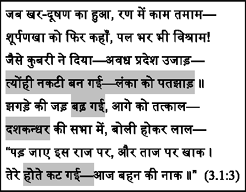
We begin with three representative couplets taken from various points in the chapter Rāvaṇ-vadh in Laṅkā Kāṇḍ, which describe Ravan's last stand in the war, to demonstrate Kathavachak's handling of lexical items and grammatical forms affiliated with the Braj tradition, at least in the minds of many in his audience.

Here both lines have been entirely recomposed in the 1960 excerpt, so much so that the Braj absolutive at the end of the second pad (foot or quarter of the couplet),  (having rushed), disappears, as does the Braj verbal stem at the end of the fourth foot,
 , part of a compound verb which, if given in standard word order would read,
 (unconsciousness struck, that is, [he] fell unconscious). Despite these forms, it is clear that we are dealing with a register of Hindi that is not entirely (purely) literary Braj or modern Delhi-standard Hindi, for in both the above couplet and the following one, the author has utilized the
 post-position, a feature that is characteristic of the latter language. We may surmise therefore that the idiom in the early Radheshyam Ramayana reflects a midway point between late literary Braj and modern literary Hindi.
The next example strictly concerns vocabulary, not verbal forms. Here, the couplet is unchanged in the latter printing, such that two words associated with Braj and archaic, literary Hindi generally (

and

), in word-final position, are retained:

In this case, both couplets are identical, notwithstanding ‘

’ in the second line (1960), which appears to be a typographical error. (All other printings consulted rendered this line ‘

’.) As the two examples above demonstrate, Kathavachak was more inclined to edit out Braj verbal forms than non-verbal forms. But in the case of Braj-inspired nouns, he was less inclined to alter them if they happened to land at the end of the verse, as here. These predilections can be observed in the following couplet in which Mandodari sees her husband Ravan fallen on the battlefield:

Although the first line remains untouched, the second line is totally rewritten such that the Braj perfective,  (was overcome), is eliminated in favour of a vocative phrase which, incidently, ends in a tadbhav noun,
 (king). Although archaic (as opposed to the more standard tatsam
 ), this does conveniently suit the meter and end rhyme. Meanwhile, the Braj post-position
 becomes
 (on), and the Braj absolutive
 (having fallen) becomes
 (having screamed), now appended to
 (fell) as the main (perfective) verb. Despite all these lexical changes, it is clear that the author also sought to improve the technical quality of his verse here and in many other places. Revisions to the second line of this dohā correct a defect in meter; the last foot now contains the standard eleven mātrās, as opposed to ten.
Turning to the songs, it should first be noted that they undergo much less revision than other parts of the text. Many have a charming, archaic flavour that was probably savoured by audience members, who may have had them on their lips and were therefore resistant to changes in them. Although entertaining, the songs generally do not advance the narrative significantly nor do they add substantially new material. Rather, these verses, most less than half a page in length, reinforce the gist of the narrative and add emphasis, particularly at emotional high points. Every bhāg closes with a song. The two bhāgs with the most songs are Dhanuṣ-yajña (17) and Vivāh (13), whilst the whole text averages about eight songs per bhāg.Footnote 47
In the following song (typical though perhaps slightly more revised than most), from Vivāh, Sita's mother advises her daughter on pātivrat dharm (the dharma of a dutiful wife) on the day of her marriage to Ram:

Aside from slight changes in spelling and punctuation, edits in the 1959 version of this song, as in others, were probably geared, at least in Kathavachak's mind, towards general refinement of the verse, the minimal rewording showing little regard for mitigating vocabulary associated with Braj.  seemingly only corrects a small error. The second half of lines one, three, and five were apparently rewritten only to avoid the repetition of ‘
 ’, but resulting in extraneous verbiage in the last line (
 ). Meanwhile, Braj vocabulary, represented by the vocative ‘
 ’ and the accusative ‘
 ’ (others) are not affected.
Examples relating to Urdu (and colloquial speech, generally)
The next series of examples all point to the reduction in Urdu vocabulary and informal speech overall in the revised Radheshyam Ramayan. In this scene, taken from Daśarath kā pratijña-pālan in Ayodhyā Kāṇḍ, Ram confronts his heartbroken father and learns of Kaikeyi's sinister machinations:

Here we may observe that a number of words of Perso-Arabic origin have been changed to ones of Sanskrit origin— (unconscious),
 (as though),
 (upset). A shift from colloquial to elite speech is also apparent as tadbhav forms and colloquial deśī words are transmuted into tatsam forms—
 (esteemed),
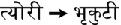 (eyebrow),
 (son),
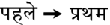 (first). In some instances, this has led to slight shifts in meaning or nuance—for example,
 (fine)
 (ideal)—yet in other instances, the language is entirely rewritten, as in the second half of line four and all of line six. Formerly, Ram kissed Dasharath's toe—a touching gesture, but with the revised language, he now merely takes the dust of his father's feet. At the same time, the former end-rhyme of
 and
 gives way to the facile repetition of
 . Apparently Kathavachak failed to find a synonym of that rhymed with
 , and so was forced to rewrite the whole line.
In making such revisions, Kathavachak seemingly felt constrained to use Sanskritic vocabulary that, whilst conforming to the meter, did not always lend itself to the same former poetic sophistication. He also took the liberty of changing the meter, as the above example illustrates, in order to accommodate his revisions. In the excerpt from 1939, a dohā beginning with ‘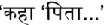 has been changed to a caupāī,
 in the 1959 excerpt. The stylistic force of the dohā, which is used in the Radheshyam Ramayan (and the Rāmcaritmānas) to provide an occasional break from the monotony of the caupāī, and sometimes, to add emphasis to the import of the surrounding passages, is here lost.
Between 1939 and 1959, in a move towards standardization,  takes on the śuddh spelling
 , and between 1947 and 1959
 becomes the more formal
 . The spelling of the verbal forms with the final syllable
 , and the medial or final syllable
 tend to be changed to their now standard forms,
 and
 , respectively, here illustrated by the example of the past participle,
 . Of course some of these small changes may have simply been random or due to human error on the part of press workers. This is especially likely in terms of punctuation where considerable variation across printings occurs.
The next example, comprised almost entirely of direct speech, also reveals similar types of edits. In this scene from Aṅgad-Rāvaṇ kā saṃvād in Laṅkā Kāṇḍ, Ravan insults Angad who has come to Lanka as Ram's emissary.

Here again there is a transition to more formal, more śuddh Hindi. In the first line, Ravan's opening salvo: ‘ ’, is subsequently changed to ‘
 ’. Although the first line is now more cumbersome, it does provide the necessary end-rhyme with the form,
 (work), to complement
 (scholar). Meanwhile, the Persian word
 (much) is conveniently omitted in the new version, as is the Persian word
 (scholar) which becomes
 in the 1960 printing. Given its provenance,
 , has connotations of a Muslim master or poet, whilst
 suggests a Hindu pandit. In the same line, the Sanskritic word
 (ascetic), remains unchanged in the latter printing.
In the third line, the sentence ‘ ’, is transformed into the somewhat more elevated ‘
 ’. Further down, the updating of ‘
 ’ (to be insolent) to simply ‘
 ’ - (to be annoying) seems designed to rid the phrase of the Persian suffix
 . Similarly, the last line is totally rewritten, with the result that another Persian word,
 , (without right) is excised: ‘

 ’
 ‘
 ‘
 ‘. Interestingly, it seems Kathavachak chose to rewrite this line to improve the quality of his verse—to say something novel, rather than repeat himself. The line also wryly reminds us that Angad is, in fact, a monkey. Insulting his simian nature, Ravan, though of demon stock, considers himself much superior to Angad.
A third example of just two caupāī couplets is from the sole chapter in Kiṣkindhā Kāṇḍ, Rām-Sugrīv kī mitratā, which concerns Ravan's kidnapping of Sita. (Here the corresponding excerpt from 1947 is also included as it departs from the other two.) Ram has just heard Sugriv's account of what he saw and heard the day Ravan abducted Sita. Upon learning that she dropped some of her jewellery:

The chief edit in the first couplet of 1947 printing is the transition from Arabic  to Sanskritic
 (nearby). This compelled Kathavachak to also rewrite the following line to maintain the requisite end rhyme. Hence
 is compressed to
 (brought) and
 is transformed into an epithet,
 (‘light of his line’). Apparently dissatisfied with this non-specific epithet, by 1960 he has rewritten the first line, and substituted the formal adverb
 (just then) for . Meanwhile, changes made to the last line of the 1960 printing seem directed towards more precision. It was the act of seeing Sita's earring that made Ram become so emotional. This concern for clarity in syntactical relationships, often manifested by a more careful use of post-positions (here
 ), is one seen elsewhere in the revised Radheshyam Ramayan.Footnote 49
One last example comes from the second chapter of Araṇya Kāṇḍ, Sītā-haraṇ—incidentally, the first bhāg Kathavachak composed and published.Footnote 50 In the following scene, we witness the aftermath of Lakshman's mutilation of the demonness, Shurpanakha, hearing her words to her brother Ravan, seated in his royal court in Lanka. Here are the four caupāī couplets that open the chapter:

Here again we may note a transition to a more standardized and more formal śuddh Hindi in the latter excerpt from 1960. For instance,  becomes
 , necessitating serious revision of the following line to maintain the rhyme scheme. The 1960 printing contains more verbal tense agreement, with both main verbs now in the perfective:
 (ruined)/
 (became), though technically, a metrically longer transitive verb (
 , made) should have been used in the latter instance. The subsequent couplet has been rewritten entirely, with the result that Persian and Arabic vocabulary—
 (disturbance),
 (court), and
 (lament)—has been expunged. Whereas in the 1942 printing,
 and each fell at the end of a line, now in the 1960 printing, we find the formal, Sanskritic adverb
 (at that moment) combined with a Persian word common in colloquial Hindi,
 (red, or here, enraged). If Urdu was to be used, it was done so sparingly, and as much as possible using common Urdu words.
Updating in Shurpanakha's two lines of dialogue in which she implies, in the 1942 printing, that Ravan has been engaging in debauchery, whilst she has been disfigured and harrassed, only results in the net loss of one word associated with Urdu. But Kathāvāvak had to effect more extensive revision of the first line in order to maintain the internal rhyme scheme:  (leisure). . .
 (wine goblet)
 (kingdom). . .
 (crown). By downplaying Ravan's licentiousness, and instead emphasizing his ineffectualness as regent, this edit works to ‘sanitize’ the import of the verse.
Over the course of the next five pages of the chapter Sīta-haraṇ, in which Ravan converses first with his demonic sister, Shurpanakha, and then with his reluctant accomplice Marich, we may observe that the speech of Shurpanakha and Ravan contains about the same amount of Urdu in the 1960 printing as in the 1942 one, whilst that of the ‘good demon’ Marich is thoroughly Sanskritized.Footnote 53 For this reason, it would be tempting to speculate that Kathavachak was less inclined to Sanskritize demonic speech, and instead invested them with ‘demon Urdu’. But such a hypothesis is not borne out in the dialogue of demons in later books. Rather, the explanation for this anomaly seems to be more pedestrian. Kathavachak was likely to be more meticulous in his editing of some portions of his text than others, leading to, at times, an uneven quality in the linguistic texture of the mature poem. Lapses in the process of Sanskritization may also be explained by his reluctance to tamper with particularly pleasing verses, even if inflected towards Urdu on the Hindi-Urdu spectrum.
Conclusion
Given the above textual evidence and the fact that all of the versions consulted here were published by the author's own press, Rādheśyām Pustakālay, strongly suggests that Kathavachak himself revised his Ramayan, and this view is consistent with information provided by his grandson and press manager's son. But what specifically prompted Kathavachak to revise his text and ‘purify’ the Hindi in his Ramayan?Footnote 54 Why did he do so over such a long period of time? And why were the most dramatic changes apparently carried out in the 1940s and 1950s? After all, the Hindi movement was already about 40 years old by the time Kathavachak commenced his Ramayan.Footnote 55
In answering the last question first, it makes sense that Kathavachak would have had the leisure to undertake a massive editing project in the 1940s and 1950s. By then the Parsi theatre was in decline thanks largely to the influence of Hindi cinema. It was also during these years that Kathavachak took a hiatus from his career in the theatre, after the untimely death of his eldest son in 1947.Footnote 56 But he clearly began his editing process much earlier, perhaps from the time of its inception, in part, as a natural outgrowth of his improvisational style as a kathāvācak and his desire to improve the quality of his verse. But the fact that the editing process was so protracted and staged underscores both the massive size of the project—the text being over 600 pages in length—and perhaps also the slow, progressive crystallization of Kathavachak's own views regarding language.
In his teens and twenties, Kathavachak was perhaps too young to fully appreciate the subtleties of the language debates then raging in North India. In retrospect, we may well think of Kathavachak as an ‘organic intellectual’ in the earliest phase of his career when he first composed his Ramayan. There is a certain naiveté in the language of his original text. It is the language of a young brahmin in the Hindi-Urdu heartland around the turn of the twentieth century, at a time when Braj and Urdu still had much cultural currency, even in avowedly Hindi literature. Only slightly affected by the occasional nod to the Braj tradition, and only slightly elevated above colloquial speech, his language suggests the mixed linguistic register of someone steeped in a multi-cultural (Hindu-Muslim) environment, as yet untouched by rhetoric associating language and religion in a reflexive and artificial fashion. It should also be remembered that in the field of poetry, many diehard Hindi supporters only belatedly came to promote Khari Boli over Braj.
Regarding the use of Urdu in the Radheshyam Ramayan, it also helps to understand the progressive rise of literary Khari Boli Hindi—a rise that did not occur simultaneously across North India. Urdu publishing held sway longer in the western regions (including Bareilly district) than in the eastern ones, such that in the former, Hindi publishing did not really vie with Urdu until the mid 1920s.Footnote 57 Evidence from three sources—education, publication and membership in voluntary language organizations—all ‘suggest that the strongholds of Sanskritized Hindi lay in the eastern part of the province [NWP&O]’.Footnote 58 Indeed the main cosmopolitan centres supporting the two languages through publications and societies were Lucknow in the Urdu west and Varanasi/Allahabad in the Hindi east. Not coincidentally the two major institutions supporting Hindi literature, the Nāgarī Pracāriṇī Sabhā (Society for the Advancement of Hindi, founded 1893) and Hindī Sāhitya Sammelan (Association of Hindi Literature, founded 1910), were based in Varanasi and Allahabad, respectively.
With this background in mind, we may now turn to the crux of the matter: the question of the author/editor's intentions in all of this. Kathavachak probably began to seriously embrace śuddh Hindi only gradually as a grown man, and only in the second or third decade of the twentieth century. Very likely, he eventually succumbed to the kind of critique he received after a November 1914 performance in Meerut. After copious praise for the performance, the reviewer felt constrained to write (in English):
Not meaning any disrespect to the famous reciter, we regret we find ourselves constrained to offer a criticism or two by way of a friendly suggestion. The language he has employed in his work is a curious amalgam of Sanskrit, Hindi, Urdu, and Persian—an impurity which of course considerably detracts from the merits of his otherwise excellent versification. We assert, after a careful study of facts, that in about ninety cases out of a hundred, the jarring and alien Urdu and Persian words have been used by him quite unnecessarily. All these can easily be dovetailed offhand by melodious Hindi words with an identical sense and without the slightest prejudice to the meter or order of words in the verse. But he has sought fit to use [words] like 
 (to cite only a few) where
 etc. would have been equally serviceable—nay would have even enhanced the beauty of the context. He delights in making divine Sita address Rama with that nasty word
 . Kaushilya calls Sita
 , etc.
It cannot be that he has done this with a view to make the language easily intelligible by all the audience; for what means he then by the totally Sanskritised lines, such as  , or by totally Persianised couplet like
 ,
 We think this should have been avoided and many of the phrases and words should have been deleted.
But we presume this is all due to inadvertency and probably also to an inordinate love of  (alliteration) and
 (pun) which are prominently abundant in the work. We hope Pandit Radhey Shyam will soon pay his attention to this and wash off these defects. It is for this reason alone that we have made bold to offer these remarks in a sincere spirit. We wish, respectfully to remind him that at the present day Hindi ‘expects every Hindu writer to do his duty’.Footnote 59
In time Kathavachak, it seems, sought to ‘do his duty’, and acquiesced to the demands of a movement determined to institutionalize Khari Boli for the sake of Hindi-speaking Hindus in North India.
Another clue to Kathavachak's change of heart in matters of language may be found in his close relationship with Madanmohan Malviya, founder of Kāśī Viśvavidyālay (Banaras Hindu University, 1916), as well as a nationalist, educator, and Hindi proponent. Two or three years prior to the above-mentioned critique, Malviya had travelled to Bareilly whilst on a tour to solicit donations for the building of Banaras Hindu University. Kathavachak personally assisted in that effort, writing songs—in essence, lyrical pleas for solicitations—used during Malviya's dramatic procession through the streets of Bareilly. Whilst Kathavachak facilitated financial support for Malviya through his network of connections with the Brahmin community in Bareilly, Malviya rewarded Kathavachak with copious praise and encouragement of his early literary and dramatic efforts,Footnote 60 particularly in that they were so centred on Hindu culture. Reciting the sacred stories of Hinduism, he told Kathavachak, was the dharma of Brahmins. Throughout his life, Kathavachak considered himself a śiṣya (disciple) of Malviya.Footnote 61
It is not difficult to conclude that Malviya also influenced Kathavachak regarding his views on Khari Boli Hindi.Footnote 62 Although Malviya supported the Hindi movement, he was not an advocate of a highly Sanskritized variety of Hindi, but rather of a more catholic, authentic variety, such that education in that medium would be more useful, and citizens, particularly the relatively few in the professional class, more productive.Footnote 63 We can also imagine that Kathavachak likewise saw a utilitarian purpose in the language of his Ramayan: it could serve to make Tulsi's Ramayan in Avadhi more accessible to Hindi-speaking Hindus in North India. Indeed some of Kathavachak's edits did in fact improve the quality of his poem, that is, if we are to admit the merits of increased standardization and decreased repetition. However, it is telling that a half century after Kathavachak's death, some of those in one Ramlila association, that of Subhashnagar in the author's hometown of Bareilly, are now questioning whether it might be time to reduce or perhaps even eliminate the use of the Radheshyam Ramayan in their annual performance because, by one estimate, only about 20 per cent of the mostly working-class audience actually understands Kathavachak's dialogues completely, although a poor sound system is also to blame.Footnote 64
We may conclude that the move towards a more formal, standardized register of Hindi with less Braj and Urdu probably worked against Kathavachak's own explicit goal of crafting a Ramayan in language accessible to the ordinary Hindi speaker. Because of this, ironically, in Kathavachak's lifetime the mature Radheshyam Ramayan was probably less useful than the original one.
At the same time—and whilst this will always be a matter of personal taste—it is difficult not to conclude that the mature Radheshyam Ramayana is in many places less lyrical and charming than the original one. While we may find fewer metrical errors and less regular language usage, something intangible and essential has been lost by Kathavachak's process of editing out much Braj and Urdu-inflected language. It is not for nothing that at the Subhashnagar Ramlila about a quarter of the cast (primarily older actors) still prefer to use the text of the original Radheshyam Ramayana, for they find its mixed register of Hindi-Urdu more melodious and pleasing than the śuddh Hindi of the revised text. Younger actors who tend to be more highly educated and schooled in official Hindi, in contrast, prefer the revised text because they are not in full command of the Urdu vocabulary contained in the original text, which is now becoming obsolete as lila script.
Like the Ramayana itself, there are many Radheshyam Ramayanas, ones that are ‘Braj/Urdu-ish’ and ‘Hindi-ish’ at the extremes, and a number of intermediary versions in between.