





Introduction
Learning collocations has long been considered one of the more challenging aspects of second language acquisition (SLA). In native speakers, collocation knowledge seems to arise naturally from years of language experience underlying sensitivity to the distributional properties of their L1, including word co-occurrence patterns (e.g., Bybee, Reference Bybee2006; Hoey, Reference Hoey2005). In advanced L2 learners, frequency and likelihood of co-occurrence have also been found to play a role in explaining the processing of multiword combinations (e.g., Öksüz et al., Reference Öksüz, Brezina and Rebuschat2021). However, in line with usage-based approaches to SLA, the development of L2 collocational knowledge not only relies on exposure to L2 input but can also benefit from conscious attention to word combinations that might be low in perceptual salience or sensitive to negative L2 transfer (e.g., Boers et al., Reference Boers, Demecheleer, Coxhead and Webb2014).
Typographic enhancement (TE) has been proposed as a means to increase the perceptual salience of L2 collocations. Studies have shown that the combination of repeated exposure and typographic enhancement can facilitate collocation learning from L2 reading (e.g., Jung et al., Reference Jung, Stainer and Tran2022; Pellicer-Sánchez et al., Reference Pellicer-Sánchez, Siyanova-Chanturia and Parente2022; Puimège et al., Reference Puimège, Montero Perez and Peters2024; Sonbul & Schmitt, Reference Sonbul and Schmitt2013; Szudarski & Carter, Reference Szudarski and Carter2016; Toomer & Elgort, Reference Toomer and Elgort2019; Webb et al., Reference Webb, Newton and Chang2013). The positive effects of TE have often been explained through attention, whereby increased visual salience promotes noticing and deeper processing of collocations and strengthens their representations in the mental lexicon.
Recent eye-tracking research has shown that TE can indeed increase attention to novel L2 collocations during reading (Choi, Reference Choi2017; Jung et al., Reference Jung, Stainer and Tran2022; Puimège et al., Reference Puimège, Montero Perez and Peters2024). However, this effect tends to be brief and limited to the initial exposure, particularly when later exposures are not enhanced (Puimège et al., Reference Puimège, Montero Perez and Peters2024). Moreover, most previous studies have treated exposure frequency as a categorical variable (e.g., three vs. six), without examining how collocation processing changes across repeated exposures (e.g., Jung et al., Reference Jung, Stainer and Tran2022). Thus, it remains unclear how collocation processing changes from the first to the final exposure in enhanced and unenhanced conditions. In particular, little is known about whether TE leads to sustained attention across exposures or modulates the speed and efficiency with which collocations are processed in real time.
Moreover, although learning of vocabulary items from L2 exposure is assumed to increase in line with the amount of attention they receive (see Schmidt’s [Reference Schmidt1990] noticing hypothesis), there is no consensus regarding the relationship between summed reading times (i.e., total amount of attention) and learning. In fact, recent research has indicated that depending on the underlying cognitive processes, the strength of the relationship between overt attention and learning may vary (Elgort & Beyersmann, Reference Elgort and Beyersmann2024). Moreover, TE, as a factor that influences how L2 learners allocate attention, may alter the nature of this relationship. That is, TE may strengthen, weaken, or otherwise change the role of attention as a predictor of learning (e.g., Lee & Révész, Reference Lee and Révész2018). Therefore, it is important to examine how TE moderates the relationship between attention and L2 collocational learning.
The current study addresses these gaps by using eye-tracking and vocabulary tests to examine how TE affects the processing and learning of novel L2 collocations encountered repeatedly in text and whether and how it shapes the link between attention and collocation learning.
Literature review
Collocations in a first and second language
In native speakers, knowledge of collocations is thought to arise through a largely implicit, frequency-driven learning process (e.g., Siyanova-Chanturia & Martinez, Reference Siyanova-Chanturia and Martinez2015). Through repeated encounters with words in varying contexts, the L1 language system updates collocational associations, which over time come to reflect the distributional properties of words that, despite differences in individual experience, are largely shared by adult native speakers (e.g., Hoey, Reference Hoey2005). Psycholinguistic research indicates reliable effects of distributional variables (e.g., corpus frequency and association strength) on language users’ judgments, response times, and reading fluency of collocations (e.g., Carrol & Conklin, Reference Carrol and Conklin2020; Durrant & Doherty, Reference Durrant and Doherty2010; Gyllstad & Wolter, Reference Gyllstad and Wolter2016). Sensitivity to collocation patterns in online language processing is thought to be key to successful communication (e.g., Conklin & Carroll, Reference Conklin and Carrol2021).
Learning L2 collocations has been found to rely on the same distributional variables, as evidenced, for example, by processing advantages for collocations over novel word strings and frequency effects on L2 collocational processing (e.g., Öksüz et al., Reference Öksüz, Brezina and Rebuschat2021; Wolter & Gyllstad, Reference Wolter and Gyllstad2013; Yi, Reference Yi2018). However, in the context of SLA, collocational knowledge remains to be one of the more advanced—and more challenging—aspects of learning a second or foreign language, with some researchers claiming that mastery of collocations remains a source of difficulty even at advanced levels of L2 proficiency (e.g., Laufer & Waldman, Reference Laufer and Waldman2011; Nesselhauf, Reference Nesselhauf2005).
A primary component of the difficulty underlying collocation learning is the seemingly arbitrary way in which words combine to form conventional associations. Common examples include adjective-noun collocations (heavy rain, strong beer), which can be contrasted with nonconventional combinations (strong rain, heavy beer) that are semantically and syntactically similar but are nonetheless considered unconventional or “non-nativelike” (e.g., Henriksen, Reference Henriksen2013; Pawley & Syder, Reference Pawley, Syder, Richards and Schmidt1983). At the same time, L2 collocation learning has been shown to be marked by L1 congruency effects (e.g., Wolter & Yamashita, Reference Wolter and Yamashita2018) and L1 interference in speech and writing (e.g., Laufer & Waldman, Reference Laufer and Waldman2011). Furthermore, acquiring an extensive repertoire of L2 collocations is thought to require vast amounts of L2 exposure (Pellicer-Sánchez et al., Reference Pellicer-Sánchez, Siyanova-Chanturia and Parente2022). Researchers have therefore highlighted the importance of providing learners with input containing authentic L2 collocations and other multiword expressions, for example, in textbooks (e.g., Northbrook & Conklin, Reference Northbrook and Conklin2018). The limited time that L2 teachers can spend on the explicit teaching of collocations in language classrooms has also raised the necessity for out-of-school engagement with L2 collocations through meaning-focused activities like reading or TV viewing.
Low salience of collocations in language input can be another challenge for L2 learners (e.g., Boers & Lindstromberg, Reference Boers and Lindstromberg2009). Collocations that have a transparent meaning or consist of familiar words (tell a joke, fast asleep) can go unnoticed as targets for L2 learning (e.g., Boers, Reference Boers and Webb2020; Boers et al., Reference Boers, Demecheleer, Coxhead and Webb2014; Wray, Reference Wray2002) as they do not stand out as linguistic units. A lack of explicit attention to collocations could therefore leave them poorly represented in memory and inaccessible for productive use (Boers et al., Reference Boers, Demecheleer, Coxhead and Webb2014).
Incidental learning of L2 collocations from reading
Incidental vocabulary learning refers to the learning of single or multiword items from meaning-focused activities such as reading or TV viewing, where comprehension rather than learning vocabulary is the primary goal (Schmitt, Reference Schmitt2010). A growing body of research has shown that reading can promote incidental learning of L2 collocations (e.g., Pellicer-Sánchez, Reference Pellicer-Sánchez2017; Webb et al., Reference Webb, Newton and Chang2013; Vu & Peters, Reference Vu and Peters2021). Within this line of research, several factors have been found to influence learning outcomes.
One factor is the frequency of exposure to L2 collocations in a text. For example, Webb et al. (Reference Webb, Newton and Chang2013) investigated the learning of 18 verb-noun collocations through reading-while-listening. Taiwanese learners of English read different versions of the same graded reader, which varied in the number of occurrences of target collocations. The results showed that exposure to target collocations in the reader resulted in learning, but learning gains differed significantly across 1, 5, 10, and 15 exposures, with higher frequencies producing greater learning gains. In contrast, Pellicer-Sánchez (Reference Pellicer-Sánchez2017) compared the effects of two levels of exposure frequency. Learners of English from various L1 backgrounds read six adjective-pseudoword collocations (e.g., dirty soters) four or eight times in the context of a story. Although considerable long-term effects on collocation knowledge were found in both groups, no significant repetition effect was found. Similarly, Szudarski and Carter (Reference Szudarski and Carter2016) did not find a repetition effect in their study comparing six and 12 exposures to verb-noun and adjective-noun collocations during meaning-focused reading.
Notably, all the above-mentioned studies operationalized exposure frequency at the text level. However, text-level frequency may not necessarily correspond to how often participants actually fixate target collocations, which may partly account for the mixed findings from these studies. More fine-grained indices of exposure, such as eye-tracking measures, including fixation time and fixation count, may provide a more precise estimate of learners’ attentional engagement with target collocations and better predict the learning gains in subsequent vocabulary tests. We discuss these measures in greater detail below.
A second factor influencing the learning of L2 collocations is their salience in text. As noted earlier, collocations, particularly those composed of familiar words, can be difficult for L2 learners to recognize as formulaic, multiword units (Boers, Reference Boers and Webb2020). One way to counter this low salience of collocations in written or spoken input is to temporarily direct learners’ attention to them through various forms of input enhancement (e.g., Szudarski & Carter, Reference Szudarski and Carter2016). One widely researched input enhancement technique is typographic enhancement (TE), which involves boldfacing or underlining the target vocabulary or grammar structures in a text. The use of TE is grounded in input enhancement theory (Sharwood Smith, Reference Sharwood Smith1993), which asserts that visually salient input is more likely to be noticed and attended to. TE is further supported by SLA learning theories such as Schmidt’s (Reference Schmidt1990) noticing hypothesis and Leow’s (Reference Leow2015) model of L2 learning processes in instructed SLA, both of which posit that conscious attention to linguistic forms is necessary for initial processing and learning of L2 input.
Several studies have examined the effects of TE techniques on learners’ acquisition of collocations during meaning-focused reading (Choi, Reference Choi2017; Jung et al., Reference Jung, Stainer and Tran2022; Puimège et al., Reference Puimège, Montero Perez and Peters2024; Sonbul & Schmitt, Reference Sonbul and Schmitt2013; Szudarski & Carter, Reference Szudarski and Carter2016; Vu & Peters, Reference Vu and Peters2021) and found that it enhances learners’ noticing and learning of collocating word forms. For example, in a study with L2 learners of English, Szudarski and Carter (Reference Szudarski and Carter2016) compared the learning gains from reading with and without TE and found that underlining collocations in L2 reading text led to improved long-term recall and recognition of those collocations.
Similarly, Sonbul and Schmitt (Reference Sonbul and Schmitt2013) examined the effects of TE on the learning of 15 low-frequency English medical collocations (e.g., cloud baby) repeated three times in the treatment text. Participants included L1 and L2 speakers of English, and learning gains were measured using a cued form recall test and a form recognition test. Additionally, an unmasked priming task was used to assess the processing fluency of the target collocations. The results showed that TE significantly improved participants’ learning gains: enhanced collocations were recalled and recognized better by L2 learners than unenhanced collocations. However, the priming task results did not show any evidence for collocation priming. Toomer and Elgort (Reference Toomer and Elgort2019) conducted a partial replication and extension of Sonbul and Schmitt (Reference Sonbul and Schmitt2013) by extending the duration of the treatment from two to three sessions spread across two consecutive days and increasing the number of occurrences of the target collocations in the reading materials from three to nine. The results, again, showed a significant positive effect of TE on learners’ recall and recognition of the form of target collocations. In addition, unlike Sonbul and Schmitt (Reference Sonbul and Schmitt2013), Toomer and Elgort (Reference Toomer and Elgort2019) found evidence for collocation priming for the collocations learned in the unenhanced condition but not for the collocations learned in the enhanced condition. Toomer and Elgort proposed that the use of TE might have altered the participants’ natural reading of the experimental texts, specifically the process of word-to-context integration. However, how exactly TE might have affected the reading process itself was not explored in their study. Investigating L2 learners’ real-time processing of enhanced and unenhanced collocations may help clarify these potential effects.
Eye-tracking research into L2 collocation learning from reading
Eye tracking has been widely employed to capture natural reading behaviors (Cop et al., Reference Cop, Drieghe and Duyck2015) without requiring secondary tasks that may interfere with comprehension or learning. Eye-movement measures reflect both early (e.g., familiarity check and lexical access) and late reading processes (e.g., word-to-text integration), as indexed by metrics such as gaze duration and total reading time, respectively (Godfroid, Reference Godfroid2020).
Eye-tracking studies examining L2 vocabulary learning from reading have consistently shown that unfamiliar words in a text attract greater visual attention (i.e., more and longer fixations) than familiar words (e.g., Godfroid et al., Reference Godfroid, Boers and Housen2013) and that the amount of attention decreases with repeated exposure (e.g., Godfroid et al., Reference Godfroid, Ahn, Choi, Ballard, Cui, Johnston, Lee, Sarkar and Yoon2018). Cross-exposure reductions in fixation times have been interpreted as evidence of increasing familiarity and processing fluency, indicating incremental vocabulary development (Joseph et al., Reference Joseph, Wonnacott, Forbes and Nation2014; Pellicer-Sánchez, Reference Pellicer-Sánchez2016). In light of this, a few studies have measured reductions in fixation times on L2 collocations across repeated exposures to examine the development of processing ease and familiarity. Extending single-word analyses to multiword units, these studies typically treated collocations as a single phrasal region of interest rather than analyzing each node separately (Carrol & Conklin, Reference Carrol and Conklin2015).
Pellicer-Sánchez et al. (Reference Pellicer-Sánchez, Siyanova-Chanturia and Parente2022), for example, measured learners’ fixation times on whole collocations to track changes in processing fluency. In their study, L1 and L2 English readers read an experimental text under one of three conditions: (1) novel collocations repeated four times, (2) novel collocations repeated eight times, and (3) a control condition with familiar adjective-noun collocations repeated eight times. Target items included six adjective-pseudoword collocations. Learning was assessed using five posttests measuring the learning of the form and meaning of both pseudowords and collocations. Results showed no significant differences in learning target collocations between four- and eight-exposure conditions. However, participants’ total reading times on collocations decreased gradually during the initial exposures, indicating that exposure count affected learners’ processing efforts when reading the target items. In comparison with the control condition, reading times decreased more rapidly for novel collocations, suggesting that learners’ familiarity with the target collocations led to facilitated processing. Nonetheless, even after eight encounters, reading times on novel collocations were still longer than on control items, suggesting that more than eight exposures may be necessary for L2 learners to develop fluent processing of novel collocations, perhaps especially when those collocations contain a novel word form (i.e., a pseudoword).
Aside from measuring changes in processing fluency, eye-tracking research has also examined how TE influences the processing of collocations in real time. Choi (Reference Choi2017), for instance, found that boldfacing collocations in an L2 reading passage led to longer total fixation times on target collocations during reading and improved form recall of the entire collocation in a form recall posttest. The study also reported an attentional tradeoff effect, showing that unenhanced information was more difficult to recall in the TE group. Similarly, Jung et al. (Reference Jung, Stainer and Tran2022) found increased fixation durations for enhanced adjective-pseudonoun collocations when they were repeated six times in a text compared to when they were repeated three times. Whereas these studies show attention-enhancing effects of TE, other research suggests that there may be possible limits to its usefulness in L2 collocation learning.
In a study with Dutch-speaking L2 English learners, Puimège et al. (Reference Puimège, Montero Perez and Peters2024) investigated how initial TE of an L2 collocation (enhancing only the first occurrence) influenced the attention to the same collocation in later occurrences. In the first exposure, the results revealed longer fixation durations on the enhanced collocations compared to unenhanced collocations. However, this increased attention did not carry over to later exposures where the collocations were no longer typographically enhanced. The researchers concluded that TE may only temporarily boost learners’ attention, and its effects are not necessarily carried over to the later unenhanced occurrences.
Based on existing findings, it seems that the effects of TE on collocation reading may covary with repeated exposure. What remains unclear is the extent to which TE leads to sustained attention to novel collocations when those collocations are repeatedly enhanced in the input. Even though TE has been found to promote attention to collocations when combined with repetition (Jung et al., Reference Jung, Stainer and Tran2022), repeated enhancement might either be associated with sustained attention or with faster decreases in reading times as a result of more rapid familiarization, compared to an unenhanced condition. In the latter case, the positive relationship between TE and learners’ fixation times would disappear with repeated exposure, not because the target collocations are no longer noticed (e.g., Puimège et al., Reference Puimège, Montero Perez and Peters2024), but because they are read more fluently, allowing for more efficient attention distribution during reading. The question of how TE interacts with repetition in impacting L2 learners’ attention to collocations thus calls for further investigation.
Reading times as a predictor of learning outcomes
A key assumption in eye-tracking research is that reading times (i.e., amount of visual attention) reflect deeper or more elaborate processing and should therefore be positively associated with learning outcomes (e.g., Godfroid et al., Reference Godfroid, Boers and Housen2013; Schmidt, Reference Schmidt1990). Accordingly, several eye-tracking studies have reported a positive relationship between learners’ fixation times on novel L2 words and learning of certain lexical aspects, such as meaning (e.g., Godfroid et al., Reference Godfroid, Ahn, Choi, Ballard, Cui, Johnston, Lee, Sarkar and Yoon2018; Pellicer-Sánchez, Reference Pellicer-Sánchez2016) or form (e.g., Mohamed, Reference Mohamed2018; Tuzcu & Loewen, Reference Tuzcu and Loewen2026), whereas other studies have found no such relationship (e.g., Elgort et al., Reference Elgort, Brysbaert, Stevens and Van Assche2018).
These mixed findings suggest that the relationship between attention and learning is more complex than previously assumed (Pellicer-Sánchez, Reference Pellicer-Sánchez and Webb2020) and that reading times may indicate different underlying cognitive processes in different learning conditions (Elgort & Beyersmann, Reference Elgort and Beyersmann2024). Specifically, longer reading times may either indicate processing difficulty or deeper engagement and efforts to learn unfamiliar items. While processing difficulty is likely to hinder learning and result in a negative or null relationship with learning gains, learning effort may facilitate vocabulary learning and result in a positive attention-learning relationship.
The predictive value of attention may also depend on the conditions under which learning takes place (see Montero Perez et al., Reference Montero Perez, Peters and Desmet2015), for example, in the presence of TE. In the context of L2 grammar learning, Issa and Morgan-Short (Reference Issa and Morgan-Short2019) reported a positive relationship between attention (gaze durations in particular) and learning of L2 Spanish direct object pronouns across enhanced and unenhanced conditions. On the other hand, in video-based listening tasks targeting present perfect and past tense in L2 English, Lee and Révész (Reference Lee and Révész2020) reported that enhanced captions produced the strongest positive relationship between attention and learning gains. Conversely, in a study investigating the learning of pronominal anaphoric reference in L2 English through enhanced and unenhanced image captions, Lee and Révész (Reference Lee and Révész2018) found a positive attention-learning relationship only for the unenhanced captions. They interpreted this in the light of the different levels of processing promoted by each caption type, suggesting that visual attention may provide a less informative index of learning when items are made more salient through TE.
Evidence from vocabulary research is also inconclusive. In a study examining the learning of Dutch single words by L3 Dutch learners through watching a TV show over four weeks, Pattemore et al. (Reference Pattemore, Fan, Fiche and Loerts2025) reported no significant effects of total reading time and skipping on learning gains and no moderating effects of TE. Similarly, Pellicer-Sánchez et al. (Reference Pellicer-Sánchez, Siyanova-Chanturia and Parente2022) reported no significant relationship between the amount of attention to target collocations (measured by the summed reading times across exposures on the full target collocation) and collocation posttest scores. Jung et al. (Reference Jung, Stainer and Tran2022), on the other hand, explored the effects of exposure frequency and TE on collocation learning from reading and reported that total fixation duration and total fixation count on full target collocations significantly predicted collocation recognition and recall. However, they treated attention as a main-effect predictor and did not examine the potential moderating effects of TE.
Taken together, the existing literature offers no consistent picture of how TE moderates the attention-learning relationship. Grammar studies suggest that TE can either strengthen this link (Issa & Morgan-Short, Reference Issa and Morgan-Short2019; Lee & Révész, Reference Lee and Révész2020) or attenuate it (Lee & Révész, Reference Lee and Révész2020), whereas vocabulary studies have produced largely null findings. For collocations in particular, the moderating role of TE remains unclear. Furthermore, when TE and repetition are combined in a single experiment, as in the present study, competing effects of processing fluency development (i.e., shorter reading times across exposures) and attention (i.e., longer reading times due to increased salience) may further complicate the relationship between attention and learning. Therefore, more research is needed to understand in what ways TE alters L2 collocation processing as well as the relationship between attention and learning outcomes.
Rationale and research questions
The studies reviewed above primarily indicate positive effects of TE on learners’ attention to and retention of L2 collocations from reading. However, relatively little is known about the effect of TE over multiple exposures to collocations in a text. It remains unclear to what extent TE promotes (or impedes) decreases in fixation times across repeated exposures, which have been associated with the development of collocation processing fluency (e.g., Pellicer-Sanchez et al., Reference Pellicer-Sánchez, Siyanova-Chanturia and Parente2022). Exploring this question is essential to better understand the pedagogic value and potential tradeoffs of TE in L2 collocation learning.
To that end, the present study examines the effects of TE on the processing and learning of L2 collocations repeated multiple times in a text. Specifically, we examined (a) if the processing of enhanced and unenhanced collocations differed across exposures, as reflected in learners’ eye movements, (b) if TE improved learning of the form of target collocations, as measured by form recall and recognition tests, and (c) if online processing during reading was associated with the learning of these collocations. Our study addressed the following research questions:
-
1. How do TE and repeated exposure influence learners’ attention to novel L2 collocations during reading?
-
For unenhanced collocations, previous research suggests that attention decreases with repeated encounters (Pellicer-Sánchez et al., Reference Pellicer-Sánchez, Siyanova-Chanturia and Parente2022). Accordingly, we expected fixation durations and counts to decrease across exposures, showing increasing familiarity with these collocations.
-
For enhanced collocations, two competing hypotheses were considered. First, if TE consistently attracts attention to target collocations, fixation durations and counts should remain stable across repeated exposures. Second, TE may facilitate more efficient processing; in this case, after an initial increased attention, fixation durations and counts should decrease more steeply for enhanced collocations than unenhanced collocations, reflecting faster processing supported by increased visual salience.
-
2. How does TE affect the learning of novel L2 collocations from reading?
-
Consistent with previous findings, enhanced collocations were expected to yield greater learning gains than unenhanced collocations.
-
3. To what extent does TE moderate the relationship between a learner’s attention to novel L2 collocations, as measured by total reading times, and their subsequent learning of these collocations, as assessed through form recall and form recognition tests?
-
Based on prior research, greater attention was expected to predict higher learning gains on both form recall and recognition tests. However, because limited research has examined the moderating role of TE in this relationship and reported mixed findings, no directional hypotheses were formulated regarding its effects. Instead, we examined whether TE interacted with total reading times in predicting learning gains.
This study employed a treatment-immediate posttest design, with TE manipulated as a within-participant variable. To assess L2 learners’ online processing of enhanced and unenhanced target collocations repeated multiple times in the texts, their eye movements were recorded while reading. Learning gains were measured using two vocabulary posttests. Combining eye-tracking data with posttest results allowed us to examine how TE influenced learners’ attention to novel collocations and whether it moderated the relationship between reading times and L2 collocation learning.
Methodology
Participants
Sixty-nine participants were initially recruited for the experiment, of whom three did not complete the full experiment. Of the remaining 66 participants (n female = 56, n male = 10, M age = 20.61, SD age = 2.37), 48 were assigned to the experimental group and 18 to the control group. Considering potential effects of the L1 on L2 reading processes (Berzak et al., Reference Berzak, Nakamura, Flynn and Katz2017) and collocation learning (Yamashita & Jiang, Reference Yamashita and Jiang2010), we controlled the participants’ L1 background to decrease the amount of L1-induced variability in response times and learning gains. Participants, all native speakers of Dutch, were recruited from various university programs in Flanders (the Dutch-speaking region of Belgium), with 24 students majoring in language-related studies (e.g., applied linguistics, speech therapy, communication science). All participants reported having normal or corrected-to-normal vision. Participants’ self-reported proficiency ranged from pre-intermediate to native-like, with the majority reporting upper-intermediate (n = 31) or advanced (n = 15) reading ability in English, and some reporting pre-intermediate (n = 2), intermediate (n = 7), or native-like (n = 9) reading ability. On the Vocabulary Size Test (VST; Nation & Beglar, Reference Nation and Beglar2007), the participants’ mean score was 104.61 out of 140, and the scores were comparable across groups (see Table 1 for the VST scores by group). Ethical approval for the study was obtained from the ethics committee of the university where the data collection took place. Participants were recruited on a voluntary basis, provided written informed consent prior to participation, and received a 30 EUR compensation for completing the experiment.
Participants’ average scores, standard deviations, and 95% confidence intervals on the VST by group

Table 1. Long description
A table comparing participants’ average scores, standard deviations, and 95% confidence intervals on the Vocabulary Size Test (VST) by group. The table has two rows and four columns. Column headers are M, SD, and 95% CIs. Row labels are Experimental group (n = 48) and Control group (n = 18). Row 1: Experimental group (n = 48), M, 103.33; SD, 14.45; 95% CIs, 101.44, 105.23. Row 2: Control group (n = 18), M, 105.05; SD, 18.27; 95% CIs, 103.65, 106.44.
Materials
The learning materials and vocabulary tests used in this study were adapted from Toomer and Elgort (Reference Toomer and Elgort2019), whose original data collection materials are publicly available on the Open Science Framework at https://osf.io/qy2c3.
The target collocations were 15 medical collocations in English (e.g., cloud baby and iron lung). The frequency of each target collocation was relatively low (M = 0.10, SD = 0.21) in the Corpus of Contemporary American English (COCA; Davies, Reference Davies2008). The component words belonged to the most frequent 4,000 word families according to the British National Corpus (BNC) and Corpus of Contemporary American English (COCA) word family lists (Nation, 2017).
The learning materials consisted of nine 500-word reading texts, covering a range of medical topics. A single text contained three occurrences of five target collocations so that, in total, each participant encountered 15 collocations nine times across reading texts. Participants were exposed to all target collocations in the first three texts they read (five collocations per text). The first occurrence of each target collocation was accompanied by a one-time in-text explanation of its meaning, which was not repeated in subsequent texts. Ninety-seven per cent of each text consisted of the 3,000 most frequent words in the British National Corpus. The original reading texts were slightly adapted to ensure accurate and reliable eye-tracking data. For example, we ensured that the target collocations were never the first or last word of a sentence or were never preceded or followed by punctuation, as readers tend to over- or undershoot the words in these positions (Godfroid, Reference Godfroid2020; Rayner & Pollatsek, Reference Rayner, Pollatsek, Traxler and Gernsbacher2006).
Treatment conditions
The target collocations in this study appeared in one of two conditions in the texts: enhanced (target collocations were bolded) and unenhanced (target collocations were not bolded). Participants in the experimental group encountered half of the target items (seven or eight collocations) in the enhanced condition and the other half in the unenhanced condition. Following a counterbalanced design, two versions of the eye-tracking experiment were created so that each participant encountered different collocations in the different conditions. For example, pure absence was enhanced in Version A and unenhanced in Version B. However, for each participant, the same seven or eight collocations consistently appeared in the same condition throughout the experiment. Participants were randomly assigned to one of the two versions at the beginning of the data collection.
Eye-tracking measures
Interest areas (IA) were created for all target collocations and their component words. In the current study, we only report analyses of collocation-level IA in order to limit the number of related statistical tests. We analyzed one early (first-pass reading time) and three late (rereading odds, total reading time, and fixation count) eye-tracking measures to capture differential effects of TE on lower-order (orthographic familiarity check and lexical access) and higher-order (semantic encoding and word-to-text integration) processes (e.g., Grabe, Reference Grabe2008; Reichle et al., Reference Reichle, Warren and McConnell2009).
The early measure first-pass reading time (i.e., the sum of fixations before leaving the IA) was included to examine the effect of TE on learners’ initial noticing of target collocations, as well as decreases in reading times associated with familiarity and developing processing fluency. Differences in early measures have previously been associated with the recognition of collocations as known word combinations, whereby known collocations receive shorter first-pass reading times than novel word combinations (e.g., Carrol & Conklin, Reference Carrol and Conklin2020). In the context of a reading passage, seeing target collocations repeatedly might cause reductions in first-pass reading times, as learners become familiarized with the target items and process them more automatically (Pellicer-Sánchez et al., Reference Pellicer-Sánchez, Siyanova-Chanturia and Parente2022; Sonbul et al., Reference Sonbul, El-Dakhs, Conklin and Carrol2023). Furthermore, because TE is likely to increase the salience of target collocations, increased levels of overt attention at initial exposure might be accompanied by a faster or stronger reduction in first-pass reading times across exposures.
The late measure of rereading odds (i.e., the odds of refixating an IA after the first visit) was included to examine the effects of TE on contextual integration and semantic processing of target collocations. Unlike rereading time, which represents the amount of time learners spend refixating on target items and therefore only includes data for items that were revisited, rereading odds constitute a binary measure reflecting the probability of rereading an item across all data points. In the present study, rereading odds may reflect learning efforts or deliberate attempts to study target collocations. Alternatively, rereading has been associated with learners’ ability to integrate new collocations into their contexts (e.g., Grabe, Reference Grabe2008). Increased rereading odds may therefore also reflect difficulties in semantic and contextual processing of target collocations.
Finally, total reading time (i.e., the total sum of fixations on the IA) and fixation count (i.e., the total number of fixations on the IA) were included to examine learners’ total amount of attention to target collocations. Previous studies have found that TE was associated with significantly longer total reading times (e.g., Choi, Reference Choi2017; Puimège et al., Reference Puimège, Montero Perez and Peters2024), interpreting this finding as evidence for the salience-raising effect of TE on collocation learning. In the current study, the role of TE as a form of salience enhancement might be more complex due to the repeated exposures embedded in the reading experiment. Specifically, TE might be associated with increased total reading times at the initial contextual exposure, but not at later exposures. Moreover, TE might differentially impact fixation count, which reflects the total number of times learners (re)fixate target items. By analyzing both total reading time and fixation count, we could test the associations of these measures with learning, in direct comparison with Jung et al. (Reference Jung, Stainer and Tran2022).
Vocabulary measures
A cued form recall test, a form recognition test, and a priming task were used to measure the learning of L2 collocations. For form recall and form recognition tests, participants read a 500-word text similar to ones given in the learning phase. This text contained the second word of each target collocation in context, but the first words were missing. In the cued form recall test, participants were given the meaning of each target collocation in a gloss in the margin, and they were asked to complete the first word of each collocation. The same text was also used to assess form recognition, but instead of glosses, participants received multiple-choice options for each collocation. The options contained the correct word, three distractors, and an “I don’t know” option. Both tests were administered via a computer in the lab.
The priming task was designed using PsychoPy (Peirce et al., Reference Peirce, Gray, Simpson, MacAskill, Höchenberger, Sogo, Kastman and Lindeløv2019). The critical stimuli for this task included 15 target collocations (e.g., cloud baby) and 15 control pairs (e.g., steam baby). The first word of each target collocation (e.g., cloud) served as the prime, whereas the second word (e.g., baby) served as the target. As in Sonbul and Schmitt (Reference Sonbul and Schmitt2013) and Toomer and Elgort (Reference Toomer and Elgort2019), collocation priming was operationalized as faster responses to target words presented as part of target collocations than those presented as part of control pairs (for further details about this test, see Sonbul & Schmitt, Reference Sonbul and Schmitt2013). In this study, we examined only the immediate learning gains rather than delayed gains, which resulted in a relatively small dataset for this task. Due to the limited number of data points, it is difficult to determine whether a nonsignificant result reflects a true lack of collocation priming or simply the small dataset size. For this reason, the results of the priming task are not reported in this paper.
Procedure
The data was collected individually in an eye-tracking lab at a Flemish university in two sessions over two consecutive days. In the first session, participants were randomly assigned to the experimental and control groups. The experimental group read the first six texts while their eye movements were recorded. Each text was followed by two true-or-false comprehension questions, which were included to encourage focus on meaning and promote incidental learning conditions. At the beginning of the experiment, all participants were encouraged to read for comprehension and were informed about the comprehension questions.
Eye movements were recorded using the Eyelink Portable Duo (SR Research Ltd.; https://www.sr-research.com/) at a sampling rate of 500 Hz. Participants were seated in front of a 1,280 × 1,024 resolution monitor. A chin rest was installed to reduce head movements while reading. Recording was monocular (dominant eye). The text was presented in Consolas, size 18, triple-spaced on a light gray background at a 73 cm reading distance from the monitor (character size: 0.3° visual angle, maximum error: 0.5° visual angle). Before the learning texts, participants read a short practice text about obesity during which they got familiar with the experiment (e.g., learned how to move from one screen to the next, etc.). A 9-point calibration was conducted before the practice text and after every three texts, or whenever considerable drift or track loss occurred. The texts were presented across 54 screens, each followed by a drift check.
In the second session, the experimental group read the remaining three texts in the eye-tracking experiment. After the learning phase, participants received the vocabulary tests. They first completed the priming task, followed by the form recall and form recognition tests, respectively. After completing these tests, to check their prior knowledge of target collocations, participants were asked how familiar they were with these collocations before the experiment. Specifically, participants were asked to indicate whether or not they had heard/seen the target collocations before and, if so, if they could explain the meaning.
Participants in the control group also came to the eye-tracking lab twice. However, these participants read a different set of texts (10 texts consisting of approximately 6,000 words in total). These texts did not include any of the target collocations and were only given to these participants to ensure that participants in both groups spent comparable time completing the experiment. However, the control group also completed the same vocabulary tests assessing the knowledge of 15 target collocations that were given to the experimental group.
Finally, all participants completed the Vocabulary Size Test online on the data collection platform Gorilla (www.gorilla.sc) (Anwyl-Irvine et al., Reference Anwyl-Irvine, Massonnié, Flitton, Kirkham and Evershed2019). This test was completed autonomously outside the lab.
Data preprocessing
The eye-tracking data was preprocessed in two steps: (a) visual data inspection and (b) data cleaning. First, 118 trials (6.5%) containing track loss or drift that could not be manually corrected were deleted. Next, vertical drift was manually corrected in the remaining trials before applying the default four-step data cleaning in Data Viewer (SR Research). The final preprocessing step involved investigating the amount of prior knowledge of the target collocations based on participants’ self-reports. Participants’ reported prior knowledge was 18% (SD = 38%) (21% for the experimental group and 11% for the control group). Moreover, three collocations, i.e., gene therapy, golden hour, and shell shock, were reported to be familiar by more than one third of the participants (41%, 55%, and 67%, respectively) and were therefore removed from the dataset. Thus, only data for twelve remaining target collocations were included in the analysis.
Data analysis
Responses on the two vocabulary tests were scored using a binary scoring system, with correct responses receiving 1 and incorrect responses receiving 0. In scoring the cued form recall test, we used a strict scoring procedure, and only responses containing the exact collocate of the second word, as it appeared in the reading texts, were accepted as correct. Responses were marked incorrect if they included either a non-collocate (e.g., steel lung instead of iron lung) or a collocate not featured in the reading texts (e.g., primary complaint instead of chief complaint). Responses with minor misspelling errors (e.g., gab periods, gen therapy, and regonal control) or incorrect word forms (e.g., region control and splitted hand) were marked as correct (10 instances out of 960 data points).
All data were analyzed with R version 4.0.2 using mixed-effects modeling. We fitted linear and nonlinear (logistic, Poisson) mixed-effects models according to the type of dependent variables using the lmer or glmer function in the lme4 package (Bates et al., Reference Bates, Mächler, Bolker and Walker2015). All models contained by-participant and by-item random intercepts. Random slopes were added to the models when they improved the model fit, as determined by Akaike Information Criterion (AIC) values. In case of non-convergence, random slopes contributing the least variance were removed one at a time until convergence was achieved. This procedure was aimed to retain the maximal random effects structure supported by the data (Barr et al., Reference Barr, Levy, Scheepers and Tily2013). Participants’ vocabulary size, their reported prior knowledge of target items, and item length (number of characters) were standardized and added to the models as covariates, as these variables have previously been shown to influence learning from reading (e.g., Toomer & Elgort, Reference Toomer and Elgort2019). Linear models were subjected to model criticism (Baayen & Milin, Reference Baayen and Milin2010). Data points with standardized residuals exceeding 2.5 SDs were removed, and all models were refitted.
The effects of TE and repetition on the eye-tracking measures (RQ 1) were analyzed using two linear mixed models (first-pass time and total reading time) and two generalized linear mixed models (rereading odds and fixation count). Fixed effects included TE (enhanced, unenhanced), Count (nine-level numeric variable), and the interaction between these two variables.
The effect of TE on participants’ posttest scores (RQ 2) was analyzed in two separate mixed logistic regression analyses for each test: (1) a preliminary test comparing the learning gains of the control group and the experimental group, and (2) a main analysis comparing the learning gains for the enhanced and unenhanced collocations. In the preliminary analyses, group (i.e., experimental vs. control) was the main predictor; in the main analyses, TE was the main predictor. We also included odds ratios (OR) to better interpret the coefficient estimates.
Finally, to explore whether attention during reading predicted collocation learning and whether this relationship was moderated by TE (RQ 3), we ran a third set of logistic mixed-effects models. The dependent variable in these models was the binary vocabulary test scores. The independent variables included TE, the summed total reading time,Footnote 1 and their interaction.
Results
Research question 1: The effects of typographic enhancement and exposure on learners’ attention to target collocations
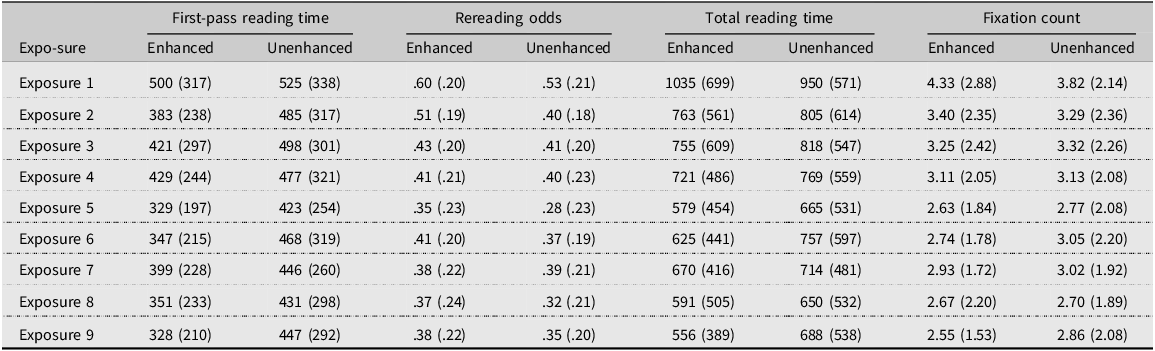
Descriptive statistics of eye-tracking measures are given in Table 2. The tables for full model results are given in Appendix S1 in the Online Supplementary Materials.
Means and standard deviations (in parentheses) for eye-tracking measures

Table 2. Long description
A table with nine rows and six columns comparing eye-tracking measures for enhanced and unenhanced conditions across nine exposure levels. The columns are labeled First-pass reading time, Rereading odds, Total reading time, and Fixation count, each with Enhanced and Unenhanced sub-columns. Row labels are Expo-sure 1 through Expo-sure 9. Each cell contains a value with a standard deviation in parentheses. Notable trends include variations in reading times, rereading odds, and fixation counts between enhanced and unenhanced conditions across different exposure levels.
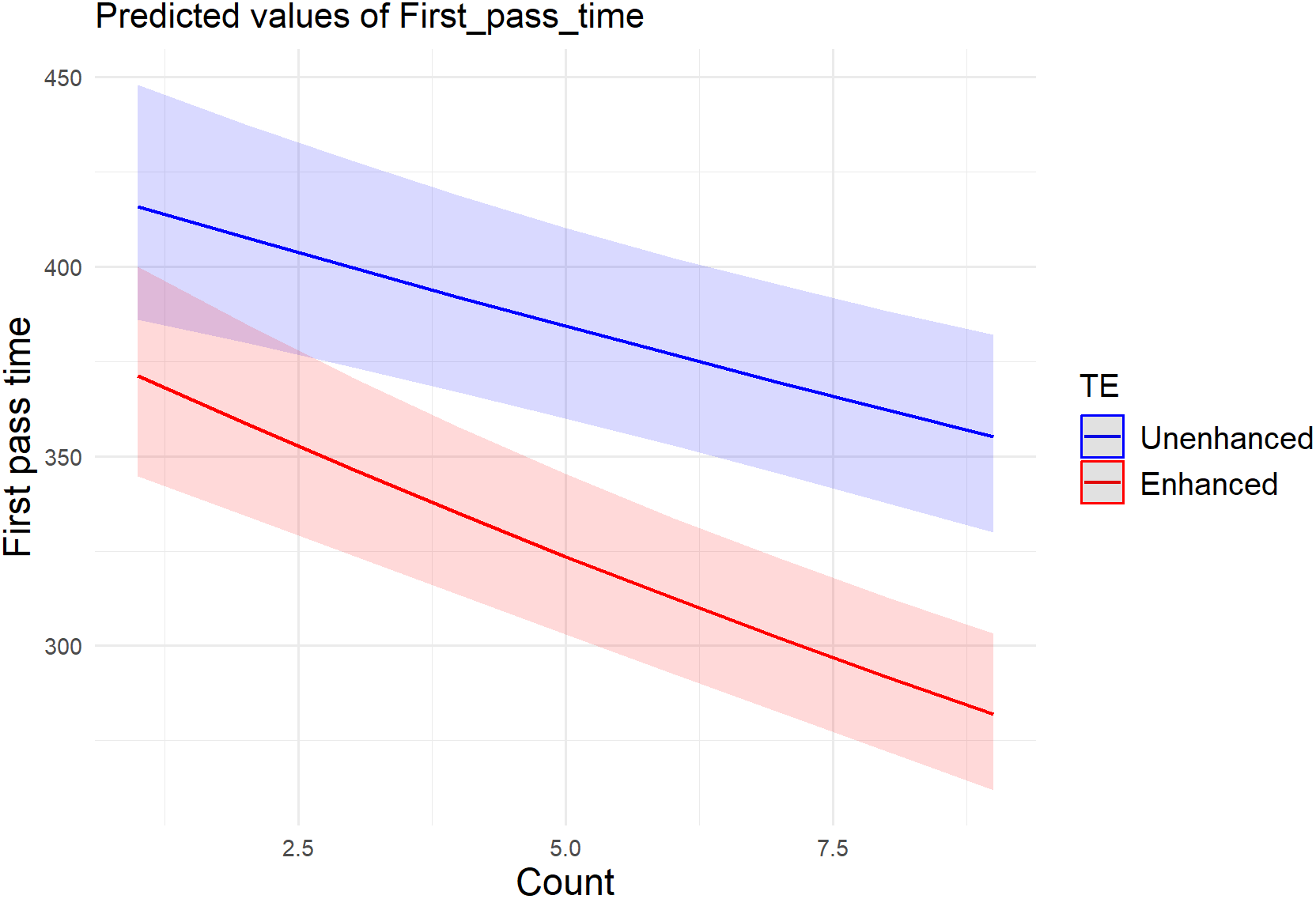
The model for first-pass reading times revealed statistically significant main effects of TE and exposure count. Enhanced collocations received significantly shorter first-pass reading times than unenhanced collocations (b = −0.11, SE = 0.03, d = −0.21, p = .001). First-pass reading times decreased across exposures for both enhanced and unenhanced collocations (b = −0.02, SE = 0.01, d = −0.04, p < .001). The interaction between TE and exposure count was also statistically significant (b = −0.01, SE = 0.01, d = −0.02, p = .040), with a steeper decline in first-pass reading times for enhanced collocations than unenhanced collocations across exposures (see Figure 1).
Predicted values and 95% confidence intervals of log-transformed first-pass reading time by exposure count and TE.

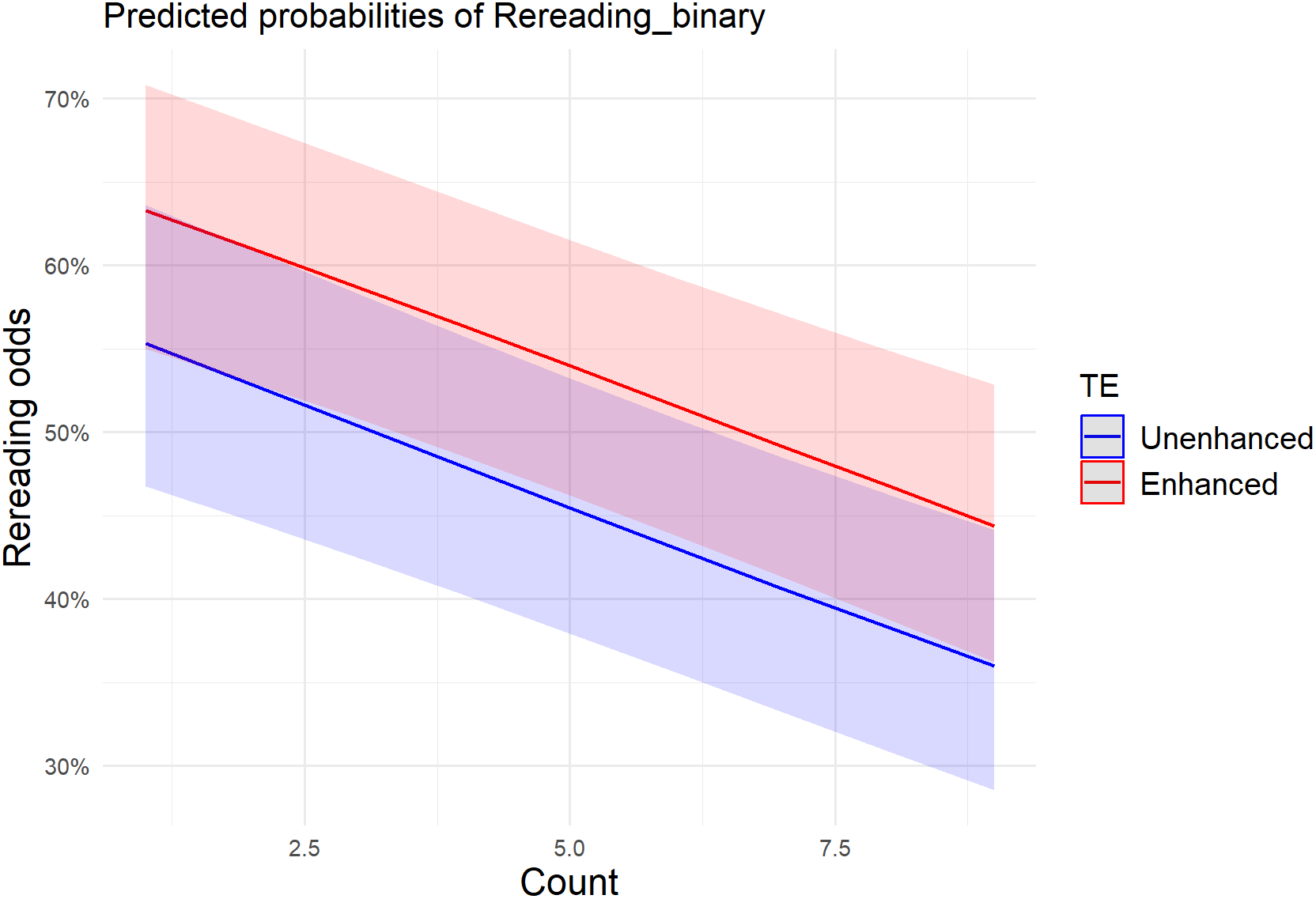
For rereading odds, the models showed a statistically significant effect of TE and exposure count. Rereading odds were higher for enhanced collocations compared to unenhanced collocations (OR = 1.39, SE = 0.20, p = .025). Rereading odds decreased across exposures for both enhanced and unenhanced collocations (OR = 0.91, SE = 0.02, p < .001). The interaction between TE and exposure count was not statistically significant (OR = 1.00, SE = 0.03, p = .92), showing that the decrease in rereading odds from the first encounter to the last was similar in both conditions (see Figure 2).
Predicted probabilities and 95% confidence intervals of rereading by exposure count and TE.

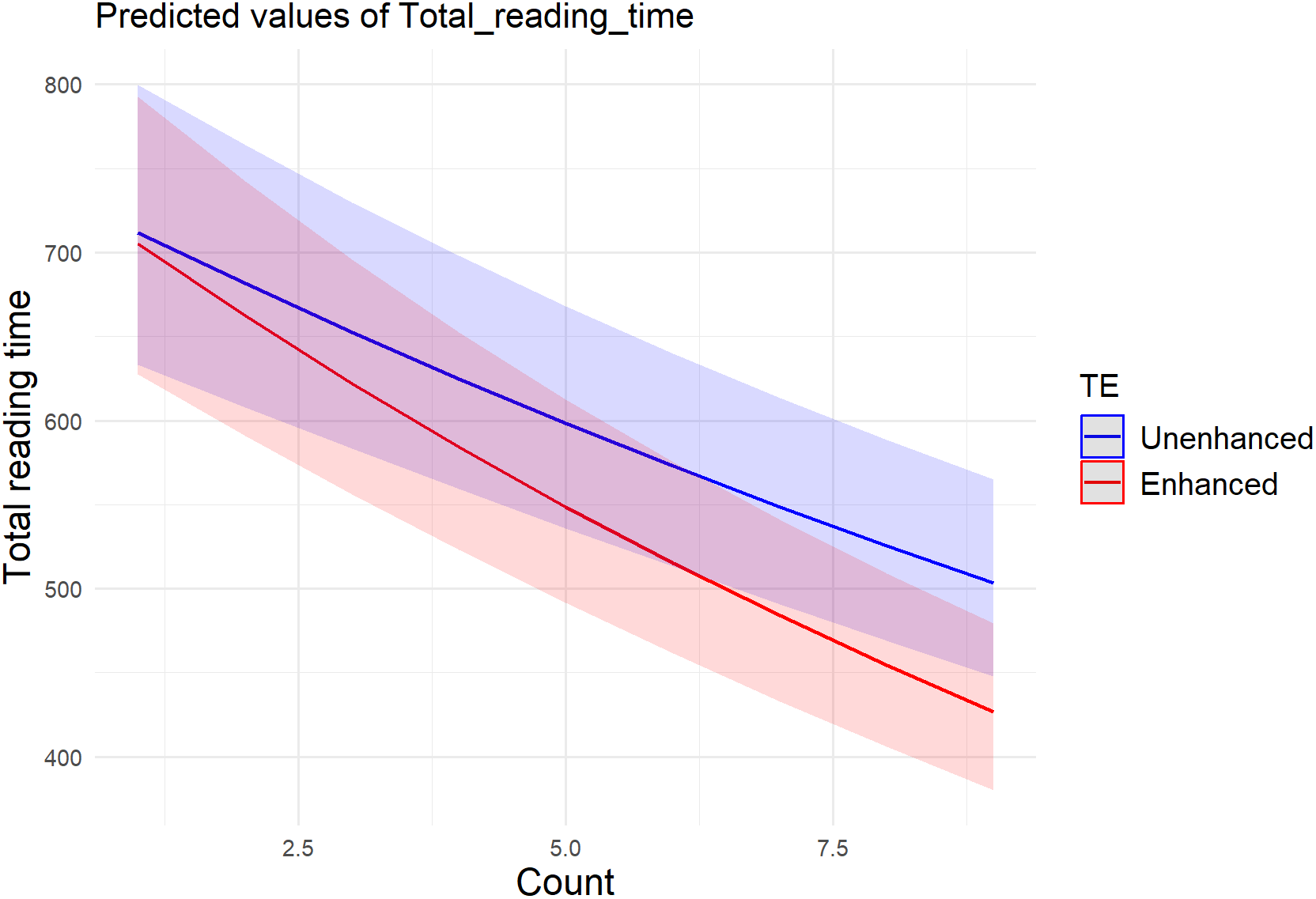
For total reading times, the main effect of exposure count was significant (b = −0.05, SE = 0.01, d = −0.08, p < .001), indicating that the total reading times decreased across exposures in both conditions. The main effect of TE was not statistically significant (b = −0.01, SE = 0.04, d = −0.02, p = .790). The TE × exposure count interaction, however, was statistically significant (b = −0.01, SE = 0.01, d = −0.02, p = .029). As the pattern observed for first-pass reading times, the reduction in total reading times across exposures was sharper for enhanced collocations than unenhanced collocations (see Figure 3).
Predicted values and 95% confidence intervals of log-transformed total reading time by exposure count and TE.

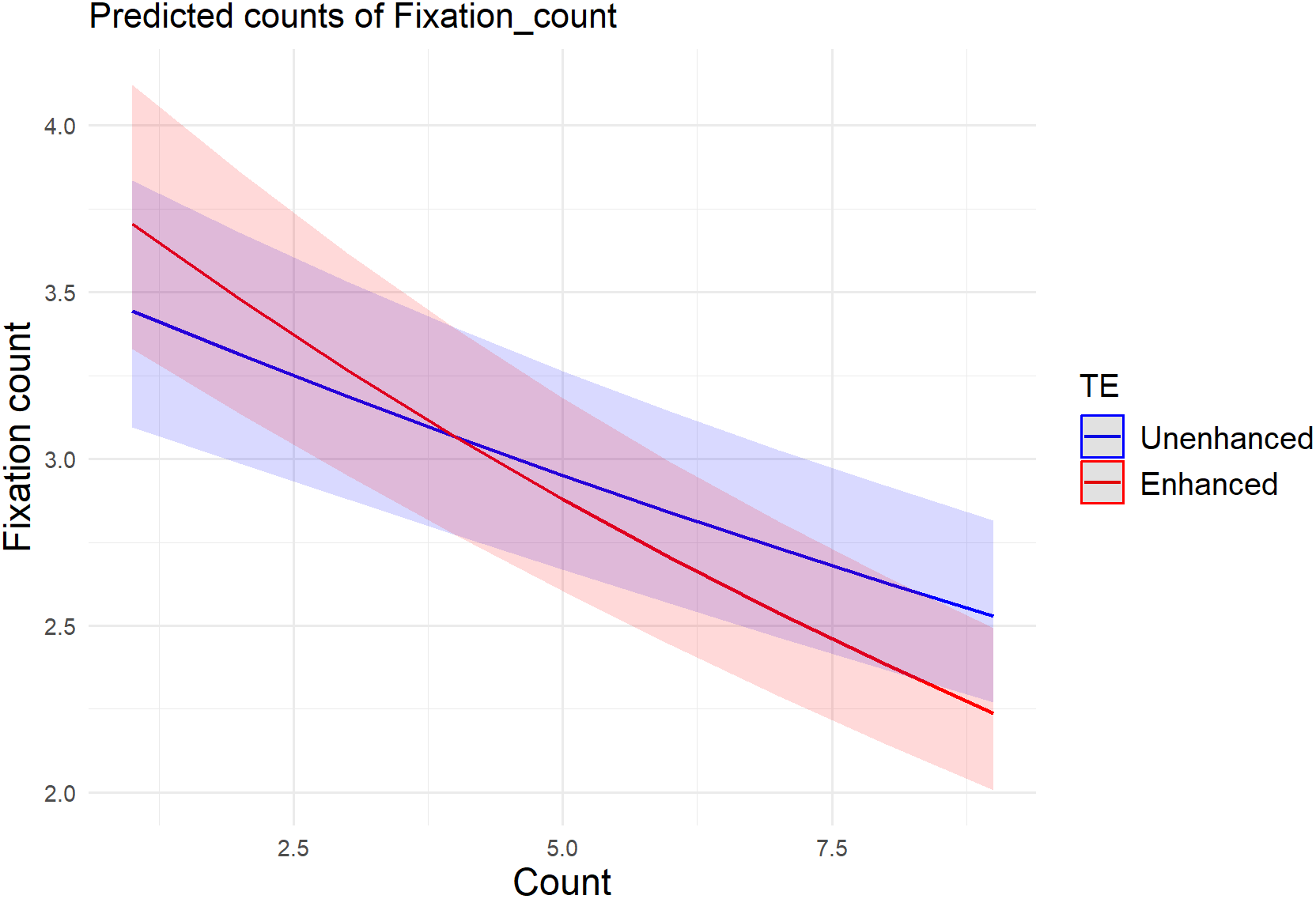
Finally, the results for fixation count showed a significant main effect of exposure count (IRR = 0.96, SE = 0.00, CI [0.95, 0.97], p < .001), indicating an approximate 4% reduction in fixation count per exposure. The results also revealed a significant main effect of TE (IRR = 1.10, SE = 0.04, CI [1.03, 1.18], p = .008) and a significant TE × exposure count interaction (IRR = 0.98, SE = 0.01, CI [0.96, 0.99], p < .001), indicating that the reduction in total number of fixations across exposures was steeper for enhanced than for unenhanced collocations (see Figure 4).
Predicted values and 95% confidence intervals of fixation count by exposure count and TE.

Research question 2: The effects of typographic enhancement on the learning of target collocations
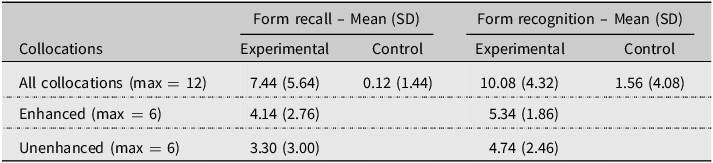
Table 3 presents the descriptive results of the two vocabulary tests. Figure 5 visualizes these results, showing group-level means (black dots with error bars) and individual-level means (colored dots, separated by group and condition). The complete mixed-effects model results are available in Appendix S2 in the Online Supplementary Materials.
Average scores and standard deviations (in parentheses) for the form recall and form recognition tests by groups and conditions

Table 3. Long description
A table comparing form recall and form recognition scores across different conditions. The table has four rows and four columns. The columns are labeled ‘Collocations’, ‘Form recall - Mean (SD) Experimental’, ‘Form recall - Mean (SD) Control’, ‘Form recognition - Mean (SD) Experimental’, and ‘Form recognition - Mean (SD) Control’. The rows are labeled ‘All collocations (max = 12)’, ‘Enhanced (max = 6)’, and ‘Unenhanced (max = 6)’. Row 1: All collocations (max = 12), Form recall - Mean (SD) Experimental: 7.44 (5.64), Form recall - Mean (SD) Control: 0.12 (1.44), Form recognition - Mean (SD) Experimental: 10.08 (4.32), Form recognition - Mean (SD) Control: 1.56 (4.08). Row 2: Enhanced (max = 6), Form recall - Mean (SD) Experimental: 4.14 (2.76), Form recall - Mean (SD) Control: 0.00 (0.00), Form recognition - Mean (SD) Experimental: 5.34 (1.86), Form recognition - Mean (SD) Control: 0.00 (0.00). Row 3: Unenhanced (max = 6), Form recall - Mean (SD) Experimental: 3.30 (3.00), Form recall - Mean (SD) Control: 0.00 (0.00), Form recognition - Mean (SD) Experimental: 4.74 (2.46), Form recognition - Mean (SD) Control: 0.00 (0.00).
Accuracy rate per group and condition.

In the preliminary analyses, group emerged as a statistically significant predictor of response accuracy in both form recall (b = 6.31, SE = 0.75, p < .001) and form recognition (b = 5.03, SE = 0.76, p < .001) tests. The odds of answering correctly in the form recall and form recognition tests were 552 and 102 times higher for the experimental group than the control group.
The main analyses indicated a statistically significant effect of TE on form recall (b = 1.09, SE = 0.24, p < .001) and form recognition scores (b = 1.16, SE = 0.29, p < .001). The odds of correct responses for the enhanced collocations were 2.96 (form recall) and 3.19 (form recognition) times higher than those for the unenhanced collocations. Participants’ vocabulary size and their prior knowledge were also statistically significant predictors of learning gains in both tests.
Research question 3: The effects of typographic enhancement on the relationship between attention and target collocation learning
The models examining the summed total reading time and its interaction with TE as predictors of collocation learning (see Figure 6) revealed only a marginal effect of the summed total reading time on form recall accuracy (b = −0.81, OR = 0.45, SE = 0.44, p = .069). This relationship was negative, indicating that longer reading times were associated with lower form recall accuracy. The interaction between summed total reading time and TE was not statistically significant (b = −0.47, OR = 0.62, SE = 0.53, p = .370), suggesting this effect was consistent across both enhanced and unenhanced conditions. For form recognition, the model showed no significant effects of summed total reading time (b = 0.29, OR = 1.34, SE = 0.40, p = .461), nor a significant interaction between summed total reading time and TE (b = −0.42, OR = 0.65, SE = 0.54, p = .429). The full model results are available in Appendix S3 in the Online Supplementary Materials.
Summed total reading time as a predictor of form recall and form recognition accuracy for enhanced and unenhanced collocations.

Discussion
Typographic enhancement in processing target collocations during reading
The eye-tracking results indicated that enhanced collocations received shorter first-pass reading times and fixation counts but higher odds of rereading, whereas total reading times were similar across enhanced and unenhanced conditions. In both conditions, repeated exposure was associated with decreased reading times and fixation counts and lower odds of rereading. Furthermore, although a repetition effect emerged in both conditions, the interaction between exposure count and TE indicated that reading times and fixation counts declined more rapidly for enhanced than for unenhanced items.
At first glance, the shorter first pass times for enhanced collocations may seem inconsistent with the predicted attention-raising function of TE (e.g., Choi, Reference Choi2017; Jung et al., Reference Jung, Stainer and Tran2022). However, our findings suggest that TE still directed learners’ attention to L2 collocations, albeit differently than previously hypothesized. The steeper declines in both first pass and total reading times for enhanced collocations across exposures suggest that TE may accelerate lexical access and familiarity development (e.g., Pellicer-Sanchez et al., 2022), particularly in the early stages of reading. The greater visual saliency of enhanced items might facilitate quicker recognition of collocational units and more efficient processing, reducing the need for prolonged attention over repeated exposures. This interpretation aligns with input enhancement theory (Sharwood Smith, Reference Sharwood Smith1993), which posits that visually salient input increases the likelihood of noticing target items, accelerating the learning process. In the present study, TE might have boosted learners’ initial noticing of target items, which in turn speeded up processing across exposures. In contrast, rereading odds were significantly higher for enhanced collocations, with no clear interaction between TE and exposure count. This suggests that visual saliency made learners more likely to revisit enhanced collocations, since they could locate them more easily in the text. Therefore, contrary to our expectations and previous research (e.g., Choi, Reference Choi2017), the attention-raising effect of TE may not always be reflected by longer reading times but rather by a more pronounced reduction in reading times and the number of fixations across exposures and increased reanalysis of the target items.
An alternative explanation for the discrepancy between early and late measures is that TE helped learners distribute their attention more efficiently during reading. On the first pass, they spent less time on enhanced collocations, allowing them to redirect their attention towards other information (e.g., unenhanced collocations) and subsequently re-analyze the enhanced collocations after reading a larger unit of text. This explanation sheds a different light on the more rapid decrease in reading times for enhanced collocations: as learners became familiar with the experimental materials, they adapted to the presence of TE, leading to shorter initial fixation times and greater re-analysis of the target collocations. This interpretation supports Toomer and Elgort’s (Reference Toomer and Elgort2019) proposal that the presence of TE may alter the global reading process, potentially leading to more superficial contextual processing of enhanced collocations, in particular during the first pass.
Two factors may further help explain the discrepancies between our findings and those reported in previous studies. First, the single-word components of the target collocations in this study were high-frequency words, unlike the adjective-pseudonoun collocations in Jung et al. (Reference Jung, Stainer and Tran2022), for example. Because learners were presumably already familiar with these individual words, TE might have facilitated faster identification of the two components as a meaningful unit, thus reducing processing times. In contrast, for unenhanced collocations, familiarity with individual word components might have increased cognitive effort, as learners might have needed to work harder to integrate the individual words into a collocational unit without the visual cues provided by TE (Boers et al., Reference Boers, Demecheleer, Coxhead and Webb2014). Second, unlike in previous studies (e.g., Choi, Reference Choi2017; Jung et al., Reference Jung, Stainer and Tran2022), the target items in the present study were medical collocations, associated with context-specific meanings that were central to the content of the reading passages. By contrast, Choi’s (Reference Choi2017) target collocations (e.g., nighttime routine and air circulation), for example, were more general in meaning and perhaps less crucial for comprehension of the experimental texts. In the present study, TE may therefore have helped learners identify important collocations more easily, thereby facilitating form-meaning mapping. Conversely, unenhanced collocations may have been more difficult to process due to their lower salience in the reading text.
Across both conditions, our results showed a gradual decrease in reading times (i.e., first-pass times and total reading times), fixation counts, and rereading odds across repeated encounters, showing increased familiarity and fluency in the processing of target collocations. This pattern corroborates the findings of previous reading studies reporting a frequency effect on the processing fluency of collocations (e.g., Pellicer-Sánchez et al., Reference Pellicer-Sánchez, Siyanova-Chanturia and Parente2022). Importantly, the decline in reading times and fixation counts was steeper for enhanced collocations than for unenhanced ones. This finding suggests that TE interacts with repetition effects, potentially amplifying the benefits of repeated exposure by accelerating lexical access and familiarity check stages of reading and reducing the cognitive load of subsequent encounters. In this way, our findings suggest that TE, along with repeated exposure, can make target collocations easier to access and reprocess.
If changes in processing fluency are considered as an indicator of the development of collocation knowledge (e.g., Ellis, Reference Ellis1994; Paradis, Reference Paradis and Ellis1994; Pellicer-Sanchez et al., Reference Pellicer-Sánchez, Siyanova-Chanturia and Parente2022), the decrease in reading times over repeated exposures suggests that collocation learning was in progress for both enhanced and unenhanced collocations, with quicker development patterns for enhanced collocations. However, whether and how the observed effects of TE influence the development of implicit collocation knowledge remain unclear, as the present study did not assess implicit knowledge development (see vocabulary measures). Further research is needed to disentangle different accounts of changes in processing times, for example, by including a decontextualized sentence-reading task incorporating target collocations after the learning intervention (e.g., Elgort et al., Reference Elgort, Brysbaert, Stevens and Van Assche2018).
Typographic enhancement in learning of target collocations
The results from the form recall and form recognition tests showed evidence for a strong positive effect of TE: enhanced items were considerably more likely to be recalled and recognized correctly than unenhanced items. This finding shows that TE not only affects noticing of and attention to target collocations, as observed in the eye-tracking data, but also facilitates memory encoding of the novel collocations. This finding adds to the existing evidence for positive effects of TE on immediate learning gains in collocation knowledge (Choi, Reference Choi2017; Sonbul & Schmitt, Reference Sonbul and Schmitt2013; Szudarski & Carter, Reference Szudarski and Carter2016; Toomer & Elgort, Reference Toomer and Elgort2019). Furthermore, learning gains were high overall, especially compared to previous studies examining collocation learning from meaning-focused reading (e.g., Puimège et al., Reference Puimège, Montero Perez and Peters2024; Szudarski & Carter, Reference Szudarski and Carter2016). The fact that even unenhanced collocations were learned well (approximately 55% in the recall test, and 79% in the recognition test) might have to do with the high occurrence rate of the target items, which may have increased their salience regardless of the TE (see also Peters et al., Reference Peters, Puimège and Szudarski2023). These high learning gains for both enhanced and unenhanced collocations also mirror the repetition effects observed in eye-tracking data, highlighting the benefits of frequent encounters for learning and the additional advantage provided by TE.
Attention and learning relationship
Regarding the relationship between attention and learning, we observed a negative marginal effect of summed total reading times on form recall (but this effect was statistically significant for summed first pass time; see Appendix S4), regardless of TE. In other words, longer reading times were associated with lower learning gains, and TE did not moderate this relationship. This pattern may not be surprising considering that we observed overall shorter fixation durations but higher learning gains for enhanced collocations.
These results conflict with the findings reporting positive attention and learning relationships for L2 grammar (Issa & Morgan-Short, Reference Issa and Morgan-Short2019; Lee & Révész, Reference Lee and Révész2020) and vocabulary (Jung et al., Reference Jung, Stainer and Tran2022). It is, however, consistent with Lee and Révész’s (Reference Lee and Révész2018) finding that enhancement may not always strengthen the attention-learning relationship. In fact, the absence of a positive relationship between reading times and learning gains for enhanced collocations supports our earlier argument that rather than simply increasing attention as measured by fixation durations and counts, TE optimizes attention by enabling learners to process collocations more quickly and efficiently.
The negative relationship between attention and learning for both enhanced and unenhanced collocations may suggest that longer reading times in this study indicate processing difficulty rather than learning effort, as conceptualized in previous research (e.g., Godfroid et al., Reference Godfroid, Ahn, Choi, Ballard, Cui, Johnston, Lee, Sarkar and Yoon2018), aligning with Elgort and Beyersmann’s (Reference Elgort and Beyersmann2024) interpretation.
Beyond this cognitive interpretation, two design-related features may have also contributed to the negative attention and learning relationship. First, the presence of embedded explanations of each target collocation at their first occurrence in the texts may have reduced the need for contextual inference during reading, thereby limiting deeper engagement and cognitive effort devoted to learning collocations. This pattern resembles the PRE condition in Elgort and Beyersmann’s (Reference Elgort and Beyersmann2024) study, in which prior access to pseudowords and their meanings similarly reduced the need for meaning inference during reading and attenuated the relationship between attention and learning. Second, the centrality of the target collocations to text comprehension and their dense repetition throughout the texts may have reduced the need for sustained attention once their meanings were established. Under conditions in which target collocations appear less frequently and are less central to comprehension, TE may play a more visible role in directing attention, and reading times may serve as a better index of learning effort.
Unlike form recall, no relationship was observed between attention and form recognition. One possible explanation for this finding relates to the differences in processing depth and memory strength required by the two test types. Recall tests, which require learners to retrieve target collocations from memory without external cues, typically necessitate more robust lexical representations in the mental lexicon. If greater reductions in reading times reflect more efficient collocational processing and stronger mental representations, then these reductions are more likely to support successful recall. Recognition tests, by contrast, may rely more on superficial processing and familiarity-based judgments, allowing learners to identify target collocations without fully specified lexical representations. As a result, recognition performance may show a weaker relationship with reductions in reading times than recall performance. Alternatively, the lack of a relationship between attention and form recognition may be due to a ceiling effect for this test (see Figures 5 and 6), leading to reduced variability in posttest scores and a smaller chance of detecting a significant attention-learning relationship.
Conclusion
In order to advance our understanding of TE effects in L2 vocabulary learning, our study investigated L2 collocation learning from reading using eye-tracking and vocabulary knowledge tests. Contrary to previous findings, TE was associated with shorter first pass times. However, rereading odds and fixation counts were higher for enhanced collocations, suggesting greater reanalysis of enhanced than unenhanced collocations. Interaction effects with repeated exposure showed that TE modified the reading processes of L2 learners by accelerating the processing of collocations across exposures. TE also led to increased form recall and recognition scores, but the relationship between cumulative reading scores and learning scores was only marginal for form recall and absent for form recognition. Moreover, TE had no moderating effects on the attention-learning relationship.
It is important to note that the target collocations in the present study were central to the content of the reading passages. Because lexical items that are essential to text comprehension are likely to receive greater attention and deeper processing, the findings may not generalize to reading conditions in which novel collocations are not central to comprehension. Future research can investigate how the importance of target collocations for text comprehension influences the effects of TE and repeated exposure to L2 learners’ attention levels and learning gains.
Secondly, prior knowledge of the target collocations was assessed through a post-experiment self-report rather than a pretest. This approach was adopted to avoid exposing participants to the target collocations before the reading task. However, it may not have fully captured partial knowledge of the collocations. Future research should consider using more sensitive measures of prior collocational knowledge while minimizing pre-exposure effects.
Moreover, the present study did not include delayed posttests. Recent findings suggest that the effect of TE may be short-lived, in particular when TE is only applied briefly in the L2 input (Puimège et al., Reference Puimège, Montero Perez and Peters2024). Considering that collocation learning is a gradual process that requires repeated exposure over time, strong conclusions about the effects of TE on long-term retention cannot be drawn from this study. Nevertheless, the consistent effect of TE in both vocabulary posttests is striking and highlights its potential value for supporting L2 collocation learning. Future research should investigate the effects of TE on the long-term retention of target collocations and if the attention-learning relationship changes over time.
Additionally, our participants were university-level Dutch-speaking learners of English with high proficiency. Future research may examine other learner populations to assess the generalizability of these findings.
Finally, even though we controlled item effects by counterbalancing the two TE conditions, contextual differences across item exposures may have contributed to variance in the eye movement data. Future studies could randomize the order in which the target collocations are encountered to better control for contextual variation.
Overall, our findings offer novel insights into the effects of TE on the online processing of collocations when they are repeatedly encountered during reading and invite further research exploring its short- and long-term effects in the learning and processing of L2 collocations and the relationship between them.
Supplementary material
The supplementary material for this article can be found at https://doi.org/10.1017/S0142716426100885.
Replication package
Replication data and materials for this article can be found at https://osf.io/75pwg.
Acknowledgements
We would like to thank the two anonymous reviewers and Associate Editor Ethan Kutlu for their invaluable suggestions and insights.
Competing interests
The authors declare none.



 Open access

