

Introduction: collective futures under suspended crisis
As we move into the twenty-first century, the list of things people feel anxious about has grown fast. Climate change, pandemics, and artificial intelligence all figure among diverse global risk agendas, but the future and past threat of nuclear war still stands apart. It is both a sudden modern threat and a disaster that continues to shape public imagination over time (Beck Reference Beck1992; Bulletin of the Atomic Scientists 2026). (Bulletin of the Atomic Scientists was founded in 1945 by Albert Einstein, J. Robert Oppenheimer, and scientists at University of Chicago who had worked on the Manhattan Project to develop the first atomic weapons).
The nuclear age did not only produce new weapons. It produced new ways of imagining how the future might end, and how societies might survive extreme rupture. Historians and cultural scholars have shown that nuclear fear-generated powerful narrative forms, scenarios, and rehearsals that allowed people to think through catastrophe long before it could ever be experienced directly (eg Boyer Reference Boyer2005; Masco Reference Masco2020). What matters here is that nuclear war sits at the edge of what can be witnessed and then narrated. It is hard to turn into ordinary ‘lessons learned’, so it often returns through stories, images, plans, and built systems that make the unliveable future easier to picture (Boyer Reference Boyer2005; Masco Reference Masco2020).
Research on collective future thinking makes a similar argument from a social and psychological perspective. Nuclear fear and anxiety exercises do not simply aim to predict the future (Anderson Reference Anderson2010). They narrate, rehearse, and stage possible futures through shared cultural forms, making uncertainty manageable and actionable in the present (Beckert Reference Beckert2016; Kashima et al. Reference Kashima, Bain, Fernando and Truong2025). Anticipation, in this sense, becomes a collective practice rather than an individual forecast. This is also a political practice. It shapes what counts as a sensible threat, what kinds of action feel justified, and what forms of authority appear necessary under risk (Beckert Reference Beckert2016).
Cold War government bunkers intensify this dynamic because they turn prediction into a space that can be entered, occupied, and lived in. They translate imagined catastrophe into a designed interior world, structured by routines, hierarchy, thresholds, and life support systems. In practical terms, they show how an imagined future gets broken down into tasks, zones, and chains of command that can be walked, staffed, and maintained.
What is most striking, however, is that the event these bunkers were built for never arrived in Britain. Nuclear attack did not occur during the Cold War. As a result, these sites now exist as material rehearsals of an unrealised future. Their significance does not lie in the endurance of ruins after destruction, but in the endurance of preparation after non-occurrence. What remains is not memory of disaster itself, but memory of preparing for disaster, embedded in spatial organisation, institutional routine, and atmosphere (Assmann Reference Assmann2012). That distinction is central to the argument.
Hauntology helps to clarify this condition. Derrida describes a time that is ‘out of joint’ (our time is out of joint, we are haunted by the ‘impure, impure history of ghosts’ (Derrida Reference Derrida and Kamuf1994, p. 221)), where absence can still have force and continue to organise the present (Derrida Reference Derrida and Kamuf1994). Cold War bunkers fit this description because they were designed around an ending, nuclear war and its aftermath, that never became part of everyday experience, yet still shapes how these spaces are sensed, managed, repaired, and mobilised today. Fisher’s account of ‘lost futures’ and Gordon’s sociological account of haunting make it possible to read the bunker as more than a relic: it becomes a device that keeps a not-yet, and now never, close to hand (Gordon Reference Gordon2008; Fisher Reference Fisher2014).
This perspective matter because nuclear anxiety is again becoming harder to ignore. Contemporary risk assessments point to renewed nuclear tensions alongside climate instability and technological risk, while public devices such as the Doomsday Clock frame nuclear war as a continuing global danger (Bulletin of the Atomic Scientists 2024). (The Doomsday Clock is a design that ‘warns the public about how close we are to destroying our world’ with dangerous technologies of our own making. Founded by scientists and engineers of the Manhattan Project in the wake of the atomic bombings of Hiroshima and Nagasaki, the Bulletin of the Atomic Scientists has been alerting humanity to the danger of nuclear catastrophe since December 1945.) In this context, Cold War bunkers return as ready-made templates for imagining future crisis, not only as historical remains, but also as active cultural forms that circulate through museums, media, planning language, and public fear.
The article therefore makes two connected claims. The first is theoretical. Suspended crisis is not just an abstract idea about time. It is built into spatial organisation, infrastructural hierarchy, and practices of representation. Cold War bunkers make collective future thinking material by turning uncertainty into architecture and procedure, and by storing a form of memory produced through rehearsal rather than catastrophe. This also builds on, while slightly redirecting, work in infrastructure and preparedness studies. Taylor’s recent work on bunkered data centres, for instance, shows how bunker imaginaries are reworked in contemporary cultures of data security and future-proofing (Taylor Reference Taylor2021, Reference Taylor2023). My concern is complementary but distinct: I focus on Cold War government bunkers as heritage and media sites where an unrealised future becomes culturally and visually reactivated.
The second claim is methodological. A creative practice focused on 3D LiDAR capture and point cloud visualisation offers a way to examine this suspended condition without treating the scan as a purely scientific revelation of hidden space. The two case-study sites discussed below are accessible to embodied human movement, so the point cloud is not used here to reveal what could not otherwise be seen. Rather, it is used as a practice-led critical image: evidential, atmospheric, partial, and interpretive. It records space while keeping gaps, occlusions, and incomplete surfaces visible. Its temporal claim is therefore modest and specific. The scan has a micro-temporality of capture, because its points are gathered through sequential movement and stitching, but this micro-temporality should not be confused with the bunker’s larger historical temporality across years or decades.
Clear and Park (Reference Clear and Park2025) describe point clouds as a liminal medium, occupying a threshold between quantitative mapping and qualitative interpretation, where measurement coexists with uncertainty and where affect and critique can surface alongside technical capture. In this study, point clouds are therefore not treated as neutral records or as raw data awaiting completion. They function as a critical representational form whose spatial gaps, micro-temporal capture, and atmospheric qualities help connect the method to the theory of suspended crisis.
The two contributions are not simply parallel; they rely on one another. Suspended crisis poses a representational problem, because a catastrophe that never arrived leaves no event to document, only the apparatus of waiting. The point cloud answers that problem in kind. Its gaps, occlusions, and partial viewpoints do not merely illustrate the theory but give non-arrival a visible form, so that preparedness can be studied not only as a system but as something encountered, framed, and reactivated through memory. This fit between object, theory, and representation is developed in detail in the later sections of the article, where the bunker is read as a narrative template for contemporary crisis imagination, but it should be understood from the outset as the connective tissue of the argument.
‘Suspended crisis’: anticipation as non-arrival
The term ‘suspended crisis’ names a condition where an expected disaster stays active in culture and material life but never becomes lived history (Anderson Reference Anderson2010). This first step of the argument is concerned with anticipation as organisation. Suspended crisis is not fear fading away, nor a threat that has been solved. It is a durable way of facing forward. Anticipation here is not just a feeling. It is a practical orientation that pulls possible futures into present work, design, training, budgets, and institutional routine (Adams et al. Reference Adams, Murphy and Clarke2009; Beckert Reference Beckert2016). The bunker matters because it shows this forward pull at an architectural scale.
This temporal pattern becomes sharper if it is compared with aftermath and commemoration. The idea of aftermath assumes that an event has happened, and the present is shaped by mourning, repair, blame, and rebuilding (Winter Reference Winter2014). Commemoration assumes a past event stable enough to be narrated and ritualised in public form (Nora Reference Nora1989). Suspended crisis is different. The bunker is built for aftermath, but there is no aftermath. Its time is a long ‘before’ that continues inside the later ‘after’ of decommissioning and reuse. This is the first layer of the argument: collective future thinking can be organised materially before the event, and can remain active even when the event never arrives.
A distinction between fear and anxiety helps to explain how this works. Fear is easier to tie to a clear object, while anxiety is shaped by uncertainty and by anticipation of harm that cannot be fully located or timed (Barlow Reference Barlow2000; Grupe and Nitschke Reference Grupe and Nitschke2013; LeDoux Reference LeDoux2016). Suspended crisis contains both. Bunkers respond to a clearly imagined object, nuclear attack, but they also organise life under uncertainty. They build procedures for acting when the outside world may be unknown: sustaining communications, producing an operational picture, maintaining welfare, and keeping authority in place. This is why bunkers matter as infrastructures. They are not only shelters. They are organisational machines.
Bunkers materialise this by working backwards from an assumed ending. The imagined strike becomes a design rule that sets thresholds, adjacencies, circulation, zoning, and resource systems. Atmosphere matters as evidence, not decoration, because it is produced by material and spatial conditions that sit between objective setting and felt experience (Böhme Reference Böhme1993; Anderson Reference Anderson2009). In bunker interiors, enclosure, repetition, ventilation, and low light do not just reflect fear. They help stabilise a prolonged ‘almost’ time, a sense of emergency that is rehearsed but never completed.
This establishes the infrastructural level of suspended crisis. The next question is slightly different: how does a future that did not arrive continue to act on the present? That is the work of the following section. It turns from anticipation as organisation to hauntology as a way of understanding non-arrival as a continuing force.
Hauntology and non-arrival: the bunker as a spectral organiser of the present
Derrida’s hauntology gives us a way to see why ‘non-arrival’ is not the same as ‘absence’. A ghost, in Derrida’s sense, is something that is neither fully here nor fully gone, yet it can still shape how people see, interpret, and act (Derrida Reference Derrida and Kamuf1994; Davis Reference Davis2005). Scholars who build on Derrida often stress this point: the spectral is about how the past, and what has not yet arrived, can still enter the present and unsettle it without becoming a straightforward ‘event’ (Davis Reference Davis2005; Blanco and Peeren Reference Blanco and Peeren2013). This is the second layer of the argument. Suspended crisis is not only organised before the event; it also persists after non-arrival as a spectral pressure on the present.
This has two consequences that matter for collective future thinking. First, bunkers show that anticipation is not only in people’s minds. It can be fixed into infrastructure. Once built, material systems can keep carrying an imagined future long after the moment that produced them has passed (Adams et al. Reference Adams, Murphy and Clarke2009; Beckert Reference Beckert2016). The bunker is a strong example because it was designed to make a catastrophic future administratively workable. It turns ‘what if’ into rooms, routes, thresholds, and life-support systems, and it turns dread into scheduling and staffing.
Second, bunkers show that the ‘end point’ in anticipatory governance is not simply the end of the world. It is the end of ordinary political time. By this, I mean the everyday tempo through which politics normally makes itself legitimate, through procedure, public visibility, deliberation, and the expectation that decisions can be contested and revised. Emergency planning assumes a move into a different time condition, where normal rules and rhythms are suspended, access is controlled, movement is restricted, decisions are sped up, and survival depends on technical systems (Agamben Reference Agamben2008). Even when bunkers are later treated as heritage, the traces of this emergency time remain readable in their spatial structure.
Mark Fisher’s work on hauntology helps make sense of why this feels so persistent. These bunkers are not nostalgic objects in the usual sense. They point to a future that once felt plausible and planned, but that did not arrive, and it remains as an atmosphere that does not fully lift (Fisher Reference Fisher2014). Avery Gordon’s account of haunting is also useful here. Gordon describes haunting as what happens when something lost, denied, or difficult to face keeps making itself felt in ordinary life (Gordon Reference Gordon2008). In bunker terms, what returns is not the nuclear event itself. What returns is the structure of feeling produced by living alongside the possibility of that event, and by building institutions that trained themselves to endure it.
Cold War bunkers are unsettling for this reason. They were built for a specific imagined disaster, but today that disaster exists mainly as a structural possibility rather than a memory. The bunker’s internal order records a model of future governance that never had to be enacted, yet it still trained institutions and still shapes public imagination. In this sense, doors, partitions, filtration systems, and command rooms do not only symbolise danger. They make danger operationally present at the level of administration, because they stage how authority would survive inside a broken world (Heritage Gateway 2009; Historic Environment Scotland 2021).
This also helps explain why bunkers resonate again in contemporary conflict imagination. Nuclear anxiety is rising, and arms control is weakening. The Stockholm International Peace Research Institute’s (SIPRI) assessment points to a growing risk environment and the emergence of a new nuclear arms race (SIPRI 2025). The Bulletin of the Atomic Scientists has pushed the Doomsday Clock to 85 s to midnight in 2026, explicitly linking nuclear danger to wider systemic risks (Bulletin of the Atomic Scientists 2026). The National Risk Register (it is the government’s assessment of the most serious risks facing the United Kingdom. It provides the government’s updated assessment of the likelihood and potential impact of a broad range of risks that may directly affect the United Kingdom and its interests) also includes nuclear-related scenarios within its public-facing account of conflict and instability risks (Cabinet Office 2025). These signals do not prove that nuclear war is imminent, but they do show why nuclear futures have become culturally active again. The bunker becomes a reference point for ‘how to cope’ with systemic rupture, even when that reference is indirect.
Memory without catastrophe: latent cultural memory and cultural trauma as rehearsal
This leads to a third and more specific question about disused nuclear bunkers in the present. If nuclear disaster did not happen, then what do these sites actually record? The answer is not ‘nothing’. Bunkers hold the memory of preparation. They keep the memory of drills, plans, and routines that made catastrophe thinkable and workable at an administrative level. This final part of the theory section therefore shifts from the spectral force of non-arrival to the social storage of preparedness.
If hauntology explains why the bunker carries a ghostly sense of time, memory studies help explain how its meaning lasts in society. Assmann (Reference Assmann2012) is especially helpful because she treats cultural memory as an institutional achievement. Memory does not only live in eyewitnesses. It continues through media, practices, and archives that stabilise meaning across time (Assmann Reference Assmann2012). From this view, memory can be ‘latent’ because it can be stored and later reactivated without being constantly retold. The bunker is a striking case of latent cultural memory because it does not preserve a past event. It preserves a past orientation towards a future event.
In other words, bunker interiors are archives of an imagined aftermath. The material world records how officials thought the post-strike period would have to be organised. What matters is not only the presence of objects, but also the way space is arranged to turn uncertainty into workflow. Here, the bunker becomes a storehouse of anticipatory scripts, a practical layout for living ‘after’ before any ‘after’ ever arrived. This is close to what Grusin (Reference Grusin2010) calls premediation. Futures are rehearsed in advance through forms that manage public feeling and reduce the shock of surprise, even when the event never comes (Grusin Reference Grusin2010).
Alexander’s theory of cultural trauma helps clarify what is unusual here. For Alexander (Reference Alexander2004), trauma is not only the damaging event itself. It is a cultural process in which groups interpret harm, assign responsibility, and rebuild collective identity through public meaning (Alexander Reference Alexander2004). Bunkers complicate this model because the catastrophe they anticipated did not occur, yet the expectation of injury became lodged in institutions. Civil defence planning and continuity-of-government thinking repeatedly produced images of mass death, social breakdown, and moral conflict, and then returned to those images through plans, exercises, and built systems. The bunker is the condensed material form of that repetition.
This is important because rehearsal produces feeling. A society can build a durable emotional structure around vulnerability and survival even without direct experience of catastrophe. The bunker fixes this structure in material form. It lets people imagine catastrophe as a route through space, step by step, door by door, corridor by corridor. Atmosphere matters here because it is how a prepared future becomes sensed as real. Theories of atmosphere treat feeling as produced by spatial and material conditions that are shared and public, not just private states of mind (Böhme Reference Böhme1993; Anderson Reference Anderson2009). In this sense, the bunker offers something like a ‘memory of the future’. It stores scripts and moods that guide how catastrophic futures can be faced in the present.
This is the central paradox of suspended crisis. First, anticipation becomes infrastructure. Second, non-arrival remains active as a spectral pressure on the present. Third, rehearsal becomes a latent form of cultural memory. What remains is not the memory of disaster, but the memory of response. When a bunker becomes a museum, a restoration project, or a media object, its latent archive is reactivated. In bunker terms, what returns is not the nuclear event. What returns is the organised possibility of that event, and the feelings built around living alongside it.
Sites and afterlives: Kelvedon Hatch and Barnton Quarry as contrasting forms of suspended crisis
Having established a theoretical context for imagining disused nuclear bunkers in the present, I now turn to two British Cold War bunker sites whose later histories show different ways that suspended crisis carries-on in the present.
Kelvedon Hatch in Essex is described in the Historic England research record as a heavily protected concrete bunker. It was first built in the 1950s as a Sector Operations Centre within the ROTOR programme, directing interceptions for the Metropolitan Sector of RAF Fighter Command. (RAF Fighter Command was one of the commands of the Royal Air Force. It was formed in 1936 to allow more specialised control of fighter aircraft.) Historic England also records how, by the early 1960s, the Home Office took it over and converted it into a Regional Seat of Government, later known as a Sub Regional Control and then a Regional Government Headquarters. In the early 1990s, it was sold, re-equipped with Cold War material, and opened to the public as a tourist attraction. Heritage Gateway (2009) shows, in one site biography, the full arc of anticipatory governance and its post-Cold War translation into public heritage.
This shift matters because museumisation does not make the haunting disappear. It manages it. In a museum setting, suspended crisis becomes a curated encounter. The layout and fittings that once supported emergency governance are turned into a route for visitors, and the story of preparation is shaped into something teachable, legible, and sometimes even entertaining. That is why museum studies remain useful here. Bennett (Reference Bennett2013) frames museums as cultural technologies that organise publics through controlled display and movement, not simply as neutral containers for objects. Smith (Reference Smith2006) shows how heritage is often shaped by an authorised discourse that decides which meanings become official, and which remain marginal. Macdonald (Reference Macdonald2013) links musealisation to how the past is made present through active intervention, rather than simply preserved. Together, these approaches help explain Kelvedon Hatch as a carefully staged heritage object where the bunker’s anticipatory design becomes part of an organised public narrative (Figure 1).
The carefully curated exhibits inside the Kelvedon Hatch bunker, Photographed by the author.

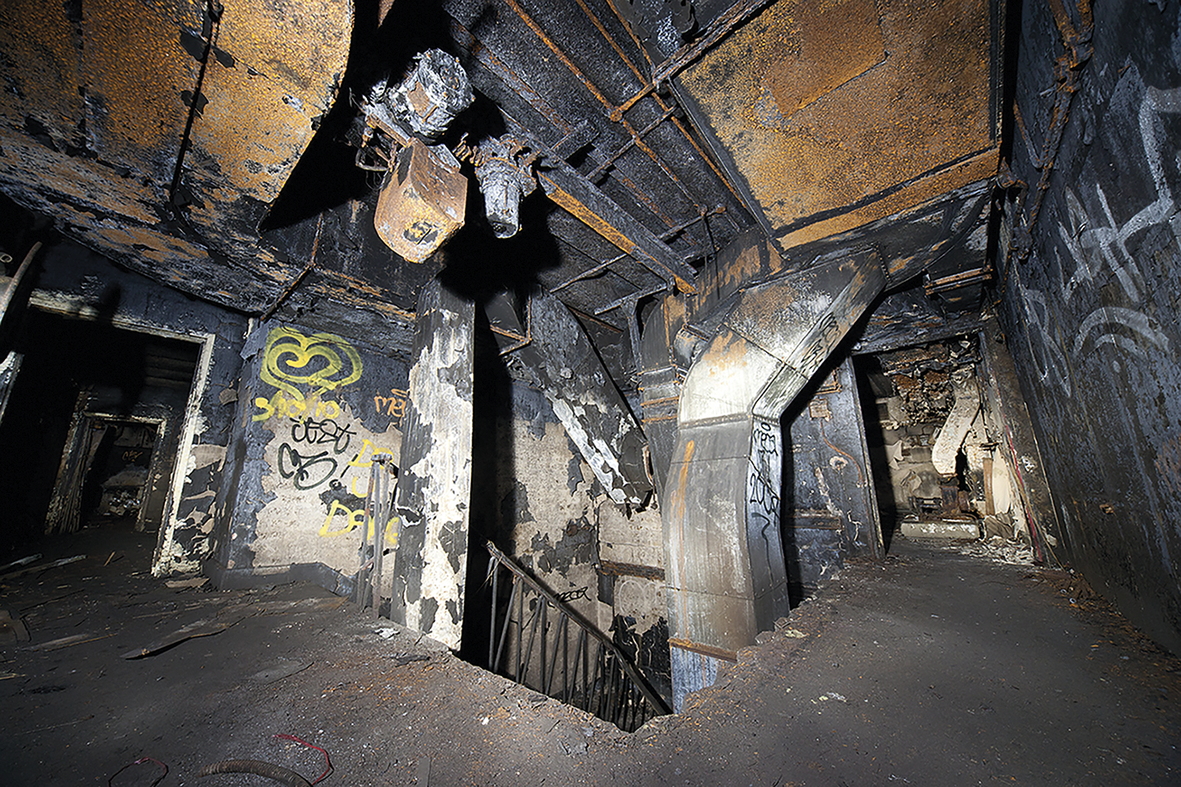
Barnton Quarry in Edinburgh has a different afterlife. Historic Environment Scotland granted Category A listed status in June 2021, and the designation documentation describes a military complex built in two phases, with a Second World War Sector Operations Command centre and a Cold War era R4 ROTOR headquarters connected by a tunnel. (The R4 ROTOR bunker was a 1950s-era, three-story underground Sector Operations Centre (SOC) designed to harden Britain’s air defences, with 10-foot thick reinforced concrete walls built in a ‘cut-and-cover’ method.) The portal text details key internal features, including a central plotting room in the earlier building and a three storey subterranean R4 structure from 1951 to 1953. It also notes later civil defence adaptation, including a surviving radio studio added when the site was used as a Regional Seat of Government, intended to support continued broadcasting in the event of nuclear attack. Historic Environment Scotland (2021) also stresses that, despite later damage and loss, the core layout and some interior features such as ventilation and communications equipment still survive and remain readable.
Listing changes what the site becomes. Barnton is not primarily offered as a finished visitor story. It is stabilised through designation, repair debates, and negotiations about future use. In this setting, suspended crisis is managed as material heritage rather than mainly as narrative. The question becomes what should be repaired, what should remain as trace, what can be opened, and what must stay closed. Harrison (Reference Harrison2012) is useful here because it treats heritage as an active practice that is tied to present and future concerns, not simply to the past. Smith (Reference Smith2006) also matters again because authorised heritage frameworks shape what kinds of access, interpretation, and conservation become possible. Barnton’s status makes the bunker’s future deliberately open, but within a formal system of control and responsibility that keeps its infrastructural logic in view (Figure 2).
Fire-damaged structures inside the Barnton Quarry bunker that remain unrepaired; photographed by Ben Copper.
Together these two sites show how a non-arrived event can remain socially active under different regimes of publicness and governance. Kelvedon Hatch makes suspended crisis visitable, and turns rehearsal into a guided experience. Barnton Quarry makes suspended crisis administratively and materially consequential through listing and restoration. In both cases, the bunker’s future facing function does not end with decommissioning. It is reactivated through heritage institutions, which means that Cold War anticipation continues to work through contemporary practices of access, interpretation, and maintenance.
This contrast is methodologically important because the argument about bunkers as templates for future crisis depends on these afterlives (Bennett Reference Bennett2020). Non-arrival is not an abstract condition floating above the site. It is shaped by present management. Which corridors are open, which surfaces are repainted or left to decay, which rooms are lit, which are sealed off, and which atmospheres are kept or allowed to fade. Museumisation can stabilise crisis as a public story of preparedness (Lakoff Reference Lakoff2007). Designation and repair can stabilise it as a problem of material vulnerability, long-term care, and future reuse. Both are forms of contemporary rehearsal because they keep the imagined crisis alive by showing how it should be remembered, and by suggesting how it might return (Lakoff Reference Lakoff2007; Anderson Reference Anderson2010). This is why the afterlife of the bunker is not background context. It is part of the evidence, because it is one of the main ways suspended crisis becomes readable today.
3D LiDAR scanning and point-cloud visualisation as analytic medium
This study uses mobile 3D capture and point cloud processing because bunkers require a way of recording that can show how they are encountered under restricted and sequential conditions. The methodological contribution is not that LiDAR reveals an otherwise inaccessible underground world. Both case-study sites can be physically entered and perceived through embodied movement. Rather, the contribution lies in using point cloud visualisation as a practice-led critical image: a way of holding together spatial evidence, atmosphere, partial viewpoint, and the conditions of access through which the bunker becomes knowable.
Conventional photography is limited because it fixes one viewpoint at a time and often makes surfaces look cleaner, flatter, or more dramatic than they feel in person. Hand-measured drawings can clarify structure, but they tend to stabilise the bunker into a more coherent object than the encounter itself allows. Point cloud imaging works differently. It does not replace embodied experience, but it translates that experience into a granular field of surfaces, gaps, densities, and occlusions.
In practical terms, point cloud scanning on site is done by moving slowly through the bunker with an LiDAR-enabled device, following the same route a person would physically take. As the scanner moves, it sends out signals and records the surfaces they return from. The bunker is therefore built up bit by bit, not captured all at once. What is produced is a field of points in space, with each point marking a place where part of a wall, floor, ceiling, doorway, or object was detected. This is the basic way of seeing in point cloud technology. It does not begin with a complete object and then describe it. It gradually assembles the space through many partial views. That makes it especially suitable for bunker interiors, where access is limited, sight lines are narrow, and no single position can offer a total view (Figure 3).
A grid displayed by LiDAR scanning the interior space of the bunker, digital recorded by the author.

In this project, data capture was carried out using a smartphone with a 48-megapixel camera and an LiDAR-equipped device in Polycam Space Mode. This is not used as a substitute for architectural survey or forensic recording. The images are not presented as scientific proof of hidden dimensions that ordinary perception could not reach. They are used as part of a creative and analytic practice that makes visible the relation between the bunker’s physical organisation and the conditions of moving through it (Polycam 2025). This also clarifies the art and science question raised by point cloud work: the scan is grounded in measured capture, but its contribution here is interpretive and critical rather than purely revelatory (Costantino et al. Reference Costantino, Vozza, Pepe and Alfio2022).
The capture process followed a continuous walk through the bunker route. This is not only a practical decision, but also a conceptual one. Bunkers are designed as sequences. Their logic is expressed through the chain of spaces, not through any single room viewed in isolation. A continuous mobile scan preserves that chain as a record of passage. It allows the analysis to return not only to individual rooms, but also to the route itself. This matters because thresholds, narrowed passages, and changes in visibility are central to how bunkers turn anticipation into spatial procedure. In other words, the scan records not only what the bunker looks like, but also how it is encountered through movement (Figure 4).
The digital exploration of the Barnton Quarry bunker entrance corridor, digital drawing by the author.

After the site visit, the raw data are exported as a point cloud, in this case in PLY format. This keeps the bunker as a granular field rather than turning it into a smooth and visually resolved surface. Each point records a sampled position in three-dimensional space and may also carry colour information, which helps later reading of material change and surface condition without producing a polished virtual walk-through (Polycam 2025). At this stage, important decisions are made. One of the most important concerns point density, or what may be understood as the size of the ‘net’ used to see the space. A finer net captures smaller details and produces a denser cloud. A coarser net reduces detail and makes larger spatial relations easier to read. These choices do not simply improve or reduce quality. They produce different kinds of image and therefore different kinds of evidence. A dense cloud may reveal surface texture, damage, or small traces. A looser cloud may make thresholds, voids, and wider relations more visible. Point cloud practice is therefore not a neutral technical process. It involves judgement about scale, visibility, and legibility, and those choices shape what the image allows the researcher to know (Figure 5).
Kelvedon Hatch Bunker overall structural point cloud effect, digital drawing by the author.

Point cloud handling and image making were carried out in TouchDesigner. This matters because it allows the dataset to function not only as a model, but also as a generator of images. It allows the point cloud to be rotated, sectioned, filtered, cropped, enlarged, and re-framed (Derivative 2021). These operations make the method part of the argument rather than a neutral illustration of it. They allow the bunker to appear as an unstable field of evidence and atmosphere, without converting it into a polished reconstruction (Figure 6).
Point-cloud images make visible the continuity, occlusion, instability, and partial viewpoints of Cold War bunkers, digital drawing by the author.

The point cloud also keeps the marks of its own making. Even where time is not stored as explicit data for each point, the dataset is still made from many moments because it is produced through movement. This should be understood as a micro-temporality of capture rather than as evidence of the bunker’s historical change across days, years, or decades. Wolfgang Ernst’s work on time-critical media is useful here because it directs attention to the operative, technical time of media processes, the timing by which signals and data are generated, rather than to historical duration in the conventional sense (Ernst Reference Ernst2016). In this article, then, the point cloud’s temporality is modest but important: it registers the sequential conditions of scanning, not the long historical time of the bunker itself (Figure 7).
Point-cloud images of Kelvedon Hatch showing a composite field of captured surfaces rather than an X-ray view through concrete, digital drawing by the author.

Point-cloud images therefore sit between measurement and interpretation. They are built from many samples taken from different positions, and they can show complex space while still preserving uncertainty, incompletion, and dependence on viewpoint. This matters because the bunker is not simply a container of past memory. It is an architecture of non-arrival, where an expected event continues to shape the present through preparedness, restriction, and rehearsal (Derrida Reference Derrida and Kamuf1994; Gordon Reference Gordon2008; Fisher Reference Fisher2014). The point cloud does not reveal this condition by itself. Rather, it becomes useful when read with archival evidence, site history, and the theoretical argument about suspended crisis.
In short, 3D LiDAR point clouds support my theoretical argument at the level of form because they record the bunker as it is encountered under restricted conditions. The bunker was built to face an unknowable future through thresholds, sequences, and hierarchies of life support. The point cloud is built from partial viewpoints and retains visible seams between visibility and loss. Its gaps are often the most truthful record of constraint, while its atmospheric quality helps register the bunker as a charged heritage space. It is this fit between object, theory, and representation that makes point clouds effective for showing bunkers as infrastructures of suspended crisis. They do not add atmosphere from outside, nor do they claim scientific revelation. Instead, they make the bunker’s condition of non-arrival legible through a visual medium that is evidential, interpretive, and deliberately incomplete (Derrida Reference Derrida and Kamuf1994; Gordon Reference Gordon2008; Fisher Reference Fisher2014; Clear and Park Reference Clear and Park2025).
The bunker as a narrative template: rehearsing governance under catastrophe
If Cold War bunkers were built as crisis infrastructure, their force today lies in how they re-enter public culture under new security pressures. In the United Kingdom, recent policy frames resilience as a continuing task, not a one off response. The UK Government Resilience Framework sets out a long-term programme for building capability across risks, with a clear emphasis on preparation, systems, and coordination up to 2030 (Cabinet Office 2022). The National Risk Register also matters here because it formalises public-facing risk knowledge and presents risk as something to be reviewed, updated, and acted on, rather than stored as a settled memory (Cabinet Office 2025). Under these conditions, Cold War bunkers are not only historic remains. They act as working reference points for how the state once tried to picture continuity, authority, and survival under extreme threat.
Point cloud work helps clarify what is distinctive about these bunker ‘templates’. The aim is not to build a seamless virtual tour that suggests total knowledge. The aim is to produce a series of images that keep the bunker’s partial visibility in view, so that anticipatory governance can be studied as a practice that always works with gaps (Anderson Reference Anderson2010). That is why point clouds suit the argument about suspended crisis. Their form is built from many situated views, and the result remains granular, incomplete, and dependent on where the operator could stand and what the sensor could see. Clear and Park (Reference Clear and Park2025) describe point clouds as an in-between medium, where technical capture and interpretive image-making meet, and where fragmentation can be an analytic strength rather than a failure. This is the point at which the methodological contribution extends existing infrastructure studies: it does not only describe preparedness as a system, but uses a practice-led visual medium to show how preparedness is encountered, framed, and reactivated as memory.
The theoretical value of these images is not that they simply look ‘ghostly’. It is that their representational logic can be made to correspond to the bunker’s condition when handled critically. Derrida’s hauntology treats the non-arrived not as absence, but as a kind of active remainder that continues to organise perception and action (Derrida Reference Derrida and Kamuf1994). Fisher’s account of hauntology as a culture haunted by futures that failed to happen helps specify why the Cold War bunker still feels charged: it belongs to a moment when catastrophe was treated as thinkable and administratively manageable, and that managerial confidence now returns as a strange relic (Fisher Reference Fisher2014). Gordon’s work is also useful because it insists that haunting is social and practical. It is about how what is unresolved or suppressed makes itself felt in ordinary life and demands interpretation (Gordon Reference Gordon2008). A point-cloud image can work with this structure of feeling, not because it scientifically uncovers hidden time, but because it gives a form to partial encounter, restricted visibility, and the persistence of an unrealised future in built space.
Taken together, these cases show why Cold War bunkers return so strongly in contemporary crisis imagination. They offer a complete, if unsettling, picture of what continuity is supposed to look like under disaster: hierarchy, information control, controlled movement, and life-support systems that make authority physically possible. They also expose the limit of that promise, because the event that was meant to justify the system never happened. This is where suspended crisis becomes analytically sharp. The bunker is both reassurance and accusation (Duffield Reference Duffield2011). It reassures because it claims that uncertainty can be managed. It accuses because it reveals the political and moral work required to make catastrophe governable in advance. Point-cloud images strengthen this claim because they keep the bunker’s non-arrival visible at the level of representation. Their incompleteness is not a technical defect to be hidden (Yang et al. Reference Yang, Haala and Dong2023). It is a visual form that fits an infrastructure built around an unrealised future.
Conclusion
This project makes a strong interdisciplinary contribution to the broad field of memory, mind and media because it shows that these three domains are not separate in crisis infrastructures, but materially and methodologically entangled. It argues that Cold War and wartime bunkers should not be understood only as heritage sites that preserve past events, but as architectures that store and organise anticipated futures. In memory studies terms, this shifts the discussion from memory as recall of what happened to memory as institutional rehearsal, where preparation, waiting, and non-arrival become historically active. This is an important move because it extends memory research beyond commemoration and trauma after the event, and shows how infrastructures can carry latent, procedural, and deferred forms of cultural memory.
This article contributes to the study of mind by explaining how bunker space shapes perception, feeling, and cognition under conditions of uncertainty. It argues that bunkers do not simply represent crisis. They actively train ways of sensing and thinking through thresholds, restricted movement, partial visibility, repetition, and controlled access. In this sense, the bunker becomes a spatial model of decision-making under incomplete information, and the analysis links architectural form to attention, anxiety, and anticipatory reasoning. This helps connect architectural research to wider debates on mind, affect, and environmental cognition, because it shows that psychological and political conditions are not only internal experiences, but are also produced through spatial organisation.
This study recognises scanning and point cloud visualisation as cognitive media rather than neutral recording tools, and argues that they shape what can be known. It places 3D LiDAR scanning, point cloud capture, and visual processing within the same visual framework as other recorded forms of spatial inquiry, while carefully limiting the claim about temporality. A point cloud is not evidence of the bunker changing across long historical time. It is a composite of many moments of capture and movement, a micro-temporal media object whose gaps and seams can be interpreted alongside the bunker’s broader historical condition of suspended crisis. This directly links media form to the argument about memory, mind, and non-arrival, without overstating the scan as a direct record of historical duration.
More broadly, the paper offers a framework for understanding how memory is transmitted through infrastructure, how thought is shaped by the anticipatory conditions of architecture, and how media forms can register unresolved time without forcing closure. Through a combined theoretical and practice-based approach, it demonstrates how bunker architecture and point cloud visualisation together show memory, mind, and media interacting in the cultural life of suspended crisis.
Data availability statement
The data that support the findings of this study are openly available in the article (no specific data were created outside of the analysis presented in the article).
Acknowledgements
I would like to acknowledge Dr. Christos Kakalis and Professor Adam Sharr for their comments and advice.
Funding statement
This work received no specific grant from any funding agency, commercial, or not-for-profit sectors. Open access funding provided by Newcastle University.
Competing interests
The authors declare none.
AI transparency statement
The author used ChatGPT (OpenAI, ‘GPT-5.2 Thinking’) as assistive tools for wording alternatives and proofreading support in February 2026. All substantive writing, images, arguments, and analysis are original works of the author. Final proofreading was also conducted by a native speaker. No AI-generated images are included.
Yan Cheng (Newcastle University) is a doctoral researcher in Architecture with extensive professional and academic experience in heritage, memory, and creative practice. Yan is currently researching wartime and Cold War bunkers in Britain through interdisciplinary approaches linking architecture, heritage studies, memory studies, and digital methods.


 Open access

