


Introduction
A large body of evidence highlights the efficacy of Behavioural Activation (BA) for depression (for a recent meta-analysis see Ekers et al., Reference Ekers, Webster, Van Straten, Cuijpers, Richards and Gilbody2014). Behavioural activation has been found efficacious across the lifespan (Meeks, Teri, Van Haitsma and Looney, Reference Meeks, Teri, Van Haitsma and Looney2006; McCauley, Schloredt, Gudmundsen, Martell and Dimidjian, Reference McCauley, Schloredt, Gudmundsen, Martell and Dimidjian2011), with different clinical populations (Daughters et al., Reference Daughters, Braun, Sargeant, Reynolds, Hopko and Blanco2008; Hopko, Bell, Armento, Hunt and Lejuez, Reference Hopko, Bell, Armento, Hunt and Lejuez2005), and in brief treatments as short as one session (Gawrysiak, Nicholas, and Hopko, Reference Gawrysiak, Nicholas and Hopko2009). Despite a huge repertoire of studies, important questions remain unanswered. Little is known about the active ingredient, or indeed ingredients, within BA. What changes occur as a result of BA treatment leading to decreased depressive symptomatology? This study focused on exploring these questions by investigating a proposed, potential cognitive mechanism of action – changes in approach/avoidance tendencies.
Several models of depression have highlighted the role of approach deficits and increased avoidance (e.g. Ferster, Reference Ferster1973; Hopko, Lejuez, Ruggiero and Eifert, Reference Hopko, Lejuez, Ruggiero and Eifert2003; Jacobson, Martell and Dimidjian, Reference Jacobson, Martell and Dimidjian2001). Individuals with depression are less likely to generate specific, attainable and adaptive approach goals (Dickson and MacLeod, Reference Dickson and MacLeod2004a, b), a deficit that is assumed to be at the core of a vicious cycle in which a reduction in generation of approach goals leads to diminished expectations of pleasurable outcomes, facilitating the maintenance of depressive symptoms and exacerbating feelings of hopelessness. Similarly, there is evidence suggesting an important role of both behavioural and cognitive avoidance in the maintenance of depression (Moulds, Kandris, Starr and Wong, Reference Moulds, Kandris, Starr and Wong2007; Ottenbreit and Dobson, Reference Ottenbreit and Dobson2004).
Recently, Trew (Reference Trew2011) proposed a conceptual model of approach and avoidance processes in relation to depression, which includes three key processes: (i) decreased approach and increased avoidance contributes to the development and maintenance of depression by reducing potential access to sources of positive reinforcement; (ii) avoidance contributes to several negative information processing biases observed in depression; and (iii) avoidance processes and dysregulated approach and avoidance system connections lead to approach perseveration, whereby an individual continues to follow unachievable goals, maintaining depression.
Understanding the mechanisms of change of behavioural activation has been identified as the next step by several researchers. As approach and avoidance behaviours have been explicitly targeted as a focus of treatment, Martell, Addis and Dimidjian (Reference Martell, Addis, Dimidjian, Hayes, Linehan and Follette2004) proposed that this could be a possible active ingredient of behavioural activation treatments. Whilst avoidance has been highlighted in earlier theories relating to depression (see for example, Ferster, Reference Ferster1973) and is an important target in newer variants of behavioural activation treatments (Lejuez, Hopko, LePage, Hopko and McNeil, Reference Lejuez, Hopko, LePage, Hopko and McNeil2001, Martell, Addis and Jacobson, Reference Martell, Addis and Jacobson2001), this has been overlooked in subsequent research. It is conceivable that changes in approach and avoidance behaviours during the course of behavioural activation treatment may mediate changes in depressive symptomatology.
The aim of the current study was to probe this mechanism of action. For this purpose, we used a minimal BA intervention comprising only one treatment session, following the procedures by Gawrysiak, Nicholas and Hopko (Reference Gawrysiak, Nicholas and Hopko2009), to serve as an analogue for more comprehensive BA treatments. Research in other domains has demonstrated that cognitive changes following such brief interventions can significantly predict treatment effects after periods as long as 4 weeks (Reinecke, Waldenmaier, Cooper and Harmer, Reference Reinecke, Waldenmaier, Cooper and Harmer2013). For the assessment of different aspects of behavioural and cognitive avoidance, research often uses self-report questionnaires. However, self-reports of such tendencies depend on awareness of the reported processes, which might be difficult to observe due to the fact that avoidance occurs often automatically. Moreover, self-reports may be significantly influenced by expectations or beliefs. Recent research has therefore explored the use of indirect tasks, which capitalize on variations in reaction time occurring as a function of the compatibility between stimulus valence and mode of response. The Approach-Avoidance Task (AAT) by Rinck and Becker (Reference Rinck and Becker2007) is based on the observation that avoidance tendencies facilitate arm movements that push objects away from oneself, while approach tendencies facilitate arm movements that pull objects closer to oneself. In the task, pictures of different valence are presented in frames that signal participants to either push or pull a joystick and thereby zoom the image to become bigger or smaller, appearing more distant or closer to the individual. As participants are asked to respond to the frames any variation in response time that is due to differences in valence of the images can be attributed to be a consequence of increased approach or avoidance tendencies towards the images. Indeed, a number of previous studies have shown that the task provides a meaningful index of individuals’ automatic tendencies to avoid or approach relevant stimuli such as faces (Heuer, Rinck and Becker, Reference Heuer, Rinck and Becker2007; Vrijsen, Van Oostrom, Speckens, Becker and Rinck, Reference Vrijsen, Van Oostrom, Speckens, Becker and Rinck2013).
In the current study, we investigated the effects of a single session of BA for patients suffering from acute depression, using both self-report measures and the AAT. Given the high relevance of social stimuli, we assumed that biases towards approach or avoidance would be particularly strong in response to facial expressions. We therefore used the AAT with pictures of faces, showing positive and a range of negative as well as neutral expressions. We hypothesized that, compared to a waitlist control, the brief BA intervention would lead to significantly stronger reductions in depressive symptoms and self-reported tendencies towards avoidance as well as increases in self-reported approach tendencies, and that the intervention would increase approach tendencies towards positive faces in the AAT. As BA treatments do not explicitly instruct patients to approach negative experiences, we did not formulate any specific hypotheses regarding effects on avoidance tendencies towards negative faces. Finally, we expected that the hypothesized changes in approach/avoidance would be related to decreases in depressive symptoms from the beginning to the end of the treatment phase.
Method
Participants
Participants were recruited from two primary care psychological therapies services in South London. All participants provided informed consent in line with ethical approval granted for the study by the London City Road and Hampstead NRES ethics committee.
Participants were eligible for inclusion if they met diagnostic criteria for Major Depressive Disorder (MDD), were aged between 18 and 60, able to speak fluent English, and scored above 10 on the Patient Health Questionnaire-9 (Kroenke, Spitzer and Williams, Reference Kroenke, Spitzer and Williams2001). Exclusion criteria for the study included a history of psychosis or mania, recent self-harm (within the last 4 weeks), current diagnosis of eating disorder, obsessive compulsive disorder, current drug/alcohol/medication abuse or dependence, history of traumatic brain injury or epileptic seizures, unable to refrain from taking benzodiazepines 48 hours before completing the experimental tasks, and psychotherapy or counselling at a frequency of more than once a month. Participants currently taking antidepressants were included in the study, with the caveat that medication had not been changed during the 4 weeks before starting the study. All participants received financial remuneration for their participation in the study.
Design and power
Participants were randomized in a ratio of 1:1 to either treatment or waiting list control. Randomization was conducted following a simple randomization protocol using sealed envelopes and a manually generated randomization sequence (permuted blocked randomization with blocks of size 4) achieved through shuffling of the envelopes that remained concealed until assignment to the groups. The sequence was generated by an independent statistician. Participants were enrolled and assigned to the intervention by the lead researcher (FN).
Depressive symptoms, self-reports of cognitive avoidance and other cognitive factors, and behavioural approach/avoidance tendencies were assessed before and after the 1-week treatment phase. Sample size was determined pragmatically and taking into account previous work by Gawrysiak et al. (Reference Gawrysiak, Nicholas and Hopko2009), which had demonstrated a large effect size investigating the effects of a one-session BA treatment on depressive symptoms in students (d = 1.61). In order to detect an effect of this size with 95% power at an alpha level of .05, we would have only needed 10 participants in each of the two groups. As the reported effect seemed unusually high and we expected cognitive effects to be subtler than reductions in symptoms, we decided to aim for a sample of approximately twice this size.
Assessment of diagnostic status and severity of symptoms
Current diagnostic status was determined using the Major Depression Module of the Structured Clinical Interview for DSM-IV Axis I (SCID-I; First, Spitzer, Gibbon and Williams, Reference First, Spitzer, Gibbon and Williams2002), administered by a trained clinical psychologist (FN). Severity of current symptoms of depression was assessed using the Patient Health Questionnaire-9 (PHQ-9, Kroenke et al., Reference Kroenke, Spitzer and Williams2001), a measure that is widely used within primary care settings. The PHQ-9 asks patients to rate presence of symptoms over the past 2 weeks. At follow-up assessment instructions of this questionnaire were modified to ask patients to report presence of symptoms during the past week in order to keep the period of reporting in line with the duration of the intervention. Items are answered on a 4-point Likert scale, with scores ranging from 0 to 27. Cut-off points of 5, 10, 15 and 20 correspond with symptoms of mild, moderate, moderately-severe, and severe depression respectively. Internal consistency of the scale in the current sample was α = .77 before, and α = .89 after the end of the treatment.
Self-report assessments of approach/avoidance tendencies and related factors
In order to assess self-reports of different facets of approach and avoidance we used the Behavioural Activation for Depression Scale (BADS; Kanter, Mulick, Busch, Berlin and Martell, Reference Kanter, Mulick, Busch, Berlin and Martell2007), the Cognitive Behavioural Avoidance Scale (CBAS; Ottenbreit and Dobson, Reference Ottenbreit and Dobson2004), and the Acceptance and Action Questionnaire (AAQ; Hayes et al., Reference Hayes, Strosahl, Wilson, Bissett, Pistorello and Toarmino2004).
The BADS was developed to measure when and how individuals become less avoidant and more activated over the course of treatment. It consists of 25 items, producing a total scale score reflecting four facets (activation; avoidance/rumination; work/school impairment; and social impairment). Items are answered using a 6-point Likert scale with higher scores representing increased behavioural activation. Internal consistency of the total scale in the current sample was α = .84 before and α = .89 after treatment.
The CBAS (Ottenbreit and Dobson, Reference Ottenbreit and Dobson2004) was developed as a multidimensional measure of avoidance in relation to depression. It has 31 items, which are answered using a 5-point Likert scale. Scores yield a total scale score reflecting 4 facets (behavioural social; cognitive non-social; cognitive social; and behavioural nonsocial avoidance), with higher total scores yielding an indication of more avoidant behaviours. In the current study internal consistency for the total scale was α = .94 before and α = .95 after treatment.
The AAQ (Hayes et al., Reference Hayes, Strosahl, Wilson, Bissett, Pistorello and Toarmino2004) has been designed to measure experiential avoidance and psychological flexibility. The AAQ consists of 16 items answered using a 7-point Likert scale, with higher scores intended to indicate a higher level of experiential avoidance. Internal consistency in the current study was adequate, α = .70 before and α = .62 after treatment.
In addition to self-reports of avoidance, we also assessed ruminative tendencies using the Ruminative Responses Scale (RRS; Treynor, Gonzalez and Nolen-Hoeksema, Reference Treynor, Gonzalez and Nolen-Hoeksema2003). The RRS measures ruminative responses to depressed mood by asking individuals what they generally do when they are feeling depressed. It is comprised of 22 items, rated using a 4-point Likert scale. Internal consistency in the current sample was α = .88 before and α = .63 after treatment.
Approach-Avoidance Task (AAT)
In order to assess automatic tendencies towards approach and avoidance, we used the Approach Avoidance Task, an established, implicit measure (see for example, Heuer et al., Reference Heuer, Rinck and Becker2007; Vrijsen et al., Reference Vrijsen, Van Oostrom, Speckens, Becker and Rinck2013). In the version of the task used here, approach and avoidance tendencies were assessed using participants’ reaction times to a range of different facial expressions (happy, angry, sad, disgusted and neutral). Participants were instructed to either push or pull a joystick as fast as possible depending on the colour shading of the presented item, that is to pull the joystick towards them for grey shaded pictures, and push the joystick away from them for brown shaded pictures. The task employs a “zooming” effect to create the visual impression that pictures are actually approached or avoided. Once the joystick is moved all the way in the correct direction, the picture disappears. Reaction times are recorded from initiation of a trial to disappearance of the picture, with the speed of the joystick movement being used as an indicator of the individual's behavioural approach and avoidance towards the presented picture. In order to start each trial, participants pressed a “fire” button on the back of the joystick.
Stimuli consisted of a series of 80 pictures taken of eight different individuals (4 male, 4 female), each showing five different expressions (happy, sad, angry, disgusted, neutral), and constructed in two versions, one with brown and one with grey shading. In addition, there were 20 filler pictures that presented checkerboard patterns. Participants received 10 practice trials in which checkerboard patterns were presented. The actual test consisted of 200 trials.
Reaction time data from the AAT were screened for potential outliers (cf. Vrijsen et al., Reference Vrijsen, Van Oostrom, Speckens, Becker and Rinck2013). The top and bottom 1% of trial reaction times were deleted, and participants with an overall mean reaction time of >1000 ms across both time-points (n = 3) or with more than 20% errors (n = 1) were excluded. AAT effect scores were computed by subtracting the mean reaction time of the pull trials of a given facial expression category from the push trials of the same category, yielding a single indicator of approach/avoidance, with positive scores indicating relatively stronger approach and negative scores indicating relatively stronger avoidance.
Intervention
Participants received a modified version of the Behavioral Activation Treatment for Depression (BATD) designed by Gawrysiak et al. (Reference Gawrysiak, Nicholas and Hopko2009), in which the comprehensive BATD treatment manual (Hopko and Lejuez, Reference Hopko and Lejuez2007; Lejuez, Hopko and Hopko, Reference Lejuez, Hopko and Hopko2001) has been reduced to one treatment session, lasting between 60 and 90 minutes. BATD lends itself particularly well to the investigation of mechanisms of behavioural activation as the treatment uses no additional strategies beyond those directly related to activation. The treatment was administered by a clinical psychologist in training (FN) in a one-to-one setting. The treatment was introduced to participants, with a discussion of the different symptoms of depression. A rationale for how the treatment works, extracted from the BATD protocol, and brief psycho-education was provided. The focus of the session was on identifying and scheduling potential activities using the “life goal/area assessment” approach. Participants were encouraged to think of three to five specific, measurable, action-orientated, realistic and time limited goals to complete during the 1-week treatment interval. Behavioural checkout sheets were populated during the session, and completed by participants on a daily basis. Participants were asked to specify the frequency and duration of each goal on the sheet. The sheet served as a means of monitoring goals during the 1-week treatment interval and to assess treatment compliance.
Participants in the control condition were in contact with services and continued any pharmacological therapies (other than benzodiazepines, use of which excluded potential participants) as usual, as they waited for treatment through the service to commence following the end of the intervention phase of the study. They were advised that, should they wish, they would be receiving the treatment session one month after the initial assessment.
Procedure
Potential participants were screened via telephone and those who were eligible were then invited to come to the department for an initial session in a dedicated interview room, in which participants completed the battery of outcome measures. Participants were then randomized to one of the two conditions, and those who had been allocated to the BATD received the treatment session at this point. All participants were invited to come to the department again after 1 week and completed the battery of outcome measures again at this point.
Statistical analyses
We analysed group differences in symptoms and cognitive variables at postassessment adjusted for baseline scores using univariate ANCOVAs. Given the focus on mechanisms and the preliminary character of our study, analyses were based on observed data rather than intention-to-treat samples. Mediation analyses were conducted using the bootstrapping approach developed by Preacher and Hayes (Reference Preacher and Hayes2008).
Results
Participants
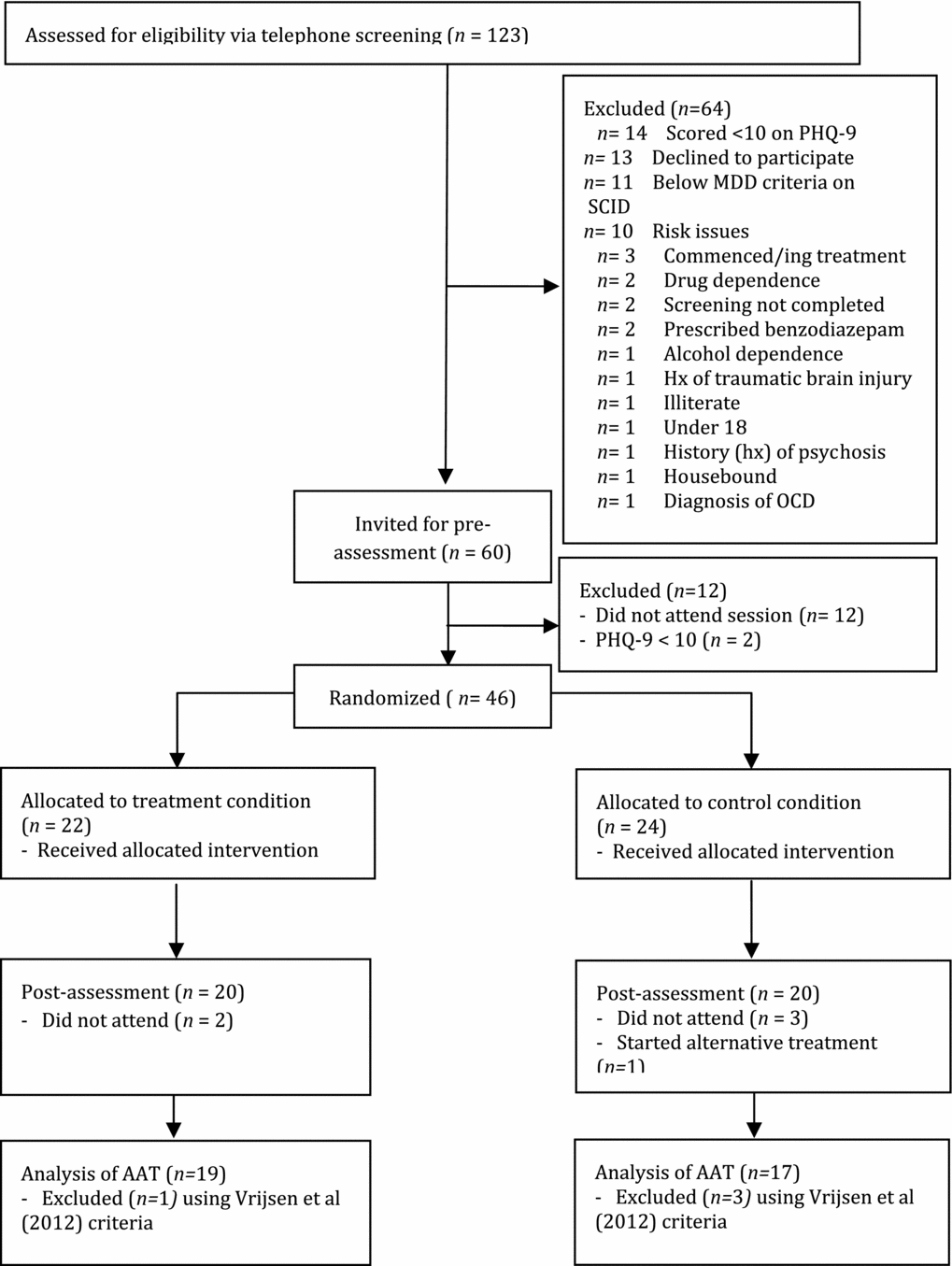
Following screening procedures (n = 123), 60 individuals were invited for the initial assessment session, 48 of whom attended, and 46 of whom met all inclusion criteria (n = 2 were excluded due to a PHQ-9 score below 10) and were randomized to the two treatments (n = 22 in the treatment, n = 24 in the control condition). Six of these participants were lost over the course of the intervention (n = 5 did not attend the second assessment session, 2 of whom had been allocated to the treatment group and 3 of whom had been allocated to the control group) or had to be excluded (n = 1 participant in the control group commenced additional psychological treatment at a weekly frequency), so that data from 40 participants (n = 20 in each group) was available for analyses. A sample of 36 participants was used for analyses of AAT data (4 participants had to be excluded due to invalid data, see further below). The flow of participants through the study is depicted in Figure 1.
Flow of participants through the study

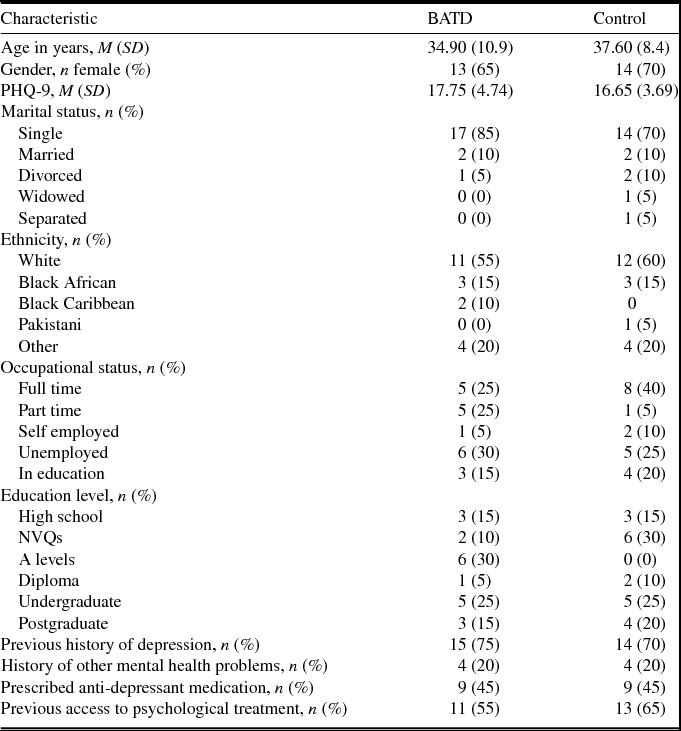
The two groups were comparable in their sociodemographic characteristics, which are listed in Table 1.
Group differences on participant demographic characteristics

Treatment compliance
Participants in the BATD group were assigned an average of 4.2 activities to complete over the 1-week treatment interval (SD = 0.93), of which they reported to have completed an average of 2.1 (SD = 1.21), translating into an average compliance rate of 51.4% (SD = 29.14).
Changes from before to after treatment
Questionnaires
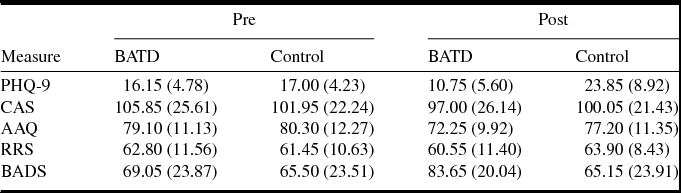
Table 2 shows the means and standard deviations of self-reported depression and approach/avoidance tendencies at pre and posttreatment. Adjusting for baseline scores, there were a significant group differences in PHQ-9 depression, F(1, 37) = 16.03, p = .000, η 2 = .30, and BADS scores, F(1, 37) = 11.02, p = .002, η 2 = .23, at postassessment. Analyses of the CBAS, RRS, and AAQ did not yield any significant group differences, all p > .10. Interaction effects on the self-report questionnaires remained significant when we applied Bonferroni-correction for multiple testing, taking into account that five questionnaires were used to test changes, α/5 = .01.
Test statistics and scores on self-report measures of depression and approach/avoidance tendencies in BATD (n = 19) and control (n = 17) participants at pre and posttreatment

Notes: PHQ-9 = Patient Health Questionnaire 9; CAS = Cognitive Avoidance Scale; AAQ = Action and Avoidance Questionnaire; RRS = Ruminative Response Scale; BADS = Behavioural Activation for Depression Scale
AAT
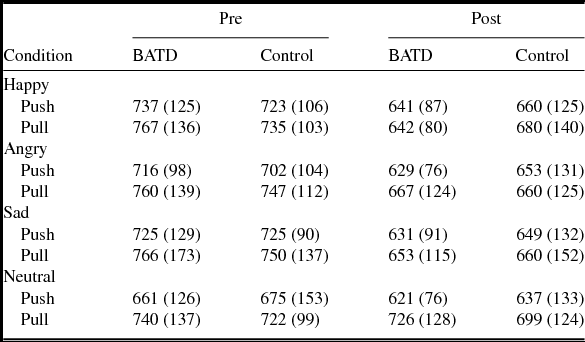
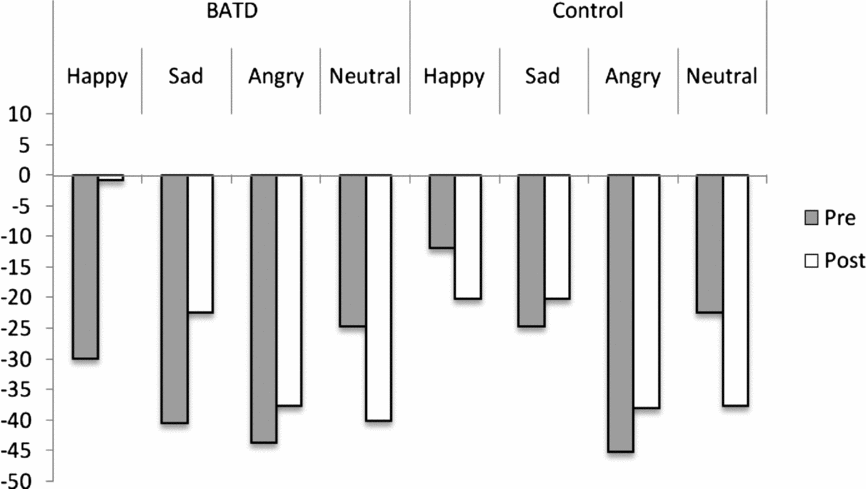
Exclusion of reaction time data from trials that met criteria for potential outliers as described in the method section resulted in a sample of 36 participants for whom valid data were available at both points of assessment (treatment n = 17, control n = 19). As in previous research, error rates were low, less than 5% on average. Means and standard deviations of reaction times for all combinations of facial expressions and directions of movement in each group at pre and posttreatment are shown in Table 3. Figure 2 shows the mean effect scores for responses to happy, sad, angry, and neutral faces at pre and posttreatment in each of the groups (for brevity, effect scores for responses to disgusted faces are not reported here as there were no clear hypotheses regarding responses to these faces). Group comparisons of AAT effect scores at posttreatment (adjusting for baseline levels) yielded a marginally significant effect for happy faces, F(1, 33) = 3.91, p = .057, η 2 = .11, indicating relatively stronger approach to happy faces in the group who had received the single session of BA. Similar analyses of AAT effect scores for sad, angry, and neutral faces did not yield any significant effects, all p > .10. Effects on the self-report questionnaires remained significant when we applied Bonferroni-correction for multiple testing taking into account that eight different outcome measures were used to test changes, α/8 = .006.
Means and standard deviations of AAT reaction times in BATD (n = 19) and control (n = 17) participants at pre and posttreatment

Mean AAT effect scores at pre and posttreatment in the BATD (n = 17) and control (n = 19) participants (positive scores indicate relatively stronger approach, negative scores indicate relatively stronger avoidance)

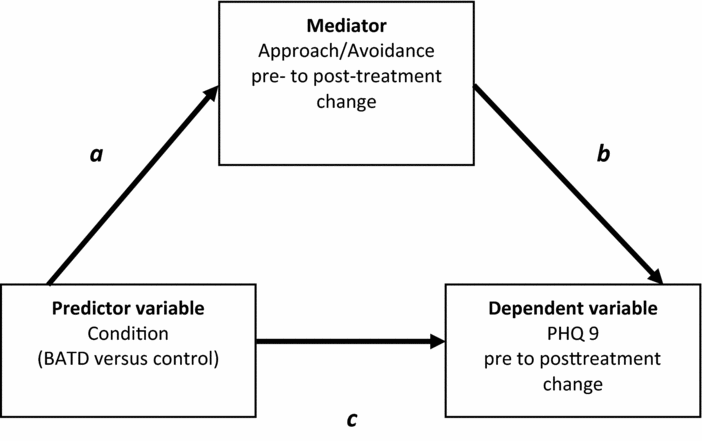
Mediational analyses
In order to explore the potential role of changes in BADS scores in conveying treatment effects on depressive symptoms, we conducted a mediational analysis (see Figure 3). This showed a small but significant indirect effect of treatment on changes in PHQ-9 scores through changes in BADS scores, β ind= 0.15, 95% bootstrapped, CI (0.005, 0.412), κ 2 = 0.17, 95% bootstrapped CI (0.015, 0.392), in addition to a significant direct effect of treatment on changes in PHQ-9, β = 0.54, p < .01. The indirect effect was due to significant direct effects of treatment on change in BADS scores, β = −0.41, p < .01, and a significant direct effect of change in BADS scores on change in PHQ-9 scores, β = −0.53, p < .01. Please note that the term “effect” does not imply causality in the current context.
Mediation pathway for relationship between treatment condition and change in PHQ-9 as mediated by approach/avoidance behavioural tendencies. a = direct effect of condition on approach/avoidance behaviour; b = direct effect of approach/avoidance behaviour on PHQ-9 change; c = direct effect of treatment condition on PHQ-9 change

Discussion
The current study investigated the effects of a single-session, one-week behavioural activation intervention in currently depressed patients, following previous work in non-clinical samples. In line with our hypotheses, we found significant improvements in self-reported symptoms of depression, suggesting that even such a brief intervention might have beneficial effects in patients, at least in the short-term. This is consistent with and supports the often-practised use of brief behavioural activation at the beginning of cognitive therapies for depression. However, rates of compliance were relatively low. On average, participants engaged in only about half of the activities that they had planned with the therapist, which may hint at the fact that more support is needed in order to help patients make use of behavioural activation and harvest the full potential of the intervention.
The main purpose of using a single-session behavioural activation protocol in the current study was to explore potential mechanisms of action. Results from our analyses of patients’ self-reports confirmed the assumption that behavioural activation increases behavioural approach tendencies. As expected, differences between the two intervention groups in self-reports on the BADS were not only evident in their general levels of activation, but were also reported to have generalized to work and social functioning. Mediational analyses supported the assumption that increases in behavioural activation were instrumental for symptom reduction, although the size of this effect was small, suggesting considerable room for other factors that remained unexplored in the current study. In contrast to the findings on self-reported behavioural activation, there was no evidence that the brief BA intervention had led to significant reductions in self-reported cognitive avoidance as reflected in patients’ tendencies towards rumination and experiential avoidance. A similar pattern of findings emerged with regard to patients’ implicit tendencies towards approach/avoidance as assessed through the AAT task, in which we observed a trend towards treatment-related increases in approach towards happy faces, with participants showing faster pull responses to happy faces, but no significant effects or trends suggesting reductions in the avoidance of negative faces. Given the fact that the current study used only a single-session intervention, these results suggest that effects of behavioural activation may take some time to transfer into changes in cognition. The observed trend in implicit responses to happy faces may indicate that such changes become visible more easily for approach tendencies, which would be in line with previous research on mechanisms of action that found behavioural activation to work mainly through affecting reward systems (Dichter et al., Reference Dichter, Felder, Petty, Bizzell, Ernst and Smoski2009), although it is important to interpret such trends with utmost caution.
Limitations
The current study has a number of limitations. First, because of the brevity of the intervention, and the fact that compliance was relatively low, the effects we observed were relatively subtle. Second, a temporal sequence mediational model was used in this study. It would be helpful for future studies to utilize a time lag design so that temporal precedence could be established. Third, because of the small sample size, the current findings should be seen as preliminary in nature. In particular, detection of treatment effects in reaction time measures such as the AAT typically requires larger samples than those recruited in the current study, and further research will have to replicate findings in larger samples. Fourth, treatments and assessments were not conducted blind as participants were screened, assessed, measured and treated by the same person (FN), thus introducing potential for bias.
Taking into account these limitations, the findings from the current study may contribute to our understanding of the ways in which behavioural activation can counter deficits involved in the maintenance of depressive symptoms. According to Trew (Reference Trew2011) decreased approach and increased avoidance contributes to the development and maintenance of depression through reducing access to sources of positive reinforcement, contributing to negative biases in information processing, and increasing the likelihood of approach perseveration. The current findings suggest that, at least initially, behavioural activation affects the first of these mechanisms, but activation might not generalize as easily to affect negative cognitive biases. This would be generally in line with the evolution of behavioural activation interventions, where more recent developments have increased the focus on explicitly addressing cognitive avoidance. However, further research with more extended BA interventions will be necessary in order to determine if and when BA might reduce negative cognitive biases.
Major Depressive Disorder is a heterogeneous condition and there is now an increased interest in parsing endophenotypes, such as blunted reward learning, neuroticism, and cognitive control (Webb et al., Reference Webb, Dillon, Pechtel, Goer, Murray and Huys2016), in order to facilitate more targeted delivery of treatments. Studies investigating the potential mechanisms of action and more precise knowledge about effects on different aspects of psychological functioning are of great importance in this regard. The current findings point towards the potential of even very brief BA intervention to increase approach tendencies. More research seems needed to investigate effects on negative cognitive biases and avoidance tendencies.
Acknowledgments
The authors would like to thank the Southwark and Lambeth Psychological Therapies Services, in particular, Hielkje Verbrugge and Jeremy Oliver, for their assistance with recruitment, and Dr Janet Wingrove for her support and advice.
Ethical standards: The authors assert that all procedures contributing to this work comply with the ethical standards of the relevant national and institutional committees on human experimentation and with the Helsinki Declaration of 1975, as revised in 2008.
Financial support: This research received no specific grant from any funding agency, commercial or not-for-profit sectors.
Conflict of interest: The authors have no conflicts of interest with respect to this publication.



Comments
No Comments have been published for this article.