Healthcare workers (HCWs) serve as a vector for MRSA transmission in healthcare settings. In acute-care hospitals, contact precautions (eg, single room, gown and gloves for all patient-healthcare personnel contact, patient room restriction) are used for patients colonized with MRSA to reduce transmission to other patients.Reference Siegel, Rhinehart, Jackson and Chiarello 1 Neither the effectiveness nor safety of contact precautions have been evaluated for MRSA-colonized residents in nursing homes.Reference Trick, Weinstein and DeMarais 2 – Reference Johannessen 4 Unlike patients in acute-care hospitals, residents of nursing homes are encouraged to interact with each other, to eat in common areas, and to share other activities. Because of the focus on a home-like environment, the emphasis for infection prevention is on the use of standard precautions with all residents.Reference Johannessen 4 Standard precautions recommend gloves for contact with blood, body fluids, skin breakdown, or mucous membranes and gowns for situations in which clothing contamination with blood or body fluids might occur. The current Centers for Disease Control and Prevention (CDC) isolation guidelines are vague for nursing home settings largely due to lack of evidence.Reference Hughes, Tunney and Bradley 3 The CDC guidelines suggest that deciding whether to implement contact precautions or to modify contact precautions for MRSA colonized residents should be based on the local case mix.Reference Siegel, Rhinehart, Jackson and Chiarello 1
We recently performed a study of residents and HCWs from 13 community-based nursing homes in 2 states to estimate the frequency of MRSA transmission to gowns and gloves worn by HCWs interacting with residents.Reference Roghmann, Johnson and Sorkin 5 We identified 5 high-risk activities for gown and glove contamination with MRSA: dressing, transferring, providing hygiene, changing linens, and toileting the resident. Furthermore, HCWs caring for residents with chronic skin breakdown had higher rates of gown and glove contamination compared with HCWs caring for residents without chronic skin breakdown. We estimated costs of using gowns and gloves for high-risk care activities for 3 groups: (1) residents with MRSA colonization identified by active surveillance, (2) residents with chronic skin breakdown, and (3) all residents. In this report, we estimate the costs of 3 MRSA transmission prevention scenarios as well as the cost of standard precautions in community-based nursing homes using data on care activities from our study.
METHODS
Data Sources
A total of 401 residents and their HCWs were enrolled in our prospective observational study. Culture swabs for MRSA were acquired from these residents from anterior nares and perianal skin. We recorded their normal schedule of care; for example, did a resident require a type of care and if so, how often? This approach was used to determine the probability that a resident received a particular type of care. We asked HCWs to wear gowns and gloves during usual care interactions and observed them. More than a single type of care was often provided (or bundled) during a single interaction. The interaction data were used to determine the probability that certain care activities were bundled.
Potential MRSA Prevention Scenarios
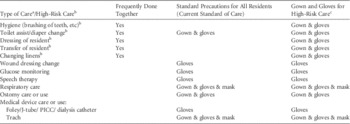
We compared the current standard of care (ie, standard precautions) to the use of gowns and gloves for 5 high-risk care activities for (1) residents with MRSA colonization identified by active surveillance, (2) residents with chronic skin breakdown, and (3) all residents. The use of personal protective equipment (eg, gowns and gloves) varied across these categories by type of care and whether the resident had chronic skin breakdown (Table 1). Most nursing-home residents who are colonized with MRSA are not known to be MRSA colonized because surveillance cultures are not routinely used in this setting.Reference Ye, Mukamel, Huang, Li and Temkin-Greener 6
Comparison of Standard Precaution to Potential MRSA Transmission Prevention Strategies in Community-Based Nursing Homes

a We assumed that neither gowns nor gloves would be worn for bathing and showering, medications, physical exam, physical, or occupational therapy under any scenario.
b High-risk care.
c For (1) residents with MRSA colonization or (2) residents with chronic skin breakdown or (3) all residents.
Analytic Assumptions and Cost Estimates
The cost analysis was conducted from the perspective of a community-based nursing home. Residents were divided into the 3 groups as described above. Standard precautions and the use of gown and gloves for high-risk care applied to all residents. Under these management scenarios, we assumed that the costs of precautions applied to all residents. In the MRSA colonization identified by active surveillance scenario, we assumed that gowns and gloves were used for high-risk care for those who tested positive for MRSA colonization, while standard precautions were employed for those who did not test positive for MRSA colonization. In the chronic skin-breakdown scenario, we assumed that gowns and gloves were used for high-risk care for only residents with chronic skin breakdown and that standard precautions were used for the residents without chronic skin breakdown. Within each of the 4 scenarios, we defined the care given as a single type of care, high-risk care given with other care, or low-risk care given with other low-risk care as subgroups.
Study data provided daily information regarding the type of care provided to each patient, the type of HCW who provided it, and the frequency of the type of care received. Data on quantity units of care established resident-level clinical care scenarios and consequent resource utilization associated with each type of care received. For example, the use of gowns and gloves for care activities was guided by the information provided in Table 1 and was assigned to each type of care identified by the activity-level study data.
Resource utilization associated with type of care was first categorized as single care, multiple-type high-risk care, or multiple-type low-risk care. We accounted for the bundling that typically occurs when providing daily high-risk care to avoid overestimating the costs of care. Cost components focused on variable costs and included the quantity measures of gowns, pairs of gloves, and time to don and doff gown and gloves, along with their unit costs. Unit costs for gowns and gloves were $0.96 and $0.09, respectively.Reference Kang, Mandsager, Biddle and Weber 7 HCW costs were estimated using a time and motion approach based on recorded time (in minutes) for HCWs to don and doff a gown and gloves and the hourly wages of HCWs.Reference Kang, Mandsager, Biddle and Weber 7 – 11 The time to don and doff a gown and gloves was set at 1 minute.Reference Kang, Mandsager, Biddle and Weber 7 Hourly wages for HCWs (ie, nurses, nurse’s aides, physical therapists, occupational therapists, and speech therapists) were based on hourly wage data available from the Bureau of Labor Statistics. The hourly wage data represented individuals working in nursing care facilities in Maryland, reflected gross pay based on a work year of 2,080 hours and included standard employer fringe benefits: registered nurses ($30.02), nurse aides ($12.09), physical therapists ($42.74), occupational therapists ($41.71), and speech therapists ($42.95). 12
Data used to calculate total costs for residents in each group were based on costs incurred during a period of observation up to 28 days. Costs were calculated using quantity data regarding the units of types of care (ie, activity) multiplied by unit cost data reflecting the unit cost associated with each type of care. The costs associated with each type of care were summed across all residents to calculate a total cost of each type of care in each subgroup in each study arm. In a given study arm, the total monthly costs were calculated as the sum of the total costs across each type of care. More information regarding the cost calculation is provided in the Online Supplementary Appendix. We assumed 100% adherence to gown and glove use by type of care delivered. Results provided the average total variable costs associated with each type of scenario for all types of care that were then stratified by cost components. Given the length of the prior study from 2012 to 2014, costs were measured nominally in 2014 dollars.
RESULTS
We observed differences across the various types of care in terms of the primary HCW involved in providing the type of care. A registered nurse provided the following types of care: medications, wound dressing change, glucose monitoring, respiratory care, ostomy care, and other medical device care. A nurse’s aide performed the following types of care: bathing, hygiene, toileting, feeding, dressing, transfer, changing linens, physical exams, multiple-type high-risk care, and multiple-type low-risk care. A physical therapist, occupational therapist, and speech therapist provided physical therapy, occupational therapy, and speech therapy, respectively. A total of 28% of residents were MRSA colonized; 17% of residents had chronic skin breakdown.
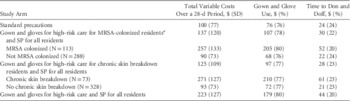
Our cost estimates for the different scenarios for MRSA prevention in nursing homes are summarized across our study population in Table 1. The overall cost of gowns and gloves for standard precautions was $100 per resident over a 28-day period. If gown and glove use for high-risk care is restricted to those with chronic skin breakdown or MRSA colonization, average costs will increase to $125 and $137 per resident, respectively. If gowns and gloves are used for high-risk care for all residents in addition to standard precautions, the average cost per resident will increase substantially by $123 to $223.
Table 2 also shows costs stratified by supplies and nursing time. The costs are largely driven by the cost of gowns and gloves, which make up 76%–80% of the estimated costs. The average cost of care for the MRSA-colonized residents and residents with chronic skin breakdown are slightly higher than the average cost for the entire population because of differences in care activities.
Average Total Variable Cost Per Resident Over 28 Days for Clinically Important Subgroups, Stratified by Cost Components

NOTE. SD, standard deviation; SP, standard precautions; MRSA, methicillin-resistant Staphylococcus aureus.
a Additional (fixed) cost of $2,212 ($5.53 per person) assuming 100% testing for MRSA.
DISCUSSION
Our major findings are the relative increase in the estimated costs associated with gown and glove use for high-risk care. The use of gowns and gloves for high-risk activities for all residents increases the cost by 123%. Most of this cost is due to the cost of gowns. This increase can be ameliorated if specific clinically relevant subsets (eg, those with chronic skin breakdown or MRSA colonization) are targeted for gown and glove use for high-risk activities.
The increased costs associated with increased gown and glove use are consistent with other cost analyses in infection control.Reference Lai, Kelley, Melvin, Belliveau and Fontecchio 13 , Reference Macartney, Gorelick, Manning, Hodinka and Bell 14 The idea of targeting a high-risk group of nursing homes residents for gown and glove use for care has been shown to be effective in a recent cluster randomized trial by a co-author, which targeted residents with urinary catheters and feeding tubes.Reference Mody, Krein and Saint 15 Our original study did not demonstrate increased transmission in residents with these devices, perhaps because the use of these devices was uncommon in the study population. Our current analyses demonstrate the potential cost advantages of the type of approach described in that study.
A limitation of our analysis is that these scenarios have not been tested in clinical trials against the current standard of care; thus, we do not know the effectiveness of each scenario and cannot estimate the cost effectiveness of each in terms of preventing MRSA transmission and infections. Given the focus on infection prevention in nursing homes, the more expensive scenario could indeed be cost-effective or even cost saving for facilities. The strength of our analyses is that it is based on actual data from a multisite, prospective study involving diverse nursing homes in 2 geographically disparate sites. Data were collected in community-based nursing homes, which comprise the vast majority of nursing homes (94%) in the United States.Reference Harrington, Carrillo, Dowdell, Tang and Blank 16 The demographics of the study population are generally representative of the US nursing home population with regard to gender and ethnicity.Reference Roghmann, Johnson and Sorkin 5 Finally, we identified MRSA colonization using surveillance cultures at enrollment, and our prevalence rate was similar to those of other studies.Reference Hudson, Reynolds and Spratt 17 – Reference Mody, Kauffman, Donabedian, Zervos and Bradley 20
Approximately 1.5 million persons in the United States reside in nursing homes. 21 Approximately 30% of nursing home residents are colonized with MRSA, which can be spread from patient-to-patient by HCWs.Reference Hudson, Reynolds and Spratt 17 – Reference Mody, Kauffman, Donabedian, Zervos and Bradley 20 The Centers for Medicare and Medicaid Services has recently proposed substantial changes to the regulations requiring nursing homes to have more robust infection control programs which will substantially increase costs for nursing homes. Our prior study and this cost analysis demonstrate the possibility and the advantages of stratifying infection prevention strategies based on resident characteristics.
ACKNOWLEDGMENTS
We thank the staff and residents of the participating nursing homes.
Financial support. This project was funded under contract/grant number 1R18HS019979-01A1 from the Agency for Healthcare Research and Quality (AHRQ), U.S. Department of Health and Human Services. The opinions expressed in this document are those of the authors and do not reflect the official position of AHRQ or the U.S. Department of Health and Human Services. Dr. Mody is supported by the Ann Arbor VA Geriatrics Research, Education, and Clinical Center, National Institute on Aging (grant nos. R01 AG032298, R01 AG41780, and R18 HS019979) and University of Michigan Claude D. Pepper Older Americans Independence Center (grant no. P30 AG024824).
Potential conflicts of interest. C.D.M reports that he received grant funding from Bayer and Pfizer and personal fees from Bayer, Pfizer, and Cubist. All other authors report no conflicts of interest pertaining to this article.
SUPPLEMENTARY MATERIAL
For supplementary material/s referred to in this article, please visit http://dx.doi.org/10.1017/ice.2016.96.