Introduction
Dementia is a major healthcare challenge worldwide. A growing number of people are dying with dementia in developed society (Lobo et al., Reference Lobo2000; Hebert et al., Reference Hebert, Scherr, Bienias, Bennett and Evans2003) and research suggests that palliative care delivered to these patients is not always optimal (Hurley et al., Reference Hurley, Volicer and Blasi2000; Sachs et al., Reference Sachs, Shega and Cox-Hayley2004; Mitchell et al., Reference Mitchell2009). However, large-scale nationwide data are lacking on how and in what circumstances older people with dementia die. Previous studies have focused on patients in hospitals or nursing homes, or those with advanced dementia only, and are limited in terms of national representativity (Engel et al., Reference Engel, Kiely and Mitchell2006; Mitchell et al., Reference Mitchell, Kiely, Jones, Prigerson, Volicer and Teno2006; Reference Mitchell2009; Sampson et al., Reference Sampson, Gould, Lee and Blanchard2006). One recent large-scale study of nursing home residents dying with advanced dementia (the CASCADE-study) addressed the clinical course and the characteristics of the final stages of advanced dementia using prospective data gathered in 22 nursing homes in the Boston area of the United States (Mitchell et al., Reference Mitchell2009). However, not all patients develop an advanced form of dementia, and in many countries a substantial proportion of patients with dementia live and die at home (Mitchell et al., Reference Mitchell, Teno, Miller and Mor2005; Houttekier et al., Reference Houttekier, Cohen, Bilsen, Addington-Hall, Onwuteaka-Philipsen and Deliens2010). Additionally, comparisons between those dying with and those without dementia might provide important insights into the differences in clinical challenges at the end of life of both patient groups.
Carried out in 2008, we report the results of a nationwide study on dying with dementia in Belgium across different care settings, using the Belgian Network of General Practitioners (GPs). This network, like other European Sentinel Networks, has a long history in surveillance of health-related epidemiological data, e.g. on diabetes, stroke, cancer, and accidents (Lobet et al., Reference Lobet1987; Fleming et al., Reference Fleming, Schellevis and Van Casteren2004), and several years of experience in surveillance of end-of-life issues (Van den Block et al., Reference Van den Block, Deschepper, Bilsen, Van Casteren and Deliens2007a; Reference Van den Block2008; Reference Van den Block, Deschepper, Bilsen, Bossuyt, Van Casteren and Deliens2009). Because detailed information concerning a patient's condition and the care provided cannot always be automatically extracted from the patients’ medical records, a registration directly with GPs has an important surplus value. In the past, several of the registrations (e.g. stroke mortality, suicide incidences) have been compared with data from external resources and have resulted in a good validity of the sentinel network's registrations (Devroey et al., Reference Devroey, Van Casteren and Buntinx2003; Bossuyt et al., Reference Bossuyt and Van Casteren2007). Comparisons of death certificate data and health insurance data with the network's results on place of death and care setting trajectories in Belgium also point at high validity (Cohen et al., Reference Cohen, Bilsen, Hooft, Deboosere, van der Wal and Deliens2006; Gielen et al., Reference Gielen, Remacle and Mertens2010).
The main objective of this study is to describe how older people die with mild or severe dementia in Belgium and to compare with patients dying without dementia.
We investigate the medical care provided at the end of life, elements of the communication process in the final months of life, and the dying process in the last week of life.
Methods
Study design, setting, and selection of study subjects
In Belgium, almost everyone, including residents of care homes, has a GP whom they contact regularly. Although GPs may not have a legally sustained gatekeeper's role for referral to more specialist care, in practice the coverage of primary care is almost universal. Given this pivotal position, the GP is a good source of information about the care patients receive.
The sentinel network of GPs exists for more than 30 years to monitor various health-related problems over long and repeated periods; it is coordinated by the Scientific Institute of Public Health, and it is very stable in terms of participating GPs with a low turnover rate from year to year and representative of all practicing GPs in Belgium in terms of age, sex, and geographic distribution (Van den Block et al., Reference Van den Block, Deschepper, Bilsen, Van Casteren and Deliens2007b). In 2008, the sentinel network of GPs, which included 172 practices, together recorded all deaths of their practice patients older than one year of age within a week of occurrence using a standardized registration form. A detailed description of the study's methodology is described elsewhere (Van den Block et al., Reference Van den Block, Deschepper, Bilsen, Van Casteren and Deliens2007b). Patients having dementia were identified by asking the GP: “Did you or another doctor determine the diagnosis of dementia? No/Yes, mild dementia/Yes, severe dementia.” Previous work in Belgium and the Netherlands has shown that the diagnostic accuracy of GPs in dementia was found acceptable compared with clinical experts (van Hout et al., Reference van Hout, Vernooij-Dassen, Poels, Hoefnagels and Grol2000; Buntinx et al., Reference Buntinx, De Lepeleire and Ylieff2006). Additionally, the long-lasting relationship and regular contacts with patients makes them arguably a reliable source to provide this information.
For 16 cases, this information was missing. Valid information was gathered for 1,108 cases. Age, sex, and place of death for the Dutch-speaking part of our sample (n = 664) could be compared with corresponding official mortality rates of 2007, provided by the Flemish Agency for Care and Health (n = 45,940). Our sample was representative for sex and age, but hospital deaths (44.3%, 95% CI 40.5–48.2 vs. 52.3%; 95% CI 51.7–52.8) were slightly underrepresented (multinomial 95% CI exact method).
Measurements
In this study, we focus on three important domains concerning end of life, i.e. medical care processes, communication processes, and the dying process. These domains can also be identified in several conceptual frameworks concerning quality of end-of-life care some of which are specifically for older patients and patients with dementia (Steinhauser et al., Reference Steinhauser, Christakis, Clipp, McNeilly, McIntyre and Tulsky2000; Wenger et al., Reference Wenger and Rosenfeld2001; Casarett et al., Reference Casarett, Teno and Higginson2006).
-
– medical care processes: number of GP–patient encounters in the final three months of life (and/or encounters between GP and patient's relatives regarding the patient); occurrence of at least one transition between care settings in the final three months of life; in case of hospital death, the moment of admission (in last week vs. before last week); the patient's main treatment goal in the last week of life (cure, prolonging life, palliation); involvement of specialist palliative care services during the last three months of life (homecare or care home team, mobile hospital team, palliative care unit, or palliative day care).
-
– communication processes: content of the GP–patient conversations in the last month of life and before; whether the patient had ever expressed wishes about any medical treatment that he/she would or would not want in the final phase of life, the place of death, and about who was to make decisions regarding medical treatments/acts in his/her place in the event the patient would no longer be able to speak for him/herself (proxy decision-maker).
-
– dying process (last week of life): patient's decision-making capability in the last week of life: (fully capable, sometimes capable sometimes not, not capable at all); functional status using the ECOG-Performance Status Scale (0—Fully active; 1—Ambulatory, capable of work of a light nature; 2—Capable of self-care but not work; 3–-In bed ≥50% of the time, capable of only limited self-care; 4—Completely bedridden, incapable of self-care); whether the patient was in a coma or unconscious immediately before death and if so, for how long; symptom distress using the Memorial Symptom Assessment Scale; A symptom is labeled as causing distress if it was present and distressed the patient “quite a bit” or “ very much” (physical symptoms), or if it was present and the patient “frequently” or “almost constantly” felt this way (psychological symptoms), as reported and judged by the GP (Hickman et al., Reference Hickman, Tilden and Tolle2001); whether the patient died in their place of choice.
We also surveyed patient characteristics and whether or not death had occurred “suddenly and totally unexpectedly” as judged by the GP. Most questions were developed and pretested in previous research (Oken et al., Reference Oken1982; Hickman et al., Reference Hickman, Tilden and Tolle2001; Van den Block et al., Reference Van den Block, Deschepper, Bilsen, Van Casteren and Deliens2007a; Reference Van den Block2007b; Reference Van den Block, Deschepper, Bilsen, Bossuyt, Van Casteren and Deliens2008), and several have been used in end-of-life care research conducted via the sentinel network of GPs (Van den Block et al., Reference Van den Block2008; Reference Van den Block, Deschepper, Bilsen, Bossuyt, Van Casteren and Deliens2009).
Analyses
Fishers’ Exact Tests were used to test differences between patients with and without dementia, and between patients with mild and severe dementia. Statistical significance was set at p ≤ 0.05. Associations were further explored in multivariate logistic regression analyses investigating the independent effect of dementia (yes/no, and mild/severe) on all care and outcome measure separately while adjusting for age, gender, cause of death, and whether death could be foreseen. We also controlled for place of death except in the models examining the association between diagnosis of dementia and terminal hospital admission, because of multicollinearity problems. We additionally investigated possible interaction effects between these patient characteristics and dementia. In the tables, we display the odds-ratios in cases where a main effect of dementia was found. We used SPSS-17 and StatXact6 for all statistical computations.
Results
Patient characteristics
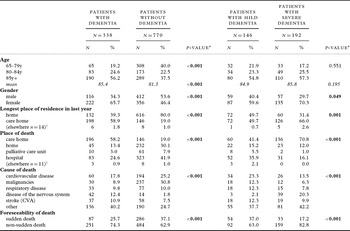
One third (31%) of the study population had dementia according to their GP (Table 1). Of these, 57% had severe and 43% had mild dementia at the time of death. Fifty-six percent of all patients with dementia were aged 85 or older and 66% were women. Death occurred in a care home in 59% of cases and was non-sudden in 74%.
Older people dying with and without dementia: patient characteristics

Missing values for gender n = 2, for longest place of residence n = 2, place of death n = 1.
* Fisher's Exact Test or T-test for equality of means to test differences between patients with and without dementia, and between patients with mild and severe dementia.
† Not included in statistical analysis.
Compared with the rest of the sample, those dying with dementia were older, more often female, and their deaths were more often non-sudden. They were more likely to reside in a care home rather than at home in their last year of life and to die in a care home. Compared with patients with mild dementia, patients with severe dementia more often died non-suddenly, and more often resided and died in a care home.
Medical care processes at the end of life
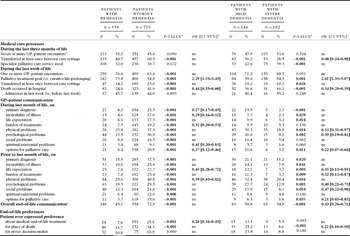
During the last three months of life, patients with dementia had on average seven contacts with their GP, 41% experienced at least one transition between care settings and 32% received specialist palliative care (Table 2). During the last week of life, 77% had contact with their GP, 74% received treatment aimed at palliation, and 14% were transferred at least once; a quarter died in hospital. Older people with dementia received treatment principally aimed at palliation in 74% and 26% received treatment mainly aimed at cure or life-prolonging, compared to 55% and 45%, respectively, among those not diagnosed with dementia. Within the dementia group, the severity of dementia was related to having received a palliative treatment goal during the last week of life: 60% of patients diagnosed with mild dementia versus 85% of patients with severe dementia (thus 40% vs. 15%, respectively, received treatment mainly aimed at cure or life-prolonging).
Characteristics of medical care and communication processes at the end of life

Missing values for timing of terminal hospital admission n = 10; treatment goal n = 37; use of specialist palliative care services n = 3; for communication between patient and GP <3%; missing values or indicated by the GP as unknown, for treatment preferences n = 100, for preference for place of death n = 138; for preference for proxy decision-maker n = 132.
* Fisher's Exact to test differences between patients with and without dementia, and between patients with mild and severe dementia.
† Odds ratio with 95% confidence intervals from multivariate logistic regression models comparing patients with (1) and without dementia (0) and comparing patients with severe (1) and mild dementia (0).
‡ Dichotomized at its median value.
§ Whether patient–GP conversations were occurring about one or more issues within or prior to the last month of life.
Compared with other older people, those with dementia were twice as likely to have a palliative treatment goal during the last week of life, and half as likely to die in hospital.
Compared with patients with mild dementia, patients with severe dementia were half as likely to be transferred in the last three months of life, two and a half times more likely to receive treatment aimed at palliation, and three times less likely to die in a hospital.
Communication processes at the end of life
Of all issues, physical problems were the most common topic of conversation between patients with dementia and their GP before (26%) and during (24%) the last month of life, followed by psychological problems (19% and 14%, respectively) (Table 2). Options for palliative care were rarely addressed. Overall, communication on end-of-life care was reported for 45% of patients. GPs reported that their patient had ever expressed a preference about the place of death (16%), a proxy decision-maker in the event he or she would no longer be able to speak for him or herself (11%), or about any medical treatment that he or she would or would not want in the last phase of life (11%).
Comparisons with the patients without dementia showed that several end-of-life care issues and preferences were not only significantly less often discussed with dementia patients but there was also less awareness of these patients’ ever expressed end-of-life care treatment preferences. By contrast, the proportion of patients who had ever expressed a preference for a proxy decision-maker to make decisions on their behalf was independent of patient group. The severity of dementia was of particular importance in communication processes at the end of life: compared with mild dementia, severe dementia was related to fewer end-of-life care discussions in the last month of life and before.
The dying phase
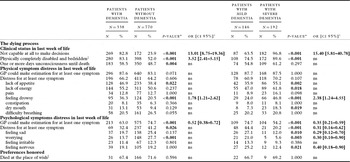
During the last week of life, the majority of dementia patients were no longer capable of making decisions (83%), completely bedridden and incapable of self-care (83%), and unconscious or in a coma for one or more days until death (59%) (Table 3). According to their GP's estimations, 66% experienced physical distress from at least one symptom during the last week, mostly in terms of a lack of appetite (47%), lack of energy (55%), and drowsiness (36%). Distress from psychological symptoms was judged to occur in 32% of patients, mostly related to feeling sad (20%) or feeling nervous (19%). Finally, 67% of dementia patients with an expressed preference for place of death actually died in their place of choice.
Characteristics of the dying process (last week of life)

Missing values for decision-making capability n = 62; performance status n = 6; consciousness n = 77.
Additional missing values on symptom distress vary between n = 38 (feeling nervous) up to n = 135 (dry mouth).
* Fisher's Exact Test to test differences between patients with and without dementia, and between patients with mild and severe dementia.
† Odds ratio with 95% confidence intervals from multivariate logistic regression models comparing patients with (1) and without dementia (0), and comparing patients with severe (1) and mild dementia (0).
‡ Performance status grade 4 (compared with grade 0–3).
§ For patients of whom the GP was informed about the preferred place of death.
Compared with other older people, those with dementia were 13 times more likely to be incapable of making decisions in the last week of life, more than three and a half times more likely to be completely disabled and twice as likely to be distressed by drowsiness as perceived by their GP.
Compared with patients with mild dementia, patients with severe dementia were 15 times less likely to be capable of decision-making during the last week of life, three times less likely to have psychological distress, and more than two times more likely to feel distressed from drowsiness according to the GP.
Discussion
To our knowledge, this study is the first to describe the circumstances of death for a nationwide population of patients having dementia, irrespective of care setting. It also compares patients with and without dementia and those with mild versus severe dementia. Other strengths of the study include the use of a nationwide and representative network of GPs not selected on the basis of a specific interest in end-of-life care research (Lobet et al., Reference Lobet1987), the representativeness of the identified sample of deaths with the exception of hospital deaths, the research methodology and design which have been used since 2005 to monitor care received at the end of life (Van den Block et al., Reference Van den Block, Deschepper, Bilsen, Van Casteren and Deliens2007a; Reference Van den Block2007b; Reference Van den Block2008), and several control mechanisms used to ensure reporting quality (Van den Block et al., Reference Van den Block, Deschepper, Bilsen, Van Casteren and Deliens2007b): we pretested the questionnaire in 20 GPs for comprehensibility and performed an automatic follow-up and telephone contact with them to prevent missing data. Upon data entry, the registration forms were closely scrutinized for errors and data were entered with consistency, range, and skip checks.
Several limitations of this study also deserve comment. First, we needed to rely on the GP's judgment of diagnoses and severity of dementia which might have resulted in a limited number of misclassifications. Second, notwithstanding end-of-life care registrations made by the Belgian sentinel network of GPs have been found to be valid in previous research (Cohen et al., Reference Cohen, Bilsen, Hooft, Deboosere, van der Wal and Deliens2006; Gielen et al., Reference Gielen, Remacle and Mertens2010), we were not able to validate the GPs’ self-reports against external sources in this particular study. Third, although being a limitation of all investigation using self-reports, we cannot exclude a retrospective recall bias. GPs are asked to make retrospective judgments of their own behavior at that time, and they might have provided socially desirable answers. Also, by using a retrospective data collection approach, a possible recall bias about the care provided in the final months of life cannot be excluded. This was partly minimized by collecting data on a weekly basis, leaving little time between death and registration, and by instructing the GP to use patient files as much as possible. Finally, although an extensive set of domains of end-of-life care was taken into account, several aspects could not be covered, e.g. the specific care setting trajectories of dementia patients at the end of life, the support given to the patient's family, the coordination of care across providers and care settings, etc.
While dementia research mostly focuses on patients with advanced dementia (Engel et al., Reference Engel, Kiely and Mitchell2006; Mitchell et al., Reference Mitchell2009), this study shows that in four out of ten dementia patients death occurs before the disease has progressed to an advanced form, and that there is a strong association between the severity of dementia and the location of death. Patients with dementia more often die in a care home than other older patients, a finding that appears to be particularly true for those with severe dementia. That percentages vary greatly depending on the severity of the dementia diagnosis might indicate that efforts are being undertaken to prevent transferring patients with severe dementia to the hospital. This might be related to the growth in anticipatory do-not-hospitalize decisions in Flemish care homes within the last years (De Gendt et al., Reference De Gendt, Bilsen, Stichele and Deliens2010). However, 25% of patients with dementia (and 16% of those with advanced dementia) still die in hospital in Belgium. Other studies also show that hospital deaths are not uncommon in this population, e.g. a US study reported 15.6% of deaths from dementia take place in hospital (Mitchell et al., Reference Mitchell, Teno, Miller and Mor2005). These results not only highlight the importance of studying dementia across different care settings but also more importantly pose questions concerning the quality of dying of those experiencing such late-stage hospital transitions (Sampson et al., Reference Sampson, Gould, Lee and Blanchard2006; Van den Block et al., Reference Van den Block, Deschepper, Bilsen, Van Casteren and Deliens2007a).
A striking result is that dementia patients’ end-of-life treatment preferences often remain unknown and that proxy decision-makers are rarely appointed. However, a timely exploration of these preferences is especially recommended for patients with dementia (Hurley et al., Reference Hurley, Volicer and Blasi2000), which is stressed by our finding that many patients lack decision-making capacity at the very end of life. Recent work conducted among care home residents in Belgium also showed that few patients having dementia had formally assigned a proxy decision-maker (11% of residents diagnosed with moderate dementia, and 7% of these with severe dementia) (De Gendt et al., Reference De Gendt, Bilsen, Stichele, Deliens and De Gendt2011). On the contrary, in the United States, almost all nursing home residents with advanced dementia have a designated substitute decision-maker (Mitchell et al., Reference Mitchell, Kiely and Hamel2004), possibly due to the enactment of the Patient Self-Determination Act two decades ago mandating the discussion of advance directives. Our results may stimulate healthcare professionals to initiate advance care planning timely, to effectively explore preferences of patients for palliative care and end-of-life treatment decisions, and to designate a proxy decision-maker more often.
Corresponding with prior work (Sachs et al., Reference Sachs, Shega and Cox-Hayley2004), our results also suggest that dementia is not always recognized as a trigger for a palliative care approach. However, the World Health Organization poses that the principles of palliative care – defined as an approach that improves the quality of life of patients and their families facing the problems associated with life-threatening illness, through the prevention and relief of suffering by means of early identification and impeccable assessment and treatment of pain and other problems, physical, psychosocial, and spiritual – should be applied as early as possible in the course of any chronic, ultimately fatal illness, in conjunction with other therapies (World Health Organization, 2002). In line with this approach, it may be advisable to initiate palliative care timely in the dementia disease trajectory and absence of a principal palliative treatment goal at the end of these persons’ life may be considered as possibly problematic. Notwithstanding, it might in itself be reassuring that GPs more often anticipate death in case of severe compared with mild dementia, still one out of six patients with severe dementia died suddenly and totally unexpectedly according to the GP, and one out of four dementia patients (16% of severe and 40% of mild dementia patients) still received treatment principally aimed at cure or prolonging life until the very end of life. Also, palliative care was rarely discussed and specialist palliative care services (homecare or care home team, mobile hospital team, palliative care unit, or palliative day care) were involved not more often among those with dementia than among other older people.
In conclusion, while many older people die with mild or severe dementia in Belgium, several areas of end-of-life care provision could be improved. Early communication and exploration of wishes and appointment of a proxy decision-maker are important components of an early palliative care approach which appears to be initiated too infrequently. People with dementia might benefit from an early palliative care approach.
Conflict of interest
None.
Description of authors’ roles
KM had full access to all the data in the study and takes responsibility for the integrity of the data and the accuracy of the data analysis. Study conception and design was by KM, LVDB, ME, JB, VVC, and LD; Acquisition of data was conducted by KM, LVDB, NB, and VVC. Analysis and interpretation of data was handled by KM, LVDB, ME, NB, JB, VVC, and LD; Drafting of the paper was by KM; Critical revision of the paper for important intellectual content was done by KM, LVDB, ME, NB, JB, VVC, and LD; Statistical analysis was done by KM and LVDB; Funds were obtained by LVDB, VVC, and LD; Administrative, technical, or material support was arranged by KM, LVDB, ME, NB, VVC, and LD; Supervision was by LVDB, VVC, and LD.
Acknowledgments
The authors thank Nathalie Bossuyt (MA, MD) for support in the data collection and statistical advice; Jane Ruthven for English editing; the Flemish Ministry of Welfare, Public Health and Family for giving us access to their death certificate data; and all participating sentinel GPs for providing the study data.
This study is part of the “Monitoring Quality of End-of-Life Care (MELC) Study,” a collaboration between the Vrije Universiteit Brussel, Ghent University, Antwerp University, the Scientific Institute of Public Health, Belgium, and VU University Medical Center Amsterdam, the Netherlands. This study is supported by a grant from the Institute for the Promotion of Innovation by Science and Technology in Flanders (SBO IWT nr. 050158). The Belgian Sentinel Network of GPs is supported by the Flemish and Walloon Community of Belgium. The study protocol and anonymity procedures were approved by the ethical review board of the University Hospital of the Vrije Universiteit Brussel.
Role of sponsor
The Fund for Scientific Research, The Research Council of the Vrije Universiteit Brussel, The Institute for the Promotion of Innovation by Science and Technology in Flanders, and the Flemish and Walloon Ministry of Welfare, Public Health and Family did not have any role in the design and conduct of the study, collection, management, analysis and interpretation of the data, and in preparation, review, or approval of this paper.
The authors have not entered into agreement with the funding organization that has limited their ability to complete the research as planned and publish the results. The authors have had full control of all the primary data. The authors are willing to allow the journal to review their data if requested.
Ethical approval
In Belgium, the study protocol and anonymity procedures were approved by the ethical review board of the University Hospital of the Vrije Universiteit Brussel. Patient anonymity was preserved and physician confidentiality maintained through the registration and data entry processes.