Economic historians have recently made great progress in studying the past by applying the tools and concepts of New Institutional Economics. A fundamental element of this achievement has been to go beyond the narrow confines of previous approaches. Whereas the application of narrow neoclassical economic analysis typically lacked an appreciation for the role of history and focused primarily on the efficiency properties of institutions, the new trend has been to integrate economic and historical approaches for richer and more comprehensive explanations of how and why history mattered. Similarly, whereas unsystematic historical approaches lacked sound theoretical bases and proceeded narrowly by focusing on how previous customs and traditions were responsible for the existence of an institution, the new approach has been also to examine the properties of the institution that ensured its survival.
The literature on Ottoman taxation, however, has somehow failed to benefit from these developments. A narrow historical approach has dominated the literature, as scholars have studied the regional, legal, political, and economic complexities of the tax system primarily by identifying continuities with the historical precedent in Islamic law, the Byzantine state, or various other institutions of previous states. The Ottomans are said to have adopted the local customs and methods of taxation that they inherited in a newly conquered region, combining them with the tax codes of other regions as necessary. Referring to the Sultanic law code for landholding and taxation, Halil İnalcıik provides this type of explanation when he writes, “It was this law code, actually a combination of Islamic and local practices related to the Roman–Byzantine legacy, which administered the relationships in Ottoman landholding and taxation.” In an exemplary statement of how the dominant historical approach has tried to explain the tax system, he continues, “In fact, the system was closely analogous to that of previous Islamic and Byzantine states, and there was no reason for the Ottomans to revolutionize tested methods as long as the state received its revenues.”1
Halil İnalcık [with Donald Quataert], An Economic and Social History of the Ottoman Empire, 1300–1914, 2 vols. (New York: Cambridge University Press, 1994), 1:105. For the relationship among Byzantine, Balkan, Islamic, and Ottoman taxation, see Ömer Lütfi Barkan, “Türkiye
de Toprak Meselesinin Tarihi Esasları,” Ülkü Halkevleri Dergisi 60 (1938): 51–63; ibid., 63:233–40; ibid., 64:339–46; Michael Boyd, “The Evolution of Agrarian Institutions: The Case of Medieval and Ottoman Serbia,” Explorations in Economic History 28 (1991): 36–53; Halil İnalcık, “The Problem of the Relationship between Byzantine and Ottoman Taxation,” Akten des XI. Internationalen Byzantinisten-Kongresses 1958 (Munich, 1960): 237–42; idem., Economic and Social History, 70, 149–53; Bernard Lewis, “Ottoman Land Tenure and Taxation in Syria,” Studia Islamica 50 (1979): 109–24.
While İnalcık's statement may be accurate in general terms, it cannot be taken as the basis for an argument against using a systematic, theoretical approach. Although the similarities between the tax systems of the Ottomans and their predecessors seem to support a narrow historical approach, identifying the historical precedents of tax categories does not by itself provide a complete explanation for why a certain mixture of taxes, and not something else, was adopted. The origins and the persistence of a tax system are different things. The key problem with İnalcık's approach is that it does not explain why the Ottomans chose certain elements of the Islamic or Byzantine legacy and not others. That there were many components of previous tax systems, such as labor services, that the Ottomans carefully and systematically discontinued suggests the presence of some rules and a selection process that kept some elements of previous systems and discarded others. While conquering land from multiple predecessor states, the Ottomans inherited the tax systems of multiple legal and political traditions that needed to be molded into a coherent whole. History did matter, of course, at least by way of providing a menu of choices available to the Ottomans and in shaping the regional variety. But a satisfactory explanation of the system as a whole demands that an appeal to history be complemented with knowledge of the general structure of taxes and the forces that affected the Ottomans' choice of one type of precedent over the others.
This paper aims to study the Ottoman system of taxation by integrating economic and historical approaches. Borrowing insights from recent developments in New Institutional Economics and using information from the published tax registers of the Ottoman Empire, I examine the overall structure and efficiency of the system and the way it was shaped by regional conditions and institutional history. Three objectives thus guide the inquiry. The first is to identify the general structure of the tax system. Although historians have proposed various ways of classifying Ottoman taxes, they have typically chosen ad hoc categories of classification, failing to determine the general structure of taxes or a mechanism to distinguish between them systematically. I construct an economic classification of taxes that depends on systematic differences in the tax base.
The second objective of the paper is to examine the efficiency of the tax system. Identifying the general structure of taxes makes it possible to ask why this, rather than some other, structure was chosen. Adopting an economic approach and focusing on the efficiency properties of the system, I argue that the choice of how to levy taxes on an item or activity was determined primarily by the cost of measuring the tax base.
The third objective is to explain the regional diversity of Ottoman taxes. Despite having a common structure, taxes varied significantly among the regions of the Ottoman Empire in names, bases, and rates. Some of these variations can be viewed simply as efficient adaptations of the system to local conditions. But a satisfactory explanation of the system as a whole requires that we integrate economic and historical approaches by studying not just how the Ottomans were able to transform some taxes for efficiency but also how institutional rigidities prevented them from transforming others.
THE EFFICIENCY AND PATH-DEPENDENCE OF INSTITUTIONS
Methodological differences between the narrow variants of the economic and historical approaches originate primarily from the contrast between their views of institutions. In a narrow, ahistorical economic approach, an institution is simply the efficient solution to an economic problem. In this view, a process of competition would weed out inferior institutions, ensuring the survival of only those that best solve the problem. Institutions are thus endogenous responses to the environment, outcomes of some sort of a selection process that generates efficient results. It follows that changes in the environment (e.g., prices, technology) would create incentives to alter existing institutions and to construct new ones that are better suited to the new environment. The economic historian's task then becomes simply to identify the economic problem and the competitive forces responsible for the existence of an institution.
According to an equally narrow historical view, competitive forces do not affect institutions. History is what matters. From an atheoretical and unsystematic historical approach to institutions, their existence is not directly associated with a particular property such as equity or efficiency. An institution may survive not because it was a static efficient response to an economic problem but because it was the product of a dynamic and irreversible historical process in which past institutions determine the nature and evolution of those that exist today and in the future. To explain the prevalence and divergent paths of institutions, we need to examine their history.
Whereas some of the early works in economic history may have been from narrow variants of economic or historical perspectives, recent contributions have increasingly recognized the deficiencies of a one-sided, narrow approach and aimed to bridge the gap between the two perspectives. Economic historians would now generally agree that both competitive and historical forces matter in shaping institutions. The challenging task is to determine how exactly to integrate the two types of approaches for a complete explanation. The influence of history is sometimes described in economic history by the term “path dependence,” referring to the way outcomes are generated by allocative processes that are unable to break free of their own history. We need to know not only which institutions best served particular needs but also how societies often had distinct institutional trajectories that did not yield to competitive forces and why some societies could not easily transplant more successful institutions of other societies. Approaching from the other side of the explanatory scheme, we need to know how and why some institutions managed to break free of their historical path.
The importance of integrating multiple perspectives may be most evident in New Institutional Economics, where leading proponents have shifted positions from adopting an efficiency view of institutions to recognizing the importance of path-dependence. Douglass North, a Nobel laureate pioneer of the New Institutional approach in economic history, has explicitly “abandoned the efficiency view of institutions” and proposed a more comprehensive analysis of institutions, institutional change, and economic performance.2
Douglass C. North, Institutions, Institutional Change and Economic Performance (Cambridge: Cambridge University Press, 1990), 7. For other examples and discussion, see Alexander J. Field, “The Problem with Neoclassical Institutional Economics: A Critique with Special Reference to the North/Thomas Model of Pre-1500 Europe,” Exploration in Economic History 18 (1981): 174–98; Kaushik Basu, Eric Jones, and Ekkehart Schlicht, “The Growth and Decay of Custom: The Role of New Institutional Economics in History,” Explorations in Economic History 24 (1987): 1–21.
In addition to providing historical richness, New Institutional economists have develop the tools and concepts of modern institutional political economy and used them to explain how and why history mattered. In other words, they have brought systematic theory to the task of explaining institutions. Some of the recent influential studies of Middle Eastern institutions have also come from this perspective, as can be seen in the works of Timur Kuran and Avner Greif.
3 See, for example, Timur Kuran, “Why the Middle East Is Economically Underdeveloped: Historical Mechanisms of Institutional Stagnation” Journal of Economic Perspectives 18 (2004): 71–90; Avner Greif, “Cultural Beliefs and the Organization of Society: A Historical and Theoretical Reflection on Collectivist and Individualist Societies,” Journal of Political Economy 102 (1994): 912–50.
It is now time to apply insights from these developments to an examination of the Ottoman tax system.
THE GENERAL STRUCTURE OF THE OTTOMAN SYSTEM OF TAXATION
Studies of the Ottoman system of taxation typically use the detailed information recorded in imperial registers (defter-i hākanī) as a source. Upon conquering new lands, the Ottomans typically surveyed all taxable resources and activities and recorded the information in tax registers commonly known as the tahrir defterleri. As circumstances changed over time, they conducted subsequent periodic surveys to update the information on the empire's current sources of revenue. The registers were used for a variety of purposes, including serving as official records to establish legal claims to land, assessing the empire's expected tax revenues, and appropriating some of the revenues to the military and administrative officials as remuneration for their services. Fortunately, many of these registers have survived to the present and are available to researchers in various archives in Turkey and other countries that were previously under Ottoman domination, making it possible to study the Ottoman system of taxation in great detail.4
Halil İnalcık, “Ottoman Methods of Conquest,” Studia Islamica 2 (1954): 103–30; idem., Economic and Social History, chap. 5; Douglas A. Howard, “The Historical Development of the Ottoman Imperial Registry (Defter-i Hakanî): Mid-fifteenth to Mid-seventeenth Centuries,” Archivum Ottomanicum 11 (1986): 213–30; Metin M. Coşgel, “Ottoman Tax Registers (Tahrir Defterleri),” Historical Methods 37 (2004): 87– 100.
At the beginning of each district's register was its tax code, a document called kānūnnāme.5
On the history and types of Ottoman tax codes, see Encyclopaedia of Islam, 2nd ed. (hereafter EI2) (Leiden: Brill, 1960), s.v. “Kânūnnâme” (Halil İnalcık); Douglas A. Howard, “Historical Scholarship and the Classical Ottoman Kanunnames,” Archivum Ottomanicum 14 (1995–96): 79–107. For collections of tax codes, see Ömer Lütfi Barkan, XV ve XVI. Asirlarda Osmanlı İmparatorluǧunda Zirai Ekonominin Hukuki ve-Mali Esasları. Cilt 1: Kanunlar (Istanbul: Burhaneddin Matbaası, 1943); Ahmed Akgündüz, Osmanlı Kanunnâmeleri ve Hukukî Tahlilleri (Istanbul: Osmanlı Araştirmala
ı Vakfı, 1990).
Tax codes show that the Ottomans did not use complicated tax instruments such as the income tax or the value-added tax for public finance, because they faced various constraints in their capacity to gather the information required to administer taxes. Instead, they relied on simpler and more feasible taxes such as lump-sum taxes on shops, personal taxes with standard rates within a district or province, and production taxes that were collected as simple proportions of output or based simply on the amounts of land or another input. Because taxes were levied on numerous groups of people and activities, however, the resulting system was still inevitably complex. The types and rates of taxes could vary significantly between regions, making the system more complicated. It must have been complicated enough—even, perhaps, for the government's own agents—that the government felt obligated to carefully lay out the basic tax regulations of each district in a formal code and to specify the rates at which each tax was to be collected in different circumstances.
To reduce the complexity of taxes, we need to classify them by using a coherent standard. Previous classifications of taxes, however, have not been satisfactorily coherent or enlightening. Whereas some historians have examined each tax in isolation and thus avoided the problem of classification, others have classified the taxes based on ad hoc or purely legal, rather than economic, categories. As an example of the former, Neşet Çaǧatay described taxes in an encyclopedic style by taking them in alphabetical order, making no attempt to group them into categories.6
Neşet Çaǧatay, “Osmanlı İmparatorluǧunda Reayadan Alınan Vergi ve-Resimler,” AÜDTCFD 5 (1947): 483–511.
Although this work, as one of the earliest studies in the field, undoubtedly contributed to our understanding of the Ottoman system of taxation, such an approach is ultimately incomplete and unsatisfactory because if fails to provide the framework around which each of these taxes were collected. As an example of an ad hoc classification of taxes, İnalcık grouped tax revenues recorded in the tax registers into four groups: personal taxes, tithes, various fees and fines, and extraordinary levies.
7 İnalcık, Economic and Social History, 55–75.
Lacking a clear theoretical basis, however, this ad hoc classification is also unsatisfactory and confusing. It is not clear, for example, why fees on some agricultural products and fines on criminal misdemeanors belong to the same category and how tithes are to be distinguished from other taxes on agricultural products. Although the distinction between categories may have been based on the method of collection (cash versus in-kind), this does not explain why personal taxes, collected in cash, were put in a separate category from fees and fines.
Ottoman taxes have also been studied within a legal framework by distinguishing between Islamic and customary taxes.8
For example, starting with this distinction, Ziya Kazıcı examines Ottoman taxes belonging in the Islamic category: see Ziya Kazıcı, Osmanlılarda Vergi Sistemi (Istanbul: Şamil Yayınevi, 1977). For examples of problems related to the distinction, see İnalcık, Economic and Social History, 72–74; Lewis, “Ottoman Land Tenure and Taxation,” 119–20. In a study of Ottoman finance procedures, Linda Darling finds it more useful to classify taxes according to the recipient of the tax revenue: see Linda Darling, Revenue-Raising and Legitimacy: Tax Collection and Finance Administration in the Ottoman Empire, 1560–1660. (New York: E. J. Brill, 1996). Because of our focus on the generation of tax revenue, issues related to their distribution are omitted here. For a study of how transaction costs affected the distribution of Ottoman tax revenues, see Metin M. Coşgel and Thomas J. Miceli, “Risk, Transaction Costs, and Tax Assignment: Government Finance in the Ottoman Empire,” Journal of Economic History (2005). For an economic analysis of Ottoman taxes in the 19th century, see Süleyman sudi, Osmanlı Vergi Düzeni (Defter-i Muktesid) (Isparta, 1996).
For example, whereas the tithes had a well-established basis in Islamic taxation, some of the personal taxes used by the Ottomans had no clear basis in Islamic law. Although the distinction between the Islamic and customary taxes may have been useful in identifying the legal precedent for taxes, it does not help in understanding the basic structure of the system as a whole. It does not help in distinguishing between the taxes found within each category or in identifying commonalities between the taxes found in the two categories. For example, distinguishing between the Islamic and customary origins of taxes does not help in understanding the differences among various Islamic ways of taxing agricultural products, such as the difference between the tithes used in taxing wheat and the fees used in taxing fruits and vegetables. It similarly does not help in understanding the commonalities between taxes with Islamic and customary origins. The tithes observed in the European provinces that the Ottomans simply preserved from the tax systems of predecessor Christian states, for example, are essentially identical to those observed in the Arab lands, though their legal basis may have been different. Although previous ad hoc or legal classifications of Ottoman taxes may have served well for some purposes, they do not provide a coherent framework for classification and a consistent procedure for differentiation.
9 İnalcık's seminal study of Ottoman personal taxes, however, was successful precisely because it considered the personal tax system as a whole and provided the broad categories of its framework: see Halil İnalcık, “Osmanlılarda Raiyyet Rüsumu,” Belleten 23 (1959): 575–610.
Despite the enormous complexity of the Ottoman system of taxation on the surface, it had a simple basic structure. To understand the fundamental elements of this structure, I will use simple insights and concepts from the economic theory of taxation and follow the usual analytical procedure of classifying taxes according to their base. A tax base is simply the item on which the tax is levied. Ottoman tax bases can be grouped into three major categories: personal taxes levied on people or households; trade taxes on the goods and services brought to market for sale; and production taxes on various farming and manufacturing activities. The Ottoman budgets included other sources of revenue, such as tribute from vassal states, profits from government-owned enterprises, and revenues from various fees and fines such as the marriage fees and criminal fines.10
Extraordinary levies to the state called avar ız-ı divaniyye are also omitted because of their irregular nature during the 15th and 16th centuries. On Ottoman state revenues, see İnalcık, Economic and Social History, 55–76. On revenues as fees and fines from marriages and misdemeanors, see Amy Singer, “Marriages and Misdemeanors: A Record of resm-i
arūs ve bād-i havā,” Princeton Papers in Near Eastern Studies 4 (1996): 113–52.
Because I am focusing on tax revenues, other sources of revenue are excluded from this classification.
Legally, personal taxes resulted from the dependent status of the subjects.11
For a detailed account and the historical origins of personal taxes, see İnalcık, “Osmanlılarda Raiyyet Rüsumu.”
Although the names and rates of personal taxes could vary among regions, they were commonly levied on people or households. The tax rates could vary among taxpayers, depending on their observable characteristics, such as land ownership and marital status, which served as an index of their ability to generate income and pay taxes. For example, under the conventional system of taxing subjects, a married subject who held farmland workable by a pair (
çift) of oxen paid the
çift tax, which was higher than the amount paid by bachelors (
resm-i mücerred) and those possessing less than a
çift or no land (
resm-i bennāk). Those unable to work, such as the elderly and the disabled, were exempted from personal taxes.
12 Because the amount of land also affected these taxes, İnalcık insists that “[t]his was actually a system assessing peasants' labor and land in combination: see İnalcık, Economic and Social History, 149. That the tax rates also depended on one's age and marital status, however, suggests that the taxpayer himself was the broader tax base. Although those who owned land paid at a higher rate, even landless subjects were responsible for paying the personal tax.
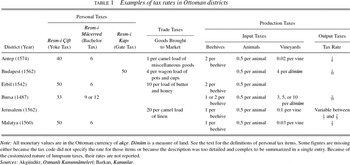
Table 1 shows examples of personal taxes in the Ottoman Empire during the 15th and 16th centuries. Representing the differences in rates and the geographical diversity of the empire during this period, the table includes information from such diverse districts as Jerusalem in the eastern Mediterranean, Budapest in Europe, Bursa in western Asia Minor, Erbil in northern Iraq, and Antep and Malatya in eastern Asia Minor.13
For the complete tax codes of these and other districts, see Akgündüz, Osmanlı Kanunnâmeleri; Barkan, Kanunlar.
Personal taxes were typically levied in cash. The rates for the
çift tax, for example were specified in terms of the Ottoman currency of
akçe and varied from being 33
akçes in Bursa in 1487 to 50
akçes in Erbil in 1542 and Malatya in 1560.
The second general category of Ottoman taxes consisted of the trade taxes that applied to market exchange of goods and services. Trade taxes included customs dues and the general market tax, exacted on items brought for exchange into towns and villages that hosted periodic markets. The tax base was the item brought in for trade. The tax codes, especially of districts with large markets, specified the rates at which various goods, spices, animals, slaves, and agricultural products were to be taxed. In some places, trade taxes took the form of gate dues that applied to items in transit or brought in for local consumption. Items could also be taxed at ports or river crossings. Although most trade taxes were levied in cash, the tax rates for some items were specified in kind. In the Jerusalem district, for example, fruit brought to market was taxed at the rate of one-thirtieth, but linens were taxed at twenty akçes per camel load.
In the third category were the production taxes that applied to various productive activities in agriculture and manufacturing. These taxes can be further divided into three subcategories, depending on the tax base: output taxes that were levied on the total output of an activity, input taxes on one of the inputs used in production, and enterprise taxes on the activity as a whole.
Output taxes consisted of the tithes (öşür) applying primarily to grains, legumes, and fibers. Taxes on these products were to be collected in kind, as a share of the total output. The usual rate was one-tenth, typically with an additional one-fortieth, called salāriye, collected as fodder for the horses of the fief holder. As Table 1 shows, the rates could vary significantly between regions, sometimes even between villages within a region. Despite such variations, however, output taxes throughout the empire had the common property of being based on the harvested product and collected at rates specified as a percentage share of the total output. The usual rate of one-tenth, for example, meant that the tax collector claimed his share immediately after the harvest as 10 percent of the output of wheat, barley, lentils, and so on.
Input taxes applied primarily to the taxation of fruit, vegetables, and animal products. Taxes for these items were levied on the land, trees, or other inputs used in their production rather than on total output. For example, taxes on the production of fruit, nuts, and dates depended on the number (sometimes also the age, height, and type) of trees. Similarly, taxes on vineyards typically depended on the number of vines; taxes on vegetables depended on the amount of land allocated to them; and taxes on animal products depended on the number of animals or other inputs, such as beehives.
Enterprise taxes were levied not on the total output or one of the inputs used in production but on the activity as a whole. In towns, they applied to retail stores and manufacturing enterprises such as dye houses, tanneries, juice makers, slaughterhouses, and soapmakers.
14 For urban taxes and activities in Anatolia, see Suraiya Faroqhi, “Taxation and Urban Activities in Sixteenth-Century Anatolia,” International Journal of Turkish Studies 1 (1979–80): 19–53.
This method was also used in the taxation of agricultural production in uninhabited lands called
mezraas and in some small or remote villages. The tax rate for enterprise taxes was specified as a lump-sum payment, presumably determined by some estimate of the profitability of the enterprise. Because enterprise taxes were customized to activities, the tax codes typically did not codify standardized rates for these activities (except in some rare occasions, such as when they specified the tax rates for retail stores as “per store”). Because the lump-sum rates showed great variability in the tax registers, they are not reported in Table 1.
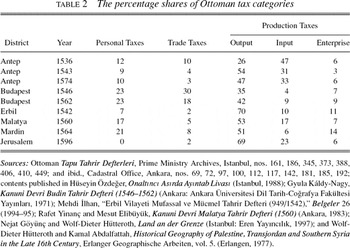
To show the relative importance of different tax categories for Ottoman finances, Table 2 reports the proportional share of each category in representative regions of the empire, calculated from the tax registers of these regions.15
These figures have been calculated from the tax information on towns and villages. The information recorded for other potential sources of revenue, such as ruined mills or uninhabited lands, are omitted to keep figures comparable across districts.
The proportions of tax categories show significant variations among these regions and over time, probably based on such factors as differences in tax rates and climatic and soil conditions. Despite these variations, one can see a clear pattern: a majority of the tax revenue in most regions came from output taxes, and trade taxes typically constituted the smallest proportion.
THE EFFICIENCY OF THE OTTOMAN TAX SYSTEM
Because the ultimate objective of a tax system is to maximize revenues, it is reasonable to expect the system to be designed to raise revenues as efficiently as possible. To examine the efficiency of the Ottoman system of taxation, let us leave aside for a moment the effect of history and focus instead on the system's ability to solve economic problems. The issue is to explain the logic and structure of the tax system—why the tax on some items or activities were levied on one type of base and others on another type. For example, why were the taxes on grains typically levied on the output, while those on fruit and vegetables were levied on one of the inputs? Similarly, why were trade taxes levied on items brought to the market for trade rather than on the revenue or profits from the trade or as a personal lump-sum payment on the tradesman himself? Within each broad category a number of subcategories could be observed, depending on, for example, whether to base the input tax on land, livestock, trees, or other capital inputs; which products to levy output taxes; and how to determine the relevant characteristics of taxpayers for personal taxes. Moreover, because new types of taxes could be created by mixing these categories in many different ways, the possibilities were numerous.16
The issue of taxes is analogous to the problem of choosing among the rich variety of contractual forms observed in history. On the contractual mix in agriculture in the U.S. South since the Civil War, for example, see Lee J. Alston and Robert Higgs, “Contractual Mix in Southern Agriculture since the Civil War: Facts, Hypotheses, and Tests,” Journal of Economic History 42 (1982): 327–53. On medieval contracts, see Metin M. Coşgel, “Risk Sharing in Medieval Agriculture,” Journal of European Economic History 21 (1992): 99–110. For reviews of the relevant literature, see Douglas W. Allen, “Cropshare Contracts,” in The New Palgrave Dictionary of Economics and the Law, ed. Peter Newman (New York: Stockton Press, 1998); Keijiro Otsuka, Hiroyuki Chuma, and Yujiro Hayami, “Land and Labor Contracts in Agrarian Economies: Theories and Facts,” Journal of Economic Literature 30 (1992): 1965–2018.
To explain various organizational forms observed in history, economic historians have viewed them as institutional responses to the problems posed by risk and transaction costs. In a hypothetical world without risks or transaction costs, the organization of production and exchange activities would not affect the use of resources. But in reality, both risk and transaction costs exist and pose problems. The presence of risks may pose problems because if we do not know which outcomes may be realized tomorrow, we may have to change the allocation of our resources and the design of an institution today to insure against the undesirable outcomes. The presence of transaction costs may also affect outcomes because if the information required for an activity or exchange is costly and imperfect, institutions may have to be designed to solve the information problem as cheaply as possible. Economic historians have used risk or transaction cost based approaches to explain various interesting organizations and institutional arrangements observed in history.
CAN AGRICULTURAL RISKS EXPLAIN THE TAX SYSTEM?
To determine whether a risk-based explanation of the structure of the Ottoman tax system would be satisfactory, one must start by observing how differently risks would have been allocated under different types of taxes. Focusing on production taxes, it is easy to see how output taxes have different implications from input or enterprise taxes for how disasters affect the after-tax incomes of taxpayers. Suppose an activity is subject to the output tax. This method would make it possible for the taxpayer to shift part of the production risk onto the state, because if there is a crop failure, taxes will fall proportional to the reduction in output. However, if the same activity is subject to the input tax, the crop failure will affect only the taxpayer's income, because the amount of taxes would remain unchanged. The same is true for enterprise taxes. Under both methods, the producer would assume all the risk. Output taxes will thus provide better opportunities for the state and the taxpayers to share risks.
How the difference between taxes in facilitating risk sharing would affect the choice of taxes depends on the risk attitudes of the state and the taxpayers. If the state or the taxpayers are indifferent between risky and safe incomes, for example, there would be no reason to expect the presence of risks to affect the tax system, because it will not matter which type of tax is used to generate revenue, all else being the same. But it is more reasonable to suppose that the taxpayers were risk-averse and that the state was better able to deal with risks than taxpayers (because it was able to diversify the risk among taxpayers and regions). In that case, a state concerned with the welfare of its taxpayers would be expected to accommodate their risk-aversion and improve aggregate welfare by choosing output taxes over other types in taxing an activity.
Some frequently cited evidence from pre-Ottoman times, dating back to the 8th century, seems to support the importance of risk in determining the choice between tax types in this region. Based on a petition by the peasants of Iraq during the 770s, the caliph is said to have agreed to (re)introduce output taxes (the muqāsama method) to facilitate the sharing of risks between the government and the peasants.17
Eliyahu Ashtor, A Social and Economic History of the Near East in the Middle Ages (Berkeley: University of California Press, 1976), 40. In fact, long before economists justified crop-sharing contracts and output taxes on risk-sharing grounds, the Muslim scholar Abu Yusuf had argued in favor of output taxes because input taxes (the misāḥa method) posed greater price risks. For a discussion, see Frede Løkkegaard, Islamic Taxation in the Classic Period, with Special Reference to Circumstances in Iraq (Copenhagen: Branner and Korch, 1950), 114.
Assuming that the risks were still high during the 15th and 16th centuries and that the means for insuring against them were still limited, one could extend the argument to the period of the Ottoman rule and argue that it was because of risk considerations that the Ottomans used output taxes for grains.
A complete explanation of Ottoman taxation, however, must account for not just why output taxes existed but also why they existed with input, enterprise, and other types of taxes within the same system. The coexistence of taxes can be explained only via factors that varied among activities. For example, if the distribution of production risks was the primary consideration, then one would expect output taxes to consist of the highest-risk products. The typical mixture of input and output taxes observed in Ottoman taxation, however, does not seem to support this expectation. Some of the products that were subject to input taxes were actually more prone to product failure from pests, disease, and severe weather than some of the other products that were subject to output taxes. For example, whereas all fruit and vegetables, regardless of their delicateness and perishability, were typically subject to input taxes, some of the hardier grains were subject to output taxes.18
On the different species of food plants, see Robert W. Schery, Plants for Man (Englewood Cliffs, N.J.: Prentice-Hall, 1972). See also, for examples of crop production and field-crop ecosystems in this region, Itzhak Arnon, Agriculture in Dry Lands: Principles and Practice (New York: Elsevier, 1992); C. J. Pearson, ed., Field Crop Systems, Ecosystems of the World, vol. 18 (New York: Elsevier, 1992), chap. 14.
Moreover, if the distribution of production risks was the primary consideration, then there would have been no reason for input and enterprise taxes to coexist as subcategories of production taxes. Under both types of taxes, the tax amount would have been independent of the actual level of output, and the taxpayer thus would have assumed all the risks.
19 One can also propose an incentive-based explanation of production taxes based on the taxpayer's incentives to use resources efficiently under different categories of taxes and the possibility of misaligned incentives between the state and the taxpayers. But the incentive-based argument does not fit the evidence well, either. Although the state legally owned the land and retained the eminent domain, the possession and usufruct rights belonged to farmers. The taxpayers' interests in using the land (or trees, animals, and other natural resources) were thus aligned with those of the state.
MEASUREMENT COSTS AND THE TAX SYSTEM
For a more satisfactory explanation of Ottoman taxation, I will turn to transaction cost economics. In market exchange, the transaction costs include the time, effort, and other resources used in locating parties to trade with, negotiating the terms of the trade, and drawing up and enforcing contracts. In the transaction-cost approach to the analysis of organizations and institutions, their presence and form are treated as the results of choice, subject to the constraints of transaction costs. If these costs were zero, it would not matter which institutional or organizational form were chosen for production or exchange activities. But when transaction costs are positive, the efficiency principle requires that the form that best economizes on these costs be adopted. Various organizational arrangements can thus be explained in terms of how the costs of transactions vary among alternatives. By focusing on transaction costs, economic historians have been able to explain a variety of institutional arrangements, including the firm, sharecropping, and manorial contracts.
Although the transaction-cost approach has been used primarily in the analysis of private organizations and institutions, it can easily be extended to the analysis of the public sector and tax systems. If the transaction costs were zero, it would make no difference which base the government used to tax an economic activity. In taxing production, for example, the government could raise the same amount of revenue through any combination of input, output, and enterprise taxes, ranging from levying the amount on only one of them to an equal or varying amounts of each. But in a world complicated by transaction costs, the cost may vary significantly among taxable activities and bases, making it costlier for the government to collect taxes using some methods than others. In that case, the difference in transaction costs may explain why some activities are taxed via one type of a base rather than another.
The transaction cost that is most relevant in studying taxes is the cost of measuring the tax base.20
For the importance of measurement costs in determining crop-sharing contracts in modern agriculture, see Douglas W. Allen and Dean Lueck, “Contract Choice in Modern Agriculture: Cash Rent versus Cropshare,” Journal of Law and Economics 35 (1992): 397–426. For the general importance of measurement cost for the organization of markets, see Yoram Barzel, “Measurement Cost and the Organization of Markets,” Journal of Law and Economics 25 (1982): 27–48.
These are simply the time and resources required to determine the value of the tax base, such as those that would be needed in classifying different types of items constituting the base (possibly varying in shape, size, ripeness, and so on), quantifying the total amount in each category, and estimating the monetary value. By focusing on measurement, we are able to explain both the choice of taxable economic activities and the choice of a base for their taxation. Efficiency in tax collection typically restricts states to tax only observable activities, and the Ottoman state was no exception. Consumption, for example, was generally not taxed because it was difficult to observe. Non-market exchange and productive activities that took place at home, such as cleaning and cooking, were similarly not taxed. Instead, easily observable activities such as market exchange and agricultural and manufacturing production were taxed. Once the state decided to tax an activity, it was also important to choose a tax base that could be easily measured. It would not have been sufficient for the cost of measurement to be low to the taxpayer himself, because he had an incentive to hide revenue whenever possible. The state or its agents who received the taxes had to be able to measure the tax base independently at low cost. Moreover, hiring a tax collector introduced a principal-agent problem to tax collection, accompanied by agency costs. For example, the tax collector could make side agreements with the taxpayer to collect reduced taxes in return for a transfer payment to himself (a bribe).
Examining differences in the cost of measurement in light of the Ottoman economy of this period helps to understand the structure of the tax system as a whole. Trade taxes, for example, were based on observable items, such as the goods brought for exchange, rather than the costlier-to-observe exchange itself, which is consistent with our knowledge of the institutions and technology surrounding exchange at this time. Similarly, because the state could not directly observe the marginal product of labor or the income-generating capacity of individuals, personal taxes were based on the household as a whole or on observable characteristics such as marital status and landownership.
To illustrate the importance of the cost of measurement in detail, I will focus on production taxes and explain the choice of output, input, or enterprise as the base in taxing a productive activity. Comparing the cost of measurement helps to understand the observed subcategories of production taxes, with taxes on grains levied on the output; those on fruit and vegetables on one of the inputs; and those on manufacturing activities on the enterprise itself. Once again, if the output of activities could have been measured at no cost, they could all be taxed under the category of, say, output taxes and there would have been no need for input or enterprise taxes. The total output would have been the tax base, and the tax amount would have been determined either as a proportion of output or as its cash equivalent. In reality, however, the cost of measurement varied significantly among activities. Whereas both the producer and the tax collector could easily measure the output of some activities, for other activities the tax collector had to incur significant cost in determining the quality or quantity of the output.21
Court records show frequent disputes arising from the division of harvests, which supports the importance of measurement costs for division. On harvest-related disputes in the Jerusalem court records, see Amy Singer, Palestinian Peasants and Ottoman Officials: Rural Administration around Sixteenth-Century Jerusalem (New York: Cambridge University Press, 1994), 90–99.
The cost to the tax collector was probably the lowest for products such as cereal grains, whose characteristics and harvest technology made it easy to determine both the quality and the quantity of output at low cost. Because the harvested crop was fairly homogenous for these items, the tax collector did not have to incur high cost by inspecting the whole output closely to determine its quality. The quantity of cereal grains could also be determined at low cost. The technology for harvesting these products and the brevity of their harvest period made it easy for the tax collector to observe the output, and difficult for the taxpayer to under-report it.
22 On the relationship between the harvest and tax-collection schedules in the Aleppo region, see Margaret L. Venzke, “The Sixteenth-Century Ottoman Sanjaq of Aleppo: A Study of Provincial Taxation” (Ph.D. diss., Columbia University, New York, 1981), 135–39.
The division of the grain output could be a fairly simple matter of, for example, first threshing all the cut grain together and then dividing it between the parties, or similarly loading every
nth wagon (with
being the tax ratio) of the harvested grain as the share of the tax recipient.
The cost of measuring the output could be considerably higher for other products, such as fruit and vegetables, because the total output could include products with significant variations in size, taste, shape, and ripeness. Even when the tax collector could observe the quantity, the taxpayer could still increase his share of the output simply by keeping the best items to himself. Given the taxpayer's incentive to under-report the quality by such means, the tax collectors had to incur cost by physically being present (or hiring an agent) for close inspection of the quality of output. Not just the quality but also the quantity of total output could be difficult to determine for some products, in particular those with harvests lasting for a long time. Because continual harvests created opportunities for such concerns as overnight theft, the tax collector would have had to incur costs in trying to prevent any crop from being withdrawn from division, which would have resulted in a high cost of determining the quantity independently.
Whenever the cost of measuring the output of an activity was prohibitively high, the next best alternative for the state could be to choose one of the inputs as the tax base. For the input tax method to be an efficient alternative, however, the quality and quantity of the base had to be easily observable. Land and trees, for example, were better candidates than seed, water, fertilizers, and labor. The taxpayer could not evade taxes by under-reporting the number of trees or amount of land used in production, because these quantities remained fixed during the production period and the tax collector could easily observe them. The production tax on fruit was thus typically levied on the number of trees, and the tax on vegetables was levied on the amount of land allocated to them. Whenever it was expensive to measure the output of an activity but cheap to measure one of the inputs, the activity was taxed using the input tax method.
When neither the output nor any of the inputs were easily observable, the last resort for the state was to tax the activity as a whole. This was typically the case for manufacturing enterprises such as juice makers and soapmakers in towns and agricultural production in remote villages or uninhabited fields.23
For evidence of increasing cost of measurement in distant villages, see Metin Kunt, The Sultan's Servants (New York: Columbia University Press, 1983), 19.
Because the cost of measuring the output or one of the inputs of these activities would have been very high, the state determined the tax amount as a lump-sum payment that was levied on the enterprise itself.
EXPLAINING REGIONAL DIVERSITY
The structure of the Ottoman system of taxation shared many elements with those of preceding and contemporary states, suggesting the presence of a selection process that caused these structures to converge toward an efficient ideal. Output and input taxes, for example, were similar in principle to the basic categories of Islamic taxation of production known as the muqāsama and misāḥa methods.
24 On Islamic taxation, see Løkkegaard, Islamic Taxation EI2, s.v. “Kharādj” (A. K. S. Lambton); on Islamic law on land taxes, see also Baber Johansen, The Islamic Law on Land Tax and Rent (New York: Croom Helm, 1988).
Enterprise taxes were also similar to the
maqṭū method of assessment (sometimes also called dīmūs, a word of Greek origin from the pre-Islamic period). These categories typically formed the basic structure of the production taxes observed in various Islamic states that the Arab, Persian, Turkish, and other rulers had established in the Middle East before the Ottomans. Ottoman personal taxes also resembled those of predecessor states—in particular, the Byzantine Empire.
25 On the commonalities between the Byzantine and Ottoman taxes, see İnalcık, “Problem of the Relationship”; idem., Economic and Social History, 149–53; Anthony Bryer and Heath Lowry, eds., Continuity and Change in Late Byzantine and Early Ottoman Society. Papers Given at a Symposium at Dumbarton Oaks in May 1982 (Washington, D.C.: Dumbarton Oaks Research Library and Collection, 1986). On the tax systems of other contemporary Islamic states, the Safavid and Mughal empires, see also Shireen Moosvi, The Economy of the Mughal Empire c. 1595. A Statistical Study (Delhi: Oxford University Press, 1987); Willem Floor, A Fiscal Study of Iran in the Safavid and Qajar Periods. 1500–1925 (New York: Bibliotheca Persica Press, 1998).
The
çift tax, for example, was similar in principle to the Byzantine tax called
zeugaratikidon. These commonalities clearly support the view that the observed structure of Ottoman taxes had efficiency properties that made it more desirable than its alternatives.
Identifying the efficiency properties of the structure of taxes, however, is not the same as claiming that the system was efficient as a whole or that it was the same efficient system that ruled taxation in all regions of the empire. The vast empire that the Ottomans had built by the mid-16th century had inherited not only common elements but also various idiosyncrasies from the customs and administrative practices of preceding states, and the tax system that they developed reflected these idiosyncrasies. There were significant variations between the taxes observed in different regions of the empire, some of which can be seen in Table 1.
The taxes in different regions varied in names and rate structures. Personal taxes, for example, varied significantly. Under the conventional system observed in Asia Minor, personal taxes were based on adult males, and the tax rate varied by marital status and landownership. The subjects in Hungary, however, paid personal taxes in terms of the gate (kapı) tax, for which the unit of taxation was the household rather than adult males, and the tax amount did not change with marital status or landownership. Moreover, personal taxes were not even fully implemented in all areas (although non–Muslim subjects throughout the empire paid a poll tax called cizye). In Jerusalem and surrounding districts, for example, the Ottomans did not introduce the çift tax or any other form of personal tax systematically levied on individuals or households.
Production taxes also varied among regions. Although the usual output-tax rate was one-tenth, a higher rate of one-fifth was applied in some of the provinces annexed after the mid-16th century.26
İnalcık, Economic and Social History, 112–14.
The rates could sometimes vary even among the villages within a region. In the Palestine, southern Syria, and Transjordan region, for example, the rates varied between one-seventh to two-fifths in 1596.
27 For a quantitative analysis of the efficiency and redistributive properties of the variable tax rates in this region, see Metin M. Coşgel, “Taxes, Efficiency, and Redistribution: Discriminatory Taxation of Villages in Ottoman Palestine, Southern Syria, and Transjordan in the Sixteenth Century,” Explorations in Economic History (2005).
Activities taxed under one category in one region could be taxed under another category in another region. Whereas beehive taxes were levied on the output of honey as output tax (under some circumstances) in Hungary, they were based on the hive itself as input tax in other regions. Similarly, there could even be differences within the same type of an activity within a region, as was the case for the taxation of olive products in the Arab lands. A clear distinction was made between the products of rumānī trees (generally interpreted as referring to aged trees), which were taxed based on output, and islāmī trees (younger trees), which were taxed based on the number of trees.
It may be possible to explain some of these differences from an efficiency view of the tax system. Taxes may have varied between regions as efficient adaptations to local conditions. For example, if the harvesting technology or the local stock of knowledge about the expected output varied significantly between two regions, then measuring the tax base of a productive activity might have been cheaper in some regions than in others, and the tax codes might have reflected these differences by taxing the activity based on output in one region and based on input in the other. This may have been the reason that beehive taxes were based on the output of honey in some regions and on the number of hives in others. Differences in production technology could also have caused the tax systems to vary. Research has shown, for example, that differences in irrigation technology were one reason for the system of variable tax rates observed in the Fertile Crescent, where the output tax rates were higher in villages with easier access to irrigation water than in others.28
Some of the changes the Ottomans introduced into the tax systems of some regions after conquest also seem to support the efficiency view of the tax system. A well-known example of such a change is how the Ottomans abolished some feudal labor services. Whereas under the pre-Ottoman tax system the subjects owed labor services to their feudal lords, such as building barns, gathering firewood, or working on his land, the Ottomans converted these service obligations to cash payments. Historians have often interpreted the Ottomans' tendency to commute labor services as an example of their benevolence toward new subjects. But the phenomenon can also be viewed from an economic perspective as efficient adaptation of previous forms of personal taxes to the Ottoman system of government and taxation. Labor services would have been an inefficient method of payment for personal taxes. It would have caused efficiency distortions, because the tax collectors would have had to incur cost monitoring the taxpayers, who had no incentives to work diligently for the tax collector to ensure that the tax payment was made at the required amounts. Despite the inefficiency, labor services could have survived under previous regimes because of path-dependence. But a regime change gave the Ottomans an opportunity to discontinue excessive inefficiencies and highly undesirable elements. Although converting labor services to cash payments was by no means peculiar to the Ottomans, as a centralized regime they had additional reasons for this conversion. Tax revenues were allocated not just to military personnel but also to the central and provincial governments.29
For analyses of the principles for the distribution of tax revenues in the Ottoman Empire, see Kunt, Sultan's Servants; Coşgel and Miceli, “Risk, Transaction Costs, and Tax Assignment.”
Because these governments did not directly engage in production, they had no need for labor services. Even the cavalrymen who resided in the countryside were likely to be away from the land during the production season, fighting in the battlefield for long periods, with limited time and ability to engage in production and maintain a large farm with heavy demand for labor services. These factors together meant that labor service was not a viable method of payment for personal taxes in the Ottoman Empire. The Ottomans thus significantly altered the historical precedent by converting pre-conquest labor services to cash payments, providing an example of how economic principles shaped the selection from available methods of taxation.
It is difficult, however, to explain all components of the Ottoman tax system using only economic principles. If efficiency was the sole driving force in designing taxes, then the truly efficient system would have replaced all others, and regional differences would have been mere adaptations of this system to local conditions. But there are numerous other regional differences that are difficult to explain using economic principles or an efficiency view of institutions. Consider some of the differences in tax bases and rate structures observed in the empire. Among personal taxes, for example, numerous differences existed between regions not just in the local names of personal taxes but also in their bases and rate structures, raising the question of why the more efficient ones did not replace others. If it was more efficient to vary the rates of personal taxes based on the characteristics of adult males (because of, for example, varying abilities to pay), as was the case under the çift tax system, then one would have expected personal taxes observed in the Balkans (where the payment was based on the household as a whole rather than on individuals) to be replaced by the çift tax system. Similarly, if a uniform rate for output taxes was more desirable, one would expect it to have replaced the rate structure observed in parts of the Fertile Crescent with rates that varied between villages. But in both cases, the Ottomans simply adopted the prevailing taxes and rate structures, making no systematic attempt to change things one way or another. They did not extend the çift tax system to the Balkans or the Fertile Crescent. Neither did they change the output tax rates that varied between villages in the Fertile Crescent to a uniform-rate system that prevailed in the rest of the empire. It is difficult to explain such continuities of sharply different rate structures merely as efficient adaptations of the tax system to local conditions.
These examples indicate that certain institutions were more flexible than others, and history was less of a constraint in some areas than in others. Although the Ottoman government's ultimate objective in designing the tax system may have been to maximize tax revenues, it could not seek efficiency and minimize transaction costs as it wished. It needed to work within the parameters of various institutional constraints. But it was not completely bound by these constraints, either. The challenge is to sort out these cases, and this paper contributes to this task.
One of the institutional constraints that could have affected the Ottomans' choice of taxes was the legal system. Timur Kuran has shown various ways in which Islamic law affected the institutional endowment of the Middle East.30
Kuran, “Why the Middle East Is Economically Underdeveloped.”
For example, the Islamic inheritance rules and contract law restricted the organizational forms available for business enterprises, and the rigidities of law governing pious foundations inhibited their autonomy and the provision of public services. It does not seem, however, that the legal system introduced significant rigidities into the tax system. There were two mechanisms for the Ottomans to avoid legal obstacles in tax design. The first was to take advantage of the controversial but legally recognized catchall category of customary taxes. Turkish states traditionally adopted a dual legal system, particularly in public administration and taxation.
31 Halil İnalcık, “Suleiman the Lawgiver and Ottoman Law,” Archivum Ottomanicum 1 (1969): 108–11.
The taxes that did not fit clearly into Islamic law could thus still be considered legal as belonging to the category of customary taxes. This was particularly useful in designing the tax code of a newly conquered area, where the Ottomans could adopt existing taxes under this category rather than be forced to overhaul the tax system according to the principles of Islamic taxation. Various forms of personal taxes, for example, were incorporated into the Ottoman tax system as customary taxes. The Ottomans preserved even some taxes that were in conflict with general Islamic principles. Taxes on producing wine and raising swine were preserved in the Balkans, for example, even though the consumption of alcohol and pork was banned under Islam. Although there were occasional debates within the Ottoman hierarchy about the legitimacy of some of these taxes or the customary category as a whole, the presence of the category for the most part prevented the legal system from being a significant obstacle in tax design.
The other mechanism to avoid legal obstacles was to take liberties in interpreting Islamic law itself. There were times that the shifting balance of power within the Ottoman government limited the independence of customary taxes from Islamic law. Those designing the taxes were under pressure to justify the legitimacy of taxes under Islamic law. Given the importance of taxes for state revenues and the flexibility of Islamic law on taxation, however, the pressure was not necessarily a significant constraint. If they so wished, legal scholars could take liberties in interpretation that were in line with the interests of the government—for example, by trying to fit customary taxes inherited from non-Islamic predecessors into the categories of Islamic law. This was the case when Ebu's-Su
ud Efendi, the famous minister for religious matters (şeyhülislam) of the mid-16th century, offered an interpretation of the çift tax as belonging to a category of Islamic taxes called misāḥa, even though it was clearly developed after the feudal practices of previous non-Islamic states and thus had a different origin.
Although the legal system may have been an insignificant constraint on the choice of taxes, political obstacles were significant. There were at least two sources of rigidity in Ottoman politics with significant influences on the tax system. The first was from various pressure groups with vested interests in the prevailing system of taxation. This was most evident during conquests, which naturally aimed to alter previous forms of tax and property relationships while establishing Ottoman rule. But in regions of power strongholds, the process often required the Ottomans to take a gradual approach to changing the tax system, if at all.32
For Ottoman methods of conquest and assimilation, see İnalcık, “Ottoman Methods.”
In eastern Asia Minor, for example, they preserved the rights of some landholders to collect taxes (under a system called
mālikāne dī vānī). They similarly preserved the pre-conquest taxes and tax-collection rights in other regions and made concessions to some tribes or recognized their semiautonomous status with respect to taxation. The objective in these compromises and concessions was not to minimize transaction costs or to maximize tax revenue, but to establish Ottoman rule within the institutional constraints of conquest politics. Any attempt to understand the post-conquest tax systems of these regions would thus have to examine the rigidities created by the relative powers and interests of established political groups.
The second source of rigidity was the general population of taxpayers. Opposition to taxes has been one of the most common reasons for popular uprisings in history.33
David F. Burg, A World History of Tax Rebellions: An Encyclopedia of Tax Rebels, Revolts, and Riots from Antiquity to the Present (New York: Routledge, 2003).
Taxpayers naturally resist higher taxes, and they prefer stable, secure incomes. This type of resistance may also have been most evident during conquests. Unless changing taxes clearly would have eliminated excessively oppressive elements of the previous tax system (as may have been the case for labor services), the general population would have been likely to prefer the status quo to change for fear that change might mean higher taxes and worse conditions. And they could even have fled the land or revolted against the new regime if the changes were perceived to be too burdensome. Even if an existing tax system was known to be inefficient, therefore, the Ottomans had to weigh their desire to change the system carefully against the possibility of political instability. An inefficient tax system could thus have survived if political rigidities prevented a ruler from changing it.
Given the political realities surrounding conquest, assimilation, and stability, the Ottomans were not free to change the tax codes as they wished. Even if they could have increased tax revenues in Hungary by changing personal taxes from the system based on the household as a whole to a differential rate structure based on the characteristics of its individual members, they would have met stiff resistance from those who would have had to pay higher taxes. Because of this resistance, they could not have implemented the change easily. They similarly could not have easily changed the rate structure of output taxes in the Fertile Crescent from discriminatory rates to a uniform rate, because this would have meant higher rates for some villages. Political obstacles existed not just in newly conquered lands but also in well-assimilated regions. Once the tax code of a region was adopted, changing it would have been difficult because the general population, accustomed to paying taxes under a familiar system, and powerful groups with vested interests in this system would have continued to resist the change.
There were various other forms of institutional rigidities against changing taxes. Units of measurement varied significantly between regions, making it difficult to standardize the bases and rates of taxes across the empire. Social and demographic institutions may also have contributed to regional diversity. The size and structure of families and households, for example, may have varied between regions or between ethnic and religious groups, making it difficult to implement one region's personal tax system in another region, even though one may have been more efficient or equitable than the other. Even the lingual diversity may have been an obstacle to change. There were numerous types of scripts and languages within the empire, creating barriers to transplanting components of one region's tax system onto another region. Even if the tax systems of some regions contained inefficient or inequitable elements, institutional rigidities might have guarded their survival.
CONCLUSION
New Institutional Economics provides rich tools and concepts that allow us to go beyond the previously narrow frameworks of economic and historical approaches to the study of Ottoman taxation. Whereas economic historians have conventionally studied Ottoman taxes from a narrow historical perspective by simply identifying elements of continuity with the precedent, this paper has identified the properties of these elements that explain why their continuity was desirable. Integrating economic and historical perspectives for a more complete approach, it has examined the structure, efficiency, and regional diversity of Ottoman taxes.
The general structure of taxes made it possible for the Ottomans to economize on the cost of measuring the tax base. Personal taxes were based not on unobservable income or productivity but on observable characteristics such as marital status and landownership. The choice of a base for production taxes similarly depended on how the cost of measurement varied among bases. Taxes on some products, such as grains, were levied on the output because the tax collectors could easily measure the harvested output. Taxes on other products, such as fruit and vegetables, however, were levied not on output but on one of the inputs used in production because it was cheaper to measure the amount of this input than the total output. The system of applying different types of bases to productive activities allowed the Ottomans to minimize the transaction cost of taxation. The same was true for trade taxes.
Although identifying desirable properties maybe sufficient to explain some of the regional differences in taxes within the empire, it fails to explain others. Some of the regional variations in the methods and rates of taxation can be viewed as efficient adaptations of the system to the local conditions of production technology or the changing needs of public expenditures. Other variations, however, were outcomes not of adaptation but of institutional rigidity. They reflected how previous practices were molded into the Ottoman system of taxation within various political, social, and other types of institutional constraints. In drafting the tax code of a newly conquered region, the Ottomans had to consider carefully the prevailing local practices and rates of taxation, maintaining a delicate balance between efficient taxation and political assimilation. Competitive forces toward efficient taxation must have clashed continually with institutional obstacles against change throughout the empire, requiring that we integrate economic analysis of the efficiency of Ottoman taxes and historical studies of their continuity.
Author's note: I gratefully acknowledge financial support from the National Science Foundation (grant no. SES-0433358) and the University of Connecticut Research Foundation. I also thank Dhammika Dharmapala, Thomas Miceli, reviewers for IJMES, and the participants at the 2002 Annual Cliometrics Conference in La Crosse, Wisconsin, and the 2003 Iowa Alumni Workshop in Iowa City, Iowa, for helpful comments and suggestions. Ali Özdemir, Sadık Yıldırım, and Hüseyin Yılmaz provided valuable research assistance.