On 5 September 1927, a silent film with orchestral accompaniment opened at the Capitol cinema in Berlin. Directed by Ludwig Berger (1892–1969), Der Meister von Nürnberg was a recognizable but freely adapted version of Wagner’s Die Meistersinger von Nürnberg. The film faded into general obscurity shortly afterwards and is not widely known or easily accessed today,Footnote 1 but it is nonetheless remembered occasionally as an interesting chapter in the history of the adaptation and reception of Wagner (and more specifically Die Meistersinger).Footnote 2 The première of the film prompted several heated protests in the German press, which in turn revealed conflicted attitudes among members of Germany’s educated bourgeoisie towards aspects of twentieth-century modernity.
Der Meister von Nürnberg is a piece of film history that even now defies easy categorization. Was it a cynical and commercial product of the Weimar-era film industry, or did it spring – as its production company Phoebus claimed – from ‘an earnest desire to produce a pure German film’?Footnote 3 Was it an ephemeral costume drama of no consequence or a critical and hard-hitting commentary on its own times? My argument will be that it was many of these things, and that its significance lies precisely in these contradictions: it was a complicated and paradoxical film for a complex, turbulent period. The film appears to recoil from Germany’s early twentieth-century history, and not just by means of simple escapism: there is, I will suggest, a very tangible thread of alienation that runs throughout the film and sets the tone in its final scene. By ‘alienation’ I refer not to the Verfremdungseffekt of Brechtian theory or the social estrangement of Marxist theory (Entfremdung), but rather to the feelings of emptiness, chaos, exile and relativism that Siegfried Kracauer claimed metropolitan modernity had inflicted on the intellectuals of the early 1920s.Footnote 4 The type of alienation I have in mind also arguably had a strong link to the feelings of displacement that the new German republic aroused in many of its citizens in the years following the First World War. As Peter E. Gordon and John P. McCormick suggest, despite ‘the diversity and disunity of narratives’ one might expect to find in Weimar discourse,
it is nevertheless striking how various thinkers in different domains identified their age as one of dissension and disorientation. Indeed, if there is one theme that seems to appear across the entire range of Weimar intellectual history it is the very awareness of anxiety signified by the prevalence of the term crisis.Footnote 5
This article argues that Der Meister von Nürnberg and its early negative reception are both manifestations of related forms of alienation in the Weimar years, while recognizing the film’s close alignment with the era’s profit-orientated practices of diversion. The film scholar Anton Kaes has pointed out that the overwhelming majority of films produced in Weimar Germany were ‘formulaic genre movies’ and notes an output between 1920 and 1927 of around 500 features per year, ‘close to 80 percent of which are no longer available’.Footnote 6 Der Meister von Nürnberg was unquestionably the product of an entertainment industry, not to mention a director who made his name filming fairy tales and operetta. According to Hans H. Wollenberg, the editor of the German film journal Lichtbild-Bühne between 1920 and 1933, musical comedies were, in fact, the most common genre in the silent film era: their plots served as scenarios, and their music was used as film accompaniment.Footnote 7 Thomas Elsaesser sets the canonical works of the 1920s in the much wider context of film output, other entertainment forms and industry norms and imperatives, and names Berger as one of a number of ‘leading figures not associated with Expressionist films’ who were ‘prolific directors, often more successful and sometimes no less accomplished than the famous names’.Footnote 8 Elsaesser’s recent book Film History as Media Archaeology is built explicitly around an archaeological approach to film history, in which unearthed objects allow the scholar to infer ‘a whole way of life’ and in which masterpieces can be ‘less telling and valuable than more “run-of-the mill” studio productions’.Footnote 9 This provides a useful way of thinking about forgotten films and cultural history in general, so the reality of everyday routine will play an important role in this article, acting as a useful counterpoint to the idea that Der Meister von Nürnberg encapsulates a particular form of Weimar-inflected alienation.
Der Meister von Nürnberg has not yet attracted sustained attention within Wagner scholarship or within literature on opera and film, but is worth taking seriously as a multilayered artefact of its time. As this article will demonstrate, it constitutes an effective lens through which to examine various sensitivities in opera’s relationship with film in 1920s Germany, providing in particular a fascinating demonstration of the historically conditioned reverence for Wagner’s Die Meistersinger that existed within conservative opera criticism in 1920s Germany. The film also illustrates some ambiguities in Weimar-era film making and consumption, its ephemerality serving as a key to several wider features of the Weimar cultural landscape. Although Der Meister von Nürnberg is part of a long line of Wagner-inspired films that extends to the present,Footnote 10 it stands at the end of the silent-era Wagner films, occupying a valedictory position that says as much about the era as about the artefact; as Elsaesser suggests (see above, note 9), the excavated item that appears at first sight to be inconsequential can, in fact, serve as an entry point to far wider cultural concerns. For these reasons, and because Der Meister von Nürnberg encapsulates particularly clearly the imbrication of high art and entertainment in early twentieth-century Western culture, the film exceeds curiosity status and emerges here as a multivalent fragment of a complex, contradiction-ridden time.
Analysis of the film is inevitably hampered by its ephemerality. In particular, the loss of Willy Schmidt-Gentner’s score, which would have been performed as a live accompaniment to the action on screen, makes any attempt at interpretation provisional and incomplete. What follows is very much based on the silent visual material that survives in the Deutsches Filminstitut und Filmmuseum archive in Wiesbaden, interpreted on the basis of Weimar-era film theory by Rudolf Arnheim, Béla Balázs and Kracauer, reviews and articles from 1920s music journals and newspapers, Berger’s autobiography and recent Weimar-related film theory by Elsaesser and Kaes among others. The framework is intentionally interdisciplinary, in part to compensate for the ghostly absence at the heart of this research: the film’s score is glimpsed only in tantalizingly short descriptions from 1927 of Schmidt-Gentner’s eclectic work. But despite this lack of hard evidence concerning the original sound of Der Meister von Nürnberg, music plays an important role in this article. If a single artefact can be studied in order to understand a whole context, so too can a context be examined in order to approach a missing object. If music is understood not as a series of fixed texts, but rather as a set of flexible practices embedded within related but not specifically musical contexts, then perhaps the sound of Der Meister von Nürnberg is not as lost as might first appear to be the case. There is, in other words, at least a certain amount to be inferred on the basis of established knowledge about film music practice in silent-era Weimar Germany and the particulars of this film’s reception. In any case, the film cannot be understood as anything other than an opera film. Its existence and meaning are contingent on Wagner’s Die Meistersinger, and its notoriety is based on the anger of 1920s devotees of that opera, who have shaped most of the known discourse around the film. Until now, the written vestiges of these critics’ anger have been more accessible to scholars than the film, but this article seeks to redress that imbalance, and to piece together an understanding of Der Meister von Nürnberg that recognizes art and its ongoing adaptation as an expression not only of identity, fear and territory-marking, but also of entertainment, routine and ephemerality.
Der Meister von Nürnberg: Wagner as a vehicle for satire
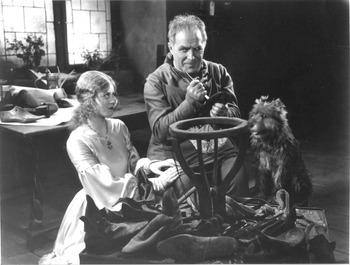
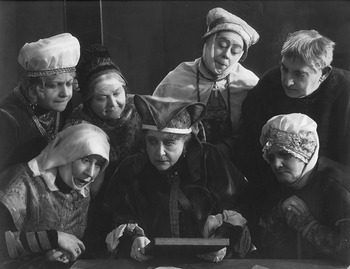
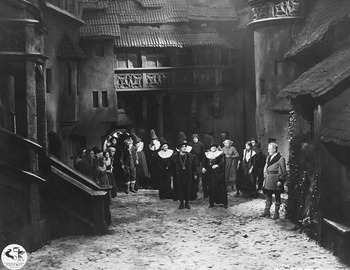
Three screenwriters were responsible for the script of Der Meister von Nürnberg: the director Ludwig Berger; Robert Liebmann, whose extensive credits as a writer included many of Berger’s other films and The Blue Angel (1930); and Rudolf Rittner, who also played Hans Sachs. Most of the characters in the film are derived from Wagner’s Die Meistersinger, but with some additions, so Sachs, Pogner, Evchen (the diminutive form of ‘Eva’), Walther von Stolzing, Beckmesser, David and Magdalena are joined by representatives of the Stolzing family and members of the town council. In some senses, the plot is quite similar to that of the opera: the unattractive town clerk Beckmesser wants to marry Evchen, the daughter of the rich goldsmith Pogner. Evchen turns in consternation to her neighbour the town cobbler Sachs, who is in love with Evchen, but faces competition in the form of the younger Walther von Stolzing. Sachs helps Walther, thereby sacrificing his love for Evchen and helping the young couple to unite. One difference is that the film’s plot involves a poetry competition rather than a song competition. It is set in the period that Wagner envisaged, and some of the scenery follows Wagner’s stage directions: Sachs’s workshop, for instance (see Figure 1), corresponds very closely with Angelo II Quaglio and Christian Jank’s designs for the 1868 première of Die Meistersinger. Footnote 11 On another level, the contents of the film are very different: Walther’s relations, for example (see Figure 2), produce a more precise impression of his aristocratic family background than is suggested in the opera, which presents Walther as a troublesome exception to the norm – as an individual who must accept the communal values of the Meistersinger before he himself becomes acceptable. In addition to this, the members of the town council (see Figure 3) provide a sense of Nuremberg’s political structures which is missing from the opera. This is an important change, because in Die Meistersinger formal structures other than the guilds are suppressed, and the townspeople of Nuremberg appear to govern themselves in an organic way.
Maria Matray as Evchen and Rudolf Rittner as Hans Sachs in Der Meister von Nürnberg. DFF – Deutsches Filminstitut & Filmmuseum.

Adele Sandrock (centre) as Walther’s aunt, with other cast members as Walther’s relations, in Der Meister von Nürnberg. DFF – Deutsches Filminstitut & Filmmuseum.

Members of the town council with Sachs (right) and Beckmesser (background left, in spectacles and boots) in Der Meister von Nürnberg. DFF – Deutsches Filminstitut & Filmmuseum.

Berger puts politics at the forefront of his film, which opens with the caption ‘Nürnberg stand vor der Bürgermeisterwahl’ (‘Nuremberg was about to elect a mayor’). Beckmesser is corrupt, promising the position of mayor to Pogner on the condition that he be allowed to marry Evchen. Walther participates in the poetry competition from a prison cell, where he has been locked up by the town’s guards after pretending to be an apprentice and attempting to elope with Evchen. His competition entry is written by Sachs, who visits Walther in prison and hands the younger man the winning poem. When Walther is released from prison and the young lovers are united, Berger’s normally outgoing Sachs becomes uncharacteristically introspective. The last scene is set in his workshop; David asks if he may put the worktable in the street, since there are people there to see the cobbler. Sachs looks out at the cheerful crowd, but refuses to greet them. The film ends with his normally good-humoured face in an unusually serious expression.
The plot of Wagner’s Die Meistersinger functions on a number of levels, one of which involves the classic comic structure whereby two young lovers are blocked in their desires by an older man (Beckmesser). The lovers manage to bypass this hurdle with the help of a resourceful friend (Sachs), and in the end the way is clear for them to marry and for the outsider (Walther) to be absorbed into the community at the expense of the scapegoat (Beckmesser). That element of classic comedy is largely preserved in the film, even if Berger’s Walther is not obviously integrated into the community by the end of the film.Footnote 12 Secondly, Wagner’s Die Meistersinger is an exploration of artistic creativity and tradition, and of the ideal balance between the two. Walther, the impetuous aristocrat, learns that his singing needs structure, and the Meistersinger learn that rules are not everything. This element is entirely missing from the film: since Walther does not write his own poem for the poetry competition, there is no opportunity to cast him as a daring artistic innovator. The remediation of the opera perhaps explains the change from song to poetry competition, since everyday live cinema accompaniments in the period were highly unlikely to include tenors capable of convincing performances of Walther’s prize song from Die Meistersinger. But there are other, less literal ways of understanding the complete loss of the guild of the Meistersinger from the film,Footnote 13 particularly since the medium of music is, in fact, diegetically present in one scene in the form of congregational singing. Plenty has been written about perceived anxieties surrounding mute ‘speech’ in silent-era film and, as Michal Grover-Friedlander suggests, opera would appear to intensify this sense of lack, since, ‘Opera epitomises voice and vocality, and silent film embodies the absence of voice.’Footnote 14 But as Grover-Friedlander acknowledges, early opera films do not necessarily shy away from representing and drawing attention to sung arias,Footnote 15 so Berger’s change of medium from song to written word could be argued to relate instead to anxiety about the perceived degeneration of national culture and identity. The poetry competition is portrayed as a crude and largely artless affair: apart from Sachs’s poem, which is based on a folk song collected by Johann Gottfried Herder, all the entries to the poetry competition are pitiful.Footnote 16 Wagner famously uses Die Meistersinger to reflect on Germanness and on perceived threats to German culture, injecting into Sachs’s final speech a nationalist tone that has troubled many commentators and stage directors in the light of Germany’s fateful twentieth-century history. I will return to this point later and suggest that Berger’s film, situated as it was at a different point in German history, deals with a different set of perceived threats to German culture, but for now I would like to examine some elements of satire in the film, and to make the argument that this satire is an important part of the film’s ambiguity.
Elsaesser mentions Peter Sloterdijk’s characterization of Weimar Germany as a period of irony, reflexivity and theatricality, and proposes that, ‘Weimar cinema has a serious sense of self-parody.’Footnote 17 So it is in the case of Der Meister von Nürnberg, which opens with a theatrical frame story, in which five figures (seemingly members of the town council) are seated in a Gothic hall around a table covered with papers and parchments. When a large hand is seen placing further figures around the table, it suddenly becomes apparent that this is a model, with actual people standing around it; this play on scale and reality strikes an ironic note of distance, and acknowledges the theatrical roots of the plot.Footnote 18 Berger wrote of his earlier film A Glass of Water (1923, based on Eugène Scribe’s play Le verre d’eau) that the characters were like ‘puppets tumbling between politics and love’;Footnote 19 here too there is a suggestion that the members of the town council are puppet-like and lacking in intelligence or autonomy. This impression is reinforced in the following scene, in which the tailor dresses a mannequin in the furs and chain destined for the new mayor. A goat included in the shot robs the moment of any gravitas, and when a young character knocks the hat off the mannequin, a straw head is revealed.Footnote 20 Just moments later, the town councillors are seen wearing comically tall hats, exactly like the one that has just been knocked off the dummy. This sequence is telling: there is satire here, and it operates not very far under the surface. This same satire is aimed at Beckmesser, when he is seen on his way to court Evchen and make his corrupt proposal to her father. That he loses a bouquet of flowers on the way and presents Evchen with an empty wrapper is one obvious source of comedy, but another occurs when he enters Pogner’s workshop and is seen in the background against an apparently much larger cat in the foreground. This entrance diminishes him and his mission, and brings to mind the comment of Balázs that, ‘Opinion and judgement are implicit in the angle of the shot.’Footnote 21
Berger’s work treats Wagner’s Die Meistersinger as a vehicle for satire rather than as a simple target: the film relates tangentially to the long history of Wagner parodies in many forms and media, but diverges from these in the sense that the satire is aimed not so much at Wagner’s work as at politics, privilege and corruption. Beckmesser’s corruption, which is first exposed in the scene with Pogner, is later underlined in a scene in church – Wagner’s opening scene, displaced and heavily adapted. The Gothic interior of the church is filled with townspeople singing a hymn, the notated melody of which appears on an intertitle and was woven into the musical accompaniment at early performances of the film.Footnote 22 Elsaesser argues that silent film ‘is full of sound cues in the image’,Footnote 23 but here Berger takes things one step further, as if he were providing hymn books for a congregation. It is an instance of irony, not just because notated music appears on screen at the point at which this music plays a diegetic function in the film, but also because Beckmesser, seated behind Pogner, sings in Pogner’s ear a contrafactum about the mayoral position that awaits him on account of their corrupt deal.
Writing in a retrospective exhibition catalogue on Berger, the cultural historian Walther Huder argues that tempo, grace and ironic distance are hallmarks of Berger’s work. The films are aware of their playful character, he suggests, and in the silent films, ‘The elements of satire, of social parody and also of political allusion cannot be overlooked.’Footnote 24 Huder also acknowledges Kracauer’s opposing view in From Caligari to Hitler; according to Kracauer, Berger’s A Glass of Water and Cinderella (both released in 1923) ‘provided the illusion of a never-never land in which the poor salesgirl triumphs over the conniving queen, and the kind fairy godmother helps Cinderella win Prince Charming’, all at a time when ‘inflation grew all-devouring and political passion was at its height’.Footnote 25 Similar comments – though not specifically directed at Berger – can be found in Bálazs’s ‘The Spirit of Film’, which describes the flight from reality as ‘an essential ideological component of the bourgeois film’,Footnote 26 and in Arnheim’s Film als Kunst, in which a typical plot involving a previously arrogant but now suddenly impoverished aristocrat courting a middle-class girl is named as an example of bourgeois film that promotes happy endings for individuals rather than wider social reform. As Arnheim argues, ‘Ninety per cent of film production is in the hands of people to whose interest it is to stabilise the social order in which they are comfortable, who have an interest in deflecting revolutionary energies and letting them run on to buffers.’Footnote 27 I will return later to the vested interests of big business, capitalism and (indirectly) even the military in the production and reception of Der Meister von Nürnberg, but for now I intend to examine the relevance of these criticisms to the film and to consider whether Der Meister von Nürnberg has sufficient complexity to surpass the escapist formula of mainstream Weimar cinema identified by Kracauer, Bálazs and Arnheim.
Alienation, entertainment and various points in between
In his well-known essay ‘The Little Shopgirls Go to the Movies’, Kracauer displays his growing disenchantment with cinema, which he felt had not lived up to its revolutionary potential. Society had moulded it too much in its own image, he argued, not necessarily by requiring films to reflect reality, but rather by expecting films to suppress reality. One way in which it did this was by setting films in the past: ‘Since one runs the danger, when picturing current events, of turning easily excitable masses against powerful institutions that are in fact often not appealing, one prefers to direct the camera toward a Middle Age that the audience will find harmlessly edifying.’Footnote 28 Der Meister von Nürnberg is not quite set in the Middle Ages, but it is undeniably one of the ‘endless series of costume films on a grand scale from every possible historical period’ that Wollenberg believed was prompted by the success of Ernst Lubitsch’s Madame Dubarry (1919).Footnote 29 Its painstaking recreation of sixteenth-century Nuremberg streetscapes and interiors not only corresponded with the letter or spirit of Wagner’s stage directions, but also proved popular with several critics, who commented on the film’s beautiful imagery.Footnote 30
Bruce Murray expands on Arnheim’s criticism of the Weimar film industry, arguing that it ‘responded to the desires of investors as well as to economic pressures and […] privileged an antirepublican, authoritarian orientation […] Many films of mainstream cinema recommended submission to authority and the myth of upward social mobility as solutions to social insecurity and the fear of proletarianization.’Footnote 31 Der Meister von Nürnberg includes individual social mobility in the form of Evchen, who ends up with a confident young aristocrat rather than a middle-aged cobbler. Her attraction to Walther is apparently based wholly on appearance, not character, and their feelings for one another are indicated in typical cinematic terms: soft lighting, mysterious breezes and lingering, radiant gazes caught in close-up. Walther is played by Gustav Fröhlich, who had recently achieved a career breakthrough as the youthful lead in Metropolis, that is, as the instigator at the conclusion of that film of an implausible and much-criticized reconciliation between the forces of industry and a crowd of oppressed, revolting workers.
Berger’s film unquestionably contains elements that accord with criticism by Arnheim, Bálazs, Kracauer and Murray, yet other aspects of Der Meister von Nürnberg contradict the idea that it is politically submissive mainstream cinema. In the film, politics and the forces of law and order are presented in a highly unflattering light: the unrefined town councillors are satirized by means already outlined above, and one of them participates in the riot on midsummer’s eve. The allure of high office (here the position of mayor) is seen to have a thoroughly corrupting effect, with the result that the vain and self-serving Beckmesser can persuade Pogner to agree to a rigged poetry competition and his daughter’s hand in marriage in exchange for power. The people of Nuremberg lack any visible signs of social cohesion and are held in check not by a natural sense of community, but by the heavy-handed town guards. In the scene following Evchen and Walther’s attempted elopement, the guards are presented as a threatening mob: they parade the captured Walther through the streets to the beat of a drum and mill around with long flaming torches. In the poetry competition scene, when Beckmesser tries to pass off the winning poem as his own and is exposed by his inability to recite it correctly, he is protected from the angry crowd by the guards, who are thus seen to favour the corrupt.
Walther, the young aristocratic prize for Evchen’s social mobility, is portrayed as a wilful and imperious youth, whose first action on reaching Nuremberg is to throw his hat on the ground for the pleasure of seeing one of the townspeople pick it up. He is without any apparent talents and is content to win the competition by duplicitous means; nor is he redeemed by his love for Evchen, since there is no sign by the end of the film that he has become any less arrogant or more willing to count himself as one of the people. As for the natural authority and wisdom vested in Sachs by Wagner, these are undermined in the film by Rittner’s puckish countenance and his character’s impulsiveness, occasional hot temper and ultimate introspection. Berger’s Sachs is, however, the one character who possesses poetic ability and the capacity to act unselfishly, and he chooses solitude at the end of the film, as if to distance himself from all the compromised characters around him. There is no holy German art to celebrate, a displacement reflected in the absence of the guild of the Meistersinger and in the sheer banality of the townspeople’s entries to the poetry competition.
In a sense, what Berger creates with this film is a subversion not just of Wagner’s characters and their concerns but also of the various forms of authority that one might expect to find affirmed in mainstream cinema from the Weimar era. There is reason to conclude that this historical film was politically critical of its own period, and that as proposed earlier, Berger used the historical plot to reflect on internal threats to German culture arising from the trauma of the First World War and subsequent political developments. Huder’s assertion that Berger’s silent films contain political allusion is supported by Berger himself in his autobiography. Writing about his film A Glass of Water (the film that Kracauer had written off as escapist), the director noted:
What was decisive was the point of view a film’s plot occupied in relation to the present. A Glass of Water was about a political intrigue between two parties at court, and the party for peace triumphed over the party for war. That was what we all wished for our time […] While we were at work looking at our own time through the lens of comedy, the news about Rathenau’s murder reached us.Footnote 32
Berger does not mention Der Meister von Nürnberg in his autobiography (perhaps because of the negative reaction to it), but the book is full of telling observations that reveal his disenchantment with society and politics in the period in which he was making the film. The director had had a privileged and musical upbringing as the son of a well-connected banker: he was a classic example of the educated bourgeoisie, and he felt very displaced by the effects of the First World War. He believed that he was living through a philistine age, in which the idealists were dead and politicians lacked integrity. He deplored the republican ministers who felt honoured to be seen beside highly decorated military figures, but also condemned the counter-revolutionaries, retired military and unemployed warmongers.Footnote 33 His was the position in the middle: the non-military, supposedly apolitical standpoint of the disinherited cultivated classes. By 1931, it seemed to him that Germany had disappeared off the face of the earth, leaving in its place ‘communist intrigues and a terrible type of revolver nationalism’, not to mention tastes in theatre, music and film with which he could not identify.Footnote 34
Berger’s attitude towards the film industry, which sustained him throughout these years of change, was far from straightforward. In his autobiography, he treats mass entertainment with suspicion, and the first section to deal with cinema is entirely negative: Berger accuses it of fanning the social abandon that the First World War had created and of stunting a generation that was too lazy to read.Footnote 35 Characterizing UFA (Universum-Film-Aktiengesellschaft, the largest German film company) as a sanctuary for ‘stellungslose Majore’ (‘unemployed majors’),Footnote 36 he condemns the company for its unprincipled pursuit of profit through sensationalism.Footnote 37 Given Berger’s alienated disposition during the 1920s and his ambivalence towards the film industry, I would argue that Der Meister von Nürnberg constitutes a form of alienated cinema in reaction to conditions that followed the war. This alienation manifested itself in an adaptation of Die Meistersinger that defied the celebratory nature of Wagner’s original, cast doubt on Germany’s artistic heritage and represented politics and law enforcement in a highly cynical and critical light. Berger was, I would suggest, responding to what he saw as the crassness of post-war Germany, the tawdriness of its mass entertainment industry and the dangers posed by its inept and disingenuous politicians and officials. Rather than associating threats to traditional German culture with external influences, as Wagner had in Sachs’s lines ‘und welschen Dunst mit welschem Tand / sie pflanzen uns in deutsches Land; / was deutsch und echt, wüsst’ keiner mehr’ (‘and foreign delusions and baubles / will take hold of Germany; / and no one would know any more what was German and genuine’),Footnote 38 Berger looked inwards and satirized German culture itself. The final scene, in which Sachs retreats from a crowd of supporters and fellow townspeople, sums up the feelings of exile that Berger appears to have experienced in his own country. The happy ending is therefore not what it seems: the young lovers are united, but the comedy falters at the end, failing to deliver any festive closure or a socially inclusive affirmation of the new couple and the community around them.Footnote 39
That is one interpretation of the film, at any rate. Whether Berger’s satire was apparent to anyone in 1927 is uncertain, but an anonymous critic writing for the Deutsche allgemeine Zeitung complained about the contemporary physiognomies of the cast and noted, ‘It is nonetheless striking that a modern, mobile form of expression, modern abruptness and contemporary psychology seem to have been deliberately applied to the strange, unhurried figures of Renaissance Nuremberg.’Footnote 40 That particular review is one of several that provide insights into the première, which Berger’s production company Phoebus went to considerable lengths to promote. The Capitol cinema, at which the film was screened, was a new and luxurious ‘picture palace’ located in Berlin’s zoo district and operated by Phoebus in direct competition with the UFA-owned Palast am Zoo. The Capitol, designed by Hans Poelzig, an architect and set designer associated with both expressionism and new objectivity, had a sober exterior that led to a towering auditorium of approximately 1,300 seats. According to the critic from the Deutsche allgemeine Zeitung, on the evening of the gala première, the façade of the cinema was temporarily decorated as a Gothic town hall, celebrities caused traffic jams around the Gedächtniskirche and guests wore evening dress.Footnote 41 Berger and several cast members attended this benefit performance in aid of the trade union for German theatre workers,Footnote 42 and were warmly applauded at the end of the evening.Footnote 43 Also in attendance – ironically, given the contents of the film – were ‘Berlin’s lord mayor, the police president and several ministers’.Footnote 44
Musically, this was an evening of some ambition: several soloists of the Staatsoper and the Städtische Oper took part in an introductory concert that included excerpts from Wagner’s Die Meistersinger, in particular Walther’s prize song and the ‘Wach auf’ chorus.Footnote 45 The music by Schmidt-Gentner, one of the most successful film composers at the time, was performed by a full orchestra of perhaps 60 musicians;Footnote 46 according to various reviews, it was closely related to Wagner’s Die Meistersinger – possibly up to 70% so, according to one hostile source (who also mentioned that the riot scene was not set to Wagner, but had newly composed music of its own).Footnote 47 One of the later protests against the film criticized the score’s mixture of Wagner, Bruckner, Richard Strauss, jazz and the hymn sung by the townspeople.Footnote 48
The idea that jazz (or rather what passed for jazz in 1920s Germany) played some role in the proceedings is intriguing, but unfortunately there is no record of how it was used or at what point(s) in the film it was woven into the score. That it was present is not wholly surprising, however, since 1927 was the year that had seen the première and explosion in popularity of Ernst Krenek’s opera Jonny spielt auf, a work that mixed popular dance-music idioms with the sounds of modernist art music and thus provided a notable precedent for the mobilization of ‘jazz’ tropes within opera-related work.Footnote 49 The remaining particulars of the film’s gala opening leave no doubt about the tone of the occasion: it was resoundingly hegemonic in its combination of traditional high culture and political power, and it also followed the type of pattern identified and criticized by Kracauer in his essay ‘Cult of Distraction: On Berlin’s Picture Palaces’. Here, Kracauer analyses the effects of the revue-style events that combined film and live entertainment in Berlin’s new picture palaces, and rejects this type of programming on several counts: the conjunction of two-dimensional screening and the physicality of real performers called into question the spatiality of what was projected on screen; the longing to return to the bourgeois conditions of the theatre revealed reactionary tendencies; and the attempt to produce an organic whole out of film and live performance was misguided and robbed film of its particular capacity to reflect – by means of undisguised distraction – the ‘uncontrolled anarchy’ of the world.Footnote 50 In the case of Der Meister von Nürnberg, the opening night clearly attempted to create an organic bridge between Wagner as opera and Wagner freely adapted as film: the revue-style event had many of the trappings of traditional bourgeois culture, and while the film itself arguably invited critical reflection on the anarchy of modernity, it also rejected this modernity and offered a disconsolate view of the fate of German culture. By Kracauer’s standards, this was reactionary, regressive fare, and yet to many conservative Wagnerians of the period it was a provocation that demanded urgent public condemnation.
Berlin versus Bavaria: reaction to Der Meister von Nürnberg and its relationship to the reception of Die Meistersinger in Weimar Germany
Critical reaction to Der Meister von Nürnberg can be divided into two distinct phases: the first comprises the reviews that appeared in the Berlin press shortly after the première, while the second encompasses a variety of articles that respond to the idea of the film. Many of the reviews of the initial stage were positive, praising in particular Berger’s lightness of touch and Rittner’s characterization of Sachs. In the Deutsche allgemeine Zeitung there was even praise for Schmidt-Gentner’s score, which was described as a successful mix of ‘programme music, Wagner opera and film accompaniment’.Footnote 51 Some critics maintained a more condescending position, describing Berger’s work as nothing more than ‘a nice costume drama and big crowd-pleaser’,Footnote 52 but almost all critics expected the film to be successful. One review in the conservative Deutsche Tageszeitung pointed the way towards the second stage of the film’s reception, with the critic in question complaining about the liberties Berger had taken with Wagner’s characters.Footnote 53
In the articles that make up the second phase of critical reaction, the emphasis was placed on the idea of degradation and deformation, and a consensus emerged that Wagner’s work had to be protected from villainous exploitation. The first of these was Hugo Rasch’s ‘Schutz dem Urheber!’ (‘Protection for the Creator!’), published in the Allgemeine Musikzeitung, which urged the adoption of a paragraph into German law that would prevent the detrimental altering or arrangement of works commonly recognized as important to art, education or the edification of the population. Die Meistersinger von Nürnberg was precisely such a work, according to Rasch: he described it as ‘common property of the German people’ and maintained that it was coveted throughout ‘the whole globe’. He took particular exception to Berger’s Sachs, ‘a thoroughly dishonest, clean-shaven comedian with a constantly crafty expression’, and to the new, apparently indecent Evchen, who immediately started ‘flirting with a tradesman’s apprentice in church’.Footnote 54 These objections revealed the critic’s fear of sexual and social revolution: the absence of Sachs’s beard was presumably taken as a loss of patriarchy, and Evchen’s interest in a social inferior (in fact, Walther in disguise) appeared to him as sexual dissoluteness and betrayal of class.
That these violations of Rasch’s values were part of an adaptation of Die Meistersinger undoubtedly added to the critic’s outrage, since his assertion that the opera was recognized enviously around the world fitted neatly into Meistersinger-related discourse of the period. Unlike the reception and production of Die Meistersinger after the Second World War, which has often problematized the opera on the grounds of xenophobia and demagoguery (in particular with regards to Hans Sachs’s final speech) and potential anti-Semitism in the text, music and characterization of Beckmesser, Weimar commentators on Die Meistersinger raised no race-related questions about Beckmesser and tended to read the opera positively according to their own form of politics.Footnote 55 Undoubtedly, the opera was mobilized repeatedly within Weimar discourse in support of reactionary tropes concerning German spirituality/depth in the face of ‘superficial’ non-German intellectualism, and German community/Heimat versus international cosmopolitanism.Footnote 56 But so too was the opera celebrated in relation to very different types of politics: for the liberal Jewish critic Alfred Einstein, Die Meistersinger was a more ‘national’ work than any of Wagner’s tragedies, but it was neither völkisch nor politically nationalist. Einstein saw in Die Meistersinger a wholly positive representation of Nuremberg society and described Sachs as a representative of the people ‘who through deep human and artistic experience stands above the parties’.Footnote 57 Bernhard Diebold, a liberal columnist of the Frankfurter Zeitung, declared Die Meistersinger ‘the most democratic stage work between “Tell” and Hauptmann’s “Webern”’ and claimed that, ‘Nowhere in all of the theatrical arts was the German Volk so magnificently declared sovereign as in Die Meistersinger, this singing comic and festive celebration of democracy.’Footnote 58 Perhaps Diebold had in mind the song contest and the Nurembergers’ choice of Walther as winner, but the idea that Wagner’s townspeople are completely sovereign in their decision is difficult to uphold given Sachs’s careful management of the events surrounding Walther’s performance. But that type of detail was of little concern to many Weimar commentators across the political spectrum: the point instead was to harness Die Meistersinger in support of their own version of German identity and values.Footnote 59
Following defeat in the First World War and the humiliation of the Treaty of Versailles, which imposed territorial and military losses and punitive reparations on the German nation, some commentators began to see performance-based art as a valuable national asset that could not be appropriated by foreign powers. In the wake of hyperinflation in 1922–3, which had a disastrous effect on the prosperity of many private individuals, various critics depicted Die Meistersinger not only as a German artistic treasure but also as a comfort and consolation in times of hardship. David B. Dennis draws attention to an article in the Völkischer Beobachter on the 1923 Munich Festival that asserted, ‘Of all our rich possessions, practically nothing is left to us but our holy German Art.’Footnote 60 In 1924, Max Schillings, Intendant of the Staatsoper Berlin, described Sachs’s words ‘Zerging in Dunst / Das heil’ge röm’sche Reich, / Uns bliebe gleich / Die heil’ge deutsche Kunst!’ (‘Even if the Holy Roman Empire / should dissolve in mist, / for us there would yet remain / holy German art!’) as counsel both comforting and serious at a time ‘wo alles drängt und drückt’ (‘where all is stress and strain’).Footnote 61 Quoting the same words from the Schlußrede of Die Meistersinger, Max Koch argued in 1927 that, ‘Ever since the destruction of German power we must hope and strive for the restoration of our world status above all through “holy German art”.’Footnote 62
Perhaps it was the pronounced sense of crisis and hardship during the early years of the Weimar Republic that led several writers to depict Die Meistersinger in terms of victory. Hans Joachim Moser described the development of German opera as a battle won by Die Meistersinger:
When Wagner–Hans Sachs finally brought the indescribably rich and detailed work brimming with Teutonic vitality to a close with the proud, earnest warning, ‘Honour your German Masters, then you will conjure up good spirits!’, that was the triumph song par excellence of German opera, which after two centuries of struggling for its own place had prevailed against the opera music of the whole world.Footnote 63
Die Meistersinger was chosen by Siegfried Wagner to open the 1924 Bayreuth Festival after a closure of ten years owing to the First World War and its aftermath. As the first performance drew to an end, the audience stood up together for Hans Sachs’s final speech and the concluding chorus, and then broke into a spontaneous rendition of ‘Deutschland über Alles’, singing it in its entirety – a nationalist demonstration that alarmed and dismayed Siegfried, despite the anti-republicanism of Bayreuth and its association from 1923 onwards with Hitler.Footnote 64 In a letter of November 1927 to the periodical Die Lesestunde, Thomas Mann declared that Die Meistersinger was ‘a great and universally acknowledged German victory, a total triumph of the German spirit’.Footnote 65 This was the context against which Rasch’s words must be understood: for many Weimar-era opera lovers, Die Meistersinger constituted an outlet for various forms of nationalist sentiment, or emotional and comforting territory in the midst of profound change. As Theodor W. Adorno put it, the bourgeoisie of his day was dispossessed and no longer constituted a cultural unity: ‘The most they can do’, he suggested, ‘is commemorate their happier years at performances of Die Meistersinger.’Footnote 66
Given the liberties that Berger took with the opera, it is perhaps not so surprising that his film attracted a mixed response. What is more surprising is the extent of the reaction to the film and the way in which this reaction was quickly organized into two formal protests. Soon after Rasch’s article appeared, Wilhelm Matthes reproduced it in the conservative Nuremberg daily Fränkischer Kurier and added a warning that seemed to foresee the later effects of Regietheater: ‘Enough with the shamelessness and provocation of the German spirit and German masterpieces! If the nation doesn’t help itself in this matter, within weeks we will witness a resourceful director change the magic garden in Wagner’s Parsifal into a brothel.’Footnote 67 Echoing Rasch’s call for legislative protection of Germany’s artistic heritage, Matthes invited Nuremberg’s town council and cultural bodies to protest loudly against Berger’s film, and expected Haus Wahnfried and all supporters of German culture to join in. Less than a week later, Matthes returned to the topic and reported that a protest had indeed been issued, which included the following statement:
The signatories protest as vehemently as possible against the film, not only because it misuses the most German work of Richard Wagner in the most unscrupulous manner, but also because the city of Nuremberg with its great historical past has been debased before the whole Volk by being thus dragged down into a low atmosphere.Footnote 68
This complaint was signed by representatives of 20 cultural organizations, including the Germanisches Nationalmuseum, the municipal orchestra of Nuremberg, the local branch of the Deutsche Akademie, several choral associations, the Nuremberg branch of the Richard Wagner Association of German Women and the evidently conservative-nationalist organization Ring Schwarz-Weiß-Rot Nürnberg (the Nuremberg Black-White-Red Ring).Footnote 69
Writing in the Allgemeine Musikzeitung, Paul Schwers praised the Nuremberg protest as a remarkable vindication of Matthes’s call for action. Schwers had the further satisfaction of reporting a second wave of protest among ‘leading circles’ in Munich, whose numbers included the lord mayor of the city and the representatives of the theatre and music advisory committee there, Hans Pfitzner and Siegmund von Hausegger.Footnote 70 The new protest ran along very similar lines to the Nuremberg precursor and appears to have had some influence in Munich, where, according to the liberal Berlin-based Vossische Zeitung, opera singers from the Nationaltheater were prevented by their company from taking part in the local première of the film.
One of the striking aspects of the second stage of the film’s reception is that it emanated, for the most part, from people who had not seen the film. Rasch’s ‘Schutz dem Urheber!’ was founded on first-hand viewing of Der Meister von Nürnberg, but it is difficult to identify any other protester who had seen Berger’s work. This detail was not lost on the management of Phoebus, who issued a statement condemning Matthes for sparking the initial Nuremberg protest without personal knowledge of the film and announced legal action against him and the editor of the Fränkischer Kurier. As Phoebus also argued, the film had been officially recognized by the relevant film authorities as ‘künstlerisch wertvoll’ (‘artistically valuable’) and had sprung from ‘an earnest desire to produce a pure German film’.Footnote 71 It pointed out that the film had run for four successful weeks in Berlin, and had attracted much praise in the Berlin, Dresden and Cologne press.
Phoebus was, however, no doubt aware that a film’s success in one city did not guarantee success in other cities. As Corey Ross has noted, the film press of the time frequently discussed differences in taste between Berlin audiences and those elsewhere, and as a 1926 Film Kurier article quoted by Ross argued, ‘Films which cause a sensation in Berlin can flop in Munich and vice versa.’Footnote 72 Ross points out that over three-quarters of Munich’s cinemas had a seating capacity of less than 300,Footnote 73 and that, ‘Whereas mixed programmes (combining film with various types of live sketches and revues) were common in Berlin, Cologne and Düsseldorf, they were rare in Hamburg and non-existent in Frankfurt and Munich.’Footnote 74 The ban on Munich opera singers taking part in local screenings of Der Meister von Nürnberg could, therefore, have had as much to do with regional cinema practices as with the effects of the protest against the film. As for the city in which the protest began, on the basis of low annual per capita cinema visits in comparison with Berlin, Düsseldorf and Hamburg, Ross names Nuremberg as one of the least ‘cinema-friendly’ cities in Germany.Footnote 75 To those involved in the protests against Der Meister von Nürnberg, it was clear that cultural differences between Bavaria and Berlin played an important role. As Schwers complained in the Allgemeine Musikzeitung, ‘As soon as the first news of the Nuremberg protest reached Berlin, the left-wing press wheeled out the more-or-less heavy artillery to cast suspicion on and ridicule this movement to protect German culture.’Footnote 76
Cinema in 1920s Germany: residual middle-class resistance and political intrigue
One reason this protection of German culture was deemed necessary was the increasing presence and influence of cinema within Weimar Germany. In Wilhelmine Germany, the earliest variety-style cinema was significantly at odds with the dominant forms of high culture, and to members of the educated bourgeoisie it counted as an unquestionably second-class activity. As Wollenberg points out, in 1912 the Association of Berlin Theatre Directors attempted to prevent any stage actors from taking part in film,Footnote 77 demonstrating a desire at the time to keep the two spheres firmly apart. Film was commonly associated with cheap sensationalism, immorality and even pornography, so that by the time a dedicated film law and censorship were introduced in 1920, there was, as Elsaesser puts it, ‘a surprising consensus across the political spectrum about the cinema being regarded [as] undesirable and a nuisance’.Footnote 78
Despite this widespread suspicion, cinema grew exponentially in the early twentieth century, and as an expanding industry it was bound to seek out new consumers across the social spectrum. A 1927 edition of Der neue Film reflected on this expansion, noting that turn-of-the-century Germany had only two cinema theatres, but that in the meantime this number had increased to 4,000.Footnote 79 According to Kaes, ‘In 1927, Berlin alone had more than 300 movie theaters with 165,000 seats; about 30 of these “palaces of distractions” (Kracauer) seated more than 1000 people, and several of them had up to 3000 seats. In the Reich, about two million Germans went to the movies every day.’Footnote 80 By this point, cinema was no longer a peripheral working-class entertainment that could be ignored or easily bracketed off from ‘legitimate’ high culture. Many film historians point to the use of literary sources, the development of feature-length films and the luxurious new cinemas as catalysts for the increasing acceptance of film within middle-class circles, and by 1928 Kracauer could argue that, ‘Today all segments of the population stream to the movies, from the workers in suburban movie theatres to the haute bourgeoisie in the cinema palaces.’Footnote 81 But as Kaes points out, cinema’s ‘literary ambitions necessarily drove it onto the battlefield of cultural criticism’,Footnote 82 with the result that questions about the value and role of cinema continued well beyond criticism of Der Meister von Nürnberg in 1927.Footnote 83
For some particularly conservative members of the educated bourgeoisie, cinema in middle-class guise was undoubtedly more threatening than the old-style working-class entertainment. With boundaries between high and low culture beginning to blur, the privileged position of traditional elitist culture was challenged, and the status of an art form such as opera began to seem less certain. The 1920s saw the publication of many articles about a perceived crisis in opera, many of which attributed at least some of that crisis to the rise of cinema.Footnote 84 This was a matter of cultural ascendency, but also at stake was the perceived integrity of a canon of supposedly self-contained musical works. As Marcia J. Citron has pointed out, the performative music of ‘silent’ films was fluid and subject to change from performance to performance. It challenged ‘ideals of unity and fidelity that were valued in the late nineteenth and early twentieth centuries’, and the relationship between opera and silent film therefore rested on a ‘premodernist aesthetic of flexibility’.Footnote 85 In his denunciation of Berger’s Meistersinger film, Rasch reminded his readers that Berlin’s Capitol had also screened Strauss’s Rosenkavalier film (1926), and that Strauss himself had participated in the ‘coarsening’ of ‘one of his most exquisite works’. This was clearly a mystery and an outrage to the critic, who pronounced that a terrible seed had germinated.Footnote 86 Rasch’s article was a statement of fear, not just because cinema appeared to be cheapening opera and wilfully pulling it asunder, but also because opera was not in a position to ward off the systems and imperatives of the film industry.
The German film industry of 1927 was controlled by right-wing industrialists such as Alfred Hugenberg, a conservative-nationalist businessman who had recently acquired a large stake in the UFA production company. Vast swathes of the right-wing German press were also controlled by Hugenberg, who no doubt was displeased that UFA’s rival Phoebus had received secret funding from the War Ministry (a fact that emerged just before the release of Der Meister von Nürnberg ).Footnote 87 Hugenberg was known to use his newspapers to create good publicity for UFA’s films; in this case, he had both the motivation and the means to further the protests against his rival’s film. Given the military source of Phoebus’s secret funding, the production company may have had a mission to create propaganda that would lead to support for a remilitarized Germany,Footnote 88 or at least must have been under some pressure to produce work of an apparently national nature. In any case, its defence of Der Meister von Nürnberg as arising from ‘an earnest desire to produce a pure German film’ is significant. According to Thomas J. Saunders, ‘Cultural typecasting and defense of German peculiarities dovetailed with efforts to elevate film from notoriety to respectability. The trade press attempted to consolidate the motion picture’s sociocultural position by portraying it as a national institution.’Footnote 89
Phoebus’s idea of pure Germanness evidently differed wildly from that of the ill-disposed critics, but another industry-related factor must have been at play in its decision to adapt Die Meistersinger. Writing in the Berliner Tribüne just months before Der Meister von Nürnberg was released, one critic argued that a film deemed artistic or cultural always had an appeal that was three times as strong as that of a standard film.Footnote 90 Indeed, within the regulations governing Weimar cinema, high culture and box-office takings were related in an official way. As Murray explains,
The Lampe Committee, organized by the ministry of the interior and named after its chairman Felix Lampe, worked with national censorship boards and decided whether films were künstlerisch (artistic), volksbildend (generally contributing to public edification), or Lehrfilm (educational film). Films that qualified were granted partial exemption from the Lustbarkeitssteuer, the entertainment tax levied on box-office receipts.Footnote 91
By adapting a Wagner opera, Phoebus must therefore have counted both on healthy box-office receipts and on the ‘artistically valuable’ classification that would reduce the tax on that income.
Der Meister von Nürnberg as entertainment artefact
Given the likelihood that the adaptation of Wagner’s ‘most German’ opera was as rooted in financial and industry-related considerations as it was in Berger’s love for the opera,Footnote 92 it now seems advisable to consider Der Meister von Nürnberg not just as an artefact of film and opera history, but also as a means of understanding common cultural practices in the Weimar Republic. Even though the film was exceptional in the short-lived furore it provoked, Der Meister von Nürnberg represented business as usual, and was in many senses utterly typical of cinema at the time. Elsaesser notes that throughout the 1920s, cinema ‘conducted [a dialogue or contest] with other popular entertainment forms, such as operetta, folk theatre and cabaret’,Footnote 93 and quotes Alexander Jason’s statistic that until 1932 only 3% of German film scripts involved original stories. According to Elsaesser, ‘The rest were, in one form or another, adaptations from literature, stage, operetta and newspaper feuilletons.’Footnote 94
Early German film had a lively relationship with musical forms of theatre – not just with operetta, an undisputedly popular entertainment form in its own right, but also with many different types of opera. The following facts are well known, but they serve as a useful reminder of the inextricable link between opera and cinema in Germany of the early twentieth century. In 1903, Oskar Messter screened his first Tonbild – a short film of a few minutes designed to accompany pre-recorded sound. He went on to film a great number of these in the first decade of the twentieth century, basing many of them on scenes or arias from operas such as Siegfried, Lohengrin, Salome and Rigoletto, as well as numerous operettas. Messter also produced the feature-length biopic Richard Wagner (1913), which included a score specially created for the film by Giuseppe Becce, one of the early pioneers of film music.
From this point onwards, German opera films increased in length, and were no longer conceived to run alongside pre-recorded music: instead, they made use of live musical accompaniment, often involving arrangements of excerpts from the relevant opera scores. Examples include Lohengrin (1916), Martha (1916), Cavalleria rusticana (1917), Der Freischütz (1918) and Der Waffenschmied (1918), all produced by Jakob Beck for Delog (Deutsche Lichtspielopern Gesellschaft), and some of which toured with soloists, chorus and orchestra,Footnote 95 as well as Der fliegende Holländer (Harmonie, 1918). Live music varied according to the means and status of the cinema: by 1914, ensembles were common in most mid-sized and larger cinemas;Footnote 96 these ranged in size from a piano trio to a ‘salon orchestra’ of approximately a dozen players by 1920.Footnote 97 During the 1920s, orchestra sizes grew steadily, particularly with the opening of the picture palaces in the middle of that decade. ‘Compilation’ accompaniments consisting of stitched-together extracts of existing music were common, and these drew heavily on operatic repertoire; in this way, opera often formed part of the experience of films that were otherwise unrelated to the art form. By 1927, the link between film and opera (and Wagner, more specifically) was well established and in no way exceptional.
In addition to the routine use of opera music and plots, several prominent representatives of theatre and music made their mark during this period with high-profile film operas such as Ernst Lubitsch’s Carmen (1918), with the star of silent film, Pola Negri, in the title role, and Strauss’s collaboration on the above-mentioned film version of Der Rosenkavalier (1926), directed by Robert Wiene (also director of The Cabinet of Doctor Caligari). As was the case with Der Meister von Nürnberg, the Rosenkavalier film involved considerable adaptation of the original opera plot; the score was closely based on the orchestral music of Der Rosenkavalier, but incorporated some smaller works by Strauss that were not from the opera. That even the work of a living composer and playwright could be quite significantly adapted to conform with cinema norms suggests that Berger’s reworking of Wagner’s Die Meistersinger should have come as no surprise to film audiences the following year, and that their outrage was directed towards practices that had become routine. True, Strauss and Hugo von Hofmannsthal were alive and able to agree to the Rosenkavalier film project, whereas Wagner was dead and knew nothing of the use of his music and plots by film makers. Consider, however, that Strauss was a native and an honorary citizen of Munich, where the second protest against Der Meister von Nürnberg originated, and that the operas Der Rosenkavalier and Die Meistersinger both explored the theme of renounced desire, mixed the profound and classically comic, paired off a young male aristocrat with a young bourgeois woman and shared a common historicizing tendency and the superficial appearance of turning away from musical modernism, and the difference in reception of the two films becomes all the more striking. According to the prominent music critic Hans Heinz Stuckenschmidt, Strauss’s role as conductor of the Rosenkavalier film première even had the effect of making film and film music respectable in certain circles.Footnote 98
Stuckenschmidt had great respect for Schmidt-Gentner, the creator of the music for Der Meister von Nürnberg: in the eyes of the critic, he possessed all the attributes of a successful cinema musician, namely ‘routine, imagination, an absolute feel for tempo […] and a comprehensive capacity to characterize all registers of emotion, from tragedy to the grotesque’.Footnote 99 By the time Schmidt-Gentner started work on Der Meister von Nürnberg, he had already created music for more than 40 films, including the highly regarded Student of Prague (1926). As a musical director as well as a composer, Schmidt-Gentner conducted the opening night of Der Meister von Nürnberg at Berlin’s Capitol cinema – a gala event that was highly typical of industry practices, even down to the decorations that adorned the façade of the Capitol.Footnote 100 Cast members were expected to attend film opening nights for marketing purposes,Footnote 101 and would have been known to the public for their previous roles in film and theatre.
At this point, it is worth pausing over Rittner’s contribution to Der Meister von Nürnberg as lead actor and one of the scriptwriters. Rittner had a successful early career as a stage actor and was active at several prestigious Berlin theatres between 1894 and 1907, particularly in lead roles by Gerhard Hauptmann. As Berger notes in his autobiography, Rittner retired from the stage at the height of his fame and left Berlin to live on his ancestors’ farm in Silesia – a decision that had become legendary and that greatly impressed Berger, who remembered Rittner telling him that, ‘We’re only good as long as we’re in the opposition.’Footnote 102 The actor emerged from his retirement between 1922 and 1930, when he joined the casts of nine films, including Berger’s A Glass of Water and Fritz Lang’s Die Nibelungen. His role in Der Meister von Nürnberg is, I would suggest, based on his own biography and the traits for which he had become known. The scene at the end of the film, where he withdraws from an adulating crowd, recalls his withdrawal from Berlin theatre life and his turn away from society at the point he was most in demand. The scene is, in other words, ironic: it presumes some knowledge of Rittner’s biography, and could be interpreted as a counterpart to the framing device at the opening of the film. It is worth recalling here Elsaesser’s comment that even the tragic moments of Weimar cinema ‘are not without tongue-in-cheek, [a] sign of a culture finally unable to take itself altogether too seriously’.Footnote 103 The ending of Der Meister von Nürnberg functions not only as a representation of alienation that can be read as a rejection of post-First World War German culture but also as a gesture of ironic self-awareness that ultimately involves an oppositional quality as well.
Perhaps the final scene of Der Meister von Nürnberg also points towards another of Elsaesser’s archaeological touchstones – that of obsolescence. Elsaesser writes of a ‘poetics of obsolescence’, whereby cinema as a once dominant commodifier of images has given way to other media forms, thereby gaining a certain freedom and the status of art. But he also deals with waves of earlier obsolescence, including the death of silent film in the late 1920s. He defines the years 1927–32 as a ‘transitional period’, during which silent cinema’s claim to artistry, innovation and internationalism crumbled in the face of huge investments in sound cinema.Footnote 104 Despite a widely negative reaction to sound film on the part of contemporary critics, existing film was literally destroyed in the move to it, for as Kaes notes, ‘Silent films were melted down for their silver and celluloid contents or sold in small pieces as novelty items. There were no film archives then to preserve even major films.’Footnote 105
In Der Meister von Nürnberg, Hans Sachs assumes a certain obsolescence in the final scene, having made way for the young lovers and turned away from the townspeople. Even if this is an ironic framing device based on Rittner’s biography, there is melancholy here: the film refuses to create a false aura of wholeness and unity, perhaps because it sees itself as part of a disappearing culture. In his autobiography, Berger speaks of the horror of seeing sound film for the first time, and although this experience is most likely to have taken place in 1929, it is logical to assume that in 1927 he was aware of attempts to move cinema in that direction and may have understood some of the implications of that process.Footnote 106 The art of silent film was extremely short-lived, and so were the films themselves for the most part. In addition to this, Berger regarded himself as part of an endangered, even obsolete, culture – that of the educated bourgeoisie. Unlike Wagner, who celebrated his own construction of idealized German culture with apparent conviction in the Festwiese scene of Die Meistersinger, Berger regarded the culture in which he grew up as fatally diminished, and arguably encapsulated this sense of obsolescence in Der Meister von Nürnberg.
The culture in which Berger was raised included opera and his own early experiences as an opera director at a time of anxiety over the supposed death of the art form. As Heather Wiebe notes, ‘For much of the twentieth century, opera had been considered dead or dying, the defunct product of societies that had themselves been superseded.’ But she also draws attention to obsolescence’s ‘particular quality of pastness’, remarking that, ‘It is the troublesome persistence of something that has outlived its function.’Footnote 107 As is now obvious, opera did not die in the first half of the twentieth century: it persisted in its out-of-time fashion, threatened by modernity, technological developments and socio-economic change, as countless commentators pointed out, but never coming even remotely close to extinction. Silent film was, however, another matter: its obsolescence was much more pervasive, and any material leftovers were partial at best. Today, Der Meister von Nürnberg persists in only the most marginal of ways and is rendered profoundly silent in the absence of a surviving score or any attempts (other than the most occasional) to revive it publicly.
Here, then, is the point at which Berger’s alienation and the everyday entertainment of the Weimar film industry meet: Berger’s melancholic-ironic suggestion of ephemerality belongs in both camps, as does the whole of his film. This very Weimar-esque combination of factors – critique, diversion, irony and transience – could be argued to align with Carolyn Abbate’s concept of ‘ethical frivolity’, which she associates with operetta films of the early sound era and sees as ‘summoning heightened attentiveness to observe the ways in which [… these] films encourage us to make peace with impermanence and insouciance’.Footnote 108 The ephemerality of Der Meister von Nürnberg is, in fact, part of its condition as an artefact of modernity and contradictory business–cultural interests: the film courts popularity and the mass metropolitan audience, but strives nevertheless for a position within traditional elite culture. Or, to express this paradox as Elsaesser does, ‘Strategies of insinuation and pastiche [… disavowed] the cinema’s industrial conditions of production by promoting it as art, while at the same time ensuring that this art did not alienate those whose habit of “going to the cinema” was to become part of an economically desirable modernity of consumption.’Footnote 109
Ironically, Wagner’s operas have also been depicted as populist art, or as proto-industrialism hidden within high culture. In Mann’s understanding of Die Meistersinger, one idea remains unchanged from ‘An Essay on the Theatre’ (1908) to ‘The Sorrows and Grandeur of Richard Wagner’ (1933): that Die Meistersinger is emblematic of Wagner’s need for popularity with a broad public. In the earlier essay, Mann asks:
How could a dramatist and man of the theater in the grand manner ever be anything other than a romantic democrat of the kind that Wagner is in Die Meistersinger – given that the ideal theater audience cannot be other than representative of the people, united by common popular feeling, yet unsophisticated and desirous of being entertained?Footnote 110
This idea is confirmed in ‘The Sorrows and Grandeur of Richard Wagner’, in which Die Meistersinger is described as ‘the antithesis of all elitist exclusivity in art, and wholly characteristic of Wagner’s democratic-revolutionary aesthetic, his view of art as a direct appeal to the hearts of the people’.Footnote 111 Peter Franklin remarks that Wagner’s works can be understood not just as canonical operas (and therefore ‘high art’), but also as precursors to ‘the techniques, technology, and aesthetics of mass-entertainment film’. Referring to Adorno’s opinion that in Wagner’s works ‘we witness the birth of film out of the spirit of music’, Franklin concludes that, ‘The lesson we must learn from Wagner, Nietzsche, and Adorno is that “art” and “entertainment” always mediate each other even as they appear to be in conflict.’Footnote 112
If the idea of art and entertainment mediating each other is true of Wagner’s operas (including Die Meistersinger), it is even more pertinent in the case of an early twentieth-century opera film produced in the Weimar Republic. At a time of great flux, German cinema of the 1920s looked both forwards and backwards, attempted to court mass popularity and the cultivated classes simultaneously, and was both rampantly commercial and quite evasive about its economic imperatives. In the midst of this, Der Meister von Nürnberg stands as a largely overlooked but compelling testament to several sociocultural and industrial fault lines of the period: as a fractured and paradoxical entity, it represents Weimar-era love of and investment in Wagner’s Meistersinger, but also political and social alienation, critique of its own time and culture and everyday, ephemeral routine.