1. Introduction
The genus Decennatherium was erected by Crusafont (Reference Crusafont1952) for the description of giraffid dental and postcranial material from the Vallesian Late Miocene deposits of Nombrevilla and Los Valles de Fuentidueña (MN9, Spain). He not only erected a new genus but also a new species Decennatherium pachecoi (Crusafont Reference Crusafont1952; Ríos et al. Reference Ríos, Sánchez and Morales2016). The new addition to the genus, Decennatherium rex was described by Ríos et al. (Reference Ríos, Sánchez and Morales2017) based on abundant skeletal material from the MN10 deposits of Cerro de los Batallones, specifically Batallones-10, that with more than a 60% of giraffid remains (Martín-Perea et al. Reference Martín-Perea, Morales, Cantero, Courtenay, Hernández Fernández and Domingo2021) constitutes one of the most complete samples of the giraffid fossil record. This abundance is reflected in the hundreds of D. rex remains found on the site, many of them in anatomical connection, allowing for the first description of giraffid vestigial metapodials and hyoid bones as well as the complete ontologenetic series of the skulls of the taxon.
The estimated height of D. rex to the cross is ~2 m and ~2.8 m to the top of the ossicones, and a body mass ranging from 776,7 to 1367,1 kg, very similar to the weight of an adult extant Giraffa and heavier than an adult Okapia (Ríos et al. Reference Ríos, Sánchez and Morales2017, Fig. 1). The results of the Ríos et al. (Reference Ríos, Sánchez and Morales2017) cladistic analysis show Decennatherium as a basal offshoot of a clade containing the gigantic samotheres and sivatheres, characterised by the presence of a Sivatherium-like headgear among other features.
Location of Cerro de los Batallones.: (a) location of Cerro de los Batallones (yellow star) within Spain (modified from Calvo et al. Reference Calvo, Pozo, Silva and Morales2013); (b) map of Cerro de los Batallones and location of the fossil sites bearing giraffid remains (modified from Calvo et al. Reference Calvo, Pozo, Silva and Morales2013); and (c) size of Decennatherium rex (illustration by O. Sanisidro).

Decennatherium rex is the earliest example of the basic Sivatherium-like headgear (Ríos et al. Reference Ríos, Sánchez and Morales2017, figs 3–5 and 32–33). This consists of a four-ossicone pattern with two small anteriorly-oriented frontal ossicones plus two much larger, caudally-oriented and curved, fronto-parietal ossicones covered by numerous longitudinal ridges. The Iberian Birgerbohlinia schaubi from the Turolian of Piera and Crevillente-2 shows a larger version of D. rex ossicones, and the gigantic Sivatherium hendeyi from the Pliocene and Sivatherium giganteum and Sivatherium maurusium from the Pleistocene of Africa show the most extreme versions of this plan (Ríos et al. Reference Ríos, Sánchez and Morales2017, figs 32–33).
The variability of the posterior ossicones is extensively described within this clade (Ríos et al. Reference Ríos, Sánchez and Morales2017; Ríos & Morales Reference Ríos and Morales2019) and has also been described in several sivatherine taxa as S. maurusium (Harris Reference Harris1974). There are both sexual and ontogenetic differences in Decennatherium ossicone development with two morphotypes described so far for both anterior and posterior ossicones, with males and older adults having larger, wider and more ornamented ossicones,
2. Geological background
The fossil site-complex of Cerro de los Batallones (Batallones butte) is located near the town of Torrejón de Velasco (Madrid province, Late Miocene, MN10, ca. 9.1 Ma), between the Jarama River Valley and the Prados-Guatén Depression in the central area of the Cenozoic Madrid Basin (Calvo et al. Reference Calvo, Pozo, Silva and Morales2013). The fossil sites were found during mining operations at the butte (1991–2008) for the extraction of sepiolite. The fossil site-complex of Batallones comprises a system of nine, non-interconnected distinct sites located on the structural butte deposited in terrestrial environments during the early Vallesian (early Late Miocene, ca. 9 Ma) (Fig. 1a, b). Batallones-10, discovered in 2007, was the last fossil locality discovered in Cerro de los Batallones (Fig. 1b). Though all sites are Vallesian in age, there are slight differences in composition of micro-mammals and macro-mammals among the different fossil deposits that were attributed to minor temporal differences, indicating that Batallones-10 is older than the rest of the sites. The Cerro de los Batallones sites are hosted in cavities with an hourglass-shaped vertical profile, formed due to pseudokarstic processes in the Late Miocene (Pozo et al. Reference Pozo, Calvo, Silva, Morales, Peláez-Campomanes and Nieto2004; Calvo et al. Reference Calvo, Pozo, Silva and Morales2013). These cavities were scattered throughout a woodland landscape with wooded grassland patches (Domingo et al. Reference Domingo, Domingo, Badgley, Sanisidro and Morales2013, Reference Domingo, Domingo, Abella, Valenciano, Badgley and Morales2016).
The most important of the herbivore-dominated assemblages in Cerro de los Batallones is Batallones-10. This site was discovered in 2007 and contains several autochthonous multitaxic assemblages. A total of 15 large-mammal species are documented, including: hipparionine horses (Hipparion sp.) (Romano et al. Reference Romano, Pesquero, Alberdi and Morales2017; Sanisidro & Cantalapiedra Reference Sanisidro, Cantalapiedra and Morales2017; Domingo et al. Reference Domingo, Cantero, García-Real, Chamorro Sancho, Museo Arqueológico Regionaltín-Perea, Alberdi and Morales2018); giraffes (D. rex) (Ríos et al. Reference Ríos, Sánchez and Morales2017; Ríos & Morales Reference Ríos and Morales2019); proboscideans (Alberdi et al. Reference Alberdi, de la Iglesia, Montoya, Morales and Morales2017), rhinocerotids (Sanisidro & Cantalapiedra Reference Sanisidro, Cantalapiedra and Morales2017); moschids (Sánchez et al. Reference Sánchez, Domingo and Morales2009, Reference Sánchez, Quiralte and Morales2011; Pickford Reference Pickford2015); and medium-sized bovids and suids. Carnivore remains are scarce, including hyaenids (Fraile Reference Fraile2016, Reference Fraile and Morales2017), and mustelids and mephitids (Valenciano et al. Reference Valenciano, Abella, Sanisidro, Hartstone-Rose, Alvarez-Sierra and Morales2015, Reference Valenciano, Pérez-Ramos, Abella, Morales, Bonis and Wedelin2020; Valenciano Reference Valenciano and Morales2017; Valenciano & Govender Reference Valenciano and Govender2020). There is also a rich assemblage of small mammals, including insectivores, rodents and lagomorphs (López-Antoñanzas et al. Reference López-Antoñanzas, Peláez-Campomanes, Álvarez-Sierra and García-Paredes2010; Alvarez-Sierra et al. Reference Alvarez-Sierra, García-Paredes, Gómez Cano, Hernández-Ballarín, van den Hoek Ostende, López-Antoñanzas, López-Guerrero, Oliver, Peláez-Campomanes and Morales2017; Medina-Chevarrías et al. Reference Medina-Chevarrías, Oliver, López-Guerrero, Peláez-Campomanes and Álvarez-Sierra2019). Other vertebrates identified at the Cerro de los Batallones sites include birds, fishes, amphibians, and reptiles, including large and small tortoises and lizards (Morales Reference Morales and Morales2017). Mortality data, with abundant young individuals and the presence of pregnant females, indicate a catastrophic process of bone accumulation mainly driven by prolonged drought (Martín-Perea et al. Reference Martín-Perea, Morales, Cantero, Courtenay, Hernández Fernández and Domingo2021). The high proportions of partially preserved or fully-articulated skeletons, and absence of carnivore feeding marks on bones, suggest that carcasses were undisturbed by predation. Rapid desiccation of soft tissues kept many of the joints intact, resulting in a high proportion of articulated remains. During drought episodes, large mammalian herbivores congregated around a shrinking waterhole, depleting the local vegetation, such that weakened individuals died of starvation and miring rather than dehydration (Martín-Perea et al. Reference Martín-Perea, Morales, Cantero, Courtenay, Hernández Fernández and Domingo2021). Given that Batallones-10 was deposited in a small waterhole (Calvo et al. Reference Calvo, Pozo, Silva and Morales2013), the working hypothesis is that the Batallones-10 assemblage conforms to an attritional model, where animals died of natural causes around the waterhole that they habitually visited (Martín-Perea et al. Reference Martín-Perea, Morales, Cantero, Courtenay, Hernández Fernández and Domingo2021). Therefore, the assemblage was the result of a gradual, attritional mortality profile often observed in sites frequented by taxa over long periods of time, such as watering holes (Agenbroad Reference Agenbroad1978; Barnosky Reference Barnosky1985). The site is placed in the middle of the occurrence of the Vallesian Crisis, a period of profound faunal reorganisation related to global changes in climate seasonality (Domingo et al. Reference Domingo, Badgley, Azanza, DeMiguel and Alberdi2014; Gómez-Cano et al. Reference Gómez-Cano, Cantalapiedra, Álvarez-Sierra and Hernández Fernández2014; Azanza et al. Reference Azanza, Alberdi, Blanco, Cantalapiedra, DeMiguel, Domingo, Gómez Cano, Hernández Fernández and Morales2017; Blanco et al. Reference Blanco, Gómez Cano, Cantalapiedra, Domingo, Domingo, Menéndez, Flynn and Hernández Fernández2018, Reference Blanco, Calatayud, Museo Arqueológico Regionaltín-Perea, Domingo, Menéndez, Müller, Hernández Fernández and & Cantalapiedra2021) that may have affected the possibilities of survival in the area.
3. Materials and methods
3.1. Material
The description is based on a new partial cranium of D. rex bearing two anterior and two posterior ossicones from the Late Miocene deposits of the site Batallones-10 curated by the MNCN-CSIC (Madrid, Spain). The comparative material of D. rex also comes from the MNCN-CSIC collections. Comparative crania data of Birgerbohlinia schaubi come from Piera (Torrent dels Traginers, Piera, MN11) and from Crevillente-2 (Crevillente, Alicante, MN11), and are curated by the Institut Català de Paleontologia (Sabadell, Spain) and the Museo de Geologia de la Universidad de Valencia (Burjasot, Spain). Other cranial data were collected from material curated by the American Museum of Natural History (New York, USA), the Natural History Museum (London, UK), the Muséum national d'histoire naturelle (Paris, France), and the Naturhistorisches Museum Wien (Vienna, Austria).
3.2. Measurements
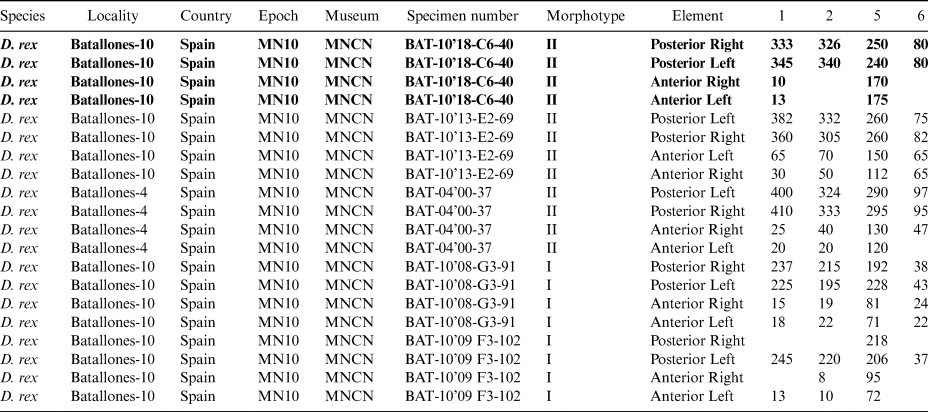
We mostly follow the measurements proposed by Ríos et al. (Reference Ríos, Sánchez and Morales2017) for the skull Ríos et al. (Reference Ríos, Sánchez and Morales2017: Online S1, Figs S1.1, S1.2). All measurements are presented in Table 1. We took all measurements with Mitutoyo digital calipers.
Comparative measurements of Decennatherium rex ossicones

Boldface type mentioned as new studied material.
1 Length of the ossicone (dorsal).
2 Length of the ossicone(ventral).
3 Anteroposterior diameter (APD) at the ossicone base.
4 Transverse diameter (TD) at the ossicone base.
5 Circumference at the ossicone base.
6 Circumference at the ossicone tip.
7 APD at the ossicone tip.
8 TD at the ossicone tip.
9 Perpendicular height; of the ossicone from skull roof to tip.
10 TD at the middle of the ossicone.
11 APD at the middle of the ossicone.
12 Distance between tips of anterior ossicones/distance between tips posterior ossicones.
13 Distance between bases of anterior ossicones/distance between bases of posterior ossicones.
14 Distance between bases of anterior and posterior ossicones of the same side.
3.3. Nomenclature
For anatomical nomenclature of the cranial skeleton we follow Barone (Reference Barone1999), and the terminology proposed by Bärmann & Rössner (Reference Bärmann and Rössner2011), and Azanza (Reference Azanza2000) for the dentition.
4. Systematic palaeontology
MAMMALIA Linnaeus, Reference Linnaeus1758
CETARTIODACTYLA Montgelard et al. Reference Montgelard, Catzeflis and Douzery1997
RUMINANTIA Scopoli, Reference Scopoli1777
PECORA sensu Webb & Taylor, Reference Webb and Taylor1980
GIRAFFIDAE Gray, Reference Gray1821
Genus Decennatherium Crusafont, Reference Crusafont1952
D. rex Ríos et al. Reference Ríos, Sánchez and Morales2017
(Fig. 2)
4.1. Etymology
Rex, Latin for king.
4.2. Emended diagnosis
A large giraffid with two pairs of ossicones. Smaller anterior pair located above the orbits and anteriorly oriented, and variable as it can show a single ossification point or that each be formed by two bosses and separated by a septum. Larger posterior pair located posterior to the orbits and posteriorly oriented. Posterior ossicones curved, showing a high number of ridges on their surface. Middle indentation of the hard palate slightly posterior to the M3. Broad occipital. Long premaxillae. Elongated diastema. p3 lacking mesolingual conid. Slightly molarised p4. Cervical vertebrae of medium length. Scapula with acromion. Robust postcranial skeleton. Metacarpals of medium length showing a medium depth palmar trough. Differs from Decennatherium pachecoi in: p3 with an isolated wall-like mesolingual conid structure; anterior stylid and conid of the p3 always present; and more robust metapodials.
4.3. Holotype
BAT10’13-E2-69, skull with ossicones and mandible.
4.4. Paratypes
The remaining referred material from Batallones-10.
4.5. Locality, age and horizon
Batallones-10, Cerro de los Batallones, late Vallesian, MN 10, local zone J, Madrid province, Spain. (ca. 9 Ma) (Fig. 1).
4.6. Material
BAT10’18-C6-40, partial cranium bearing two anterior and two posterior ossicones (Fig. 2).
5. Description
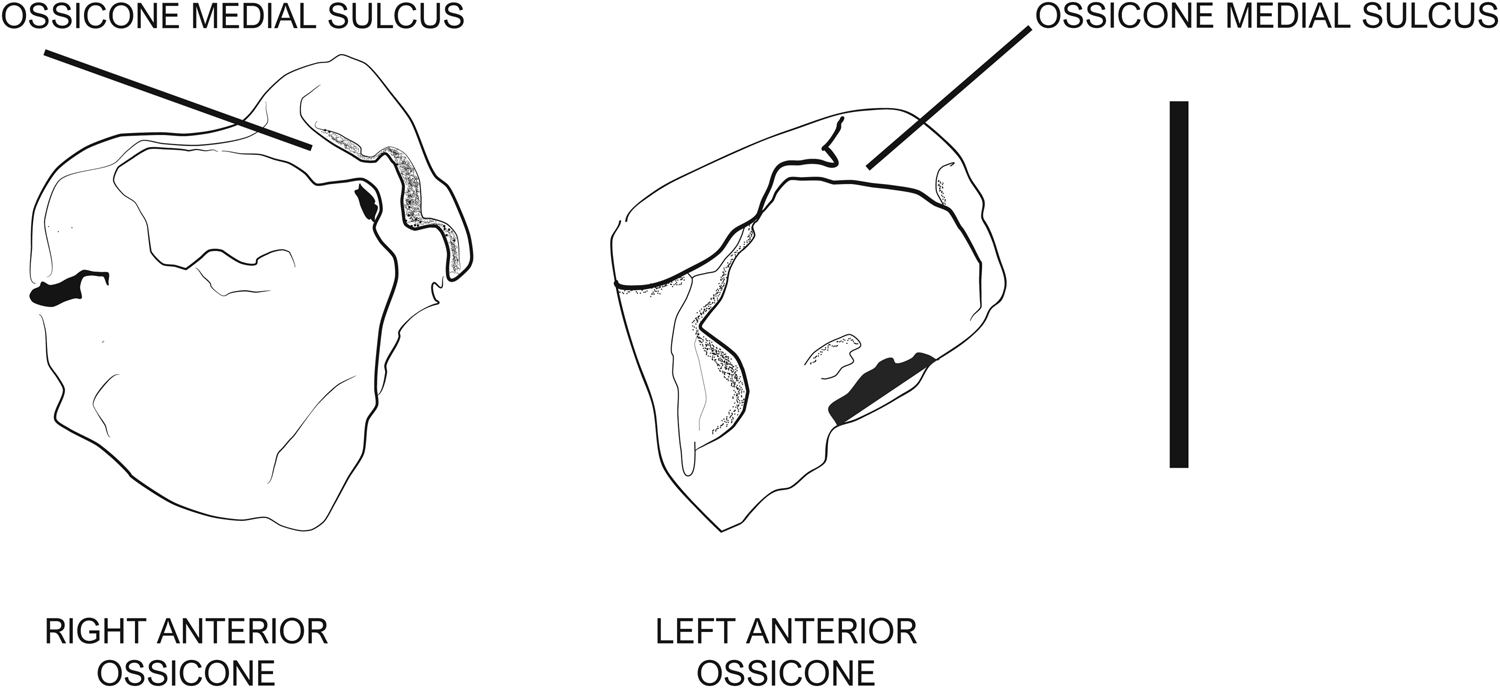
BAT10’18-C6-40 (Figs 2, 3), is a partial skull bearing two anterior and two posterior ossicones. The anterior ossicones are frontal and each of them is formed by two asymmetrical bosses. Each one is separated by a deep septum that reaches the skull roof and runs diagonally to the sagittal skull plane (Fig. 3). They reach a vertical height of 13 mm. The anterior boss is larger occupying three-quarters of the total anterior ossicone area. The posterior ossicones are long, reaching 345 mm in length, and are located posterior to the orbits over the parietals. They are oriented posteriorly and slightly outwards. The posterior ossicones are curved, ornamented by numerous surface ridges, which run longitudinally from the base to the tip of the ossicone. There is a large swelling located dorsally on the middle of the ossicone at a similar height on the right and left ossicones. The apices are blunt. The surface of the ossicones is very porous, similarly to the surface of the ossicones of extant Giraffa. This may indicate that even with their large size they were covered in hair, irrigated by the cornual artery. There is no development of the frontal sinus to hollow the ossicones.
BAT10’18-C6-40, skull fragment of Decennatherium rex bearing four ossicones: (a) posterior view; (b) medial/lateral view; (c) ventral view of the basioccipital region; (d) dorsal view; (e) close-up of the right anterior ossicone; and (f) close-up of the left anterior ossicone.

BAT10’18-C6-40: anterior ossicones interpretative drawing showing the medial sulcus.

In ventral view the foramen magnum is rounded and deep with a deep intercondylar groove. The retroarticular process expansion is not fused to the bullae, which are not very developed. The auditory meatus is rounded and laterally oriented. The bassioccipital muscular tubercles of the occipital are very prominent. Measurements are detailed in Table 1.
6. Discussion
6.1. Ontogenetic state
BAT10’18-C6-40 corresponds to D. rex Morphotype II (Fig. 4) as it shows a higher development in both anterior and posterior ossicones than Morphotype I (Ríos et al. Reference Ríos, Sánchez and Morales2017). Morphotype II most likely corresponds with adult males (Ríos & Morales Reference Ríos and Morales2019). BAT10’18-C6-40 only has the first swelling or bump that appears in D. rex males’ ontogenetic process as a consequence of secondary bone deposition, indicating that it was not too advanced in its ontogenetic development – older males show a much higher number of dorsal ventral and lateral swellings resulting from this secondary bone may be related to the age of the individual. This agrees with Solounias et al. (Reference Solounias, Teaford and Walker1988) who stated that these small irregular protuberances have a somewhat fixed position, suggesting a genetic basis.
Decennatherium rex skulls showing ossicone variability: (a, b) BAT-10’08-G3-91, morphptype I (female) skull in (a) medial/lateral view; (b) ventral view; (c, d) BAT10’13.E2-69, morphptype II (male) skull in (c) medial/lateral view; (d) ventral view; (e, f) BAT-04’00-37, morphptype II (old male) skull in E medial/lateral view; and (f) ventral view.

6.2. Anterior ossicone variability
Posterior ossicone variability has already been described in several sivatherine taxa as S. maurusium (Harris Reference Harris1974) and D. rex (Ríos et al. Reference Ríos, Sánchez and Morales2017; Ríos & Morales Reference Ríos and Morales2019) (Fig. 3), but anterior ossicone variability has never been discussed for four-ossicone giraffid taxa. All anterior ossicones found in both previously described D. rex morphotypes arise from a single osteological base; however, BAT10’18-C6-40 accounts for a third morphotype found in D. rex anterior ossicones (Ríos et al. Reference Ríos, Sánchez and Morales2017; Ríos & Morales Reference Ríos and Morales2019). BAT10'18-C6-40 is identified as an adult D. rex male not very advanced in age on the basis of the development of the posterior ossicones and the development of the middle dorsal swelling. However, its anterior ossicones differ, as usually the smaller anterior pair in males is more developed, conical, and is anteriorly oriented forming an angle with the skull roof of approximately 60°, while reaching 65 mm in height. Morphotype I (females) anterior and posterior ossicones are less developed than in BAT10’18-C6-40 and the anterior ossicones are reduced to unattached little circular discs with a pointy projection in the middle, and the slenderer posterior ossicones range from 225 mm to 270 mm in length. The distance between the bases of the anterior and posterior ossicones in morphotype II also differs, doubling morphotype II in comparison to that of morphotype I (~80 mm vs ~40 mm). According to Harris (Reference Harris1974), his disparity in size and development of the bumps in giraffid posterior ossicones may represent individual variability, but it is also possible that the amount of secondary bone apposition, in the form of ornamentation, may be a function of the age of the individual. However, the morphological disparity of the anterior ossicones of BAT10’18-C6-40 clearly accounts for a third anterior ossicone morphotype in D. rex, specifically a second variant of morphotype II. This new morphotype and this high degree of anterior ossicone variability may be related to the specimen being a male (which deposit more secondary bone) as well as the ontogenetic state of the individual. This new specimen represents a new example of cranial variability in D. rex, and makes it the extinct giraffid with the largest anterior ossicone variability found so far in the fossil record.
7. Conclusions
The recovery of a new partial cranium of D. rex Ríos et al. Reference Ríos, Sánchez and Morales2017, bearing two anterior and two posterior ossicones from the Late Miocene deposits of the site Batallones-10 (MN-10, Cerro de los Batallones, Madrid Basin), sheds light on the complex variability of the cranial appendages of these extinct giraffids. The special features of the anterior ossicones of BAT10’18-C6-40, each formed by two bosses and separated by a diagonally placed septum, increase the range of morphological variability found in the anterior ossicones of giraffids. Posterior ossicone variability has already been described in several sivatherine taxa but anterior ossicone variability has never been discussed for four-ossicone taxa. This new specimen accounts for the third morphotype found in D. rex anterior ossicones (Ríos et al. Reference Ríos, Sánchez and Morales2017; Ríos & Morales Reference Ríos and Morales2019). BAT10’18-C6-40 is identified as an adult, but not elderly, D. rex male on the basis of the development of the posterior ossicones. These are large and already show the first large bump, which in this taxon is always located on the middle of the dorsal surface at a similar height on the right and left ossicones (Ríos et al. Reference Ríos, Sánchez and Morales2017), agreeing with Solounias et al. (Reference Solounias, Teaford and Walker1988) on the hypothesis of these small irregular protuberances having a genetic basis for their fixed position. This new specimen represents a new example of cranial variability in D. rex, and makes it the extinct giraffid with the highest anterior ossicone variability found so far.
8. Acknowledgements
MR thanks the Stimulus of Scientific Employment, Individual Support – 2018 Call grant by the Fundação para a Ciência e a Tecnologia (Portugal, CEECIND/02199/2018) and GeoBioTec as well as the project EXPL/CTA-PAL/0832/2021. MR also thanks the SYNTHESIS + program 2019.
We also thank P. Perez and S. Fraile (MNCN-CSIC, Madrid, Spain), L. Celia and D. DeMiguel (ICP, Barcelona, Spain), P. Montoya (MGUV, Valencia, Spain), J. Galkin, J. Meng and E. Westwig (American Museum of Natural History; New York, USA), P. Brewer and S. Pappa (Natural History Museum, London, UK), C. Argot and S. Peigne (Muséum national d'histoire naturelle, Paris, France), U. B. Göhlich (Naturhistorisches Museum Wien, Vienna, Austria), and their respective home institutions for giving us access to their giraffid fossil collections. We thank E. Cantero, B. Gómez and P. Gutierrez for the preparation of the BAT10 fossils.
9. Competing interest statement
None.