Sung Latin poetry at the medieval Abbey of Sankt Gallen is typically associated with the generation of Notker Balbulus (d. c. 912), Tuotilo (d. c. 913) and Ratpert (d. c. 900), as well as their immediate pupils and successors.Footnote 1 The most celebrated corpus of sung verse is the collection of sequences entitled Liber ymnorum that Notker dedicated in 884 to Liutward, Bishop of Vercelli, Abbot of Bobbio, and Archchaplain and Chancellor to Emperor Charles the Fat.Footnote 2 To these versus ad sequentias may be added processional hymns or versus composed by Ratpert, Waldram (c. 900) and Hartmann (d. 925).Footnote 3 Further examples of sung poetry in the liturgy at Sankt Gallen in this period include versified introductions to tropes, especially in the form of what appears to be a cycle composed in hymnic forms for the Introit, several of which have been cautiously attributed to Notker.Footnote 4 Latin poetry sung outside of the liturgy is represented chiefly by notations added to a large number of metra from Boethius’s De consolatione philosophiae and other independent poems in a collection of didactic works whose earliest layer of text was copied at Sankt Gallen in the last quarter of the ninth century.Footnote 5 By contrast, the singing of Latin verse at Sankt Gallen before the last third of the ninth century remains almost entirely unknown, compounded by the fact that notated manuscripts of tropes, sequences and versus survive only from the closing years of the ninth century onwards.Footnote 6
Such a pattern of surviving evidence has contributed to the view that there was a flowering of music and poetry at Sankt Gallen from Notker’s generation onwards, enabled by a growth in learning fostered by a sequence of famed Masters beginning with Notker’s teachers, Iso and the Irishman Marcellus (both d. 871).Footnote 7 In turn, the fostering of a song school at the Abbey has been seen to reflect the wider cultural growth and self-confidence of the institution following confirmation of its status as an imperial abbey by Emperor Louis the German in 833 and the rebuilding of the abbey church under Abbot Gozbert in the 830s.Footnote 8 This familiar narrative of a golden period is supported by an in-house history of the abbey begun by Ratpert and then continued in a colourful vein by Ekkehard IV (d. c. 1060).Footnote 9 At the same time, it has tended to obscure aspects of Sankt Gallen’s musical history that cannot be linked with named individuals, notated sources and vivid anecdotes. In particular, the repertories available to the generation of Notker, Tuotilo and Ratpert, the versified models that Iso taught and used as the basis for his advice, and the nature of the musical culture of the abbey before the period characterised by new composition by identifiable individuals and the development of a highly sophisticated notation, remain an open question.
New light is shed on the culture of sung Latin verse at Sankt Gallen around the turn of the ninth century by a collection long known to literary scholars, but whose musical implications have not previously been explored in any detail, i.e. Leiden Voss. Lat. Q. 69.Footnote 10 This collection is significant first because the verse collection within the codex transmits rhythmical and metrical Latin verse in sung forms, thereby witnessing to song culture at the Abbey of Sankt Gallen substantially before our earliest previous witnesses. It provides evidence of an ongoing process of adaptation and correction to verse texts in the central years of Carolingian rule, which in turn served to provide models for later developments. The Leiden collection also stands at the very beginnings of a tradition of verse collections that extends from the ninth through to the mid-eleventh century and whose contents afford a glimpse into a clerical culture of song outside of the regular liturgical cursus.
THE VERSE COLLECTION OF LEIDEN VOSS. LAT. Q. 69
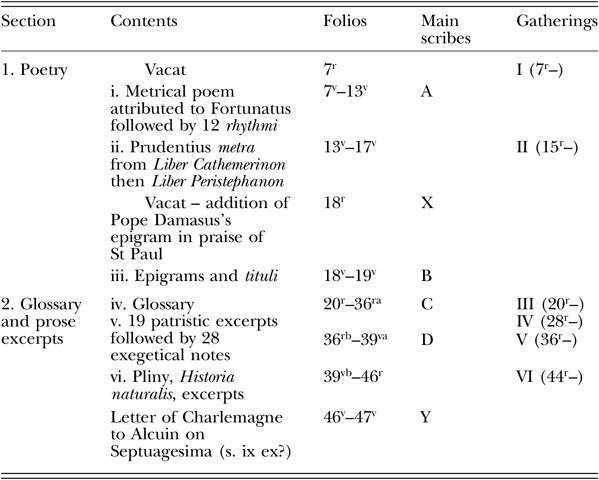
In its current state, Leiden Voss lat. Q. 69 comprises six separate books, the second of which spans some forty folios (fols. 7–47). The second book was copied by multiple scribes whose work cannot always be easily distinguished, but their neat and clear scripts are consistent with the overall elegant presentation within a codex of medium dimensions (25 × 16 cm). The physical construction of the second book is regular and marked by clear sectional divisions: eight folio gatherings were maintained except at the end of the two main sections where local arrangements were made to ensure that new content began on new gatherings.Footnote 11 The ruling is likewise regular throughout the book: two columns are marked out by three pairs of perpendicular lines set 5–6 mm apart; there are usually thirty-five horizontal lines per page, with small changes made during the copying project seemingly to accommodate the material within a set number of gatherings.Footnote 12 Care was also taken in the ordering of materials: the book divides neatly into two sections, beginning with poetry of various types (fols. 7r–19v) and then a glossary followed by prose excerpts (fols. 20r–46r). Blank covers originally preceded both the opening mainly rhythmical and accentual Latin poems followed by the poetry of Prudentius (fol. 7r) and the inscriptions and epigrams (fol. 18r). The clearest changes of scribe align with new contents across both sections, i.e. the opening of the inscriptions (fol. 18v), the glossary (fol. 20r) and the patristic excerpts (fol. 36rb). The work of multiple scribes can be discerned within sections, closely interwoven to the extent of one scribe copying the first strophe of a poem which was then completed by another (Plus solito coeunt, fol. 16r).Footnote 13 This combination of physical, compilational, and copying features suggests that several scribes worked in close proximity to execute a carefully planned project, with the blank spaces allowing flexibility in completing the copying of individual sections.
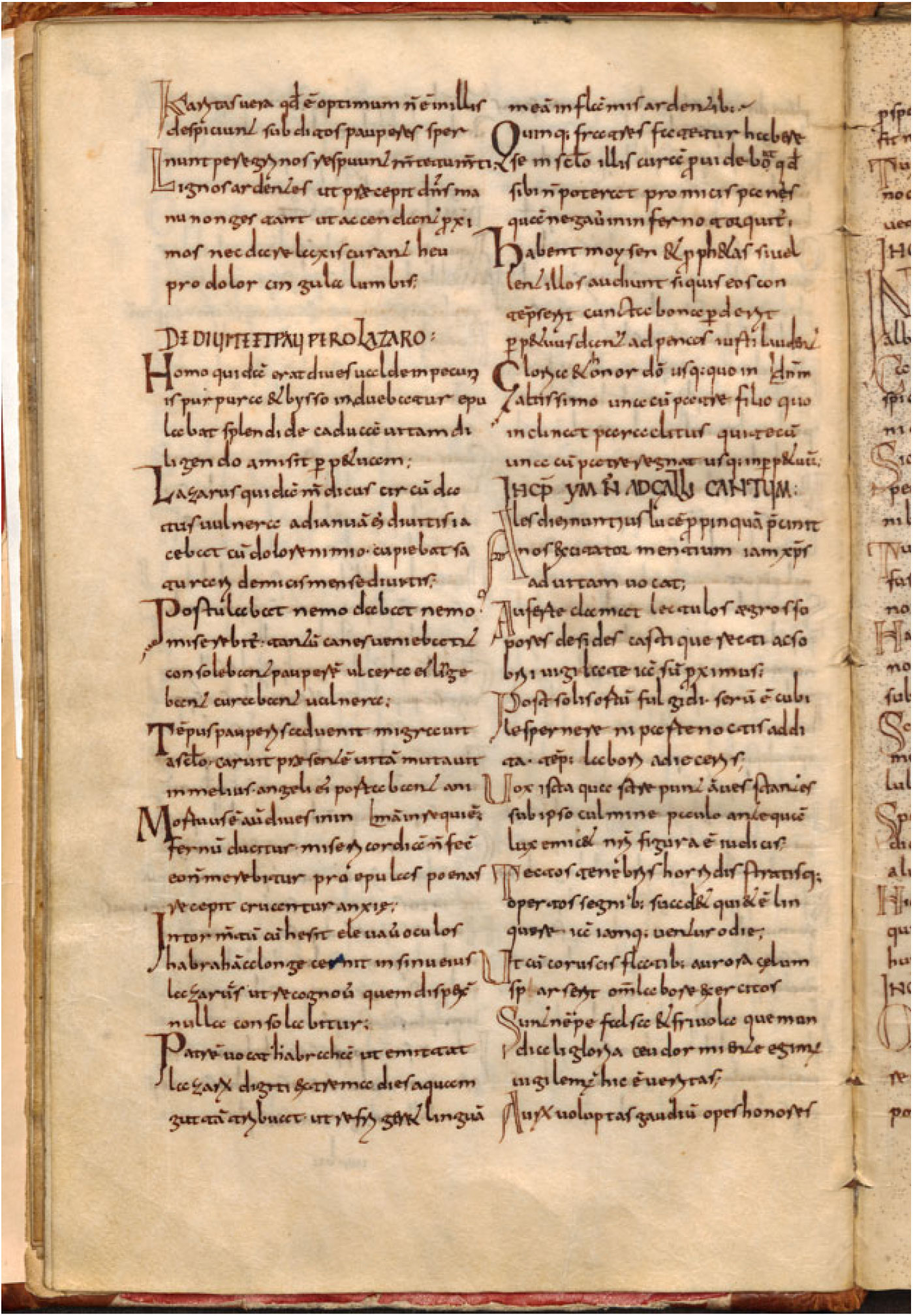
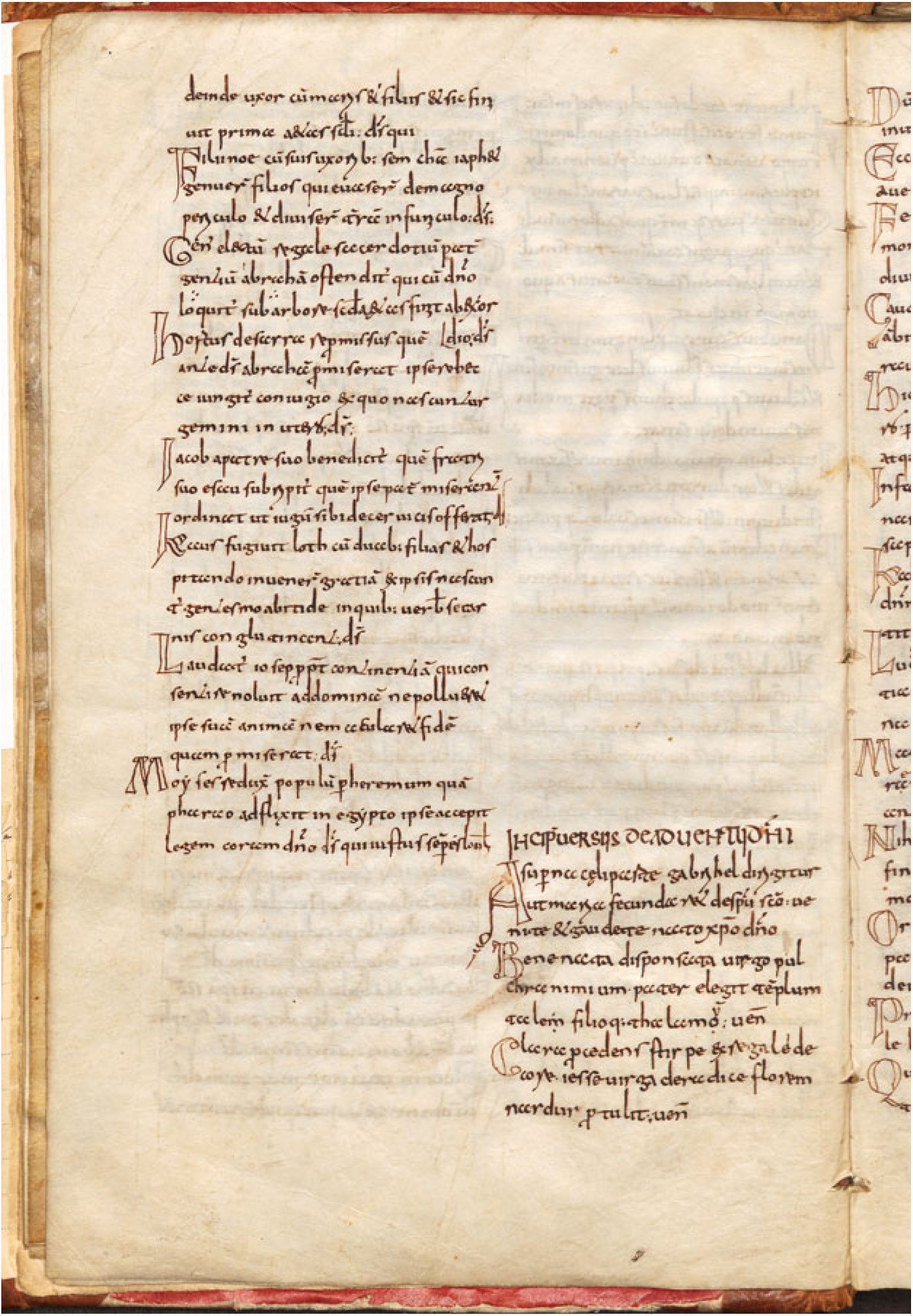
Ludwig Traube, Bernhard Bischoff and Elias Lowe agreed in assigning the copying of the manuscript to several different scribes writing Alemannic minuscules at the Abbey of Sankt Gallen around the year 800.Footnote 14 The grounds for their attribution are not fully elaborated, but a later Sankt Gallen provenance for the collection is assured by the thirteenth-century charter and list of abbots copied by Manegold, Dean of Sankt Gallen, that makes up Pt. V of the manuscript.Footnote 15 More pertinently, the scripts in Pt. II are consistent with the style of Alemannic minuscule employed at the abbeys of Sankt Gallen and Reichenau c. 800 (see Figures 1 and 2 below for scripts from the poetic section).Footnote 16 The formation of specific letters, frequent ligatures and distinctive descenders in the rustic capital forms indicate a relatively late stage in the Alemannic script;Footnote 17 in particular, the ensemble of features recalls scripts found in two collections, one of biblical-historical and biblical-geographical texts copied c. 800 (Sankt Gallen 133) and one of grammatical texts copied towards the end of the eighth century (Sankt Gallen 876). There are visual similarities to Sankt Gallen 876 in the mostly undecorated hollow majuscule capitals and uncoloured hollow initials, whose non-figural decorations include internal bands and comb-like shafts, as well as upper globules in leaf-like configurations and extended tails often ending in dashes and a headed diagonal stroke or swirl.Footnote 18 The use of several insular abbreviations and at least one insular ligature as noted by Lowe aligns with the well-attested reception of insular texts at Sankt Gallen, while the presence of Old High German accords with the tradition of glossing in Old High German at Sankt Gallen from c. 750 onwards.Footnote 19
Leiden Universiteitsbibliotheek Vossianus Lat. Q. 69, fol. 13v. Reproduced with the permission of the Universiteitsbibliotheek

Leiden Universiteitsbibliotheek Vossianus Lat. Q. 69, fol. 9v. Reproduced with the permission of the Universiteitsbibliotheek

There is therefore a strong case for attributing the copying of the second book of Leiden Voss. Lat. Q. 69 to Sankt Gallen during the time of Abbot Werdo (784–812), a period characterised by the systematic correction, collation and improvement of codices, and expansion of the previous concentration on copying biblical and patristic literature to include commentaries and compendia, grammatical, geographic and other technical writings as well as Saints’ lives.Footnote 20 The customarily assigned date of c. 800 may be qualified on internal grounds. Alcuin’s dedicatory poem for Charlemagne’s newly added chapel at Aix-la-Chapelle was copied towards the end of a series of epigrams and tituli as part of the earliest layer of Pt. II.Footnote 21 The presence of this poem sets boundaries on the dates for the copying of this part of the manuscript. A letter written by Alcuin in 798 records that construction of the Palatine Chapel was almost complete, although it was not until 805 that Pope Leo III consecrated the chapel.Footnote 22 It remains possible that the dedicatory verses, which can still be seen today encircling the chapel above the first tier of the octagonal arches, were transmitted as a text before 805, but it is most likely they were copied into the Leiden manuscript sometime after the consecration. Taking this into account, a cautious date for the copying of Pt. II would be the first decade of the ninth century.
The second book of Leiden Voss. Lat. Q. 69 has been described as a ‘Schoolbook or Proto-Encyclopaedic Miscellany’ on the grounds of its contents, many of which can be traced back ultimately to insular sources (see Table 1).Footnote 23 To begin with the second section, the Latin-Anglo-Saxon glossary has been traced to the teaching of Theodore and Hadrian at Canterbury from the years 670–90.Footnote 24 The brief technical, geographical and philosophical excerpts from patristic authors on diverse topics that follow (including dimensions of the ark, the seven man-made wonders of the world and the character of the Saxons) can be traced back to texts familiar in Anglo-Saxon England and strongly suggest compilation with a didactic purpose in mind.Footnote 25 The subsequent twenty-eight short exegetical notes contain much material from the Canterbury School at the time of Theodore and Hadrian.Footnote 26 An insular origin has likewise been suggested for the excerpts from Pliny’s Historia naturalis, which concentrate on Britain, Ireland, the Orkneys and Greenland.Footnote 27 The confection of astronomical excerpts, which may have been put together in the circle of Bede after his death, also seems particularly suited to teaching.Footnote 28 A later ninth-century addition, a letter of Charlemagne to Alcuin on the celebration of Septuagesima, closes the second section in its current state.Footnote 29
The contents and copying of Pt. II of Leiden Voss. lat. Q. 69

A didactic purpose is likewise probable for the first section, which is set apart by its concentration on poetry and in which insular connections are again to the fore. Inscriptions and epigrams as collected together in syllogae from the seventh century onwards served as models for imitative literary composition, as well as offering up role models for emulation and reinforcing an imaginative cultural connection to Rome.Footnote 30 The epigrams and tituli in this manuscript open with a series of poems whose ordering is lightly adapted from a seventh-century Spanish collection of short poems of Italian origin known as the Anthologia Isidoriana (so-called because the poems are found in a few manuscripts that also contain Isidore’s Etymologiae).Footnote 31 Pope Gregory the Great is given particular prominence in the sequence presented in this manuscript by the simple operation of moving the opening two poems in the Anthologia Isidoriana to the end. The effect of this reordering is to place the Roman poems at the head of the collection, i.e. poems on Pope Gregory (2), St Peter’s Rome, St Paul’s Rome and Pope Damasus.Footnote 32 An insular source may lie behind this reshuffle given the esteem in which Gregory was held in England,Footnote 33 although it remains most likely that the switch was made directly from a copy of the Anthologia Isidoriana given the preservation of most of the ordering from this collection. A prayer by Eugenius of Toledo and a letter by Dynamius the Grammarian to his pupil were added after the inscriptions and tituli.Footnote 34 Turning to the opening poetic material, the association of Prudentian metra and rhythmic poetry with teaching is well established. The work of Prudentius was central to the canon of Christian poets that formed the basis of learning during the Carolingian era, providing a model of both grammatical and doctrinal orthodoxy.Footnote 35 The collection of mainly rhythmical Latin poems that opens this section of the manuscript may similarly be broadly associated with teaching insofar as non-liturgical rhythmical poetry of this era has tended to be regarded within the monastic context as edificatory material for cloister, cell or schoolroom.
There is therefore ample justification for describing the whole of Pt. II of Leiden Voss. Lat. Q. 69 as a carefully planned collection of material suited to supporting learning. It was evidently copied from multiple different collections of material, several (although not all) of which may be traced back to insular sources. The copying of the second book of Leiden Voss. lat. Q. 69 is thus consistent with the wider project of compiling and copying texts under Abbot Werdo, but it is not simply a didactic compilation or encyclopedic miscellany. It is newly proposed here that the opening poetry in this manuscript, i.e. the rhythmi and the Prudentian metra, can also be considered a collection of songs.
The two groups of poetry copied at the opening of the manuscript will be considered here in turn. Before considering internal evidence, perhaps the strongest visual index of singing and one which extends across both groups of material should be considered, namely layout. Both the rhythmi and the Prudentian metra are copied in strophes, which open with a littera notabilior but whose internal line endings are not marked by majuscules or punctuation (see Figure 1). This continuous strophic layout was not inherited from antiquity, but newly introduced in the Middle Ages. It is first found in the Bangor Antiphonary of 680–91 and was later used in a series of ninth-century hymn collections, as well as being employed for rhythmi on secular topics.Footnote 36 As summarised by Malcolm Parkes, ‘since the melodies were familiar, scribes could copy the verses of a hymn stanza across the page or column like a prose text’.Footnote 37 The continuous strophic format adopted therefore implies that melodies were known for all the texts; in other words, the layout requires melodies to be heard in the mind of the reader in order to appreciate the poetic lines, which would have been particularly important for comprehension of the more complex Prudentian metra. A case may therefore be made for considering music as integral to the design of the verse collection in Leiden Voss. lat. Q. 69.
INDIVIDUAL POEMS
The poetry in the Leiden manuscript has previously attracted attention as the earliest substantial corpus of rhythmi, standing at the beginning of an initially Carolingian tradition of collecting together accentual Latin poetry composed from the seventh through to the ninth centuries.Footnote 38 Rhythmi of this kind remained in circulation up to the mid-eleventh century, as witnessed by the Cambridge Songs, before being overtaken by new repertories of sung versus and conductus characterised by regular accentuation through the line and newly created verse forms. It has previously been argued that individual collections of rhythmi, which typically also include occasional strophic metrical verses from late antiquity onwards, were collections of verse intended to be sung, whether or not notation was added to individual songs. Jan Ziolkowski, for example, has argued that the Cambridge Songs was the result of a compilation made by a ‘song-lover’.Footnote 39 I have proposed elsewhere that three of the main Carolingian poetic collections dating from the second half of the ninth century were drawn up as collections of sung items.Footnote 40
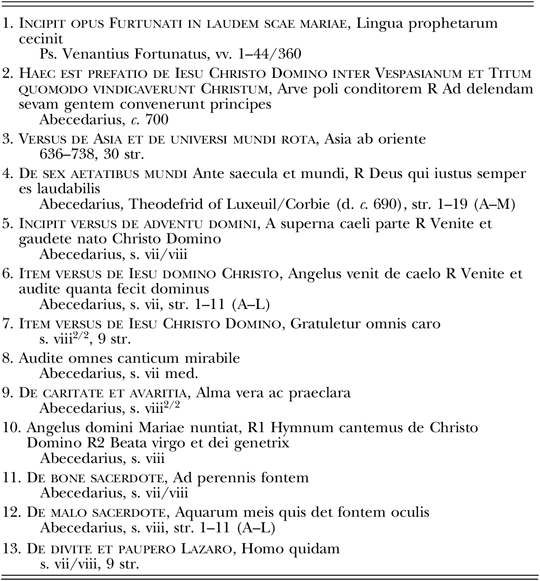
Several of the poems gathered together at the opening of Leiden Voss. lat. Q. 69 have hymnic features (see Table 2). Almost all are abecedary rhythmi, i.e. accentual poems organised into strophes that begin with successive letters of the alphabet. The formal model was Sedulius’s fifth-century hymn A solis ortus cardine, which also provided a template for basing a hymn on the main events of Christ’s life, namely the incarnation, the coming of the magi, Christ’s miracles, the raising of Lazarus, the Passion, the Harrowing of Hell and the Resurrection. The mnemonic and didactic value of both the abecedary framework and the narrative structure is clear. Of the four poems that do not follow the Sedulian model in either structure or content, one traces a similar set of themes in hymnic fashion (Gratuletur omnis caro, no. 7) and is copied amid the abecedary verse, another concentrates on a single topic (Dives et Lazarus) and was later used as a processional hymn (Homo quidam, no. 13). This leaves only two poems, the first of which is the opening metrical poem attributed to Venantius Fortunatus (Lingua prophetarum cecinit, no. 1), whose truncated version focuses on Old Testament prophecies of the incarnation.Footnote 41 The second is a rare cosmographic poem paraphrasing Isidore’s Etymologiae that survives in a different version in two earlier manuscripts copied at Sankt Gallen (Asia ab oriente, no. 3).
The verse collection in Leiden Voss. lat. Q. 69

The ordering of the poems in the Leiden collection is also significant. The collection opens with the only metrum by a recognised auctoritas, Venantius Fortunatus, who is also the only author mentioned in the rubrics (no. 1). There follow historical and geographical poems (nos. 2–4) and then poems that hint at a liturgically organised Temporal series, i.e. a poem whose rubric mentions Advent (5), then Nativity poems (6–7) followed by one relating to Easter (no. 8). Poems on individual figures are placed at the end in hierarchical order, beginning with Mary (no. 11), then priests (good and bad, nos. 11 and 12), then the laymen Dives and Lazarus (no. 13). The significance of these groupings should not be overplayed since they were not emphasised by the rubricator. Even so, the only metrical poem is placed first and a highly regarded author is named, followed by abecedary poems tracing events in the life of Christ, then poems on other figures.
Similar features have been observed in the ordering of other ninth-century collections of poetry all of whose items appear to have been sung. In two later ninth-century poetic collections associated with St-Denis (a hymnal and verse collection now held in Berne, and a capitulary now held in Verona to which verse was added in the margins), the poetry of Fortunatus is again placed at the head, followed by poems by named authors, then anonymous abecedary rhythmi, with Boethian and Prudentian metra handled separately.Footnote 42 In a late ninth-century verse collection copied at St-Bertin now held in Brussels, the mutilated opening of the collection begins with poems that paraphrase Old Testament stories, followed by a collection of abecedary rhythmi loosely ordered by topic, beginning with poems in the order of the Temporale and ending with those for individual figures.Footnote 43 A series of moralistic poems is copied next before hymnic poems that divide in broad terms into those dealing with the life of Christ, and those addressed to individual saints. Again, the groupings are not absolute and may reflect patterns of transmission as much as overarching patterns imposed as a distinct programme by a single compiler. The point nevertheless needs emphasising that authorship, arrangement by poetic style (metrical, rhythmical, alphabetical) and content (historical, hymnic, moral-didactic), as well as a broad distinction between events in the life of Christ and other individual figures, are present in a number of ninth-century collections of Latin poetry suited to sung performance.
In considering the musical implications of the individual poems in the Leiden collection in more detail, four indexes of singing will be addressed in turn: (1) notation for the same poems in later manuscripts, (2) refrains, (3) internal references to singing and (4) abridged versions of texts. None of these factors is sufficient in itself as a sign of musical performance but taken together they build a strong case for considering the poems as sung items and create a picture of the state of sung versus at Sankt Gallen at the beginning of the ninth century.
Notated Concordances
The absence of notation from the Leiden manuscript is not in itself surprising in view of its early date of copying.Footnote 44 It is also the case that few non-liturgical rhythmi survive with notation before the twelfth century. Indeed, no systematically notated corpus of rhythmi survives from this period; where neumes were added, they were typically inserted at a later date, by a number of different scribes, between the lines of manuscripts not prepared for notation. In total, there are around only thirty surviving notated rhythmi out of several hundred composed before c. 900 whose texts were in all probability sung.Footnote 45 While the number of surviving notated rhythmi is small, a far larger number may be presumed to have been sung on the grounds of their form (strophic and refrain forms) and contents (hymns, laments, ballads, love-songs, computus, etc.).Footnote 46
Key evidence for singing rhythmi outside the liturgy at Sankt Gallen is provided by the fact that the opening strophes of nos. 4, 7, 8 and 9 were added in the same order to a previously blank leaf in a later ninth-century Sankt Gallen compilation (Naples IV. G. 68). Three of the four poems were notated in the Naples manuscript and the other presented in a similar way insofar as only the opening strophe was copied, thereby strongly implying an interest in musical properties. There is also a close textual relation between the versions of the poems found in the Leiden and Naples manuscripts; Dieter Schaller observed that three of the four share unique variants and the other (Audite omnes) is found only in these two sources.Footnote 47 Ante saecula et mundi provides a particularly strong case as of the three manuscripts that transmit the poem, all of which were copied at Sankt Gallen, only the Leiden and Naples manuscripts include the refrain. Francesco Stella has noted further that the Leiden version seems to correct an earlier text that lies closer to oral tradition as reflected by the earlier Sankt Gallen source (Sankt Gallen 2, 760–80), and that while the Leiden and Naples versions share common variants, the Naples version offers further grammatical regularisation.Footnote 48 It is therefore most likely that the scribe who added texts and neumes to the Naples manuscript had either the Leiden version or a closely related one to hand, and continued a process of correctio begun in the earlier source.Footnote 49
Refrains
A second index of musical performance is the presence of refrains, which were recorded for five of the rhythmi (nos. 2, 4, 5, 6 and 10). Andreas Haug has argued that refrain in Latin song before the advent of the ‘New Song’ in the eleventh century is ‘real, performative, and functional’, introducing a shift in focus from the narrative function of the strophes to a repeating thematic core.Footnote 50 By extension, the presence of a refrain in the ‘Old Song’ strongly implies sung performance, drawing on a ritual distinction between verses sung by soloists and a respond sung by a group. Theodefrid’s ritmus on the six ages of the world (Ante saecula et mundi, no. 4), for example, reads Deus qui iustus semper es laudabilis, which matches the rhythmical scheme of the strophe (an imitation of an iambic trimeter) while having the quality of a liturgical prose formula. The wording brings to mind the Canticle of the Three Boys (Daniel 3:26–7):Footnote 51
Benedictus es domine deus patrum nostrorum, et laudabilis, et gloriosum nomen tuum in secula. Quia iustus es in omnibus quae fecisti nobis …
The poem also features a marked shift in voice. The opening two strophes, both beginning with the letter A, are part of an introduction whose author is identified in the second strophe as Theodefrid. The first two strophes thus assume a personal, almost prayer-like quality of dedicatory address:Footnote 52
Thereafter, the abecedary poem proper begins, in which the strophes retell a universal history stretching from Adam to the Last Judgement. This sets up a tension between reported biblical narrative in the strophes and direct address in the mode of praise in the refrain. The overall impression is of a refrain that is communal and laudatory in character, set against a story told by single narrator assuming the authorial position of Theodefrid.
There are several other examples of what appear to be quotations in refrains that suggest liturgical and communal rendition. Two previously noted are the refrains for Angelus venit de caelo (6) and A superna parte (5), which seem to be direct imitations. The refrain of A superna parte appears to be a direct imitation of the refrain of Angelus venit de caelo, which is most likely earlier since it is taken from Psalm 65:16:Footnote 53
Psalm 65:16: Venite, audite, et narrabo, omnes qui timetis Deum, quanta fecit Dominus anima meae.
The decidedly anti-Semitic Arve poli conditorem, which reworks passages from Pseudo-Hegesippus’s De excidio urbis Hierosolymitanae as adapted from Josephus’s The Jewish War, has a refrain with an even more distant echo. The language of Psalm 2, which speaks in bellicose terms of the Lord’s anointed conquering the Gentile nations and having them in possession as an inheritance, is arguably inverted to describe the exploits of Emperors Vespasian and his son Titus in crushing Jewish rebellion during the first Jewish–Roman War:Footnote 54
Psalm 2:2 (and Acts 4:26): Astiterunt reges terrae, et principes convenerunt in unum adversus Dominum, et adversus Christum ejus.
What is significant in these cases is not simply the presence of refrains but the fact that they quote from sung texts, which is itself consistent with wider practice in rhythmical poetry of this period. The so-called Mozarabic preces, penitential strophic songs with refrains used in the Old Spanish rite that seemingly date back to the second half of the seventh century, feature many such examples of refrains that appear to be quotations from liturgical formulae, e.g. Deus miserere, Deus miserere, miserere nobis pro peccatis nostris. As argued by Norberg, these refrains introduced lines that have no direct classical percursors and may have served as the basis for new rhythmical poetic forms.Footnote 55 In addition, the phenomenon suggests a basis in ritual practice, articulating a distinction between narrative verses suited to performance by soloists, and refrains that reprise a thematic core and suggest communal performance.Footnote 56 This distinction in kind is articulated clearly at the opening of Angelus Domini Mariae (10), whose refrain, found only in this manuscript, refers to itself as a communally performed hymn:Footnote 57
Internal References to Singing
Angelus domini introduces the third index of musical performance, the possibility that the Leiden abecedary rhythmi were festal songs or hymns of some sort. Two follow the Sedulian model referred to above closely in terms of theme and structure (A superna caeli parte, 5, and Angelus venit de caelo, 6); one is abecedary, focused on retelling the Christmas story and described in its rubric as ‘De adnuntiatione Sanctae Mariae’ (Angelus domini Mariae nuntiat, 10); and two more are transmitted as hymns in later manuscripts (Gratuletur omnis, 7, and Homo quidam, 13). All of these hint at sung performance through shared generic characteristics as hymns. In addition, two rhythmi contain internal references to their own sung performance. Alma vera ac praeclara (9) is abecedary, but thematically consists of alternating strophes on caritas and its opposite, avaritia. From strophe R onwards, the focus shifts to praise of God and reference is made to the poem as a hymn that is communally sung:Footnote 58
Audite omnes (8) is particularly instructive. It begins in common with several abecedary rhythmi with an appeal to an audience to listen to the song about to be sung, using a formula that alludes to an oral tradition in which a singer gathers an audience.Footnote 59 What follows is a song in two parts, the first of which describes the Harrowing of Hell (strophes A–I),Footnote 60 before the second part turns to the Easter resurrection story (strophes L onwards). The antepenultimate and penultimate strophes (X and Y) add more detail about the supposed performance context.Footnote 61

The image of different social circles united in song at court has been understood as realistic. Norberg suggested that the poem may refer to performance at the Merovingian court at a time when mayors of the palace (the potentes personae) held sway, thus after the reign of Dagobert, which ended in 639.Footnote 62 The poet expresses a visionary hope that the redemption promised by the Harrowing of Hell and Resurrection will bring together high and low, rich and poor, abbot and novice, cleric and king. Whatever the original performance context, the poem as copied in Leiden manuscript records a richly allusive Easter hymn suited to performance outside of the regular liturgical round.
Shortened Versions
Among rhythmi in the main Carolingian collections, the number of strophes for songs of diverse kinds generally stands between nine and fifteen strophes, in contrast to Office hymns, which typically have eight strophes. There are two exceptions to this pattern. Poems that paraphrase biblical stories are much longer in their full versions, ranging from circa thirty-five to circa seventy strophes, from which shorter versions of between eight and twenty strophes were made, seemingly for purposes of sung performance since the concise versions typically concentrate on narrative, excising theological reflection.Footnote 63 Abecedary poems are also typically longer, for the most part standing at a full twenty-three strophes, occasionally with an extra doxology, although a number of shorter abecedary poems also survive.Footnote 64
Shortened versions of poems in the Leiden manuscript divide into two types. First, abecedary poems in which copying was cut abruptly short with space left to complete the whole, as for Ante saecula et mundi and Angelus venit de caelo, nos. 4 and 6 (see Figure 2 for Ante saecula et mundi, which breaks off following strophe M). In these cases, the cessation of copying around the mid-point of abecedary poems was linked by Karl Strecker to mounting grammatical errors in the text, which implies that the scribe stopped copying from an exemplar with the intent of finding a better version, leaving sufficient space to do so at a future point.Footnote 65 No such proliferation of grammatical errors can be proposed for Aquarum meis (no. 12), which similarly breaks off before the M strophe, but with no space left before the beginning of the next poem. It is possible that space was originally left for continuation of Aquarum meis since the next poem, Homo quidam, seems to have been added by a new scribe or at least copied in a way that sets it apart from the preceding poetry, suggesting at least a different exemplar. It is the only text among the individual poems to have initials that are not left empty, and the only poem in the whole collection to have blackened strophic initials throughout, including for the first strophe. Another unusual feature is that a single line was left blank before the rubric of this last poem before the Prudentian metra (see Figure 1 above). If space was originally left for the continuation of Aquarum meis and Homo quidam was added in the gap, then this would reduce the number of non-abecedary verse in the earliest layer of Leiden Voss. lat. Q. 69 to only three out of twelve: the opening metrum, the cosmographic ritmus, and Gratuletur omnis.Footnote 66
Leaving aside abecedary poems, a number of other texts exist in versions significantly shorter than those found elsewhere (nos. 1, 3, 7 and 13). In the first two instances, the Pseudo-Fortunatus and the cosmographic poem, much longer texts are significantly reduced. The shortened version of the Pseudo-Fortunatus, Lingua prophetarum, stands as a poem of forty-four lines or twenty-two couplets, which aligns it with other sung poems in the collection, i.e. equivalent to eleven strophes of a poem written in four-line strophes. The cosmographic poem, Asia ab oriente, is substantially longer, appearing in a version of thirty strophes that follows the westward march of description from Asia as far as Spain, but cutting short before passing to Africa, Italy and Britain.Footnote 67 The whole gives the impression of a poem suited to teaching, somewhat akin to the more lengthy computus songs that can extend up to seventy strophes and are intent on summarising technical information, while also being sung.
Gratuletur omnis (no. 7), like many hymnic rhythmi, is transmitted with a variable number of strophes found in many different orders. The version recorded here does not transmit the more conventional closing strophes offering praise but does feature the middle strophes summarising Christ’s miracles and the Harrowing of Hell; in other words, the version given is closer to the pattern of the abecedary verses than a conventional hymn. Something similar may be traced for the final poem in the collection, Homo quidam (no. 13), whose version is not as short as those found in later hymnals, which are reduced to the typical eight strophes, but still sits within the typical range of sung poems at ten strophes. A case for reduction in overall length on associated musical grounds may therefore be made for three out of the four non-abecedary shortened poems, and for one on the basis of a didactic parallel with computus songs.
The overlapping indices for musical performance that have been highlighted within this section are: (i) the presence of notation for the same poems in later manuscripts from the same centre (4, 7, 8, 9) or elsewhere (13); (ii) the use of refrains, especially when using language redolent of sung liturgical formulae (2, 4, 5, 6, 10); (iii) internal references to singing (1, 2, 8, 9 and 10); and (iv) shortened versions of texts (1, 3, 7 and 13, possibly also 4, 6 and 12). One or more indices of musical performance can therefore be found for all but one of the poems in the collection, i.e. Ad perennis vitae fontem (11), which seems to be merely a case of happenstance since this poem forms a pair with the following one as abecedary verses on the theme of good and bad priests respectively. As stated earlier, none of the indications is sufficient by itself to guarantee musical performance and other motivations informing this gathering of poems are not ruled out by highlighting musical factors. There is, for example, a clear educational component to the assembly of poems on historical and geographical topics, as well as the poems that summarise key aspects of Christian teaching through biblical paraphrase. To reduce the poetry to a solely didactic purpose, though, even one that included music as an aid to learning, obscures a number of key points. To highlight only a couple, there remains a tension between a presumed use for teaching and the poor state of the texts by any assessment of their grammatical content. In addition, the mix of themes (didactic, moral, penitential, satirical, festal) is identical to that found in later Latin collections that have been recognised as anthologies of sung texts, such as the Cambridge Songs.
PRUDENTIAN METRA
The Prudentian poems that follow the rhythmi in the Leiden collection have not so far attracted significant comment. Catalogue entries and previous studies of the manuscript have recorded the fact that the poems are taken in series from his two collections of lyric poems, namely the Liber Cathemerinon (hereafter LC), which contains hymns for hours and seasons, and the Liber Peristephanon (hereafter LP), which contains hymns for saints. It has also been noted that the poems appear in this manuscript in significantly shortened forms. It will be argued here that both the shortened versions of the Prudentian lyric poems and the ordering of the poems in the Liber Peristephanon can be linked to musical performance and a liturgical frame of reference for reading the poetry.
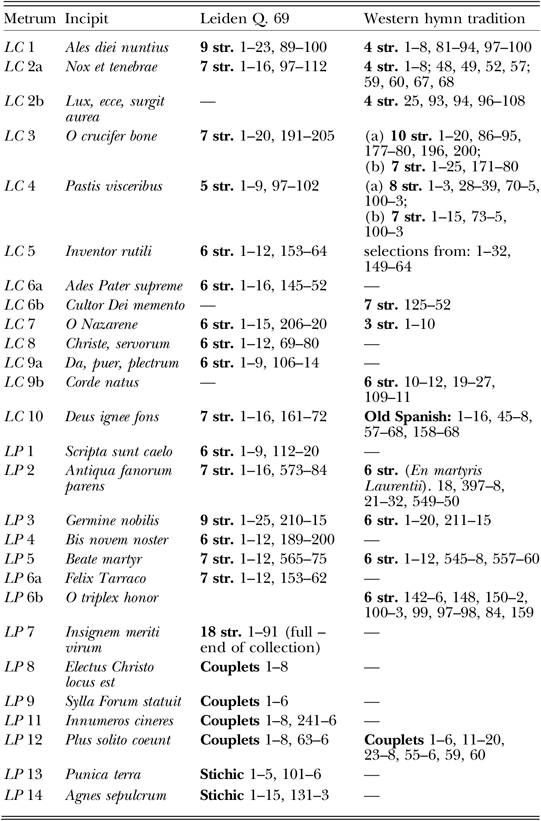
A survey of the shortened forms of the Prudentian poems is provided in Table 3.Footnote 68 As may be seen, centos were constructed by taking lines from the beginning and end of each poem to produce shortened versions of between 6–9 strophes. The main exceptions are the stichic poems and the seventh poem of the Peristephanon, which is the only one copied in full, presumably for reasons related to its position at the end of the Prudentian selection in this manuscript. Taking lines from the beginning and ending strophes of each poem makes some sense given Prudentius’s general pattern of working, according to which the theme of each poem (the hour of the day or the particular saint) is introduced at the opening and a summary provided at the end. In between, Prudentius typically turns to exempla that often interweave several different stories combined with exegesis.
Extracts from Prudentian metra in Leiden Voss. lat. Q. 69

As might be expected, the abridged texts that result in the Leiden collection vary in their success as adaptations. Two contrasting examples may be highlighted by way of example. Pastis visceribus, the fourth poem in the Liber Cathemerinon, is entitled Hymnus post cibum and is found in later medieval collections as a processional hymn after the main meal on Easter day.Footnote 69 The selection of lines given in the Leiden manuscript focuses on giving thanks and praise for the taking of food, passing over reflection on the body as an unclean shrine, Christ as true food, and the story of Daniel receiving heavenly sustenance while in the lions’ den. The top and tailed text works relatively well, although the starving lions in the penultimate strophe appear without introduction and there is no explicit thanks for the meal just taken. Later adaptations within the hymn repertory overcome these faults by introducing a strophe from the middle of the poem that renders due thanks, and by omitting the penultimate strophe.Footnote 70

The reduction of Ades Pater supreme, a hymn before sleep, works well initially by cutting off before mention of the river Lethe in the fifth strophe. The poem continues on to consideration of dreams, Joseph’s interpretations of dreams and St John the Divine’s revelations. The abridged version picks up again in the penultimate strophe, but the cut is jarring, beginning with the command ‘discede’ or ‘depart!’, which is addressed to the deceptive serpent who disturbs our hearts at rest as described in the immediately preceding strophe that was not included. A neater solution was found in hymn traditions by beginning seven strophes from the end with the words Cultor Dei, resulting in a coherent hymn dispelling sinful thoughts before sleep.Footnote 71

The shortened versions in the Leiden collection and the poems that were transformed into liturgical hymns share some overlap in the choice of extracts (see Table 3 above), but none of the adaptations is precisely the same. The liturgical hymns show greater flexibility of practice, including drawing on lines from within the middle of the poem, on occasion changing the order of lines, and from time to time not taking lines from both the beginning and the end. The Leiden versions, by contrast, take a schematic approach to reduction, selecting only opening and closing strophes. The closest surviving comparison is found in the Prudentian extracts in another varied ninth-century collection of strophic poetry, all of which may be shown to have been sung, i.e. a notated verse collection that opens with a cycle of hymns most likely copied at St-Denis in the second third of the ninth century, Berne 455. In a section of this manuscript that also contains shortened metra in strophic form from Boethius’s De consolatione philosophiae, the scribe systematically copied out only the opening eight strophes of a selection of Prudentian poems from the Liber Cathemerinon that had not already found a place in the Office.Footnote 72
It is possible that the abridged Prudentian poems in the Leiden manuscript represent an attempt at reducing longer poems to functional liturgical hymns. There are already hints that Prudentius’s poetry was being adapted to hymnic forms in the two earliest surviving manuscripts. A Trinitarian formula was added by a seventh-century scribe to the end of Scripta sunt caelo (LP 1) in a sixth-century Italian copy of Prudentius’s poetry now held in the Biblioteca Ambrosiana in Milan.Footnote 73 Horizontal lines appear in the other surviving sixth-century copy now held in Paris, setting apart the opening two strophes of Pastis visceribus (LC 4, 1–6) and Deus ignee fons (LC 10, 1–8).Footnote 74 The earliest Frankish documented examples of adaptation in liturgical sources are the three Prudentian office hymns adapted from the two opening poems of the Liber Cathemerinon that appear in the first layer of the New Hymnal, which was dated by Donald Bullough to the court of Louis the Pious in the 820s.Footnote 75 In a Prudentius collection copied at St-Denis in the second quarter of the ninth century, dividing lines are found in the margin that broadly correspond to the adaptations of the same two poems in the New Hymnal.Footnote 76 In addition, the internal line Cultor Dei memento (LC 6, 125), which marks the beginning of a hymn later established in the New Hymnal, is set apart by being copied in capitals.
While the idea of the Leiden collection as an early experiment at hymnic adaptation is intriguing, the non-sequiturs seem unlikely even as a trial run. An alternative hypothesis is that the Leiden texts were not sung at all but functioned as educational digests. This remains a possibility, but to remove singing from the picture entirely would be to overlook the fact that the abridged versions fall consistently within the length of hymns (6–9 strophes). It also worth noting at this point that the parallel abridged versions in the verse collection from the St-Denis manuscript now held in Berne were notated most likely before the second third of the tenth century with melodies that match those recorded for hymns at a later date.Footnote 77 A more powerful explanation is that the Leiden reductions witness to a parallel tradition of singing Prudentius outside of the liturgy that was not under the same institutional pressures to result in a final, polished text that were brought to bear on the fashioning of hymns. The motivation for making these sung reductions may have been manifold: to learn an edificatory text, to learn metre, to practise making hymns from longer late antique texts, and to practise making hymns and songs. All of these possibilities will be kept in mind, but in seeking to narrow possibilities further, a final index of the way in which the Prudentian metra were understood in the Leiden manuscript may be considered, namely their ordering.
The standard ordering of the poems in modern editions of the Peristephanon dates back to an edition published in Vienna in 1501.Footnote 78 The earliest sources display four separate traditions of ordering as identified by the first philologist to study the manuscript tradition in depth, Joannes Bergman. Two of these ordering traditions date from the sixth century (which he designated Aa and Ab), and two date back to ninth-century sources (Ba and Bb).Footnote 79 While various theories have been proposed for the earliest ‘A’ orderings, the most authoritative view is that no overarching rationale can be detected behind any tradition of ordering.Footnote 80 A common feature of the Ba and Bb traditions is that the Peristephanon is copied immediately after nos. 1–10 of the Liber Cathemerinon, whose nos. 11–12 are placed straight after the Peristephanon.Footnote 81 The conception of the two works as complementary books of hymns may be traced back as far as Gennadius, writing at the end of the fifth century, who added a short section on Prudentius to Jerome’s De viris illustribus that bracketed the two together.Footnote 82 In a number of manuscripts from the ninth century onwards, the Liber Cathemerinon is referred to as the first book of hymns and the Peristephanon as the second.Footnote 83
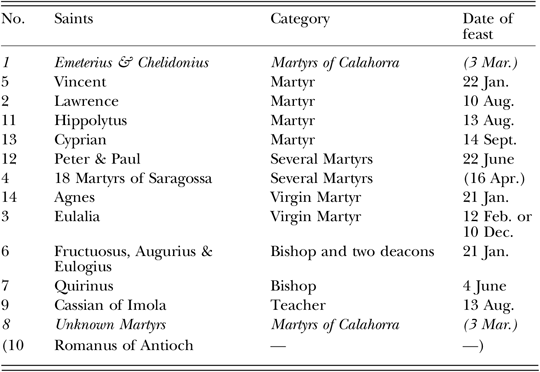
As for the rationale of the ordering traditions, a closer look at the German or Bb tradition, which is particularly associated with manuscripts from the Abbey of Sankt Gallen and first represented by the Leiden manuscript, suggests that the poems from the Peristephanon were ordered in part according to the liturgical calendar (see Table 4).
Ordering of metra in the German (Bb) tradition of the Liber Peristephanon

Number 10, which appears at the foot of the list, is placed outside the ordering scheme since it is the only poem to refer to an Eastern saint (St Romanus of Antioch) and is substantially longer than any other poem in the Peristephanon. It was transmitted separately from the rest of the Peristephanon throughout the Middle Ages, leading most modern scholars to conclude that it does not belong with the collection.Footnote 84 This poem also does not feature in the Leiden excerpts; it is included in Table 4 simply because it usually follows the Peristephanon in the wider Bb tradition. A second preliminary observation is that the Bb tradition opens and closes with poems on the martyrs of Calahorra (nos. 1 and 8), which was in all likelihood Prudentius’s home town. This is understandable as the first poem introduces the themes of the collection as a whole, while the last stands apart as an epitaph inscribed on a baptistery. Within these bookends, ordering appears to be determined by class of saint and date of martyrdom. Widely celebrated individual martyrs are placed first, organised internally according to date of celebration as widely recorded in early Sacramentaries: Vincent, Lawrence, Hippolytus and Cyprian. There follow two poems for what might be described as the class of several martyrs: Peter and Paul, and the 18 Martyrs of Saragossa. Then come the two poems for Virgin Martyrs, again in calendrical order: Agnes followed by Eulalia. Finally, there are the saints who were not widely celebrated in the ninth century but are nevertheless ordered according to their calendrical date of martyrdom as recorded in early martyrologies beginning with Pseudo-Jerome: Fructuosus and his two companions, Quirinus of Sisicia and Cassian of Imola.Footnote 85
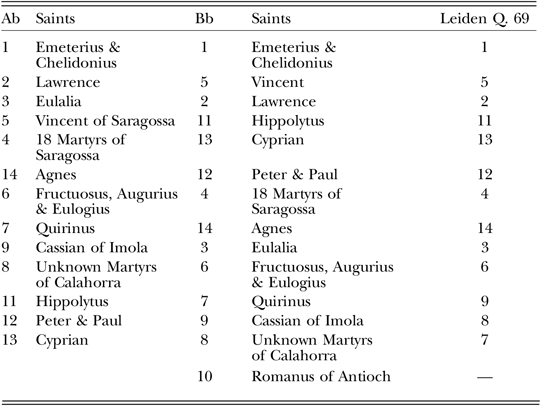
There are two anomalies in the ordering. The first concerns the 18 Martyrs of Saragossa, whose date of observation should place them before SS Peter and Paul. The most likely reason for this displacement can be found if the Bb tradition is compared to its immediate ancestor, the Ab tradition (see Table 5). Comparison of the traditions reveals that two blocks of material remained unchanged between the Ab and Bb traditions: the coupling of 4 and 14 (the Martyrs of Saragossa and Agnes), and the ordering of minor saints (6, 7, 9 and 8). The latter raises the possibility that their ordering of minor saints was simply retained from the Aa tradition rather than the non-Calahorran saints being newly placed in the correct liturgical order. Indeed, there is some evidence for the idea that the dates of celebration for these obscure saints were not known at Sankt Gallen. An introductory remark added to a calendar of saints copied at the Abbey in the early tenth century (Sankt Gallen 566) states that Cassian’s date of celebration among others was not known there at this time.Footnote 86 In a similar vein, the date for the celebration of the Martyrs of Saragossa, which does not feature in the same calendar, was in all probability not known at Sankt Gallen, where they were not observed. In these circumstances, it would make some sense to copy the poem after the hierarchically more important feast of SS Peter and Paul and, as in the Aa tradition, immediately before the poem about Eulalia.
The Ab (s. vi–), Bb (s. ix–) and Leiden ordering traditions of the Liber Peristephanon

The second anomaly is that in the Leiden manuscript alone of the Bb tradition Quirinus (no. 7) is placed at the end of the selection, after the Unknown Martyrs of Calahorra (see the last column of Table 5). As already noted, the text is presented differently from all others in being copied in full. No definitive reason for its unusual presentation can be identified at present, although it may be connected with the fact that the poem was moved to the end of the sequence, most likely from an earlier manuscript of the Bb tradition that preserved the original Aa ordering of 6, 7, 9, 8.
Further evidence can be brought to bear upon the significance of the liturgical ordering in the Peristephanon by reading it alongside the Liber Cathemerinon. The closing two poems of the Liber Cathemerinon do not follow the Peristephanon in the Leiden manuscript, unlike in the rest of the Bb tradition. The omission of poems celebrating Christmas Day and Epiphany (LC 11 and 12) leaves an overall sequence across the two books that begins with the daily round (cockcrow, morning, before and after the main meal, for the lighting of lamps, and before sleep, LC 1–6) and then hymns for occasional use (for times of fasting, for every hour, and for the burials of the dead, LC 7–10), before passing to the Liber Peristephanon for hymns for individual saints subdivided into celebrated individual martyrs, several apostles, several martyrs, virgin martyrs and minor martyrs. A parallel may be drawn with the rapid expansion in the early decades of the ninth century in hymns assigned to weekdays and to specific feasts, and hymns for the Sanctorale.Footnote 87 In seeking to understand further the ways in which the Leiden collection fits into wider Carolingian developments, it is time to turn to its historical context both at Sankt Gallen and beyond.
LEIDEN VOSS. LAT. Q. 69 IN CONTEXT
The poetic contents of the second book of Leiden Voss. lat. Q. 69 are consistent with what is known of the wider context of copying at Sankt Gallen at the time insofar as they show evidence of copying from a number of different sources brought to the Abbey.Footnote 88 As mentioned above, insular sources probably lie behind the epigrams and tituli. As for the Prudentian metra, the Bb textual tradition is found first in Leiden Voss. lat. Q. 69 and then during the ninth century predominantly, but not exclusively, in manuscripts from Sankt Gallen.Footnote 89 Since the ordering in Leiden Voss. lat. Q. 69 is already an adaption of the Bb tradition found predominantly in German-speaking areas, it is most likely that the Prudentian metra were copied from an Alemannic exemplar. The specific exemplar used was in all probability not written out in continuous strophes since the scribes of the Leiden manuscript erred in calculating the length of strophes on two occasions.Footnote 90 The ordering of metra found in Leiden Voss. lat. Q. 69 is not found anywhere else and may have been created at the Abbey of Sankt Gallen around the time of the copying of the manuscript.
A different background may be sketched for the rhythmi, which may be traced back ultimately to a centre for the composition of abecedary verse at Luxeuil and Corbie as early as the seventh century.Footnote 91 The fact that the alphabetical verses appear in series from Ante saecula et mundi through to Aquarum meis (interrupted only by Gratuletur omnis) implies that they were copied en bloc, especially since alphabetical rhythmi were copied out separately in later ninth-century northern French poetic collections.Footnote 92 It is impossible to say whether the specific versions of rhythmi found in the Leiden manuscript, including shortened versions and refrains unique to this collection and to Sankt Gallen, were the result of an in-house redaction.Footnote 93 Yet it may be observed that the interlinear corrections by hands writing an Alemannic minuscule similar to the base scripts, which are found with some regularity following the truncated version of Ante saecula et mundi, imply a marked concern for correctio in reception.
The copying of Leiden Voss. lat. Q. 69 is therefore consistent with an active reception of texts at Sankt Gallen c. 800 in terms of compilation, correction and adaptation. Its relation to the later song tradition at the Abbey is initially puzzling due to the lack of evidence for a continuous song culture at Sankt Gallen in the first half of the ninth century. If we turn our attention instead to the song culture in the region, then a far richer and continuous picture emerges. At nearby Reichenau, with which Sankt Gallen shared books, commemorative obligations and on occasion the same abbot, there is evidence in the first half of the ninth century for learned teaching, literary composition in metrical verse, the composition of hymns, and even an interest in singing Prudentian verse. There was certainly an active engagement with and possibly even contribution to hymn reform at Reichenau in this period: all three versions of the hymnal (Old, Frankish and New) were available at the Abbey with hints of another stage of reform in the survival of a previously unknown hymn for Lauds copied by the librarian, Reginbert (d. 846).Footnote 94 In addition, Walahfrid Strabo (d. 849), who was a pupil of the earliest attested teacher at Reichenau, Wetti (d. 824), not only composed metrical verse, including several hymns, but also composed poetry in a liturgical cycle for feasts of both Temporale and Sanctorale.Footnote 95 He also provides the first evidence of historical interest in the singing of Prudentian verse, writing in his liturgical handbook composed in the early 840s that hymns by Prudentius were sung alongside those of Ambrose, Hilary and Bede in previous centuries, thereby justifying the practice of singing metrical compositions in church in his time.Footnote 96 Strabo’s views may well have been shaped by his experience of the New Hymnal at the Court of Louis the Pious, where he was tutor to the future Charles the Bald from 829 to 838, followed by his interrupted return to Reichenau as abbot from 838 to 842.
Strabo’s poetry was certainly known at Sankt Gallen by the second half of the ninth century.Footnote 97 Close connections between Sankt Gallen and Reichenau in the first half of the ninth century are attested by the Sankt Gallen school plan, which was copied by Reginbert for Abbot Gozbert of Sankt Gallen (816–37).Footnote 98 Further indication of Reichenau’s intellectual leadership in this period comes in the form of the later dates at Sankt Gallen of the first-attested librarian (Uto, 860), school teacher Iso (d. 871), and library list (mid-ninth century).Footnote 99 It is therefore perhaps not surprising that an interest in Prudentian verse and rhythmi at Sankt Gallen after Leiden Voss lat. Q. 69 may be traced only in the second half of the ninth century.
That Prudentius’s poetry was taught, known and admired at Sankt Gallen is evident from Notker’s letter to his pupil Salomo, De viris illustribus, in which he made suggestions for reading, beginning with Prudentius’s corpus as a model for learning metre.Footnote 100 Notker’s recommendations also reflect the works available at Sankt Gallen, for in the Sankt Gallen catalogue of the mid-ninth century, in a section labelled De metris, comes the work of Christian poets (Iuvencus, Sedulius, Arator, Avitus, Prosper), followed by no. 383, Metrum Aurelii Prudentii libri VII in volumine I.Footnote 101 Prudentian turns of phrases also came to mind in composition. As has been shown by literary scholars, Prudentian verse is alluded to on several occasions in the processional versus gathered together in Sankt Gallen 381. This is most notable in Hartmann’s hymn for Holy Innocents, Cum natus esset dominus, which makes repeated reference to Prudentius’s Epiphany hymn and specifically the section beginning Salvete flores describing the slaughter of the Innocents.Footnote 102 More or less explicit Prudentian vocabulary can also be found in Ratpert’s Ardua spes mundi and Annua sancte Dei, as well as in several of the poems for St Magnus as traced by Peter Stotz.Footnote 103 That Prudentian verse was also drawn into the ritual of the liturgy is likewise seen in the way the titulus for St Stephen, one of the forty-nine quatrains that constitute Prudentius’s Tituli historiarum, was adopted as a self-standing introduction to the Introit in the late ninth-century cycle.Footnote 104
For all this interest in Prudentius’s poetry at Sankt Gallen later in the ninth century, sung Prudentian verses in later non-liturgical Sankt Gallen manuscripts show no signs of direct contact with the Leiden versions and there is a striking absence of Prudentian processional versus at Sankt Gallen.Footnote 105 From the late ninth century onwards there is instead a clear preference for newly composed sung versus by Sankt Gallen authors; indeed, the only processional versus not by a Sankt Gallen poet in Sankt Gallen 381 is Venantius Fortunatus’s Salve festa dies.Footnote 106 A substantial change in the reception of Prudentius at Sankt Gallen seems to have occurred by the end of the ninth century, by which time the singing of versus at Sankt Gallen was not just a matter of creative reception of older texts; rather, older sung versus were drawn upon as a resource and inspiration for new liturgical composition.
Symptomatic of this new phase in reception is the extended Prudentian reference in the opening lines of the first sequence of Liber ymnorum:Footnote 107

The relation between Natus ante saecula and Corde natus (from LC 9) is one of a shared sequence of ideas, concisely and richly expressed.Footnote 108 Both texts announce a hymn in praise of one born before the beginning of time, who is the origin of the world and time itself, and whom angels praise in celestial harmony. The placing of this Prudentian allusion at the head of the cycle of the Liber ymnorum arguably serves as a means of legitimising a newly composed lyric cycle of hymns, as well as paying homage to a model that is being emulated and transformed. Prudentius seems to have served as a source of stylistic inspiration for introducing a lyric voice into hymnody, combining elegant expression with a masterful handling of lyric forms, thereby extending Strabo’s defence and practical promotion of ymni in the previous generation.Footnote 109 Even more pertinently, Prudentian hymns as presented in the Bb tradition provided a model for a liturgically ordered lyric cycle with a strong emphasis on Roman martyrs, perhaps with a silent nod to Strabo’s use of the liturgical cursus as a structure for a newly composed poetic cycle.
It was not only the Prudentius tradition as represented in Leiden Voss. lat. Q. 69 that provided a creative model for later generations at Sankt Gallen, but also rhythmi. As noted above, the scribe who added versus to blank folios in the Naples manuscript appears to have had Leiden Voss. lat. Q. 69 or a closely related manuscript before his eyes, given the preservation of the ordering and sharing of unique variants in all four cases. Principles of rhythmical verse also informed the poetry of the Liber ymnorum, especially the use of poetic lines with repeating patterns of cadential accent. The workings of paired isosyllabic and even isotonic stanzas may be appreciated through two adjacent versicles from Congaudent angelorum:Footnote 110

In the first cited versicle, the number of syllables in the line is fixed between lines, but the accent pattern varies at the opening of the line. In the second versicle, not only the number of syllables, but also the placement of the accent is fixed throughout each line. What results is not the rhythmical poetry of the previous generation, which imitated inherited classical forms. Yet the same fundamental principles remain, namely definition of the poetic line or versus by syllable count and accent pattern, fixed especially at cadences. It was in rhythmi of the first half of the ninth century, as epitomised by the accentual poetry of Gottschalk of Orbais and Paulinus of Aquileia, both of whose poetry was known to Strabo, that the crucial step away from direct imitatio of classical models to new compositio, drawing on extrapolated principles of syllable count and accent pattern, was first undertaken.
In sketching connections between sung poetry at Sankt Gallen in the first and second half of the ninth century, and directing attention to developments at Reichenau as a crucial intermediary step, the tantalising question arises whether Iso had the earlier Prudentian and rhythmi tradition of versus in mind when recommending to Notker his principle of setting texts to sequence melodies, i.e. singulae motus cantilenae singulas syllabas debent habere.Footnote 111 Clear evidence is lacking insofar as melodies recorded at a later date for Prudentian verse and rhythmi are not predominantly syllabic in the manner of sequences.Footnote 112 Even so, there is a shared principle at work in versus traditions and the sequences of the Liber ymnorum insofar as both proceed from the syllable as the fundamental unit of design. Fixed syllable count or isosyllabism is characteristic not only of rhythmi but also of Prudentian metra due to the lyric and fixed-syllable metrical forms employed.Footnote 113 Evidence that melodies of versus were conceived syllabically lies in the way that melodies were shared. The association of particular syllables in the line (the first, second, third, etc.) with specific melodic gestures may be seen in detail for two rhythmi copied in the Leiden manuscript which share a melody in the late ninth-century Naples manuscript, i.e. Gratuletur omnis and Alma vera. Both of the poems are accentual imitations of a trochaic trimetre, or 3 × 8p + 7pp.Footnote 114 The two poems also share both regular accentuation through the line and routine division at the quarter-line.
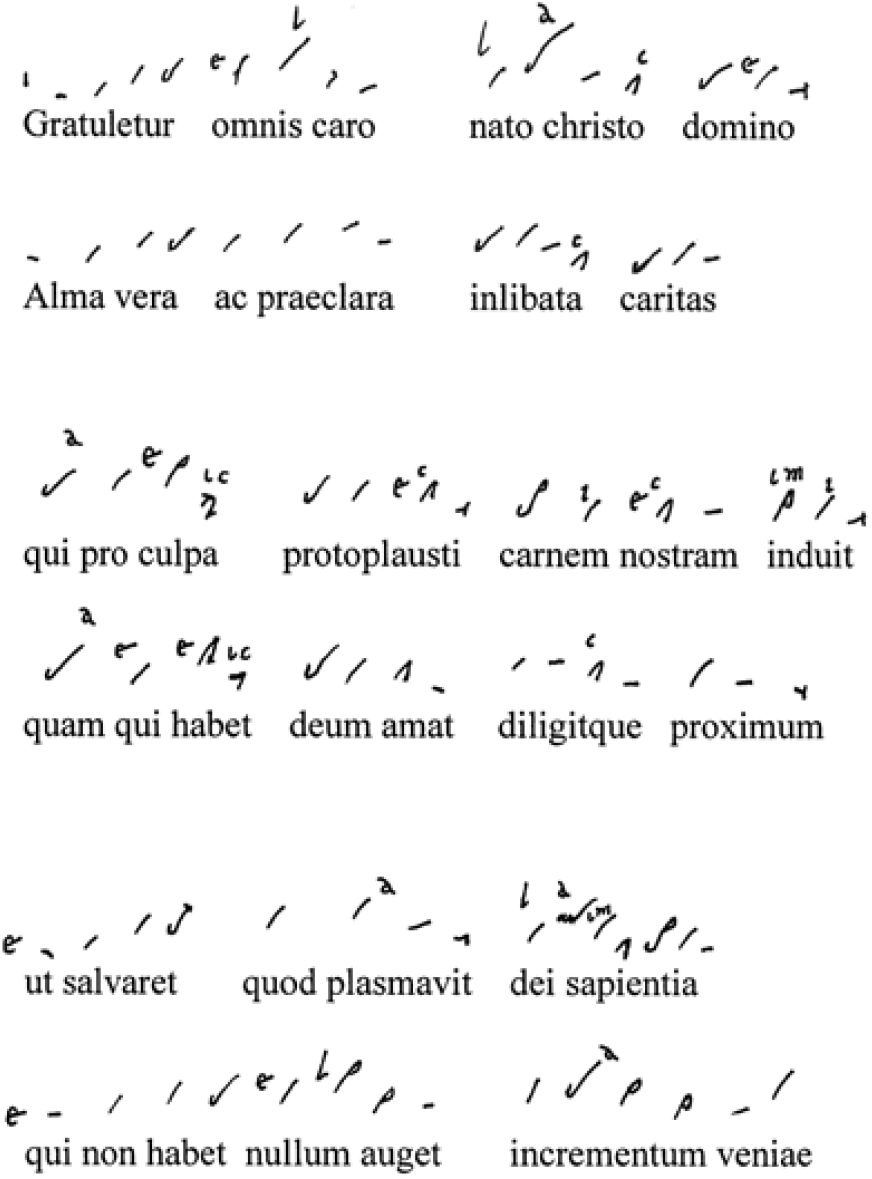
The neumes added to the first strophes of the two poems as copied in the Naples manuscript are almost identical from syllable to syllable, tracing a highly articulated melodic form delineated by melodic contour and repetition at strophe, line, half-line and quarter-line. As may be seen in Example 1, the neumes for the opening lines of both Gratuletur omnis and Alma vera repeat in the third line, creating a closed strophe articulated by linear melodic repetition, ABA′. The half-line of the initial A is also articulated through melodic contour as the melody of the first half of the line traces a single melodic arch, creating an internal a+b divided by the caesura in the opening melodic A. Elaine Stratton Hild has also pointed to the way that the melody articulates the poetry at the quarter-line through repetition of melodic contour in the second line, resulting in a B-line melody with a threefold melodic repetition over syllables 1–4, 5–8, and 9–12.Footnote 115
Melodies for Gratuletur omnis caro and Alma vera, Naples IV. G. 68, fol. 207r

Similar working principles can be traced for the melodies for Prudentian metra in the form of the neumes added to the opening lines of O crucifer bone in Sankt Gallen 136. The neumes trace a melody later recorded for this text both in non-liturgical sources and as a processional hymn. The melodic tradition is stable not only in the set of notations transcribed in Example 2 but also in all other notated non-liturgical manuscripts identified to date.Footnote 116 This is not to say that the melody remained unchanged in transmission, as is clear from the different number of pitches signalled at the last syllable in the first line, rather the melodic shape is retained between versions and melodic direction is identified with specific syllables. In all versions the melody reaches its peak at the fourth syllable, falls from the fifth to sixth syllable, and then follows a jagged melodic motion through to the final syllable in the first line.
Melodies for Prudentius’s O crucifer bone (LC 3), line i

These creative practices are in evidence again in the processional versus collected together in Sankt Gallen 381, which was copied c. 930 but includes a number of earlier texts composed by Ratpert (d. c. 900) and Hartmann (d. 925). Several make use of refrains and in the case of Hartmann’s Humili prece and the rhythmical litany Votis supplicis draw on a distinctive feature of the rhythmi tradition, namely the use of prose refrains. There are also a striking number of shared melodies in Sankt Gallen 381: of the twenty-three versus in the collection, shared melodic shapes may be traced for at least six.Footnote 117 In these instances, the same process as that traced above for Gratuletus omnis and Alma vera was followed, i.e. units of melodic movement (or motus as represented by a single neume) were routinely transferred intact between poetic texts with only occasional adjustments to adapt to changing metrical subdivisions.
The general observations made here are sufficient to make two fundamental points. First, melodies recorded for rhythmi and Prudentian verse demonstrate that each syllable typically had no more than one melodic motion (as represented by a single neume), as in the vast majority of hymns. Second, syllabic identity is routinely preserved insofar as melodic motions are associated with particular syllables within the poetic line. These two principles accord with the basic principle of the Isonian rule, namely singulae motus cantilenae singulas syllabas debent habere. A practice of aligning at first pre-existing and later newly-composed texts to melodies conceived as short segments made up of individual motus was familiar from the versus tradition. In all probability this tradition of sung strophic versus was well known to Iso by the mid-ninth century and informed his recommendation to Notker, whatever other models he may have known for the sequence at this time.
FROM CORRECTIO TO EMULATIO
The fundamental claim made in this study is that Leiden Voss. lat. Q. 69 was part of a copying, correction and compilation phase at Sankt Gallen c. 800 that included sung texts. The melodies for the poems transmitted in the Leiden manuscript are not recoverable, but their existence is signalled by the abridged forms of the Prudentian metra, the wider sung tradition of the rhythmi, and the continuous strophic layout adopted for both sets of material. Melody may therefore be said to be immanent in the codex insofar as the text prompted melodic recall in the mind of the reader, who drew upon this melody to make sense of the poetic designs. It has also been argued that the Leiden songs remained in transmission and served as a foundational stage for later compositions at Sankt Gallen. The rhythmi provided a model for sequence poetry through their patterning of accent and for the later tradition of Sankt Gallen processional versus through their use of refrain forms. The Prudentian metra also served as a model for lyric verse arranged in a liturgical cycle as later found in the Liber ymnorum.
The collection of verse in Leiden Voss. lat. Q. 69 may be considered symptomatic of wider Carolingian developments. Michel Huglo argued that the emphasis on studying classical and late antique texts under the Carolingian renovatio coincided with a desire to add hymns of various kinds to the rather austere liturgy as received from Rome, which excluded versified texts.Footnote 118 He located the initial impetus for this development in northern France around the turn of the ninth century, tracing the adaption of longer poems into largely processional versus by Fortunatus variously to Angilbert at St-Riquier, court circles and churches in the region of Paris. Viewed against this background, the Prudentian centos in Leiden Voss. lat. Q. 69 may be understood as part of two related endeavours being pursued contemporaneously in northern France. The first involved identifying suitable adaptions from longer late antique poems for use as processional or other versus in the liturgy, especially in Holy Week. The second employed late antique lyric in the context of teaching and learning, which appears to have extended into singing as implied by both the addition of musical notation at an early date to non-liturgical manuscripts, and other indications of sung performance as supplied by rubrics and distinctive patterns of copying.
It is also proposed here that a historiographic tendency to focus on composition by named individuals at single institutions has obscured the role played by Reichenau as a forerunner to the later song culture at Sankt Gallen. The fundamental requirements for song composition were already in place at Reichenau, namely a store of corrected texts to use as a basis for lyric composition, manuals for learning metre, and high levels of literacy and learning. The justification of hymn composition given by Walahfrid in his Libellus also assumes particular interest given Notker’s care to legitimise his new compositions with the title Liber ymnorum. The practice of composing sung metra at Reichenau in the first half of the ninth century also provides an immediate background in hymnic composition, whose definition at the level of individual syllables and procedures of melodic exchange were fundamental to later Sankt Gallen versus composition of all kinds. A tradition of sung versus at Reichenau may therefore be understood to form a practical link between the traditions of singing received texts implied in Leiden Voss lat. Q. 69 and the later song tradition at Sankt Gallen.
There is also ample evidence to support the claim that the opening section of Pt. II of Leiden Voss. lat. Q. 69 stands within a series of Latin song collections stretching from the ninth century up to the Cambridge Songs manuscript of the mid-eleventh century. These song collections transmit a repertory characterised by several distinct types of sung Latin verse, but which also has consistency in its inclusion of extracts from classical authors, late antique metrical verse by authors such as Boethius, Prudentius and Martianus Capella, rhythmical verse dating back to the seventh century, and early medieval occasional metrical verse. The formation of what might be generally termed a versus repertory at individual centres and within compilations with different immediate ends was inflected differently but shared a nucleus of texts. The formation of this repertory appears to have been a Carolingian achievement and one that deserves recognition as a distinctive product of the Carolingian renovatio.
Leiden Voss. lat. Q. 69 therefore provides insight into a stage at Sankt Gallen when verse texts were being copied, corrected and ordered as a resource for creating new song traditions. The focus of this work appears initially to have been didactic, by which is meant simply any form of learning that took place outside of the liturgical round, and at least some melodies were evidently known for these texts at Sankt Gallen by the late ninth century at the latest. It is not possible on the basis of the evidence to speak of a song school or the flourishing of a song culture at the turn of the ninth century at Sankt Gallen, but what was happening appears to have been just as crucial; namely, a reception of song models, initially for correctio, and later for imitatio and eventually emulatio. The overall trajectory in the ninth century at Sankt Gallen may therefore be characterised as one leading from correctio and ordinatio of inherited models at the beginning of the century through to independent compositions by the last quarter. The evidence of Leiden Voss. lat. Q. 69 is that melody played a role alongside text throughout this process.
Appendix Manuscript Sigla and Abbreviations
- Berlin 542
Berlin, Deutsche Staatsbibliothek Hamilton 542
- Berne 264
Berne, Burgerbibliothek 264
- Berne 394
Berne, Burgerbibliothek 394
- Berne 455
Berne, Burgerbibliothek 455
- Brussels 8860–8867
Brussels, Bibliothèque Royale de Belgique 8860–8867
- Cambridge Corpus 223
Cambridge, Corpus Christi College 223
- Leiden Burm. Q. 3
Leiden, Bibliotheek der Rijksuniversiteit, Burm. Q. 3
- Leiden Voss. lat. Q. 69
Leiden, Universiteitsbibliotheek Vossianus Lat. Q. 69
- Madrid 289
Madrid, Biblioteca Nacional de España 289
- Milan Ambros. D. 36 sup.
Milan, Biblioteca Ambrosiana, D. 36 sup.
- Montpellier 219
Montpellier, Université, Bibliothèque de la Faculté de Médécine
- Munich clm 14395
Munich, Bayerische Staatsbibliothek clm 14395
- Munich clm 18922
Munich, Bayerische Staatsbibliothek clm 18922
- Naples IV. G. 68
Naples, Biblioteca nazionale IV. G. 68
- Oxford Auct. F. 3. 6
Oxford, Bodleian Library Auct. F. 3. 6
- Oxford Auct. T. 2 22
Oxford, Bodleian Library Auct. T. 2. 22
- Oxford Oriel 3
Oxford, Oriel College 3
- Paris lat. 1154
Paris, Bibliothèque nationale de France lat. 1154
- Paris lat. 8084
Paris, Bibliothèque nationale de France lat. 8084
- Paris n.a. lat. 1064
Paris, Bibliothèque nationale de France n.a. lat. 1064
- Sankt Gallen 2
Sankt Gallen, Stiftsbibliothek 2
- Sankt Gallen 133
Sankt Gallen, Stiftsbibliothek 133
- Sankt Gallen 136
Sankt Gallen, Stiftsbibliothek 136
- Sankt Gallen 185
Sankt Gallen, Stiftsbibliothek 185
- Sankt Gallen 228
Sankt Gallen, Stiftsbibliothek 228
- Sankt Gallen 381
Sankt Gallen, Stiftsbibliothek 381
- Sankt Gallen 484
Sankt Gallen, Stiftsbibliothek 484
- Sankt Gallen 548
Sankt Gallen, Stiftsbibliothek 548
- Sankt Gallen 566
Sankt Gallen, Stiftsbibliothek 566
- Sankt Gallen 869
Sankt Gallen, Stiftsbibliothek 869
- Sankt Gallen 876
Sankt Gallen, Stiftsbibliothek 876
- Trier 1093
Trier, Stadtbibliothek 1093
- Udine 2
Udine, Biblioteca Arcivescovile 2
- Verona LXXXVIII
Verona, Biblioteca capitolare LXXXVIII
- Verona XC
Verona, Biblioteca capitolare XC
- AH
Analecta hymnica medii aevi, ed. G. M. Dreves, C. Blume and H. M. Bannister, 54 vols. (Leipzig, 1886–1922)
- CLA
Codices Latini antiquiores: A Palaeographical Guide to Manuscripts Prior to the Ninth Century, ed. E. A. Lowe, 11 vols. (Oxford, 1934–71)
- CRM
Corpus rhythmorum musicum saec. iv–ix, I: Songs in Non-Liturgical Sources, 1. Lyrics, ed. F. Stella and S. Barrett (Florence, 2007)
- KfH
B. Bischoff, Katalog der festländischen Handschriften des neunten Jahrhunderts (mit ausnahme der Wisigotischen), 4 vols. (Wiesbaden, 1998–2017)
- LC
Prudentius, Liber Cathemerinon
- LP
Prudentius, Liber Peristephanon
- MS
B. Bischoff, Mittelalterliche Studien: Ausgewählte Aufsätze zur Schriftkunde und Literaturgeschichte, 3 vols. (Stuttgart, 1966–81)
- PLAC
Monumenta Germaniae Historica. Poetae Latini aevi Carolini, ed. E. Dümmler, L. Traube, P. von Winterfeld and K. Strecker, 4 vols. (Berlin, 1881–1923)