

Introduction
Uncertainty in the response of agro-ecosystem models to environmental conditions can be attributed to differences in the structure of the models. This has urged for benchmarking actions at an international level, where estimation of process-oriented epistemic uncertainties is done by running several models supposed to simulate the same reality (ensemble modelling) so as to generate an expanded envelope of uncertainty (Asseng et al., Reference Asseng, Ewert, Rosenzweig, Jones, Hatfield, Ruane, Boote, Thorburn, Rötter, Cammarano, Brisson, Basso, Martre, Aggarwal, Angulo, Bertuzzi, Biernath, Doltra, Gayler, Goldberg, Grant, Heng, Hooker, Hunt, Ingwersen, Izaurralde, Kersebaum, Müller, Naresh Kumar, Nendel, O’Leary, Olesen, Osborne, Palosuo, Priesack, Ripoche, Semenov, Shcherbak, Steduto, Stöckle, Stratonovitch, Streck, Supit, Travasso, Tao, Waha, Wallach, White and Wolf2013; Bassu et al., Reference Bassu, Brisson, Durand, Boote, Lizaso, Jones, Rosenzweig, Ruane, Adam, Baron, Basso, Biernath, Boogaard, Conijn, Corbeels, Deryng, De Sanctis, Gayler, Grassini, Hatfield, Hoek, Izaurralde, Jongschaap, Kemanian, Kersebaum, Kim, Kumar, Makowski, Müller, Nendel, Priesack, Pravia, Sau, Shcherbak, Tao, Teixeira, Timlin and Waha2014; Li et al., Reference Li, Hasegawa, Yin, Zhu, Boote, Adam, Bregaglio, Buis, Confalonieri, Fumoto, Gaydon, Marcaida, Nakagawa, Oriol, Ruane, Ruget, Singh, Singh, Tang, Tao, Wilkens, Yoshida, Zhang and Bouman2014). We address the same issues with grassland ecosystems in Europe and Israel, with focus on permanent, semi-natural or sown grasslands under management for at least 5 years, composed of multiple plant species. Simulations of the grassland yield as well as carbon and water fluxes are inherently uncertain because they are driven by complex interactions. The present study evaluates a set of grassland models to estimate the uncertainty on yield and other outputs and explore how grassland models differ in simulations of response variables to individual climate change factors (temperature, precipitation and atmospheric CO2 concentration ([CO2])).
Material and methods
In all, nine long-term grassland sites used for the modelling exercise cover a broad gradient of geographic and climatic conditions as well as a variety of management practices. In all, four of them (Laqueuille, France; Monte Bondone, Italy; Grillenburg, Germany; Oensingen, Switzerland), equipped with an eddy covariance system to determine the net ecosystem exchange (NEE) of CO2 on a daily basis, are data-rich grasslands, including gross primary production (GPP) and total ecosystem respiration (RECO) (NEE=RECO−GPP). At the flux-tower sites the biophysical knowledge of the grassland ecosystem is complemented with soil water content and temperature, and actual evapotranspiration measurements. Other grassland sites (Kempten, Germany; Lelystad, the Netherlands; Matta, Israel; Rothamsted, United Kingdom; Sassari, Italy) focus on forage production under a range of conditions. A total of nine models were used: AnnuGrow, ARMOSA, Biome-BGC MuSo, CARAIB, EPIC, LPJmL, PaSim, SPACSYS and STICS. Some models (AnnuGrow, EPIC and STICS) do not generate carbon fluxes. Model evaluation included uncalibrated (blind) and calibrated simulations, and responses to climate change and atmospheric factors (sensitivity runs).
Results
While the analyses are still ongoing, a few illustrative results are given.
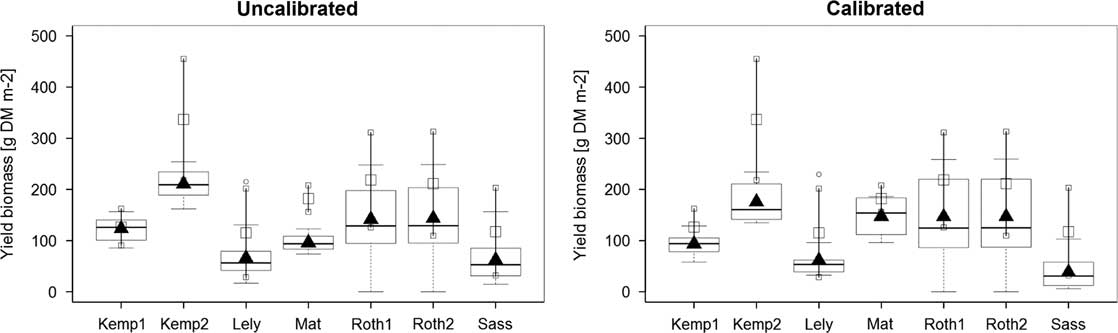
Figure 1 shows that the boxplot of simulated yield biomass is not very different before (nine models) and after (seven models) calibration, with quite general underestimations but on average calibrated results fit better to observations. Taking the Mediterranean site of Matta (Mat) as an example, the improvement of calibration on blind tests is reflected in the values of performance indicators (with seven models, relative root mean square error from 83% to 36%).
Observed and simulated average yearly yield biomass per cutting (g DM m−2) for five locations using nine models for blind runs (left) and seven models for calibrated runs (right). Locations are: Kempten, Germany (Kemp1, cut four times per year; Kemp2, cut two times per year); Lelystad, the Netherlands (Lely); Matta, Israel (Mat); Rothamsted, United Kingdom (Roth1, NH4–N fertilization; Roth2, NO3–N fertilization); Sassari, Italy (Sass). Open squares are mean observed yields plus or minus one standard deviation. Filled triangles are the mean of simulated yields for each location. Boxes are delimiting the 25th and 75th percentiles with the median inside. Whiskers are 10th and 90th percentiles. Hollow circles indicate outliers.

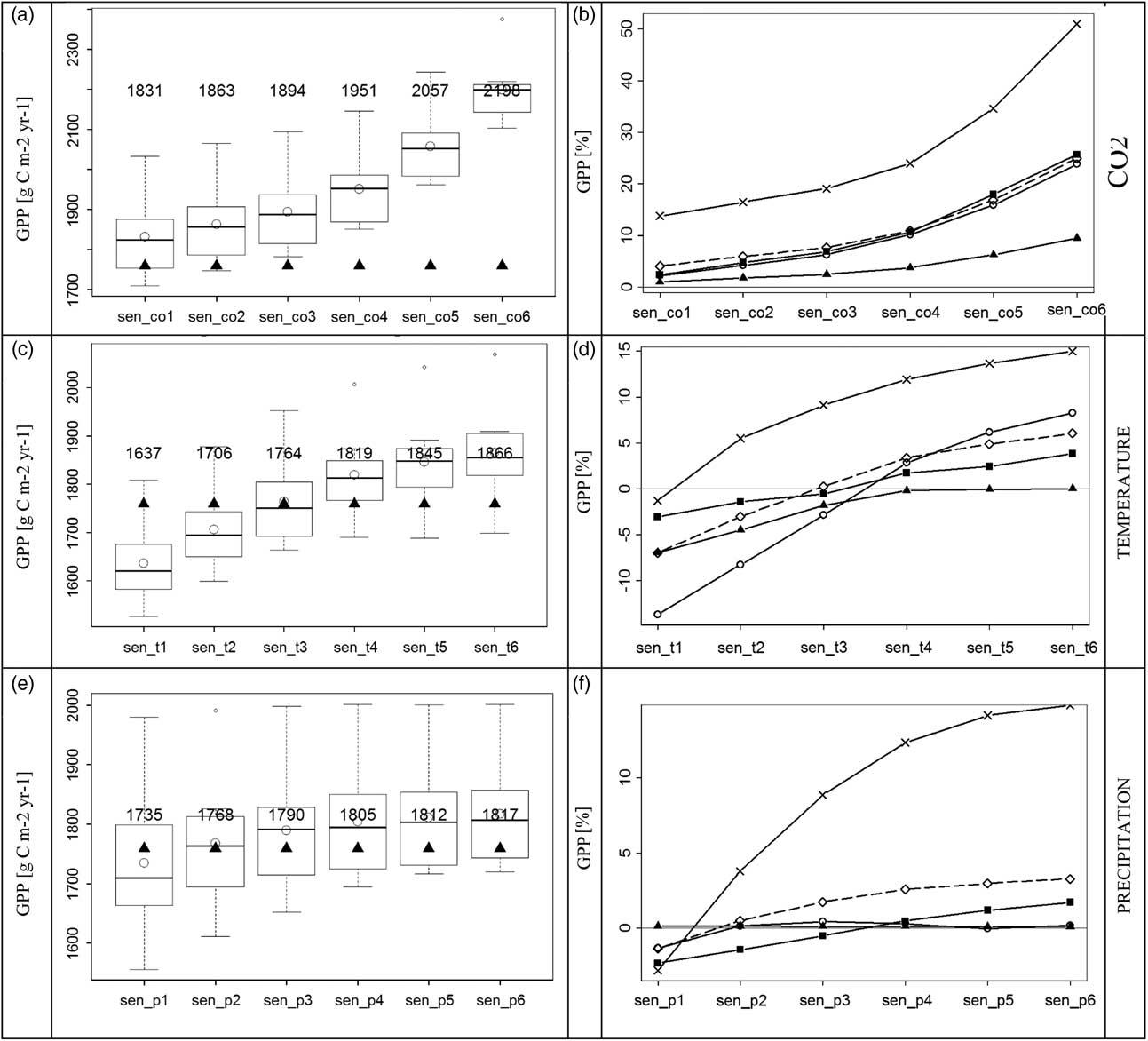
To study simulated responses to temperature, precipitation and [CO2] (one factor at a time) at each site and management, six scenarios were created from the baseline weather .
Simulated effects of [CO2], temperature and precipitation changes on the yearly GPP (g C m−2 year−1), obtained at Oensingen (Switzerland) with five calibrated models. Scenarios were generated by changing the weather baseline (2002–08): for [CO2] by +5%, +10%, +15%, +25%, +50%, +100% on a baseline of 380 ppm (sen_co1 to sen_co6); for hourly or daily maximum and minimum temperatures by −25%, −10%, −5%, +5%, +10%, +25% of the standard deviation (sen_t1 to sen_t6); for rainy hours or days, hourly or daily precipitations by −25%, −10%, −5%, +5%, +10%, +25% of the standard deviation (sen_p1 to sen_p6). On the left, hollow circles and the values are the mean of sensitivity simulations, and filled triangles are the mean of calibrated runs (same value for each scenario). On the right, different markers indicate different models.

Taken the example of Oensingen (Switzerland) with five models, simulated yearly changes of GPP (2002-2008 average) increases with [CO2] at roughly exponential rate, by ∼25% on average with doubled [CO2] (Figure 2a and b). The latter is in agreement with the experimental evidence (e.g., Ainsworth and Rogers, 2007). However, large differences in the response of different models to [CO2] are visible, which suggest the need to apply an ensemble of models to capture the potential GPP changes. A common trend of the models is that yearly GPP increases with air temperature (Figure 2c). On average, GPP increases by 6-7% when temperature increases by 25% but, even in this case, one model is more sensitive than others to temperature conditions and may have overestimated the effect of warming (Figure 2d). Precipitation scenarios show a lesser effect on GPP changes than temperature and [CO2] with the exception of one model, and the average response is more complex (Figure 2e and f). At a relatively humid site like Oensingen, some reduction in precipitation can even have a positive effect on GPP owing to, for instance, less nitrogen leaching or non-saturated conditions (e.g., simulated GPP increased on average by 1% when the amount of precipitation decreased by 10%).
Conclusions
Some calibration may be required to improve accuracy and reduce uncertainty in biomass and carbon-water cycle estimations in Europe and Israel. The results indicate that alternative models show a different sensitivity to climate change factors (which can be explained later by looking into the processes in the models) and that the application of an ensemble of models might attain better performance than a single model. In particular, the high sensitivity of simulated GPP values to [CO2] and temperature indicates the need for model users to pay more attention on the responsiveness to these factors other than precipitation. This is important, also considering the fundamental effect of rising temperature and [CO2] on the C cycling of terrestrial ecosystems (Dieleman et al., 2012).
Acknowledgement
Research performed within ‘FACCE MACSUR – Modelling European Agriculture with Climate Change for Food Security, a FACCE-JPI knowledge hub’.
Further information
The LiveM International Livestock Modelling and Research Colloquium was hosted by the Basque Centre for Climate Change (BC3) at the Maritime Museum in Bilbao, Spain between 14 and 16 October 2014. LiveM is the livestock and grassland modelling theme of the EU knowledge hub Modelling European Agriculture with Climate Change for Food Security (MACSUR). The MACSUR project is a pilot knowledge hub started by FACCE-JPI in 2012. It provides an opportunity to explore the role and potential of multi-disciplinary networking structures to address complex regional and global issues. More information on MACSUR and the LiveM theme can be found at www.macsur.eu, with PDFs of slides from conference presentations available through the conference website (http://www.livem2014bilbao.com/).