Introduction
Despite the traditional view that bipolar disorder (BD) is a relapsing and remitting disorder, it is clear that in many cases the longitudinal trajectory is poor, with significant inter-episode subsyndromal symptomatology, a negative impact on relationships and vocational adjustment, and high rates of associated disability, psychiatric comorbidity, substance misuse and suicide Reference Murray and Lopez(1,Reference Jones and Tarrier2).
Although pharmacotherapy is the mainstay of effective treatment for BD, many people do not respond adequately, with ongoing subsyndromal symptoms being common Reference Maj, Goldberg and Harrow(3,Reference Keck, Mcelroy and Strakowski4). Non-adherence is also problematic, but even when people are adherent to mood stabilisers, relapse rates are as high as 40% in the first year, 60% in the second year and 73% over five or more years Reference Gitlin, Swendsen, Heller and Hammen(5). Psychosocial stressors contribute to relapse vulnerability Reference Johnson(6). Furthermore, the greater the number of relapses an individual has, the higher the possibility of future relapse Reference Maj(7). Thus, non-pharmacological approaches as an adjunct to medication are critical in ensuring optimal outcomes for people with BD. This paper presents an overview of published randomised controlled trials (RCTs) of various psychosocial modalities, as adjunctive treatment to pharmacotherapy for BD.
The literature
A number of comprehensive reviews of this area have recently been published (Reference Scott, Colom and Vieta8–Reference Miklowitz10) and it is not our intent to regurgitate those publications, here. Instead, we provide a brief overview of the relevant literature, updated with more recently published work; address the strengths and weaknesses of those studies and offer a critical reflection on the implications of the findings for clinical practice.
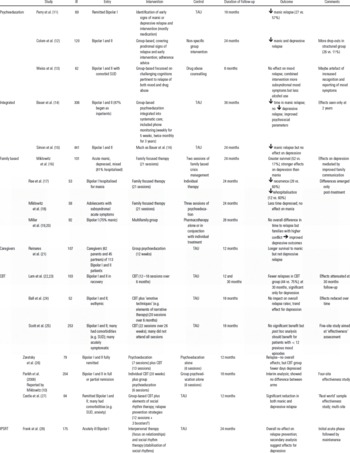
Table 1 outlines the published RCTs of psychosocial treatments in BD with more than 50 subjects. Following Miklowitz Reference Miklowitz(10), we consider the studies under the following headings:
Summary of published trials of psychosocial interventions for bipolar disorder (restricted to those with n>50)

↓, decreased; →, led to; CBT, cognitive behavioural therapy; IPSRT, interpersonal social rhythm therapy; SUD, substance use disorder; TAU, treatment as usual.
1. Psychoeducation, where the major emphasis is on teaching individuals about the nature of the illness and the ways of avoiding relapse.
2. Integrated treatments, where the psychosocial intervention is imbedded into usual clinical care.
3. Family therapy, where family psychoeducation is the main focus of therapy.
4. Cognitive-behaviour therapy (CBT) focuses on skill development using cognitive strategies such as exploration of negative cognitions relating to mood, and teaches elements of stimulus control, such as how to respond to triggers and mood changes.
5. Interpersonal social rhythm therapy (IPSRT), where the emphasis is on regulation of daily rhythms such as sleep and activities, in conjunction with interpersonal therapy emphasising the impact of the illness on relationships.
Discussion
Do the interventions work, and for what?
Relapse. Overall relapse rates have generally been reduced by psychosocial interventions for BD, irrespective of modality. In the main, the success of the interventions have been more in terms of a reduction in relapse of one pole of the illness; i.e. either depressive or manic episodes. To some extent, this relates to the type of treatment. In terms of psychoeducational programmes, that of Perry et al. Reference Perry, Tarrier, Morriss, Mccarthy and Limb(11) showed the benefit for manic but not for depressive relapse, while the psychoeducation programme of Colom et al. Reference Colom, Vieta and Martinez-Aran(12) showed efficacy for both depressive and manic relapses, although there were more drop-outs in the intervention arm (26 vs. 11% in the control intervention).
CBT interventions have tended to be more effective for the depressive pole, probably reflecting the emphasis on negative cognitive styles in that type of therapy. Castle et al. Reference Castle, Berk, Berk, Lauder, Chamberlain and Gilbert(27) and Castle Reference Castle(29) developed an intervention that is CBT-based but which includes a substantial psychoeducational component, and which also incorporates other parameters such as elements of social rhythm therapy. This package was effective in reducing both manic and depressive relapses. Zaretsky et al. Reference Zaretsky, Lancee, Miller, Harris and Parikh(26) tried to parcel out the effects of CBT plus psychoeducation versus psychoeducation alone, and found no overall differences apart from a tendency for the CBT group to have fewer days in depression; this finding is potentially confounded by the greater contact time with participants in the CBT arm (overall 20 sessions vs. 6 for those in the psychoeducation alone arm). An interim analysis of a similar study by Parikh and colleagues (reported by Miklowitz Reference Miklowitz(10)) also failed to show any substantial additional benefit for CBT over psychoeducation alone, despite the fact that the CBT group had 20 additional weeks of contact with the study therapists.
Miklowitz Reference Miklowitz(10) postulated that interventions with a particular emphasis on interpersonal coping skills would be most effective in reducing depressive episodes, and the IPSRT intervention of Frank et al. Reference Frank, Kupfer and Thase(28) showed benefit for depression only. Family based interventions have also tended to impact the depressive more than the manic pole of the illness, putatively mediated by improved family communication and reduced family conflict (Reference Miklowitz, George, Richards, Simoneau and Suddath16,Reference Miklowitz, Axelson and Birmaher18–Reference Miller, Gabor and Keitner20). Rae et al. Reference Rae, Tompson, Miklowitz, Goldstein, Hwang and Mintz(17) showed that family focussed therapy could, compared with individual therapy, reduce hospitalisations over and above reduced relapse rates, suggesting more tolerance of the family to their loved one being unwell, and their feeling more competent to deal with them in the family environment. The single study that targeted caregivers directly Reference Reinares, Colom and Sanchez-Moreno(21) showed a longer time to manic, but not depressive relapse: the mechanism is unclear.
Studies [other than those of Colom et al. Reference Colom, Vieta and Martinez-Aran(12), Castle et al. Reference Castle, Berk, Berk, Lauder, Chamberlain and Gilbert(27), Castle Reference Castle(29) and Reinares et al. Reference Reinares, Colom and Sanchez-Moreno(21)] have tended not to differentiate between manic and hypomanic relapse. Early recognition of the prodrome of mania reducing the severity of the ‘highs’, and prevention of full-blown mania is clinically important for the individual as well as in terms of service utilisation, notably hospitalisation. The study of Castle et al. Reference Castle, Berk, Berk, Lauder, Chamberlain and Gilbert(27) and Castle Reference Castle(29), which incorporated elements of psychoeducation, CBT and social rhythm therapy, obviated manic relapse but more patients in the intervention arm had hypomanic relapses, suggesting they could recognise imminent signs of mania and take appropriate remedial action. Of interest is that at 120 days post-intervention, hypomanic relapses were also significantly reduced, suggesting an ongoing learning effect of the intervention.
Hospitalisation. Reduction in hospitalisation is clearly an important goal for bipolar interventions, as this reduces disruption to the individual's life and also saves costs. Not all studies have reported on hospitalisation outcomes, and intriguingly reduced manic relapse was not always associated with reduced time in hospital [e.g. Bauer et al. Reference Bauer, Mcbride and Williford(14)]. Family focussed interventions do seem to reduce hospitalisations [e.g. Rae et al. Reference Rae, Tompson, Miklowitz, Goldstein, Hwang and Mintz(17) and Solomon et al. Reference Solomon, Keitner, Ryan, Kelley and Miller(30)], and those CBT interventions that have been successful in reducing relapse have also shown reduction in time in hospital [e.g. Lam et al. Reference Lam, Hayward, Watkins, Wright and Sham(23)]. We require a better understanding of pathways to hospitalisation for people with bipolar and how psychosocial interventions might impact these.
Other parameters. Few studies have specifically addressed broader psychosocial outcomes such as quality of life and vocational parameters. This is surprising, given that symptom measures alone constitute a limited assessment of BD outcomes Reference Murray and Michalak(31), and it may be in functional/quality of life outcomes that psychosocial interventions make their strongest contribution Reference Michalak, Murray, Young, Ferrier and Michalak(32). The small evidence base suggests that quality of life improves relatively slowly after treatment (perhaps paralleling functional recovery), and designs should include 12- to 24-month follow-up assessments to investigate these effects.
It is reasonable to expect that better symptom control and reduced hospitalisations will impact beneficially on psychosocial adjustment, and our experience has been that participants generally feel much more ‘in control’ of their lives and better equipped to handle life's ongoing challenges. In those studies that have measured psychosocial functioning objectively (Reference Perry, Tarrier, Morriss, Mccarthy and Limb11,Reference Bauer, Mcbride and Williford14,Reference Lam, Hayward, Watkins, Wright and Sham23), the intervention groups have shown improvement in most domains examined. Whether these changes are a direct consequence of better symptom control and reduced relapse rates, or are mediated by improvement in factors such as adjustment to having a chronic illness, psychosocial support, cognition or issues such as stigma, remains to be comprehensively studied.
What elements work?
In addition to the generic effects of therapy that are mediated through pathways including therapeutic alliance and support, what appears to be crucial in the efficacy of psychosocial interventions in BD is that a number of core components are addressed. These include psychoeducation, enhanced adherence to medication, early identification of prodromes, dealing with stress (including their cognitive mediation) and rhythm stabilisation Reference Vieta and Colom(33). However, the benefit of an additional systematic approach to skill development and enhancement is less clear from the literature. The provision of booster sessions by Lam et al. Reference Lam, Watkins and Hayward(22) provided some ongoing skill enhancement after termination and showed more comprehensive results than similar studies without booster sessions Reference Perry, Tarrier, Morriss, Mccarthy and Limb(11). The study of Castle et al. Reference Castle, Berk, Berk, Lauder, Chamberlain and Gilbert(27) and Castle Reference Castle(29) also included booster sessions, and the outcomes were promising (Table 1). Thus, booster sessions seem to be of value. What is not yet clear, however, is how many boosters should be provided and over what period. Very long-term follow-up studies are required to start answering such questions.
There is a problem with the generalisability of many of the interventions, with limits to their utility and applicability in routine clinical practice. For example, the interventions tend to require a large number of sessions, potentially limiting cost-effectiveness (Reference Miklowitz, George, Richards, Simoneau and Suddath16–Reference Miklowitz, Axelson and Birmaher18). One way of addressing this issue is to offer group-based interventions, which may be more cost-effective. Group therapy can have added benefits over individual intervention, with the context of group process encouraging social functioning and providing the buffering effects of social support Reference Yalom(34). Controlled studies using group-based, time-limited interventions that provide education, coping skills and behaviour modification, such as CBT, have been shown to improve secondary outcomes that contribute to relapse, e.g. understanding early warning signs. However, these changes may not be sustained, as their effectiveness in controlled trials is difficult to generalise to daily life.
To date, Colom et al. Reference Colom, Vieta and Martinez-Aran(12), Castle et al. Reference Castle, Berk, Berk, Lauder, Chamberlain and Gilbert(27) and Castle Reference Castle(29) have published data on group-based RCTs for BD; the former study was essentially psychoeducational, the latter eclectic. In the Colom et al. Reference Colom, Vieta and Martinez-Aran(12) study, sessions incorporated a number of approaches, including stress management techniques, problem-solving, establishment of routines and strategies for managing warning signs. In comparison with a befriending group, the intervention group experienced a significant reduction in number of participants who relapsed; the number and length of hospitalisations were also lower. The study of Castle et al. Reference Castle, Berk, Berk, Lauder, Chamberlain and Gilbert(27) and Castle Reference Castle(29) adopted a group-based approach and used a number of elements of therapies found beneficial in previous studies (see above and Table 1). The intervention was effective, relative to a ‘treatment as usual’ control, in reducing both depressive and manic relapses. Thus, group-based programmes are effective for BD, but whether they have particular benefits over individual care awaits investigation with a controlled trial.
Peer support in the context of group-based programmes may be of value in sustaining outcomes, and the 5-year follow-up from the group psychoeducation programme of Colom et al. Reference Colom, Vieta and Martinez-Aran(12) will shed some light on this. Of interest is that those integrated interventions that involved ongoing group therapy Reference Bauer, Mcbride and Williford(14), as well as family focussed therapy Reference Rae, Tompson, Miklowitz, Goldstein, Hwang and Mintz(17), have reported more sustained benefits (albeit that these are initially delayed). Ongoing formal or informal support and reinforcement of self-management skills may help maintain positive outcomes.
Those studies that have explicitly incorporated the psychosocial interventions into everyday care are particularly important in terms of their potential ‘reach.’ The US-based studies of Bauer et al. Reference Bauer, Mcbride and Williford(14) and Simon et al. Reference Simon, Ludman, Bauer, Unutzer and Operskalski(15) both used a group-based approach, with five weekly groups followed by twice monthly for up to 2 Reference Simon, Ludman, Bauer, Unutzer and Operskalski(15) or 3 Reference Bauer, Mcbride and Williford(14) years. Both these studies showed benefit for manic rather than depressive symptoms. The NIHM-sponsored STEP-BD programme Reference Miklowitz, Otto and Frank(35) compared a comprehensive intervention incorporating elements of CBT, IPSRT and family focussed therapy (30 sessions delivered over 9 months), and compared this with a brief (three sessions ) psychoeducational intervention. All patients were acutely depressed at baseline. Those patients in the intensive group recovered more rapidly and were more likely to remain well, but the effect was only significant for depression. These integrated interventions, although encouraging in terms of outcomes, do not show benefit for both poles of the illness, and the interventions themselves are complex (especially in STEP-BD) and presumably costly given the number of sessions and time-period of delivery.
The complexity and resource implications of many of the aforementioned models have led to the investigation of internet-based psychosocial treatment models, which have overt advantages in cost and reach. Such models could be conceptualised as psychosocial ‘primary care’ in counterpoint to the more complex ‘tertiary’ models discussed; these models require evaluation in formal studies, a number of which are underway (see below).
There is generally a lack of clarity regarding the mechanisms whereby psychosocial interventions exert their effect. An obvious candidate is simply better medication adherence, but the positive effect of psychoeducation was found even in highly adherent patients Reference Colom, Vieta and Martinez-Aran(12), and as has been stated above, adherence alone is not a guarantee of relapse prevention. Separate mechanisms may operate on different outcomes. Anti-manic effects of psychosocial interventions may in part be mediated by increased adherence, although effects on depression may be through mechanisms including cognition and reduction of negative cognitions, interpersonal and family stress Reference Morriss, Faizal, Jones, Williamson, Bolton and Mccarthy(36). Certainly those studies based on CBT techniques would address dysfunctional cognitions and provide behavioural skills around monitoring, problem-solving and goal setting, whereas social rhythm therapies emphasise regulation of lifestyle and psychoeducation interventions include monitoring of early warning signs and early intervention should these manifest. The extent to which therapeutic gains are due to factors common across psychotherapies [e.g. the support, learning and action domains of Lambert and Ogles Reference Lambert, Ogles and Lambert(37)] has received negligible attention. In summary, little is known about how adjunctive psychosocial interventions achieve their effects, precluding the refinement, targeting and rationalisation of interventions.
Which patients respond?
There is a deficit in published studies, in terms of generalisability. For example, studies have relied on referrals from mental health services Reference Lam, Watkins and Hayward(22,Reference Scott, Paykel and Morriss25) or University clinics Reference Colom, Vieta and Martinez-Aran(12), while in reality many people with BD are either not in treatment at all or are looked after exclusively by their general practitioner (GP).
A number of studies excluded people with other Axis I comorbidities including substance dependence (Reference Perry, Tarrier, Morriss, Mccarthy and Limb11,Reference Colom, Vieta and Martinez-Aran12,Reference Lam, Watkins and Hayward22). Such comorbidities are extremely common in BD, and their exclusion refines study samples unrealistically; indeed, it has been suggested that psychosocial interventions may also be effective in addressing comorbid symptomatology Reference Berk, Berk and Castle(38). The largest RCT in this area, namely that of Scott et al. Reference Scott, Paykel and Morriss(25), explicitly adopted a ‘pragmatic’ approach, with relatively few exclusion criteria. However, their subjects had to have been in contact with mental health services in the 6 months prior to enrolment, again raising questions of generalisability. The study of Castle et al. Reference Castle, Berk, Berk, Lauder, Chamberlain and Gilbert(27) and Castle Reference Castle(29) specifically recruited patients from multiple sources, including specialist mental health clinics, GPs, and direct to patients through support groups and media. Referral source was not a predictor of outcome. There were few exclusion criteria, and comorbidities were the rule rather than the exception; again, these were effectively managed during the intervention (e.g. there were very few drop-outs from this study), and again the number of comorbidities did not predict worse outcome.
Also, most studies have concentrated on bipolar I disorder, whereas bipolar II has been relatively neglected. Given the relatively higher prevalence of bipolar II, and the disabilities associated, this is an important gap in the literature Reference Colom, Vieta and Sanchez-Moreno(39). To the best of our knowledge, bipolar III and cyclothymia have not been systematically addressed by psychosocial interventions. Likewise, few studies have included patients with mixed states or rapid cycling disorder, again a gap in the literature because those variants carry particularly high levels of morbidity and are notoriously difficult to manage effectively with medication alone Reference Berk, Dodd and Mahli(40,Reference Vieta41).
Another contentious issue is what phase of the illness and level of severity patients should be at, to benefit from inclusion in psychosocial interventions. Most of the psychoeducation and CBT studies recruited patients who were remitted, and these arguably showed the best overall outcomes with relatively brief interventions Reference Scott, Colom and Vieta(8,Reference Benyon, Soares-Weiser, Woolacott, Duffy and Geddes9). Family focussed studies tended to accept ‘partially stabilised’ patients, possibly because the families could begin therapy in any event. The integrated studies of Bauer et al. Reference Bauer, Mcbride and Williford(14) and of Simon et al. Reference Simon, Ludman, Bauer, Unutzer and Operskalski(15), as well as STEP-BD Reference Miklowitz, Otto and Frank(35), recruited patients who were acutely unwell, and in the IPSRT of Frank et al. Reference Frank, Kupfer and Thase(28) a two-phase approach was adopted, with an initial remission phase followed by ongoing relapse prevention; it was only phase 2 that showed benefit in terms of reduction in relapse. Interestingly, in the integrated study of Simon et al. Reference Simon, Ludman, Bauer, Unutzer and Operskalski(15), it was those participants who were more severely ill at baseline who benefited most from the intervention.
One of the criticisms of the negative study of Scott et al. Reference Scott, Paykel and Morriss(25) was that they included many patients who were very unwell at baseline (nearly a third were in acute episode), although we are not aware of any subanalyses according to the level of initial symptomatology. The study of Scott et al. Reference Scott, Paykel and Morriss(25) also raises the issue of whether patients are more likely to benefit from psychosocial interventions if they have suffered fewer episodes of illness. Scott et al. Reference Scott, Paykel and Morriss(25) used the mean number of prior episodes (12) as their cut-off, but this approach has been criticised Reference Lam(42), and other studies have foreshadowed a cut-off at six prior episodes Reference Perry, Tarrier, Morriss, Mccarthy and Limb(11). This is concordant with the pharmacotherapy literature, where individuals with fewer episodes being more likely to respond to treatment Reference Franchini, Zanardi, Smeraldi and Gasperinin(43). These data support the notion of early intervention and staging in BD Reference Berk, Hallam and Lucas(44,Reference Berk, Hallam and Mcgorry45). Psychosocial interventions should therefore be instituted as early as possible in the course of the illness, so that fewer episodes are experienced and less damage done in terms of the illness itself, and the psychosocial consequences. Having said this, there is insufficient evidence to preclude patients further along in their illness course, from participating usefully in psychosocial interventions; indeed, we have found a number of individuals who have had numerous prior episodes but who respond well to such an intervention.
Conclusions
It seems obvious that psychosocial interventions are important for people with BD, given the tendency for the disorder to be a relapsing illness even in the setting of adequate pharmacotherapy. Those studies that have been rigorously conducted, using randomised controlled designs, provide some encouragement to clinicians and patients alike, in that they point to benefit in terms of reduction of relapse overall, reduced hospitalisation rates and improved psychosocial outcomes. However, the studies thus far have tended to impact one rather than both poles of the illness, and the manic pole has been less consistently ameliorated. Also, the precise elements that work for which individual remains understudied. The field also needs to clarify which patients are most likely to benefit, from what and at what stage of their illness. Programmes need to be expanded to include patients with other psychiatric and drug and alcohol comorbidities, as these are common and disabling, and show independent benefit from psychosocial treatments. There is also a pressing need to make these interventions more widely available, and further dissemination of the technology and training of clinicians is imperative. Studies that have incorporated psychosocial treatment into mainstream clinical practice are most welcome, but it is important that fidelity of such interventions is maintained and continual upskilling of clinicians ensured. The role of bibliotherapy Reference Berk, Berk, Castle and Lauder(46) and internet-driven programmes deserves further attention, as adjuncts to face-to-face psychosocial treatments, and/or including therapists available online: such programmes have shown promise in the depression sphere Reference Robertson, Smith, Castle and Tannenbaum(47). Several studies are currently in progress investigating the efficacy of online interventions in BD. These studies all take slightly different approaches Reference Lauder, Chester and Berk(48). Two are RCTs with relapse as the major outcome measure. Barnes et al. Reference Barnes, Harvey, Mitchell, Smith and Wilhelm(49) are comparing an online disease management intervention with an attention control condition, whereas Lauder and colleagues Reference Chong, Holdsworth and Gilbert(50,Reference Lauder, Berk and Castle51) are comparing psychoeducation with CBT in an online self-help modality. Proudfoot et al. Reference Proudfoot, Parker, Manicavasagar and Smith(52) are investigating a peer support model for those recently diagnosed, with outcomes focused on illness symptoms, functional and psychological variables. We await the definitive outcomes from these studies. The potential of online approaches to reduce costs, increase availability and remove other help-seeking barriers such as stigma has been much anticipated. However, cost–benefit analyses need to be rigorously conducted and results disseminated, if clinicians are to be able to advocate for resources to be channelled into this area of need.
Acknowledgements
The authors are most grateful for financial support from beyondblue and the Medical Benefits Fund for our bipolar programme.