Power shifts are a long-standing object of study in international politics. For Thucydides, “increasing Athenian greatness and the resulting fear among the Lacedaemonians made going to war inevitable.”Footnote 1 Recently, power transition theory focuses on power shifts as a cause of systemic wars.Footnote 2 Likewise, rationalist explanations for war point to large and rapid power shifts as a sufficient cause for war.Footnote 3
Still, two problems remain in the study of power shifts. First, although most existing scholarship conceptualizes them as exogenous, most large and rapid shifts in the balance of power are endogenous to state interaction, resulting from militarization efforts. Second, the few studies that endogenize power shifts fail to acknowledge the time lag between the moment in which a state decides to invest in military capabilities and the moment these become available, ignoring the possibility of a preventive attack. This possibility informs states' decisions to develop new military capabilities that would produce large and rapid power shifts, such as nuclear weapons. The prospect of prevention makes it possible to deter large and rapid power shifts peacefully. No existing scholarship fully incorporates key properties of most large and rapid power shifts.
We conceptualize power shifts as the result of a state's investment in military capabilities that have a delayed return and then determine when they trigger preventive wars.Footnote 4 When investments in military capabilities are transparent, other states can resort to preventive war to preclude a large and rapid power shift. The specter of preventive war in turn deters states from making investments that would produce such shifts because they would be attacked before the new capabilities become available. This means that preventive wars do not occur when military investments are transparent; peace always prevails regardless of the magnitude of possible power shifts. Small shifts would not be enough to trigger preventive wars. Large shifts would, but they are deterred through the possibility of war. Endogenous power shifts produce war only under (realistic) conditions of uncertainty about military investment decisions. Uncertainty about a state's military investment decisions prevents other states from trusting that investments will be detected.
This uncertainty has two effects. First, it opens the possibility of a state secretly investing in significant military capabilities, hoping to produce a large and rapid power shift as a fait accompli. Second, and consequently, it gives other states an incentive to strike preventively even in the absence of unambiguous evidence that an investment leading to a large and rapid power shift is underway. In other words, uncertainty about the timely detection of military investments makes preventive wars rational even against targets that are “innocent”–those that have been deterred from undertaking military investments. The likelihood of preventive war in turn depends on its effectiveness: how long it guarantees that the target will not militarize. Greater effectiveness makes a preventive war more tempting, undermining peace. At the same time, greater effectiveness makes the threat of preventive war more credible, making military investments less likely. Taken together, these two effects increase the likelihood that preventive wars are mistaken.
Our argument makes two main contributions. First, we specify a new causal mechanism for preventive wars. In exogenous power shifts, preventive war can happen with perfect information. This is not so when power shifts are endogenous, in which case preventive war requires uncertainty. Using the language of rationalist explanations for war, we show that when power shifts are endogenous, commitment problems lead to war only in the presence of information problems. Second, we show how preventive wars can happen within a rationalist framework even against a target that is not investing in military power. These contributions have important practical implications in an era of US military preponderance. An investment in military capabilities—for example, a nuclear-weapons program—is more likely to effect a large and rapid power shift when the prior relative power of the militarizing state is low. But if states with low relative power are more likely to produce large and rapid power shifts, they are also more likely to be targeted by preventive attacks launched by more powerful states. We show that such preventive attacks can occur in the absence of unambiguous evidence that the target is militarizing. This means that preventive military action launched by powerful states such as the United States will sometimes target states that are not conducting suspected military investments.
To illustrate our theory, we turn to the case of the 2003 US-launched invasion of Iraq to shed light on four important and hitherto underplayed aspects of the run-up to that war. First, an important factor triggering the war was the US administration's fear that an Iraqi weapons of mass destruction (WMD) program would produce a large and rapid endogenous power shift. Second, the war's timing was conditioned by the 11 September 2001 terrorist attacks, which shaped US perceptions of the consequences of Iraqi nuclearization. Third, uncertainty about whether Iraq was indeed pursuing a WMD program led to an ultimately mistaken preventive war. Finally, we account for why the United States attacked Iraq rather than other plausible but relatively more powerful targets such as North Korea. In sum, determined to prevent Iraqi leader Saddam Hussein from acquiring nuclear weapons, the US administration was unable to prove that Iraq was not, in fact, developing them. Faced with the possibility of a large and rapid power shift in favor of Iraq and operating with imperfect information about Iraq's militarization decision, the administration of US President George W. Bush opted for a preventive war, which was mistaken because there was no active Iraqi nuclear program.
Theory and Literature
Power shifts have been the focus of a long research tradition called power transition theory.Footnote 5 For power transition theorists, shifts result from differential rates of economic growth, likely to set “the whole system sliding almost irretrievably toward war.”Footnote 6 As a rising state increases its power, it is likely to become dissatisfied with the international status quo. At the same time, the declining state has incentives to preserve that status quo. This tension, power-transition theorists argue, is likely to produce war.
However, power transition theory has left several important questions unanswered. First, the causes of a rising state's dissatisfaction remain undetermined, with no agreement over whether such dissatisfaction stems from risk acceptance,Footnote 7 status dissonance,Footnote 8 or territorial disputes.Footnote 9 Second, there is no agreement on how to operationalize dissatisfaction to make it empirically testable.Footnote 10 Finally, the literature is split on whether war will be launched by the rising challengerFootnote 11 or the declining state.Footnote 12 In sum, power transition theory has reached a stalemate, with competing logics, different operationalization strategies, and inconsistent empirical predictions.
More recently, rationalist explanations for war have identified commitment problems as the causal link between power shifts and war.Footnote 13 In the context of a large and rapid power shift, the rising state cannot credibly commit to refrain from exploiting its future advantage. This may lead the declining state to strike preventively. For Powell, “the crucial issue in commitment problems is that in the anarchy of international politics, states may be unable to commit themselves to following through on an agreement and may also have incentives to renege on it. If these incentives undermine the outcomes that are Pareto-superior to fighting, the states may find themselves in a situation in which at least one of them prefers war to peace.”Footnote 14
Both these lines of scholarship conceptualize power shifts as the product of exogenous changes in state power, typically through differential rates of economic growth.Footnote 15 But exogenous power shifts are rarely large and rapid. In fact, most large and rapid power shifts result from changes in relative military power, which are the endogenous product of state decisions. A look at standard measures of state power, such as the Composite Index of National Capabilities (CINC) included in the Correlates of War (COW) data set, corroborates this point.Footnote 16 The CINC index is the average of each state's share of total and urban population, military personnel and spending, energy consumption, and iron and steel production. During the period between 1816 and 2007, there are only three instances of an annual power shift greater than 10 percent between any two major powers during peacetime, representing 0.15 percent of all dyads. If we disaggregate the CINC index into its exogenous and endogenous components, however, the greater prevalence of endogenous power shifts becomes clear. To show this, we construct two new indices. CINCexo averages the four exogenous components of the CINC index, total and urban population, energy consumption, and iron and steel production. CINCend averages the two components of the CINC index that are more explicitly the product of endogenous decisions: military personnel and spending. As Powell noted, most shifts resulting from economic growth are in practice quite small.Footnote 17 During the 1816 to 2007 period, we find five annual shifts greater than 10 percent in exogenous power (CINCexo) between major powers during peacetime, representing 0.25 percent of all dyads. In contrast, we find 111 annual shifts greater than 10 percent in endogenous power (CINCend), or 5.45 percent of all dyads. Figure 1 below shows the frequency of power shifts according to each of the three indices.
Distribution of exogenous and endogenous power shifts as a function of their magnitude

Given that most large and rapid power shifts—those severe enough to produce war—are endogenous, their conceptualization as exogenous appears inadequate. Instead, we conceptualize power shifts as the result of decisions to invest in military capabilities and focus on the strategic context in which these decisions are made.Footnote 18 Focusing on this strategic context highlights the possibility that a state will be the target of a preventive war between the moment it is suspected of making an investment in military capabilities and the moment these would come to fruition. It also highlights the possibility that a state will be deterred from acquiring additional military capabilities by the prospect of preventive war.
Some recent work has looked at the effects of endogenous power shifts by analyzing strategic interactions between states over resources that affect the future distribution of power.Footnote 19 Although these studies are a step in the right direction, they provide no guidance on what seem to be the most frequent power shifts, namely, those resulting from investments in military capabilities.Footnote 20 Addressing this final step, a literature has emerged on militarization that analyzes state decisions on which fraction of their resources they allocate toward military assets.Footnote 21 But these models assume that militarization decisions produce an immediate effect on the balance of power, missing the fact that military capabilities always result from investment decisions that have delayed returns—that is, there is a nonnegligible period of time between the decision to invest and the moment these capabilities become available. During this period, an attack against the militarizing state has the potential to destroy its investment in new weapons without having to face the additional capability that would come with their possession, making it possible to deter militarization by the threat of preventive war.
Certainly, there are situations where militarization appears to produce an immediate power shift. Yet this perception results from information problems: it follows from a failure to observe the prior decision to invest in military capabilities. We therefore subsume this particular case into a general theory of militarization and evaluate the effect of the information environment on the likelihood of militarization and of preventive war.
Our theory focuses on the strategic interaction between a state deciding whether to invest in military capabilities (in deterrence terminology, the target) and another considering whether to prevent that investment from yielding results (the deterrer), capturing the calculations of both. Militarization shifts the balance of power in favor of the target. Whenever this shift is greater than the cost of the investment in armaments, the target should invest. But the target is aware of the risk that its investment, since it has delayed returns, will be destroyed by a preventive strike before yielding fruit. It must thus anticipate the deterrer's incentive to prevent the power shift from occurring by striking preventively. The deterrer, for its part, must weigh the cost of preventive action against that of inaction. The cost of action is the cost of preventive war—that is, the value of the resources destroyed in preventing militarization.Footnote 22 The cost of inaction is the value of the concessions the target will demand once it has acquired additional military capabilities, reflecting the target's increased ability to convert policy preferences into outcomes once it possesses more military power.
Our central argument is that, in the context of endogenous power shifts, preventive war takes place only when there is uncertainty about a state's decision to invest in military capabilities. When one state's investment is not guaranteed to be detected by its adversaries, there is an incentive for attempting to present militarization as a fait accompli, precluding a preventive war. Knowing this, states that fear large and rapid adverse power shifts may launch preventive attacks even when information about the target's investment decision is ambiguous. Overall, the likelihood that endogenous power shifts lead to war hinges on the net effect of militarization, defined as the effect of militarization on the balance of power relative to the cost of preventive war. The higher the net effect of militarization, the more likely are preventive wars based on ambiguous evidence, increasing the incidence of mistaken wars. Stated differently, powerful states, for which preventive action is less costly, are more likely to launch wars against weaker targets that are wrongly suspected of having made vast military investments.
When an investment decision is perfectly observable, peace always prevails regardless of the magnitude of the power shift it would produce. When the net effect of militarization is small, preventive war is not rationalizable. Since threats of preventive attack by the deterrer are not credible, the target makes its investment. When, however, the net effect of militarization is large, threats of preventive war are credible. The target, understanding that attempted militarization would invite a preventive strike, refrains from investing. Perfect information about the investment allows militarization to be peacefully deterred. In the case of endogenous large and rapid power shifts, therefore, a rising state's inability to commit not to exploit its future power advantage does not per se generate war.
In reality, though, the deterrer may be unable to ascertain the target's decision whether to invest in added military capabilities. The target will thus be tempted to develop additional capabilities while trying to avoid detection. Understanding this, the deterrer cannot commit to refrain from preventively attacking the target. As a result, the target may develop additional capabilities and, independently, the deterrer may strike preventively.Footnote 23 The greater the quality of the information available to the deterrer about the target's investments in military power, the more confident it can be about deterring militarization peacefully. As the quality of that information increases, then, the lower the likelihood is of both conflict and militarization, and thus the lower the likelihood is of mistaken preventive wars—wars launched against an “innocent” target.
Moreover, the likelihood of preventive war depends on its effectiveness, defined as the period of time during which it ensures the target will not militarize. As it becomes more effective, preventive war is more tempting to the deterrer, making peace more difficult to enforce. At the same time, the threat of a preventive war becomes more credible, making militarization less likely and therefore preventive wars more likely to be mistaken.
It is important to acknowledge that there are at least two information problems at play in the context of endogenous power shifts, one related to whether a state has decided to invest in military capabilities and another related to the configuration of the particular weapons program in which the state may have invested. Three reasons lead us to restrict our attention to the former. First, although information problems stemming from hidden actions are the appropriate lens to understand how militarization may cause war, they have received relatively little attention within the rationalist framework.Footnote 24 Military capabilities are acquired only after they are pursued, so that the key information problem is whether the state has taken the action of investing in such capabilities. Second, our treatment allows us to address uncertainty about the configuration of the particular weapons program in which the state has invested by incorporating it into the cost of preventive war. As this second type of uncertainty increases, the deterrer needs to augment the target set of a putative preventive strike in order to reach a particular level of effectiveness. Third, there is no necessary logical link between these two types of information problem.Footnote 25 In sum, we agree that the ability of the target state to generate uncertainty about the configuration or location of its weapons-development sites may be linked to the effectiveness of preventive war but opt for bracketing this type of information problem in order to focus on the more basic problem of uncertainty about whether an investment in military capabilities has been made.Footnote 26
The Model
Basic Framework
We model a strategic interaction between two states, T (the “target”) and D (the “deterrer”). T decides whether to acquire additional military capabilities, that is, “militarize,” and D decides whether to launch a preventive war. T's militarization decision is a costly investment with delayed returns: it costs k > 0 in period t and comes to fruition in period t + 1, if D does not strike preventively.Footnote 27
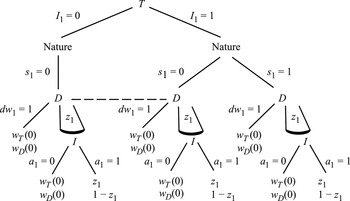
In keeping with the literature, states face two “problems.” The first is a commitment problem, in that they are unable to commit to abiding by any agreements in the future.Footnote 28 The second is an information problem, meaning here that D may be imperfectly informed about T's investment decision in period t when deciding whether to strike.Footnote 29 If T does not invest (I t = 0), s t = 0. If T invests (I t = 1), s t = 1 with probability p s ∈ [0,1], and s t = 0 with probability 1 − p s . Intuitively, s t = 1 represents an unambiguous signal of T's militarization, while s t = 0 is an ambiguous signal. We say that information problems are absent if the signal is perfectly informative (p s = 1).
After receiving its signal, D decides whether to declare war (dw t = 1, if it declares war; dw t = 0, if it does not). The alternative to a preventive war is a peaceful division of the pie, where D offers a share z t to T, keeping 1 − z t for itself. T then decides whether to accept D's offer z t (a t = 1, if it accepts the offer; a t = 0, if it does not). If T accepts the offer z t , it is implemented at t. If T rejects D's offer, war ensues. In any war, country i gets a payoff w i (M t ) ≥ 0 in period t, where M t represents T's current military capabilities (M t ∈ {0,1}, where M t = 1 if and only if T has acquired additional military capabilities). We assume that war is inefficient, that is, for any M t ∈ {0,1},
 $$
w_T (M_t ) + w_D (M_t ) < 1
$$
and call 1 − w T (0) − w D (0) the cost of a preventive war. We define a preventive war to be mistaken if it is made against a state that is not investing in military capabilities. Furthermore, we assume that countries discount the future (by factor δ ∈ (0,1)). We call δ[w T (1) − w T (0)] the effect of militarization, that is, the improvement in T's discounted war payoff resulting from its investment in military capabilities. Consider first a simple, two-period version of the game.
The Two-Period Game
Timing and solution concept
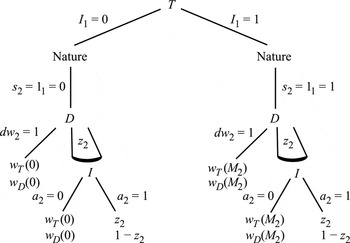
In this version, T has a single opportunity to invest in military capabilities, in period 1 (for the game tree, see Figures 2 and 3).Footnote 30 After T's decision to invest in period 1, Nature sends a signal s 1, then D decides whether to declare war or offer a share z 1, which T may accept or reject. In period 2, T cannot invest in military capabilitiesFootnote 31 and its prior investment decision is revealed (s 2 = I 1), through the occurrence, or not, of a military exercise or test. After this signal, D declares war or offers a share z 2, which T may accept or reject.
Game tree, period 1

Game tree, period 2

We solve for Perfect Bayesian Equilibria (PBE) of this dynamic game of imperfect information. This requires that at each information set, play is sequentially rational given beliefs and beliefs are updated using Bayes's rule whenever possible.Footnote 32
Solving the game
The solution in period 2 is straightforward. First, peace prevails since war is inefficient and there is no commitment problem or information problem. Second, the terms that T can extract increase with its military capabilities:
Proposition 1. In period 2, there is always peace, where D offers z 2* = w T (M 2) and T accepts any z 2 ≥ w T (M 2).
Proof. Straightforward.
Thus militarization is a costly attempt to extract resources from another state.
Moving up, we reach general conclusions about the outcome of period 1. First, if the effect of militarization is smaller than the cost of preventive war, preventive war is not rationalizable and peace must prevail. Indeed, if the maximum concessions that D would have to make to T in period 2 are smaller than the cost of preventive war, that is, the bargaining surplus that D does not extract by going to war, D cannot rationalize the decision to go to war. Second, if the effect of militarization is smaller than the cost of investment, militarization is not rationalizable and peace must prevail. Indeed, if the maximum benefit that T can extract from militarization is smaller than the cost of investment, T cannot rationalize the decision to invest in military capabilities. Thus, D need not fear the target's militarization when facing an ambiguous signal and peace prevails. In sum:
Proposition 2. In period 1, there is always peace if the effect of militarization is smaller than the cost of a preventive war or smaller than the cost of the investment.
Proof. See the appendix.
The situation is richer if preventive war and the investment in military capabilities are both rationalizable.
Proposition 3. Consider period 1 and assume that the effect of militarization is greater than the cost of a preventive war and greater than the cost of the investment.
-
1. If the signal is sufficiently informative, that is,
(2) $$
\left( {1 - p_s } \right)\delta \left[ {w_T (1) - w_T (0)} \right] \le k
$$

then peace prevails.
-
2. If the signal is not sufficiently informative, that is, condition (2) fails, then T militarizes with the following probability:
(3)
$$
q^ * = {1 \over {p_s + \left( {1 - p_s } \right){{\delta \left[ {w_T (1) - w_T (0)} \right]} \over {1 - w_T \left( 0 \right) - w_D \left( 0 \right)}}}}
$$
After s 1 = 1, preventive war occurs. After s 1 = 0, peace prevails with the following probability:
(4)
$$
r^ * = {k \over {\left( {1 - p_s } \right)\delta \left[ {w_T (1) - w_T (0)} \right]}}
$$
and preventive war occurs with probability 1 − r *.


Proof. See the appendix.
This proposition shows that if the signal's informativeness is sufficiently high (case 1), the threat of preventive war is sufficient to deter any investment. D is confident that it can detect militarization attempts, and need not attack preventively when it receives an ambiguous signal. If the informativeness of the signal is not sufficiently high (case 2), strategic uncertainty remains and war occurs with positive probability. We conclude the following:
Theorem 1. When shifts in the balance of power are endogenous, commitment problems may cause war only if information problems are present.
Proof. Follows from propositions 2 and 3.
This stands in contrast to the traditional rationalist framework, where commitment problems may cause war even in the absence of information problems.Footnote 33 The difference comes from the fact that, when shifts in the balance of power are the result of a costly investment with delayed returns, the declining state can use the threat of a preventive strike to deter the target from militarizing. Therefore, large and rapid endogenous shifts in the balance of power do not occur and peace prevails. This theorem thus highlights a particular type of commitment problem that may cause conflict. Whereas when shifts in the balance of power are exogenous, commitment problems may cause war because a state cannot commit to refrain from exploiting its future power advantage, when shifts in the balance of power are endogenous, commitment problems may cause war because a state cannot commit to refrain from investing in military capabilities.
Information problems are thus necessary for conflict. The greater their severity is, the greater is the likelihood of conflict. Indeed, the more informative the signal is, the more effective are threats of preventive war and the more confident is the deterrer that it need not worry about an ambiguous signal. As a result, we conclude the following:
Corollary 1. The greater the informativeness of the signal is
-
1. the more stringent become the conditions under which preventive wars happen with positive probability and, if such conditions are met,
-
2. the smaller is the probability of preventive war and
-
3. the smaller is the share of preventive wars that are mistaken.
Proof. See the appendix.
The Infinite-Horizon Game
Building an infinite-horizon game enables us to assess the robustness of the previous results and investigate two additional questions. First, is war avoidable when states are engaged in an ongoing relationship? A finite game produces a unique solution, where the deterrer extracts the most favorable peaceful terms. We may worry that by precluding “concessions” this setup is responsible for war. Second, how does the likelihood of war depend on its effectiveness—the period of time during which it effectively demilitarizes the target?Footnote 34
In the infinite-horizon version of the previous game, the target first decides whether to invest in military capabilities. If it makes the investment and peace prevails, the target possesses these additional military capabilities, and keeps them from then on. If a preventive war occurs, it demilitarizes the target for N periods, where N is the effectiveness of a preventive war.
First, we note that a necessary condition for war is that both militarization and preventive war are rationalizable. Yet even in those circumstances, we may believe that war can be avoided. The target should be willing to accept some concessions, short of the terms it would extract after militarization, to save the cost of investment. The deterrer should want to offer some concessions, knowing that if it later reneged on them, the target would militarize, thus extracting greater concessions in the future. Generally, peace can be enforced if the concessions needed to prevent militarization are smaller than the cost of a preventive war, averaged over the effectiveness of the preventive war—that is, if the cost of peace is smaller than the cost of war.Footnote 35
The standard logic suggests that efficiency could be enforced if players are sufficiently patient.Footnote 36 If a deviation entails a short-term benefit, for example, reneging on a payment, and a long-term punishment (that is, reverting to the inefficient equilibrium), then as players become more patient, the threat of future punishment looms larger and efficiency can be enforced.
Yet this does not fully characterize the strategic interaction between the target and the deterrer. For the target, the best deviation is to militarize. This entails a short-term cost, that is, the cost of investment, and a long-term benefit, that is, greater concessions resulting from militarization. As the target becomes more patient, it demands greater—not smaller—concessions. For the deterrer, preventive wars produce a sustained benefit, since they obviate the need for concessions while the target is effectively demilitarized. Thus, war may occur even in an infinite-horizon game where countries are very patient.
Understanding that preventive war is not an artifact of the finite-horizon game, we can first confirm that an increase in the quality of the signal has the same effect as in the two-period game.Footnote 37 One additional mechanism, germane to the infinite-horizon setting, is that a better signal reduces the cost of peace. Indeed, as the signal becomes more informative, the target is less tempted to militarize and the deterrer is less concerned about ambiguous signals. Thus, the deterrer can make smaller concessions to prevent militarization: peace and efficiency are achieved more easily.
Next, we can analyze the role that a preventive war's effectiveness plays on its likelihood. As a preventive war becomes more effective, it becomes more attractive to the deterrer, since it lifts the need to make concessions for a longer period of time. The first direct implication is that it is more difficult to sustain efficiency. The second effect is that threats of preventive war are more credible. As a result, the target is less likely to militarize, so that preventive wars are less likely, and more likely to be mistaken. Formally, this means the following:
Corollary 2. The greater the effectiveness of a preventive war is
-
1. the less stringent become the conditions under which preventive wars happen with positive probability, and if such conditions are met,
-
2. the smaller is the probability of preventive war; and
-
3. the greater is the share of preventive wars that are mistaken.
Proof. See the appendix.
To summarize the results of our formalization, under conditions of perfect information about a state's decision to invest in additional military capabilities, the specter of a potentially large and rapid power shift never leads to preventive war. Rather, such large and rapid power shifts can be deterred. When uncertainty about the investment is introduced, peace prevails whenever the effect of militarization is smaller than the cost of war. If this effect is also smaller than the cost of the investment, militarization is not rationalizable. If, however, the effect of militarization is greater than both the cost of the investment and the cost of a preventive war, peace may break down. The set of circumstances under which war becomes possible and the probability that it will break out both increase as the quality of the information decreases. Furthermore, as the likelihood of preventive war increases, so does the probability that it will be mistaken, that is, waged against an unarming target. Finally, the more effective a preventive war is in ensuring the absence of future investments in additional military capabilities, the broader the set of conditions under which war becomes possible, the lower the probability that it will break out, and the greater the likelihood that it will be mistaken. As with exogenous power shifts, investments in military capabilities may generate commitment problems that lead to war. Unlike exogenous power shifts, however, such commitment problems will lead to war only when information is imperfect.
The US-Led Invasion of Iraq
In principle, the theory presented in this article applies to any interaction between two actors where one can take a costly and potentially hidden action to affect the outcome of conflict.Footnote 38 Here, we focus on the model's lessons for an important topic: preventive counterproliferation wars. More precisely, our theory sheds light on important mechanisms that appear to have been at work in the 2003 invasion of Iraq.
The 2003 US invasion of Iraq is a controversial case, with scholars debating the proper framework to analyze the crisis and also its lessons for international-relations theory. Our purpose in this article is not to claim that our theory offers a definitive or complete explanation for the case. Rather, it is to show how our theory illuminates aspects of the Iraq case that have been underexplored.
On 20 March 2003, a US-led coalition invaded Iraq. The main US motivation for the war was to prevent suspected Iraqi nuclearization, which Washington thought would bring about a large and rapid shift in the balance of power in favor of Iraq. The invasion came after a protracted United Nations inspection process aimed at guaranteeing the end of the Iraqi WMD program, including its nuclear component. Arguing that Saddam Hussein's regime was not fully cooperating with the inspectors, the US administration justified the invasion as the only way to obviate the threat of a nuclear-armed Iraq. Coalition forces quickly prevailed, deposing Saddam's regime with relative ease. Baghdad fell a mere twenty-one days after the invasion was launched and the major-operations phase of the war ended six days later.
During the run-up to the invasion, the US government's casus belli rested on suspicion that Saddam was developing WMD—including nuclear weapons—thus presenting an imminent threat.Footnote 39 Avoidance of a possible large and rapid power shift was therefore at the center of the case for war. Granted, a multiplicity of other arguments was introduced to justify the invasion, including Iraqi human-rights abuses and the need to democratize the Middle East.Footnote 40 But WMD played the central role in the US administration's case for forcible regime change. In his 2002 State of the Union address, President Bush had pledged not to “permit the world's most dangerous regimes to threaten us with the world's most destructive weapons.”Footnote 41 He soon thereafter reiterated the argument by saying, “Saddam Hussein must understand that if he does not disarm, for the sake of peace, we, along with others, will go disarm Saddam Hussein.”Footnote 42 On 5 February 2003, in a highly publicized attempt to legitimize the invasion, Secretary of State Colin Powell made a presentation to the UN Security Council called “Iraq: Failing to Disarm.” Powell argued that “possession of the world's most deadly weapons was the ultimate trump card [and] the United States would not—could not—run the risk to the American people that Saddam Hussein would one day use his weapons of mass destruction.”Footnote 43 The day after Baghdad fell, in the absence of any immediate WMD findings on the ground, White House press secretary Ari Fleischer repeated it: “We have high confidence that they have weapons of mass destruction. That is what this war was about.”Footnote 44 In short, the case the US administration presented had at its core concerns about a large and rapid shift in the balance of power in favor of Iraq as a result of Baghdad's WMD investments.
Iraq's nuclear acquisition would represent a large and rapid power shift that would make Saddam immune to any externally driven regime-change efforts, ending his vulnerability to US military action. The cost of war against a nonnuclear Iraq, in contrast, was expected to be relatively low because US forces would, given the precedent of the 1991 Gulf War, no doubt prevail. In the past, Iraq had possessed impressive military forces. But already in 1991, Saddam found himself in a weaker position. During the Gulf War, Iraqi forces were decisively expelled from Kuwait by a US-led coalition.Footnote 45 Significantly, Iraq lost much of its military materiel in that conflict.Footnote 46 Iraq's relative weakness also gave the United States free rein to impose a severe sanctions regime that further crippled Iraqi capabilities. By 2003, Iraq's military was poorly trained and equipped. The balance of power clearly favored the United States. In this context, the US ability to depose Saddam promptly was never in doubt. Although fighting a defensive war in its own country against an expeditionary force, the Iraqi army lost all engagements with coalition forces and ended up suffering 9,200 fatalities—or more than fifty times the 172 lives lost by coalition forces.Footnote 47 This cost was several orders of magnitude smaller than the expected cost of deposing a nuclear-armed Saddam. This difference accounts for US insistence in guaranteeing Iraqi nonnuclear status, if necessary by force.
The second point our theory highlights in the case of the Iraq war is the role of the terrorist attacks of 11 September 2001 in accounting for the war's timing. Iraq had been suspected of not abiding by the terms of the post–Gulf War cease-fire, but an invasion did not happen until the events of 9/11 undermined the US administration's trust in the intelligence community's ability to detect security threats in a timely manner.Footnote 48 In the aftermath of the attacks, the Bush administration became particularly worried, based on flimsy intelligence, about the possibility of an Iraqi nuclear handoff to a terrorist group for use against US targets.Footnote 49 In any case, a nuclear Iraq would pose a particularly thorny problem for US security. It would not only be able to provide a terrorist group with a nuclear weapon but it would also make any US retaliation exceedingly costly. Specifically, a US attempt to depose a nuclear-armed Saddam by force would place him in a “use them or lose them” situation, and was therefore unfeasible.Footnote 50 As then-National Security Advisor [NSA] Condoleezza Rice put it in her memoirs:
A policy maker confronted with one assessment that says that Baghdad “could make a nuclear weapon within several months to a year” should it “acquire sufficient fissile material from abroad” and the INR alternative view that could not speak to timing is not likely to take the risks of accepting the latter, particularly after 9/11 and the specter of WMD terrorism… We'd failed to connect the dots on September 10 and had never imagined the use of civilian airliners as missiles against the World Trade Center and the Pentagon; that an unconstrained Saddam might aid a terrorist in an attack on the United States did not seem far-fetched.Footnote 51
This higher sensitivity to a low-probability event made peace harder to sustain. In this sense, the invasion of Iraq represented the paradigmatic application of the “1 percent doctrine,” attributed to Vice President Dick Cheney. This doctrine suggests that, in the post-9/11 security environment, the United States must deal with “low-probability, high-impact” events as if they were certain.Footnote 52 Thus the United States acted as if Iraqi nuclearization were all but certain and launched a preventive war, which subsequently proved mistaken.
Next, our model shows how the US administration's inability to eradicate uncertainty about the status of Iraq's nuclear program was essential to the breakdown of peace. Enjoying a preponderance of power and determined to avoid the repetition of the 11 September 2001 terrorist attacks, the United States set a high standard of evidence for proof of Iraq's disarmament. Since the United States could not be certain of detecting a Iraqi nuclear program, it feared Iraq would be tempted to build a nuclear weapon and place Washington before a fait accompli. Unable to prove this negative point and unwilling to run the risk of facing a nuclear Iraq, the United States decided to launch a preventive war that ultimately rested on mistaken grounds.Footnote 53
Retrospectively, much has been made of intelligence failures, but the problem was that in order to change US policy, intelligence reports would have to prove that Iraq did not have and would not develop WMD. Unfortunately, it is almost impossible for intelligence services to prove a negative. In fact, Western intelligence communities were determined not to miss the next threat and were therefore taking a more sanguine line regarding Iraq's WMD program. As Jervis notes, “the belief that Iraq had active WMD programs was held by all intelligence services, even those of countries that opposed the war.”Footnote 54 Based on the imperfect information the United States possessed about Iraq's WMD capabilities, “[a] responsible judgment could not have been that the programs had ceased.”Footnote 55 Jervis concludes that
at best, intelligence could have said that there was no firm evidence that Saddam had stockpiles of chemical and biological weapons or was actively pursuing nuclear bombs. It could not have said that he had ceased his efforts… Furthermore, intelligence could not have said that Saddam would not resume pursuit of WMD at some point in the future.Footnote 56
In part, uncertainty about the Iraqi WMD program was magnified by the strategic situation in which the United States benefited from great relative power. Were Saddam ever to announce or acknowledge publicly his investment in a nuclear-weapons program—as Soviet leader Joseph Stalin did in 1945—he would invite likely preventive action from the United States.Footnote 57 The US administration, for its part, facing relatively low costs of war as a result of its power preponderance, demanded a high degree of certainty that Iraq had given up developing nuclear weapons in order to refrain from launching a preventive attack.
According to the terms of the 1991 ceasefire, Iraq was forbidden from developing WMD and long-range missiles. To verify Iraqi compliance, the United Nations Special Commission (UNSCOM) was created and its inspectors were deployed in the country. After repeated violations of its disarmament obligations, growing tensions, and US air strikes, Iraq evicted UNSCOM in December 1998. Scott Ritter, the commission's chief inspector at the time, noted that “without effective monitoring, Iraq can in a very short period of time measured in months, reconstitute chemical biological weapons, long-range ballistic missiles to deliver these weapons, and even certain aspects of their nuclear weaponization program.”Footnote 58 Consequently, the UN was unable to certify Iraq's complete disarmament.Footnote 59 Under mounting pressure, Saddam finally agreed to let UN inspectors back in on 26 September 2002. Earlier that month, the British International Institute for Strategic Studies concluded that Iraq possessed the scientific apparatus to “assemble nuclear weapons within months if fissile material from foreign sources were obtained.”Footnote 60 In fact, Hans Blix, the chief inspector for the United Nations Monitoring, Verification and Inspection Commission (UNMOVIC) (which had replaced UNSCOM), was unable to ascertain whether Iraq possessed any WMD. UNMOVIC's work was plagued by discrepancies between Iraqi reports of WMD quantities produced and destroyed. According to Blix, UNMOVIC's reports “do not contend that weapons of mass destruction remain in Iraq, but nor do they exclude that possibility. They point to lack of evidence and inconsistencies, which raise question marks, which must be straightened out, if weapons dossiers are to be closed and confidence is to arise.”Footnote 61 In his final prewar presentation to the UN Security Council, Blix was remarkably ambiguous:
It is obvious that, while the numerous initiatives, which are now taken by the Iraqi side with a view to resolving some long-standing open disarmament issues, can be seen as “active,” or even “proactive,” these initiatives three to four months into the new resolution cannot be said to constitute “immediate” cooperation. Nor do they necessarily cover all areas of relevance.Footnote 62
Indeed, there was a broad political consensus in Washington that Saddam possessed, or intended to acquire, WMD.Footnote 63 US Senator John Kerry from Massachusetts, soon to become the Democratic presidential nominee, claimed that “according to the CIA's report, all US intelligence experts agree that Iraq is seeking nuclear weapons. There is little question that Saddam Hussein wants to develop nuclear weapons.”Footnote 64
As became clear after the war, Iraq possessed no WMD and had no consistent WMD programs. Furthermore, Saddam seems to have abandoned his nuclear program—though not his intention of resuming it—years before the war. The United States had been able to terminate the Iraqi nuclear-weapons program through the sanctions regime in place since the 1991 war.Footnote 65 All the Iraq Survey Group could find after the invasion was evidence that Saddam intended to revive such programs if and when sanctions were lifted. The group's final report states:
Saddam wanted to recreate Iraq's WMD capability—which was essentially destroyed in 1991—after sanctions were removed… Saddam aspired to develop a nuclear capability—in an incremental fashion, irrespective of international pressure and the resulting economic risks—but he intended to focus on ballistic missile and tactical chemical warfare (CW) capabilities.Footnote 66
Finally, our theory helps account for why the United States set its crosshairs on Iraq rather than another plausible target: North Korea. The United States had long suspected North Korea of intending to develop nuclear weapons and had gone to the brink of war over this issue in the 1994 crisis.Footnote 67 A mere two weeks after the fall of Baghdad, North Korean officials announced to their US counterparts that they possessed nuclear weapons, a claim validated by the CIA in August 2003.Footnote 68 Why, then, did Washington pursue a mistaken preventive strike against Iraq, whose nuclear program had in practice ended, rather than target North Korea, whose nuclear program was fast approaching completion?
The strategic interaction the United States had with North Korea at the time differs in a crucial aspect. Given Pyongyang's ability to impose heavy costs on the United States and its allies in case of a military conflagration, the cost of a preventive war against North Korea was expected to be much greater than that of a war against Iraq. By the same token, the effect of North Korean nuclearization would be relatively small, given the limited range of policy options available to the United States even vis-à-vis a nonnuclear North Korea. Indeed, Pyongyang could turn Seoul into a “sea of fire” using its conventional artillery.Footnote 69 At the peak of the 1994 crisis between the United States and North Korea over the latter's nuclear program, on 17 June, then-President Kim Youngsam of South Korea reportedly told President Bill Clinton over the phone:
I can't make the Korean peninsula a battlefield. Once war breaks out, numerous citizens and soldiers would be killed, the economy would be ruined, and foreign capital would leave the country. Even if the United States carries out surgical air strikes, North Korea will immediately fire back to the major South Korean cities. Many lives were gone during the Korean War, and now we have stronger weapons. No war again.Footnote 70
Decision makers in Washington consistently made a similar assessment. US military estimates dating from 1994 expected that in case war broke out in the Korean peninsula, “the US would sustain 52,000 casualties, and South Korea up to 490,000, in the first ninety days of a full-blown conflict.”Footnote 71 By 1999, then-former Secretary of Defense William Perry, reporting to Congress on the evolution of the situation, argued that “the intensity of combat in another war on the Peninsula would be unparalleled in US experience since the Korean War of 1950–53.”Footnote 72 Along similar lines, Rice (the National Security Advisor at the time) recalls in the context of President Bush's misgivings about the North Korean regime's reactivation of its nuclear facilities in 2002 that “given the consequences of conflict on the Korean peninsula, there didn't seem to be many alternatives… The Pentagon wanted no part of armed conflict on the Korean peninsula. We were without a workable strategy.”Footnote 73
Against this background of a potentially costly preventive war in the 1990s, the US government reached a peaceful agreement with Pyongyang—the 1994 Agreed Framework. In this agreement, North Korea committed to freezing its nuclear program. In exchange, the United States committed to building two light water nuclear reactors (from which weapons-grade fissile material cannot be derived) in North Korea, providing the country with energy supplies while these reactors were being built, issuing formal security assurances precluding the use of US nuclear weapons against North Korea, and working toward the end of sanctions against the Pyongyang regime. This agreement helped ensure North Korea's nonnuclear status for almost another decade. Unfortunately, this type of grand bargain could not be reached with Iraq, where the net effect of nuclear acquisition was perceived to be greater.
Although a rationalist approach can thus account for important features of the Iraq War, others disagree. In an important article, Lake argues that the rationalist framework cannot account for the war because of two shortcomings.Footnote 74 First, the two main causes of conflict in the rationalist framework—information and commitment problems—are constant features of international relations.Footnote 75 Thus, according to Lake, the rationalist framework cannot explain why bargaining broke down in this particular instance but not others, such as the run-up to North Korean nuclearization. Second, the main mechanism that produced the Iraq war lies outside the rationalist framework. For Lake, the war was caused by cognitive biases and irrational self-delusion.Footnote 76 While Washington failed to obtain better information about the cost of war and to incorporate mounting evidence that Iraq had disbanded its WMD program, Saddam failed to ascertain the level of US resolve about fighting the war and continued to send mixed signals in an attempt to placate both its regional enemies and the United States. For Lake, these actions counter the basic assumption of rationality. As a solution, he calls for “a behavioral theory of war.”Footnote 77
In our view, however, neither criticism stands. First, the fact that the rationalist framework builds on fundamental problems of weakly institutionalized settings—information and commitment problems—is a strength not a weakness. The framework's predictive power lies in its ability to highlight how particular circumstances exacerbate such problems, thus increasing the likelihood that bargaining breaks down and war occurs. As we argued, the cost of inaction against possible threats was perceived to be greater after 9/11 and the cost of a preventive war, relative to the effect of nuclearization, was perceived to be lower against Iraq than against North Korea. The model thus highlights some factors that may help account for the timing of the war against Iraq and for the absence of war on the Korean peninsula in the same time period.
Second, Lake's call for a behavioral revolution does not appear warranted. Granted, the standard rationalist framework has important shortcomings. In our minds, the key commitment problem was that Saddam could not refrain from investing in nuclear weapons, and the key information problem was that Washington could not be certain of detecting an Iraqi nuclear investment before it yielded fruits. The standard rationalist framework cannot account for such problems because it assumes that shifts in the balance of power occur exogenously. Yet it is possible to capture such problems and remain within the rationalist framework by endogenizing such power shifts, as we do, without launching a behavioral revolution.
The other aspects that Lake emphasizes—misperceptions and multiple audiences—may have played a role in the run-up to the war. Yet it is not clear that including misperceptions or multiple audiences is necessary for an account of the war, or that their inclusion requires a behavioral revolution.
Examining Iraqi behavior, Lake finds two dimensions that negate a rational treatment of the case. First, he concludes in retrospect that Saddam strongly misperceived US resolve to invade. Yet the rationalist framework highlights how the United States had an incentive to misrepresent its resolve to invade in order to achieve its preferred outcome peacefully. If it was clear to both sides that Saddam would back down if confronted with a UN security resolution or with a mere troop mobilization, then a (counterfactual) low-resolve US administration would have had an incentive to bluff by sending signals of high resolve. This, however, undermined the credibility of US signals of resolve. The fact that the US administration was highly resolved to invade Iraq does not therefore mean that a rational Iraqi government should have believed it. Furthermore, Saddam possessed a strategy—granted, an ultimately flawed one—to placate US aggression. He hoped first that Russia or France would intercede on Iraq's behalf to prevent a US invasion and that, in case these efforts failed, Iraqi forces would be capable of increasing US military costs to the point at which American public opinion would force Washington to back down.Footnote 78 Given Iraq's international isolation and US power preponderance, such hopes were soon dashed. But this does not mean his behavior was irrational or that an archetypal rational state could not reach the same conclusion.
Second, Lake points out the role of multiple audiences in accounting for the seemingly puzzling behavior Saddam displayed throughout the 1990s and in the run-up to the crisis, never revealing that the Iraqi nuclear program had been disabled by the sanctions regime despite rising US pressure to prove this point. Lake is right that, as first UNSCOM and then UNMOVIC reports repeatedly emphasized, Iraq did not act like it had nothing to hide. Rather, it often engaged international inspectors in a noncooperative fashion, heightening suspicion. After the war, the Iraq Survey Group concluded that Saddam, while trying to persuade the United States that it had no active WMD, was trying to create uncertainty to impress upon Iran and possibly also Israel and his own people that he might have some WMD capabilities.Footnote 79 While multiple audiences were in play, our theory shows that they were not necessary to produce war. A theory allowing for multiple audiences and multiple ambiguous signals could produce a richer account of Saddam's behavior. In particular, understanding the US incentive to misrepresent its preferences, and gambling that Washington was not resolved, Saddam could have chosen one of the more ambiguous signals in an attempt to shore up his credentials against other audiences and facilitate the eventual resumption of the WMD programs. Yet in our opinion a key friction that contributed to the occurrence of war was that the United States was uncertain about its ability to detect current and future attempts to nuclearize. This argument need not assume the existence of multiple audiences, nor does it warrant a behavioral revolution. Moreover, our argument offers a more plausible account of the war's timing. After all, Saddam had been playing to multiple audiences for more than a decade before the war.Footnote 80
Likewise, Lake finds two features in US behavior that lie outside the rationalist framework. First, he argues that the Bush administration's underestimation of the costs of war and postwar governance in Iraq played an important role in eliminating the bargaining range and producing war.Footnote 81 It is true that ex ante US assessments of the Iraq War's cost subsequently proved to have significantly underestimated it. It is also true that, in terms of our model, the lower the expected cost of war, the lower the anticipated effect of Iraqi nuclearization that could still justify war. But US estimates of this effect, particularly given putative links between Saddam's regime and terrorist groups, were particularly dire, so that war would have been justified even if its estimated cost would have been higher than predicted at the time. In fact, war was attractive not only because it was cheap, but also because it could lead to Saddam's ouster from power and thus offer an effective method of preventing his acquisition of nuclear weapons.
This brings us to the second supposedly irrational feature Lake points out in US behavior in the Iraq case: the standard the Bush administration demanded Iraq to satisfy to prove the absence of a WMD program was too stringent—indeed irrational. But what kind of evidence could Washington have “rationally” demanded to alleviate any concern about Saddam's intentions to nuclearize? WMD programs are relatively easy to dissimulate and future intentions are remarkably difficult to signal in a credible fashion. Indeed, the Iraq Survey Group took two years of unfettered access to Iraqi facilities to conclude that Saddam's WMD program had in fact been dismantled.Footnote 82 Furthermore, the CIA concluded after the invasion that Saddam was intent on resuming his nuclear program.Footnote 83 Given intelligence reports estimating that Iraqi nuclearization could happen “within several months to a year,” further delay could bring Iraq closer to nuclearization, leaving little time for the United States to react and strike preventively. How could inspections have proven the negative within a reasonable timeline?Footnote 84 Rationality does not impose restrictions on preferences, but simply on the expected behavior given particular preferences.
By 2002–2003, the United States possessed an overwhelming power advantage over Iraq. Reeling from the 11 September 2001 terrorist attacks, the US administration heightened its perception of the threat posed by Saddam's putative WMD capability. Unable to obtain definitive information about Iraq's decision to forfeit nuclear acquisition, and fearing a large and rapid adverse power shift, the United States launched a preventive war—a mistaken one, as it turned out, since Saddam had long before given up his WMD programs.
Conclusion
Because militarization efforts can go undetected, some states may pursue them in the hope of presenting their adversaries with a fait accompli. Aware of this possibility, other states may attack an adversary for fear of its militarization even if they do not possess unambiguous evidence that such militarization is taking place. Thus, information problems play a crucial role in providing a rationalist explanation for war. Ever since Fearon's seminal article,Footnote 85 commitment problems are seen as a sufficient cause of war in the presence of large and rapid power shifts.Footnote 86 Thus far, however, the rationalist literature has assumed that shifts are produced exogenously, freely, or immediately, before another state can strike preventively. In our view, large and rapid power shifts typically result from a state's decision to militarize, which is best understood as a costly investment with delayed returns in military capability. Conceptualizing power shifts this way, we show that power shifts do not in and of themselves lead to conflict. Only when informational problems are present do power shifts lead to war.
We illustrated the causal logic of our theory with an account of the US-led invasion of Iraq in 2003. Iraq's inability to commit to not develop nuclear weapons, paired with the US inability to verify the absence of an Iraqi nuclear program, played a key role in the decision to go to war. More broadly, our theory indicates that mistaken preventive wars are more likely under conditions of power preponderance, such as unipolar international systems. This qualifies generally accepted claims about the peacefulness of a unipolar world,Footnote 87 which have only recently been disputed.Footnote 88 Furthermore, our theory can help solve a long-standing contradiction in studies of preventive war.Footnote 89 Arguing about democracy's pacifying effects, Schweller claims that “only nondemocratic regimes wage preventive wars against rising opponents.”Footnote 90 But he restricts this argument to “power shifts between states of roughly equal strength.”Footnote 91 We show that a state—democratic or not—is more likely to launch a preventive war when the net effect of militarization is high—that is, the cost of preventive war is lower relative to the expected power shift it is meant to forestall. When the net effect of militarization is low, “appeasement” (that is, peaceful acceptance of another state's rise) becomes the rational policy choice.Footnote 92 Consistent with this evidence, democratic support for a preventive strike is greater if the target state is “half as strong” rather than “as strong as” the home country.Footnote 93
Turning to current policy debates, our theory has implications for US policy toward the Iranian nuclear program. Some scholars have argued in favor of a preventive strike. For Kroenig, a war is the “least bad option,” because its cost is not as frightening as the consequences of a nuclear-armed Iran.Footnote 94 In other words, the net effect of Iranian nuclearization would be high. Our analysis of the Iranian case differs in two points.Footnote 95 First, we believe Kroenig underestimates the cost of war. A preventive strike on Iran's nuclear program would be quite costly.Footnote 96 The Iranian program is extensive, with key installations close to population centers or buried underground. Furthermore, Iran possesses the ability to inflict damage on US interests in the region, including disrupting the flow of oil through the Strait of Hormuz;Footnote 97 firing missiles at, and encouraging Hezbollah attacks on, Israel; and undermining US goals in Iraq and Afghanistan. Second, we think Kroenig overestimates the effectiveness of a preventive strike. Short of an all-out invasion—which most proponents of a strike rightly rule out on the grounds that it would be too costly to be rational—a preventive strike will leave Tehran's regime in place. As a civilian, oil-rich, parliamentary dictatorship, the Iranian regime is relatively stableFootnote 98 and unlikely to be unseated by a preventive strike. Even if it were toppled, the nuclear program enjoys widespread support in Iran and could be resumed quickly. This means that a preventive strike would guarantee Iranian nonnuclearization for a only relatively short period of time.Footnote 99 Therefore, in our view, Iranian nuclearization does not configure a shift of such magnitude that would justify a US preventive strike, given its limited effectiveness.
Generalizing, our theory offers implications for the likelihood of preventive attacks against nuclear programs. In our view, the cost of a preventive war, relative to the effect of nuclearization, increases with the size of the target set, the proximity of such targets to population centers, and the relative capabilities of the target. In some cases, this cost may be so high that preventive war is not a rational option and proliferation occurs unimpeded. For example, we believe that the ability of the Soviet Union to end the US nuclear monopoly in 1949 resulted from the US inability to launch a surgical counterproliferation preventive strike. Given the absence of intelligence that enabled the construction of a target set for the Soviet nuclear program, a preventive strike needed to cripple the Soviet Union. But since the US nuclear arsenal was far from possessing this capability, any strike in practice meant a massive conventional attack. Given the conventional balance of power, such an attack was expected to lead to significant Soviet territorial gains. A preventive strike was simply too costly to be a viable option.Footnote 100
Looking ahead, we believe that the strategic framework presented in this article is a useful building block in a strategic theory of nuclear proliferation. Our framework may help bridge the gap between existing theories that focus on those states considering nuclear acquisition (the “demand side”) and those that focus on states interested in preventing proliferation (the “supply side”). One important next step in constructing this theory would be to supplement the argument laid out here with an analysis of the strategic interaction between a potential proliferator and a nuclear ally, which would allow a weaker state to deter preventive military action while developing its own nuclear capability. We reserve this question for future research.Footnote 101