INTRODUCTION
Pediatric concussion is a highly prevalent health condition affecting one in six children before the age of 10 years (Langlois, Rutland-Brown, & Thomas, Reference Langlois, Rutland-Brown and Thomas2006), with even higher incidence rates observed in adolescents and young adults aged 15 to 24 years (Cassidy et al., Reference Cassidy, Carroll, Peloso, Borg, von Holst and Coronado2004). Post-concussive symptoms (PCS) often occur following a concussion and include a range of physical, cognitive, and emotional complaints (Sady, Vaughan, & Gioia, Reference Sady, Vaughan and Gioia2014). PCS are expected to resolve within approximately 1–3 months post-injury for the majority of children (Barlow et al., Reference Barlow, Crawford, Stevenson, Sandhu, Belanger and Dewey2010); however, 15–30% of children will suffer prolonged PCS beyond that time (Babcock et al., Reference Babcock, Byczkowski, Wade, Ho, Mookerjee and Bazarian2013; Barlow et al., Reference Barlow, Crawford, Stevenson, Sandhu, Belanger and Dewey2010; Grool et al., Reference Grool, Aglipay, Momoli, Meehan, Freedman and Yeates2016; Zemek et al., Reference Zemek, Barrowman, Freedman, Gravel, Gagnon and McGahem2016). Given this alarming statistic, increasing attention has been paid to examining differences between children who do and do not show delayed recovery (i.e., persistent PCS).
Injury-related factors that predict persistent PCS include the presence of headache, nausea/vomiting, and loss of consciousness at the time of injury (Babcock et al., Reference Babcock, Byczkowski, Wade, Ho, Mookerjee and Bazarian2013; McNally et al., Reference McNally, Bangert, Dietrich, Nuss, Rusin, Wright and Yeates2014; Zemek et al., Reference Zemek, Farion, Sampson and McGahern2013). Non-injury factors, such as older age at injury (Zemek et al., Reference Zemek, Farion, Sampson and McGahern2013), being female (Taylor et al., Reference Taylor, Dietrich, Nuss, Wright, Rusin, Bangert and Yeates2010), pre-injury learning and psychiatric problems (Ponsford et al., Reference Ponsford, Willmott, Rothwell, Cameron, Ayton, Nelmus and Ng1999), ineffective coping strategies (Woodrome et al., Reference Woodrome, Yeates, Taylor, Rusin, Bangert, Dietrich and Wright2011), and lower pre-injury cognitive ability (Fay et al., Reference Fay, Yeates, Taylor, Bangert, Dietrich, Nuss and Wright2010) have also been linked to the presence of persistent PCS in children. The relative contribution of injury versus non-injury factors to persistent PCS is not well understood (McNally et al., Reference McNally, Bangert, Dietrich, Nuss, Rusin, Wright and Yeates2014).
Another injury-related factor that may contribute to persistent PCS is a history of multiple (i.e., two or more) concussions. Some evidence suggests that multiple concussions may result in greater PCS, although findings are inconsistent and the reasons for any linkage remain controversial (Barker et al., Reference Barker, Russo, Barker, Rice, Jeffrey, Broderick and Craddock2017; Bijur, Haslum, & Golding, Reference Bijur, Haslum and Golding1996; Brooks et al., Reference Brooks, McKay, Mrazik, Barlow, Meeuwisse and Emery2013, Reference Brooks, Mannix, Maxwell, Zafonte, Berkner and Iverson2016; Iverson, Gaetz, Lovell, & Collins, Reference Iverson, Gaetz, Lovell and Collins2004; Iverson, Brooks, Lovell, & Collins, Reference Iverson, Brooks, Lovell and Collins2006; Mannix et al., Reference Mannix, Iverson, Maxwell, Atkins, Zafonte and Berkner2014). Given the inconsistencies in the literature regarding cumulative effects of multiple concussions, the possibility of a dose-response relationship (whether physiological or psychosocial in nature) between number of concussions and persistent PCS cannot be dismissed.
An additional non-injury factor garnering attention in adult concussion research is psychological resilience. Psychological resilience is conceptualized as the process of harboring interpersonal qualities that enable one to adapt or thrive in the face of adversity (Connor & Davidson, Reference Connor and Davidson2003). Such qualities include personal competence, tenacity, trust in one’s instincts, and positive acceptance of change (Connor & Davidson, Reference Connor and Davidson2003). Psychological resilience can also be thought of as one’s ability to “bounce back” from illness, injury, or other stressors. Historically, resilience research focused on identifying interpersonal, societal, and cultural factors that enabled children to adapt and thrive in adverse circumstances, such as poverty, family violence, and poor parenting (e.g., Anthony, Reference Anthony1974; Werner, Reference Werner1997; Werner & Smith, Reference Werner and Smith1992).
Recently, however, researchers have begun to focus more specifically on psychological resilience as an important, and potentially modifiable (e.g., Steinhardt & Dolbier, Reference Steinhardt and Dolbier2008), factor in medical populations, and have examined its role in predicting the outcome of several physical ailments, including brain injury. Psychological resilience has been found to predict PCS in adults with a history of concussion, such that lower resilience is related to greater PCS (Losoi et al., Reference Losoi, Silverberg, Waljas, Turunen, Rosti-Otajarvi, Helminen and Iverson2015; Reference Losoi, Silverberg, Waljas, Turunen, Rosti-Otajarvi, Helminen and Iverson2016; Merritt et al. Reference Merritt, Lange and French2015; Sullivan, Edmed, Allan, Smith, & Karlsson, Reference Sullivan, Edmed, Allan, Smith and Karlsson2015). However, the relationship between resilience and PCS has not yet been explored in a pediatric sample.
The current study, therefore, aimed to examine both injury-related (i.e., single vs. multiple concussion) and non-injury related (i.e., psychological resilience) factors that may be related to the risk of persistent PCS after pediatric concussion. More specifically, the study sought to explore the role of resilience as a predictor and potential moderator of PCS in the context of single versus multiple concussion, in comparison to orthopedic injury (OI), in children 8–18 years of age.
Both concussion groups were expected to report higher PCS than the OI group, with the multiple concussion group endorsing the greatest PCS. Psychological resilience was predicted to be negatively associated with PCS ratings in all groups. The association between resilience and PCS was hypothesized to vary as a function of injury type, such that the strongest association would be found in children with multiple concussion and the weakest association in children with OI. Thus, resilience would act as a moderator of PCS, such that the groups would not differ significantly in PCS among children with high resilience, but would differ significantly in PCS among children with low resilience, with the highest PCS ratings seen in the multiple concussion group. A secondary analysis examined the relation of resilience to different dimensions of PCS to determine whether resilience would differ in its relationship to different dimensions of PCS (i.e., physical, cognitive, emotional, fatigue).
METHODS
Participants
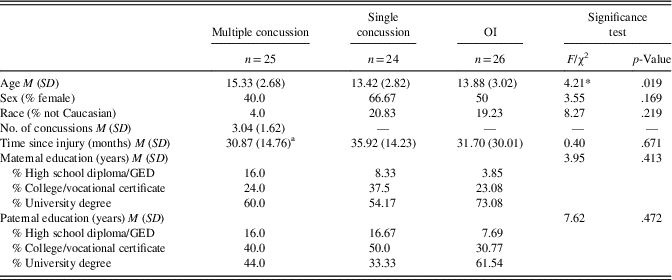
The present study was a planned sub-study of a larger parent project, which received approval from the Conjoint Health Research Ethics Board. Demographic characteristics of the sample are presented in Table 1. Participants were recruited from existing research databases derived from patients originally presenting to the emergency department, as well as various outpatient clinics (e.g., concussion clinic), at the Alberta Children’s Hospital (ACH) in Calgary, Alberta. The participants fell into three groups: (1) children and adolescents with multiple concussions (i.e., a history of two or more prior concussions; n=26), (2) children and adolescents with a single concussion (n=24), and (3) children and adolescents with an OI not involving the head (n=25). The OI group was included as a non-head injury comparison to measure the potential dose-response effect of concussion (i.e., provide a baseline), while simultaneously controlling for the effect of exposure to a medical trauma as well as environmental and behavioral factors that make a child more likely to sustain an injury.
Demographic characteristics of study sample

GED=general education development (high school equivalent).
a Time since most recent injury.
*Significant group difference (p<.05).
All participants were at least 6 months post-injury at the time of recruitment. Inclusion criteria for the concussion groups are in keeping with the Centers for Disease Control and Prevetion definition of a concussion (National Center for Injury Prevention and Control, 2003), and included injury to the head that occurred greater than 6 months before recruitment, diagnosis of concussion by a health care professional at the time of injury, and report of at least one new symptom at the time of injury (e.g., headache, nausea, dizziness). The time frame for exposure to injury (i.e.,>6 months before recruitment) is in keeping with recent data describing expectations for recovery (i.e., 1–3 months; Barlow et al., Reference Barlow, Crawford, Stevenson, Sandhu, Belanger and Dewey2010), indicating that symptoms present after 6 months can be considered persistent and refractory.
Inclusion criteria for the OI group were a minor injury [i.e., Abbreviated Injury Scale (AAAM, 2008) score of 3 or less] to the thorax, upper extremity, or lower extremity, and presentation to a healthcare professional for management of the injury. Exclusionary criteria for all groups included history of a moderate or severe traumatic brain injury (TBI); history of substance abuse, psychiatric hospitalization, or neurological disorder; or visual, hearing, motor, or language deficits that could lessen a child’s ability to complete questionnaires. Exclusion criteria for the OI group also included a parent-reported history of any previous TBI.
The majority of participants (i.e., n=58) who were recruited for the parent study were contacted by phone and received a letter inviting them to participate in the study. Additional participants (i.e., n=17) were recruited from the same sources, including any who declined to participate in the parent study. The latter were offered the option to participate in the current sub-study only, which required them to complete all measures via mail, as also approved by the Research Ethics Board. All potential participants were screened for inclusion and exclusion criteria and, if eligible, provided signed parental consent and child assent upon enrolment into the study.
A total of 170 participants were contacted between September 2014 and November 2016 via letter and phone call and invited to participate in the parent study, and an additional 29 participants were contacted via phone call to participate in the mail-out portion of this study, for a total of 199 contacts. Approximately 61% of potential recruits either did not follow up with the research assistant, declined participation, or were not enrolled due to sample limits, and three additional participants were omitted from analyses due to exclusionary criteria (one participant was too old, two participants with concussions less than 6 months before enrollment), leaving 26 children with multiple concussion, 24 with single concussion, and 25 with OI.
Significant differences in age, sex, and injury group (i.e., multiple concussion, single concussion, OI) were observed between those who did and did not participate. Specifically, those who did not participate were more likely to be in the single concussion group (χ2=14.18; p=.001), were more likely to be male (χ2=7.57; p=.006), and were slightly older (M=15.47; SD=2.15 vs. M=14.22; SD=3.06; t(124.71)=3.12; p=.002). These differences were due largely to the methodology for the parent study, which used targeted recruitment to attempt to match groups for age and sex for neuroimaging purposes. That is, additional recruitment efforts were made to fulfill goals of equal sample sizes for the three groups, such that a large number of potential participants with a history of single concussion or orthopedic injury (recruited from a previous hockey study, and, therefore, mostly males) were contacted to fill a few remaining spaces in those groups. Although several of these children agreed to participate, only a few were actually enrolled to best match groups for sex and age.
The final sample (N=75) consisted of 39 females (52%) and 36 males (48%). Participants ranged in age from 8 to 18 years (M=14.20; SD=2.88), and time between injury and study recruitment ranged from 6.51 to 130.66 months (M=32.94; SD=19.59). Number of previous concussions in the multiple concussion group ranged from 2 to 8 (M=3.04; SD=1.62). Information on etiology of concussions (e.g., mechanism of injury) was not collected. Participants who completed the full parent study did not differ significantly from those who completed the mail-out portion on demographic, injury, or primary outcome variables (i.e., age, sex, race, number of previous concussions, time since injury, maternal education, paternal education, Post-Concussion Symptom Inventory [PCSI] self-report, PCSI parent-report). Significant demographic differences between injury groups were found only for age (F=4.21; p=.019), with the highest mean age in the multiple concussion group.
Measures
Post-concussion symptoms
PCS were measured by having children and parents complete the PCSI. The PCSI is a rating scale that has several versions, including a self-report (child) form and a parent-proxy report form that asks the child or parent to rate the severity of the child’s current symptoms (i.e., yesterday and today) by indicating how much of a problem each symptom is for the child. Both the PCSI child report and parent-proxy report forms consist of 26 items rated on a 7-point scale indicating the severity of the problem (0=Not a problem, 3=Moderate problem, 6=Severe problem). Total possible scores range from 0 to 156, with higher scores indicative of more severe PCS. The PCSI has demonstrated moderately high test–retest reliability, strong internal consistency, and good convergent validity (Sady, Vaughan, & Gioia, Reference Sady, Vaughan and Gioia2014). Total scores from each version of the PCSI were included in the main analysis to examine the effect of resilience on PCS.
Given that post-concussion symptoms are multi-dimensional, Sady and colleagues (Reference Sady, Vaughan and Gioia2014) recently examined the symptom dimensions of the PCSI through factor analysis. They identified four correlated symptom dimensions: physical, cognitive, emotional, and sleep/fatigue. Thus, secondary analyses were performed to identify relationships between resilience and the four symptom dimensions of the PCSI.
Psychological resilience
Psychological resilience was measured by having children complete the Connor-Davidson Resilience Scale (CD-RISC; Connor & Davidson, Reference Connor and Davidson2003). The CD-RISC is a 25-item rating scale that measures factors related to resilience, such as personal competence, tenacity, tolerance of negative affect, positive acceptance of change, control, and spiritual influences (Connor & Davidson, Reference Connor and Davidson2003). Each item is measured on a 5-point scale (0=Not true at all, 2=Sometimes true, 4=True nearly all the time). Total possible scores range from 0 to 100, with higher scores indicative of greater resilience. The CD-RISC demonstrates sound psychometric properties in the general adult and adolescent population, as well as in clinical samples (Connor & Davidson, Reference Connor and Davidson2003). Limited published studies have examined the psychometric properties of the CD-RISC in children; however, the available evidence supports its construct validity when administered to a pediatric medical sample (Laliberté Durish, Brooks, & Yeates, Reference Laliberté Durish, Brooks and Yeates2017). The CD-RISC has a Grade 5 reading level; therefore, items were read aloud to participants younger than 10 years of age.
Procedure
Children recruited for the parent study completed the measures in a designated testing room, and parents completed the parent version of the questionnaires in a separate room. Participants recruited to participate in the mail-out portion of the study were mailed a package containing a consent form, all parent and child questionnaires, and instructions for completion (e.g., parent and child forms to be completed separately). Packages were then mailed back to the research lab in a pre-stamped envelope upon completion.
Statistical Analyses
Statistical analyses were conducted using IBM SPSS Statistics software, Version 24 (IBM, 2016). Descriptive statistics of demographic variables (i.e., age, sex, race, parent education), the primary predictor variable (i.e., CD-RISC), and primary outcome variables (i.e., PCSI child report, PCSI parent report) were calculated for each group. An analysis of variance was conducted to examine group differences on primary predictor and outcome variables, followed by Tukey honest significant difference post hoc analyses of between-group differences. Hierarchical regression analyses were performed with group and resilience entered as predictor variables and the two total scores for PCS ratings (i.e., PCSI child report, PCSI parent report) examined separately as dependent variables, to assess whether group or resilience predicted PCS. Two dummy variables were created to compare the multiple and single concussion groups to the OI group. Group×resilience interaction terms were created to assess the moderating effect of resilience on PCS.
Predictors were entered in three steps for the primary regression analyses: (1) two dummy variables for group, (2) resilience (i.e., CD-RISC total score), and (3) two group×resilience interaction terms. Similar regression analyses were completed to examine the effect of group and resilience on each of the four child and parent PCSI domain scores (i.e., physical, cognitive, emotional, and sleep/fatigue). Multiple comparisons were controlled for in a family-wise manner using the false discovery rate (Benajmini & Hochberg, Reference Benjamini and Hochberg1995).
RESULTS
Group means and standard deviations for the PCSI and the CD-RISC are presented in Table 2. Significant group differences were present for both child- and parent-reported PCS (F=4.40; p=.016; F=7.72; p=.026), with the difference for child ratings remaining significant after controlling for multiple comparisons. Post hoc comparisons indicated that the multiple concussion group reported higher mean child-rated PCS than the OI group. No significant group differences were present on the CD-RISC. Child- and parent-reported PCS were significantly correlated (r=.54; p<.001), although parents reported lower total PCS scores than children, in contrast to some previous research (Sady et al., Reference Sady, Vaughan and Gioia2014).
Group means and comparisons on the PCSI and CD-RISC

PCSI=Post-Concussion Symptom Inventory (total raw score); CD-RISC=Connor-Davidson Resilience Scale (total raw score).
a Tukey HSD post-hoc test of multiple comparisons.
*Significant group difference (p < .05).
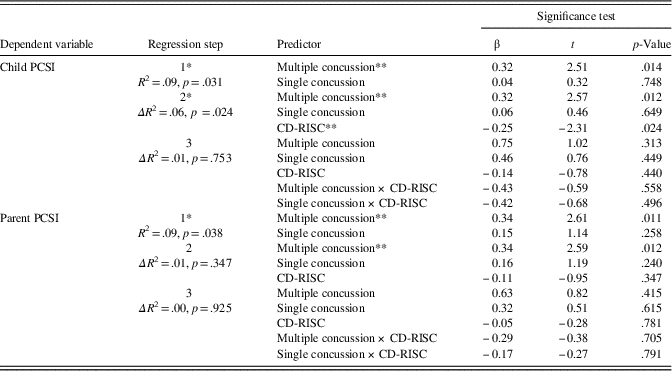
Primary regression analyses are summarized in Table 3. A significant effect of group (i.e., the contribution of both dummy variables) was found for both child- and parent- reported PCS (R 2=.09; p=.031; R 2=.09; p=.038). The dummy variable comparing the multiple concussion group to the OI group was a significant predictor of both child- and parent-reported PCS, with the multiple concussion group endorsing greater symptoms than the OI group (t(72)=2.51; p=.014; t(70)=2.61; p=.011, respectively). Additionally, the CD-RISC was a significant, unique predictor of child-reported PCS (ΔR 2=.06; p=.024), with lower resilience predicting greater PCS, but did not predict parent-reported PCS. None of the group×resilience interactions were significant for either child- or parent-reported PCS.
Primary regression analyses

PCSI=Post-Concussion Symptom Inventory (total raw score); CD-RISC=Connor-Davidson Resilience Scale (total raw score).
*Significant effect (p < .05).
**Significant after controlling for multiple comparisons (false discovery rate).
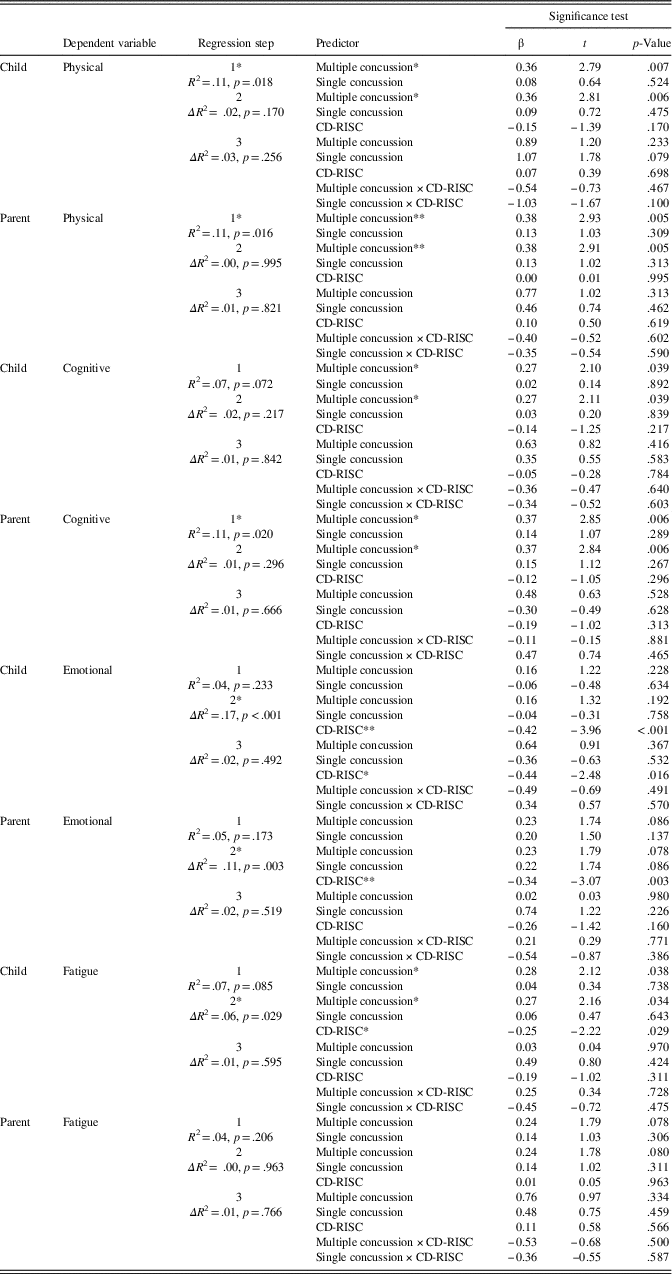
When specific domains of PCS were analyzed (see Table 4), a significant effect of group (i.e., the contribution of both dummy variables) was found for both child- and parent-reported physical symptoms (R 2=.11; p=.018; R 2=.11; p=.016) and parent-reported cognitive symptoms (R 2=.11; p=.020). In all cases, the multiple concussion group, but not the single concussion group, reported more severe symptoms than the OI group. The multiple concussion group also reported significantly more child-reported cognitive and fatigue-related symptoms, even after accounting for resilience (t(72)=2.11; β=0.27; p=.039; and t(72)=2.16; β=0.27; p=.034, respectively). After taking group into account, resilience was a significant predictor of both child- and parent-reported emotional symptoms (R 2 Δ=.17; p < .001 and R 2 Δ=.11; p=.003; respectively), as well as child-reported fatigue symptoms (R 2 Δ=.06; p=.029).
Prediction of PCSI domain scores

PCSI=Post-Concussion Symptom Inventory (raw score); CD-RISC=Connor-Davidson Resilience Scale (total raw score)
*Significant (i.e., p < .05).
**Significant after controlling for multiple comparisons (false discovery rate).
In all cases, lower CD-RISC scores predicted higher PCSI scores. Only the main effect of the multiple concussion group on parent-reported physical symptoms, as well as the effect of resilience on child- and parent-reported emotional symptoms, remained significant after correcting for multiple comparisons. No significant interactions between group and resilience were found for any of the PCS domain scores.
DISCUSSION
This study examined the role of single versus multiple concussions and psychological resilience as predictors of persistent PCS. The results support our hypothesis that multiple concussions would be associated with the highest levels of PCS. The multiple concussion group showed significantly higher levels of both child- and parent-reported PCS than the OI group, but the single concussion group did not. This finding is consistent with previous research suggesting that children with a single concussion do not differ from those with OI on symptom report long after injury, while those with two or more concussions endorse greater PCS (Brooks et al., Reference Brooks, McKay, Mrazik, Barlow, Meeuwisse and Emery2013; Iverson et al., Reference Iverson, Gardner, Terry, Ponsford, Sills, Broshek and Solomon2017; Rieger et al., Reference Rieger, Lewandowski, Callahan, Spenceley, Truckenmiller, Gathke and Miller2013). Group differences involving the multiple concussion group were found in several PCS symptom domains. Specifically, the multiple concussion group demonstrated higher levels of physical and cognitive symptoms, as reported by both the child and parent, as well as more child-reported fatigue. The lack of group differences for emotional symptoms suggests that somatic and cognitive symptoms may be more injury-specific.
The current results also provide partial support for our hypothesis that resilience would be negatively associated with PCS. The CD-RISC was significantly associated with child-reported total PCS, such that lower resilience predicted greater PCS. Notably, a similar relationship was not found between resilience and parent-reported total PCS. Therefore, self-report biases or common method variance could be driving these effects (Podsakoff, MacKenzie, Lee, & Podsakoff, Reference Podsakoff, MacKenzie, Lee and Podsakoff2003). That is, children who are more likely to rate themselves as highly resilient may also, by nature of their response style, be more likely to rate themselves as having fewer problems.
On the other hand, resilience was a predictor of both child- and parent-rated PCS at the domain level, but only for emotional symptoms and fatigue symptoms. Specifically, higher resilience predicted fewer emotional symptoms as reported by both child and parent, as well as fewer child-reported fatigue symptoms. Thus, psychological resilience may be less related to physical and cognitive symptoms, and instead may serve to protect primarily against emotional symptoms. In this case, resilience may also predict fatigue because of the known relationship between emotional distress and fatigue (Thomsen, Mehlsen, Christensen, & Zachariae, Reference Thomsen, Mehlsen, Christensen and Zachariae2003; Van Dyk, Thompson, & Nelson, Reference Van Dyk, Thompson and Nelson2016). However, the correlation between emotional and fatigue symptoms in the current sample is not greater than the correlations among other symptom domains.
A major question for the current study was whether psychological resilience would act as a moderator of persistent PCS following concussion and OI. Our findings fail to support this hypothesis. The relatively small sample size may provide a methodological explanation for the failure to detect significant interactions indicative of moderation. Interactions require more power to detect than main effects, and the relatively low sample size of the groups may not have provided adequate power to detect significance. Alternatively, no interaction effects may actually exist, and resilience may help to account for symptoms in children with both kinds of injuries.
Strengths and Limitations
A major strength of the current study is that it begins to fill a void in the literature regarding the relationship between both injury and non-injury factors, specifically history of previous concussion and resilience, and long-term outcome following concussion in children and adolescents. Furthermore, the study results are consistent with previous findings regarding the relationship between resilience and PCS in adult concussion. Additionally, the findings provide a rationale for developing and testing interventions designed to promote psychological resilience, with the goal of improving outcomes for children with concussion.
However, the results should be interpreted in light of several study limitations. First, the average time since injury was 2.7 years, making it very difficult to determine whether the group differences in PCS are causally related to concussion or to other factors (e.g., expectations about the effects of concussion, premorbid risk factors); thus, a study that uses a prospective, longitudinal methodology may be necessary to confirm the nature of the group differences. Notably, the relationships of psychological resilience to PCS are less likely to be affected by these considerations, given that the groups did not differ in resilience. Second, retrospective pre-injury ratings of PCS were not obtained, and participants were seen long after injury, precluding any comparison of baseline symptoms. Third, the study is limited by the relatively small sample size, which meant it was not adequately powered to detect small effect sizes. Relatedly, to maximize sample size, the age range of participants was purposely broad (i.e., 8–18 years); however, although adolescent age is a significant predictor of PCS (e.g., Zemek, Farion, Sampson, & McGahern, Reference Zemek, Farion, Sampson and McGahern2013), we examined children and adolescents as a single group because our sample size was not sufficiently large to treat age as a moderator. Thus, we were unable to consider possible age-related variation in our findings. Fourth, the significant effects of resilience for child-reported total PCS were not paralleled by similar findings for parent-reported total PCS. Therefore, shared rater variance may be driving the effects seen for child-reported total PCS scores. However, resilience was a predictor of parent ratings of emotional symptoms, suggesting that the results cannot be attributed entirely to shared rater variance. Finally, the parent study involved neuroimaging, which is a significant incentive for families who may suspect neurological deficits based on the presence of symptoms, potentially biasing the sample to include a larger proportion of highly symptomatic participants.
CONCLUSIONS
Both a history of two or more previous concussions and lower psychological resilience predict increased severity of PCS long after injury. Given that resilience is a dynamic and modifiable construct (Johnston et al., Reference Johnston, Porteous, Crilly, Burton, Elliot, Iversen and Black2015; Steinhardt & Dolbier, Reference Steinhardt and Dolbier2008), the findings suggest that direct interventions that increase resilience may help to prevent or alleviate PCS after concussion. The prevention or alleviation of PCS may increase quality of life for affected children and families while also reducing the burden of increased health care usage associated with persistent PCS.
ACKNOWLEDGMENTS
Thanks to Lianne Tomfohr-Madsen PhD and Vina Goghari PhD for being part of Ms. Laliberté Durish’s MSc committee. The authors thank the members of the NEURO-detect study team (Zeanna Jadavji BSc, Shane Virani MSc, Vickie Plourde PhD, Trevor Low BSc, Helen Carlson PhD, Karen Barlow MB ChB MRCPCH (UK) MSc, Michael Esser MD PhD, Kathryn Schneider PhD PT, Frank MacMaster PhD, Catherine Lebel PhD, R. Marc Lebel PhD, Signe Bray PhD, and Ashley Harris PhD). Thanks to Lonna Mitchell BA and Kalina Slepicka BA for scoring protocols and (alphabetically) Amy Bobyn, Dominique Bonneville BA (Hons), Shauna Bulman, Shelby MacPhail, Maya Sohn, and Cole Sugden for assistance with data entry. Thanks to Brenda Turley BA (Hons), Carolyn Emery PhD PT, and Kathryn Schneider PhD PT for assisting with recruitment. Recruitment of some control participants was done using the Healthy Infants and Children Clinical Research Program database (HICCUP; http://www.ucalgary.ca/paediatrics_hiccup). Thanks to the families who participated in this study and generously donated their time to research. Funding: This study was funded by the Shaikh Family Research Award, an endowment held by the Alberta Children’s Hospital Foundation and granted to Brian Brooks by the Alberta Children’s Hospital Research Institute. Additional support for the study was provided from the Ronald and Irene Ward Chair in Pediatric Brain Injury (awarded to Keith Yeates). Christianne Laliberté Durish received funding from Alberta Innovates Health Solutions and Alberta Children’s Hospital Research Institute in the form of graduate studentships. Brian Brooks received salary support from the CIHR Embedded Clinical Research Award. Conflict of Interest: Brian Brooks receives royalties for the sales of the Pediatric Forensic Neuropsychology textbook (2012, Oxford University Press) and three pediatric neuropsychological tests [Child and Adolescent Memory Profile (Sherman and Brooks, Reference Sherman and Brooks2015a, PAR Inc.), Memory Validity Profile (Sherman and Brooks, Reference Sherman and Brooks2015b, PAR Inc.), and Multidimensional Everyday Memory Ratings for Youth (Sherman and Brooks, Reference Sherman and Brooks2017, PAR Inc.)]. He previously received in-kind support (free test credits) from the publisher of a computerized cognitive test (CNS Vital Signs, Chapel Hill, North Carolina) for prior studies. Keith Yeates receives royalties for book sales from Guilford Press and Cambridge University Press, and occasionally serves as a paid expert in forensic cases. None of the authors have a financial interest in any measures used in the present study.