Introduction
Leg weakness is a major economic and welfare problem in the broiler industry (Sorensen et al., Reference Sorensen, Su and Kestin1999; Weeks et al., Reference Weeks, Danbury, Davies, Hunt and Kestin2000; Venäläinen et al., Reference Venäläinen, Valaja and Jalava2006). It can increase mortality, downgrades and number of culls (Morris, 1993). Since modern broilers are too heavy for normal locomotion, they tend to spend 76% to 86% of the day lying, and the proportion of broilers lying increased with age and lameness (Weeks et al., Reference Weeks, Danbury, Davies, Hunt and Kestin2000). Thus, sitting behavior is strongly associated with poor walking ability and is of serious welfare consequence as birds suffer pain (Julian, Reference Julian1998), have difficulty reaching for food and water and may lose weight (Yalçın et al., Reference Yalçın, Settar and Dicle1998). In a survey in Denmark, impaired walking ability was found in 75% of the chicks (Sanotra et al., Reference Sanotra, Lund, Ersboll, Petersen and Vestergaard2001).
Several management techniques have been used to improve walking ability and bone growth (Yalçın et al., Reference Yalçın, Settar and Dicle1998; Su et al., Reference Su, Sorensen and Kestin1999; Bizeray et al., Reference Bizeray, Estevez, Leterrier and Faure2002a). Protein restriction may affect bone growth and gait score (GS). Feeding diets containing 30% or 40% less protein from 1 to 6 weeks of age reduced growth and incidence of leg disorders of turkey toms (Ferket and Sell, Reference Ferket and Sell1989). Yalçın et al. (Reference Yalçın, Settar and Dicle1998) reported that the diets contained 20.5% and 21.9% protein from 0 to 4 and 4 to 7 weeks, respectively, resulting in fewer birds with poor walking quality. However, diet containing low protein (LP) and amino acid levels may enhance general activity in chickens (Rovee-Collier et al., Reference Rovee-Collier, Collier, Egert and Jackson1993).
Previous studies demonstrated that exercise can improve bone strength and decrease leg disorders (Balog et al., Reference Balog, Bayyari, Rath, Huff and Anthony1997; Falcone et al., Reference Falcone, Mench and Wakenell2004). However, it was found that dispersing whole wheat on the floor from 8 to 17 days of age impaired the walking ability of broilers (Bizeray et al., Reference Bizeray, Estevez, Leterrier and Faure2002a). It was also reported that feed-restricted broilers appeared more active during the feed-restricted period by scratching and searching the litter for food (Nielsen et al., Reference Nielsen, Litherland and Nøddegaard2003; de Jong et al., Reference de Jong, Fillerup and Blokhuis2005). However, Lippens et al. (Reference Lippens, Huyghebaert and De Groote2002) found a trend towards reduced mortality by 80% of ad libitum intake from 4 to 7 days but no clear effect on leg problems. On the contrary, Su et al. (Reference Su, Sorensen and Kestin1999) reported that birds fed fewer meals per day had better walking ability. Bruno et al. (Reference Bruno, Furlan, Malheiros and Macari2000) noted that bone length and width reduced when feed was restricted to 40% of ad libitum intake in broiler from 7 to 14 days.
The aim of the present experiment was to determine the effect of meal-feeding regimes with wheat feeding during feed withdrawal and protein restriction on performance, walking ability and some bone and carcass characteristics of broilers.
Material and methods
Animals and diets
A total of 420 mixed-sex 1-day-old Ross-308 chicks were obtained from a breeder flock 34 weeks of age. All chicks were wing banded on the day of hatching, weighed and randomly assigned into 21 pens with 20 chicks per pen (15 birds/m2). The floor was covered with wood-shaving litter. The experimental house was artificially heated to provide standard brooding temperatures (28°C to 34°C) from hatch to 3 weeks and the growing period temperature remained 23°C. The lighting schedule was 24L : 0D from 0 to 7 days and 22L : 2D (darkness from 2300 to 0100 h) from 7 to 45 days.
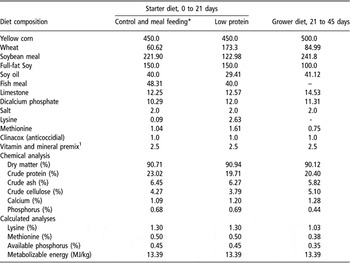
All chicks were fed on starter diet (control diet, 13.39 MJ ME and 230 g crude protein (CP) per kg, Table 1) from 0 to 7 days. On day 7, these chicks were subjected to three treatment groups from 7 to 21 days. Treatments were as follows: (1) control (C): chicks were fed on the starter diet containing 13.39 MJ ME and 230 g CP per kg; (2) meal feeding (MF): chicks were maintained fed on starter diet from 0100 to 0900 h and from 1500 to 2300 h. Feeders were lifted from 0900 to 1500 h and daily 10 g whole wheat per bird was dispersed onto the litter; and (3) LP diet: chicks were fed a LP diet (13.39 MJ ME 197 g CP per kg). From days 21 to 45, all chicks were fed with a grower diet (13.39 MJ ME and 204 g CP per kg) ad libitum. Water was provided ad libitum. The compositions of experimental diets are shown in Table 1.
Composition of the diets (g/kg)

1Vitamin–mineral premix provided per kg of diet; vitamin A, 12 000 IU; vitamin D3, 3000 IU; vitamin E, 50 mg; vitamin K3, 5 mg; vitamin B1 (thiamin), 3 mg; vitamin B2 (riboflavin) 6 mg; vitamin B6, 5 mg; vitamin B12, 0.03 mg; niacin, 30 mg; biotin, 0.10 mg; calcium D-pantothenate, 10 mg; folic acid, 1 mg; choline chloride, 400 mg; manganese, 100 mg; iron, 60 mg; zinc, 60 mg; copper, 5 mg; iodine, 1 mg; cobalt, 0.2 mg; selenium, 0.2 mg.
*Meal feeding: chicks were fed on starter diet from 0100 to 0900 h and from 1500 to 2100 h. Feeders were lifted from 0900 to 1500 h and daily 10 g whole wheat per bird was dispersed onto the litter.
Measurements
Individual body weight (BW) was measured on days 7, 21 and 45. Body weight gain (BWG) from 7 to 21 and from 21 to 45 days was calculated for each chick. Feed consumption (FC) was measured on pen bases on the same days and corrected for mortality. Feed efficiency was calculated as the ratio between total BWG to total FC of all birds in each pen. Dispersed whole wheat was not included as feed consumed in the MF treatment because the amount of unconsumed wheat remaining in the litter of pen could not be determined (Bizeray et al., Reference Bizeray, Estevez, Leterrier and Faure2002a). Broilers were observed individually and classified into four different categories by two observers consulting together at 45 days of age: 0, the bird walked normally; 1, the bird able to walk but had an obvious gait defect; 2, the bird walked only when driven; 3, the bird could not walk (Yalçın et al., Reference Yalçın, Settar and Dicle1998).
All chicks’ pen shank length and width were measured on days 21 and 45. Following the measuring of shank length and width of all chicks, 42 live male birds (two male chicks from each subgroup) were weighed, humanely slaughtered and eviscerated at 21 to 45 days of age. Carcass, breast with backbone and thigh with hip, neck and wing weights were taken from all eviscerated chicks. Percentage of carcass yield (carcass weight : live weight) and part weight : carcass weight ratio (breast, thigh, neck wing weights relative to carcass weight) were determined. The left tibia was removed; muscle and connective tissues were cleaned and immediately weighed. Bones were frozen and stored at −20°C until analyzed. Breaking strength was determined on thawed whole tibia. The tests were performed on 3-point bending using an Instron Universal Machine (Norgaard-Nielsen, Reference Norgaard-Nielsen1990). The center of each bone was broken with a probe (10 mm diameter) at 30 mm/min speed. The supports for each bone were 30 mm apart. The breaking strength was determined from the failure point (peak) of each loading curve. The bone samples were cut at points 20 (proximal) and 50% (mid-diaphysis) along their length and were ashed at 550°C for 16 h to determine tibia ash content and were expressed as percentage of ash.
The pH value of the samples was measured with a pH meter (Hanna Instruments-8413), using an FC-200 probe by thrusting the probe into the breast and thigh meat. Cooking loss was determined in 1.5-cm-thick meat samples of similar geometry, individually placed inside polyethylene bags in a water bath at 75°C for 20 min until the temperature of 70°C was achieved and then cooled for 30 min. The samples were removed from the bags, dried with paper and weighed (Önenç and Kaya, Reference Önenç and Kaya2004). The weight loss, expressed as a percentage of initial weight, was the cooking loss.
Statistical analyses
The distribution of GSs within control; MF and LP were analyzed using the χ 2-test. There were no birds with a GS of 3, χ 2 analyses were performed over three GSs (0, 1 and 2). The current data were analyzed using the General Linear Models procedure of the Statistical Analysis System (SAS, 1996). The models included control, MF and LP. Effects of feeding methods and sex and interactions were included in the model for BW and BWG. Means were separated using Duncan’s multiple range tests. The results of statistical analysis were shown as mean values and standard error of the mean ± s.e. in tables.
Results
Growth performance
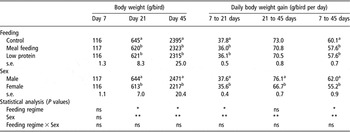
Average livability value was 97.4 ± 1.35 (%) for experiment and significant differences were not found among treatments. The BW and weight gain of the chicks are presented in Table 2. There were no BW differences at 7 days among treatment groups. Control birds had significantly (P < 0.05) heavier BW at 21 and 45 days compared to MF and LP groups. However, there were no significant differences between MF and LP groups. BW gain followed the same pattern from 7 to 21 and from 7 to 45 days. Weight gain in the control group was higher than the MF and LP groups, but weight gain did not differ in the MF and LP groups. BW gain did not differ among the groups at 21 to 45 days. BW and weight gain of males were significantly higher than females throughout the experiment (P < 0.01). From restriction period to slaughter age, both BW and BWG of the MF and LP groups were lower compared to control birds. Interactions between treatment and sex had no effect on examined parameters (not shown in table).
Effects of feeding regime and sex on body weight (g), and body weight gain (g/bird per day) of broilers

a,bMeans within a column with different superscripts are significant (*P < 0.05; **P < 0.01).
s.e. = standard error of the means (pooled); P = probability; ns = non-significant (P > 0.05).
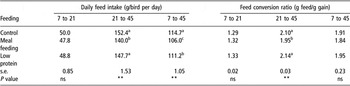
The feed intake and feed conversion ratio (FCR) of the chicks are presented in Table 3. Although control birds consumed more feed from 7 to 21 days than restricted broilers, feed intake was similar among groups (P > 0.05). At the period of 21 to 45 days lower feed intake was observed in the MF group than others (P < 0.01). Also, feed intake in the MF group was the lowest than that of the control and LP groups and feed intake in the LP group was lower than that in the control group at 7 to 45 days (P < 0.01). Feed efficiency was the best in the MF group compared with other groups at the periods of 21 to 45 days (P < 0.01). On the other hand, FCR was not statistically influenced by the treatments at the periods of 7 to 21 and 7 to 45 days (P > 0.05). Whole wheat consumption dispersed onto the litter was not included in feed intake of the MF group. However, we could not measure the unconsumed amount of it.
Effects of feeding regime on daily feed intake and feed efficiency of broilers

a,bMeans within a column with different superscripts are significant (**P < 0.01).
s.e. = standard error of the means (pooled); P = probability; ns = non-significant (P > 0.05).
Gait score and bone traits
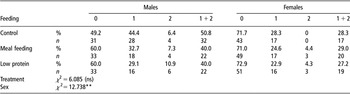
The distribution of birds in each GS categories is presented in Table 4. As shown in Table 4, meal-time feeding and dietary LP had no effect but sex had significant effect on GS of broilers at 45 days. There were no broilers with score 3 in the treatment groups. However, the percentages of birds with poor walking ability (namely, scores 1 and 2) were high in males (P < 0.01). The overall number of birds with leg disorders (1 + 2, male and female) were 50.8% and 28.3%; 40.0% and 29.0%; and 40.0% and 27.2% for the control, the MF and the LP groups, respectively (Table 4).
Distribution of male and female broilers with each gait score (0, 1 and 2)* at 45 days according to feeding treatment

*Gait scores: 0 = the bird walked normally; 1 = the bird able to walk but had an obvious gait defect; 2 = the bird walked only when driven.
P = probability; ns = non-significant (P > 0.05).
**P < 0.01.
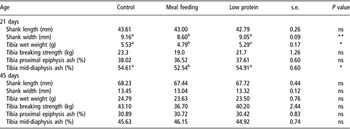
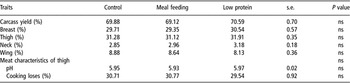
Effects of treatments on bone traits of the groups are given in Table 5. The shank width, tibia wet weight and tibia mid-diaphysis ash percentage of the MF group were significantly lower than that of the control and the LP groups at 21 days (P < 0.05). Significant differences were not found on bone traits at 45 days (P > 0.05). Effects of treatments on carcass and meat characteristics of the groups are given in Table 6. Carcass and breast yield, thigh, neck, wing and meat pH and cooking loss were not different among groups (P > 0.05).
Effects of feeding regime on bone traits of male broilers

a,bMeans within the same row with different superscripts are significant (*P < 0.05; **P < 0.01).
s.e. = standard error of the means (pooled); P = probability; ns = non-significant (P > 0.05).
Effects of feeding regime on carcass characteristics of broilers

s.e. = standard error of the means (pooled); P = probability; ns = non-significant (P > 0.05).
Discussion
The aim of this research was to investigate meal feeding and dispersing onto the floor whole wheat and a LP diet in the early life of chicks’ performance, GS, carcass and bone traits. Because the majority of bone consolidation occurs during the first 3 weeks of age (Rose et al., Reference Rose, Constantin and Letterier1996), modifying growth rate and increasing activity during this early period may be the most appropriate age to improve bone quality (Bizeray et al., Reference Bizeray, Estevez, Leterrier and Faure2002a). The reduction in leg problems may also be related to changes in muscle tissue because of slowing down of the growth rate (Tesseraud et al., Reference Tesseraud, Larbier, Chagneau and Geraert1992).
The current study showed that the meal-time feeding birds had a poor live BW and FC but better feed efficiency compared with the control birds. These findings were supported by Ballay et al. (Reference Ballay, Dunnington, Gross and Siegel1992), Su et al. (Reference Su, Sorensen and Kestin1999), Lee and Leeson (Reference Lee and Leeson2001) and Bizeray et al. (Reference Bizeray, Estevez, Leterrier and Faure2002a). They reported that the birds fed fewer meals had lower BW and also had better feed efficiency than those fed more meals. Cristofri et al. (Reference Cristofri, Melluzzi, Giordani and Sirri1997) and Faria Filho et al. (Reference Faria Filho, Rosa, Vieira, Macari and Furlan2005) also reported that restricted birds utilized feed more efficiently during the restriction period and compensatory growth period. The birds fed meal-time feeding regimen were unable to adapt to feed intake and also they did not compensate BW losses until slaughter age. In the meal-time feeding group, the majority of whole wheat dispersed onto the litter was unconsumed until the end of the experiment. We observed that chicks were sighted on the floor during dispersion of whole wheat but interestingly lasted for a very short time and chicks only packed them. We used a mash starter and grower feed in the experiment. Hence, whole wheat possibly was a novel feed for chicks, perhaps making it difficult for the birds to recognize it as feed. We agree with the results of Bizeray et al. (Reference Bizeray, Estevez, Leterrier and Faure2002a) who observed similar behavior in broiler chicks. Researchers reported the whole wheat was a novel feed for 1-week-old birds, when it was supplied on the floor rather than at the feeder. In the current study, meal feeding with whole wheat dispersion onto the floor affected BW and feed efficiency in broiler. However, these results were inconsistent with the results of Bizeray et al. (Reference Bizeray, Estevez, Leterrier and Faure2002a). This difference may be caused by the dispersing manner of whole wheat. Likewise, we dispersed whole wheat onto the litter when feeder was lifted. But the researches dispersed whole wheat onto the floor when feeders exist. If it is dispersed, chicks may consume enough feed in case of whole wheat.
We observed that MF chicks were apparently more active and standing than that of the control group (personal observation by Y. Konca and E. Yaylak). Similarly, Nielsen et al. (Reference Nielsen, Litherland and Nøddegaard2003) reported that meal-fed groups were more active than the ad libitum groups. Therefore, we expected that in the meal-feeding group GS may enhance via increased locomotor activity but it was not improved. However, the percentages of birds with poor walking ability (namely, score 1 and 2) were higher in the control group but it was statistically insignificant. Our results are contrary to the results of Su et al. (Reference Su, Sorensen and Kestin1999), who found that the meal-feeding group had significantly better walking ability in the four levels of meal feeding. On the other hand, Bizeray et al. (Reference Bizeray, Estevez, Leterrier and Faure2002a) found that alternating complete diet and whole wheat onto the litter reduced GS in broilers. In their study, complete diet offered with whole wheat and birds’ BW were slightly higher than control birds at slaughter age. It is reported that there is a relationship between high BW and intensity of leg disorders in broilers (Su et al., Reference Su, Sorensen and Kestin1999). In the current study, the MF birds had lower BW than control birds, and also GS was not affected at 45 days. This is an agreement with the results of de Jong et al. (Reference de Jong, Fillerup and Blokhuis2005) who suggested that limited improvement in GS could be achieved by feed restriction.
Shank width, tibia weight, breaking strength and tibia proximal epiphysis ash in the meal-feeding group was lower compared to the control group on day 21. The effect of restriction on linear bone growth seems to be associated with chondrocyte activity (Bruno et al., Reference Bruno, Furlan, Malheiros and Macari2000), as Heinrichs et al. (Reference Heinrichs, Colli, Yanovski, Laue, Gerstl, Kramer, Uyeda and Baron1997) determined that a rapid depletion of growth plate chondrocytes and inhibition of longitudinal bone growth occur in food-restricted rabbits. Also our findings (at 21 days) are in agreement with earlier studies, which showed that food restriction could adversely affect bone formation in chicks (Bruno et al., Reference Bruno, Furlan, Malheiros and Macari2000) and rats (Fetoui et al., Reference Fetoui, Mahjoubi-Samet, Jammousi, Ellouze, Guermazi and Zeghal2006). These findings suggest that growth of bones seems to be negatively influenced at the early restriction period. Bone is a metabolically highly active tissue at early ages. Various factors are necessary to ensure normal skeletal development (Fetoui et al., Reference Fetoui, Mahjoubi-Samet, Jammousi, Ellouze, Guermazi and Zeghal2006). Our findings showed that in the MF group, tibia mid-diaphysis ash was lower than in others (P < 0.05) but tibia proximal epiphysis ash did not differ at 21 days. On the other hand, regional variations in the ash content of broiler bones were reported (Bonser and Casinos, Reference Bonser and Casinos2003).
In the present study, LP diet decreased BW, BWG and FC but feed efficiency did not differ significantly. Similarly, it is reported that the LP diets resulted in a decrease in the BW of the birds (Hurwitz et al., Reference Hurwitz, Sklan, Talpaz and Plavnik1998; Yalçın et al., Reference Yalçın, Settar and Dicle1998; Faria Filho et al., Reference Faria Filho, Rosa, Vieira, Macari and Furlan2005). Dietary protein level had no significant effect on GS as Summers et al. (Reference Summers, Shen, Leeson and Julian1984) found. Likewise, Hester et al. (Reference Hester, Suttan, Elkin and Klingensmith1985) showed that lowering the amino acid such as the lysine and methionine + cystine content of diets to 90% from NRC recommendation did not cause a significant reduction in the incidence of leg abnormalities. In contrast to Hulan et al. (Reference Hulan, Proudfoot, Ramey and Mcrae1980) and Yalçın et al. (Reference Yalçın, Settar and Dicle1998), in our study reported that a lower incidence of leg abnormalities was found in birds given LP diets. In our research, GS was affected by sex (P < 0.05). This finding is in agreement with the results of Yalçın et al. (Reference Yalçın, Settar and Dicle1998) who reported that percentage of birds with poor walking ability was higher in males than in females.
In the current study, LP diet did not affect bone parameters except shank length. Shank length was decreased by the LP diet. Yalçın et al. (Reference Yalçın, Settar and Dicle1998) observed that bone parameters such as shank length, width, tibia bone weight, breaking strength, and bone length and width were not affected by dietary protein. Similar results were published by Bahtiyarca and Konca (Reference Bahtiyarca and Konca1996), who reported that LP and amino acid (methionine and lysine) did not affect bone dry weight, length, diameter and ash but decreased bone-breaking strength in quails. On the other hand, Bizeray et al. (Reference Bizeray, Leterrier, Constantin, Picard and Faure2002b) stated that sequential feeding with lysine decreased tibia length and weight and but also had no effect on bone proximal-diaphysis and distal-end ash.
No effects of meal feeding and LP were observed on percentage yields of carcass, breast, thigh, wing, neck and pH and cooking loss of breast muscle. These observations support the findings of Palo et al. (Reference Palo, Sell, Piquer, Vilaseca and Soto-Salanova1995) who reported that carcass and breast yields were not affected in two early feed-restriction programs. Similarly, Dozier et al. (Reference Dozier, Liens, Hess, Bilgili, Gordon, Lasten and Vieira2003) confirmed these findings.
To conclude, our findings suggest that both meal feeding and LP diet reduced BW and FC but increased feed efficiency overall period. However, these methods decreased bone traits at 21 days and did not affect GS, carcass and bone traits at 45 days. The different results in the literature are due to a number of factors that can influence the responses of broilers to feed restriction. These factors are the nature, timing, severity and duration at under-nutrition and also genetic factors such as strain and sex (Lippens et al., Reference Lippens, Room, De Groote and Decuypere2000). Leg problems are important for sustainability poultry production; hence, other methods should be investigated to help solve this problem.
Acknowledgments
We would like to thank S. Yalçın (Ege University, Agricultural Faculty, Department of Animal Science) who reviewed the original manuscript and made several helpful suggestions.