All nations with rich stores of archaeological materials must confront the problem of using limited resources to protect their many cultural relics. The solution some nations have adopted is to assign different levels of legal protection to different relics based on a grading system. While the concept of giving “better” protection to “better” cultural relics has a simplistic appeal, it is difficult to put into practice—what makes a cultural relic “good”? And even if some logical criteria of “good” can be defined so as to create a sensible grading system, is a legal system based on such a grading system actually capable of achieving the protection of cultural relics?
This article examines the application of such a grading system within the legal system of the People's Republic of China (hereinafter China). The current legal context within which the grading system operates is summarized, and a recent criminal trial where the law is applied is described to illustrate the mechanism of the law. The factors used in the Chinese cultural relic grading system are identified and discussed in a structural framework of breaking down cultural relics at the category (e.g., coins); type (e.g., Qian Yuan Zhong Bao coins); and individual levels. The motivation behind each grading factor, along with the ability of the use of the grading factor in achieving the objective of protecting cultural relics, is described and analyzed. The suggestions provided here for the Chinese cultural relic grading system could give insight to those who, like the Chinese policymakers, seek to develop cultural property management solutions that balance academic and protectionist interests with personal property and trade promotion.
CURRENT STATE OF THE LAW
The specifics of the Chinese laws concerning the protection of cultural relics have been covered in detail by other authors.Footnote 1 This section will only summarize the current state of the law. A history of the development of these laws, with respect to the restrictions on the export of movable cultural relics, is provided in the Appendix.
The statute providing for the protection of cultural relics is the Law on the Protection of Cultural Relics ( ) (LPCR).Footnote 2 Article 3 of the LPCR sets up the division of movable cultural relics into Precious Cultural Relics, further subdivided into First-Class, Second-Class, and Third-Class Cultural Relics, and Common Cultural Relics. The standards for this division are set forth within the Rating Standards for Collections of Cultural Relics (
 ) (hereinafter Rating Standards).Footnote 3 First-Class Cultural Relics are “representative” cultural relics that have “especially important historical, artistic, or scientific value.” Second-Class, Third-Class, and Common Cultural Relics are relics that have, respectively, “important,” “relatively important,”Footnote 4 and “certain” historical, artistic, or scientific value. The Rating Standards also clarify, in a general way, how the grading system pertains to different categories of cultural relics. For ancient articles of currency, those that qualify as First-Class Cultural Relics “have an especial importance in the history of the development of Chinese money, or possess especial value.” The definition of coins of the other grades can be obtained by the appropriate substitution for the word “especial.”
This grading system is used within a wide range of regulations.Footnote 5 Some of these regulations are used to distinguish between the administrative protections given to relics of different grades. For example, Article 49 of the Regulations for the Implementation of the Law on the Protection of Cultural Relics ( ) (RILPCR) singles out First-Class Cultural Relics that are sole copies or that are fragile for prohibition against transportation out of China for exhibition.Footnote 6 Others distinguish between the level of public exposure and access. Under Article 35 of RILPCR, photography of First-Class Cultural Relics in the possession of cultural institutions for publication requires approval from the Central Government, while the same for Second-Class or Third-Class Cultural Relics only requires approval at the regional level.
The use of the grading system also extends into criminal law. Any cultural relic that was made before 1911 is prohibitedFootnote 7 from exit,Footnote 8 unless explicit approval has been given.Footnote 9 Smuggling of these exit-prohibited cultural relics, if sufficiently serious, can constitute a crime under Article 151 of the Criminal Law ( ).Footnote 10 The relic grading system is embedded within the definition of criminal cultural relic smuggling and the punishments as set forth in Article 3 of the Supreme People's Court's judicial explanation titled “Explanations of Some Questions Regarding the Application of the Law in Trying Criminal Cases of Smuggling” (
 ) (hereinafter Explanations):
The smuggling of exit-prohibited cultural relics, of the Third-Class and of 2 or fewer in number, is an offense of cultural relic smuggling where the circumstances are “minor” and is punishable by imprisonment of not more than 5 years and also by fines.
Cultural relic smuggling, where one of the following conditions is fulfilled, is [criminally] punishable by fixed-term imprisonment of not fewer than 5 years and also by fines:
(1) the smuggling of exit-prohibited cultural relics, of the Second-Class and of 2 or fewer in number or of the Third-Class and of 8 or fewer in number;….
Cultural relic smuggling, where one of the following conditions is fulfilled, is an offense of cultural relic smuggling where the circumstances are “especially serious” and is punishable by life imprisonment or death and by confiscation of property:
(1) the smuggling of exit-prohibited cultural relics, of the First-Class and of 1 or more in number, of the Second-Class and of 3 or more in number, or of the Third-Class and of 9 or more in number;….Footnote 11
Smuggling of exit-prohibited cultural relics that is insufficiently serious, which can be inferred from Explanations to mean smuggling of exit-prohibited Common Cultural Relics, does not constitute a crime but is punishable by fines.Footnote 12
Since the acceptance of this article for publication, the Standing Committee of the National People's Congress has been presented with and has subsequently passed the Amendment to the Criminal Law (VIII) ( ) (hereinafter Amendment), which is to take effect on May 1, 2011.Footnote 13 The relevant portion would reduce the punishments defined in Explanations, with the most important effect of removing cultural relic smuggling from the class of death penalty crimes:
The smuggling of exit-prohibited cultural relics … is punishable by fixed-term imprisonment of not fewer than 5 years but not more than 10 years, and also by fines where the circumstances are “especially serious,” the offense is punishable by fixed-term imprisonment of not fewer than 10 years or by life imprisonment, and also by confiscation of property. Where the circumstances are “minor,” the offense is punishable by fixed-term imprisonment of not more than 5 years, and also by fines.
The Amendment does not alter the preexisting definitions of “especially serious” and “minor” circumstances of cultural relic smuggling, which, presumably, would continue to be governed by Explanations.
LAW AS CURRENTLY APPLIED
On 27 September 2008, the Chinese postal service identified four suspicious packages mailed from four different post offices by one person using a pseudonym, addressed to a single person in the United States.Footnote 14 A large assortment of ancient Chinese coins was found within the packages on x-ray examination. Over the next several months, the Chinese authorities continue to monitor for and intercept similar packages, and arrested the mailer, 65-year-old Jiang Jichun ( ), in a post office when he was trying to mail yet another package of coins in March 2009.
Mr. Jiang, who was retired and had been collecting ancient coins since 2003, was mailing the coins to his son who was studying in the United States. He had actually run afoul of the authorities prior to his arrest; in 2005, he was fined by customs officials for mailing coins without a permit. Still, pressed by his son for more coins, he continued mailing coins but tried to avoid detection by using pseudonyms and by mailing coins at different post offices. In the meantime, his son was selling the coins on a well-known auction web site and acquired renown in online numismatic circles for his ability to sell coins at large quantities and at low prices. Mr. Jiang failed to use a pseudonym for his son as the recipient, and the authorities were thus able to connect the coin shipments with the coins being sold online.Footnote 15
A total of 2734 coins were recovered, and all of the coins were prohibited from exit without approval. According to the analysis by the Henan Province Commission for Cultural Relics Identification, all 23 of the mingdao ( ) knife coins and 8 of the 26 Qian Yuan Zhong Bao (
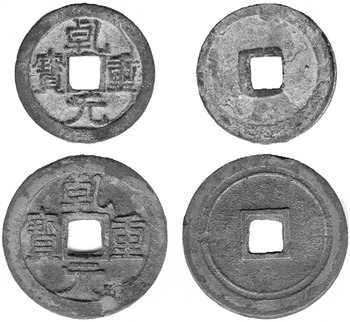
 ) coins within the hoard were Third-Class Cultural Relics. (A detailed description of these two types of coins is provided within the Appendix.) The rest of the coins were either cultural relics of a lower grade or were fakes.Footnote 16
Mr. Jiang was thus charged with smuggling 31 Third-Class Cultural Relics, and the trial was held on 28 September 2009 at the Intermediate People's Court of Zhengzhou City.Footnote 17 With all other facts well established, the sole question at trial was: are the 31 Third-Class Cultural Relics really Third-Class Cultural Relics? If the court were to find that the 31 coins were Common Cultural Relics, as the defense attorney argued,Footnote 18 then Mr. Jiang had not committed a crime and he would only be fined. If the court were to find that the 31 coins were indeed Third-Class Cultural Relics, then Mr. Jiang would have crossed the threshold of smuggling 9 Third-Class Cultural Relics and would be guilty of an offense of criminal cultural relic smuggling where the circumstances are “especially serious.” Accordingly, his punishment would be life imprisonment or death. As of this writing, a decision has yet to be announced.
NEED FOR THE GRADING SYSTEM
China, with 4000 years of documented history, is the only surviving member of the four ancient river valley civilizations. The resources needed to protect and preserve the entire volume of China's archaeological material simply do not exist. But not all of the cultural relics are equally worthy, as Professor Robert Bagley of Princeton University, an expert in early Chinese archaeology, points out
… well-preserved Chinese prehistoric pots must exist by the thousands, and broken pots are uncountable. Some of them are extremely fine and some of them are just crockery. Some are museum pieces and some are just landfill.Footnote 19
For a nation that wishes to enshrine the protection of cultural relics within the law and yet takes into consideration that not all relics can be protected, a legal scheme for the grading of relics, with an accompanying set of regulations based off on the grading, is a sensible solution. China is not the only nation with such a system; for example, both Japan and South Korea have implemented grading of relics in their laws.Footnote 20
But what factors should be considered in any cultural relic grading system? And, how can the law avoid situations like that of Mr. Jiang, whose life rests on a judicial determination of the merits of the 31 coins as cultural relics? It is worthwhile to consider the difficulty of relic grading described in the foreword to the governmental publications of the grades of cultural relics:
Each cultural relic grade is a domain. The cultural relics of one category within a single domain, that is, within the same grade, will have differences. In other words, there exists a ceiling and a floor within each grade. Between two neighboring grades, there exists a certain murkiness, a difference that is difficult to quantify. In the work of cultural relic appraisal,Footnote 21 accurate grading is the supreme achievement, and is the goal of appraisal.Footnote 22
ANALYSIS OF THE CHINESE CULTURAL RELIC GRADING SYSTEM
Constructing a legal framework to incorporate a grading scheme of cultural relics requires many levels of consideration. At the highest level, whether and how the law should treat different categories of cultural relics (e.g., weapons, coins) differently is a concern. Then within a specific category (e.g., coins), factors used to grade the different types (e.g., mingdao knife coins) must be identified. Finally, at the lowest level, whether and how the law should differentiate between the individual specimens of a single type must be identified. All of these structural levels will be considered in the following sections.
Categories of Cultural Relics
One of the most important, but not stated, questions about the entire affair of Mr. Jiang's trial is: Should the law in providing for the protection of the cultural relics take into account not only the grade of the relics but also their categories? For example, is smuggling ancient coins really as serious a crime as smuggling ancient weaponry, and therefore warrants the same punishment? As is seen in Explanations, the definition of the nature and of the punishments for crimes such as cultural relic smuggling take into consideration only the number of relics involved and their grades. This lack of differentiation between categories of relics also extends into the administrative regulations within the RILPCR. But the Rating Standards and the Standards for the Exit Examination of Cultural Relics ( ) (hereinafter Exit Examination Standards) defining the cultural relic exit-prohibitions do provide for different categories of cultural relics. The appendix of the Rating Standards, for example, provides for 26 categories, such as jadeware, sculptures, calligraphy and paintings, inkstones, articles of currency, and weapons. The Exit Examination Standards, with even finer subdivisions, provide for 71 categories. The main category of articles of currency, for example, is split into seven subdivisions of objects having to do with money, including ancient coins, ancient bills, recent machine-made coins, recent bills, molds, printing plates, and design diagrams. Should these categorizations be considered in the design of the law?
Within the context of criminal law, except for the very rare case where a person enters into a museum and steals cultural relics with clear captions that explain their grades, any person who comes into contact with the law of cultural relics probably does not have a fixed idea of the grades of the relics in question. Any grading of the relics involved will therefore be conducted after his or her act is complete and after the authorities recover the relics, as was the case for Mr. Jiang, and would be entirely useless to guide his or her behavior prior to the act. The law would seem to be very arbitrary, for example, if it would award life imprisonment and death penalties on one end of the spectrum and impose only fines on the other, without regard as to whether the criminal actually knows or should know what grade the cultural relics being smuggled belong to. The punishment therefore ought to take into account how likely the smuggler is to make a mistake about the grades of the relics.
Also, the average person can hardly be expected to be equally educated across every category of cultural relic, so that his or her ability to correctly identify and grade samples would be the same across all categories. For example, the average American can be expected to identify on sight the most famous paintings such as the Mona Lisa, because he or she has likely taken some classes on art or history or seen pictures of important sculptures and paintings. And while the average American has probably not heard of the Derveni Krater, should he or she come into possession of it, he or she can be expected to appreciate that it is an object of high technical merit and conclude that the object would fall within the protection of any law of cultural relics. But the average American is unlikely to be able to identify, on sight, the most valuable American coin. As Mr. Peter Tompa, an officer in the Ancient Coin Collectors Guild points out, “there isn't a university in the United States that teaches numismatics.”Footnote 23 Understanding why the 1933 Double Eagle is the most valuable American coin requires specific knowledge of Depression-era currency laws,Footnote 24 so a coin's value, as in the case of the 1933 Double Eagle, is often not immediately obvious at its face. Subjecting the average American to criminal punishments for his or her acts should he or she mishandle a 1933 Double Eagle would be rather Draconian. The average Chinese would be, in this regard, similar to the average American, in that his or her education and training would not be uniform with regards to every category of cultural relics.Footnote 25 It would seem then that the law should differentiate between different categories of cultural relics, taking into account the average citizen's ability to appreciate each category of cultural relics.
There are also fundamental differences between different categories of relics that the law should take into account. Coins are articles of currency and are tools of convenience. They are designed to be used and carried around in quantity and are not meant to be handled with close inspection to the details of every individual specimen. What is engraved on the coin is of primary concern mainly to the modern scholar and collector, as it differentiates coins from circular pieces of metal. In contrast, the significance of the coins in antiquity was captured in the number, material, and weight. This is reflected in the names of ancient Chinese coin types, which until the Tang dynasty (618–907) have referred to their weights, such as “half-ouncer” or “four-grainer.” The lack of need for attention to the details of the coins is also reflected in the way the coins were historically treated. The ancient Chinese strung their coins on threads, and did not care that such treatment would lead to effacement of the coin details. The relatively cavalier treatment of these coins that results from their very nature has been preserved to the modern day; today, ancient coins can be found in bowls and heaps in open air bazaars and can be bought in bulk. Indeed, Mr. Jiang testified that he bought the Qian Yuan Zhong Bao coins by weight, in units of half-kilograms.Footnote 26
Sculptures and paintings, however, are of a very different nature. Prior to the advent of mass production techniques, individual pieces had unique merit, and even in their use as mere decoration, the viewer still has to pay some attention to their details. Average people do not mindlessly shove multiple sculptures and paintings into their pockets as they would do with coins. Likewise, they would pay far closer attention when they buy a piece of sculpture or painting in an open air bazaar than when they buy coins from a heap in the same bazaar. They are therefore far less likely to make a wrong determination with regards to whether an individual piece is a Third-Class Cultural Relic or a Common Cultural Relic when the relic in question is a piece of sculpture. A crime that involves eight coins that are Third-Class Cultural Relics is arguably very different from a crime that involves eight sculptures that are Third-Class Cultural Relics; to legally treat two acts, one involving sculptures and another involving the same number of coins, equally merely because the sculptures and coins are of the same grade seems rather problematic.
Types within Categories of Cultural Relics
While the Chinese law does not treat different categories of cultural relics differently, it does make clear distinctions between specific types within a category along a published grading system, as this section now discusses.
The Illustrated Important Chinese Cultural Relics Ranking Standard Series
The Chinese Ministry of Culture is in the process of publishing a series titled Illustrated Important Chinese Cultural Relics Ranking Standard (hereinafter Illustrated Standard) consisting of 25 volumes, with about 1 volume for every single category of cultural relic listed within the Rating Standards.Footnote 27 The foreword common to all the volumes states the purpose of the publication:
[The publication of the series] would help to advance the administration of the Rating Standards for Collections of Cultural Relics, to further improve the management of cultural relics by grades and to further strengthen the management of the cultural relics circulating within society. And since it increases the transparency in the work of grading the cultural relics, [publication of the series] will assist in the fair administration of laws.Footnote 28
These volumes, available only in Chinese, provide photographs of cultural relics, with short accompanying captions giving reasons for the grades given to the cultural relics. (As of this writing, the volume concerning articles of currency has yet to be published.) Since the volumes possess authority under the eyes of the law, it is instructive to consider the reasons provided in any volume to infer the reasons for the grade assigned to cultural relics. The volume on bronzeware, Illustrated Standard: Bronzeware, is here taken to be representative.
Significantly lengthier descriptions are provided for cultural relics of the higher grades than for cultural relics of the lower grades. The following is typical of the descriptions provided for First-Class Cultural Relics in Illustrated Standard: Bronzeware:
26 Bronze Ding-Vessel Made by KeFootnote 29
Late Western Zhou (885–771 B.C.)
Height 35.4 cm, Width 33.6 cm
In the Collection of the National Palace Museum
The shape is bold, and the patterning refined. Within the body are engraved 8 lines of text totaling 72 characters. The text records that King Xiao of the Zhou dynasty in the ninth month of the twenty-third year of his reign at [the Zhou dynasty capital city of Zongzhou] commissioned his Diet Minister Ke to reorganize the Eight Armies of Chengzhou. That very year Ke made the ding-vessel for the worship of his grandfather Xiji, to express his faithfulness and to pray for fortune and longevity.
This ding-vessel has been written about by famous persons over the ages, and is a famous ceremonial vessel. The text within it is an important textual source for the research of the military organization of the Western Zhou dynasty. It thus possesses especially important historical value, and is a First-Class Cultural Relic of the state collection.Footnote 30
This contrasts against the following description, typical of Common Cultural Relics:
352 Bronze Gu-Vase with Four Ridges and Plantain Leaf Pattern
Ming (1368–1644)
Height 24 cm, Lip Diameter 12.5 cm
In the Collection of the China Relic Information Consultation Center
This gu-vase is a typical bronze piece made in imitation of ancient styles. The surface of the vase is black, and the patterns reflect the style of the Ming period. It possesses certain historical value, and is graded as a Common Cultural Relic of the state collection.Footnote 31
There is a clear inadequacy of the explanation of the grades of the Common Cultural Relics. From the standpoint of connoisseurship, the cultural relics of a higher grade would obviously lend themselves to longer and more detailed descriptions of their merits. But common people are unlikely to get their hands on relics of this quality; rather, they are likely to encounter something of significantly lower worth. The law is therefore far likelier to be concerned with their ability to differentiate between the lower grades, and should provide more specific guidance at this distinction.
Nonetheless, a description of the general balancing that takes place in the grading is provided within the foreword particular to the Illustrated Standard: Bronzeware:
The most important consideration for the determination of the grade of the bronzeware cultural relics is the historical, artistic, and scientific value the cultural relics possess. Some have all three, while others have only one or two. If a piece is well designed and well patterned, and can represent the artistic and technical capabilities of an era, such as the Gilt Figurine with a Lamp from the Western Han dynasty, it is classed as a First-Class Cultural Relic.
Some pieces have inscriptions that are important, which can reflect important events. An example would be the Gui-Food Container Made by Li from the early Western Zhou dynasty, which records the historical event of the destruction of the Shang Dynasty by King Wu of the Zhou dynasty…. These have especially important historical value, and of course are graded as First-Class Cultural Relics. Those with inscriptions that are more common are graded as Second-Class Cultural Relics.
Some pieces have a well-determined provenance, and could be used as a reference for dating. An example is the Ding-Vessel Made by Qiuwei in the fifth year of King Gong of the Western Zhou dynasty. Although its patterning is rather simple, the text in terms of recording the year has especially important value as a reference for dating, and hence is graded as a First-Class Cultural Relic.
Some pieces were not in a good state of preservation, and have been restored. But their design and patterning are special and rare. An example is the Rectangular Ding-Vessel with Human Mask Design from the late Shang dynasty. The piece has been restored from its many fragments, but there exists just one such piece, and thus it is still graded as a First-Class Cultural Relic. Another is … the Big Fu-Axe with Wide Edge from the Warring States Period. Although it is unpatterned, it is a large vessel, weighing 14.6 kilograms, and as such is the crown jewel of bronze tools. It is especially important in terms of studying the history of tools, and can still be graded as a First-Class Cultural Relic….
Some of the cultural relics have especially important historical and artistic value. An example is the You-Wine Vessel with Beast Mask Design … , with a shining black color, bold and grand patterning, and little birds decorating two opposite edges of the body. But it is already damaged, and the circular base is attached in later times, and could only be graded as a Second-Class Cultural Relic.
Some of the cultural relics have, due to the uncommon location of discovery, important historical research value. An example is the Crotched Ding-Vessel with Beast Mask Design with the “ ” inscription excavated from Shuitangwan of Ningxiang County of Hunan Province. In the Chinese Central Plain, this sort of vessel and patterning is relatively common. The inscription on the relic is also meager. But because itFootnote 32 is passed down from the Chinese Central Plain area into Hunan, the relic reflects the spread of the Shang dynasty culture south of the Yangtze and its effects on the culture of Hunan, and is graded as a Second-Class Cultural Relic. Some relics are excavated in a relatively large number in a specific region, but it is not possible to reduce their grades on that basis because they are rare from the perspective of the whole country. An example is the human mask from the Shang dynasty excavated from Zhongguo County of Shaanxi Province, which is still graded as a Second-Class Cultural Relic.Footnote 33
Bronzeware, unlike coins, are not necessarily mass-produced objects, and certain types of bronzeware might have only one specimen. Hence not all factors in the above discussion of bronzeware grading are relevant to type differentiation within a category; some, such as condition, are more relevant for specimen differentiation within a type. These factors are reserved for discussion in the next section, while the remainder of this section covers those factors, such as the balancing of the historical, artistic, and scientific value, which are relevant to the grading of types. In addition, while age is not explicitly mentioned as a factor, it appears to be relevant within the Chinese grading system and hence is also discussed.
Historical, Artistic, and Scientific Value
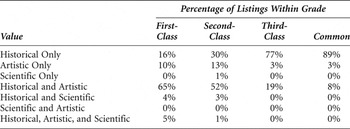
According to the common foreword in the Illustrated Standard series, the foremost consideration in the grade of a type of cultural relics is the historical, artistic, or scientific value it possesses. This is consistent with the general guidelines set forth within the Rating Standards. The captions describing the cultural relics in the Illustrated Standard: Bronzeware volume always mention the specific value possessed by the cultural relics, and unsurprisingly, as seen in Table 1, the cultural relics of the higher grades generally possess more than one value. The typical Common Cultural Relic has only historical value, while the typical First-Class Cultural Relic has both historical and artistic value. The cultural relics that have historical, artistic, and also scientific value appear to be graded at least as Second-Class.
Cultural relics in Illustrated Standard: Bronzeware, by the value possessed

The captions, however, generally do not provide reasons for why a cultural relic has a certain value. It is as such very difficult to identify trends as to why any cultural relic would possess a certain value. From the available descriptions, however, it appears that relics that possess historical value are those that provide information about some specific historical topic, be it about politics or daily life. For example, the First-Class Lupan-Cooker with a Chain has historical value because it assisted in “understanding the use of this type of [cooking] vessel,” since there were traces of fish bones and ashes on the relic when it was excavated. Artistic value appears to be indicated by the aesthetic qualities, and both artistic conception and technical execution are important considerations. An example is the Peach-Shaped Kettle with a Curved Tube, a Common Cultural Relic, which possesses artistic value because the kettle has “an ingenious design” and “rather brilliant production.” The cultural relics that have scientific value are those that yield some insight into the technology or science of ancient China. An example is the First-Class Zhong-Vessel with the Chinese Characters “ ,” which possesses scientific value because it provides information about the measurement system of the Qin (
 ) and Wei (
 ) states of the Warring States Period (475–221 bce).Footnote 34
It is very understandable that any cultural relic grading system would attempt to consider the historical value, or more specifically, the ability to provide knowledge about the past, that a cultural relic possesses in determining its grade and its due level of protection. The Rosetta Stone, for example, is unquestionably one of the most important, if not the most important, relic in the British Museum. But it would otherwise be an unremarkable fragment of an Egyptian stela, were it not be for the fact that the bilingual inscriptions provided the key for the decipherment of Egyptian hieroglyphs. The reason it is treasured, therefore, comes entirely from what it informs about the past. But the use of historical value as a measure for the worth of a cultural relic is problematic because historical value is defined with reference to the existing body of knowledge and is not intrinsic to the relic itself. As pointed out by Dr. Neil Brodie, an expert in the protection of antiquities of the Stanford Archaeology Center,
[t]here is a debate whenever a new object comes to light, which looks like it is from a certain period but is a bit “strange.” It will probably be rejected as a fake, but then it could also be very academically important. What is genuine is defined by existing knowledge.Footnote 35
Even in the absence of the problem of determining authenticity, the “strange” objects as described by Dr. Brodie are those that have more historical value, when compared to those that are duplicates of discovered material, because they deviate from and can add to the existing body of knowledge. However, it is impossible to locate with any precision the borders of the existing body of knowledge. It is therefore very difficult for any court to determine whether a relic in question actually lies within the body of knowledge and thus possess little historical value, or whether it can contribute to the body of knowledge and thus possess high historical value.
It is even more troubling to hold the average citizens accountable for accurately ascertaining the historical value of relics, since the ability of a relic to add to the existing knowledge is not apparent on its face. Even where inscriptions are present on a relic, which, according to the previously cited foreword of Illustrated Standard: Bronzeware, is highly suggestive of historical value, it is unclear that the average citizen can tell that a relic can contribute to knowledge. First of all, the Chinese language and writing system have changed much over time. Reading ancient Chinese scripts and comprehending the writing is in practice the domain of highly trained scholars. The average citizen might recognize that inscriptions are present on a relic, but without the ability to understand the text he or she has little means of determining whether the inscriptions help expand knowledge. Second, inscriptions are actually only loosely linked to the historical value of the relic. For example, practically all coins have inscriptions. To award all ancient coins high grades for historical value because of the presence of inscriptions would be extremely overinclusive. Ultimately, one can only know whether specific cultural relics can contribute to knowledge by a deep familiarity of the up-to-date published literature and of the currents of academic debate, and not even the very well-educated citizens can be expected to know or to have access to this sort of information.
There is also no satisfactory answer as to whether a cultural relic should continue to hold on to a grading made on the basis of its historical value once scholars have completed the extraction of knowledge from the relic. On one hand, allowing the historical value of cultural relics to vary on the basis of the current state of knowledge would lead to many undesirable and unacceptable results. Operating on this principle, the law would cease protection, for example, of the Rosetta Stone, because scholars have practically exhausted its ability to provide new information. But on the other hand, allowing relics to retain their historical value indefinitely also has problems. Should the law, for example, extend the same protection it provides to the Rosetta Stone to a newly discovered relic with bilingual inscriptions providing a Greek alphabet and Egyptian hieroglyph correspondence? If under the law all relics that yield a particular piece of knowledge would enjoy the same grade as the first relic that provided just such knowledge, then the grading would be meaningless. All relics would have high and indistinguishable grades because the first relic that provided knowledge would by definition possess high historical value and enjoy a high grade. If under the law only the first relics that provided some knowledge are given high grades, then the law would have to inquire, every time when assigning a cultural relic a grade, whether the relic could have provided new knowledge at the time of its discovery. But if the current borders of the body of knowledge are already hard to define, the past borders of the body of knowledge are even more subject to controversy. This would seriously undermine the ability to administer the law.
However, many of these concerns in using historical value to determine the grade of cultural relics are absent when artistic value is used. The qualities of a particular piece that confer it with artistic value are inherent in the piece itself. One does not need more information, outside of the piece itself, to determine, for example, that the Mona Lisa is of high artistic value. And even though appreciation of artistic works ultimately derives from the viewers' beliefs and experiences, the state can attempt to instill a set of common beliefs and experiences among all citizens to inform their determination of artistic value. As such, the law can demand that citizens recognize the artistic interest of the state in a particular work, even if on a personal level they do not appreciate the piece, without the same conceptual difficulty as when it demands that citizens should know enough of the boundaries of the existing body of historical knowledge to determine whether the piece expands the knowledge.
Moreover, if the law is concerned with protecting the looting of archaeological sites from destruction, then giving cultural relics that have higher artistic value a correspondingly higher level of protection may help accomplish this objective. As Dr. Brodie points out,
[w]hat people hope to find when they loot are treasures. If the criminal punishments are imposed based on how much the looted objects are treasures, then it might be able to indirectly deter looting.Footnote 36
The same argument can be applied to smuggling. Phrased differently, the profit motive is the driving force behind most activities that the law of cultural relics is interested to proscribe, and relics that are treasures, that is, those that can command a high value on the market, are those that are most vulnerable. Cultural relics that have high artistic value are those that at least on a visual level resemble treasures, and allocating a higher protection for these relics might achieve the general purpose of protecting all relics from being mistreated since criminals are less likely to disturb relics of low market value to begin with.
Cultural relics with scientific value are those that give some information about ancient science and technology, and as such, are practically a subset of the relics with historical value. The analysis that applies to the historical value can therefore be applied in the same way to the scientific value. In certain cases, it is clear that a cultural relic has scientific value; for example, the Ding-Vessel with the Chinese Characters “ ,” a First-Class Cultural Relic, has inscriptions that provide weight measurements and hence clearly provide knowledge about ancient weight systems. In other cases, however, the scientific value that a relic has is not apparent at all. For example, the Big Fu-Axe with Wide Edge, another First-Class Cultural Relic, has scientific value because it is the biggest bronze axe that is known to be made before the Qin dynasty (221–206 bce). But the relic is literally an unadorned bronze axe head; no reasonable person can infer simply from handling it that it can actually provide information about past technologies at all. It is uncertain how allocating a high grade to relics with scientific value, just as for relics with historical value, can help reach the goals of the law.Footnote 37
Provenance and Provenience
According to the foreword to Illustrated Standard: Bronzeware, provenance and provenience are both clearly considered highly valuable and are factored within the grading system. That both contribute to academic knowledge is beyond dispute; provenience is useful in terms of studying issues like the spread of culture and provenance allows for establishing secure dating of relics.
Both are also important to what the Western scholarship would label a nationalistic interest in Chinese historiography, as described in the following article:
… archaeology was to enhance the national glory and foster patriotism; second, like all other branches of scholarship, archaeology had to participate in the legitimization of the regime by validating Marxist ideology. Both the patriotic and the ideological goal directed the choice of topics for archaeological research significantly towards traditionalist historiographical concerns [of focusing upon the concerns of the ruler and of propagating the government's official interpretations of historical events]…. [A]rchaeology was, for a time, defined as a national status symbol that allowed China to stand up in competition with other civilizations. When, for instance, Xia Nai, lecturing on Japanese television, emphasized the high degree of sophistication reached by the late Neolithic cultures around 3000 B.C. and defined them—rather than the inception of dynastic states a millennium or so later—as the beginnings of ‘civilization’ in China, this was not a dispassionate scholarly statement: Xia implied that Chinese civilization was coeval with Mesopotamia and Egypt. Similar views have since been adopted by many other serious scholars. Traditional nationalist historiography also required that Chinese civilization be homegrown rather than influenced from abroad—an item that remained on the agenda of archaeology in Communist China. Discussion of cultural connections to areas outside the PRC was taboo until recently, and it still carries a certain risk…. Even more than under the Nationalist regime, the traditionalist view of history has become, in Communist China, a holy grail of patriotic consciousness.Footnote 38
In the eyes of these Western scholars, then, this interest translates to an attempt to define Chinese civilization as having come about at the earliest possible time and to characterize as many ancient cultures in as expansive an area as is possible as Chinese.Footnote 39 That this interest might be at play within the grading system can be observed from the description of the early Shang dynasty (1600–1300 bce) Double-Beast-Head-Shaped Gui-Food Container with Beast Mask Design:
The shape and patterning belong to the Shang cultural system of the Central Plain, but the relic was excavated from a Shang-era burial at the banks of the Yangtze River. This serves as evidence that during the Shang-era the Shang culture has already spread south to the midstream area of the Yangtze. It thus possesses especially important historical value, and is a First-Class Cultural Relic of the state collection.Footnote 40
A number of other cultural relics in Illustrated Standard: Bronzeware, such as the Rectangular Ding-Vessel with Human Mask Design and the Yan-Steamer with Kui-Dragon Design, are similarly graded as First-Class for demonstrating that the Shang culture has spread south toward the Yangtze from the territory of the Chinese Central Plain, the traditional cradle of Chinese civilization at the Yellow River.Footnote 41
But it is uncertain whether provenance and provenience should play a legal role. Relics that are illicitly excavated or trafficked most probably lack provenance and provenience. Therefore, it would actually be inimical to the objectives of protecting relics from looting and destruction if the relics in the hands of criminals are given lower grades, and thus correspondingly lower levels of legal protection, for their lack of provenance and provenience. Indeed, factoring provenance and provenience into the grading might provide a perverse incentive for the destruction of valuable information that could otherwise be recovered. Criminals would be encouraged to provide less complete information about the cultural relics they are arrested with, if doing so would increase the grade of the relics and incur heavier punishment upon themselves. It seems therefore that provenance and provenience should not be used as a factor in grading cultural relics.
Age
Within the previously mentioned Exit Examination Standards, the age, along with the category, are the two main factors in the definition of the cultural relics exit-prohibitions. It follows that age might be an important factor within the Chinese cultural relic grading system.
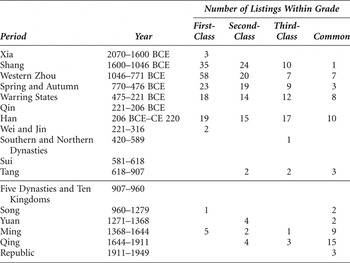
A survey of the age of the cultural relics listed within the Illustrated Standard: Bronzeware is compiled in Table 2, and clearly suggests that older relics generally are better graded.
Cultural relics in Illustrated Standard: Bronzeware, sorted by date. The line at the end of the Tang dynasty marks the cutoff date for relics that fall under the import restrictions adopted by the United States according to the Sino-U.S. Memorandum of Understanding.

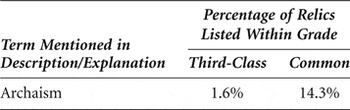
While age is not necessarily dispositive of the grade of any given cultural relic, a preference toward relics of the Han dynasty (206 bce–220 ce) and earlier appears evident. Moreover, many of the relics listed in the lowest grades are described to be archaizing, Footnote 42 as seen in Table 3.
Cultural relics of the lower grades in Illustrated Standard: Bronzeware described as archaizing. The low percentage of the relics listed as Third-Class that are archaizing is accountable for by the fact that many of those relics are themselves archaic, as seen in Table 2.

A bias toward antiquarianism in the grading system is therefore quite apparent, and some consideration other than pure academic concern is obviously at play within the grading system. The raw age of a relic by itself serves to tell little of what historical information can be provided by the relic, which, as Dr. Brodie points out, is based partly on our existing knowledge and partly on the information content of the relic itself, such as its provenance and the inscriptions.Footnote 43 Unless one subscribes to the belief that the more modern eras are better documented, and therefore that there are fewer gaps to fill or less room to revise within the existing knowledge about these later periods, one would be hard-pressed to argue that the age of the older cultural relics alone should confer them higher historical value.
The artistic merit of a cultural relic is likewise entirely divorced from its age. Unless one believes that the best of Chinese art, whether in terms of conception or execution, has already been produced in the Han dynasty (206 bce–220 ce) and earlier, one cannot correlate age with artistic merit. And there is nothing to suggest that the later Chinese dynasties did not have the economic or political strength necessary to sustain the production of great art. Certainly, the achievements of the Tang dynasty (618–907), which has even been described as “the golden age of Chinese culture,” in the arts such as poetry and paintings, in music, in technology, and in law, are recognized within the East and the West.Footnote 44 The Chinese were also arguably the foremost military and political power of the world under the Song (960–1279) and Ming (1368–1644) dynasties, and their capitals were, at their time, the largest cities of the world.Footnote 45 The artistic productivity of both periods is undisputable; indeed, the “Ming vase” might very well be the first item that comes to the mind of Westerners when thinking of Chinese art. Certainly few serious scholars will assert that the Chinese had failed to be as productive artistically in the post-Han period.
Age, however, is important for the nationalism interest described in the previous section. If it were important for the national consciousness to characterize Chinese civilization as one of the most ancient origins, then it makes sense to value the relics that would support such a narrative more highly than others. The high grades that cultural relics dating from the semimythical Xia (2070–1600 bce) and Shang (1600–1046 bce) dynasties consistently enjoy appear to support this nationalism interest.
But outside of the academic interests, using age to determine the grade of the cultural relics is helpful in terms of the mere ability to administer the law. While the difficulty of dating Chinese relics to the reign of a particular emperor is well known,Footnote 46 the application of the grading system to cultural relics, spanning a history of 4000 years, does not require as fine a dating resolution and can be adequately served by methods such as radiocarbon dating and by comparisons with contemporary artistic styles, writing, and technology. And particularly with respect to coins, the availability of dating markers would ensure relatively easy and adequate dating. For example, the evolution of the shape of coins from shells to hand tools and then to the round circles with square holes is well documented.Footnote 47 Likewise, the chronology of the scripts and calligraphy of Chinese writing is well settled and provides an additional reference. Whether a given coin without provenance, given the large number of fakes in the market, is actually authentic is often questionable;Footnote 48 however, there is little room for dispute as to what time period the coin itself appears to represent. If age were the only consideration, there would be few disputes about the grading of the cultural relics.
Individual Specimens within Types of Cultural Relics
Of the 31 out of the 2734 coins in Mr. Jiang's trial that were graded as Third-Class Cultural Relics, 8 were Qian Yuan Zhong Bao ( ) coins. However, these 8 were only a subset of 26 Qian Yuan Zhong Bao coins within Mr. Jiang's collection.Footnote 49 Why were some Qian Yuan Zhong Bao coins graded as Third-Class Cultural Relics, while others were not? The prosecutors stated that the distinctions were drawn on “size, condition, rarity.”Footnote 50 A more fundamental question that ought to be addressed, however, is whether the law should grade on the basis of individual specimens.
On one hand, it seems quite sensible for the state to desire to have its pick of the best samples of a certain type of relics. Take, for example, the following problem illustrated by Professor Bagley:
There are perhaps 200 exemplars of any particular Dürer engraving. They differ in condition: the 200th impression from a plate would not be quite as good as the first. But anybody who cares about Dürer would want all 200 of them cared for and would feel pain at the loss of even the poorest one.Footnote 51
All of the samples made from a single plate are in principle the same, yet there is a quality difference that is undeniable. Any collector, simply unable to keep all of the examples, would prefer to keep the better examples and would treat them with a correspondingly higher standard of care. To that extent, a government, acting in its capacity as a collector on behalf of the people, would be expected to do no different. That China would hope to hoard the best examples of a certain type of cultural relic by allotting different grades to individual specimens within the type is a reflection of this desire.
Moreover, differentiating between individual specimens also helps effectuate the goals of the law. As previously quoted, Dr. Brodie suggests that the law can help prevent looting by focusing on protecting relics that look like treasures. It might seem that the law, in giving higher grades for specimens of a type that simply look better, or more generally, look more valuable, is trying to track the demands of the market instead of protecting what is academically or socially more important. But such an alignment might very well achieve the ends of protecting all cultural relics, since the problem of loss of relics and destruction of archeological sites is generally a by-product of the smugglers and looters' search for the more marketable relics for sale.
But even if it seems conceptually attractive to track the market values when grading cultural relics, as Mr. Tompa points out,
[t]he question of whether a coin is superior or inferior is inherently very subjective. When judging for historical value, for example, the condition of a specimen is not important. The condition is more important to collectors than to scholars.Footnote 52
That is, what a scholar or museum would be willing to pay higher prices for would be different from what a collector would be willing to pay higher prices for. Accounting for all the possible market preferences might well be totally unadministrable, as the defense illustrated within Mr. Jiang's trial,
… the authenticator has not stated how the 8 [Third-Class Cultural Relic] Qian Yuan Zhong Bao coins are in “size, condition, and rarity” different from normal Qian Yuan Zhong Bao coins. Which one is larger, and which one is smaller? Are the larger ones worth more, or the smaller ones worth more?Footnote 53
Clearly, the factors, such as size, that make an individual specimen “better” than another is very much dependent on the type. The market might well prefer larger coins of one type and smaller coins of another type. These preferences are also subject to change. It is unclear then how the law can actually incorporate such peculiar market preferences into the grades of the relics.
Condition might be a bit more manageable as a grading criterion, since there is always a general market preference for relics of better condition. But even then it is impractical to draw lines of condition that separate one grade from another. For example, it is nearly impossible to define how good the condition of a specific specimen of a coin type with a set average rating of Third-Class Cultural Relic must be to be graded as a First-Class Cultural Relic, or how bad the condition must be for the specimen to be graded as a Common Cultural Relic. And without such clear distinctions, no one can be sure that they are not doing something illegal anytime they interact with a cultural relic. Collectors can make an utmost effort to verify through reading the available publications that the coin type whose specimen they possess is typically graded as Common, but such good-faith efforts might not protect them from harsh punishments if the condition of their coins happen to be so good that the state considers them First- or Second-Class Cultural Relics. Allowing for discretion in finding grades on the basis of condition might also defeat the grades set forth by the central governmental agencies. Since courts would make decisions on a few individual samples at a time, they have no real effective mechanisms to ensure that the average grades that they give to samples of a specific type of coins over an extended period of time actually approach the target grade of the type. As such, the grades that the courts give to a type of relic might roam, resulting in undesirable overprotection or underprotection of the relics and an overall undermining of the grading standards.
Rarity might appear to be a useful objective measure based on available market or archaeological data. Nonetheless, it is almost entirely useless as a grading factor, since protecting rare cultural relics do not advance any social objective of the law, such as protecting academic knowledge. And even though it has been previously argued that tracking the market in the grading of relics might accomplish the objectives of the law, and grading by the rarity of a relic might be a way to track the market, such a system requires the assumption that the relic in question is desirable on the market to begin with. Moreover, because the concept of rarity implies comparison and differentiation, rarity within a specific type is meaningless. While one can say, for example, that the larger samples within a specific type are rarer than smaller samples within the same type, one is drawing distinctions between samples within a type and essentially treating the larger and smaller coins as two distinct types. Using rarity to differentiate between relics within a type would allow for the infinite fracture of defined types into more specific types, each of differing value, and would defeat any grading standard set forth by the law.
In the end, it seems that the dilemma of individual specimen distinction can be resolved by returning to the question of category distinction. For example, while engravings, like those of Dürer previously discussed, and coins are both mass-produced objects, coins are by nature made at a much larger quantity. Therefore, each specific type of coin will encompass a far larger number of individual specimens than each specific type of engraving, and so the quality of coin samples is much closer to a continuum. It is therefore much easier to define sensible and effective standards that set forth what is a better or worse sample for a specific type of engraving than for a specific type of coin. Should the law treat each category of relics differently, it would then be able to apply individual specimen distinctions within the categories where such distinction is sensible, and apply only type distinctions where individual specimen distinction makes little sense.
CONCLUSION
In this article, the law providing for the grading of Chinese cultural relics has been summarized, and the factors and considerations involved in the grading have been discussed and analyzed in detail. The analysis demonstrates that the law should provide for different treatment for different categories of cultural relics, taking into account the basic nature of each category, such as how citizens come into possession of the relics. With relation to the grading of relics of different types within a single category, the law should consider a rebalancing of some of the factors that are currently used. Some factors, such as historic and scientific value, should be deemphasized, while others, such as artistic value, should be increased in importance, on the basis of whether the factors serve some useful purpose in advancing the ends of the law. Finally, the law should only apply grade differentiation for specimens of the same type in categories of relics where the category of relic, by its nature, is amenable for such specimen differentiation.
Ultimately though, it might well be questioned whether a legal system should base extreme punishments on the results of the grading of cultural relics, thus eliminating all tolerance of error in the grading and transforming an exercise that appears more fitting as an academic parlor game into a legal question with human lives on the balance. Such a discussion, however, is well beyond the scope of this article.
Appendix: A Brief History of the Laws and Regulations of the Exit of Movable Cultural Relics in China in the Twentieth and Twenty-First Centuries
The first Chinese attempt to protect relics by legislation came in 1930,Footnote 54 when the Legislative Yuan of the Republic of China (ROC) enacted the Law on the Preservation of Ancient Objects ( ). In the following years, the law was slightly amended and supplemental regulations were issued.Footnote 55 The set of regulations define 12 categories of ancient objects (
 ) as within the scope of the Law on the Preservation of Ancient Objects, including 8 categories of movable cultural relics (paintings, sculptures, engravings, books, articles of currency, clothing, weapons, vessels), ancient creatures, prehistoric remains, buildings, and a miscellaneous catchall category.Footnote 56 In addition, the regulations, foreshadowing the development of the cultural relic grading system, sets forth the use of age, rarity, and historical or artistic value as factors to determine whether an ancient relic is “worthy of preservation.”
The Law on the Preservation of Ancient Objects acknowledges the private ownership of relics already discovered, although the relics are not to be transferred to foreigners. The privately owned relics that are “important” by the standards set by the government must be registered with the government, on pain of fines. All relics that are buried underground or excavated from the ground are to be owned by the state, and violations “shall be dealt with as in the offences of theft.” In addition, “the circulation of relics,” both privately and publicly owned, “shall be limited within the country,” unless authorized “for research purposes.” Failure to comply is punishable by heavy fines.Footnote 57
In 1947, the ROC enshrined the “preservation of ancient books, ancient objects, and ancient monuments of cultural value” as a duty of the government into its Constitution.Footnote 58 The aforementioned constitution, laws, and regulations of the ROC would remain in effect in mainland China until the establishment of the People's Republic of China (PRC) in 1949 at the conclusion of the Chinese Civil War.
(It should be noted that, at the enactment of the Law on the Preservation of Cultural Relics by the ROC, Taiwan was in a period of Japanese rule that started with the end of the First Sino-Japanese War in 1885. The Japanese cultural property laws in effect at the timeFootnote 59 were the governing law in Taiwan. At the conclusion of the World War II, the Law on the Preservation of Cultural Relics became the governing law as Taiwan reverted to Chinese rule. The ROC regime would retain control over Taiwan after the Chinese Civil War, and the Law on the Preservation of Cultural Relics itself remained unamended and in force in Taiwan until 1982. The evolution of the law within the ROC is beyond the scope of this article.)
The Communist Party of China (CPC) had also regarded the preservation of cultural relics an important value of government. Even before its eventual victory in the Chinese Civil War, as far back as 1932, the governments of the territories controlled by the CPC had issued regulations for the preservation of revolutionary materials and ancient cultural relics.Footnote 60 And at the 1947 National Land Conference called to determine land reforms, the CPC promulgated the Outline Land Law ( ), which states that “special books, ancient items, and artworks with historical or scholarly value collected [from landlords] should be itemized and given to the local high-level government for processing.”Footnote 61
Shortly after the founding of the People's Republic of China in 1949, the Government Administration Council issued the Temporary Measures on the Prohibition against the Exit of Precious Cultural Relics and Books ( ) as part of an attempt to “protect [China's] cultural heritage and to prevent precious cultural relics and books relating to the revolution, history, culture, and arts from leaving the country.”Footnote 62 The law covers 10 of the same categories, excluding weapons and the catchall category, as the ROC's Law on the Preservation of Ancient Objects did, but also includes a new category of “revolutionary documents and artifacts.” Exit is permitted for items that have been examined and approved by a Committee for the Exit Appraisal of Cultural Relics (
 ) for the purposes of “foreign exhibition, exchange, gift, and development.” Cultural relics or books that otherwise have “no revolutionary, historical, or cultural value,” or which are replicas or copies can be approved for exit. Violation of the law by illicit transportation is punishable depending on the “gravity of the circumstances.”
The Reference Standards for the Exit Appraisal of Cultural Relics ( ) was published in 1960 for use in the exit appraisal of cultural relics.Footnote 63 The stated principles behind the rules, which heavily rely on the date of creation of the cultural relics as the dividing line, are
(1) With 1949 as the main reference line, all cultural relics possessing certain historical, scientific, and cultural artistic value which are fabricated, produced, or published before the victory of our people's revolution in 1949 are on principle prohibited from exit.
(2) Revolutionary cultural relics are on principle, regardless of its age, prohibited from exit.
(3) All cultural relics, should they disclose state secrets, or should they distort or negatively portray the people, or should they have negative political effects, are prohibited from exit.
(4) All cultural relics of the cultural minorities produced before 1949 are temporarily prohibited from exit.
(5) Artistic creations, original manuscripts, etc., which belong to the era of the revolution and establishment of socialism and which possess a high level of political significance and artistic merit are in principle prohibited from exit.
(6) With regards to the [authorized] exit of Common Cultural Relics under auspices of a planning committee, there would be two reference dates, by the category of the cultural relic:
(i) For some categories, a date of 1795 … all relics dating from before 1795 are prohibited from exit.
(ii) For some categories, a date of 1911 … all relics dating from before 1911 are prohibited from exit.
For cultural relics dating beyond the two reference dates, the scientific, historical, and artistic value and the rarity would be used to determine the permissibility of exit.
(7) With regards to the cultural relics carried by travelers (including aliens) which are determined during appraisal to be prohibited from exit, those that are Precious Cultural Relics should be expropriated or compensated for, while those that are common cultural relics can be returned after registration.
….
(9) All foreign cultural relics and books which are common can be given relaxed treatment, but those which possess relatively high scientific, historical, artistic merit or which are comparatively rare can be prohibited from exit.Footnote 64
The rules additionally provide for a fine categorization of the cultural relics, which is used along with the age to define the precise exit-prohibitions, in accordance with (6)(ii) quoted above.
In the following year, China took a fresh approach and replaced all previous regulations with the Temporary Regulations for the Preservation and Administration of Cultural Relics ( ) (TRPACR).Footnote 65 The new regulations definitively state that all “cultural relics with historical, artistic, and scientific value” are to be “protected” by the state, and that all undiscovered relics under the ground would be owned by the state. The regulations also take a different approach in terms of scope, and Article 2 lists general fields, rather than specific categories such as paintings, of cultural relics falling under state protection,
(1) Buildings, remains, memorials, etc., which are related to important historical events, revolutionary activities, and important persons, which are of significance for memorializing, or which have value for historical studies;
(2) Remains of ancient cultures, ancient tombs, ancient constructions, grotto temples, engravings, etc., with historical, artistic, and scientific value;
(3) Valuable works of artwork or handicraft of all periods;
(4) Revolutionary documents and ancient texts of historical, artistic, and scientific value;
(5) Representative material objects reflective of the social systems, social production, and social life of all periods.
For the “important cultural relics” that possess “historical, artistic, and scientific value,” exit is permitted with state approval only for reasons of “foreign exhibit or exchange.” Other cultural relics can be cleared for exit following appraisal.
As before, under TRPACR, violations are punishable depending on the “gravity of the circumstances.” But clarification came with the first codification of the Criminal Law ( ) in 1979, which fleshes out the punishments for crimes involving cultural relics, including the crime of illicit transportation of precious cultural relics (
 ):
Violation of the cultural relic protection regulations by the illicit transportation of precious cultural relics is punishable by fixed-term imprisonment of not fewer than 3 years but not more than 10 years, and also by fines. Where the circumstances are “serious,” the offense is punishable by fixed-term imprisonment of not fewer than 10 years or by life imprisonment, and also by confiscation of property.Footnote 66
In 1978, the State Administration of Cultural Heritage Affairs issued a directive for the division of museum collections, which “must possess historical value, artistic value, and scientific value,” into First-, Second-, and Third-Class items.Footnote 67 Additional instructions were issued for the determination of First-Class items following certain stated principles:
(1) Using Marxism, Leninism, and Mao Zedong Thought as guidance and class struggle as emphasis, and applying the viewpoint of dialectical materialism and historical materialism, fulfill the policy of “making the past serve the present” and “let a hundred schools of thought contend.”
(2) Be mindful, during the determination, of all periods, all cultures, all areas, and all aspects, avoid one-sided consideration, and strive to avoid laxity, avoid slippage, avoid mistakes, and avoid bias.
(3) Select with care, when processing cultural relics related to important historical events, revolutionary activity, and important persons as well as artifacts from important archaeological excavations, and not grade all as First-Class.
(4) Important materials that possess great revealing value or that can be of use as negative examples can be selected, but not at excessive quantities.Footnote 68
The following year, the State Council approved the Report Seeking Instructions on the Trial Measures of the Administration of the Special Exit Permission of Cultural Relics ( ), adopting the attitude that the controlled exit of cultural relics that are “duplicate and possess common value” can provide useful foreign currency for the country.Footnote 69 The Report associates the term “Common Cultural Relics” referred to in the Reference Standards for the Exit Appraisal of Cultural Relics of 1960 with those relics graded lower than Third-Class under the cultural relic grading system for museum collections. The use of the grading system has thus been expanded from museum collection maintenance into the definitions of the exit-prohibitions.
In 1982, China adopted its fourth constitution, which mandates that the state “protects famous historical remains, precious cultural relics, and other important heritage of history and culture.”Footnote 70 In the same year, the illicit transportation of precious cultural relics was elevated to a crime punishable by death penalty by the amendment of the relevant article in the Criminal Law to read that “where the circumstances are ‘especially serious,’ the offense is punishable by fixed-term imprisonment of not fewer than 10 years or by life imprisonment or death penalty.”Footnote 71 China also enacted the Law on the Protection of Cultural Relics ( ) (hereinafter LPCR 1982), superseding all prior regulations, including the TRPACR. The scope of the law, defined in Article 2, is substantially similar to that of the TRPACR:Footnote 72
(1) Remains of ancient cultures, ancient tombs, ancient constructions, grotto temples, engravings, with historical, artistic, and scientific value;
(2) Buildings, remains, memorials, which are related to important historical events, revolutionary activities, and important persons, which are of significance for memorializing or of education, or which have value for historical studies;
(3) Valuable works of artwork or handicraft of all periods;
(4) Important revolutionary documents as well as manuscripts and ancient books, etc., of historical, artistic, and scientific value;
(5) Representative material objects reflective of all social systems, social production, and social life of all nationalities and of all periods.
The law also covers fossils of ancient vertebrates and primitive humans.
Nonetheless, the LPCR 1982 introduces a number of key changes. While the TRPACR claims state ownership of all relics underground, Article 4 of the LPCR 1982 claims a much broader scope:
All cultural relics underground, in the inland waters, or territorial seas within the territory of the People's Republic of China belong to the state.
Remains of ancient culture, ancient tombs, and grotto temples belong to the state. Memorial buildings, ancient constructions, engravings, etc., designated by the state for protection, unless otherwise provided for by state regulations, belong to the state.
Cultural relics within the collections of state agencies, armed forces, state-owned enterprises, and trade organizations belong to the state.
Another important new feature of the law is its acknowledgment of private ownership of cultural relics as in the 1930 Law on the Preservation of Ancient Objects, and its statement that “the ownership rights to all collectively or individually owned memorial buildings, ancient constructions, or cultural relics passed on from previous generations are protected by state law.” The restrictions on the private ownership of the LPCR 1982 are detailed elsewhere and will not be discussed here.Footnote 73
The LPCR 1982 makes provision for the executive agency in charge of cultural relics issues to set the standards and methodology for the appraisal of cultural relics. In response, the Ministry of Culture set forth a cultural relic grading system in 1987 with the Rating Standards for Collections of Cultural Relics ( ).Footnote 74 Under this system, cultural relics are divided into three classes. First-Class Cultural Relics are “representative” cultural relics that have “especially important value,” while Second-Class and Third-Class Cultural Relics are relics that have, respectively, “important,” and “certain” value. First-Class and Second-Class Cultural Relics are considered Precious Cultural Relics within the meaning of LPCR 1982, while some Third-Class Cultural Relics, on appraisal, can also rise to the level of Precious Cultural Relics. As the LPCR 1982 uses the term Precious Cultural Relics for a variety of definitions, such as the designation of “illicit transportation of Precious Cultural Relics” as a crime, the grading system of cultural relics have therefore been further expanded from its use in museum collection maintenance and in exit-prohibition definitions to general applicability.
Later in the year, the Supreme People's Court and the Supreme People's Procurate explains and redefines, using the cultural relic grading system, the crime of illicit transportation of cultural relics in “Explanations of Some Questions Regarding the Application of the Law in Handling Criminal Cases of Cultural Theft, Excavation, Unlicensed Dealing, and Smuggling” ( ).Footnote 75 The judicial explanation provides the first definition of the crime of cultural relic smuggling (
 ). Smuggling offenses, where the cultural relics involved include Precious Cultural Relics, are equated with offenses of illicit transportation of Precious Cultural Relics (
 ) referenced in the Criminal Law. Such offenses involving Second- or Third-Class Cultural Relics are given the standard punishment for illicit transportation of Precious Cultural Relics. In accordance with the Criminal Law, the judicial explanation sets the sentence for the illicit transportation of one Third-Class Cultural Relic at imprisonment of not fewer than 3 but not more than 5 years and that of one Second-Class Cultural Relic at imprisonment of not fewer than 5 but not more than 10 years. Smuggling offenses involving First-Class Cultural Relics are defined as offenses of illicit transportation of Precious Cultural Relics where the circumstances are “especially serious,” and in accordance with the Criminal Law the sentence for such crimes is imprisonment of not fewer than 10 years, life imprisonment, or death. The punishments may be increased depending on the number of the cultural relics illicitly transported.
The judicial explanations treat cultural relic smuggling offenses, where the cultural relics involved are not Precious Cultural Relics and are thus Common Cultural Relics, as conventional smuggling offensesFootnote 76 rather than as illicit transportation of Precious Cultural Relics offenses. Depending on the monetary value of the cultural relics involved, these cultural relic smuggling cases can be treated as criminal offenses of smuggling.
In 1992, the Details for the Implementation of the Law on the Protection of Cultural Relics ( ) (DILPCR) were issued.Footnote 77 While previously it is unclear whether the grading system applies to immovable cultural relics as well as movable cultural relics, the new rules make clear that the two types of cultural relics operate on two different systems. And under the revised scheme, the grades of movable cultural relics have taken the current form discussed within the main article; namely, the relics are divided into First-Class, Second-Class, Third-Class, and Common Cultural Relics, where the First-, Second-, and Third-Class Cultural Relics are Precious Cultural Relics.
The Criminal Law was substantially revised in 1997. Among other changes, the new law codifies the aforementioned 1987 judicial explanation by dropping the definition of illicit transportation of Precious Cultural Relics and defining a new crime of cultural relic smuggling.Footnote 78 Precise definitions of the degrees of the crime would come in 2000 from the Supreme People's Court's “Explanations of Some Questions Regarding the Application of the Law in Trying Criminal Cases of Smuggling” ( ).Footnote 79 The relevant portions of this 2000 judicial explanation are quoted and discussed within the main article.
To reconcile the different grading systems defined in DILPCR and in the Rating Standards published in 1987, a new set of the Rating Standards was published in 2001.Footnote 80 This latest version of the Rating Standards is discussed in the main article. An important feature in the Rating Standards is the reintroduction of cultural relic categories into the general regulations concerning cultural relics, where until this time the only regulations in force using categories are the 1960 rules defining the exit-prohibitions. The 26 newly defined categories are: (i) jadeware and stone artifacts; (ii) pottery; (iii) chinaware; (iv) bronzeware; (v) ironware; (vi) gold and silver wares; (vii) lacquerware; (viii) sculptures; (ix) engravings and tiles; (x) calligraphy and paintings; (xi) inkstones; (xii) shells and bones; (xiii) seals and tallies; (xiv) articles of currency; (xv) ivory, bone, and horn wares; (xvi) bamboo and wood carvings; (xvii) furniture; (xviii) enamels; (xix) fabrics and embroidery; (xx) good copies of ancient texts; (xxi) inscription rubbings; (xxii) weapons; (xxiii) articles of mail; (xxiv) documents and articles of media; (xxv) archives; and (xxvi) items of famous persons.
The LPCR itself was revised substantially in 2002, with the grading system defined in the DILPCR in 1992 codified within the LPCR.Footnote 81 The other key changes to the LPCR have been documented by other authors.Footnote 82 The slightly amended 2007 form of the LPCR is discussed in the main article.
And in 2008, the new Standards for the Exit Examination of Cultural Relics ( ) were published to replace the old Reference Standards for the Exit Appraisal of Cultural Relics, after 47 years of use.Footnote 83 These latest rules prohibit the exit of all cultural relics made before 1911, significantly shifting upwards the older reference line of 1795 and impacting some 44% of cultural relics.Footnote 84
Nonetheless, in the Memorandum of Understanding signed by the United States and China in 2009 pursuant to the U.S.'s Convention on Cultural Property Implementation Act of 1983, the U.S. import restrictions agreed to by the two countries are of a significantly more modest scope in terms of the historical period, allowing for imports of relics made as early as 907, the end of the Tang dynasty (618–907).Footnote 85
On 1 May 2011, the Amendment to the Criminal Law (VIII) will take effect, removing cultural relic smuggling and 12 other crimes from the class of death penalty offenses. This amendment is discussed in the main article.
A nearly complete collection of the laws, regulations, and rules of the People's Republic of China concerning cultural relics can be found in the two-volume Compendium of Laws and Documents Concerning Affairs of Chinese Cultural Property (1949–2009) ( [1949–2009]) recently published by the State Administration of Cultural Heritage in 2009. Aside from providing in one single source the original text of documents, which many Western readers might otherwise have trouble locating and collecting, the volumes also contain detailed contents pages that effectively serve as an authoritative and official timeline of Chinese cultural property legal history. For the English reader, Professor Murphy's Plunder and Preservation published in 1995 is a dated, but still invaluable and important reference.
Appendix: The Third-Class Cultural Relics in the Jiang Trial
The coins that are graded as Third-Class Cultural Relics in the trial belong to two specific types, mingdao ( ) knife coins and Qian Yuan Zhong Bao (
 ) coins. A history and description of the types are provided here as a reference.
Mingdao ( ) Knife CoinsFootnote 86
 ) Knife Coins
As in Western civilizations, the very first media of exchange in China were items whose value were established by consensus in bartering arrangements. In the Shang dynasty (1600–1046 bce) cowries were recognized as items of value, and by the early Zhou dynasty (1046–771 bce) had become instruments of payment in their own right. Likewise, raw copper came to be used in transfer as payment. The first Chinese coins, bronze made in the shape of cowries, were the result of the merger between the two payment types.
Once the use of bronze objects to stand in as abstraction of the originals became accepted practice, the stage was set for the development of additional coin types. Tools were useful in production and thus had intrinsic value; during the Spring and Autumn Period (770–476 bce), when the power of the central government of the Zhou dynasty faded, some of the local feudal principalities circulated their own coins in the shape of tools. In the Central Plains region, where agriculture was the dominant occupation, coins were made in the shape of spades. In contrast, in the Northeast and Eastern regions, where fishing and hunting were important, coins were created in the shape of knives, or dao ( ).
By the time of the Warring States Period (475–221 bce), seven prominent states emerged out of the constant warfare and political intrigue. The northeastern state of Yan ( ) minted a series of knife coins within its territory that are now known as Yan mingdao (
 ), so named because the single character on the obverse of all of the coins, as can be seen in Figure 1, had traditionally be read as the modern Chinese character ming (
 ). The reverse contains inscriptions of various words, directions, numbers, and undeciphered characters, and hundreds of such combinations are known. The Yan mingdao is the most common form of mingdao knife coins. An incomplete estimate in 1994 indicated that the documented number of discovered coins include at least 1900 kilograms' worth of coins, plus an additional 58,000 individual specimens.Footnote 87 The coins have been widely proliferated, and samples have even been unearthed in Korea and Japan.
An example of a Yan mingdao ( ) knife coin minted in the Warring States Period (475–221 bce). The coins are named mingdao (
 ) because the character on the obverse, seen on the left, is traditionally associated with the modern Chinese character of ming (
 ). There are a large variety of inscriptions found on the reverse of these coins. In this particular sample, the characters on the reverse, seen on the right, are read as the modern Chinese character of you (
 ) and wang (
 ), which means “right” and “king” respectively. (Photograph courtesy of David Hartill)

Mingdao knife coins that were minted within the territory of the state of Qi ( ) were known as Qi mingdao (
 ). Between 284–279 bce, the state of Yan (
 ) came to occupy up to some 70 cities of Qi. It has been commonly thought that the coins were made at this time. Like the Yan mingdao coins, the obverse contains the characteristic character that has been read as ming (
 ). The reverse, however, bears characters that have been associated with place names of Qi and are written in a different calligraphic style.Footnote 88 Unlike the Yan mingdao that the Qi mingdao are based after, the numbers that are discovered is far more limited; excavations have turned up six major finds of these coins, and the discovered number is on the order of 10,000.
At trial, Mr. Jiang testified that he bought each mingdao knife coin for 30 Yuan, or $4.40. According to the defense attorney, the resulting publicity of the trial drove the prices of the mingdao knife coins to up to 300 Yuan, or $44.40.Footnote 89
Qian Yuan Zhong Bao () CoinsFootnote 90
 ) Coins
The Warring States Period came to a close in 221 bce when the state of Qin ( ) conquered all of the other six states. With unification into a central government came unification in currency as well, and the round coins with a square hole of the Qin dynasty (221–206 bce) became the standard form of all subsequent coins in imperial Chinese history. These Qin coins were named after weights (e.g., half-ouncer), and the practice of using weights as the name of coins was continued until the beginning of the Tang dynasty (618–907).
With the continual development of the monetary system, coins became more than convenient articles of exchange and were actually symbols of wealth. In lieu of weights the Tang government used labels that contain the word bao ( ), which means treasure, to name the coins it issues. The first of these coins is the Kai Yuan Tong Bao (
 ), which means Inaugural Circulating Treasure. This coin became the standard coin of the Tang dynasty and would be circulated for another 700 years until the end of the Ming dynasty (1368–1644).
The movement away from the use of weights to name coins allowed for the issue of coins of varying denominations without an equivalent adjustment in metal content and weight. The first Tang attempt to do this, during a shortage of copper under Emperor Gaozong in 666, was the Qian Feng Quan Bao ( ), which means the Spring Treasure of the Qianfeng era (666–668). The coin was to be 10 times the value of the Kai Yuan Tong Bao, but it was a failure due to the lack of credibility with the populace in its value and to extensive counterfeiting. It was withdrawn within a year of circulation.
A second attempt was made under Emperor Suzong (756–762) to help pay for military expenditures during the An Shi Rebellion (755–763); the Qian Yuan Zhong Bao ( ), which means the Heavy Treasure of the Qian Yuan era (758–760), was introduced in 758 and had the nominal worth of 10 Kai Yuan Tong Bao coins. The next year, the Double-Wheel Qian Yuan Zhong Bao was introduced and had the nominal worth of 50 Kai Yuan Tong Bao coins. The latter was distinguished from the former by the double ring on the reverse of the coin. Both types of Qian Yuan Zhong Bao coins can be seen in Figure 2. The varying sizes and weights of all types of Qian Yuan Zhong Bao coins, which average at about 12 grams but which could be as light as 1 gram, was most probably the result of governmental weight savings and private coining. There is also great variation in the patterns seen in the reverse of the coins; some have blank reverses, while some depict crescent moons or flying birds or clouds or dots.
Examples of Qian Yuan Zhong Bao ( ) coins from the Tang dynasty (618–907). The Double-Wheel Qian Yuan Zhong Bao coins, seen on the bottom, can be distinguished from the regular Qian Yuan Zhong Bao coins, seen on the top, by the presence of a double ring on the reverse of the coins. (Photograph courtesy of David Hartill)

The issue of the Qian Yuan Zhong Bao coins was again a disaster. The lack of confidence in their value and the widespread appearance of counterfeit coins caused great market disruption, and many starved to death as food prices spiraled out of control. Within a year of the issue of the Double-Wheel Qian Yuan Zhong Bao, the Tang government reduced its value to 30 of the Kai Yuan Tong Bao coins from 50, even though the market valued it at only 3.
After the end of the An Shi Rebellion in 762, the Qian Yuan Zhong Bao coins were revalued at 1 coin to 3 Kai Yuan Tong Bao coins. The Double-Wheel Qian Yuan Zhong Bao coins were revalued again to align with the market value, with the smaller ones set at 1 to 2 and the larger ones set at 1 to 3. Even this value scheme proved untenable, and all the Qian Yuan Zhong Bao coins were eventually revalued as the same as the Kai Yuan Tong Bao coins. The Tang government over time destroyed these coins and took them out of circulation, and the use of the Kai Yuan Tong Bao coins again prevailed. Despite this policy,
[q]uite a few of the [Qian Yuan Zhong Bao coins] have survived. The small ones in particular are second in number only to the [Kai Yuan Tong Bao].
Small versions of the coin appeared to have been minted again in 845; these variants, however, are few in number, and production appeared to be limited to small geographic regions.
It is not known whether Mr. Jiang was smuggling the regular Qian Yuan Zhong Bao coins or the Double-Wheel Qian Yuan Zhong Bao coins. At trial, he testified that he spent between 20 to 40 Yuan, or $2.90 to $5.90, to buy half a kilogram of these coins. According to the defense attorney, the resulting publicity of the trial has driven up the prices of the Qian Yuan Zhong Bao coins to 30 to 50 Yuan each.Footnote 91
 [Law on the Protection of Cultural Relics] (promulgated by the Standing Comm. Nat'l People's Cong., 19 Nov. 1982, amended 29 Dec. 2007, effective 29 Dec. 2007), 2008 Standing Comm. Nat'l People's Cong. Gaz. 73 (PRC) [hereinafter LPCR], translation of law as amended in 2002 available at ⟨
 [Rating Standards for Collections of Cultural Relics] (promulgated by the Ministry of Culture, 5 Apr. 2001, effective 5 Apr. 2001), (PRC) [hereinafter Rating Standards] ⟨
 [Regulations for the Implementation of the Law on the Protection of Cultural Relics] (promulgated by the St. Council, 13 May 2003, effective 1 July 2003), 2003 St. Council Gaz. 4 (PRC) [hereinafter RILPCR], translation available at ⟨
 [Standards for the Exit Examination of Cultural Relics] (promulgated by the St. Admin. of Cultural Heritage, 3 Apr. 2007, effective 5 June 2007) (PRC) [hereinafter Exit Examination Standards], ⟨
 ” is usually translated as “export,” but in the context of this discussion “leaving the country” is more appropriate. As such, the word “exit” is used instead, to remove the economic connotations that come with the word “export.”
 [Crim. Law] (promulgated by the Standing Comm. Nat'l People's Cong., 14 Mar. 1997, amended 28 Feb. 2009, effective 28 Feb. 2009), 1997 Standing Comm. Nat'l People's Cong. Gaz. 138 (PRC), translation of unamended 1997 law available at ⟨
 [Customs Law] (promulgated by the Standing Comm. Nat'l People's Cong., 22 Jan. 1987, amended 8 July 2000, effective 1 Jan. 2001), 2000 Standing Comm. Nat'l People's Cong. Gaz. 21, art. 82 (PRC), translation available at ⟨
 [Explanations of Some Questions Regarding the Application of the Law in Trying Crim. Cases of Smuggling] (promulgated by the Sup. People's Ct., 20 Sept. 2000, effective 8 Oct. 2000), 2000 Sup. People's Ct. Gaz. 194, art. 3 (PRC) [hereinafter Explanations], ⟨
 [Amendment to the Crim. Law (8) (promulgated by the Standing Comm. Nat'l People's Congress, 25 Feb. 2011, effective 1 May 2011), (PRC), ⟨
 [Cultural Properties Protection Law], Law No. 214 of 1950 (revised 2004); Culture Heritage Administration of Korea. “Heritage Classification.”
 ” with great reluctance, in that “
 ” as used in the text here lacks the sense of setting a monetary value that the word “appraisal” suggests.
 ” is the actual English name given to the cultural relic in Illustrated Standard: Bronzeware. “
 ” is romanized as an yi xia guan. State Commission, Illustrated Standard: Bronzeware, 2:134, 159, 293.
 ” is the actual English name given to the cultural relic in the Illustrated Standard: Bronzeware. “
 ” is romanized as ping an jun. An explanation of the grade provided to the axe can also be seen in the previously quoted foreword. State Commission, Illustrated Standard: Bronzeware, 2:68, 149.
 ] (1906), Presidential Directive Against the Exit of Ancient Objects [
 ] (1914), and Temporary Measures for the Preservation of Ancient Objects [
 ] (1916).
 [Law on the Preservation of Ancient Objects] (promulgated by the Legis. Yuan, 2 June 1930, amended 10 Nov. 1935, not in force) (R.O.C.), translation available at ⟨
 [Details of the Implementation of the Law on the Preservation of Ancient Objects]; Zan ding gu wu zhi fan wei ji zhong lei da gang [
 ] [Temporary Outline of the Scope and Type of Ancient Objects]. The text of these regulations can be found in Nien, “Study,” 147–49.
 , art. 108 (1947) (R.O.C.).
 [Historical Sites, Places of Scenic Beauty, and Natural Monuments Preservation Law], Law No. 44 of 1919; Kokuhō hozonhō
 [National Treasures Preservation Law], Law No. 17 of 1929; Jūyō bijutsuhin tōno hozon ni kan suru hōritsu
 [Law Regarding the Preservation of Important Works of Fine Arts], Law No. 43 of 1933. All three of these Japanese laws would be repealed and replaced by the previously cited Cultural Properties Protection Law in 1950.
 [Outline Land Law] (promulgated by the Chinese Communist Party Nat'l Land Conf., 13 Sept. 1947, effective 10 Oct. 1947), art. 9(c).
 [Temporary Measures on the Prohibition against the Exit of Precious Cultural Relics and Books], (promulgated by the Government Admin. Council, 24 May 1950, effective 6 June 1951, not in force) (PRC), reprinted in State Administration of Cultural Heritage, Compendium, 1.
 [Reference Standards for the Exit Appraisal of Cultural Relics] (promulgated by the Ministry of Culture & Ministry of Foreign Trade, 7 June 1960, effective 7 June 1960, not in force) (PRC), reprinted in State Administration of Cultural Heritage, Compendium, 18.
 [Opinion Concerning the Reference Standards for the Exit Appraisal of Cultural Relics] (promulgated by the Ministry of Culture & Ministry of Foreign Trade, 7 June 1960, effective 7 June 1960, not in force) (PRC), reprinted in State Administration of Cultural Heritage, Compendium, 17.
 [Temporary Regulations for the Preservation and Administration of Cultural Relics] (promulgated by the St. Council, 17 Nov. 1960, effective 4 Mar. 1961, not in force) (PRC) [hereinafter TRPACR], ⟨
 [Crim. Law] (promulgated by the Standing Comm. Nat'l People's Cong., 6 July 1979, effective 1 Jan. 1980, not in force) (PRC) [hereinafter Crim. Law 1979], art. 173, translation available at ⟨
 [Trial Measures on the Maintenance of Museum Collections] (St. Admin. of Cultural Heritage Affairs, 1 Jan. 1978, not in force) (PRC), art. 2, reprinted in State Administration of Cultural Heritage, Compendium, 77.
 [Standards for Determining First-Class Pieces in Museum Collections (Trial)] (St. Admin. of Cultural Heritage Affairs, 1 Jan. 1978, not in force) (PRC), reprinted in State Administration of Cultural Heritage, Compendium, 80.
 [Circular Approving the Report Seeking Instructions on the Trial Measures of the Administration of the Special Exit Permission of Cultural Relics] (St. Council, 31 July 1979, not in force) (PRC), reprinted in State Administration of Cultural Heritage, Compendium, 94.
 art. 22 (1982) (PRC).
 [Decision Concerning the Severe Punishment of Criminals Who Severely Undermine the Economy] (promulgated by the Standing Comm. Nat'l People's Congress., 8 Mar. 1982, effective 1 Apr. 1982, not in force) (PRC), ⟨
 ⟩.
 [Law on the Protection of Cultural Relics] (promulgated by the Standing Comm. Nat'l People's Cong., 19 Nov. 1982, effective 19 Nov. 1982, in force in amended form) (PRC) [hereinafter LPCR 1982], reprinted in State Administration of Cultural Heritage, Compendium, 140.
 [Rating Standards for Collections of Cultural Relics] (promulgated by the Ministry of Culture, 3 Feb. 1987, effective 3 Feb. 1987, not in force) (PRC), ⟨
 [Explanations of Some Questions Regarding the Application of the Law in Handling Crim. Cases of Cultural Theft, Excavation, Unlicensed Dealing, and Smuggling] (promulgated by the Sup. People's Ct. & the Sup. People's Proc., 27 Nov. 1987, effective 27 Nov. 1987, not in force), 1987 Sup. People's Ct. Gaz. 4, art. 5 (PRC), ⟨
 [Details for the Implementation of the Law on the Protection of Cultural Relics] (promulgated by the St. Bureau Cultural Relics, 30 Apr. 1992, effective 5 May 1992, not in force) (PRC) [hereinafter DILPCR], reprinted in State Administration of Cultural Heritage, Compendium, 291.
 [Crim. Law] (promulgated by the Standing Comm. Nat'l People's Cong., 14 Mar. 1997, effective 1 Oct. 1997, in force in amended form), 1997 Standing Comm. Nat'l People's Cong. Gaz. 138 (PRC), art. 151, ⟨
 ) under the Qin dynasty, the writing systems of the different principalities in the Spring and Autumn Period and in the Warring States Period are not unified.
 .


 .
 .
 ] (