Internalizing symptoms, including depressed affect, anxiety, and somatic symptoms, are common in adolescence (Rushton, Forcier, & Schectman, Reference Rushton, Forcier and Schectman2002; Substance Abuse and Mental Health Services Administration, 2008). The rates of depression increase from childhood to adolescence and begin to show gender differences by age 14 (Costello, Erkanli, & Angold, Reference Costello, Erkanli and Angold2006). The rates of specific anxiety disorders also increase during this period (McClure & Pine, Reference McClure, Pine, Romer and Walker2007). Because internalizing problems in adolescence compromise development and increase the risk of future psychological disorders, considerable attention has focused on these problems and the processes contributing to them.
A large body of work has documented associations between pubertal development and internalizing symptoms in adolescence, especially among girls. Puberty is associated with depression, anxiety, and related symptoms, particularly among those who mature early relative to their peers (for reviews, see Leon-Feldner, Reardon, Hayward, & Smith, Reference Leon-Feldner, Reardon, Hayward and Smith2008; Mendle, Turkheimer, & Emery, Reference Mendle, Turkheimer and Emery2007). Despite the considerable research base on these relations, the complex processes linking puberty and internalizing problems are still poorly understood. Although studies have begun to identify factors that moderate these associations, they have tended to focus on the effects of preexisting behavior problems or contextual factors (e.g., Conley & Rudolph, Reference Conley and Rudolph2009; Ge, Conger, & Elder, Reference Ge, Conger and Elder1996; Ge, Conger, & Elder, Reference Ge, Conger and Elder2001a; Rudolph & Flynn, Reference Rudolph and Flynn2007); relatively few have examined the moderating role of individual characteristics (see Rudolph & Troop-Gordon, Reference Rudolph and Troop-Gordon2010, for an exception). Thus, the links between temperament and internalizing behaviors have been pursued largely independently of those between pubertal development and internalizing behaviors. However, theoretical perspectives, such as developmental contextualism (Lerner, Reference Lerner1991) and interactionism (Magnusson, Reference Magnusson, Moen, Elder and Lüscher1995), and the ecological perspective (Bronfenbrenner & Morris, Reference Bronfenbrenner, Morris and Lerner2006) emphasize the interplay of biological, psychological, and social influences in children's development and adaptation. The current study advances this line of investigation by examining temperamental vulnerabilities that operate alongside puberty and may influence the relations between puberty and internalizing symptoms.
Pubertal Development and Adolescents' Internalizing Symptoms
Studies of pubertal development and psychosocial adjustment have typically examined either pubertal status (the level of pubertal development) or pubertal timing (the timing of physical development relative to peers). We focus on pubertal timing because it has shown more consistent associations with internalizing symptoms. Three models of pubertal timing effects have been proposed: a stage termination model, which posits that early maturers are at risk for adjustment problems; a social deviance model, which posits that both early and late maturers are at risk; and a diathesis–stress model in which the effects of early pubertal timing are accentuated for youth with particular characteristics (Susman & Rogol, Reference Susman and Rogol2004).
According to the stage termination model (Peskin, Reference Peskin1967, Reference Peskin1973), or maturation disparity hypothesis (Ge & Natsuaki, Reference Ge and Natsuaki2009), development is sequential, and children need to complete the tasks of childhood before tackling those of adolescence. Earlier pubertal maturation causes adolescents to confront the new challenges of adolescence at a young age before they have fully consolidated the developmental tasks of childhood. Thus, compared to later maturers, early maturers may be ill equipped to cope with the biological and psychosocial changes of adolescence and more vulnerable to the stress that accompanies these changes. In contrast, the social deviance model posits that increased risk of psychosocial problems is associated with being off-time in pubertal development relative to peers (Susman & Rogol, Reference Susman and Rogol2004). Being more or less mature than their age mates makes adolescents feel out of step with their peers, and the stress associated with this deviant social status increases the risk of problems. Thus, early maturing girls and late maturing boys would be at particular risk of adjustment problems because they are, respectively, the first and last of their cohort to mature. By extension, if the basis of social comparison is same-sex peers rather than the entire age cohort, both early and late pubertal maturation relative to same-sex peers would confer increased risk. Finally, the diathesis–stress model (e.g., Caspi & Moffitt, Reference Caspi and Moffitt1991; Chrousos & Dorn, Reference Chrousos, Dorn, Steinberger, Rodriguez, Frajese and Steinberger1993) suggests that individual vulnerabilities or exposure to certain social contexts accentuate the risk of psychological problems during the pubertal transition, particularly when that transition occurs at an early age. Thus, adolescents who have preexisting vulnerabilities or experience particular social contexts may be at particular risk for negative outcomes associated with early maturation.
Consistent with the stage termination model, there is substantial evidence that early maturation is associated with more internalizing problems, especially among girls (Susman & Rogol, Reference Susman and Rogol2004). Studies indicate that, compared to on-time girls, early maturing girls have higher lifetime prevalence of major depressive disorder and suicide attempts by the time they are in high school, as well as higher levels of concurrent depression (Graber, Lewisohn, & Seely, Reference Graber, Lewinsohn and Seely1997) and subsequent internalizing symptoms (Ge et al., Reference Ge, Conger and Elder1996; Reference Ge, Conger and Elder2001a). Associations between early timing and internalizing symptoms have also been reported for boys both concurrently (Susman, Dorn, & Chrousos, Reference Susman, Dorn and Chrousos1991) and over time (Ge, Conger, & Elder, Reference Ge, Conger and Elder2001b). Support for the social deviance model is weaker. Natsuaki, Beihl and Ge (Reference Natsuaki, Beihl and Ge2009) found that both early and late maturation were associated with more depressed mood for both genders in early adolescence, and Graber et al. (Reference Graber, Lewinsohn and Seely1997) found that both early and late maturing boys had higher levels of concurrent depression than on-time boys. However, others have failed to find effects of late maturation (e.g., Kaltiala-Heino, Marttunen, Rantanen, & Rimpela, Reference Kaltiala-Heino, Marttunen, Rantanen and Rimpela2003). Moreover, some research indicates that late maturation may be associated with fewer rather than more internalizing symptoms, at least among girls (Ge et al., Reference Ge, Conger and Elder1996). Regarding the diathesis–stress model, Ge et al. (Reference Ge, Conger and Elder1996) found that the connection between early psychological distress and later depression was significant for early maturing girls but not later-maturing girls, suggesting that prior distress was a risk factor primarily for early maturing girls. More recently, Rudolph and Troop-Gordon (Reference Rudolph and Troop-Gordon2010) found that earlier maturation predicted higher subsequent depression among youth with depressive personality and girls who exhibited negative self-focus. However, pubertal timing effects have rarely been examined in conjunction with adolescent temperament, even though temperamental vulnerability could affect adolescents' responses to the stresses of the pubertal transition. In this paper, we focus on emotional reactivity and self-regulation as temperamental variables that are associated with internalizing symptoms and could exacerbate the effects of early pubertal timing.
Temperament and Internalizing Symptoms
Scholars have identified emotional reactivity and self-regulation as two distinct, but related, dimensions of temperament (Eisenberg & Fabes, Reference Eisenberg, Fabes and Clark1992; Rothbart & Bates, Reference Rothbart, Bates, Damon and Eisenberg2006). Emotional reactivity refers to how easily emotions are aroused in individuals (Rothbart & Bates, Reference Rothbart, Bates, Damon and Eisenberg2006). More reactive individuals have a lower response threshold and thus respond to lower levels of stimulation than do individuals who are less reactive. In contrast, self-regulation involves mechanisms (attentional, physiological, and behavioral) that modulate reactivity and facilitate appropriate responding (Eisenberg & Fabes, Reference Eisenberg, Fabes and Clark1992; Posner & Rothbart, Reference Posner and Rothbart2000). It has also been defined as the capacity to regulate one's attention, emotions, and behavior in line with internal goals and external demands (Raffaelli & Crockett, Reference Raffaelli and Crockett2003). Thus, self-regulation overlaps with the constructs of emotion-related self-regulation (Eisenberg & Spinrad, Reference Eisenberg and Spinrad2004) and effortful control (Rothbart & Bates, Reference Rothbart, Bates, Damon and Eisenberg2006). Poor self-regulation indicates problems in managing emotions, attention, and behavior.
Although emotional reactivity and self-regulation are empirically correlated (e.g., Eisenberg et al., Reference Eisenberg, Guthrie, Fabes, Reiser, Murphy and Holgren1997), these two aspects of temperament emerge at different points in early development and follow distinct developmental courses: whereas reactivity is present at birth, self-regulation emerges later in infancy, and aspects such as executive attention and effortful control continue to develop well into the school years (Posner & Rothbart, Reference Posner and Rothbart2000). Moreover, the neural systems underlying these processes appear to be distinct although interconnected (McRae, Ochsner, & Gross, Reference McRae, Ochsner, Gross, Vohs and Baumeister2011; Rueda, Posner, & Rothbart, Reference Rueda, Posner and Rothbart2005), and recent functional MRI studies support a distinction between the two (Hare, Tottenham, Davison, Glover, & Casey, Reference Hare, Tottenham, Davison, Glover and Casey2005; Hare et al., Reference Hare, Tottenham, Galvan, Voss, Glover and Casey2008).
Based on an extensive review of research on temperament and adjustment, Eisenberg and Fabes (Reference Eisenberg, Fabes and Clark1992) proposed that emotional reactivity and self-regulation both influence adaptation. For example, high reactivity could contribute to negative affect, whereas under- or overregulation could contribute to adjustment problems. In general, research findings are consistent with these expectations. Emotional arousal or reactivity is associated with negative affect, depressive symptoms, and internalizing problems (Graber, Brooks-Gunn, & Warren, Reference Graber, Brooks-Gunn and Warren2006; Scerbo & Kolko, Reference Scerbo and Kolko1994; Shiefelbein & Susman, 2006; Susman, Dorn, Inoff-Germain, Nottelmann, & Chrousos, Reference Susman, Dorn, Inoff-Germain, Nottelmann and Chrousos1997). Studies also support an association between self-regulation and internalizing problems. Findings indicate that children and adolescents with internalizing problems (depression and anxiety) have difficulties in regulating their negative emotions and their attention (Garber, Bradfladt, & Weiss, Reference Garber, Braafladt and Weiss1995; Suveg & Zeman, Reference Suveg and Zeman2004; Wilkinson & Goodyer, Reference Wilkinson and Goodyer2006; Zeman, Shipman, & Suveg, Reference Zeman, Shipman and Suveg2002; for reviews see Kovacs, Joormann, & Gotlib, Reference Kovacs, Joormann and Gotlib2008; Zeman, Cassano, Perry-Parrish, & Stegall, Reference Zeman, Cassano, Perry-Parrish and Stegall2006). Conversely, high levels of emotion regulation are associated with fewer internalizing symptoms (Eisenberg et al., Reference Eisenberg, Cumberland, Spinrad, Fabes, Shepard and Reiser2001).
Beyond the separate contributions of emotional reactivity and self-regulation to internalizing behaviors, Eisenberg and Fabes (Reference Eisenberg, Fabes and Clark1992) proposed that these two dimensions interact such that high reactivity coupled with very high or very low self-regulation is associated with problems in adaptation. For example, people who are high in emotional reactivity but underregulated may be prone to negative emotions and distress, whereas those high in reactivity but overregulated may be prone to anxiety and personal distress. Unfortunately, research on the interactive effects of emotional reactivity and self-regulation on internalizing symptoms is largely lacking, and the studies that have been done have yielded mixed results. Thus, further research on these potential interactions is needed.
Furthermore, examining emotional reactivity and self-regulation may help illuminate the connections between pubertal timing and internalizing behavior. Increased physiological and emotional reactivity appear to be associated with the pubertal transition (Dahl & Gunnar, Reference Dahl and Gunnar2009; Walker, Sabuwalla, & Huot, Reference Walker, Sabuwalla and Huot2004). For example, studies have documented that stress reactivity is greater in adolescents than in younger children (Stroud et al., Reference Stroud, Foster, Papandonatos, Handwerger, Granger and Kivlighan2009) and may be associated with pubertal stage (Gunnar, Wewerka, Frenn, Long, & Griggs, Reference Gunnar, Wewerka, Frenn, Long and Griggs2009) and pubertal timing (Weichold, Büttig, & Silbereisen, Reference Weichold, Büttig and Silbereisen2008). Thus, emotional reactivity may increase during the pubertal transition, contributing to the increased risk of internalizing symptoms. Based on these considerations, the first goal of this study was to examine the independent contributions of pubertal timing and the two temperament variables to adolescents' internalizing behaviors.
Interactions Between Puberty and Temperament
Based on the diathesis–stress model of pubertal effects, individual differences in temperament may affect how susceptible adolescents are to stress during the pubertal transition and how well they cope with it. More reactive adolescents should be more sensitive to the challenges associated with puberty and respond more readily with negative emotions. Adolescents with poor self-regulatory skills may be less able to manage their emotions, attention, and behavior so as to cope with stress in constructive ways. Thus, in addition to making an independent contribution to predicting internalizing symptoms, high emotional reactivity and poor self-regulatory skills might interact with pubertal timing, exacerbating the effects of pubertal development on internalizing symptoms. In particular, it seems likely that early maturation coupled with either high emotional reactivity or low self-regulation would be associated with higher levels of internalizing symptoms. Although results of one study suggested that hormonal arousability may moderate the effect of pubertal timing on girls' depressed affect (Graber et al., Reference Graber, Brooks-Gunn and Warren2006), the literature on the moderating effects of temperament is very sparse. Therefore, our second goal was to explore the role of emotional reactivity and self-regulation in moderating the relations between pubertal timing and internalizing symptoms.
The Present Study
Based on previous studies, we expected that pubertal timing would be associated with internalizing symptoms. A linear association between earlier timing and internalizing would support the stage termination model; however, a curvilinear effect in which both earlier and later maturation were associated with increased internalizing would support the social deviance model. Furthermore, we expected that early maturation would be most influential for girls, because early maturing girls are the first of their age cohort to mature and because early timing effects are more consistently reported among girls. In contrast, both early and late timing effects have been reported for boys, in line with the social deviance model.
We further hypothesized that emotional reactivity and self-regulation would contribute to the prediction of internalizing symptoms above the effects of puberty, such that higher reactivity and poor self-regulation would each be associated with higher levels of internalizing behavior. Extending the previous work on the diathesis–stress model of pubertal timing, we predicted that high reactivity and poor self-regulation would interact with pubertal timing, exacerbating the negative effects of early timing. Based on the notion that being off-time is stressful and the gender difference in age of pubertal onset, we predicted that interactions between temperament and early timing would be especially likely for girls, whereas interactions between temperament and late maturation would be more likely for boys.
Finally, to examine the interactive effects of the two temperament variables and to explore the possibility that intermediate levels of emotional reactivity and self-regulation are optimal for positive psychosocial adjustment (Eisenberg & Fabes, Reference Eisenberg, Fabes and Clark1992), we tested the interaction between emotional reactivity and self-regulation and also tested both linear and curvilinear effects of the two variables. Our analytic models controlled for family income, which has been linked to internalizing symptoms in this data set (Dearing, McCartney, & Taylor, Reference Dearing, McCartney and Taylor2006) and others (McLeod & Shanahan, Reference McLeod and Shanahan1996; McLoyd, Reference McLoyd1998). Furthermore, because internalizing and externalizing problems are often comorbid (Fanti & Henrich, Reference Fanti and Henrich2010; see Oland & Shaw, Reference Oland and Shaw2005, for a review), we included externalizing behavior as a control in a final set of models. We conducted separate analyses for boys and girls because the somatic changes and underlying hormonal processes of puberty differ for boys and girls and may have distinct meanings: whereas pubertal changes often confer advantages for boys (e.g., muscle development and increased status), some changes (e.g., weight gain) may be undesirable for girls.
Method
Participants
Data for this study came from Waves 3 and 4 of the National Institute of Child Health and Human Development Study of Early Child Care and Youth Development (NICHD SECCYD). In 1991, 8,986 newborns and their mothers were recruited at 24 hospitals in 10 sites across the nation. Mothers who had multiple births, were younger than 18 years of age, were considering adoption for their infant, or showed evidence of substance use were not included (NICHD Early Child Care Research Network, 2001). Conditional random sampling was used to select 1,364 children and their families from the 5,416 families who met study criteria for participation. This sample included 80.4% Whites, 12.9% Blacks, 1.6% Asians, 0.4% American Indians, and 4.7% labeled “other.” Children were assessed multiple times during infancy and early childhood, then by grade level (kindergarten, Grades 2–6). After Grade 6, assessments were conducted at ages 12, 13, 14, and 15.
By the Grade 6 assessment (age 11; Time 1 [T1]), 339 of the original children had been lost due to attrition, resulting in a sample of 1,025 (50% male, mean age = 11.03, SD = 0.17). Follow-up occurred when the adolescents were age 15 (Time 2 [T2]; mean age = 15.5 years, SD = 0.16). The majority of mothers of the study youth had graduated from college or completed some college (68.17%), and the median total family income at T1 was $65,000 per year (range = $2,500–$1,000,000).
Attrition analyses compared the demographic characteristics of children in the original SECCYD sample who remained in the study at the age 11 assessment to those who dropped out prior to that time. Results of analyses of variance indicated that boys, F (1, 1095) = 7.03, p < .01, η2 = 0.01, children born to mothers with lower educational attainment, F (1, 1094) = 21.72, p < .001, η2 = 0.02, and children with lower family incomes, F (1, 1043) = 4.02, p < .05, η2 < 0.01, were more likely to have dropped out by age 11, but the effect sizes were small. To minimize potential bias resulting from missing data within the analytic sample, we used full information maximum likelihood, which utilizes all available data from participants at each time point.
Measures
Pubertal timing, emotional reactivity, self-regulation, and family income were assessed at age 11 (T1); internalizing symptoms were assessed at age 11 (T1) and age 15 (T2). Data on child emotional reactivity and self-regulation were collected via maternal report, and data on adolescent internalizing symptoms were based on multiple reporters (mother, father, and adolescent). Pubertal development was assessed via physical exam.
Family income to needs ratio (T1)
A proxy for socioeconomic status, the income to needs ratio is the relation of a family's income to the US poverty line for a family of that size. The income to needs ratio for a family whose income is exactly at the poverty line for their family size is 1.0 (Acs & Gallagher, Reference Acs and Gallagher2000).
Gender and race
At birth, mothers reported the race and gender of the child. For gender, boys = 0 and girls = 1. Ethnic categories included American Indian or Eskimo (.04%), Asian or Pacific Islander (1.6%), Black (12.9%), White (80.4%), and Other (4.7%). Due to low numbers of non-White participants, race was coded dichotomously (0 = White, 1 = non-White).
Pubertal timing (T1)
Tanner staging by physical exam is the most appropriate measure in studies where the hormonal or physical changes of puberty are expected to influence the outcomes of interest (Dorn, Dahl, Woodward, & Biro, Reference Dorn, Dahl, Woodward and Biro2006). In the SECCYD, a nurse or physician rated each adolescent's level of pubertal development according to Tanner stage during an annual physical examination. Girls' breast development and pubic hair were rated based on the American Academy of Pediatrics manual (Herman-Giddens & Bourdony, Reference Herman-Giddens and Bourdony1995); boys' genital development and pubic hair were rated following Tanner's original criteria (adapted from Tanner, Reference Tanner1962). Each adolescent received a Tanner stage score of 1–5 on each characteristic. In this study, Tanner scores for girls' breast development and boys' genital development at age 11 (T1) were used to index pubertal status. These changes are among the earliest visible signs of pubertal maturation and are thus appropriate for determining pubertal status during early adolescence. For boys, the Tanner distribution at age 11 was Stage 1 (n = 63), Stage 2 (n = 220), Stage 3 (n = 74), and Stage 4 (n = 15). For girls, the distribution was Stage 1 (n = 30), Stage 2 (n = 122), Stage 3 (n = 151), Stage 4 (n = 64), and Stage 5 (n = 10).
To measure pubertal timing, we standardized pubertal status scores at age 11 within sex (cf., Ge et al., Reference Ge, Conger and Elder2001b) and race (White vs. non-White) so that each youth's timing score was calculated relative to same-sex peers in the same racial category. Then, pubertal timing scores for Whites and non-Whites were pooled into a single timing variable for each gender. Higher timing scores reflected earlier maturation.
Emotional reactivity (T1)
A subset of items from Eisenberg's emotionality scale (Eisenberg, Fabes, Bernzweig, & Karbon, Reference Eisenberg, Fabes, Bernzweig and Karbon1993) was used to assess emotional reactivity. Because the focus of the study was on emotional reactivity, we selected the items that reflected reactivity rather than other aspects of emotionality (e.g., intensity). Mothers rated their child's emotional reactivity using three items: “My child is slow to become nervous, upset, or angry,” “When angry, it is easy for my child to still be rational and not overreact,” and “My child is calm and not easily aroused.” These items were rated on a 5-point scale, ranging from 1 (never) to 5 (always; α = 0.75). Items were reverse scored and averaged so that higher scores indicated greater emotional reactivity.
Self-regulation (T1)
A 20-item self-regulation measure (α = 0.90) was created for this study based on items drawn from two mother-report scales: the self-control subscale of the Social Skills Rating System (SSRS; Gresham & Elliott, Reference Gresham and Elliott1990) and the Disruptive Behavior Disorders Rating Scale (DBD; Pelham, Gnagny, Greenslade, & Milich, Reference Pelham, Gnagny, Greenslade and Milich1992). The self-control subscale of the SSRS consists of 10 items (α = 0.83) with response options ranging from 0 (never) to 2 (always). A sample item is “How often does your child end disagreements with you calmly?” The DBD assesses behaviors that reflect problems with attention, emotion regulation, and behavior. From this scale, we selected 18 items (α = 0.92) that, based on face validity, matched our conceptualization of self-regulation (i.e., regulation of attention, affect, and behavior). For example, we included items that index poor regulation of attention (e.g., “often is easily distracted”) or behavior (e.g., “often fidgets with hands or feet or squirms in seat; see Raffaelli & Crockett, Reference Raffaelli and Crockett2003, for a similar procedure). None of the retained items indexed internalizing behaviors. To avoid potential overlap with externalizing problems, we excluded any items that reflected oppositional or aggressive behavior (e.g., “often refuses to comply with adults' requests or rules” and “often is spiteful or mean”). For each of the 18 items, a mother rated the extent to which the item described her child on a scale from 0 (not at all) to 3 (very much). Item scores were reversed so that higher scores indicated better self-regulation.
To evaluate the dimensions reflected in the combined pool of items and to identify any cross-loading items, an exploratory factor analysis was conducted on the 28 items. After deleting 4 multivocal items, five factors emerged. One factor, reflecting verbal self-regulation, was dropped because it did not fit our conceptualization of self-regulation. This procedure resulted in a final pool of 20 items, comprising four factors: two based on items from the SSRS and two based on items from the DBD; intercorrelations among the four factors ranged from r = .29 to .65. A second exploratory factor analysis was conducted to generate a single score to represent self-regulation. Scale scores for each of the four remaining factors were computed and standardized to correct for the different response options in the SSRS and the DBD scales. All four subscales loaded onto a single factor (eigenvalue = 2.26). Factor scores from this higher order factor were used to measure self-regulation.
Internalizing behaviors (T1 and T2)
Multiple raters (mother, father, and adolescent) provided measures of adolescents' internalizing symptoms. Mothers and fathers completed the Child Behavioral Checklist (Achenbach & Edelbrock, Reference Achenbach and Edelbrock1981), which includes a broadband scale of internalizing symptoms (consisting of anxiety/depression, withdrawal, and somatic symptoms). This scale is widely used and has been found to be highly reliable and valid. Each parent rated the child's internalizing symptoms (e.g., “My child is too fearful or anxious”; “My child cries a lot”) during the past 6 months on a 3-point scale ranging from 0 (not true) to 2 (very often or very true). Coefficient α was 0.87 for mothers and 0.88 for fathers. The raw scale scores were square root transformed to reduce kurtosis.
Adolescents reported their own internalizing symptoms using the Children's Depression Inventory (CDI Short Form; Kovacs, Reference Kovacs1992), a widely used and recognized scale for assessing depressive symptoms in children and adolescents (Craighead, Curry, & Ilardi, Reference Craighead, Curry and Ilardi1995; Fristad, Emery, & Beck, Reference Fristad, Emery and Beck1997). The measure includes 10 self-report items (α = 0.76), each of which asks the participant to select among three alternatives reflecting the severity of particular symptoms over the past 2 weeks. For example, participants choose among the following to indicate their level of sadness: 0 = I am sad once in a while; 1 = I am sad many times; or 2 = I am sad all the time. Item scores were averaged, and the resulting score was square root transformed to reduce kurtosis. In the primary analyses, mother, father, and adolescent reports of internalizing symptoms were modeled as indicators of a latent adolescent internalizing variable at T1 and T2 in order to capture a broader depiction of adolescent internalizing behaviors (Ge et al., Reference Ge, Conger and Elder1996).
Externalizing behaviors (T1)
Mothers completed the Child Behavior Checklist (Achenbach & Edelbrock, Reference Achenbach and Edelbrock1981), which includes a broadband scale for externalizing symptoms. Mothers rated the adolescents' externalizing symptoms (e.g., “destroys things belonging to his/her family or others”) during the past 6 months on a 3-point scale ranging from 0 (not true) to 2 (very often or very true). Coefficient α was 0.90. The raw scale scores were square root transformed to reduce kurtosis. This variable was used as a control variable in the main analyses.
Results
The data analysis included three phases. First, we conducted preliminary analyses to examine the associations among the main study variables and to test for effects of gender and race. Second, we used structural equation models to test the study hypotheses. Third, we examined the impact on the primary results of controlling on T1 internalizing and T1 externalizing.
Preliminary analyses
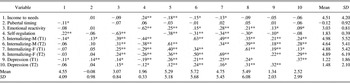
Descriptive statistics and intercorrelations among the main study variables are provided in Table 1. Among girls, pubertal timing was significantly associated with mother-reported and self-reported internalizing concurrently, such that girls with earlier maturation exhibited more internalizing symptoms. Furthermore, emotional reactivity and self-regulation were significantly associated with all three measures of internalizing at both time points such that girls with either greater emotional reactivity or poorer self-regulation exhibited more internalizing symptoms. Among boys, emotional reactivity was significantly associated with all three internalizing measures concurrently and longitudinally, such that boys with higher emotional reactivity exhibited more internalizing symptoms. Boys' self-regulation scores were significantly correlated with all three internalizing measures at both time points with the exception of CDI depression scores at T2; in each case higher levels of self-regulation were associated with lower levels of internalizing symptoms. Correlations between boys' pubertal timing and internalizing were not significant. The family income to needs ratio was significantly and negatively associated with internalizing symptoms for both genders and was included as a control variable in subsequent analyses. Emotional reactivity and self-regulation were negatively correlated in both genders. The means for the CDI scores are slightly lower than those typically reported for the long form CDI but are consistent with those reported in other studies that used the short form (e.g., Priess, Lindberg, & Hyde, Reference Priess, Lindberg and Hyde2009).
Descriptive statistics and intercorrelations for main study variables by gender

Note: Correlations for boys (n = 519) are above the diagonal; correlations for girls (n = 517) are below the diagonal. The means and standard deviations for internalizing (Child Behavior Checklist) and depression (Children's Depression Inventory) are based on the untransformed summed scores. T1, T2, Time 1, Time 2.
*p < .05. **p < .001.
Bivariate analyses of variance to examine gender differences revealed that, compared to boys, girls received higher scores on self-regulation, F (1, 1035) = 35.63, p < .001, mother's report of adolescent internalizing behavior at T2, F (1, 1035) = 10.05, p = .001, and adolescent's self-report of depression symptoms at T2, F (1, 1035) = 38.65, p < .001 (see Table 1 for means).
To examine the effects of race on internalizing behavior, we estimated structural equation models with factor scores on T1 internalizing as the dependent variable. Each model included race and either pubertal timing, reactivity, or self-regulation, along with the two-way interaction. Neither the main effect of race nor any of the interactions was significant (all ps > .10; results available from the first author). Therefore, race was not included in the main analyses.
Analyses predicting internalizing behaviors from puberty, reactivity, and self-regulation
Internalizing behavior was modeled as a latent variable at T1 and T2 based on ratings from three reporters (mother, father, and adolescent). For both genders, the ratings of all three reporters loaded significantly onto the latent internalizing variable at T1 and T2 (all ps < .001). All other variables were modeled as observed variables. To accommodate the latent dependent variable, structural equation models were used to test the predicted relations. Concurrent and longitudinal multiple indicator, multiple cause models were conducted separately by gender. Full information maximum likelihood, in which substantive model parameter estimates can be computed from incomplete data, was used to handle missing data (Hofer & Hoffman, Reference Hofer, Hoffman, Little, Bovaird and Card2007). Model fit was assessed with the χ2 likelihood ratio test, the comparative fit index (CFI), the root mean square error of approximation (RMSEA), and the standardized root mean square residual (SRMR). Values above 0.95 for the CFI, below 0.06 for the RMSEA, and below 0.08 for the SRMR were considered indicators of good model fit (Hu & Bentler, Reference Hu, Bentler and Hoyle1995).
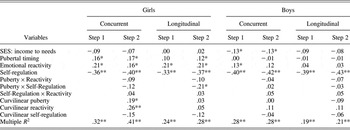
The structural equation models were conducted in three stages analogous to steps in a hierarchical regression. The first model included only the main effects of pubertal timing, emotional reactivity, and self-regulation, along with socioeconomic status (measured by family income to needs ratio), which was entered as a control variable (all assessed at T1). The second model included these variables plus interactions between puberty and emotional reactivity, puberty and self-regulation, and emotional reactivity and self-regulation, as well as curvilinear effects of pubertal timing, emotional reactivity, and self-regulation (i.e., the full model). The emotional reactivity variable was centered prior to creating the interaction terms to reduce nonessential collinearity (Aiken & West, Reference Aiken and West1991). Centering was not necessary for pubertal timing and self-regulation because the pubertal timing variable was already standardized and the self-regulation variable was based on a factor score; thus each already had a mean of 0. For each significant interaction, simple slope analyses were conducted to interpret the pattern. Results from each step of the concurrent and longitudinal analyses are reported for each gender in Table 2. Following these analyses, we tested additional models to examine the impact of controlling for T1 internalizing and T1 externalizing, respectively, in both the concurrent and longitudinal models.
Structural equation models predicting internalizing behaviors (standardized coefficients)

Note: SES, socioeconomic status.
*p < .05. **p < .001.
Models predicting internalizing among girls
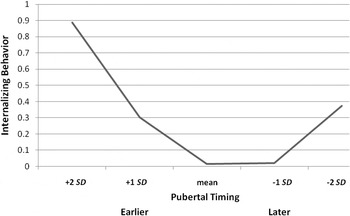
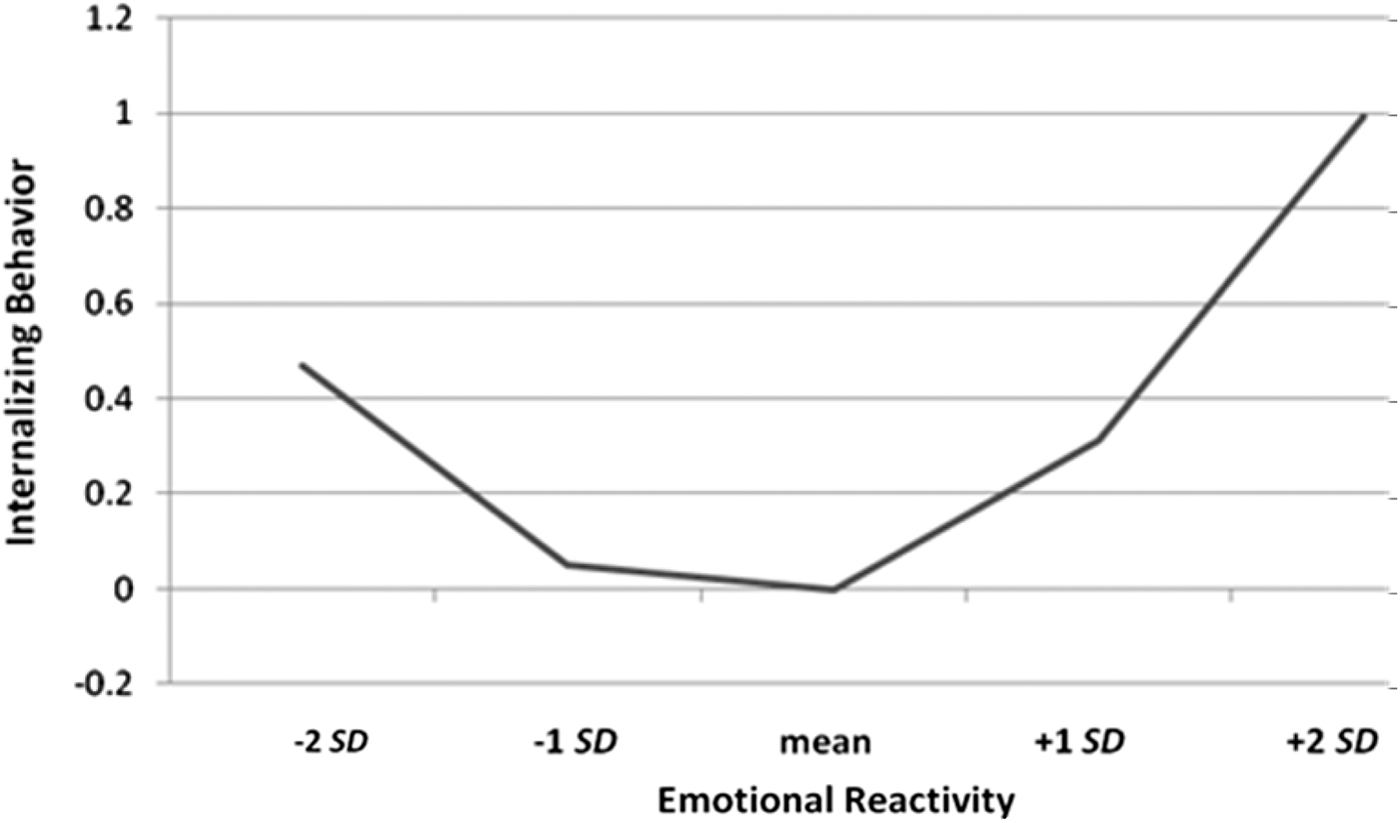
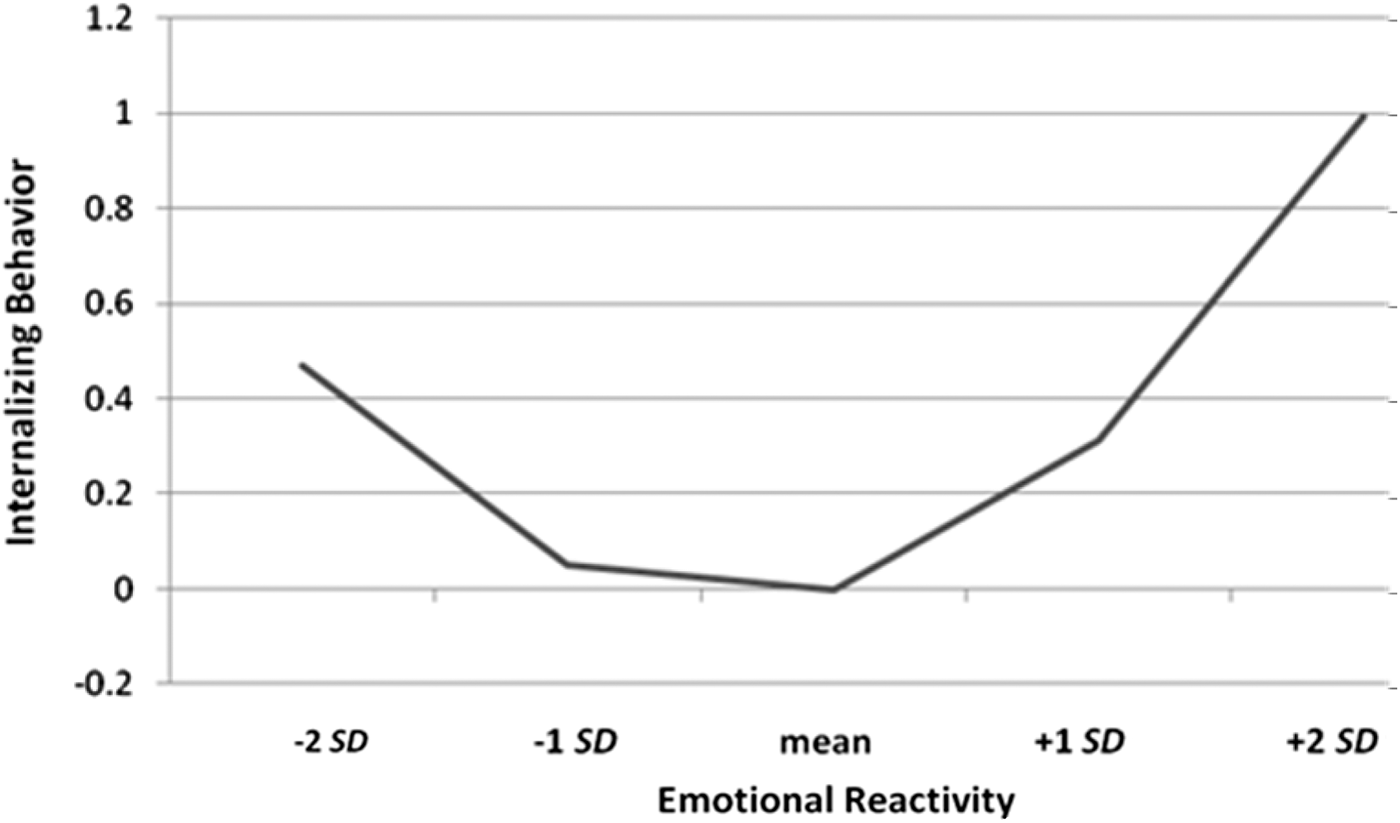
The concurrent models showed excellent fit, χ2 (8) = 8.14, p > .05, CFI = 1.00, RMSEA = 0.01, SRMR = 0.02; χ2 (20) = 20.05, p > .05, CFI = 1.00, RMSEA = 0.00, SRMR = 0.02, for the first model and the second model, respectively (see Table 2 and Figure 1). In both models, pubertal timing and emotional reactivity were positively related to internalizing symptoms, such that earlier pubertal timing and higher levels of reactivity were associated with more internalizing symptoms. Self-regulation was negatively related to internalizing in both models, such that lower levels of self-regulation were associated with more internalizing behavior. In the second model, there was a significant curvilinear effect of puberty (β = 0.19, p < .05), indicating that girls who were relatively early or late maturers were more likely to display internalizing behaviors compared to on-time maturers; this effect is shown in Figure 1. There was also a curvilinear effect of emotional reactivity (β = 0.26, p < .001), indicating that both very low and very high levels of reactivity were associated with increased levels of internalizing symptoms (see Figure 2).
The relation between girls' pubertal timing and internalizing behavior at age 11.

The relation between girls' emotional reactivity and internalizing behavior at age 11.
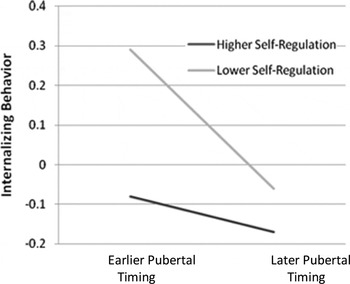
The longitudinal models for girls also showed excellent fit, χ2 (8) = 10.13, p > .05, CFI = 0.99, RMSEA = 0.02, SRMR = 0.02; χ2 (20) = 18.61, p > .05, CFI = 1.00, RMSEA = 0.00, SRMR = 0.02, for the first and second models, respectively. As shown in Table 2, pubertal timing was positively related to internalizing behavior in the second model; again, earlier timing was associated with higher levels of internalizing behavior. Reactivity was positively related, and self-regulation was negatively related to internalizing behavior in both models. In the second model there was also an interaction between puberty and self-regulation (β = –0.21, p < .05). A simple slope analysis indicated that at high levels of self-regulation (1 SD above the mean), pubertal maturation was not related to internalizing behaviors, but at low levels of self-regulation (1 SD below the mean), earlier puberty was associated with more internalizing behavior (see Figure 3). None of the curvilinear effects was significant. To determine whether the effects held with prior levels of internalizing controlled, we added T1 internalizing behavior as a covariate in the longitudinal models. When internalizing behavior at T1 was controlled, the effects of pubertal timing and emotional reactivity became nonsignificant; however, the effect of self-regulation remained significant (not shown).
The interaction between puberty and self-regulation on girls' internalizing behavior at age 15. Higher self-regulation refers to 1 SD above the mean; lower self-regulation refers to 1 SD below the mean.

In a final set of analyses, we included externalizing behavior at T1 as a covariate in the concurrent and longitudinal models to control for possible comorbidity between internalizing and externalizing behaviors. Among girls, externalizing behavior was significant in both models. The main effect of pubertal timing, the curvilinear effect of pubertal timing, and the curvilinear effect of emotional reactivity remained significant in the concurrent model; however, in the longitudinal model, the effects of pubertal timing and temperament were lost and a trend level curvilinear effect of pubertal timing appeared (p < .06). Thus some, but not all, effects of pubertal timing and temperament variables may reflect comorbidity.
Models predicting internalizing among boys
The concurrent model for boys showed excellent fit χ2 (20) = 23.82, p > .05, CFI = 0.98, RMSEA = 0.02, SRMR = 0.02 (for the full model). Emotional reactivity was significantly and positively related to internalizing behaviors in the first model only, indicating that boys with higher levels of emotional reactivity exhibited more internalizing behaviors (Table 2). In addition, self-regulation was negatively related to internalizing behavior in both steps of the concurrent model, such that poorer self-regulation was associated with more internalizing. The income to needs ratio was negatively related to internalizing behavior in both steps. The longitudinal model also had excellent fit χ2 (20) = 22.93, p > .05, CFI = 0.98, RMSEA = 0.02, SRMR = 0.02 (for the full model), but only self-regulation was a significant predictor: Boys with lower levels of self-regulation exhibited more internalizing symptoms. Controlling on internalizing behavior at T1 did not alter the pattern of results; self-regulation remained the only significant predictor.
Pubertal timing was not related to boys' internalizing behavior either concurrently or longitudinally, and none of the interactions or curvilinear effects was significant. To determine whether the lack of pubertal timing effects for boys was due to the distribution of pubertal timing at age 11, we repeated the analysis, substituting pubertal timing scores from ages 12 and 13, respectively. The effect of pubertal timing remained nonsignificant.
When externalizing behavior at T1 was included as a covariate, externalizing behavior was significant in both the concurrent and the longitudinal models. However, the effect of self-regulation remained significant in both the concurrent and the longitudinal models.
Discussion
This study was designed to examine the linkages among pubertal timing, temperament, and internalizing symptoms in adolescence. As expected, individual differences in temperament generally predicted internalizing behaviors, such that high emotional reactivity and low self-regulation were associated with more internalizing symptoms for boys and girls. There was also evidence of an interaction effect across time between pubertal timing and self-regulation among girls indicating that, as hypothesized, the effect of earlier maturation was strongest for adolescents with low levels of self-regulation. Thus, overall, temperament variables (emotional reactivity and self-regulation) and pubertal timing effects appear to operate alongside each other.
The role of pubertal timing
Among girls, earlier pubertal timing was associated with higher levels of internalizing symptoms, both concurrently and longitudinally. Furthermore, at age 11 there was also a curvilinear effect of pubertal timing, indicating that both earlier and later timing were associated with increased internalizing symptoms. Thus, both early and late maturing girls exhibited elevated symptom levels in early adolescence, but only early maturing girls continued to show increased internalizing by midadolescence. The age 11 findings are consistent with both the stage termination model (linear effect) and the social deviance model (curvilinear effect), whereas the longitudinal findings support the stage termination model. It appears that being off-time (early or late) is associated with increased internalizing during early adolescence, perhaps because this is the period when variation in pubertal maturation is most visible and salient and when girls are both aware of their status relative to age mates and wish to be “normal.” However, the elevated symptoms of late maturing girls are temporary and disappear by midadolescence, whereas those of early maturers persist. The persistence of early timing effects among girls is consistent with other research showing differences between early maturing girls and their peers in late adolescence and even adulthood, well after puberty has been completed (Weichold et al., Reference Weichold, Büttig and Silbereisen2008). Taken together, the findings provide strong support for the notion that early pubertal maturation places girls on a developmental path leading to an increased risk of internalizing disorders. However, when internalizing behavior at age 11 was controlled, the main effect of pubertal timing was no longer significant. Thus, early pubertal timing predicts subsequent levels of internalizing but does not predict change in internalizing behavior. Rather, early maturation appears to predict subsequent internalizing symptoms primarily through its link to internalizing symptoms at 11 years of age.
Associations between pubertal timing and internalizing symptoms were not found for boys. This was true even when we substituted pubertal timing scores from 12 and 13 years of age. Although the restricted distribution of boys' puberty scores at age 11 could have attenuated effects of pubertal timing, this was unlikely to be the case at ages 12 and 13 when there was greater variability in pubertal scores. The finding of more consistent timing effects among girls than boys is a common pattern in the literature (Archibald, Graber, & Brooks-Gunn, Reference Archibald, Graber, Brooks-Gunn, Adams and Berzonsky2003; Susman & Rogol, Reference Susman and Rogol2004). Furthermore, some studies indicate that, for boys, the tempo of pubertal change is more important than pubertal timing for predicting change in depression symptoms (Ge et al., Reference Ge, Kim, Brody, Conger, Simmons and Gibbons2003; Mendle, Harden, Brooks-Gunn, & Graber, Reference Mendle, Harden, Brooks-Gunn and Graber2010). Finally, although we found no evidence that pubertal timing predicted boys' levels of internalizing behavior, it is conceivable that pubertal timing would predict other problems, such as externalizing behavior, which are more common among boys. Studies of externalizing behavior indicate that some effects of pubertal timing among boys do not emerge until late adolescence (Andersson & Magnusson, Reference Andersson and Magnusson1990; Graber, Seeley, Brooks-Gunn, & Lerinsohn, Reference Graber, Seeley, Brooks-Gunn and Lewinsohn2004). Such “sleeper effects” might also be observed with respect to internalizing symptoms.
The role of emotional reactivity and self-regulation
Both emotional reactivity and self-regulation were found to predict internalizing symptoms, each in the expected direction. Whereas most of the literature to date has focused on the connections between underregulation and externalizing behaviors, the present results indicate important effects on internalizing behavior, consistent with a small but growing body of research (Eisenberg et al., Reference Eisenberg, Cumberland, Spinrad, Fabes, Shepard and Reiser2001; Garber et al., 1997; Suveg & Zeman, Reference Suveg and Zeman2004).
The effect of self-regulation was found for both genders: adolescents with higher levels of self-regulation at age 11 showed lower levels of internalizing behavior concurrently and 4 years later. Thus, it appears that better self-regulation is protective against internalizing symptoms both during the pubertal transition and over time, consistent with the perspective that self-regulation plays a fundamental role in adaptive functioning (Baumeister, Leith, Muraven, & Bratslavsky, Reference Baumeister, Leith, Muraven, Bratslavsky, Pushkar, Bukowski, Schwartzman, Stack and White1998). Moreover, the association between self-regulation and internalizing persisted even when internalizing behavior at age 11 was controlled in the analysis, suggesting that individual differences in self-regulation predict changes in internalizing symptoms. Contrary to theoretical prediction (Eisenberg & Fabes, Reference Eisenberg, Fabes and Clark1992), there was no evidence that intermediate levels of self-regulation were associated with the lowest levels of internalizing. Rather, our findings indicated a linear relation in which higher levels of self-regulation were protective against internalizing symptoms.
The effects of emotional reactivity were also in the expected direction in that higher levels were associated with elevated internalizing symptoms. This effect emerged for both genders at age 11 and for girls in the longitudinal analyses. The connection between high emotional reactivity and internalizing is consistent with theoretical models (Eisenberg & Fabes, Reference Eisenberg, Fabes and Clark1992) and a growing body of work linking emotional or physiological reactivity to internalizing symptoms (e.g., Graber et al., Reference Graber, Brooks-Gunn and Warren2006; Schiefelbein & Susman, Reference Schiefelbein and Susman2006). Among girls at age 11, there was also a curvilinear effect of emotional reactivity, such that very low and very high levels of reactivity were both associated with increased internalizing behavior. Such a possibility is implicit in Eisenberg and Fabes's (1992) model in which both low and high reactivity place individuals at risk. In the present case, the increase in internalizing associated with low reactivity appeared to be modest compared to that associated with high reactivity, suggesting that high reactivity places girls at particular risk for internalizing during the early adolescent years. This suggestion is also supported by recent findings indicating that for adolescent girls the association between early maturation and elevated internalizing symptoms is partially accounted for by heightened cortisol reactivity to stress (Natsuaki, Klimes-Dougan, et al., Reference Natsuaki, Klimes-Dougan, Ge, Shirtcliff, Hastings and Zahn-Waxler2009). Taken together, the findings suggest that greater reactivity (emotional or physiological) increases the risk of internalizing symptoms perhaps by increasing the tendency to experience negative emotions. There was no support for an interaction between emotional reactivity and self-regulation in predicting internalizing symptoms. However, evidence for such interactions is sparse, and a number of studies have failed to find the hypothesized interactions (Eisenberg, Fabes, & Spinrad, Reference Eisenberg, Fabes and Spinrad2006).
In any case, the relation between emotional reactivity and self-regulation is likely to be complex. Recent formulations of emotion regulation suggest that the unfolding of an emotional response is likely to involve both underlying reactivity and ongoing regulatory processes that modulate the response (Thompson, Lewis, & Calkins, Reference Thompson, Lewis and Calkins2008). Such a dialectical interplay makes it difficult to empirically disentangle emotional reactivity from self-regulation.
Interactions between puberty and temperament processes
There was one significant longitudinal interaction between pubertal timing and self-regulation for girls that provided modest support for the diathesis–stress hypothesis. The interaction indicated that, as predicted, earlier maturation was associated with elevated internalizing mainly among those with poor self-regulation in early adolescence. This finding is in keeping with studies showing that early maturation is more hazardous for girls with preexisting vulnerabilities (Caspi & Moffitt, Reference Caspi and Moffitt1991; Ge et al., Reference Ge, Conger and Elder1996; Rudolph & Troop-Gordon, Reference Rudolph and Troop-Gordon2010); however, in the present case the vulnerability factor was poor self-regulation, an aspect of temperament, rather than prior behavior problems or depressive personality. The interaction emerged in the longitudinal analysis and not concurrently. This pattern is suggestive of a delayed effect in which the interactive effects of early pubertal timing and poor self-regulation emerge gradually, over time. One possibility is that the stresses of adolescence (including early maturation) accumulate over time, eventually overtaxing the coping resources of girls who are initially underregulated. For example, early pubertal timing could combine with other stressors (e.g., sexual abuse or other negative life events) to increase the risk of subsequent internalizing problems (Nolen-Hoeksema & Girgus, Reference Nolen-Hoeksema and Girgus1994). Exploring such pathways could illuminate how the combination of early pubertal timing and self-regulation feeds into the development of internalizing problems among girls.
Because internalizing problems often co-occur with externalizing problems (Oland & Shaw, Reference Oland and Shaw2005), we also the explored the impact of controlling for externalizing behaviors in the models. Some, but not all, effects of pubertal timing and temperament became nonsignificant when externalizing was added as a covariate. This suggests that some of the effects of pubertal timing and temperament may reflect comorbidity between internalizing and externalizing problems. Our results are consistent with research indicating that some externalizing symptoms typically precede internalizing problems and may contribute to them (Loeber & Burke, Reference Loeber and Burke2011; Stringaris & Goodman, Reference Stringaris and Goodman2009). In future studies, it would be useful to distinguish adolescents with both problems from those with internalizing symptoms only and those with externalizing symptoms only (e.g., Fanti & Henrich, Reference Fanti and Henrich2010).
The present findings should be considered in light of several study limitations. First, although the SECCYD sample is relatively large and diverse, there were too few minority adolescents to permit analysis of specific ethnic subsamples. Thus, we do not know whether the present results extend to specific ethnic minority groups. Furthermore, youth in our sample came from families where, on average, mothers reported relatively high educational attainment and family incomes levels well above the federally defined poverty line. More diverse samples will be needed to generalize results to a broader population. Second, multiple reporters (mother, father, and adolescent) provided measures of adolescent internalizing symptoms, but the temperament measures of adolescent emotional activity and self-regulation were based on mother report. Although maternal report measures are commonly used to measure child temperament and have been found to be predictive of behavior problems in a large number of studies (Eisenberg, Fabes, Guthrie, & Reiser, Reference Eisenberg, Fabes, Guthrie and Reiser2000; Rothbart & Bates, Reference Rothbart, Bates, Damon and Eisenberg2006), relations with laboratory measures tend to be modest to moderate (Hayden et al., Reference Hayden, Durbin, Klein and Olino2010), suggesting that parent reports and laboratory measures provide somewhat different information. This is not surprising because maternal reports cover a broader range of observations than do laboratory tasks and may be subject to reporter bias. In future studies, it would be appropriate to include additional measures (e.g., self-reports or physiological indices) to supplement maternal ratings. Third, the measure of emotional reactivity was relatively short, containing only three items. The measure was internally consistent and showed the expected relationships to other variables. Nonetheless, a more comprehensive measure of emotional reactivity would be preferable in the future.
Despite these limitations, the present study is among the first to explore the simultaneous contributions of pubertal timing and temperament to adolescents' internalizing symptoms. The findings underscore the role of pubertal timing, especially early timing, in girls' but not boys' internalizing symptoms. Furthermore, emotional reactivity and self-regulation predicted internalizing symptoms in both sexes, supporting the importance of these temperament factors. Reactivity and self-regulation tended to operate independent of pubertal timing; however, among girls there was a significant interaction between early timing and self-regulation indicating that early maturation was a risk factor primarily for girls with poor self-regulation and that this effect emerged over time. These findings suggest a need to expand the conceptualization of the pathways leading to internalizing problems to include both pubertal development and temperament. Furthermore, they point to the potential for interventions focused on enhancing self-regulation, especially among early maturing girls.