1. Introduction
Property rights protection constitutes a major factor in achieving a flourishing economy (see, among others, Hodgson, Reference Hodgson2015a, Reference Hodgson2015b, Reference Hodgson2015c, Reference Hodgson2015d). In a previous paper (Economou and Kyriazis, Reference Economou and Kyriazis2017) we analysed the emergence and development of property rights in ancient Greece from the Homeric period (1100–750 bce), where they evolved gradually up to the Archaic period (750–510 bce) and were firmly established and secured in the Classical period (550–323 bce). At the beginning they were based on customs and were then gradually strengthened and institutionalised, linked to socio-political and military developments.
By the end of the 6th century, associated with the strong position of the new class of independent middle-income farmers who could afford to personally finance the relatively expensive ‘hoplite’ (military) equipment, property rights were no longer informal and based on customs but were based on formal law, backed by the state and independent courts. During the Classical period, this development was further strengthened and was associated in some cases, as in Athens, with the establishment of democracy. Property rights were strongly guaranteed by state institutions, such as specialised courts dealing with commercial issues. This development continued and was extended during the Hellenistic period (322–146 bce), which we present here, bringing the history of the development of property rights in ancient Greece to a close.
The paper analyses three case studies: Hellenistic Athens, the Hellenistic federations (also known as leagues), and Ptolemaic Egypt. We actually cover a three-stage analysis in the Hellenistic period: First, Athens, possibly the most advanced democratic city-state in Greek antiquity; second, various examples of democratic federations, comprising associations of cities; and finally Ptolemaic Egypt, a kingdom, which also comprised many cities.
During the Hellenistic period there were still independent city-states, however this period was mainly characterised by political rebuilding, the main feature being the retreat of the prestige and dynamics of the independent city-state, in favour of either royal and imperial regimes, or federal structures, of either democratic or undemocratic organisations. This was the result of the political unification of large geographical areas in mainland Greece, the former Persian Empire and part of India under an extensive ecumenical Macedonian Greek-ruled region, at first by Alexander the Great and then by his successors. Due to these developments, some Greek cities (but not all) experienced a period of economic prosperity due to the influx of money (in the form of spoils, precious metals, etc.) from the development of trade with eastern markets.
In section 2, we choose to analyse Hellenistic Athens, since the Athenian state continued to be one of the most important Greek city-states during this period as well. In section 3, we analyse the issue of ancient Greek federations (or leagues), which are less well known than other historical cases in ancient Greece, such as Athens, Sparta, Macedonia and Rhodes. These political entities developed a series of political and economic institutions that were of major importance and well worth being analysed, especially those that were related to property rights. In the international bibliography there is a debate concerning the correct political/institutional typology of these political entities: Some authors, such as Grainger (Reference Grainger1999), characterise them as leagues while others consider them as true federal states (Beck and Funke, Reference Beck, Funke, Beck and Funke2015), and some authors adopt both terms. However, recent evidence shows that they could be better described as federal states (see, among others, Beck and Funke, Reference Beck, Funke, Beck and Funke2015; Economou and Kyriazis, Reference Economou and Kyriazis2016; Economou et al., Reference Economou, Kyriazis and Metaxas2015; Mackil, Reference Mackil2013).
In order to avoid this problem of typology (and a possible historical ‘anachronism’) Mackil (Reference Mackil2013) adopts the term Koinon (singular) or Koina (plural) as these political entities were called in antiquity. Koinon means ‘common polity’, or interstate political rights between different city-states and we also adopt the term since it ‘decomposes’ our analysis from the problem of typology, since the essence of our analysis is to shed light on the institutions that are related to the property rights protection of these political entities and not to focus on ancient Greek federalism's institutional-political characteristics.
In section 4 we analyse a Hellenistic kingdom, that of Ptolemaic Egypt (305–30 bce), as a characteristic case of the kingdoms that were created by the successors of Alexander the Great, the others being the Antigonid Macedonian kingdom in mainland Greece (306–168 bce), the kingdom of Pergamum under the Attalid Dynasty (282–133 bce) and the Seleucid Empire (312–63 bce). We have decided to include Ptolemaic Egypt in order to make it clear that although Egypt was not a democracy it did provide some protection of property rights, also due to a diffusion of the ‘Greek standards’ valid in the Greek city-states. This is one of the first cases of diffusion that also took place in later periods, such as the ‘Dutch expertise’ in England after 1688 (Hodgson, Reference Hodgson2017).
Thus we have included Egypt because it was the longest lasting of the Hellenistic Kingdoms (due in part to its relatively efficient financial administration, reorganised by the diffusion of institutions from the economies of democratic states and federations in mainland Greece), and because there is more extant evidence for Egypt than the others.Footnote 1 Thus, this paper covers the issue of property rights protection by focusing on the last historical period of the ancient Greek world and Egypt, before their conquest by Rome. Section 5 presents the conclusion.
2. Property rights in Hellenistic Athens
Recent evidence and contemporary research provides convincing arguments in favour of the fact that, despite the findings of older studies (e.g. Finley, Reference Finley1973), the Athenian economy implemented many modern market-type institutions. There is a vast recent literature on this, such as in Bergh and Lyttkens (Reference Bergh and Lyttkens2014), Bitros and Karayannis (Reference Bitros and Karayannis2008), Cohen (Reference Cohen1992), Lyttkens (Reference Lyttkens2010, Reference Lyttkens2013) and Ober (Reference Ober2015).
In a recent paper (Economou and Kyriazis, Reference Economou and Kyriazis2017) we provided an extensive analysis of the property rights protection regime in Classical Athens by arguing that the Athenian economy was practising a series of market-type institutions, such as property rights protection; legally binding contracts guaranteed by courts comprising experienced jurors judging commercial cases; insurance companies; banking services, a reliable silver coinage as a means of accomplishing commercial/economic transactions, the drachma (also called, the ‘Athenian owl’) with its denominations of both silver and bronze types; and laws that protected the drachma from forgery, which was beneficial to transaction cost reduction. All these institutions led the Athenian economy to flourish during the 5th and 4th centuries bce.
A brief historical background of Athens during 322–88 bce
After the defeat of Athens in the so-called Lamian War of 323/2 bce, where Athens and some other states such as the Aetolian Koinon, tried to restrict Macedonian hegemony over central and southern Greece, a Macedonian guard was placed in the city of Athens, making it a satellite state. An oligarchic regime was established from 322 to 318 and then, during 317–307, Athens was governed by a new pro-Macedonian oligarchic regime under Demetrius Phalereus who introduced a series of important reforms. During this period, the Macedonian victors (among other repressive measures) restricted the franchise from 21,000 to 9,000 citizens owning property worth over 2,000 drachmae transforming the regime from democracy to ‘timocracy’.
Democracy was restored during the 306–287 period except for a short-lived period of tyranny during 298/7–295 under Lachares. During 286–262 Athens managed to regain its political independence with the aid of King Ptolemy II, ruler of the Hellenistic kingdom of Egypt. Then, in collaboration with Sparta under King Areas I, the Athenians declared war on Macedonia in an endeavour to regain their political independence. The attempt failed and led to the installation of a new Macedonian guard, while part of the city's walls was destroyed by demand of the Macedonians. However, the main democratic institutions, such as the citizens’ Assembly and the Council of the Five Hundred still existed, even if, to a greater or lesser extent, they were manipulated by people loyal to the Macedonian king, Antigonos II. Although Athens retained its main political, judicial and economic institutions, it became a satellite state of Macedonia in geopolitical terms (Habicht, Reference Habicht1999: 88–89, 157–166; Tracy, Reference Tracy1995: 20–21).
In 229 Athens regained (at least theoretically) its full political independence related to democratic governance, as the death of the Macedonian King Demetrius II left as his successor a minor, Philip (later to be King Philip V). The Athenians immediately seized the opportunity and expelled the Macedonian guard by bribing it with 150 talents, a significant amount of money at the time. The ‘Long Walls’ of the city were then restored. The Athenians then chose to establish a grand pacifist geopolitical strategy. Shortly after 229 they established an alliance with the Hellenistic kingdom of Egypt and, as a part of it, they began to receive financial aid (ibid., 174–176).
The Athenian state continued this strategy until 88 bce when it chose to align with King Mithridates of Pontus against the Romans. Then the Roman general Sulla laid siege and sacked Athens, ending its independence. As a final comment, it is of primary importance to say that although the bodies of decision making under democratic governance remained during almost the whole Hellenistic period, a fundamental difference between Classical and Hellenistic Athens was the restricted franchise characterising the latter for some periods of time during 322–146 bce.
An overview of property rights protection in Athens during the Hellenistic Period
According to Hodgson (Reference Hodgson2015a, Reference Hodgson2015b), institutions are systems of rules that structure social interactions. This further means that if a core of values and rules continues to be accepted as beneficial by society from period to period, there is no need to change them. This appears to have been the case with Hellenistic Athens, since historians who have specialised in Hellenistic Athens, such as Tracy (Reference Tracy1995) and Habicht (Reference Habicht1999), generally agree that during this period, the Athenian state retained and exercised in practice the major political and economic institutions that had been developed during the previous Classical period.
Property rights in Classical Athens were protected by formal laws, courts and judicial procedures. However, the evidence is scanty for the Hellenistic period, so that some of it can be attested and some of it can only be inferred. Habicht (Reference Habicht1999: 4–5) more specifically argues that some core state institutions such as the administration of justice, the official cults, the provision of food supplies, the regulation of finances and all the other areas of government administration, remained the exclusive responsibility of the citizens of Athens. In accordance with this view, Tracy (Reference Tracy1995) argues that internal institutions of the Athenian state remained essentially intact and democratic. Indeed, the courts, the assembly, the council, and the selection of officials based on it continued with some detectable interruptions down to the time of Sulla (1st century bce). Generals continued to be elected annually, and the nine traditional archons continued to play their accustomed roles each year. Other institutions such as ‘choregia’ (festival financing), ‘gymnasiarchy’,Footnote 2 and subscription lists and records of voluntary contributions (called epidosis) also continued through the Hellenistic period, suggesting that a broad-based class of wealthy men with clearly defined property rights continued to exist much as before (Davies, Reference Davies, Walbank, Austin, Frederiksen and Ogilvie2008: 295).
These arguments do not imply that a static regime of property rights was established in Athens. Athenian society was not characterised by inertia. Some new institutions, such as the nomophylakes (the ‘guardians of the laws’) were introduced during the Hellenistic period. Their chief duty was to attend meetings of the Assembly and the Council and veto actions or proposals that were illegal or contrary to the interests of Athens (Habicht, Reference Habicht1999: 45; Schwartzberg, Reference Schwartzberg2004: 319).
During that period, not only in Athens but also in the rest of the Hellenistic world, a series of associations of traders called Koina and merchant ship owners, called synodoi emporon kai naucleron, were introduced. Among them, Egyptian and Tyrian groups were already attested at Athens in the late 330s (Davies, Reference Davies, Walbank, Austin, Frederiksen and Ogilvie2008: 283). Sea trade could flourish providing that there was an established organisational structure that protected property between the city-state exporter and the city-state importer of goods and services. Davies (p. 272) writes that such transfers are part of the evidence that by 300 bce the eastern Mediterranean had long since ceased to comprise purely a set of local subsistence economies. On the contrary, the volume of interstate trade involved transport and exchange over long distances. Thus, these commercial associations could be seen as the ‘progenitors’ of early modern European joint stock companies, such as those developed in the United Provinces and England during the 16th century ad.
Moreover, during the Hellenistic period interstate commercial transactions and the movement of people and goods further rose in comparison to earlier historical periods through the institutions of isopoliteia (meaning political and economic rights between different city-states), the sale of citizenship for fiscal purposes and the ever wider spread of potential dual citizenship via proxenia grants to individuals or isopoliteia treaties between communities (ibid., 309).Footnote 3
3. Property rights in the Hellenistic Koina
During the Hellenistic period there was a further refinement of property rights, this time related to the emergence of federations. Most federations comprised independent city-states, such as the Aetolian, the Achaean and the Boeotian, which were the most integrated and democratic. There were also a few non-democratic federations, such as the Thessalian one. The federal organisation (or ‘common polity’ according to Mackil, Reference Mackil2013) emerged during the Classical period. Cultural, racial and religious issues lay behind the causes of forming federal structures, however the most important reason was protection and the security policy of the small Greek city-states in an era when the Greek world was transforming towards federations and kingdoms. The next step was that this collaboration between the city-states expanded to economic/commercial issues, since it had proved successful and beneficial for the member city-states (Beck and Funke, Reference Beck, Funke, Beck and Funke2015; Economou and Kyriazis, Reference Economou and Kyriazis2016; Economou et al., Reference Economou, Kyriazis and Metaxas2015; Mackil, Reference Mackil2013, Reference Mackil, Beck and Funke2015) and thus it became permanent.
Hellenistic federations (Koina) did not have identical political and economic structures, but it had similar ones, and Mackil (Reference Mackil2013: 1, 305–306), based on the ‘Inventory of Archaic and Classical Poleis’ developed by Hansen and Nielsen (Reference Hansen and Nielsen2004), argues that in the late 4th century bce 183 out of the 456 the city-states in mainland Greece were definitely parts of a federal state. This might even be between 46 and 50%, or almost half of all Greek cities, if it included those city-states that were situated within regions where Koina had developed but whose participation is not clearly attested by the Hansen and Nielsen inventory.
Ancient Koina introduced, for the first time, the ideas of proxenia and isopoliteia for their citizens. Proxenia is related to interstate trade. According to Migeotte (Reference Migeotte2009: chapter 4) and Lyttkens (Reference Lyttkens2013: 124), before this institution was applied, traders who travelled between Greek cities, or other places in the ancient world, faced the risk of having themselves or their property seized. There were, of course, bandits and pirates, but there was also the risk of being a foreigner engaged in a legal dispute with a citizen of a town who was backed by law, whereas the trader was not protected by any law. In order to solve this problem, which was detrimental to trade, a polis (city-state) could appoint a citizen of another polis to be proxenos. This meant that the proxenos acted as a kind of ambassador, for example, to the Athenians who visited his polis. In return, the proxenos received privileges in Athens. There were also bilateral agreements between different city-states that ensured that traders would have legal rights in city-states where they were not citizens. About 20 such agreements between Athens and its allies and other cities have been preserved, and there are examples from many other city-states as well.
The second pivotal institution regarding property rights protection was, isopoliteia, which conferred political rights at the federal level. Davies (Reference Davies, Walbank, Austin, Frederiksen and Ogilvie2008: 259) characterises isopoliteia as ‘the erosion of citizenship boundaries and the new kind of interstate relationship’ while Mackil (Reference Mackil2013: 102) as ‘full citizenship, available to any individual who chose to domicile himself in another region’ (of a federal structure). Isopoliteia agreements were further extended to include not only member states within a federation, but also a federal state as a whole and another state (independently of whether or not the latter was a federal state or a single city-state). For example, the alliance between the Aetolian and the Acarnanian Koina (federations) enabled their citizens to own land in both of them.
In another case, a series of additional inscriptions that were established around 240 bce (SEG 2.258, SEG 18.245, BE 77.231, Syll. 3 472 reproduced by Mackil, Reference Mackil2013: 102, 263) reveal that the Aetolian Koinon had reached an isopoliteia agreement of equal status with Messene, a city-state in the southwestern Peloponnese. Every federal state throughout the Greek world introduced isopoliteia, and some further examples include, among others, isopoliteia agreements between the city-state of Hierapytna and a number of other Cretan poleis, or city-states that were members of the Chalkidean Koinon (in northern Greece).
Another important institution was asylia, which meant exemption from reprisals that, for example, city A could take against city B, if the actions of a citizen of B damaged the interests of city A. In other words, with asylia, the practice of sylis meant that legal implementation of reprisals against another city was not ethically (or legally) justified (Walbank, Reference Walbank1993). According to Mackil (Reference Mackil, Beck and Funke2015: 489), asylia agreements assured freedom from seizure between the states involved. This provision was very important because it essentially separated any criminal, moral, etc. action that occurred, for example, in city-state A by a citizen from city-state B, from any kind of retaliation against city-state B's constituents as a whole in retrospect. It was a very important institution since it made ethically and practically invalid the concept of collective responsibility of all inhabitants of a city for the actions of specific people that originated from it. It is obvious that such an institutional arrangement created much better conditions for cooperation, commercial activity and property rights protection between people within the borders of a federation, or between people whose state authorities had signed decrees of mutual (interstate) citizenship agreements with foreign states.
Isopoliteia and asylia were very common institutional practices between states throughout the Hellenistic world (Beck and Funke, Reference Beck, Funke, Beck and Funke2015; Mackil, Reference Mackil2013, Reference Mackil, Beck and Funke2015; Walbank, Reference Walbank1993). In one of these cases, the cities of Teo and Magnesia in Asia Minor signed some asylia decrees with cities from the Aetolian Koinon and with cities from Crete since both the Aetolians and Cretans were notorious for their plundering activities. The Aetolian Koinon had various asylia agreements with a series of city-states throughout the Hellenistic world in the last two decades of the 3rd century, such as city-states in the eastern Aegean, as epigraphic evidence proves (Mackil, Reference Mackil2013: 115; Walbank, Reference Walbank1993).
Grants of asylia and isopoliteia were made to both individuals and communities and complaints against their violation were sometimes heard by the Aetolian assembly acting as a federal court. Such grants were conferred by other states too, but they were considered as especially valuable. Asylia agreements were obviously related to the economic/commercial activities of those who were performing interstate trade between two cities, A and B, and for this purpose they were backed by bilateral judicial conventions envisaging access by citizens of A to the courts (or a court) of B (and vice versa) and specifying procedures, the composition of the court, etc. (Davies, Reference Davies, Walbank, Austin, Frederiksen and Ogilvie2008: 289). The existence of bilateral judicial conventions is obviously related to the will of both sides to protect the property and the economic/commercial rights of citizens in both city-states.
As regards pure economic institutions, the main economic rights were those of ownership (of land and houses) by a citizen of one member city-state in another, called enktesis, and the right of intermarriage (epigamia). Enktesis rights were granted to foreigners, enabling them to acquire land or a house (or both) by a popular resolution. Epigamia conferred the right of transfer of property in the form of women's dowries (Economou and Kyriazis, Reference Economou and Kyriazis2016: 99, 105; Mackil, Reference Mackil2013: 103; Reference Mackil, Beck and Funke2015: 491). These rights are specified in two inscriptions found in the Aetolian capital of Thermos: T57, recording a treaty and alliance between the Aetolians and the Acarnanians; and T58, known as the Proxenia Decree of the Aetolian Koinon for Kallippos and Kephalos of Pronnon, where they are granted the right to own property comprising land and houses within the federation (both inscriptions reproduced by Mackil, Reference Mackil2013: 495–500).
These two property rights institutions were characteristic of all Greek federations, appearing for the first time in the 4th century. For example, Xenophon (Hell. 5.2.16–19), concerning the Chalcidian Koinon in today's modern Chalcidice, in the northern Greek peninsula, wrote: ‘if however [the city-states] become closely connected by intermarriage and the right to acquire property rights in one another's city-state, that have already been voted … will perhaps not so easily be dissolved’. An interpretation of what Xenophon argues here is that the granting of property rights at the federation level created strong incentives in favour of the federation and community of interests for the citizens.
By granting these rights at the federal level, the federation created a common market that increased welfare through the pooling of resources such as pastoral products from the highlands, grain from the plains, fishing and trade from the coast. More generally, these rights proved beneficial in economic terms for all member city-states in federations such as the Achaean and the Aetolian, since they abolished all limitations on commerce that were related to city-state organisations. This strategy of abolishing border constraints while encouraging commercial interaction is intelligently characterised by Mackil (Reference Mackil2013: 273, 281) as ‘interpolis economic transactions’ and ‘microregional interdependence’ (281).
Furthermore, epigraphic evidence has been found (for example IPArk 16), referring to the Achaean Koinon, which certifies that, with the incorporation of the city of Arcadian Orchomenus in the federation, all Achaean citizens could enjoy the right to possess land and property (houses, etc.) in Orchomenos (Mackil, Reference Mackil, Beck and Funke2015: 492). That this general principle applied to all Achaean citizens has been confirmed by Larsen (Reference Larsen1971).
A similar status was also applied to all the other federal states, such as the Aetolian (IG, IX 12; Mackil, Reference Mackil2013: 255, 302–303, Economou et al., Reference Economou, Kyriazis and Metaxas2015), the Chalcidian (Xen. Hell. 5.2.19) and the Lycian Koinon in Asia Minor. In another case, a treaty was signed around 260 bce, this time between the Acarnanian and the Aetolian federations, regulating frontiers and establishing a mutual exchange of isopoliteia and rights of intermarriage and the acquisition of land between citizens of the two states. Right of ownership of land and houses and the transfer of dowries etc., presupposes also another fundamental property right, that of the free movement of capital. How else could a citizen in one federation member-state acquire property in another city-state? Thus, the above five institutions, isopoliteia, proxenia, asylia, enktesis and epigamia are related to the modern so-called fundamental principles of a market economy, which are free circulation of goods, services, labour and capital.
Mackil (Reference Mackil, Beck and Funke2015: 488–489) argues that the above institutions were introduced as a protection of foreign merchants and as an inducement to commerce and she adds that ‘bilateral agreements were occasionally drawn up to extend reciprocal legal protections and economic privileges to the citizens, and resident foreigners of two communities’, while “isopoliteia” opened citizenship with its attendant legal and economic privileges and obligations to citizens of another community’.
This rise of the volume of commercial activity was linked to the introduction of federal currencies, in parallel to the free circulation of local currencies, which were linked to common weights and measures. For example, according to Davies (Reference Davies, Walbank, Austin, Frederiksen and Ogilvie2008: 177) the Athenian tetradrachm (four drachma) coinage went far towards creating a common monetary area for the eastern Mediterranean, and numerous surviving hoards, especially from Asia Minor during the Seleucid period and from the Levant and Near East, reflect it. The provision of common coinage was widespread among Greek federal states and the numismatic evidence has been recently surveyed (Mackil, Reference Mackil2013: 249–254) and facilitated these exchanges by reducing transaction costs (Economou and Kyriazis Reference Economou and Kyriazis2016).
Since, in the federations, federal and city-state coins circulated in parallel to local coins, we infer that banks must have been active in such operations of capital movement and currency exchange as they are attested already in Classical Athens (Cohen, Reference Cohen1992) but also in the rest of the ancient Greek world during the 4th century (Roberts, Reference Roberts2011: 130). A federal currency is an intertemporal means that may expand the volume of commercial transactions, since it reduces transaction costs. This applies to a variety of historical cases, such as the First and the Second Athenian (or Delian) Alliance (478–404 and 378–355), the Greek Koina (4th century bce to 146 bce), to modern federations such as the USA, Germany, Switzerland and India and economic unions (or would-be federations) such as the European Union (with 19 Eurozone member states out of 27 states).
The ancient historian Polybius provides a very characteristic description of this. By referring to the Achaean Koinon, he argues that ‘in my times these cities achieved such a great progress, that they had established among them, an alliance, common laws, weights and measures, and coins, and they also had common magistrates and high-ranking officials, councilmen and jurors’ (Ηist. 2. 27. 9–11. and 24.8.4–5). This passage, by referring to ‘common laws’, implies the existence of courts and justice that are obviously related to property rights protection as well as other supplementary institutions (common weights and measures, coins, and common magistrates). These institutions are related to a pivotal institution, the so-called agoranomoi, local magistrates (under the supervision of the federal authorities) whose duties were to punish those who were selling goods at exorbitant prices (Mackil, Reference Mackil2013: 268–269). Thus, the main objective of the agoranomoi was to prevent sellers from profiteering, thereby protecting the smooth functioning of the market and the interests of consumers. The agoranomoi and the federal courts had been charged with the legal protection of commercial contracts and monetary transactions (ibid., p. 272).
This evidence implies the existence of courts that provided justice at both the local (city-state) and federal levels (in regions). There is evidence that certifies that the Aetolian Koinon was organised into seven regions (where each region had a political and military governor and an economic administrator), while the neighbouring Achaean Koinon was organised into three or five regions (Polyb. Hist. 4.59; Economou et al., Reference Economou, Kyriazis and Metaxas2015; Larsen Reference Larsen1971). Thus, apart from organised courts at the local city-state level, Chaniotis (Reference Chaniotis1999) provides evidence for the existence of a federal court called koinodikion (meaning, providing justice to the Koinon), which was responsible for solving disputes or territorial differences in the Cretan Koinon as well as hearing civil and criminal cases. Obviously, in general, in the Greek Koina, common procedural rules for providing justice were exercised and the laws were recorded and stored in a special public building, intended for that purpose, as was the practice in Classical Athens (Economou and Kyriazis, Reference Economou and Kyriazis2017).
Another very interesting example (mentioned in inscription IG VIII, dated to about 225–223 bce) is that of Nicareta, a citizen of the Boeotian city-state of Thespiai, who gave a loan of 10,085 drachma and 2 obols to the city-state of Orchomenos, both cities being members of the Boeotian Koinon. It appears that Orchomenos did not repay the loan at the specified time and Nicareta appealed against Orchomenos before a federal court. She won the trial and the city-state of Orchomenos was forced to provide a significant sum of money to her as compensation, almost 50,000 drachmas, an amount almost thrice the value of her loans to Orchomenos as a whole. At the time, 50,000 drachma were a large sum of money since, as has already been mentioned, the daily wage for an unskilled worker, was 1.5 drachmas. However, the sum of money that Nicareta eventually received after she reached an agreement for a new contract with Orchomenos was much smaller, only 1,247 drachmas.
The fact that Nicareta eventually received 1,247 drachmas instead of the 50,000 awarded by the court should not lead to the hasty conclusion that Nicareta failed to defend her interests. Most importantly, she was justified in law. The fact that she received only 1,247 drachmas indicates, not the failure of the legal system to provide justice, but the failure of the city-state of Orchomenos to pay its debt (Mackil, Reference Mackil2013: 316; Schaps, Reference Schaps1979). And in such a situation, what could Nicareta do? Would it require the conversion of Orchomenos' citizens to slaves in return? Probably Nicareta, as a pragmatic woman and a competent investor and realist, would consider a new deal with Orchomenos to be a better option, with mutual concessions on both sides so that both would benefit in the end. Unfortunately, ancient inscriptions do not provide us with the final outcome of the commitment between Nicareta and Orchomenos. Schaps (Reference Schaps1979: 13, 63–65) recognises and emphasises the importance of res judicata in this incident, as the law proved capable of protecting Nicareta's property. Similar cases of women who won such trials include Kleuedra and Olympichia. Could it be that Nicareta in fact agreed to a rescheduling of her loans to Orchomenos, involving a reduction or cancellation of the first loan repayment on condition of payment of the second? If yes, then this instance is probably one of the first ever recorded cases of PSI (private sector involvement), or a ‘haircut’.Footnote 4
These cases are very interesting for the following reasons: (1) a citizen of one city-state could make a loan to another city-state (a form of public borrowing from private persons, anticipating modern bonds issues); (2) the lender was a woman, thus making it clear that, during this period (3rd century bce), women had property rights; (3) in case of disputes, a citizen had the right to appeal before a federal court, which guaranteed the safeguarding of their property rights in case they were violated by a different city-state. This predates a modern federal court's jurisdiction.
Federal courts also arbitrated over property rights of member city-states’ disputes, for example, fishing rights in the lake of Kopais in Boeotia. According to an inscription (IG, VII, 2792) found in the Kopais plain (Central Greece) and dating from the 3rd century bce (reproduced in Mackil, Reference Mackil2013: 415–448), a dispute concerning the fishing rights of two neighbouring city-states, Akraiphnion and Kopai, located on the northeastern shore of the lake, resulted in both states appealing. The matter was settled by a federal court. The existence of the agoranomoi and the federal courts (koinodikion) reveals an additional but very crucial value that was practised in the democratic federations: that of isonomia, meaning equality of all citizens before the law, a concept that was first practised in the democratic states during the Classical period, with Athens being the most representative case.
Another case that presupposes the existence and safeguarding of strong property rights is the issue of public–private partnerships (PPPs), which became more common during the Hellenistic period.Footnote 5 We illustrate this with the example of Hairephanes. In about 318 bce, the city-state of Eretria, on the island of Euboea, decided to drain Lake Ptychon, which was in its territory. The city gave a contract to Hairephanes according to which he would be the entrepreneur for this work. Hairephanes would personally finance the cost of the work and be compensated by receiving the proceeds from the cultivation of the drained land for ten years, but paying three talents per year to the city. This can be equated to an income tax, or a share of profits. Bresson (Reference Bresson2007: 240) estimates that for Hairephanes’ investment to have been profitable, the lake must have comprised more than 100 hectares and that the initial investment must have been more than ten talents. This actually means that the PPP described here is a good example of the effect of transaction costs on framing economic activities. For some reason Hairephanes must have known more about the condition and economic potential of the lake than the city of Eretria, so it made economic sense to use his services as a private operator instead of setting a state agency to do the work.
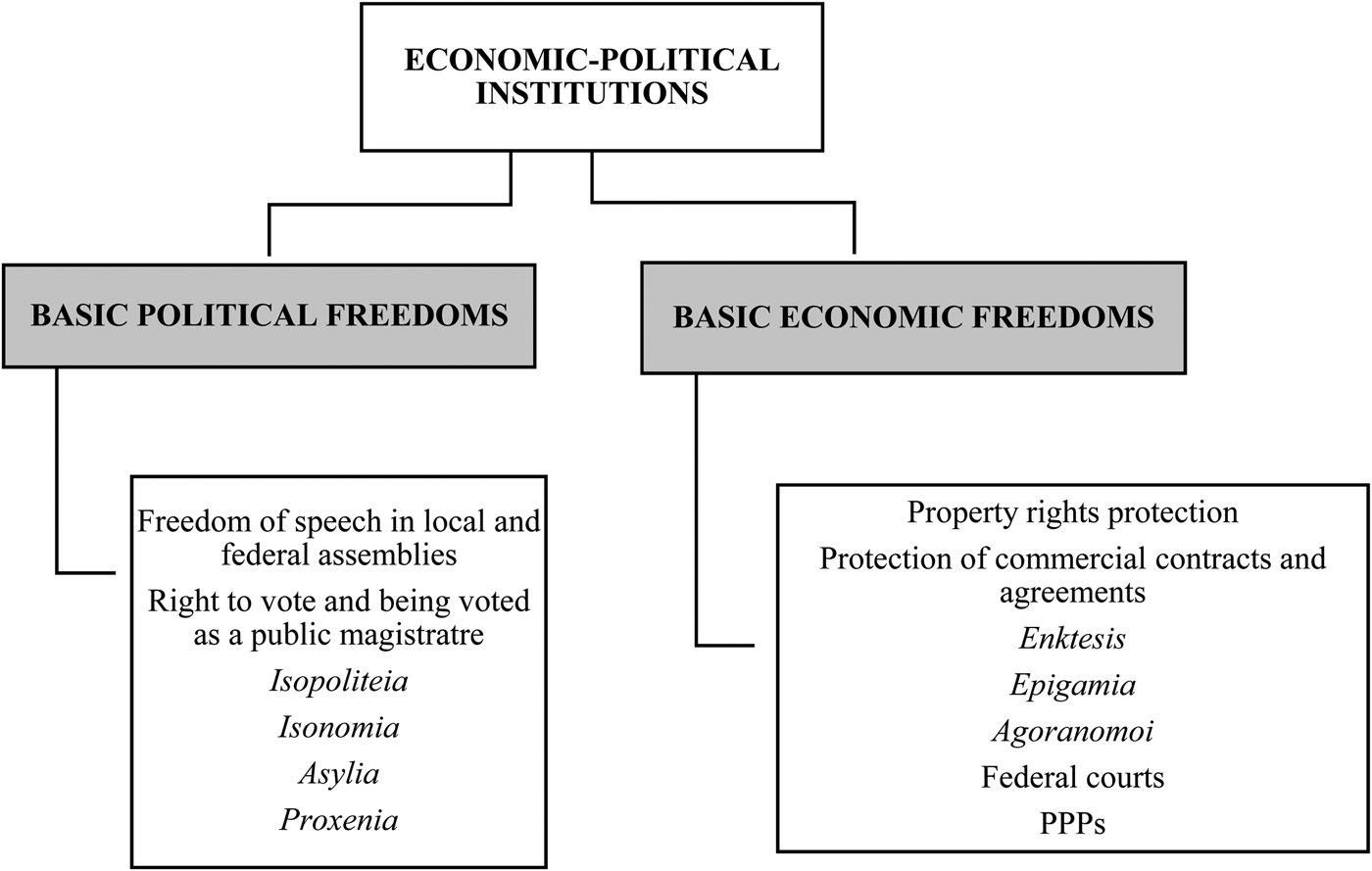
Thus, these PPPs would not have been possible without the drawing up of elaborate contracts, specifying the obligations of each party, which again would not have been possible without strong property rights. Obviously, no investor would risk substantial capital in PPPs if he was not convinced that the public side would fulfil its obligation of the contract. Figure 1 describes the basic political and economic institutions that were practised, which lay behind the success of ancient Greek federalism.
The main political and economic institutions of ancient Greek democratic federations

4. Ptolemaic Egypt
Ptolemaic Egypt was the longest enduring of the Hellenistic kingdoms, established by Alexander the Great's successors. It lasted from about 305 bce, when Ptolemy I, one of Alexander's generals, gained power in Egypt, to 30 bce, when the last Ptolemaic queen, Cleopatra VII Philopator, committed suicide after her and Marc Anthony's defeat at Actium, in 31 bce. Egypt then became a Roman province.
The Ptolemies ruled over an ethnically mixed society but there were mainly two cultural groups concerned: the Graeco-Macedonian settler class (some 10% of the total population), and the native Egyptians, perhaps at least 7 million in number (Davies, Reference Davies, Walbank, Austin, Frederiksen and Ogilvie2008: 264). Ptolemy I Soter and his descendants ruled as traditional Pharaohs, preserving many of the traditional institutions of pharaonic Egypt (temples and priesthoods, regional government, the agricultural system), combined with a new Greek-style fiscal regime lightly overlaid on top (Thonemann, Reference Thonemann2016: 29; Von Reden, Reference Von Reden2010).
The status of property rights to land tenure
According to older beliefs, the Ptolemaic Kingdom was a strong, centralised state ruled by a small minority of Greeks dominated by the military class, with an extensive bureaucracy that combined elements of state control in commercial activity (Preaux, Reference Preaux1939; Rostovtzeff, Reference Rostovtzeff1941) and mercantilism (Walbank, Reference Walbank1993) since kings attempted to collect large quantities of precious metals and, more precisely, to accumulate gold. However, modern scholars have revisited many of these theses. Egypt's economy underwent numerous radical changes during the Ptolemaic period, including the introduction of Egypt's first official coinage, the cultivation of new crops and the growth of international trade. Since the reign of Ptolemy I the kingdom started minting coins that were roughly equivalent to the Greek standards of the drachma and its denominations, the obol and the chalkous (Von Reden, Reference Von Reden2010).
Manning (Reference Manning2003: 219) adds that the Ptolemaic Kingdom was not an example of a strongly centralised state in the traditional sense of the term since the series of new institutions of taxation and the supervision of economic activity that were practised by the regime (we analyse some of them below) were mostly locally organised and close-knit social groups, and this was probably the norm. Thus, for Manning (ibid.: 228), it was actually the power of local social networks organised around the diffused economic structures of the ‘customary’ economy that was decisive in the development of the Ptolemaic state, in combination with the ability of the local elite to adapt to the new conditions. What is important is that these local elites were not only Greeks but also Egyptians as well as others, and this is documented in the private archives that have been found in numerous papyri.
A large portion of farmland belonged to the king, who leased it to agricultural workers, the free Egyptian tenant farmers, to be cultivated, and as compensation they received a significant portion of this produce (Manning, Reference Manning2003: 50). However, land could also be obtained by those individuals who provided military services to the kingdom (mostly Greeks). In compensation for military service the Ptolemaic kings provided them either with wages paid with coinage minted in royal mints (imitations of the Athenian currency) extracted from precious metals like gold, silver, and copper, or by granting them (royal) land, from 15 to 200 acres. The Ptolemaic kings settled Macedonian-Greek soldiers on royal land in order to retain a loyal fighting force. The land (‘kleros’) was given according to rank, 100 aroura Footnote 6 for cavalrymen, 30 for infantrymen, and even smaller plots of land, 25 and 20 arouras were possible. The owners were called klerouchoi and were predominantly Greeks, but could be also Thracians, Cyrenians and Hellenised Egyptians whose sons inherited their status and received ‘gift-estates’ of their own upon entering military service. This means that the privileges of a klerouchos could also be obtained by Egyptians, at least to some (small) extent. Thus, this granting of land, which started as leases, evolved into hereditary tenure, leaving Greeks in a better position on the land than their Egyptian counterparts (Davies, Reference Davies, Walbank, Austin, Frederiksen and Ogilvie2008: 266; Manning, Reference Manning2003: 56).
It is obvious that these were very generous grants of land: in order to be cultivated effectively, the soldiers had to either hire servants (mostly local Egyptians) to work the land, or buy slaves, or else a combination of the two. This is more or less similar to the case of medieval European knights who provided military services and received land as compensation from the local baron or duke, etc. According to Walbank (Reference Walbank1993), this royal strategy was better than paying wages to soldiers since paying wages was extremely costly.
Furthermore, part of the land belonged to local temples (as in Karnak, Edfu and Kom Ombo) and the local aristocracy. This local aristocracy comprised not only Greeks but native Egyptians too and, according to Manning (Reference Manning2003: 6), this is well documented in the private archives and they are an important reminder ‘that we can no longer divide the Hellenistic world into Greek colonizers and native oppressed’. The Ptolemies inherited temple-administered estates from previous periods. Traditionally, the temples leased out the land on short-term leases to cultivators, mainly native Egyptians. Soldier-owners of the land also followed this practice, presumably especially during periods when they were called to serve in the army in times of war. Thus property that belonged to the temples made up another large category of land. Temples managed land and owned large estates that supported their expenses through agricultural output. Temples, at least the larger ones, were historically part of the state, controlled by the king, though they could also be held privately by independent actors (Manning, Reference Manning2003: 68, 71, Reference Manning2004: 762).
According to Davies (Reference Davies, Walbank, Austin, Frederiksen and Ogilvie2008: 301–302) Ptolemaic kings had a range of policy choices available to them concerning the status of property rights: (1) they could leave traditional landholdings much as they were; (2) they could abrogate traditional landholdings in order to limit the power of other holders and to maximise their own, or (3) they could confer part of their own holdings on others. Case (2) could only be exercised by a king in a very strong position vis-à-vis his subjects, such as Alexander the Great. Case (3) means that in order to maintain order to patronage relationships with the local (mainly Greek) aristocracy and soldiers, land already in royal hands could be transferred as a gift, a procedure called dorea. Doreai (plural) were offered, in hierarchical order, to individuals in the royal family; the court; the administrative hierarchy; other persons of influence and prestige with a claim on the king's goodwill; individuals or groups; and temples.
This is proof that although the status of property rights protection was based on the king's decision, in practice every king had to reassign some land to his hierarchical inferiors since, according to Davies (Reference Davies, Walbank, Austin, Frederiksen and Ogilvie2008: 303), this was the only way to attract and retain men for the army and the administration and was also the best way of rewarding loyalty.
Τhe first important deduction up to this point is that land did not just belong only to the king but also to individuals, a view that is consistent with Manning (Reference Manning2003, Reference Manning2004) and Turner (Reference Turner, Walbank, Astin, Frederiksen and Ogilvie2008: 143, 146). Apart from the king, the aristocracy, the temples and the (mainly Greek) klerouchoi, the majority of the Egyptian population were tenant farmers who lived and worked on rented or leased plots of land that belonged either to the crown, or to estate holders or temples. Tenant farmers were provided with farming equipment by their employers and loaned seed such as in Fayyum (Manning, Reference Manning2003: 124).
Furthermore, newer evidence discovered in a significant number of papyri found in the Nile valley, in the Thebaid and elsewhere, proves that private land could also be held by Egyptian farmers. According to Manning (ibid.: 14, 54, 227), small family holdings were also widespread and were farmed from one generation to another. These were passed on informally and this type of land was probably classed as idioktitos, which clearly means privately held. The private holding of land could be grain land, but most often it was a small garden and vineyard plots. Thus, contrary to popular belief, private landowning did exist in Ptolemaic Egypt and is especially well attested in Upper Egypt. This is important since it means that at least a portion of the Egyptian population had the opportunity to hold private property or to mortgage their property (ibid.: 13). This further means that, alternatively, the landowners had the right to sell their land to someone else if they wished to do so.
According to Preaux (Reference Preaux1939: 131–133) the total amount of the proceeds that the king had the right to demand approached half the annual produce of the Egyptian farmers, a very high amount of produce. Due to this, the overall procedure could be seen as a merciless exploitation of tenants by the crown (meaning also that the tenants bore the full risk of bad harvests, and various other small charges for transportation, repayment of seed loans, etc.). More specifically, Manning (Reference Manning2003: 56) argues that there were two principal procedures regarding the king's share of the tenant's produce: the king had the right to demand a share of the crop, proportional to the output produced, as well as a share of the proceeds. The tenants paid a fixed rent (‘ekphorion’) for the entire plot according to its assessed value unless it was classed as hypologos, meaning that a share of the proceeds should be incorporated in the payment to the king.
However, it appears that this was not a fixed procedure that was followed everywhere. There appears to be a difference between Upper and Lower Egypt. For example, in the Thebaid, the tax on productive grain land held by temples and by individuals was collected as a percentage of the annual produce (Manning, Reference Manning2003: 59–60). This meant that if the annual produce was lower due, for example, to a bad harvest, the tax was adjusted accordingly downwards. Obviously, this was a procedure that at least alleviated the position of farmers to some degree, since it linked the tax not with a predetermined amount of money but with the actual harvesting of the annual crop, and this obviously constituted a fairer procedure.
As a final comment, due to the lack of cliometric data, any attempt to determine the degree of improvement of the socioeconomic position of both peasants and tenants during that era is rather difficult to make, thus the issue still remains open among (economic) historians. However, what is for sure is that property rights were increasingly enforced in the course of the Ptolemaic period. On this, in accordance with Vandorpe (Reference Vandorpe2000) and Manning (Reference Manning, Scheidel, Morris and Seller2007), Von Reden (Reference Von Reden2010: 105) writes that not only are the forms of land holdings on Egyptian temple estates nowadays regarded as nearly private, but klerouchic property rights also became increasingly stable as well as inheritable in the course of the 300 years of Ptolemaic rule.
Economic institutions that are related to property rights protection
Royal and private landed property, as well as the property of the temples, was protected by law. An ancient inscription such as P. Petrie, 104, Selected Papyri no. 392 (reproduced by Walbank, Reference Walbank1993: 107) attests the existence of a post termed the syggraphophylax, which was responsible for the upkeep of land contracts. Unfortunately, this inscription does not reveal further evidence, and this raises the following question: Does the inscription refer to a local city syggraphophylax, or to a general (royal) one? Since we can only guess regarding this matter, we think that what is more important is the verified existence of an institution with duties that were similar to those of a modern land registry and notary. If this specific inscription refers to a local syggraphophylax, this, as a logical consequence, means that in all probability there was also a central royal land registry office that either held all the archives of land contracts, or, alternatively, supervised local land registries.
Walbank (Reference Walbank1993) in general, based on a multitude of papyri that have been found, further refers to various cases that are related to payment orders, contracts and prices of offering contracts, rent payment orders and receipts. As to the latter, we can draw some information on property rights from the existence of land measurement receipts, which were necessary as a basis for taxation. These receipts helped to protect individual taxpayers by clearly establishing their obligations in writing. There is a wide range of extant tax receipts that cover not only land taxes, but also some additional ones, such as a salt tax (Manning, Reference Manning2003, Reference Manning, Scheidel, Morris and Seller2007: 447). The combination of land measurement and written tax receipts established clear property rights. Each individual farmer (some were ex-Macedonian soldiers who had been granted land) knew exactly the extent of his holding, which had been measured by state agents. Thus, he had a state guarantee of his property, on which he paid taxes. Tax receipts can be seen as a further guarantee of property, since they protected the owner against attempts, perhaps by local administrators, to extract more.
A series of public servants were responsible for the supervision and collection of taxes. In each area of regional administration (called nome) the kings appointed a series of dioiketai, literally meaning high-ranking provincial administrator-governors, all of whom had an officer under their authority called oikonomos, whose duties were to supervise the smooth collection of taxes while simultaneously effectively confronting any cases of tax evasion. In the pyramid of administration, under the oikonomos, were the scribal staff and the royal scribe (basilikos grammateus) and his subordinates, the topogrammateus and komogrammateus, who kept the records, among the most important of which were the survey and registration of land (Turner, Reference Turner, Walbank, Astin, Frederiksen and Ogilvie2008: 146–147; Walbank, Reference Walbank1993: 104–105).
Under them were the logistai, and eklogistai, the tax collectors, auditors and checking clerks. Turner (Reference Turner, Walbank, Astin, Frederiksen and Ogilvie2008: 152) implies that these officials were either civil servants or private individuals under contract, since tax farming evolved in ancient Greece. Tax farmers bid at auctions each year for the right to collect a particular tax in an area (Manning, Reference Manning2003: 51). Some other related posts included surveyors, law officers, etc. These posts were also related to the so-called ‘Revenue Laws’ of King Ptolemy II Philadelphos (who ruled during 283–246 bce), an economic system designed to maximise production on land. Twenty-four such laws have been specified by name (Turner, Reference Turner, Walbank, Astin, Frederiksen and Ogilvie2008: 143, 146).
The state established an effective mechanism of royal granaries for the collection of grain. Grain taxes were usually paid at state granaries throughout the year and a receipt was issued and countersigned by state officials for the taxpayer. This method of payment applied to Upper Egypt as well as the Fayyum. The taxes were paid after the harvest by the end of the regnal year and transported to the royal granary by the taxpayer. Manning argues that this practice was implemented to protect taxpayers from overzealous tax collectors. In general, except for royal granaries, the state collected taxes through royal banks (Manning, Reference Manning2003: 59, 67, 100, Reference Manning, Scheidel, Morris and Seller2007: 435, 445–446). According to Manning (ibid., 57) and Harris (Reference Harris2008), during the reign of Ptolemy I (305–284 bce), state depositories and banks replaced temples as the location of money deposits from taxation.
Furthermore, royal cultivators called basilikoi georgoi existed as well. They were mostly Egyptian peasants who cultivated a series of products such as corn. After the harvest the corn was thrashed on the public threshing floor under the eye of both cultivators and royal officers. The king claimed his due proportion, the cultivator retained the rest. It was the principal sustenance for himself and his family till the next year. Then the produce was gathered and stored temporarily in royal barns supervised by sitologoi, then transported on donkey and mule back to the nearest river harbour by a guild of transporters. At the harbour it was loaded onto a river boat. Often this was chartered by a private contractor from a company that invested in such boats. If the charterer was not himself a captain, the ship would sail under an Egyptian skipper to Rhacotis if it were to go down river, or it would go up river to the garrison at Syene, or indeed the produce, such as corn, would be distributed en route.
In other words, this meant that royal commodities such as corn were transported by privately owned vessels. Investors in such boats often turned out to be highly placed officials, Queen Berenice II (who lived between 267/6–221) being one of them. At each transfer, receipts were exchanged, so as to clarify responsibility if the quantity was shorter than expected when the corn reached its destination. Such a precaution was necessary since pilfering of goods in transport was common. According to Thonemann (Reference Thonemann2016: 31), the tax revenues of the Nile valley and the Fayyum fuelled the explosive growth of the new Ptolemaic capital of Alexandria, the New York of the Hellenistic world. Invoices of produce sent to Alexandria, which included, among others, fruit, fish and wine, denote this commercial activity (Turner, Reference Turner, Walbank, Astin, Frederiksen and Ogilvie2008: 150–151).
The existence of receipts and invoices is a strong indication that commercial transactions with binding outcomes were taking place, a basic prerequisite for a functional, established regime of property rights protection. Also the existence of private contractors of transportation companies could only flourish if an established institutional system of property rights protection backed by law could guarantee the legitimacy of these transactions.
In addition, there were royal courts with competence to resolve differences of economic content between Greeks and Egyptians called koinodikia. There were also Egyptian courts (laokritai), which decided legal cases exclusively between Egyptians, and Greek courts (chrematistai), which decided litigation between Greeks, and there was a certain series of laws through which they were obliged to perform justice, called prostagmata. Sometimes either the Egyptians or the Greeks complained that they had been wronged by justice because of their origin. However, although such phenomena possibly existed, Walbank (Reference Walbank1993) and Manning (Reference Manning2003: 53) believe that they were not the general rule and in fact, both Egyptians and Greeks managed to achieve a satisfactory modus vivendi that was related to their socio-economic coexistence in the Egyptian land.
Finally, another important institution is attested during the Ptolemaic period: the public auction as a method of assigning property rights to derelict or ownerless land. This again demonstrates the existence of strong, state-protected property rights. In the case of a public auction, the owner, the state, transferred its ownership of land through contracts to the highest bidder, in more or less the same way as it is done today (Manning, Reference Manning2003: 452).
5. Conclusion
What is important from the point of view of property rights is that their development took place not only in democratic city-states and federations but also in kingdoms. For democratic city-states and federations, the existence and safeguarding of property rights, under the aspect of isonomia (equality before the law), seems obvious. This had been achieved already in democracies during the Classical period. An important development during the Hellenistic period in the federal states was the extension and transfer of property rights within the federation and between participant city-states, such as the right of citizens in the federation to buy and own land in any city-state. This was an early manifestation of one of today's main economic freedoms, the free circulation of goods, capital and labour.
What is somewhat less obvious is that property rights existed and were guaranteed through contracts in authoritarian and centralised kingdoms like Ptolemaic Egypt as well. We suggest that this was because property rights make the signing of contracts easier, reducing transaction costs. The existence of clearly defined property rights facilitated the collection of state revenues through taxation, auctions, etc., so that property rights favoured both the state and the private owners. Further, property rights were necessary to guarantee the loyalty both of the Macedonian soldiers, the core of the Ptolemaic armies, and strong native elements, such as the temples dedicated to Egyptian gods. In the end, the guarantee of property rights helped to ensure the longevity of the Ptolemaic Dynasty (the longest of the Hellenistic kingdoms) which lasted almost three centuries.
Our main conclusion is that the evolution of property rights was strongly related to the development of new economic institutions from the Classical to the Hellenistic period (508–146 bce). The new economic institutions such as banking, insurance and market mechanisms that led to the significant rise of commercial activity and economic growth during the Classical period (Ober, Reference Ober2015; Tridimas, Reference Tridimas2018) made the development of property rights a necessary prerequisite. Furthermore, this evolution of market economy institutions went hand in hand with political liberalism through the development of direct democracy. This environment was further strengthened due to what Hodgson (Reference Hodgson2015a) characterises as the constitutive role of law and the state. Thus, the evolution of property rights in ancient Greece corroborates the pivotal interconnection between the free market economy and political liberalism, of which many prominent scholars such as F. Hayek (Reference Hayek1981) argued in favour.
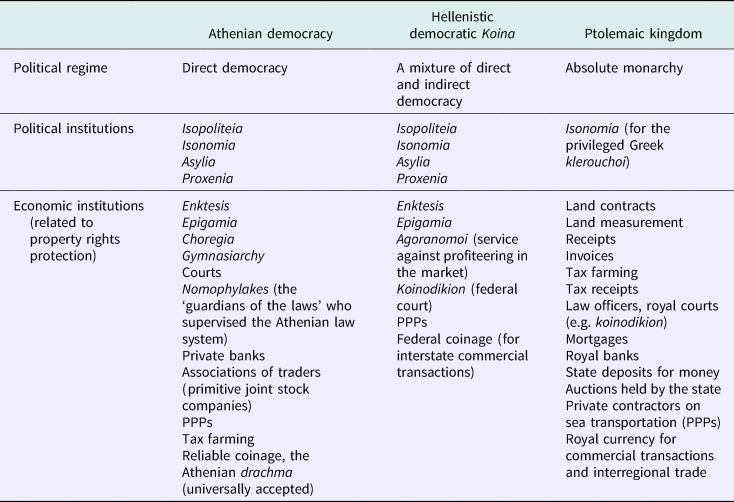
Table 1 is based on the above analysis and provides a catalogue of political and economic institutions that it is verified were practised by Athens, the democratic federations and the Ptolemaic Kingdom, during the Hellenistic period. As Table 1 shows in column 4, many market economy institutions such as commercial contracts, leasing of land and mortgages were also practised in the Ptolemaic Kingdom. Our explanation is that these economic institutions that had previously been developed in ‘liberal’ democracies such as Athens and the democratic federations were finally ‘diffused’, in a dynamic process, to the Greco-Macedonian states such as the Ptolemaic Kingdom by the economic unification of the entire region through Alexander the Great's conquest. This occurred mainly because the economic administrators of the Ptolemaic Kingdom realised that these institutions were superior in terms of economic efficiency to the previously established economic order.
The economic institutions in Hellenistic Athens, the Koina and Ptolemaic Egypt
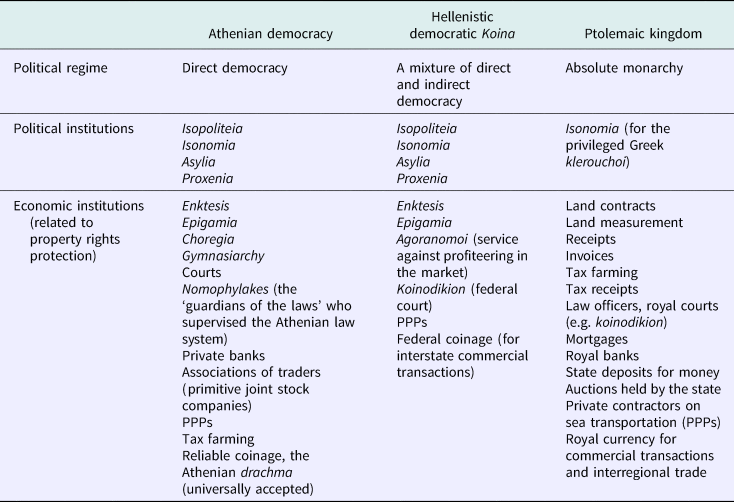
Notes:
Isopoliteia: interstate political rights between different city-states
Isonomia: equality of all citizens before the law
Enktesis: ownership (of land and houses) in one member city-state by a citizen in another
Epigamia: the right of intermarriage
Asylia: exemption from reprisals between city-states
Proxenia: An arrangement whereby a citizen (chosen by the city) hosted foreign ambassadors at his own expense, in return for honorary titles from the state
Choregia: Festival financing through the institution of ‘liturgies’, a very special type of taxation and service levied on rich Athenians
Gymnasiarchy: Expenditure on the operation and maintenance of public fitness centres
This causality, between the evolution of property rights on the one hand and the parallel development of free market economic institutions and political liberalism that finally leads to democracy on the other, has been proved with many later pivotal historical cases, such as the rise of the United Provinces and England since the Glorious Revolution of 1688 and afterwards (Hodgson, Reference Hodgson2017) and with today's USA and the EU. Thus, this causal intertemporal relationship is also confirmed through case studies of Classical (Economou and Kyriazis, Reference Economou and Kyriazis2017) and Hellenistic Greece, as the overall above analysis proves.
Acknowledgements
The authors wish to thank the editor and the anonymous reviewers for their valuable comments and suggestions, which have led to the significant improvement of this work.