Introduction
Myanmar is the largest country in continental Southeast Asia, spanning c.20 degrees of latitude and encompassing 14 terrestrial ecoregions (Olson et al., Reference Olson, Dinerstein, Wikramanayake, Burgess, Powell, Underwood, D’Amico, Itoua, Strand, Morrison, Loucks, Allnutt, Ricketts, Kura, Lamoreux, Wettengel, Hedao and Kassem2001), resulting in a great diversity of habitats and an equally rich flora. Although new species continue to be documented, particularly from northern Kachin State (e.g. Yang et al., Reference Yang, Ding, Zhou, Zhu, Li, Maw, Tan, X.-H., Y.-M., Y.-H. and M.2017; Ding et al., Reference Ding, Bin, Zhou, Li, Maw, Kyaw, Tan, X.-H., Y.-M., Y.-H. and M.2018; Tan et al., Reference Tan, Li, Zhou, Chen, Bramley, Li, X.-H., Y.-M., Y.-H. and M.2018), the flora is still relatively poorly known (Hundley & Chit Ko Ko, Reference Hundley and Chit Ko Ko1961; Frodin, Reference Frodin2001). This research is part of an ongoing collaboration between the New York Botanical Garden, the Royal Botanic Garden Edinburgh and the Myanmar Forest Research Institute to document the flora of northern Myanmar.
During a 2001 expedition by the third author, a new lanceolate-leaved Begonia species was noticed (but not collected) growing in a seasonal stream bed between Sinlumdan and Nam Ti, on the Babulongtan mountain trail (at c.27.41°N, 97.62°E). Five subsequent expeditions were made to the region, but this species was not found again until it was collected in approximately the same locality during a June 2017 expedition to the buffer zone of Hkakaborazi National Park (Armstrong 3041 [E, K, NY]). This specimen matched six previous collections from the same area (Toppin 4264 [K]; Kingdon-Ward 5561 [E], 6633 [K], 7355 [K], 9067 [BM(2), NY], 13567 [BM]), some of which were listed as doubtful records of Begonia rhoephila Ridl. from Myanmar in Hughes (Reference Hughes2008), where it is stated, “There are no records of B. rhoephila between northern Myanmar and Selangor in Peninsular Malaysia, to which Kiew (Reference Kiew2005) records it as endemic. Whilst there is a gross similarity of the Burmese specimens to B. rhoephila, they differ in having longer petioles, longer internodes, the occasional appearance of caulescent stems and the presence of curled, fleshy hairs on the veins on the underside of the leaves”.
Since the first checklist for Myanmar listed 57 species of Begonia (Hughes, Reference Hughes2008), several new species and records have been published: B. difformis (Irmsch.) W.C.Leong, C.-I Peng & K.-F.Chung (Leong et al., Reference Leong, Deng, Sun, Peng and Chung2015), B. discreta Craib (Kang et al., Reference Kang, Kyaw, Jung, Shin, Kim and Ong2018), B. foveolata Irmsch. (omitted from Hughes, Reference Hughes2008, in error, as the type is from Yangon [‘Rangoon’]) (Irmscher, Reference Irmscher1959), B. hayamiana Nob. Tanaka (Tanaka & Hughes, Reference Tanaka and Hughes2007), B. hymenophylla Gagnep. (Hughes et al., Reference Hughes, Girmansyah and Ardi2015–), B. kachinensis Nob. Tanaka (Tanaka & Hayami, Reference Tanaka and Hayami2011), B. lushaiensis C.E.C.Fisch. (reinstated from synonymy with B. modestiflora Kurz by Camfield & Hughes, Reference Camfield and Hughes2018), B. macrotoma Irmsch. (Hughes et al., Reference Hughes, Girmansyah and Ardi2015–), B. mariachristinae Wahlsteen (Wahlsteen, Reference Wahlsteen2018), B. minicarpa H.Hara (Hughes et al., Reference Hughes, Girmansyah and Ardi2015–), B. myanmarica C.-I Peng & Y.D.Kim (Tseng et al., Reference Tseng, Kim, Peng, Htwe, Cho, Kono and Chung2017), B. siamensis Gagnep., B. soluta Craib (Kang et al., Reference Kang, Kyaw, Jung, Shin, Kim and Ong2018), B. tenasserimensis Phutthai & M.Hughes (Phutthai & Hughes, Reference Phutthai and Hughes2017), B. togashii Nob. Tanaka & C.-I Peng (Tanaka & Peng, Reference Tanaka and Peng2016) and B. wui-senioris C.-I Peng (a valid name for the taxon B. lacei ined. (Peng et al., Reference Peng, Wang, Kono and Yang2014). The record for Begonia oreodoxa Chun & F.Chun ex C.Y.Wu & T.C.Ku from Myanmar in Hughes (Reference Hughes2008) is probably an error, and we also consider the record of B. incerta Craib in Kang et al. (Reference Kang, Kyaw, Jung, Shin, Kim and Ong2018) to be a misidentification (T. Phutthai, Mahidol University, personal communication). The specimens listed above do not match any of the species currently known from Myanmar, and they also differ from Begonia rhoephila from Malaysia; given the remarkable dispersal limitation and narrow endemism of most Begonia species (Hughes & Hollingsworth, Reference Hughes and Hollingsworth2008), the occurrence of this tropical species in the mountains of northern Myanmar is very unlikely.
Here we describe the new species Begonia rheophytica, bringing the total number of Begonia species known from Myanmar to 73 (listed in the Appendix). The new species belongs in Begonia sect. Platycentrum (Klotzsch) A.DC., as it has fruit with one enlarged wing, and anthers with extended connectives (Doorenbos et al., Reference Doorenbos, Sosef and De Wilde1998; Moonlight et al., Reference Moonlight, Ardi, Arroyo Padilla, Chung, Fuller, Girmansyah, Hollands, Jara-Muñoz, Kiew, Mahardika, Marasinghe, Leong, Liu, O’Connor, Peng, Pérez, Phutthai, Pullan, Rajbhandary, Reynel, Rubite, Sang, Scherberich, Shui, Tebbitt, Thomas, Wilson, Zaini and Hughes2018). We compare our specimens with two other species in Begonia sect. Platycentrum, namely B. caobangensis C.-I Peng & C.W.Lin from Vietnam (Peng et al., Reference Peng, Lin, Yang, Kono and Nguyen2015) and B. yingjiangensis S.H.Huang from Yunnan, China (Shui & Huang, Reference Shui and Huang1999), which have a similar leaf shape and a closer geographical range.
Taxonomic Treatment
Begonia rheophytica M.Hughes, sp. nov. § Platycentrum. – Type: Myanmar. Hills east of the Mali Hka, 2000–3000 ft, xii 1930, Kingdon-Ward 9067 (holo BM [BM000896328]; iso BM [BM000896327], NY [02652766]). Figs 1, 2.
Differs from Begonia caobangensis C.-I Peng & C.W.Lin in having narrower leaves (2–2.5 cm wide, not 3.9–7.3 cm) without winged petioles (versus petioles slightly winged), with the petioles having longer erect hairs (not minutely appressed tomentose to glabrous), and fruits without fleshy bristles at the apex of the wings.
Differs from Begonia rhoephila Ridl. in having shorter, curled hairs on the petioles (not erect, straight hairs), having glabrous bracts and stipules (not bracts with short hairs and stipules with hairs along the keel), and sometimes cauline leaves subtending the inflorescence (not inflorescence always arising directly from the rhizome).
Differs from Begonia yingjiangensis S.H.Huang in having smaller leaves (9–13 × 2–2.5 cm, not 22–29.5 × 5–7.5 cm), with a broadly denticulate margin (not subentire and slightly repand).
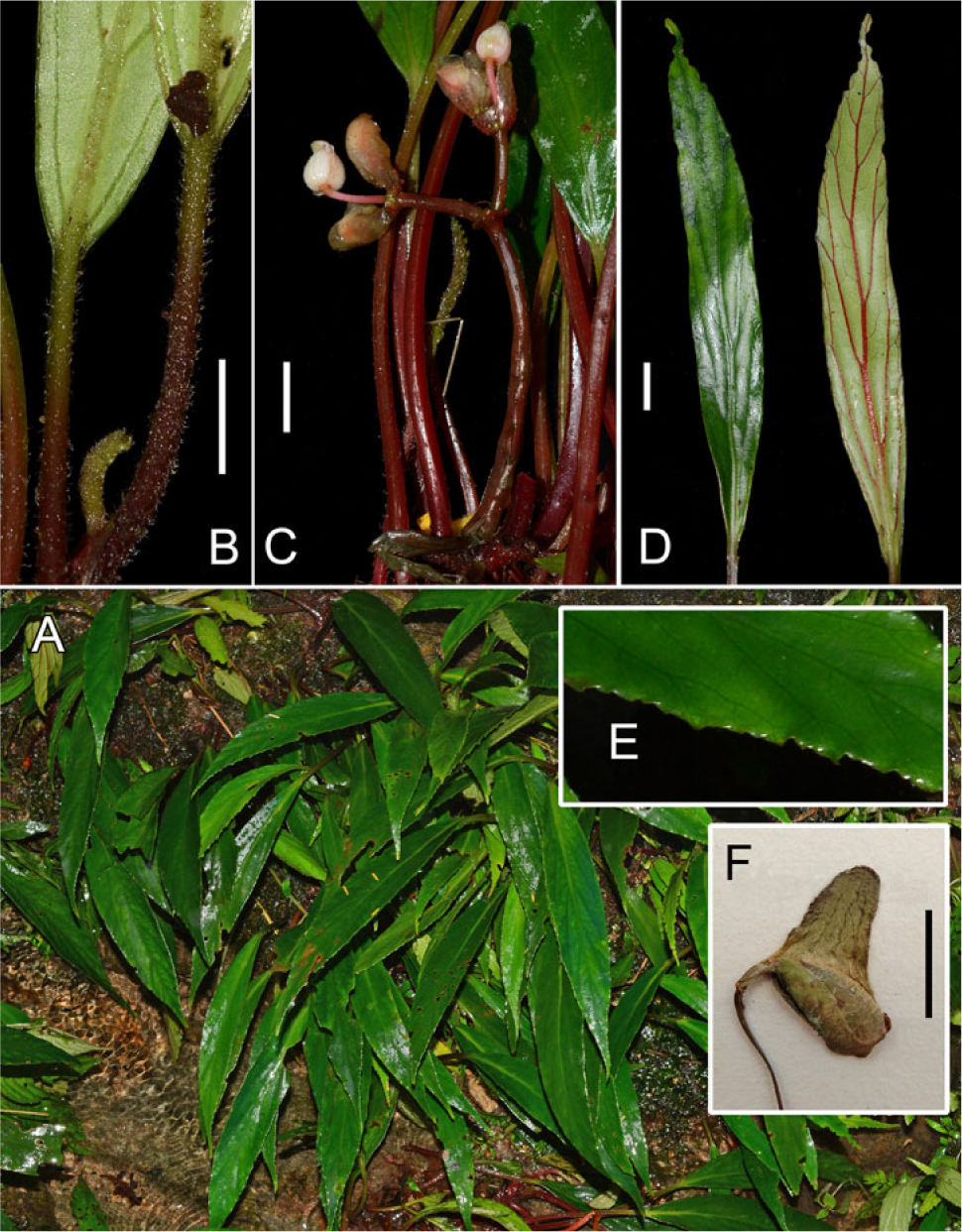
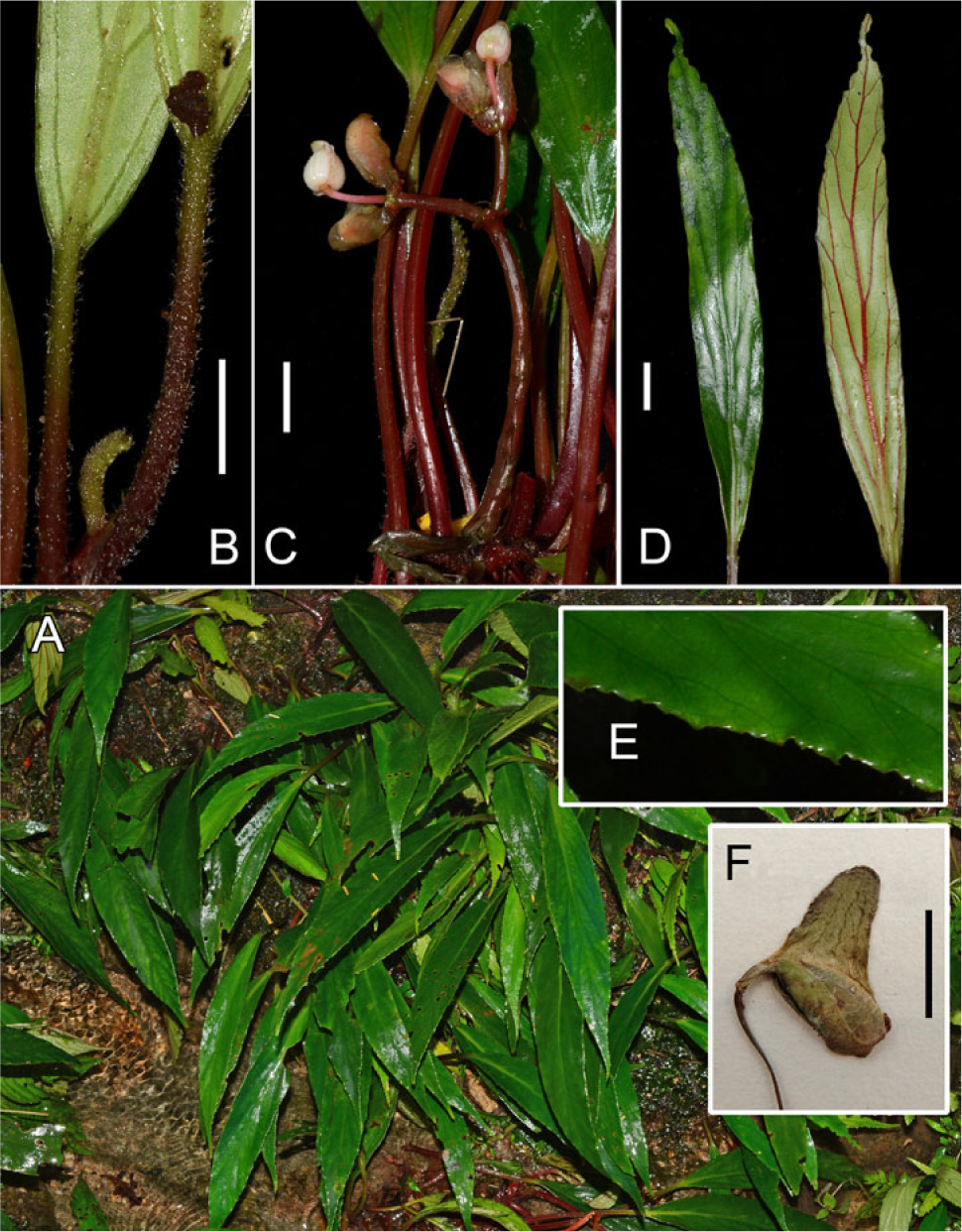
Rheophytic herb. Stem rhizomatous, c.5 mm wide when dry, internodes usually 2–5 mm long, sometimes extending to c.7 cm long on the apical flowering portion of the plant. Stipules 15 × 5 mm, glabrous, keeled, triangular, cuspidate, tip extending 2 mm. Leaves: petiole 4.5–10 cm long, slightly grooved or flattened adaxially, giving a D-shaped cross-section, c.1.5 mm wide when dry, with sparse to dense short, thin curly hairs on the abaxial side of the petiole, the adaxial side being glabrous; lamina coriaceous (‘rather thick and leathery’, Ward 5561), 9–13 × 2–2.5 cm, elongate lanceolate, symmetrical, base cuneate, tip acute, glabrous above, with short, thin curly hairs on the main veins only beneath, venation pinnate with c.8 pairs of alternate veins, margin broadly denticulate. Inflorescence axillary, cymose, usually arising from the rhizome, sometimes arising from the axil of an elongated apical portion of the stem and possessing cauline leaves, primary peduncle (5–)10–14 cm long, secondary up to 5 cm long, with up to c.7 flowers; bracts glabrous: first pair subtending the first branching of the inflorescence fused together forming a cup c.10 mm long, subsequent bracts not fused, ovate-lanceolate, c.6 mm long, smaller towards the terminal dichotomy. Male flowers: pedicel c.10 mm long, glabrous; tepals 4, glabrous, white or white suffused with pink, outer pair c.15 × 9 mm, inner pair c.12 × 5 mm; androecium with c.100 stamens on a short column, filaments c.1.5 mm long, anther c.1.5 mm long, oblong, connective extended, rounded in basal anthers and acute in apical anthers, slits lateral, extending most of the length of the anther. Female flowers unknown. Fruit borne in pairs, 2-locular, recurved, glabrous, upper wings rectangular, c.5 × 9 mm, forming a splash cup, lower wing rounded triangular, c.11 × 8 mm.
Begonia rheophytica M.Hughes, sp. nov. A, Habit in the field (note water level at the base of the image); B, abaxial surface of petiole, showing short curled hairs; C, inflorescence; D, adaxial (left) and abaxial (right) leaf surface; E, lamina margin; F, unripe fruit. A–E, Armstrong et al. 3041; F, Kingdon-Ward 13567. All scale bars, 1 cm.
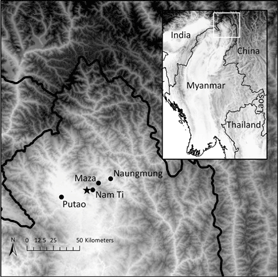
Distribution of Begonia rheophytica M.Hughes (star) in northern Myanmar, with adjacent towns highlighted for reference (circles).

Additional specimens examined. Myanmar. Kachin State: Putao District, Machanbaw Township, buffer zone of Hkakaborazi National Park, along trail between Nam Ti and Sinlundam, 798 m, 20 vi 2017, Armstrong 3041 with Thet Yu Nwe, Moe Myint Thu, San Naing Dee, Zaw Naing Tun, Hla Naing Htay, Pa Rang Gang Ken Sar (E, NY [02654022], RAF); Kachin Hills, Toppin 4264 (K); Nam Ti, 16 xi 1922, Kingdon-Ward 5561 (E [00300496]); Nam Ti, 2000 ft, 18 iv 1926, Kingdon-Ward 6633 (K); Mountains E of Fort Hertz, 3000 ft, 9 ix 1926, Kingdon-Ward 7355 (K); Hills east of Putao, 3000 ft, 10 xii 1937, Kingdon-Ward 13567 (BM).
Distribution and ecology. Forms large colonies on boulders in streams, a narrow endemic to Nam Ti in the north of Kachin State, Myanmar, at c.600–1200 m elevation (Fig. 2). Kingdon-Ward noted (Kingdon-Ward 7355 [K]) that the plant is ‘found on wet moss covered rocks in jungle torrents. The plant is liable to be more or less submerged during the summer rise’; ‘In massive clumps on stones in perennial streams, now uncovered, but submerged in the rainy season. Only seen in two streams where is was fairly abundant’ (Kingdon-Ward 9067 [BM]).
Etymology. Named after the rheophytic habit of the species (rheo-, pertaining to flowing water [Greek]).
Proposed IUCN conservation status. The only known locality is currently outside the core of the Hkakaborazi National Park. The area is potentially vulnerable to encroachment in the next decade or so, as slash-and-burn agriculture moves further up the mountain. Therefore, we consider a placement in the Vulnerable category under VU D2 (IUCN, 2017) to be appropriate, although a successful outcome for the proposed UNESCO World Heritage Site status for the area would improve the outlook for the species and necessitate a reconsideration of this category.
Discussion
The initial confusion of Begonia rheophytica with B. rhoephila and the similarity of the new species to the geographically close B. caobangensis and B. yingjiangensis are probably due to their similar rheophytic ecology and the associated adaptations of a rhizomatous habit and sturdy elongate leaves with a cuneate base. This growth form is found in four other species of Begonia from further south in the Malesian region, namely B. abdullahpieei Kiew (Perak, Peninsular Malaysia), B. fluvialis M.Hughes (West Sumatra, Indonesia), B. lilliputana M.Hughes (Aceh, Indonesia) and B. rhoephila (Selangor, Peninsular Malaysia) (Kiew, Reference Kiew2005; Hughes et al., Reference Hughes, Girmansyah and Ardi2015). Begonia rhyacophila Kiew is also found in a torrent habitat but has ovate leaves with a cordate base; however, Kiew (Reference Kiew2005) notes that in times of flood, plants would be exposed to the full force of the waterfall torrents. There is no indication that these species form a natural group (Begonia fluvialis and B. lilliputana are in Begonia sect. Jackia, with the others all in Begonia sect. Platycentrum), suggesting a repeated evolution of a similar leaf shape.
Kingdon-Ward made five expeditions (described in Kingdon-Ward, Reference Kingdon-Ward1921, Reference Kingdon-Ward1924, Reference Kingdon-Ward1930, Reference Kingdon-Ward1949) to the areas north and east of Putao, but he collected Begonia rheophytica in only one place, noting it to be ‘apparently local’. His successive specimen labels state the following: Kingdon-Ward 5561 (16 xi 1922): ‘in the stream beds around the Nam Ti’; Kingdon-Ward 6633 (18 iv 1926): ‘This species I saw, and probably collected in flower at the same spot in November 1922.’; Kingdon-Ward 7355 (9 ix 1922): ‘Apparently local (collected previously)’. The collection number 6633 was later pencilled in on the last of these specimen labels to indicate that they belong to the same population. His last collection of Begonia rheophytica was made in 1937 (Kingdon-Ward 13567 [BM]), and for which it is noted, ‘The Nam Ti valley is the only locality I know for this species’. The species even makes an appearance in Kingdon-Ward’s book From China to Hkamti Long (1924) as he describes the forest on his descent from the hills to the Hkamti (Putao) plain: “In the rocks in the stream-bed grew masses of a curious but beautiful Begonia, with snow-white flowers, and very regular, lanceolate leaves.” It is again described, 25 years later, in Burma’s Icy Mountains (1949), where he writes, “The muddy path descends about 1000 feet to the Ti Hka on a slanting traverse, winding round the hillside and crossing several gushing torrents… Clumps of Begonia with long falchion-shaped leaves instead of the usual elephant ear grew in the rocky torrent beds. I have never met with this species anywhere else”.
The label of the Toppin 4264 specimen names the locality somewhat vaguely as ‘Upper Burma: Kachin Hills’. However, on a subsequent specimen separated by only eleven collection numbers (4275 of Impatiens kamtilongensis Toppin), the locality is given more specifically as: ‘Kamti Long hills’. Kamti Long (or Hkamti Long) is the Shan name for the town that is now Putao, and the ‘hills’ may refer to the nearby Babulongtan mountain range, from where the other specimens were collected.
The sighting in 2001 and subsequent collection of Armstrong 3041 were also in more or less the same locality as the Kingdon-Ward collections, near Nam Ti, on the main trail between Putao and Naungmung, which crosses the Babulongtan mountain range, just to the south of Hkakaborzi National Park. Therefore, we suspect that all seven of the known specimens of this species were collected from the same catchment area, if not from the same population, and it is highly likely Begonia rheophytica is a very narrow endemic.
Acknowledgements
The authors would like to thank the Forest Research Institute of Myanmar for permission to carry out fieldwork and for their continued support of this research; Thammarat Phutthai (Mahidol University) for taxonomic advice; curators of herbaria BM, E, K and NY for loans and access; and Anne Griffin (RBGKew) for searching out archive material. Our tremendous appreciation also goes to our tireless Forest Department rangers and field assistants who made this work possible: Zaw Naing Tun, San Naing Dee, Hla Naing Htay, Moe Myint Thu and Pa Rang Gang Ken Sar. This research was funded in part by the US National Science Foundation (grant 1457702, ‘Floristic inventory and capacity–building in a neglected biodiversity hotspot: Myanmar’s Northern Forest Complex’). The Royal Botanic Garden Edinburgh is supported by the Scottish Government’s Rural and Environment Science and Analytical Services Division. We also thank two reviewers for constructive and insightful comments.
Appendix
A checklist of Begonia species in Myanmar
Specimen records are available from Hughes et al. (Reference Hughes, Moonlight, Jara-Muñoz, Tebbitt, Wilson and Pullan2015–).
Begonia sect. Alicida
Begonia alicida C.B.Clarke
Begonia tricuspidata C.B.Clarke
Begonia triradiata C.B.Clarke
Begonia sect. Apterobegonia
Begonia delicatula Parish ex C.B.Clarke
Begonia sect. Diploclinium
Begonia adscendens C.B.Clarke
Begonia brandisiana Kurz
Begonia burmensis L.B.Sm. & Wassh.
Begonia demissa Craib
Begonia discreta Craib
Begonia hymenophylla Gagnep.
Begonia josephi A.DC.
Begonia labordei H.Lév.
Begonia lushaiensis C.E.C.Fisch.
Begonia minicarpa H.Hara
Begonia modestiflora Kurz
Begonia parvuliflora A.DC.
Begonia picta Sm.
Begonia soluta Craib
Begonia subperfoliata Parish ex Kurz
Begonia surculigera Kurz
Begonia sect. Lauchea
Begonia adenopoda Lem.
Begonia crenata Dryand.
Begonia tenasserimensis Phutthai & M.Hughes
Begonia sect. Monophyllon
Begonia paleacea Kurz
Begonia prolifera A.DC.
Begonia sect. Parvibegonia
Begonia flaccidissima Kurz
Begonia integrifolia Dalzell
Begonia martabanica A.DC.
Begonia parishii C.B.Clarke
Begonia procridifolia Wall. ex A.DC.
Begonia sinuata Wall. ex Meisn.
Begonia sect. Platycentrum
Begonia acetosella Craib
Begonia annulata K.Koch
Begonia burkillii Dunn
Begonia cathcartii Hook.f.
Begonia difformis (Irmsch.) W.C.Leong, C.-I Peng & K.-F.Chung
Begonia discrepans Irmsch.
Begonia dux C.B.Clarke
Begonia flaviflora H.Hara
Begonia forrestii Irmsch.
Begonia foveolata Irmsch.
Begonia goniotis C.B.Clarke
Begonia griffithiana (A.DC.) Warb.
Begonia handelii Irmsch.
Begonia hatacoa Buch.-Ham. ex D.Don
Begonia hayamiana Nob. Tanaka
Begonia hemsleyana Hook.f.
Begonia iridescens Dunn
Begonia kachinensis Nob. Tanaka
Begonia kingdon-wardii Tebbitt
Begonia longifolia Blume
Begonia macrotoma Irmsch.
Begonia mariachristinae Wahlsteen
Begonia megaptera A.DC.
Begonia myanmarica C.-I Peng & Y.D.Kim
Begonia nepalensis (A.DC.) Warb.
Begonia obovoidea Craib
Begonia palmata D.Don
Begonia rex Putz.
Begonia rheophytica M.Hughes
Begonia rockii Irmsch.
Begonia roxburghii (Miq.) A.DC.
Begonia sandalifolia C.B.Clarke
Begonia siamensis Gagnep.
Begonia sikkimensis A.DC.
Begonia silletensis (A.DC.) C.B.Clarke
Begonia thomsonii A.DC.
Begonia togashii Nob. Tanaka & C.-I Peng
Begonia villifolia Irmsch.
Begonia wui-senioris C.-I Peng
Begonia sect. Reichenheimia
Begonia fibrosa C.B.Clarke
Begonia hymenophylloides Kingdon-Ward ex L.B.Sm. & Wassh.
Begonia nivea Parish ex Kurz