INTRODUCTION
Confabulations are false memories that a person genuinely believes to be true (Berlyne, Reference Berlyne1972; Moscovitch & Melo, Reference Moscovitch and Melo1997). They are found in neuropsychiatric conditions such as Korsakoff’s psychosis, anterior communicating artery aneurysm (AcoA), Alzheimer’s disease, some types of traumatic brain injury (TBI), bipolar disorder, and they are also increasingly recognized in schizophrenia (La Corte, George, Pradat-Diehl, & Barba, Reference La Corte, George, Pradat-Diehl and Barba2011; Lorente-Rovira, McKenna, Moro-Ipola, & Villagrán-Moreno, Reference Lorente-Rovira, McKenna, Moro-Ipola and Villagrán-Moreno2011; Lorente-Rovira, McKenna, Berrios, Villagrán Moreno, & Moro Ipola, Reference Lorente-Rovira, McKenna, Berrios, Villagrán Moreno and Moro Ipola2011; Salazar-Fraile et al., Reference Salazar-Fraile, Tabarés-Seisdedos, Selva-Vera, Balanzá-Martinez, Martı́nez-Arń, Catalán and Vieta2004). They are also found, in a milder form, in the healthy population (Zaragoza, Payment, Ackil, Drivdahl, & Beck, Reference Zaragoza, Payment, Ackil, Drivdahl and Beck2001). Much of what we know about confabulation comes from studies of neurological patients and the major theories of confabulation are derived from these observations.
There are four major theories of confabulation. The gap-filling theory (Kraepelin, Reference Kraepelin1971) states that confabulation serves to fill-in missing information or avoid embarrassment. It is a normal response to defective memory and can be found even in healthy people (Kopelman, Reference Kopelman1987, Reference Kopelman2010). The temporality theory states that confabulations result from a failure to suppress activated but currently irrelevant memory traces (temporal context confusion) (Schnider, Ptak, von Däniken, & Remonda, Reference Schnider, Ptak, von Däniken and Remonda2000). The source monitoring (SM) theory states that confabulations occur due to a failure in the heuristic mechanisms that help determine the origin of information in memory (Johnson & Raye, Reference Johnson and Raye1981; Johnson, Hashtroudi, & Lindsay, Reference Johnson, Hashtroudi and Lindsay1993). Retrieval theory, which enjoys the most empirical support at present, states that confabulations result from a failure of the retrieval/reconstructive processes. It involves defective search and retrieval strategies interacting with monitoring deficits. In other words, poor memory results in inaccurate information being retrieved, and poor monitoring results in the inability to reject the information as false (Gilboa & Moscovitch, Reference Gilboa and Moscovitch2002; Moscovitch & Melo, Reference Moscovitch and Melo1997).
At present, no single theory receives unequivocal support. Evaluating the various theories requires examining confabulations in a condition that presents with confabulations as well as deficits in the cognitive/metacognitive functions implicated by the various theories, like schizophrenia. Schizophrenia patients present with deficits in executive functioning, memory, source monitoring, and verbal comprehension, all of which have been implicated in confabulations (for detailed review, see Shakeel & Docherty, Reference Shakeel and Docherty2015). Examining confabulations in schizophrenia is also important because it has a pathophysiology that differs from other neuropsychiatric conditions and any functional theory of confabulation should be able to account for its presence anywhere, not just in some neuropsychiatric conditions (Shakeel & Docherty, Reference Shakeel and Docherty2015).
There is also some evidence to suggest that schizophrenia presents not just as a special condition with confabulations, but may involve a different kind of confabulation, with different features and cognitive correlates than in other disorders (see, e.g., Lorente-Rovira, Pomarol-Clotet, McCarthy, Berrios, & McKenna, Reference Lorente-Rovira, Pomarol-Clotet, McCarthy, Berrios and McKenna2007; Lorente-Rovira, Santos-Gomez, Moro, Villagrán, & McKenna, Reference Lorente-Rovira, Santos-Gomez, Moro, Villagrán and McKenna2010; Nathaniel-James & Frith, Reference Nathaniel-James and Frith1996). For instance, although schizophrenia patients sometimes generate new information (Lorente-Rovira et al., Reference Lorente-Rovira, Pomarol-Clotet, McCarthy, Berrios and McKenna2007) it has been shown that they often have a unique tendency to reorganize and restructure the original information (Lorente-Rovira et al., Reference Lorente-Rovira, Pomarol-Clotet, McCarthy, Berrios and McKenna2007; Nathaniel-James & Frith, Reference Nathaniel-James and Frith1996; Nathaniel-James, Foong, & Frith, Reference Nathaniel-James, Foong and Frith1996), unlike neurological patients who generally introduce entirely new material (e.g., Kopelman, Reference Kopelman1987). Also, there is some evidence that schizophrenic confabulations may be closely related to other symptoms of the condition, like delusions (Simpson & Done, Reference Simpson and Done2002) and formal thought disorder (FTD) (Lorente-Rovira et al., Reference Lorente-Rovira, Pomarol-Clotet, McCarthy, Berrios and McKenna2007; Nathaniel-James & Frith, Reference Nathaniel-James and Frith1996, but see Salazar-Fraile et al., Reference Salazar-Fraile, Tabarés-Seisdedos, Selva-Vera, Balanzá-Martinez, Martı́nez-Arń, Catalán and Vieta2004).
Case studies have provided some interesting examples of schizophrenic confabulations (McKenna, Reference McKenna2007; Shakeel & Docherty, Reference Shakeel and Docherty2015) and although these claims are fascinating, we have no means of verifying them. Few studies have empirically investigated confabulation in schizophrenia, often using simple paradigms like pictures or fables (Lorente-Rovira et al., Reference Lorente-Rovira, Pomarol-Clotet, McCarthy, Berrios and McKenna2007, Reference Lorente-Rovira, Santos-Gomez, Moro, Villagrán and McKenna2010; Nathaniel-James & Frith, Reference Nathaniel-James and Frith1996; Schnider, Reference Schnider2003). No study to date has investigated schizophrenic confabulations using a paradigm that contains controlled audio-visual information. Although such an approach presents methodological challenges (like developing a paradigm that will make patients as well as healthy participants confabulate), it more closely mimics the nature of autobiographical memories.
Moreover, studying confabulations using a paradigm where there is experimental control over the original information allows us to quantify how much true and false information is present and may also shed light on how a breakdown of memory mechanisms can result in the development of false memories. In the present study, we aimed to evaluate the theories of confabulation based on evidence from schizophrenia. We also developed a reliable method to analyze confabulations to assess the nature and characteristics of schizophrenic confabulation when compared to healthy participants.
For this study, we developed a reliable method to generate confabulations among the schizophrenia patients as well as healthy participants (who would not normally confabulate). We showed them a video with missing segments and assessed their memory for it after 1, 2, and 8 weeks. We aimed to investigate the nature and characteristics of schizophrenic confabulations when compared to healthy control participants. We also assessed cognition, metacognition, and symptom severity to evaluate the cognitive substrates implicated by various theories and investigate the relation between confabulation and positive symptoms. Based on a review of the literature and what is currently known about schizophrenia and confabulations, we hypothesized that when compared to healthy control participants: (1) Schizophrenia patients would generate more confabulations than healthy controls. (2) Schizophrenia patients would generate more confabulations that are related to each other in some causal or temporal manner (as they have a tendency to reorganize/restructure the original information). (3) Schizophrenia patients would confabulate even in the absence of missing information, as the gap-filling account may apply better to healthy participants.
We also aimed to evaluate the various theories, and as retrieval theory has the strongest support we hypothesized that: (4) Schizophrenia patients would remember fewer of their confabulations from week 1 at week 8. (5) Schizophrenic confabulations would be associated with memory and executive deficits more than with internal and external source monitoring. They would also be associated with temporal context confusion.
Lastly, given previous evidence suggesting that confabulation is associated with severity of psychopathology, we hypothesized that (6) Schizophrenic confabulations would be associated with delusions, hallucinations, and FTD.
METHOD
Participants
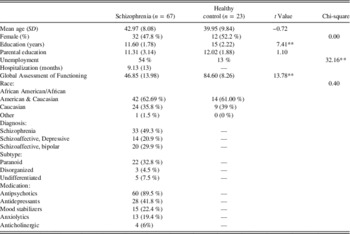
The sample consisted of outpatients with a DSM-IV diagnosis of schizophrenia or schizoaffective disorder (n=67) and healthy control participants (n=23) matched to the patients on age, gender, race/ethnicity, and parental education (see Table 1) who were part of a larger NIH grant funded project examining emotion, neurocognition, and communication disturbance (see Shakeel & Docherty, Reference Shakeel and Docherty2012). Only patients aged between 18 and 50 years, who spoke English as a primary language, and met DSM-IV criteria for schizophrenia or schizoaffective disorder were included in the sample. The Schedule for Affective Disorders and Schizophrenia—Lifetime Version (Endicott & Spitzer, Reference Endicott and Spitzer1978), adapted slightly for use with DSM-IV (American Psychiatric Association, 1994) criteria, was used to generate DSM diagnosis.
Socio-demographic details

**p<.01.
Patients were excluded if they reported a history suggestive of organic brain damage such as illness or head injury resulting in prolonged loss of consciousness, met criteria for mental retardation or current substance abuse, had a history of seizures/epilepsy, or a history of alcohol detoxification. The study was carried out with due approval of the Kent State University Institutional Review Board, thus confirming to the ethical standards laid down in the 1964 Declaration of Helsinki. Written informed consent was obtained from all participants before enrollment in the present study. All participants received monetary compensation for their participation.
Procedures
Information from the patients was collected in four sessions over a period of 8 weeks. The confabulation data were collected as described below. Symptom severity was assessed during the initial session and cognitive functions were assessed during the remaining sessions.
MEASURES
Confabulation Study
We adapted a specific paradigm (Chrobak & Zaragoza, Reference Chrobak and Zaragoza2008) to analyze confabulations in schizophrenia which involved testing over a period of 8 weeks.
Week 0: Participants watched a 20-min video about two brothers at a summer camp in an incidental learning paradigm. The participants are only told they will be watching a video to assess how adults understand the events they see. Most of the scenes are continuous segments and describe events involving the two brothers (Sullivan and Delaney), interacting with each other and with others, and performing various actions at the camp. The video was edited such that there are important segments missing from two scenes (although the participants were not told about this). In the Prank scene, Delaney stands up to make an announcement and falls in the dining hall. The scene does not show what causes him to fall. In the Sneak scene, two people are shown sneaking off in a canoe in the evening. The scene does not show where they go or what they do and skips to the next morning (for detailed checklist of events, see the Supplementary Material).
Week 1: The participants are given brief prompts about each scene and are asked to describe as fully as they can what happens during that scene. For the Prank and Sneak scene, they were additionally asked to “guess” what might have happened (who did what, when, where, with whom, etc.) in the missing segment. As these segments did not contain any information in the original video, all patients and healthy participants were essentially forced to generate false information (forced fabrication).
Week 2: The participants’ interview responses for each scene (at week 1) are read out to them verbatim and they are asked to respond (yes/no) whether they remember seeing the described events in the original video.
Week 8: Participants have a free recall session in which they are asked to recall as much of the movie as possible. This is followed by a cued recall session in which they are given brief prompts and asked for details from each scene.
Every transcript at week 8 was coded for:
Confabulation elements (elements): Number of occurrences in which a new physical/verbal action occurs. For example, “his brother drowned”; “the lady said she wanted to show her friends the camp”.
Confabulation instances (instances): Number of elements (false physical/verbal actions) that are related in some temporal/causal manner. For example, “Ratface put a banana peel on the dining floor”, “Ratface gets caught”, “Chief (who thinks Delaney was responsible) gets ready to get rid of him”, “Chief finds out the truth and apologizes to Delaney”. Instances are a subset of elements.
Fabricated elements: Number of elements of confabulation for scenes that had segments missing (“Sneak” and “Prank” scene). For example, “The chair breaks and Delaney falls”. These were the 2 scenes for which the participants were originally “forced” to generate false information.
Non-fabricated elements: Number of elements of confabulation for scenes that did not have any segments missing. (Fabricated and non-fabricated elements are mutually exclusive subsets of elements.)
True memory: Checklist based assessment of number of accurate physical/verbal actions recalled from original story (see supplementary material for complete checklist).
Total memory: Sum of false (elements) and true memory.
Temporal context confusion (TCC): Number of true events recalled in the wrong scene (e.g., recalling an event in scene 4 as having happened during the opening scene).
Repeated elements: Number of fabricated elements present at week 1 that were also recalled at week 8.
Interrater reliability analysis based on two independent raters showed an ICC of .85 for elements and .81 for true memory.
Cognitive/Metacognitive Measures
Internal Source Monitoring (ISM): ISM refers to the ability to discriminate between internally generated sources of information (Johnson et al., Reference Johnson, Hashtroudi and Lindsay1993). An ISM task we previously developed (Nienow & Docherty, Reference Nienow and Docherty2004) was used for the present study. Briefly, participants have to generate single word responses to 16 incomplete simple statements (e.g., “The first month of the year is _____”). On half the trials, the participants only think of the answer to themselves, and on the other half they say the answer out loud. Immediately after this, they are given a source recognition sheet with all the responses they said, thought, and with eight new words (total of 24 words), and they have to identify whether they had said or thought each word, or if it was new. To derive an SM score after controlling for recognition memory, the discrimination ratio [(say or think correct)/ old correct] was calculated.
External Source Monitoring (ESM): ESM refers to the ability to discriminate between externally generated sources of information (Johnson et al., Reference Johnson, Hashtroudi and Lindsay1993). An ESM task we previously developed (see Docherty, Reference Docherty2012) was used for the present study. Briefly, the participants have to listen to an audio recording of 12 statements, half of which are said by a female voice and half by a male voice. Immediately after this, the participants have to indicate whether each statement was said by a man, woman, or was new. To derive a SM score after controlling for recognition memory, the discrimination ratio [(man or woman correct)/ old correct] was calculated.
Executive function: A computerized version of the Wisconsin Card Sorting Test (Berg, Reference Berg1948) was used to derive a measure of perseverative errors (WCST-PE). Although no single test at present assesses all aspects of executive functions, WCST-PE provides an assessment of the capacity for self-regulation and effective performance, which most closely resembles the aspects of executive function significant for the strategic retrieval theories [ability to monitor and reject/suppress inaccurate information]. The standard score of total WCST-PE (which demographically corrects for age and education) was used for the present analysis.
Symptom Ratings
PANSS-CD: Severity of positive, negative, general, and total symptoms were rated using the Positive and Negative Syndrome Scale (Kay, Flszbein, & Opfer, Reference Kay, Flszbein and Opfer1987). For the present analysis, we use the PANSS conceptual disorganization score as an index of FTD.
PSYRATS: Severity of current delusions was assessed using the Psychotic Symptom Rating Scales (PSYRATS) (Haddock, McCarron, Tarrier, & Faragher, Reference Haddock, McCarron, Tarrier and Faragher1999). Current hallucination severity was calculated by adding the scores on duration, loudness and frequency of hallucinations (see Docherty, Reference Docherty2012).
RESULTS
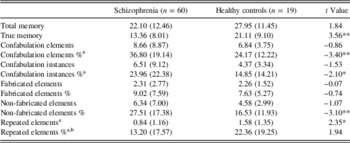
Complete data for all participants were not available owing to patient attrition between sessions and failure to complete the tests. All analyses were performed using listwise deletion and the sample sizes have been noted. Healthy participants generated significantly more true memories than the patient group (Table 2). To control for differences in the amount of information generated elements, instances, fabricated and non-fabricated elements were expressed in terms of percentage of total memory for the between group analyses. These were labeled element percent, instance percent, fabricated element percent, and non-fabricated element percent, respectively. One univariate outlier each was excluded from fabricated element and repeated element percent. For the schizophrenia group analyses (hypotheses 5–6), elements were log transformed to normalize distribution.
True and false memories, mean (SD)

a Schizophrenia: n=61.
b Repeated elements expressed as percentage of total elements.
Socio-demographic details are provided in Table 1. Table 2 shows means, standard deviations and t values for all raw scores and transformed variables.
Tests of Hypotheses
Hypothesis 1: Schizophrenia patients will generate more confabulations than healthy controls. Between-group t test showed the schizophrenia patients generated a significantly higher percentage of elements compared to healthy controls [t(47.67)=−3.40; p<.01; d=.71]. (Table 2). In fact, schizophrenia patients generated significantly more confabulation elements despite having generated fewer total memory and significantly fewer true memories compared to healthy controls (Table 2).
Hypothesis 2: Schizophrenia patients will generate more confabulations that are related to each other in some causal or temporal manner. Between group t test showed the schizophrenia patients generated a significantly higher percentage of elements that were related to each other (instances) compared to healthy control participants [t(47.95)=−2.10; p<.05; d=.62] (See Table 2).
Hypothesis 3: Schizophrenia patients will confabulate even in the absence of missing information. Multivariate analysis of variance (MANOVA) analysis showed there was a significant effect of group on number of fabricated and non-fabricated confabulation element percents [Pillai’s trace V=.08, F(2,76)=3.50; p<.05]. Separate univariate analyses of variance (ANOVAs) on the outcome variables revealed significant group effects for non-fabricated confabulation element percent [F(1,77)=6.57; p<.05; partial eta squared=.08], but not for fabricated elements percent [F(1,77)=0.55; p>.05; partial eta-squared=.01]. In other words, the schizophrenia patients generated higher percentages of elements for scenes which did not involve missing segments, compared to healthy control participants (Table 2). However, a follow-up mixed ANOVA with condition (fabricated vs. non-fabricated) as the within subject variable and group (schizophrenia vs. healthy controls) as the between subject variable did not show a significant group by condition interaction (F(1,78)=0.69; ns).
Hypothesis 4: Schizophrenia patients will remember fewer of their confabulations from week 1 at week 8. Between group t test showed the schizophrenia patients reproduced fewer of the fabricated confabulations generated at week 1 at week 8 compared to healthy control participants (t(78)=2.35; p<.05; d=.61) (Table 2).
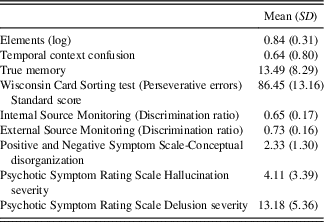
Hypothesis 5: Schizophrenic confabulations will be associated with memory and executive deficits more than with internal and external source monitoring. They will also be associated with temporal context confusion. Means and standard deviations of the patients for elements (log), TCC, true memory, WCST-PE, ISM, and ESM are shown in Table 3. Correlational analysis showed that TCC had a significant positive correlation with elements (log) (r=.29; p<.05).
Means and SDs for elements, cognitive, language related, and psychopathology variables in schizophrenia patients

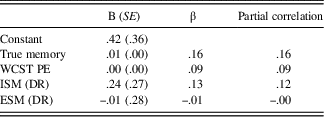
Multiple Linear regression with true memory, WCST-PE (standard score), ISM, and ESM as independent variable (IV) (forced entry method) and elements (log) as dependent variable (DV) did not result in a significant final model [F(4,51)=0.72; ns] (Table 4), nor were any of the individual test scores correlated with any confabulation variables.
Regression of true memory, executive functions, and source monitoring on confabulation elements (n=56)

WCST PE=Wisconsin Card Sorting Task (Perseverative Errors); ISM (DR)=Internal Source Monitoring (Discrimination Ratio); ESM (DR)=External Source Monitoring (Discrimination Ratio).
Hypothesis 6: Schizophrenic confabulations will be associated with delusions, hallucinations, and FTD. Correlational analysis showed that there was a significant correlation of elements (log) with PANSS-CD (r=.44; p<.01), but other correlations were not significant.
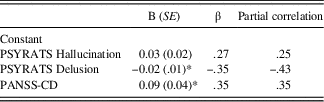
Multiple linear regression with elements (log) as the dependent variable and PSYRATS hallucinations, PANSS-CD, and PSYRATS delusions as independent variables showed that these variables result in a significant predictive model of elements (log) [F(3,41)=5.53; p<.01). The final model accounted for nearly 30% of the variance in elements (log) (R 2 =.29). The significant predictors were PSYRATS Delusion [t(41)=−2.21; p<.05; pr 2 =−43.] and PANSS-CD [t(41)=2.43; p<.05; pr 2 =.35] (Table 5).
Regression of Positive Symptoms on Confabulation Elements (n=45)

*p<.05.
PSYRATS=Psychotic Symptom Rating Scales; BPRS=Brief Psychiatry rating Scale (minus hallucination and delusion score); PANSS-CD=Positive and Negative Symptom Scale-Conceptual disorganization.
DISCUSSION
In agreement with previous studies (Lorente-Rovira et al., Reference Lorente-Rovira, Pomarol-Clotet, McCarthy, Berrios and McKenna2007, Reference Lorente-Rovira, Santos-Gomez, Moro, Villagrán and McKenna2010; Nathaniel-James & Frith, Reference Nathaniel-James and Frith1996; Nathaniel-James et al., Reference Nathaniel-James, Foong and Frith1996), the current study found that schizophrenia patients generated a significantly higher percentage of false memories than healthy control participants. Patients also generated a significantly higher percentage of false memory elements that were related to each other in some causal/temporal manner (instances).
Schizophrenia patients generated a significantly higher percentage of confabulations for scenes that did not have any segments missing (non-fabricated elements) compared with controls. However, the groups did not significantly differ on the number of false memories generated for scenes that did have segments missing (fabricated elements). This finding thus appears inconsistent with the popular view (Kraepelin, Reference Kraepelin1971; Mercer, Wapner, Gardner, & Benson, Reference Mercer, Wapner, Gardner and Benson1977) that patients confabulate to fill-in gaps in their memory or avoid embarrassment. On the other hand, given that patients in the current study had poorer memory for the video event than healthy control participants (as evidenced by lower true item recall), our finding that patients were more likely than controls to generate confabulations about actually witnessed scenes (i.e., non-fabricated elements), may reflect an attempt by patients to fill gaps in their memories.
There is no agreement in the literature over whether confabulations are a result of encoding or retrieval processes (Gilboa & Moscovitch, Reference Gilboa and Moscovitch2002; Kramer, Bryan, & Frith, Reference Kramer, Bryan and Frith1998; Nathaniel-James & Frith, Reference Nathaniel-James and Frith1996). The present study found that although schizophrenia patients generated significantly more confabulations than healthy control participants at week 8, they recollected significantly fewer of their fabricated elements from week 1 at week 8. This pattern of findings partially supports the retrieval view which suggests that confabulations are a result of failures in retrieval rather than encoding processes. However, it cannot be ruled out that schizophrenia patients have both encoding (e.g., Kramer et al., Reference Kramer, Bryan and Frith1998; Lorente-Rovira et al., Reference Lorente-Rovira, Santos-Gomez, Moro, Villagrán and McKenna2010; Nathaniel-James et al., Reference Nathaniel-James, Foong and Frith1996) and retrieval deficits, with the encoding deficits being camouflaged by the presence of poor retrieval.
Qualitatively, three characteristics of schizophrenic confabulations stand out in the narratives:
Themes: Schizophrenia patients tended to diverge from the original narrative more than healthy control participants did. While control participants often generated brief commission errors to present a coherent story [e.g., “(Delaney)…pulled the ladies back in” (the ladies were actually helped by other counselors)], patients tended to recall events that had no relevance to the story [“Sullivan and Delaney went fishing, then Sullivan fell off the boat…they were both saved by another person from the camps”]. Patients generated stories with themes as varied as a diamond heist, Sullivan dying, Delaney having smoking and drinking problems, there being an award ceremony, etc., none of which were present in the original story. We found some evidence to support the view that patients are often constrained by the context of the original information and borrow characters and events from the original story when confabulating (see Lorente-Rovira et al., Reference Lorente-Rovira, Pomarol-Clotet, McCarthy, Berrios and McKenna2007).
Subnarratives: It has been shown that the schizophrenia patients have a unique tendency to reorganize and restructure the original story, which results in changing the “sense” of the original information (Nathaniel-James et al., Reference Nathaniel-James, Foong and Frith1996; Nathaniel-James & Frith, Reference Nathaniel-James and Frith1996). The present study is the first to demonstrate that when schizophrenia patients are given longer and more complex tasks, they tend to digress and create subnarratives within their recollection of the original story rather than to reorganize the entire story. For example, none of the following events occurred in the original movie (which only shows two unrecognizable figures leaving in a canoe in this scene):
“Delaney and Sullivan (went to) see the girls. They might have been drinking or something. (The boat tipped over and) Sullivan fell into the water. They had to swim back to the shore. The little boy got sick from that. The little boy laying (sic) on the bed and Delaney was next to him and they were talking. Sullivan…died.”
It is likely that patients create these subnarratives rather than restructure the entire story because restructuring a 20-min audio-visual clip would demand significant cognitive resources.
Confidence: Healthy control participants tended to have less conviction in their false memories compared to the schizophrenia patients. Some level of uncertainty often accompanied their false memories (e.g., “I am assuming that…”; “It seems as if…”). Although not invariably, patients tended to lack this sense of uncertainty (“…Matter of fact I know he did cause…”; “I am pretty sure…”; “…and then nobody knowed (sic) that…but I did.”). This tendency for schizophrenia patients to hold on to false information with greater confidence (or “knowledge corruption”) has been demonstrated previously (Moritz, Woodward, Whitman, & Cuttler, Reference Moritz, Woodward, Whitman and Cuttler2005).
This current study systematically investigated the cognitive correlates of confabulation implicated by various theories in a schizophrenia population. We found that true memory, executive functioning, ISM and ESM did not significantly predict confabulations. Our findings in this regard fail to support the SM theory as well as the retrieval theory. In terms of the cognitive functions implicated by the retrieval theory (memory deficits and executive functioning), our findings suggest that schizophrenic confabulations are not strongly associated with memory impairments, which is similar to findings from other studies (Kramer et al., Reference Kramer, Bryan and Frith1998; Lorente-Rovira et al., Reference Lorente-Rovira, Pomarol-Clotet, McCarthy, Berrios and McKenna2007, Reference Lorente-Rovira, Santos-Gomez, Moro, Villagrán and McKenna2010; Nathaniel-James et al., Reference Nathaniel-James, Foong and Frith1996; Nathaniel-James & Frith, Reference Nathaniel-James and Frith1996; Salazar-Fraile et al., Reference Salazar-Fraile, Tabarés-Seisdedos, Selva-Vera, Balanzá-Martinez, Martı́nez-Arń, Catalán and Vieta2004).
The evidence in previous studies for executive function impairments is mixed, with some studies showing a relation between executive function and confabulations in schizophrenia, and others not (Gurd, Reference Gurd1995; Lorente-Rovira et al., Reference Lorente-Rovira, Pomarol-Clotet, McCarthy, Berrios and McKenna2007, Reference Lorente-Rovira, Santos-Gomez, Moro, Villagrán and McKenna2010; Nathaniel-James & Frith, Reference Nathaniel-James and Frith1996; Nathaniel-James et al., Reference Nathaniel-James, Foong and Frith1996). Our study failed to find a significant role for executive functions in confabulation. This is in striking contrast to the confabulations in neurological patients which have often been associated with amnesia and almost invariably with executive dysfunction (see Kopelman, Reference Kopelman2010). Although it is difficult to draw conclusions from negative findings, our results, when interpreted along with other studies that have investigated executive functions in schizophrenic confabulations (Gurd, Reference Gurd1995; Lorente-Rovira et al., Reference Lorente-Rovira, Pomarol-Clotet, McCarthy, Berrios and McKenna2007, Reference Lorente-Rovira, Santos-Gomez, Moro, Villagrán and McKenna2010; Nathaniel-James et al., Reference Nathaniel-James, Foong and Frith1996; Nathaniel-James & Frith, Reference Nathaniel-James and Frith1996), suggest the possibility that executive dysfunction may not be central to the formation of confabulations in schizophrenia (e.g., Moscovitch & Melo, Reference Moscovitch and Melo1997).
The current study investigated the role of SM in schizophrenic confabulations, and after controlling for recognition memory, we found no evidence to support a role for ISM or ESM deficits in schizophrenia (also see Ciaramelli & Ghetti, Reference Ciaramelli and Ghetti2007; Johnson, O’Connor, & Cantor, Reference Johnson, O’Connor and Cantor1997). Despite the theoretically plausible relation between SM and confabulations, the evidence is mixed even in neurological studies (Ciaramelli & Ghetti, Reference Ciaramelli and Ghetti2007; Johnson et al., Reference Johnson, O’Connor and Cantor1997).
TCC were not included in the regression analysis as the tendency to recall information in the wrong context may be categorized as a factor underlying as well as a characteristic of confabulation (Schnider, Reference Schnider2003). We found a significant positive correlation between TCC and confabulation, suggesting that confusing the order of information may play a role in some schizophrenic confabulations. While it must be noted that not all confabulations are conceptually related to confusing the order of information (Christodoulou, Reference Christodoulou1977; McKenna, Reference McKenna2007) narratives from our patients suggest that at least some confabulations may be the result of confusing the order of information, and then trying to provide a coherent story by introducing additional elements.
The present study found that delusions and FTD significantly predicted confabulations. A few studies have previously investigated the relation between delusion and confabulation, with mixed results (Salazar-Fraile et al., Reference Salazar-Fraile, Tabarés-Seisdedos, Selva-Vera, Balanzá-Martinez, Martı́nez-Arń, Catalán and Vieta2004; Simpson & Done, Reference Simpson and Done2002). We found that delusions were negatively associated with confabulations. The PSYRATS delusion score includes ratings on preoccupation, conviction, disruption to life, and distress caused by delusions. On post hoc analysis, it was observed that the delusion distress score was most strongly negatively associated with confabulations and driving the negative relationship. It is possible that higher levels of metacognitive functioning and insight in some patients may result in greater distress from delusions as well as a lower probability of accepting erroneous information as true. However, this remains to be empirically proven.
Previous studies from schizophrenia and neurological conditions have suggested that disorganization symptoms like FTD may play a role in schizophrenic confabulations (Lorente-Rovira et al., Reference Lorente-Rovira, Pomarol-Clotet, McCarthy, Berrios and McKenna2007; Nathaniel-James & Frith, Reference Nathaniel-James and Frith1996). We found a significant positive association of confabulations with FTD, suggesting that a failure to organize speech in a coherent manner may partially contribute to the generation of confabulations (also see Salazar-Fraile et al., Reference Salazar-Fraile, Tabarés-Seisdedos, Selva-Vera, Balanzá-Martinez, Martı́nez-Arń, Catalán and Vieta2004). Our findings suggest that disorders of the form and content of speech may be more closely linked than previously suspected. Future research might benefit from focusing on the neurophysiological correlates of confabulation. It is likely that neuroimaging investigations (of, e.g., the salience network) might shed better light on the relation between delusions and confabulations than has been obtained by behavioral studies.
LIMITATIONS
The current study is limited by the failure to include an independent measure of memory and the fact that all variables associated with confabulation were derived using the same paradigm. The study is also limited by unequal sample sizes and the fact that complete data was not available for all participants owing to patient attrition between sessions and failure to complete the tests (esp. for the between group analyses). We assessed all the variables for homogeneity of variance, normality of distribution, and the assumptions of parametric analyses before analyzing the data. However, unequal sample sizes and missing data are a limitation of this study.
CONCLUSIONS
Our study adds to previous studies showing that confabulations may have a significant effect on patients’ mental processes in experimental settings. Future research should investigate the effect of schizophrenic confabulation on real-world functioning. If, as is logical to expect, confabulation significantly affects socio-occupational and interpersonal functioning in patients, it will deserve a lot more attention than it has received so far.
ACKNOWLEDGMENTS
Authors declare no conflict of interest. This work was supported by the National Institute of Mental Health at the National Institutes of Health (N.M.D., grant number 5R01-MH58783) and by Kent State University.
SUPPLEMENTARY MATERIAL
To view supplementary material for this article, please visit http://dx.doi.org/10.1017/S1355617716000801