Introduction
In polyandrous insects, males often guard a female to prevent her from re-mating with other males in various ways such as prolonged copulation and post-copulatory mounting (Alcock, Reference Alcock1994). The white grub beetle Dasylepida ishigakiensis Niijima & Kinoshita (Coleoptera: Scarabaeidae), shows prolonged copulation (Arakaki et al., Reference Arakaki, Sadoyama, Kishita, Nagayama, Oyafuso, Ishimine, Ota, Akino, Fukaya, Hirai, Yamamura and Wakamura2004), but the function of this behaviour remains unknown.
Dasylepida ishigakiensis is a serious sugarcane pest in the Miyako Islands of Okinawa, Japan (Sadoyama et al., Reference Sadoyama, Oroku and Nakamori2001). The larvae feed on roots and underground stems of sugarcane, and often kill the plant shortly before harvest. They have a 2-year life cycle and spend their entire life span underground except for a short mating period (Oyafuso et al., Reference Oyafuso, Arakaki, Sadoyama, Kishita, Kawamura, Ishimine, Kinjo and Hirai2002). Adult diapause, being controlled by temperature, synchronizes reproduction with the coldest time of the year (Tanaka et al., Reference Tanaka, Yukuhiro, Yasui, Fukaya, Akino and Wakamura2008). Sexually mature adults emerge from the soil for mating at dusk in February and March. They emerge only when the evening air temperature is above 18 °C (Arakaki et al., Reference Arakaki, Sadoyama, Kishita, Nagayama, Oyafuso, Ishimine, Ota, Akino, Fukaya, Hirai, Yamamura and Wakamura2004; Fukaya et al., Reference Fukaya, Yasui, Akino, Yasuda, Tanaka, Wakamura, Maeda, Hirai, Yasuda, Nagayama and Arakaki2009). Upon emerging above ground, adult females perform a short flight and then settle on a sugarcane leaf or stalk where they release (R)-2-butanol that functions as a sex pheromone (Wakamura et al., Reference Wakamura, Yasui, Akino, Yasuda, Fukaya, Tanaka, Maeda, Arakaki, Nagayama, Sadoyama, Kishita, Oyafuso, Hokama, Kobayashi, Tarora, Uesato, Miyagi and Osuga2009a). During the dusk, males fly around for only 15 min to find calling females. Mating usually lasts as long as 2 h (Arakaki et al., Reference Arakaki, Sadoyama, Kishita, Nagayama, Oyafuso, Ishimine, Ota, Akino, Fukaya, Hirai, Yamamura and Wakamura2004). After mating, beetles return to the soil before morning. Because mated females do not appear above the ground for another mating, they have been considered to be monogamous (Arakaki et al., Reference Arakaki, Sadoyama, Kishita, Nagayama, Oyafuso, Ishimine, Ota, Akino, Fukaya, Hirai, Yamamura and Wakamura2004).
However, our unpublished observations indicate that mating pairs are sometimes surrounded by a few other males, and we hypothesized that females might have a chance to mate with other males before they return to the soil, and prolonged copulation functions as mate guarding. One of the purposes of the present study was to test this hypothesis.
Prolonged copulation may have other functions than mate guarding. For example, a variety of functions of ejaculates or male accessory gland secretions have been reported in various insects. Females alter their physiology and behaviour after mating in some insects, and that is caused by biologically active agents in the male-derived substances (Gillott, 2003). Certain substances reduce female receptivity to subsequent mating in Coleoptera (Yamane et al., Reference Yamane, Miyatake and Kimura2008a, Reference Yamane, Katsuhara and Miyatakeb). Some studies using chemical tracers have revealed that male-derived substances deposited in the female genital tract at copulation are transferred to somatic tissue or oocytes developing in the ovary (Rooney and Lewis, Reference Rooney and Lewis1999; Hayashi and Kamimura, Reference Hayashi and Kamimura2002), suggesting that the substances are used as nutrition for egg production. In Drosophila melanogaster Meigen (Diptera: Drosophilidae), some chemical components in the secretion of male accessory gland promote the female's egg production but reduce her longevity due to its side effect (Partridge and Farquhar, Reference Partridge and Farquhar1981; Fowler and Partridge, Reference Fowler and Partridge1989; Chapman et al., Reference Chapman, Hutchings and Partridge1993, Reference Chapman, Liddle, Kalb, Wolfner and Partridge1995). During copulation, a D. ishigakiensis female receives colloidal secretion (c. 6 mg) from the male and stores it in the bursa copulatrix (BC) (Tanaka et al., Reference Tanaka, Yukuhiro, Yasui, Fukaya, Akino and Wakamura2008). This substance is derived from the male accessory gland. Although the function of male secretion of D. ishigakiensis is unknown, it might exert a significant influence on the reproductive performance of female adults by enhancing the nutritional state, because this beetle does not consume food as adults due to their degenerated mouthparts (Oyafuso et al., Reference Oyafuso, Arakaki, Sadoyama, Kishita, Kawamura, Ishimine, Kinjo and Hirai2002). Prolonged copulation might be required for the secretion to be transferred from males to females in this beetle. These possibilities were also tested in the present study.
Materials and methods
Observations of post-copulatory behaviour under semi-natural conditions
To observe the post-copulatory behaviour of adult D. ishigakiensis closely, 20 mating pairs were captured by hand from 18.30 to 19.00 h in a sugarcane field on Miyako Island (24°47′N; 125°17′E; sunrise 07.18 h, sunset 18.29 h), Okinawa, Japan, on 7 February 2009. Individual mating pairs were held in plastic cups (upper diameter, 7 cm; lower diameter, 5 cm and height, 4 cm) and transferred to the campus of the Miyakojima Branch of Okinawa Prefectural Agricultural Research Centre (MB-OPARC) by 19.30 h. It took 5 min to transfer the beetles from the sugarcane field to the campus by car. The pairs were gently inoculated on leaves of four cut sugarcane stalks (height, c. 150 cm) positioned upright in the ground at an open site on the campus. Each plant was inoculated with five pairs. To allow beetles to be located easily during observations, a small piece of yellow vinyl tape with a unique number (no. 1–20) was put on the plant near each mating pair. Pairs were continuously observed during the first 75 min (19.30–20.45 h) and the last 3 h at dawn (05.00–08.00 h). During the remainder of the observation period, observations were made at intervals of 15–60 min. The time of separation of each mating pair and subsequent behaviour of the beetles were recorded. A small flashlight was used for pre-dawn observations, and did not seem to interfere with the behaviour of the beetles, as might be inferred from the fact that adult beetles are rarely attracted to a light source (Oyafuso et al., Reference Oyafuso, Arakaki, Sadoyama, Kishita, Kawamura, Ishimine, Kinjo and Hirai2002).
Observations of post-copulatory behaviour under natural conditions
To observe post-copulatory behaviour with minimum disturbance, mating pairs were observed in a sugarcane field on Miyako Island. Observations of 19 pairs were made from 2000 to 2320 h on 9 February 2009. Of those, 16 pairs were visited at intervals of about 15 min by one person, and the remaining three pairs were continuously observed by another researcher. A flashlight was used for the observations. Pairs were individually numbered and marked with a numbered piece of vinyl tape as described above.
Measurements of BC contents in the laboratory
To determine how fast the colloidal secretion is transferred from males to females during copulation, the BC content was quantified for females that were allowed to copulate for various lengths of time in the laboratory. The female beetles used were captured as mating pairs in sugarcane fields on Miyako Island on 9 February 2009 and air-transported to the Tsukuba laboratory. Females were then individually placed in plastic cups (upper diameter, 7 cm; lower diameter, 5 cm and height, 4 cm) with moist leaf mould and maintained in darkness for c. 10 days in an incubator at 20 °C. Virgin females were not used for the experiments as they were not available. They are found by flying males almost immediately after they emerge from the soil (Arakaki et al., Reference Arakaki, Sadoyama, Kishita, Nagayama, Oyafuso, Ishimine, Ota, Akino, Fukaya, Hirai, Yamamura and Wakamura2004). Sexually mature males were captured on 9 February 2009 using funnel traps baited with the synthetic sex pheromone of D. ishigakiensis adult females (Wakamura et al., Reference Wakamura, Yasui, Mochizuki, Fukumoto, Arakaki, Nagayama, Uesato, Miyagi, Oroku, Tanaka, Tokuda, Fukaya, Akino, Hirai and Shiga2009b) and transported to the Tsukuba laboratory where they were maintained as described above except at a temperature of 16 °C.
Several females and males were put together on moist sand in a plastic container (diameter, 17 cm and height, 9 cm) under dim light conditions (c. 0.03 W/m2), because mating behaviour is induced under darkening conditions (Arakaki et al., Reference Arakaki, Sadoyama, Kishita, Nagayama, Oyafuso, Ishimine, Ota, Akino, Fukaya, Hirai, Yamamura and Wakamura2004; Fukaya et al., Reference Fukaya, Yasui, Akino, Yasuda, Tanaka, Wakamura, Maeda, Hirai, Yasuda, Nagayama and Arakaki2009). As soon as mating began, mating pairs were individually transferred to Petri dishes (diameter, 9 cm and height, 1.5 cm) at a constant temperature of c. 26 °C. Mating females were separated from the males 5 or 30 min after the onset of copulation, by gently tapping the beetles with fingers. Females were individually isolated for 90–180 min at room temperature before being dissected to remove the BC, as preliminary observations had shown that the colloidal material ejaculated by males moved to the BC within 1 h of copulation (M. Tokuda and K. Harano, unpublished observations). Before dissection, the beetles were immobilized on ice. The BC contents were quantified by weighing the BC before and after removing the contents by squeezing with tweezers in saline. Females that were not allowed to mate in the laboratory (controls) and those that were allowed to copulate until they separated from the males spontaneously were also dissected to determine the BC contents. The amount of the colloidal material transferred from a male to a female during mating was determined by subtracting the average weight of the BC content in controls from the weight in mated females. The BC content in the former was negligible, 0.4 ± 0.3 mg (mean ± SD, N = 5).
To determine if females receive additional male material by multiple mating, females that had mated c. 10 days earlier in the field were allowed to mate once or twice with different males in the laboratory. For those with multiple mating, the interval between the first and second mating was less than 3 h. Within 3 h of the mating trials, the BC contents were measured as described above.
Data analysis
The time spent on a sugarcane plant after the end of copulation under natural conditions was compared between males and females by a Mann–Whitney U-test. This test was also used to evaluate the influence of extra males on the duration of the first mating. Differences in the BC contents among females, which had been allowed to mate for various lengths of time, were tested by a Kruskal–Wallis test followed by a post hoc Steel–Dwass test. The BC contents were also compared between females that mated once and those that mated twice using a Mann–Whitney U-test. All statistical tests were conducted at the 5% significance level.
Results
Post-copulatory behaviour under semi-natural conditions
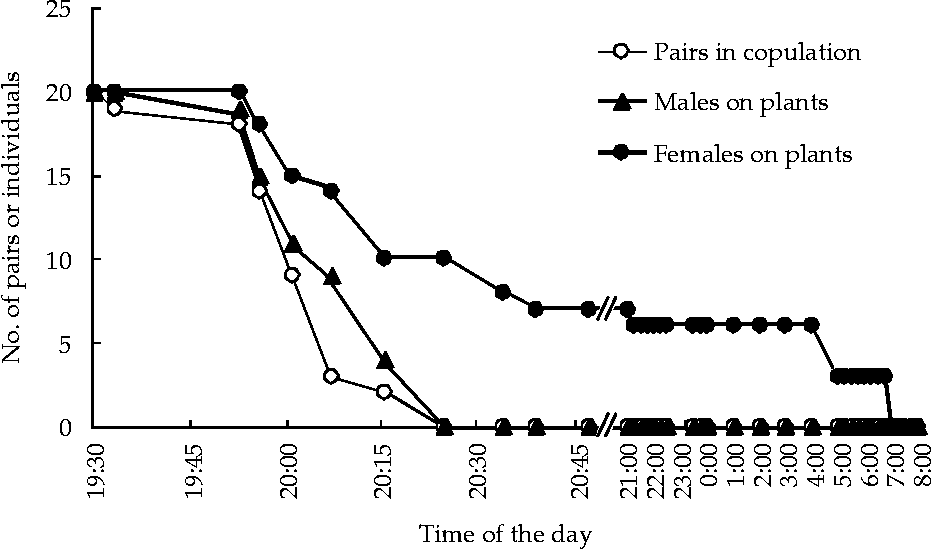
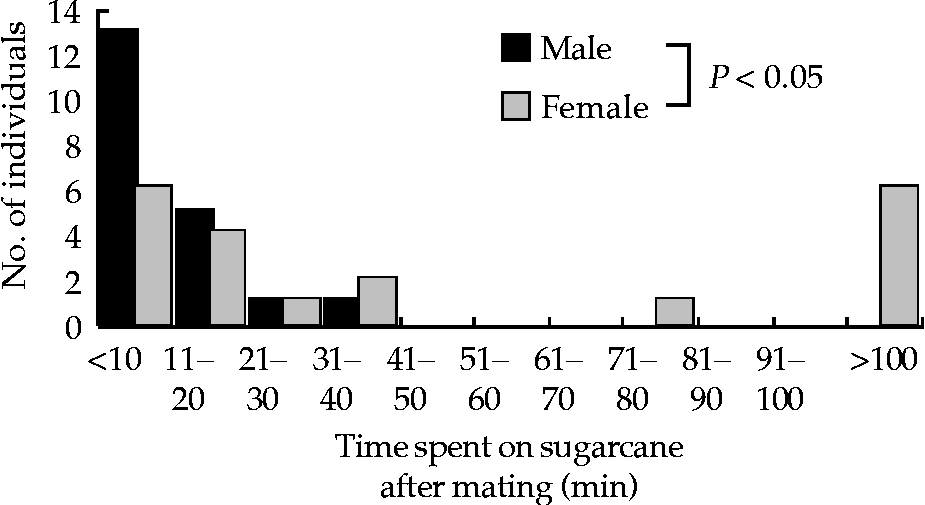
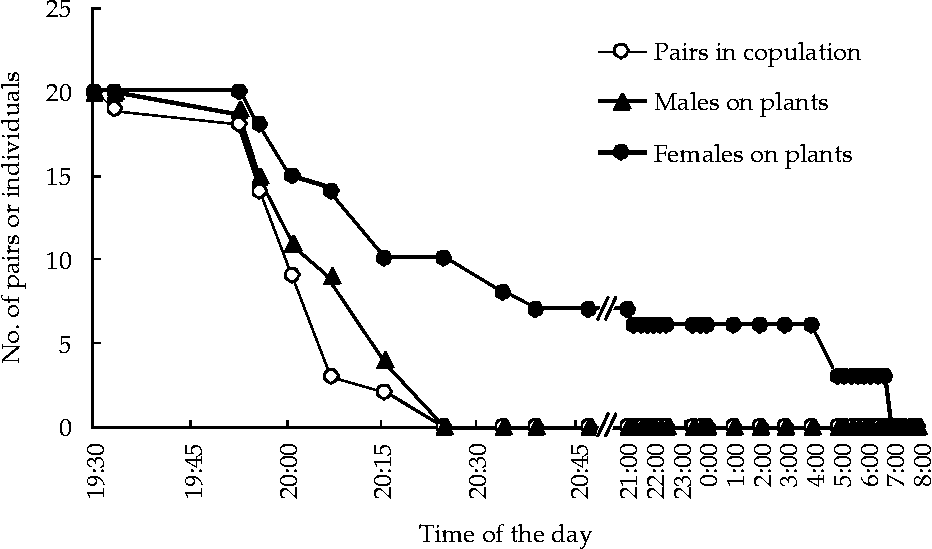
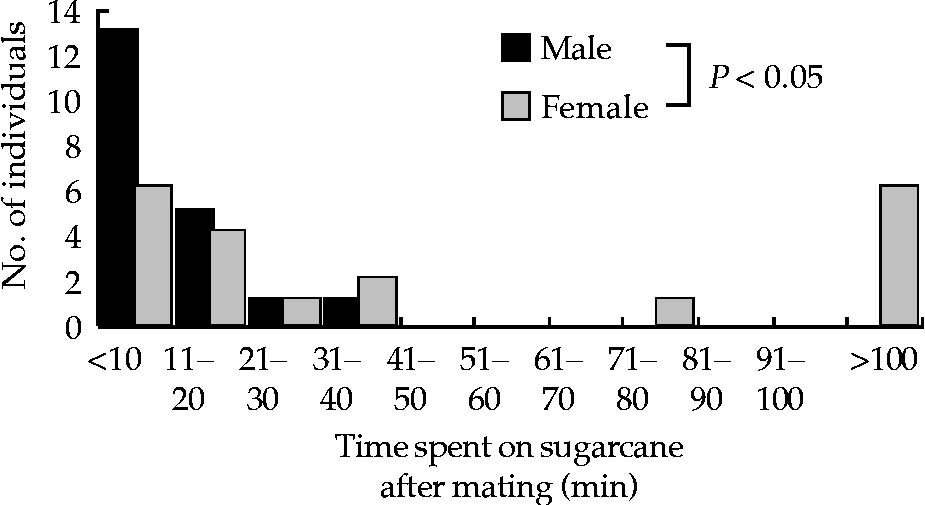
Dasylepida ishigakiensis mating pairs collected in a sugarcane field and inoculated on cut sugarcane stalks at MB-OPARC started separating at 19.50 h and had all terminated copulation by 20.25 h (Fig. 1). After mating, the beetles remained on the plant for periods ranging from several minutes to several hours and eventually left the plant by dropping to the ground. Males tended to leave earlier than females (Fig. 2; Mann–Whitney U-test: N = 20, Z = 2.46, P < 0.05). Both males and females moved little after copulation and did not show any attempts at additional mating. One male was observed mounting another individual (sex unknown) on the ground, but no mating was observed before they disappeared from view. Some females remained on vegetation until dawn when they moved a few centimetres on the plant and dropped to the ground. Otherwise, the beetles remained motionless shortly before dawn. After dropping to the ground, some adults were observed to burrow into the soil within 1 min (N = 3), while another beetle took longer (c. 9 min) before it disappeared from the ground surface completely. One male and a female flew away after dropping to the ground, but the rest were considered to have burrowed into the soil near the plants, because except for the two individuals mentioned above, no buzzing sound from flying activity was heard, and no individual was observed walking more than 50 cm from the place where it had dropped.
Changes in numbers of Dasylepida ishigakiensis pairs in copulation, males and females, on cut sugarcane plants under outdoor conditions on 7 February 2009.
Frequency distribution of time spent on sugarcane plants in males and females of Dasylepida ishigakiensis under outdoor conditions. Mann–Whitney U-test was used for statistical analysis between sexes.
Post-copulatory behaviour under natural conditions
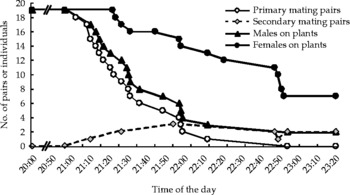
The majority of beetles terminated copulation during 21.00–22.00 h (89.5%; N = 19; Fig. 3). Mating ended much later under natural conditions than under the semi-natural conditions observed on the previous day (Fig. 1). Because adults of this species start mating at dusk (18.25–18.55 h; Arakaki et al., Reference Arakaki, Sadoyama, Kishita, Nagayama, Oyafuso, Ishimine, Ota, Akino, Fukaya, Hirai, Yamamura and Wakamura2004), mating in undisturbed pairs appeared to have lasted longer than that in the transferred and inoculated pairs. However, males were found to leave the plants earlier than females under either set of conditions (Fig. 3).
Changes in numbers of Dasylepida ishigakiensis pairs in copulation, males and females, on sugarcane plants under natural conditions on 9 February 2009. After mating with the first male, some females mated with another male that had mounted on their back.

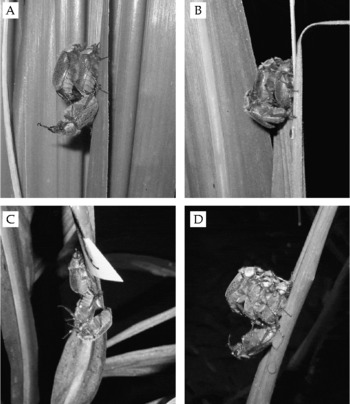
Observations of some females mating successively with two different males were unexpected, as females of this species were thought to be monogamous (Arakaki et al., Reference Arakaki, Sadoyama, Kishita, Nagayama, Oyafuso, Ishimine, Ota, Akino, Fukaya, Hirai, Yamamura and Wakamura2004). Of 19 mating pairs observed, five were accompanied by another male mounting on the back of the mating female, as the first mating male hung below from her (Fig. 4A and B), and one pair was attended by two extra males (Fig. 4D). In the latter case, the two males looked like a mounting pair on the back of the mating female. The extra males often extended the copulatory organ towards the mating female's genitalia, but did not appear to have influenced her mating with the first male. In one case, the second male positioned on the mating female copulated with her 2 min after her mating with the first male. Neither apparent refusal by the female nor interference by the first male was observed. The second male assumed the characteristic posture hanging down from the female (Fukaya et al., Reference Fukaya, Yasui, Akino, Yasuda, Tanaka, Wakamura, Maeda, Hirai, Yasuda, Nagayama and Arakaki2009), while the first male moved on the back of the second male and remained for several minutes (Fig. 4C). In another case, the first male stepped down from the female and stayed next to her for half an hour, while she was copulating with the second male, before moving to the other side of the leaf. Multiple mating was encountered in four out of the six pairs accompanied by additional males (Table 1). The other two pairs separated after mating with no additional mating observed. No multiple mating was observed in females that had not been mounted by more than one male, though some pairs had been accompanied by one or two males sitting 10 or 15 cm away. The mean duration of the first mating was not significantly influenced by the presence or absence of extra males (Table 1; Mann–Whitney U-test: N = 6, 14, Z = 1.32, P>0.05), although the sample sizes were small.
Sequential copulations in Dasylepida ishigakiensis: (A) a female and male pair in copulation with an extra male mounting the back of the female and extending his genitalia; (B) a pair terminating copulation, and a male with his genitalia withdrawing from the female; (C) a first mating male hanging on the back of the extra male now mating with the female; and (D) a mating pair with two extra mounting males.

Influences of presence or absence of extra males on the frequency of multiple mating and lengths of copulation with the first male in Dasylepida ishigakiensis

* Calculated on the assumption that onset of mating was 19.00 h based on Arakaki et al. (Reference Arakaki, Sadoyama, Kishita, Nagayama, Oyafuso, Ishimine, Ota, Akino, Fukaya, Hirai, Yamamura and Wakamura2004). † Mann–Whitney U-test for lengths of first copulation.
Effects of lengths of time in copulation and multiple mating on the BC content
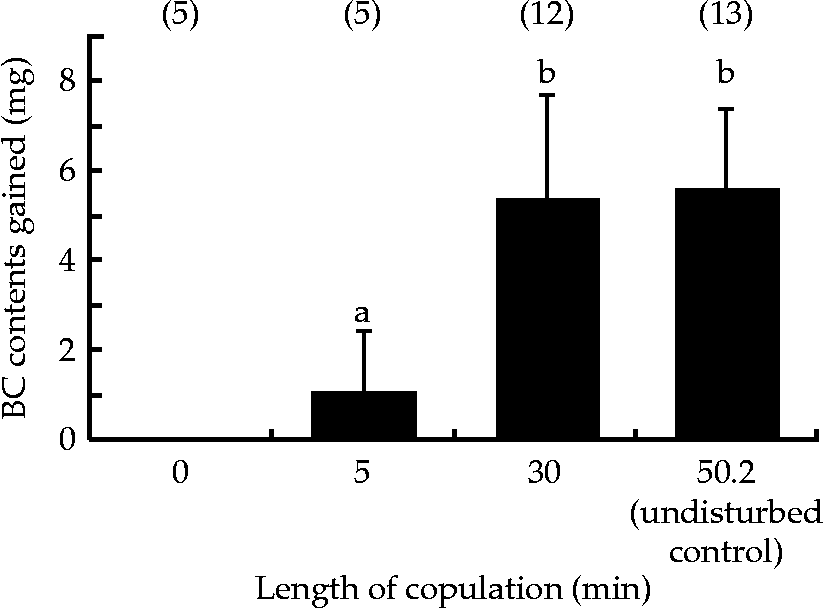
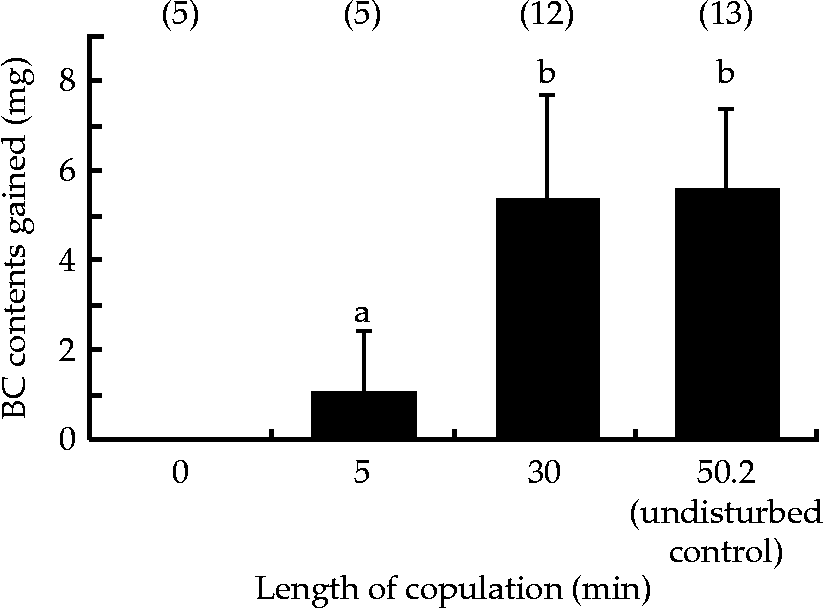
Females gained a significant amount of male substance in the BC when allowed to mate again, and the amount increased as mating was prolonged during the first 30 min (Steel–Dwass test: N = 5, 12, 13, P < 0.05, following Kruskal–Wallis test: df = 2, χ2 = 9.89, P < 0.01; Fig. 5). However, beyond 30 min no further increase was observed even in females that had been allowed to copulate without interruption (mean copulation time, 50.2 ± 10.0 min), indicating that the transfer of male substance was completed during 30 min of copulation.
Amounts of male secretion received by Dasylepida ishigakiensis females that were allowed to copulate for different intervals. The values were calculated by subtracting the mean BC content of control females from that of females allowed to mate in the laboratory. Numbers in parentheses are sample sizes, and error bars represent standard deviations. Different letters on bars indicate significant differences according to a Steel–Dwass test following a Kruskal–Wallis test (P < 0.05).
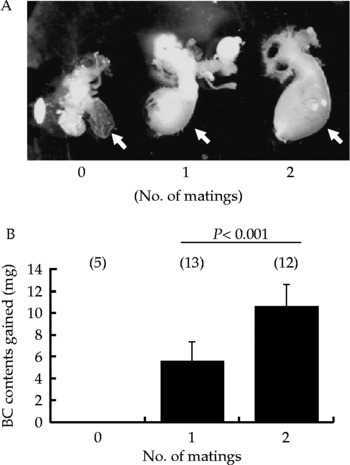
The BC was collapsed in females that had mated once c. 10 days before dissection. However, the BC expanded after one mating and expanded further after a second mating (Fig. 6A). From one mating, females gained c. 6 mg of the BC content (Fig. 6B). Additional mating increased the BC content by approximately 85%.
Changes in the BC content of Dasylepida ishigakiensis females after mating with an additional male: (A) the BCs of females mated with 0, 1 and 2 males in the laboratory. Arrows indicate BC. (B) amounts of the BC content after mating. The values in (B) were calculated by subtracting the mean BC content of control females from that of mated females. Numbers in parentheses are sample sizes, and error bars represent standard deviations. The difference between two groups of mated females was compared using Mann–Whitney U-test.

Discussion
Dasylepida ishigakiensis females have been thought to mate only once during their lives because males search for females for only a short time and mated females do not appear above the ground again once they return to the soil (Arakaki et al., Reference Arakaki, Sadoyama, Kishita, Nagayama, Oyafuso, Ishimine, Ota, Akino, Fukaya, Hirai, Yamamura and Wakamura2004). However, the present field observations revealed that some females mated for a second time with a male initially positioned on the back of the mating females, while the first male mated with the female from below (Figs 3 and 4). This is the first report of multiple mating in females of this species.
The present study also demonstrated that females mating with two males received a larger amount of male substance than those mating with a single male (Fig. 6). Studies of other insects report that the components of male ejaculate affect the reproductive performance and post-mating behaviour of females (Gillott, Reference Gillott2003). Dasylepida ishigakiensis females receive colloidal secretion from males during the mating (Tanaka et al., Reference Tanaka, Yukuhiro, Yasui, Fukaya, Akino and Wakamura2008), but in the BC this substance starts to be reduced by the next day and becomes a negligible amount after 10 days of mating. Preliminary observations failed to find any sign of expulsion of the male-derived substance by mated females which were kept on filter paper for a week in darkness (N = 8, K. Harano and S. Tanaka, unpublished observations). These observations may suggest that most of the substance stored in the organ is used by the female during this interval. Because the females of this species do not consume any food as adults, the substance transferred at a second mating might increase the quantity and/or quality of the female's progeny by improving her nutrition. Rooney and Lewis (Reference Rooney and Lewis1999) have demonstrated that short-lived, non-feeding females are selected to allocate a greater proportion of male-derived nutrients to reproduction, while longer-lived, feeding females are selected to allocate a greater proportion to somatic reserves and maintenance. It is essential to identify the role of the accessory gland secretion transferred from males to females in reproduction to understand the evolutionary significance of multiple mating in D. ishigakiensis.
Dasylepida ishigakiensis shows prolonged copulation lasting for 2 h on average (Arakaki et al., Reference Arakaki, Sadoyama, Kishita, Nagayama, Oyafuso, Ishimine, Ota, Akino, Fukaya, Hirai, Yamamura and Wakamura2004), but the significance of such prolonged copulation is not well understood in this species. In some observations, the duration of copulation is shorter than 2 h in the present study. This is likely to be due to handling and/or differences in physical conditions such as temperature and substrate. Undisturbed females observed in sugarcane fields showed prolonged copulation comparable to previous results (Arakaki et al., Reference Arakaki, Sadoyama, Kishita, Nagayama, Oyafuso, Ishimine, Ota, Akino, Fukaya, Hirai, Yamamura and Wakamura2004), and some remained in copulation for longer than 3 h (Fig. 3) provided that copulation was assumed to have started before 19.00 h for all the pairs. One possible explanation for this prolonged copulation is that males need a long time to transfer ejaculates to females. However, this is not the case for this beetle as the BC content reaches a maximum after 30 min of copulation (Fig. 5). The present study does not provide any information regarding the time required for sperm transfer. This information is also essential, although it is known that females can produce fertilized eggs after being artificially separated from the mating male 5 min after the onset of copulation (F. Yukuhiro and S. Tanaka, unpublished observations).
Another possible explanation for prolonged copulation in D. ishigakiensis may be a function as a post-insemination female guard, as known in other insects (McLain, Reference McLain1980; Cordero, Reference Cordero1990; Alcock, Reference Alcock1994; Dickinson, Reference Dickinson, Choe and Crespi1997). This possibility has not been considered for D. ishigakiensis, because males search for females only for a short time and become inactive thereafter. However, as described above, some females of this beetle were found conducting a second mating with additional males in a single evening. If those males fertilize some of the female's eggs, first mating males might be expected to display behaviour to prevent multiple mating. In the present observations, neither interference by the first mating male nor refusal of mating by the female were observed when another male tried to mate with her in this species, indicating no visible influence on the female behaviour related to mating receptivity in this beetle, as demonstrated in other insects (e.g. Yamane et al., Reference Yamane, Miyatake and Kimura2008a, Reference Yamane, Katsuhara and Miyatakeb). However, our unpublished observations indicate that mating females apparently stop attracting flying males, indicating a possibility that the male substance may control the releasing rate of the sex pheromone.
Sperm precedence or sperm competition is often related to male–female associations such as post-copulatory mate guarding by males (Hunter-Jones, Reference Hunter-Jones1957, Reference Hunter-Jones1960; Alcock, Reference Alcock1994; Zhu and Tanaka, Reference Zhu and Tanaka2002; Tanaka and Zhu, Reference Tanaka and Zhu2003; Takami, Reference Takami2007). Dasylepida ishigakiensis does not show post-copulatory mounting. This might be related to their unique posture of copulation (Fig. 4A), and males then might have started securing their paternity by prolonging copulation until the ‘window’ of mating activity passes. In sugarcane fields, three out of seven extra males failed to mate with the female which had mated with the first male, but it is unknown why not all extra males succeeded in mating with a female just underneath. One possibility is that their mating is prevented by the prolonged copulation by the first male. Extra males apparently become sexually inactive by late night (23.00 h), and both males and females become motionless until they drop to the ground. It appears that mating activity of males does not continue overnight but is instead limited to a period of at most several hours; in this scenario, prolonged copulatory behaviour could constitute a female guarding behaviour by males. This hypothesis also should be tested experimentally in the future.
Larvae of this beetle cause damage to roots and underground stems of sugarcane and often kill the plants, but severely damaged sugarcane fields show a patchy distribution according to local authorities (e.g. H. Oroku, unpublished observations). The present study may explain this distribution pattern. Upon termination of mating, most female adults retreated into the soil near the plant on which they mated (Figs 1 and 2). Because female beetles make only a short flight before mating and do not emerge from the soil after mating (Arakaki et al., Reference Arakaki, Sadoyama, Kishita, Nagayama, Oyafuso, Ishimine, Ota, Akino, Fukaya, Hirai, Yamamura and Wakamura2004), their dispersal is limited to a short range. In that case, they may reproduce in a small area repeatedly. As a result, they would develop a high local population density, causing severe damage to the limited areas. The present study suggested that the female's dispersal might be limited. It is likely that males play a major role in gene exchange among local populations of this species, but their dispersal ability is yet to be determined.
Acknowledgements
We would like to thank Mr Hiroaki Oroku of the MB-OPARC and Mr Takumi Uesato of the Okinawa Prefectural Plant Protection Centre, Miyako Branch Office, for their kind support of this project. Thanks are also due to Dr Koutaro Maeno for stimulating discussion and Ms Taeko Maeda for laboratory assistance at NIASO. The anonymous reviewers improved the manuscript.