Introduction
The introduction of the dicamba resistant (DR) trait in soybean and cotton (Gossypium hirsutum L.) has given producers an alternative herbicide for the control of herbicide-resistant weeds including waterhemp [Amaranthus tuberculatus (Moq.) J. D. Sauer], Palmer amaranth (Amaranthus palmeri S. Wats.), horseweed [Conyza canadensis (L.) Cronq.], and giant ragweed (Ambrosia trifida L.; Byker et al. Reference Byker, Soltani, Robinson, Tardif, Lawton and Sikkema2013; Hedges et al. Reference Hedges, Soltani, Hooker, Robinson and Sikkema2018; Johnson et al. Reference Johnson, Young, Matthews, Marquardt, Slack, Bradley, York, Culpepper, Hager and Al-Khatib2010; Norsworthy et al. Reference Norsworthy, Griffith, Scott, Smith and Oliver2008; Spaunhorst and Bradley Reference Spaunhorst and Bradley2013; Spaunhorst et al. Reference Spaunhorst, Siefert-Higgins and Bradley2014; Vink et al. Reference Vink, Soltani, Robinson, Tardif, Lawton and Sikkema2012). However, recent increases in applications of dicamba in the United States has led to a concurrent increase in the frequency of off-target dicamba movement to sensitive soybean in the mid-South and Midwest regions of the United States (Bradley Reference Bradley2017, Reference Bradley2018). Off-target movement of dicamba has been known to occur through tank contamination (Cundiff et al. Reference Cundiff, Reynolds and Mueller2017), physical drift (Alves et al. Reference Alves, Kruger, da Cunha, de Santana, Pinto, Guimarães and Zaric2017), and volatility (Behrens and Lueschen Reference Behrens and Lueschen1979, Bish et al. Reference Bish, Farrell, Lerch and Bradley2019). Studies have shown the extreme sensitivity of non-DR soybean to low levels of dicamba and their subsequent yield loss, particularly if the injury occurred at the reproductive growth stages (Egan et al. Reference Egan, Barlow and Mortensen2014; Foster and Griffin Reference Foster and Griffin2019; Griffin et al. Reference Griffin, Bauerle, Stephenson, Miller and Boudreaux2013; Kelly et al. Reference Kelly, Wax, Hager and Riechers2005; Kniss Reference Kniss2018; McCown et al. Reference McCown, Barber and Norsworthy2018; Osipitan et al. Reference Osipitan, Scott and Knezevic2019; Solomon and Bradley Reference Solomon and Bradley2014; Wax et al. Reference Wax, Knuth and Slife1969; Weidenhamer et al. Reference Weidenhamer, Triplett and Sobotka1989). For example, a meta-analysis conducted in 2018 showed that 0.9 g ha−1 of dicamba applied to soybean in the flowering stages of growth resulted in a 5% yield loss. However, when soybean was exposed to the same doses during vegetative growth stages, yield reductions were not as high. Kniss (Reference Kniss2018) estimated that soybean is two to six times more sensitive to dicamba when exposed at the flowering compared with the vegetative stage of growth. An earlier meta-analysis conducted by Egan et al. (Reference Egan, Barlow and Mortensen2014) also reported that when soybean was exposed to 5.6 g ha−1 dicamba during the vegetative stage of growth, yield loss was 3.7%, while the same rate of dicamba at reproductive stages resulted in an 8.7% yield loss.
Even when off-target movement of dicamba does not result in yield loss, it often causes significant injury symptoms on non-DR soybean. Symptoms on non-DR soybean can consist of delayed development, death of terminal bud, split stems, swollen petioles, leaf epinasty, terminal leaf cupping, leaf size reduction, and leaf margin chlorosis (Griffin et al. Reference Griffin, Bauerle, Stephenson, Miller and Boudreaux2013; Wax et al. Reference Wax, Knuth and Slife1969; Weidenhamer et al. Reference Weidenhamer, Triplett and Sobotka1989). Although this cosmetic damage to soybean may not always translate to yield loss, these visible cues are an indication that a chemical trespass has occurred. For example, Solomon and Bradley (Reference Solomon and Bradley2014) found that a 1/20,000th rate of dicamba (0.028 g ha−1) caused visible injury ranging from 10% to 21%; however, yield loss did not occur. Furthermore, Kniss (Reference Kniss2018) reported in a meta-analysis that 0.038 to 0.046 g ha−1 dicamba was enough to cause 5% visible injury symptoms on soybean, but is not likely to cause yield loss.
Several studies have noted that a lack of adequate precipitation can play a large role in the severity of dicamba injury and/or yield loss (Anderson et al. Reference Anderson, Clay, Wrage and Matthees2004; Egan et al. Reference Egan, Barlow and Mortensen2014; Foster and Griffin Reference Foster and Griffin2019; Kelly et al. Reference Kelly, Wax, Hager and Riechers2005; Osipitan et al. Reference Osipitan, Scott and Knezevic2019; Robinson et al. Reference Robinson, Simpson and Johnson2013; Weidenhamer et al. Reference Weidenhamer, Triplett and Sobotka1989). For example, a recent study showed that 1.85 g ae ha−1 of dicamba applied to soybean in the V2 growth stage caused a 10% reduction in yield at a dryland site, but when the same study was conducted at an irrigated site, 6.14 g ae ha−1 of dicamba was required to cause the same 10% yield reduction (Osipitan et al. Reference Osipitan, Scott and Knezevic2019). Weidenhamer et al. (Reference Weidenhamer, Triplett and Sobotka1989) also observed differences in dicamba-injured soybean yield loss severity between 1980 and 1981 and attributed these differences to dryer conditions in 1981 compared with 1980. Another recent study determined that soybean have a greater chance of recovery from dicamba injury in the mid-South if a late-maturing cultivar is planted, and suggest this response may be due to the longer period of vegetative growth, which allows soybean to produce more nodes and leaf area before flowering (McCown et al. Reference McCown, Barber and Norsworthy2018).
It has also been hypothesized that effective pest management and/or optimizing injured plant growth following a sublethal dose of a herbicide could reduce the severity of injury and yield loss in soybean (Foster and Griffin Reference Foster and Griffin2019; Kniss Reference Kniss2018). Research with foliar-applied fungicides has shown that some fungicide applications can increase soybean yield over the nontreated control even in the absence of appreciable disease pressure (Kandel et al. Reference Kandel, Mueller, Hart, Bestor, Bradley, Ames, Giesler and Wise2016). Other examples of potential yield-promoting tactics include foliar-applied nutrients and plant growth hormones. However, based on the available literature, these tactics have proven inconsistent or provided only slight increases in soybean yield (Enderson et al. Reference Enderson, Mallarino and Haq2015; Fawcett et al. Reference Fawcett, Koopman and Miller2016; Garcia and Hanway Reference Garcia and Hanway1976; Mallarino et al. Reference Mallarino, Haq, Wittry and Bermudez2001; Staton and Seamon Reference Staton and Seamon2016). The objectives of this research were to determine whether any potential recovery treatments or tactics can be used to reduce visual injury symptoms and to increase yield of soybean following injury by dicamba at either the V3 or R2 stages of growth.
Materials and Methods
General Trial Information
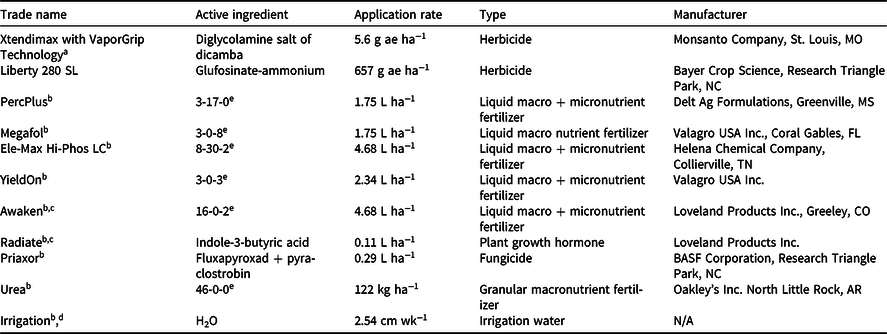
A field experiment was conducted in 2017 and repeated in 2018 and 2019 at the University of Missouri Bradford Research Center (38.89293°N, 92.20113°W) in Columbia, Missouri. The soil was a Mexico silt loam (fine, smectic, mesic Aeric Vertic Epiaqualfs) with 2.7%, 2.1%, and 2.2% organic matter content in 2017, 2018, and 2019, respectively; and a soil pH of 6.4 in 2017 and 6.0 in 2018 and 2019. Glufosinate-resistant soybean were planted into a no-till seed bed on May 30, 2017; May 1, 2018; and May 17, 2019. The indeterminated soybean cultivar ‘MS 4222’ (MorSoy Genetics, Cash AR) was planted in 2017, whereas ‘Becks 424L4’ (Becks, Atlanta, IN) was planted in 2018 and 2019. Each year, soybean was planted at a rate of 346,000 seeds ha−1. Glufosinate (657 g ae ha−1) was applied sequentially to maintain the experiment weed-free until soybean reached the R1 stage of growth. Individual plots were 1.5 by 7.6 m in size with a 1.5-m nontreated buffer on each side to reduce drift and contamination between treatments. All plots, with the exception of the nontreated control (NTC), received 5.6 g ae ha−1 dicamba (Xtendimax with VaporGrip Technology®) applied at either the V3 or R2 stage of growth. Approximately 14 d after injury treatment at V3 or R2, the recovery treatments listed in Table 1 were applied. Recovery treatments were arranged in a randomized complete block design with six replications. Dicamba was applied with a CO2-pressurized backpack sprayer equipped with 11002 Turbo TeeJet® Induction nozzles (Spraying Systems Co., Wheaton, IL) that produced ultra-coarse droplets in order to minimize drift of dicamba to nearby plots. In addition, a drift-reducing agent (On-Target®) was included. All recovery treatments were also applied with a CO2-pressurized backpack sprayer, but the spray boom was equipped with 8002 XR spray nozzles (Spraying Systems Co.) that produce medium to fine droplets in order to maximize coverage on soybean. Both dicamba injury and recovery treatments were applied at 140 L ha−1 and with a pressure of 124 kPa. All sprays were applied with a 1.5-m boom. Urea (46-0-0) with urease inhibitor (Agrotain®; Koch Agronomic Services, Wichita, KS) were applied by uniformly hand spreading the required quantity needed in each plot at a rate of 122 kg ha−1. Weekly irrigation treatments were applied with drip tape (Chapin; Jain Irrigation, Watertown, NY) that emitted water at 3.79 L h−1 in each row of the specified plot. In weeks when rainfall greater than 0.5 cm occurred, irrigation treatments were omitted.
Sources of materials used in the experiment.

a Drift reducing agent (On-Target; Winfield Solutions, St. Paul, MN) was applied at 0.5% vol/vol with dicamba treatments.
b Recovery treatments applied approximately 14 d following V3 or R2 dicamba injury.
c Nonionic surfactant (Induce; Helena Chemical Company, Collierville, TN) was applied at 0.25% vol/vol with Awaken and Radiate.
d Irrigation was applied weekly via drip irrigation, unless rain (>0.5 cm) occurred.
e Nutrient content analysis based on percent N-P-K.
Data Collection
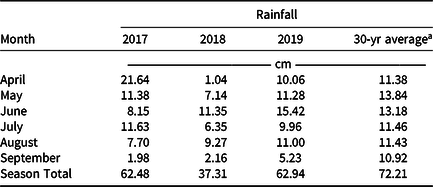
Soybean injury assessments were made 3 wk after recovery treatments were applied. Injury estimates were made visually on a scale from 0% to 100%, as defined by Behrens and Lueschen (Reference Behrens and Lueschen1979) where 0% represents no visible injury present; 1% to 20% represents slight crinkle of terminal leaflets and/or cupping of terminal leaflets and growth rate of soybean appears normal; 21% to 39% represents two or more terminal leaflets are cupped and delayed expansion of terminal leaflet and soybean are stunted; 40% to 50% represents malformed and suppressed growth of at least two terminal leaves or no expansion of terminal leaves, and terminal leaves are less than half the size of noninjured plants; 51% to 70% represents limited terminal growth or terminal bud death and axillary shoot growth that is malformed; 71% to 89% represents limited axillary shoot growth, chlorotic leaves, and some necrosis; and 90% to 100% represents leaves mostly necrotic and plants dead. Soybean height was evaluated by measuring six soybean plants per plot (three from each row) from the soil surface to the top of the soybean growing point 4 wk after recovery treatments. Prior to soybean harvest, a sample of 10 plants was collected (five from each row) and used for yield component analysis. Number of pods and reproductive nodes were determined by taking the average of the 10 subsamples for each respective treatment. Soybeans were harvested with a small-plot combine equipped with a Harvest Master H2 Single Grain Gauge® (Juniper Systems, Logan, UT) and seed yields were adjusted to 13% moisture content. Monthly rainfall totals for each month of the growing season in 2017, 2018, and 2019 are presented in Table 2 along with a 30-yr average obtained from the National Climatic Data Center (2020) for Columbia, Missouri.
Monthly rainfall (cm) from April through September in 2017, 2018, and 2019 in comparison to the 30-yr average in Columbia, Missouri

a 30-yr averages (1981–2010) obtained from National Climatic Data Center (2020).
Statistical Analysis
Data were analyzed using SAS software (version 9.4; SAS Institute, Cary NC) using the GLIMMIX procedure. Least squares means were separated using Fishers protected LSD with P ≤ 0.05. Recovery treatments, growth stage, and year along with their interactions were considered fixed effects. Replication was considered a random effect. Recovery treatment effects on yield, injury, height, and yield components were analyzed by the growth stage (V3 or R2) at which soybean plants were injured with dicamba and year (2017, 2018, 2019), due to significant growth stage and year effects (P ≤ 0.05). Additionally, in order to make conclusions about soybean yield over a wide range of environments and conditions, years and growth stage were combined and considered random effects in the analysis in a separate analysis (Blouin et al. Reference Blouin, Webster and Bond2011; Carmer et al. Reference Carmer, Nyquist and Walker1989).
Results and Discussion
Injury Following Recovery Treatments
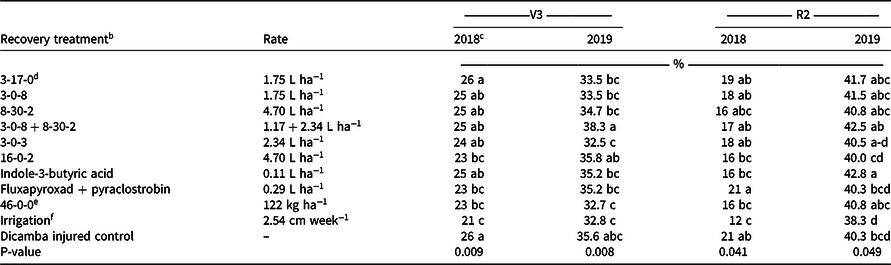
In 2017, there was not a significant effect (P > 0.70) of recovery treatment on soybean injury 3 wk after the V3 or R2 dicamba injury events. However, during 2018 and 2019, there were significant effects (P < 0.05) of recovery treatments on injury following the V3 and R2 dicamba injury events (Table 3).
Soybean injury a in response to recovery treatments applied after dicamba injury at the V3 and R2 stages of soybean growth 3 wk after recovery treatments in 2017, 2018, and 2019.

a Injury ratings on a scale from 0% to 100% based on the Behrens and Lueschen’s Index.
b Recovery treatments were applied 14 d after dicamba injury.
c Years were analyzed separately. F-tests failed to show significance for either soybean growth stage in 2017; therefore, data are not shown. Means within a column followed by the same letter are not different (P < 0.05).
d Nutrient content analysis based on percent N-P-K.
e 46-0-0 was applied with a urease inhibitor (Agrotain®) to reduce nitrogen loss via volatilization.
f Irrigation was applied weekly via drip irrigation, unless rain (>0.5 cm) occurred.
Across all 3 yr of the study, only indole-3-butyric acid applied after the R2 dicamba injury event in 2019 resulted in higher injury than the dicamba-injured (DI) control. Buzzello et al. (Reference Buzzello, Trezzi, Bittencourt, Patel and Miotto2017) also reported transient symptoms of phytotoxicity after an application of indole-3-butyric acid to soybean, but noted that these signs of injury did not result in soybean yield loss by the end of the season. These results indicate that none of these recovery treatments are likely to cause greater injury to soybean than what has already occurred as a result of off-target movement of dicamba.
None of the recovery treatments resulted in lower levels of injury than the DI control in 2017 or 2019. In 2018, weekly irrigation, and applications of 46-0-0 and 16-0-2 fertilizer resulted in less injury than the DI control following dicamba injury at either the V3 or R2 timing. Application of fluxapyroxad + pyraclostrobin also resulted in less injury at the V3 timing, whereas indole-3-butyric acid resulted in less injury following the R2 timing. All other recovery treatments applied after the V3 or R2 dicamba injury event resulted in similar levels of injury as the DI control in 2018. Weekly irrigation provided the greatest reductions in injury at either timing in 2018, with 5 percentage points less injury than the DI control following the V3 dicamba injury event and 9% less injury than the DI control following the R2 dicamba injury event. In 2019, weekly irrigation also resulted in less injury than certain recovery treatments, but it was not different from the DI control. The effectiveness of weekly irrigation as a recovery treatment in 2018 compared with 2017 or 2019 may be attributed to the lack of adequate rainfall that occurred in that year compared with the other two (Table 2). Marple et al. (Reference Marple, Al-Khatib, Shoup, Peterson and Claassen2007) also reported that when rainfall was below average, cotton injury from hormonal herbicides was reduced. In this study, much lower levels of soybean injury were also observed following the R2 dicamba injury event in 2018 compared with either 2017 or 2019. These results indicate that weekly irrigation can reduce dicamba injury symptoms on soybean, especially in a year with below average precipitation during the growing season. In their meta-analysis, Egan et el. (2014) indicated that soil moisture was one of the key factors identified by several authors as influencing the sensitivity of soybean to dicamba. Specifically, that dry conditions increased sensitivity of soybean to dicamba. The results from this research are in agreement with those findings.
Soybean Height Following Recovery Treatments
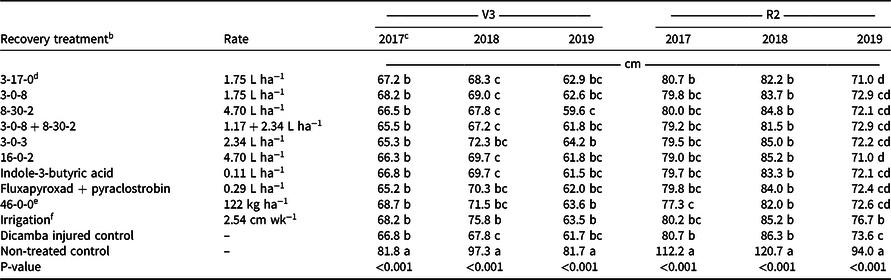
There was a significant recovery treatment effect on soybean height at each growth stage and during each year (P ≤ 0.0001; Table 4). Across all years and growth stages, DI soybean plants were from 16.5 to 39.2 cm shorter than the noninjured, nontreated control. Other authors have also shown similar soybean height reductions in response to increasing dicamba rates (Foster et al. Reference Foster, Griffin, Copes and Blouin2019; Solomon and Bradley Reference Solomon and Bradley2014; Weidenhamer et al. Reference Weidenhamer, Triplett and Sobotka1989) In 2017 and 2019, all recovery treatments applied after the V3 dicamba injury event resulted in similar height as the DI control. This response was also observed in 2018 for all recovery treatments that followed the R2 dicamba injury event. Application of 46-0-0 fertilizer in 2017, and applications of 3-17-0 and 16-0-2 fertilizers in 2019 following the R2 dicamba injury event actually resulted in soybean heights that were lower than those of the DI control, but these responses were not consistently observed across all years of the study and did not correlate with the injury ratings (Table 3) or soybean yield loss (Table 5). Krogmeier et al. (Reference Krogmeier, McCarty and Bremner1989) noted that applications of 46-0-0 fertilizer to soybean can cause foliar necrosis following application, which may have inhibited soybean growth in this study.
Soybean height a in response to recovery treatments applied after dicamba injury at the V3 and R2 stages of soybean growth 4 wk after recovery treatments in 2017, 2018, and 2019.

a Soybean plant heights were taken from the soil level to the top of the soybean growing point.
b Recovery treatments were applied 14 d after dicamba injury.
c Years were analyzed separately. Means within a column followed by the same letter are not different (P < 0.05).
d Nutrient content analysis based on percent N-P-K.
e 46-0-0 was applied with a urease inhibitor (Agrotain®) to reduce nitrogen loss via volatilization.
f Irrigation was applied weekly via drip irrigation, unless rain (>0.5 cm) occurred.
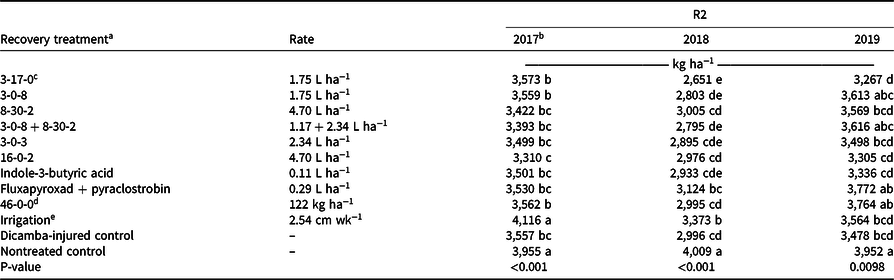
Soybean yield in response to recovery treatments following dicamba injury at the R2 stage of growth in 2017, 2018, and 2019.

a Recovery treatments were applied 14 d after dicamba injury.
b Years were analyzed separately. Means within a column followed by the same letter are not different (P < 0.05).
c Nutrient content analysis based on percent N-P-K.
d 46-0-0 was applied with a urease inhibitor (Agrotain®) to reduce nitrogen loss via volatilization.
e Irrigation was applied weekly via drip irrigation, unless rain (>0.5 cm) occurred.
Weekly irrigation was the only recovery treatment that increased soybean height compared to the DI control, and this occurred only following the V3 dicamba injury event in 2018 and the R2 dicamba injury event in 2019 (Table 4). In 2018, soybean plants were 8 cm taller as a result of weekly irrigation, whereas in 2019, soybean plants were 3.1 cm taller. Weekly irrigation also resulted in soybean plants that were taller than several of the recovery treatments that were evaluated in 2018 and 2019. Weidenhamer et al. (Reference Weidenhamer, Triplett and Sobotka1989) also reported that soybean height reductions resulting from pre-bloom applications of dicamba were greater in 1981 when drought conditions were present, compared with 1980, whereas Korte et al. (Reference Korte, Williams, Specht and Sorensen1983) showed that soybean height is likely to be substantially increased with irrigation treatments at flowering and pod fill, and combinations of flowering, pod fill, and seed enlargement. Collectively, all of these results indicate that some degree of recovery in height following dicamba injury may also be an indication of the ability of soybean to recover its yield late in the growing season.
Soybean Yield Following Recovery Treatments
There was a significant effect of recovery treatment on soybean yield following the R2 dicamba injury event in all 3 yr (P < 0.001; Table 5), but not in any year following the V3 dicamba injury event (P ≥ 0.0675). Overall, there did not appear to be a consistent recovery tactic applied after V3 dicamba injury that resulted in greater yields than the DI control.
In all 3 yr, the NTC produced greater yields than the DI control following the R2 dicamba injury event. Across all years and injury events, weekly irrigation following the R2 dicamba injury event in 2017 and 2018 was the only recovery treatment that resulted in an increased yield compared to the DI control. Overall, yields of DI soybean were lower in 2018, which is likely due to the dry conditions that were present in this year compared with 2017 or 2019 (Tables 2 and 5). For example, rainfall totals during the growing season in 2018 were nearly 25 to 35 cm less than the 30-yr average in 2017 and 2019, respectively (Table 2). Irrigation resulted in a 14% and 11% increase in soybean yield compared to the DI control in 2017 and 2018, respectively. All other recovery treatments resulted in soybean yields that were similar to those of the DI control, except for 3-17-0 fertilizer application in 2018, which actually resulted in a yield that was lower than the DI control. Ashley and Ethridge (Reference Ashley and Ethridge1978) reported that soybean yield increases are likely when irrigation is applied after the R1 stage in soybean. Osipitan et al. (Reference Osipitan, Scott and Knezevic2019) also showed that dicamba applied at 5.6 g ae ha−1 to glyphosate-resistant soybean at the V2 stage yielded 3,700 and 3,100 kg ha−1 at an irrigated versus a nonirrigated site, respectively. Weidenhamer et al. (Reference Weidenhamer, Triplett and Sobotka1989) also noted significant yield reductions for DI soybean during drought conditions compared with the previous year, which received 240 mm greater rainfall during the growing season.
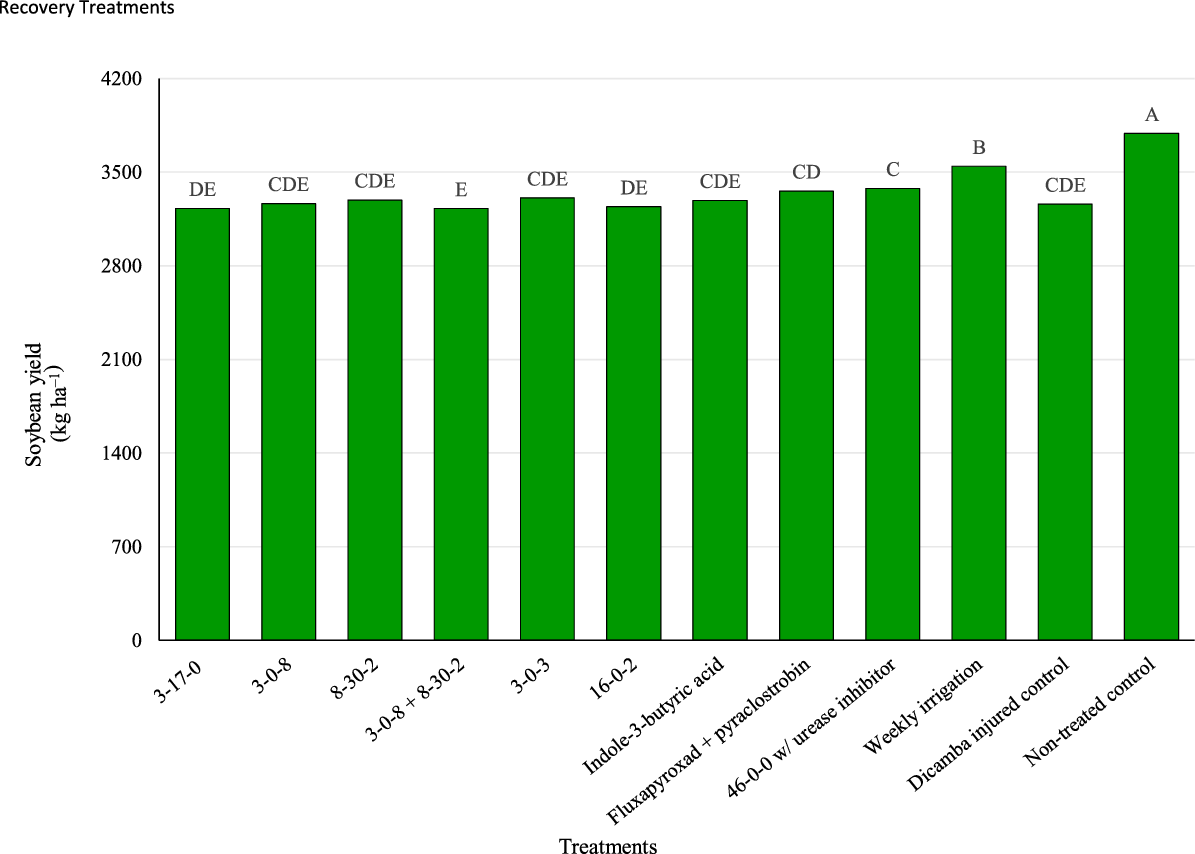
When years and growth stage were combined and considered random effects in the analysis in order to make conclusions over a wide range of environments and conditions (Blouin et al. Reference Blouin, Webster and Bond2011; Carmer et al. Reference Carmer, Nyquist and Walker1989), soybean yield results indicate that weekly irrigation treatments following a physical drift dose of 5.6 g ae ha−1 dicamba resulted in 5.2% increased yield over the DI control (Figure 1). Results reported by Osipitan et al. (Reference Osipitan, Scott and Knezevic2019) found that DI soybean under irrigation had reduced yield loss compared to those in a dryland environment. Collectively, these results confirm that irrigation does have positive yield effects to DI soybeans.
Response of soybean yield from various recovery treatments applied 14 d after dicamba injury. Results are combined across the V3 and R2 growth stage and 2017, 2018, and 2019. Bars with the same letters are not different (P > 0.05)

Soybean Yield Components Following Recovery Treatments
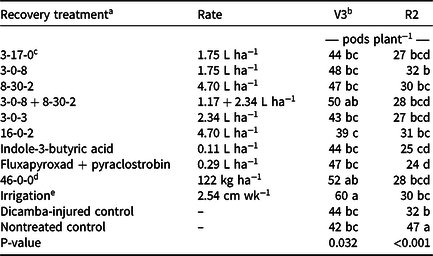
There was a recovery treatment effect on number of pods per soybean plant in 2018 following the V3 or R2 dicamba injury events (P ≤ 0.032; Table 6) but not in any other year of the study (P > 0.134). Overall, far fewer pods per plant were produced in 2018 than in 2017 or 2019 (Table 6). As discussed previously, this response is most likely related to the dry conditions and lower yields that occurred in 2018 compared with any other year of the study (Tables 2 and 5). Rainfall totals during the growing season in 2018 were nearly 35 cm less than the 30-yr average and 25 cm less than both 2017 and 2019 (Table 2). Following the V3 dicamba injury event, weekly irrigation was the only recovery treatment that resulted in more pods per plant compared to the DI or NTC. However, irrigation applied after V3 dicamba injury did not result in higher soybean yields in 2018 (Table 5). When dicamba was applied at the R2 stage in 2018, the DI control produced 32 pods per plant, in contrast to 47 pods produced by the NTC. A reduction in the number of pods per plant resulting from dicamba injury was also noted by Robinson et al. (Reference Robinson, Simpson and Johnson2013).
Soybean pods per plant in response to recovery treatments applied after dicamba injury at the V3 or R2 stages of soybean growth in 2018.

a Recovery treatments were applied 14 d after dicamba injury.
b Means within a column followed by the same letter are not different (P < 0.05).
c Nutrient content analysis based on percent N-P-K.
d 46-0-0 was applied with a urease inhibitor (Agrotain®) to reduce nitrogen loss via volatilization.
e Irrigation was applied weekly via drip irrigation, unless rain (>0.5 cm) occurred.
Results from these studies indicate that soybean injury symptoms and yield loss from dicamba injury varied from year to year, which may have been due to differences in rainfall patterns in 2017, 2018, and 2019 during the growing season. Weekly irrigation provided the greatest ability for soybean to recover from injury symptoms and to increase plant height and yield from dicamba injury at the V3 or R2 growth stage. However, no recovery treatments evaluated in this study, including weekly irrigation, restored soybean yield or height similar to the NTC. The number of pods per plant were not correlated with soybean yield following dicamba injury and recovery treatments. Soybean producers looking for methods to recover potential yield losses resulting from off-target dicamba movement to sensitive soybean should consider irrigation as a viable treatment.
Acknowledgments
We thank Delbert Knerr, Eric Oseland, Mandy Bish, Jake Vaughn, and numerous student workers who assisted with data collection. This research received no specific grant from any funding agency, commercial, or not-for-profit sectors. No conflicts of interest have been declared.