INTRODUCTION
The impact of environmental factors can be expected to be of primary importance in symbiotic interactions. This is likely to be especially true for temperature, which affects all biological and physiological processes, particularly in heterotherms (David et al. 1983). Several studies have demonstrated that temperature affects the outcome of many host-microorganism interactions, notably by affecting the replication rate and/or the level of virulence of microorganisms (reviewed by Thomas and Blanford, 2003). For example, depending on the incubation temperature Parachlamydia acanthamoeba can either exist endosymbiotically with the amoebae they infect or produce lysis (Greub, La Scola and Raoult, 2003). The outcome of symbiosis depends on complex ‘genotype-by-genotype-by-environment’ interactions (Thomas and Blanford, 2003): the host and the symbiont are both subject to the direct effects of temperature, and each displays specific responses, but the response of the symbiotic association also depends on the interactions between the two partners. Consequently, the effects of temperature on the evolution of symbiotic associations are difficult to predict. The situation gets even more complex when multiple symbiotic strains coexist within a single host, because each genotype can respond to environmental changes in a way that will modify both the relationship with the host, and the competitive interactions among symbionts. For example, Nishiguchi (2000) demonstrated that the relative abundance of the two symbiotic Vibrio species that coexist within Sepiola in the Mediterranean Sea is greatly affected by temperature. This means that the differing responses of the symbionts may affect their relative abundance, and thus the outcome of multiple infections.
We studied the effect of temperature on the symbiosis of Wolbachia, one of the most ubiquitous endosymbionts (Ishikawa, 2003). Wolbachia, an α-proteobacteria (Rickettsiaceae), infects a wide range of nematodes and arthropods and alters the reproduction of its hosts in different ways (reviewed by Stouthamer, Breeuwer and Hurst, 1999). Cytoplasmic incompatibility (CI) is the most common effect of this bacterium in insects. This is a sperm-egg incompatibility that occurs in crosses involving a male that harbours at least 1 Wolbachia strain that the female lacks, all other crosses being fertile (see Bourtzis, Braig and Karr, 2003). This mechanism allows infection and multiple infection both to spread and be maintained within host populations (Frank, 1998). The response of Wolbachia density to different temperature conditions is poorly documented (Clancy and Hoffmann, 1998; Hurst et al. 2000), and the specific response of each Wolbachia strain in multiply-infected host species to environmental conditions has not previously been investigated. However, it is known that symbiosis breaks down at both high and low temperatures (Stouthamer, Luck and Hamilton, 1990; Perrot-Minnot, Guo and Werren, 1996; Johanowicz and Hoy, 1998; Van Opijnen and Breeuwer, 1999), and that heat reduces the transmission efficiency of Wolbachia (Hurst, Jiggins and Robinson, 2001), indicating that temperature has a major impact on the symbiotic population. One conclusion of these studies is that curative temperatures vary among host species. Moreover, we do not know how temperature influences the effects of Wolbachia on host reproduction, despite numerous studies highlighting the importance of Wolbachia density for CI expression (Boyle et al. 1993; Breeuwer and Werren, 1993; Sinkins et al. 1995; Bourtzis et al. 1996, 1998; Poinsot et al. 1998; Noda et al. 2001; Ikeda et al. 2003; Veneti et al. 2003).
Here we explore the effects of temperature on Wolbachia density in Leptopilina heterotoma, a parasitic wasp that infests various Drosophila species and is widely distributed in Africa, Europe, America and Asia. Three Wolbachia strains naturally coexist within L. heterotoma individuals (Vavre et al. 1999) and all induce CI (Vavre et al. 2001; Mouton et al. 2005). Temperature changes have a major impact on Wolbachia density, and this has led us to ask 3 questions. (i) Does temperature modify the relative abundance of Wolbachia strains within multiply infected individuals? (ii) How quickly does the response to temperature change occur? (iii) What impact do these changes have on CI?
MATERIALS AND METHODS
Insect biology, strains and rearing
Leptopilina heterotoma (Hymenoptera: Figitidae) is a solitary endoparasitoid wasp infesting several Drosophila species. In this study, we used 3 lines: a triply-infected line, A7(1,2,3), a singly-infected line A7(1), and an uninfected line A7(0). A7(1,2,3) is a highly inbred line originating from Antibes (South of France) obtained by 35 generations of sib-mating, infected by 3 Wolbachia strains: wLhet1, wLhet2 and wLhet3 (Vavre et al. 1999). The A7(1) line that only harbours wLhet1, and the line A7(0) were obtained from a number of generations prior to the experiment by exposing A7(1,2,3) individuals to moderate antibiotic treatments (Vavre et al. 2001). Two other lines harbouring wLhet1 and either wLhet2 (A7(1,2)) or wLhet3 (A7(1,3)) were also obtained, but we failed to obtain lines only infected with wLhet2 or wLhet3 (Mouton et al. 2003).
The parasitoid lines were reared on a Wolbachia-free strain of Drosophila melanogaster originating from Lyon (France). Experiments and rearing were carried out without pre-imaginal competition at several temperatures (14, 18, 20 or 26 °C) under light/dark 12[ratio ]12 and 70% rate of humidity. The fresh weight of all the individuals studied was measured before DNA extraction.
Molecular techniques
We determined the Wolbachia density with real-time quantitative PCR using the LightCycler™ System with the SYBR Green I, a fluorescent DNA binding dye (Roche Diagnostics). Wolbachia were quantified by amplifying the Wolbachia surface protein gene wsp, which is a single-copy gene (Braig et al. 1998). The DNA of all Wolbachia strains was amplified by the general primers 81F, and specific primers were used to determine the specific density of each Wolbachia strain: 169F for wLhet1, 172F for wLhet2 and Het3 for wLhet3. All these forward primers were used with the same reverse primer 691R. The sequences of primers, the DNA extraction and amplification conditions, and the calculation of the number of Wolbachia cells have been described by Mouton et al. (2003). To obtain the relative density we corrected the number of Wolbachia cells by the fresh weight of each insect.
Experiment 1: effect of temperature on Wolbachia density
The A7(1,2,3) line was maintained for at least 3 generations at 14, 18, 20 or 26 °C. Newly-emerged males and females were kept at the same temperature in vials containing honey as food for 5 days before determining their total Wolbachia density, and the specific density of each Wolbachia strain as described above. Five replicates were carried out per sex at each temperature.
Experiment 2: recovery of Wolbachia density
We used the singly-infected line A7(1) to study the response to differences in temperature. We selected 2 developmental temperatures, 20 and 26 °C, because of the low mortality rates observed at these temperatures. Three mothers issued from lines maintained at 20 or 26 °C for many generations, were allowed to parasitize 100 host larvae for 24 h at 20 °C (5 replicates for each developmental temperature of mothers). On the next day, the parasitized hosts were divided into 2 groups, which were reared at 20 and 26 °C respectively (5 vials per temperature). At emergence, 5 female wasps were randomly chosen from each of the 4 temperature-conditioned groups (20-20 °C, 20-26 °C, 26-20 °C, 26-26 °C), and their bacterial density measured as above.
Experiment 3: tests for cytoplasmic incompatibility (CI)
Wasps developed at 20 or 26 °C were used to investigate 2 questions. (i) Do temperature-induced differences in Wolbachia density induce CI between males and females reared at different temperatures? (ii) Does Wolbachia density influence the expression of CI in crosses between uninfected females and males reared at different temperatures?
Crosses were performed using 2 to 3-day-old males and 1 to 2-day-old females (15 replicates per combination). Males were singly-infected A7(1), and females were either (i) singly-infected or (ii) uninfected. Mated females (visual checking) were individually isolated for 48 h at 26 °C with Drosophila larvae issued from 100 eggs (these conditions prevent Drosophila larvae from multiple infestation). Five control host groups were kept uninfested to estimate the natural mortality of Drosophila in the absence of parasitoids. After development, numbers of emerging Drosophila, male and female wasps were recorded in each vial.
In haplo-diploid species, 2 types of CI are expressed: either incompatible fertilized eggs, which normally would develop into diploid females, develop into males like the unfertilized eggs (Male Development type, MD) (Breeuwer and Werren, 1990), or they die (Female Mortality type, FM) (Breeuwer, 1997; Vavre et al. 2001). The mean numbers of males and females emerging enabled us to estimate the level of incompatibility and the percentage of MD type development for each cross (see Mouton et al. 2005).
Statistical analysis
For statistical analysis, the data were tested for departure from normality by a Shapiro test and transformed if necessary, or non-parametric tests were used.
RESULTS
Experiment 1: effect of temperature on Wolbachia density
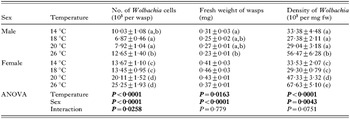
Both the total number of Wolbachia cells per wasp and the Wolbachia density (number of cells per unit wasp weight) vary significantly with temperature, but the differences are greater when expressed in terms of the fresh weight (Table 1). The density is higher in females than in males, but wasps of both sexes harboured almost twice as many bacteria when continuously reared at 26 °C compared to those reared at 18 °C. However, in males, the density is not significantly different at 18 and 20 °C while, in females, at 20 °C the density is intermediate between the densities observed at 18 and 26 °C. In both sexes we can note a surprising decrease of density from 14 to 18 °C, but the difference is not significant, indicating that the density is almost the same at these two temperatures.
Table 1. Effect of continuous rearing temperature on Wolbachia density (Total number of Wolbachia cells/insect, fresh weight of 5-day-old A7(1,2,3) wasps (mean±standard error; 5 replicates by sex and temperature). Statistical analysis by two-way ANOVA (significant effects in bold). Means marked with the same letter are not significantly different by a Tukey/Kramer test (P=0·05).)

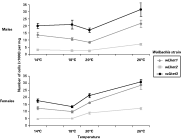
The abundance of all 3 Wolbachia strains was highest at 26 °C in both sexes, but the response of density to temperature varied according to the sex (Fig. 1; ANOVA: F1,113=4·92, P=0·028). We thus analysed the results of the two sexes separately. There was an interaction between temperature and Wolbachia strain in females (ANOVA: strain, F2,48=205·27, P<0·0001; temperature, F3,48=90·73, P<0·0001; interaction, F6,48=2·62, P=0·028): the strain wLhet2 did not have the same response to temperature as the other 2 strains (Fig. 1). We could not study the existence of such an interaction in males because of the absence of normality of the data, but it seems that the same conclusion can be drawn. In males, the density also depended on the strain (Kruskal-Wallis, H2=43·76, P<0·0001) and on the temperature (H3=8·08, P=0·044). However, the order of the abundance of the 3 strains was not affected: at all rearing temperatures, wLhet3 was the most abundant and wLhet2 the least abundant, which is consistent with previous results obtained at 20 °C (Mouton et al. 2003).

Fig. 1. Mean number of cells of each Wolbachia strain per mg fresh weight of 5-day-old triply-infected males and females developed at different temperatures. Values correspond to the average of measures on 5 individuals for each sex×temperature combination. Bars show standard error.
Experiment 2: recovery of Wolbachia density
In order to see how rapidly bacterial density changes in response to temperature, we compared the densities in mothers and daughters reared at different temperatures. As the density of all the 3 strains increases from 20 to 26 °C, we performed this experiment on the only singly-infected line of L. heterotoma available, the line A7(1) infected with the strain wLhet1. We measured the population density at emergence so as to record solely the effects of temperature during the developmental stages of the insects.
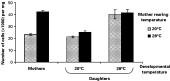
Offspring of fertilized females developed either at 20 or 26 °C were reared at 20 or 26 °C (Fig. 2). In accordance with Exp. 1, Wolbachia density was higher in mothers reared at 26 °C. Comparison between mothers and their daughters reared at the same temperature showed that density was stable (Student's t-test: P=0·811 at 26 °C and P=0·063 at 20 °C). Comparison among daughters showed that the only significant factor was the developmental temperature of daughters, whereas the developmental temperature of their mothers had no effect (ANOVA: mother temperature, F1,16=1·5, P=0·238; daughter temperature, F1,16=64·01, P<0·0001; interaction, F1,16=0·405, P=0·533). Therefore, the density reaches its temperature-specific level within a single insect generation, and the response of the Wolbachia-insect symbiosis to environmental changes takes place within the short egg-to-adult development period.

Fig. 2. Mean number of Wolbachia cells per mg fresh weight of A7(1) mothers and daughters at emergence, after development at 20 or 26 °C (5 replicates by modality). Bars show standard error.
Experiment 3: tests for cytoplasmic incompatibility (CI)
Since Wolbachia density varies with temperature, we wondered what impact this would have on CI expression.
We first tested the compatibility between A7(1) males and females developed at 20 or 26 °C (Table 2A, cross numbers 1–4). The developmental temperature of the males did not influence the development of their offspring, indicating that no CI occurs in crosses between males and females raised at different temperatures. In contrast, the developmental temperature of females does markedly influence the number of offspring and their sex-ratio, according to previous data, demonstrating that 20 °C appears to optimize fitness traits in the A7 L. heterotoma strain (Ris et al. 2004): the male-biased sex-ratio and the offspring number are higher for females developed at 20 °C.
Table 2. Tests for cytoplasmic incompatibility (Results of crosses between A7(1) males and (A) A7(1) females developed at 20 or 26 °C or (B) uninfected females developed at 26 °C. Numbers of Drosophila, numbers of male wasps, total offspring production and sex-ratio as percentage of males (means±standard errors). n, number of couples tested. ‘20’ and ‘26’ correspond to the developmental temperature.)

Secondly, we tested the influence of Wolbachia density in males on the expression of CI (type and level), by crossing A7(0) females reared at 26 °C with A7(1) males developed at either 20 or 26 °C (Table 2B, crosses 5 and 6). The bacterial density of these males was measured and proved consistent with the findings described above (almost twice at 26 °C versus 20 °C, Student's t-test, P=0·025). The same pattern was found in both crosses for all the parameters measured, indicating that the developmental temperature of the males does not influence the CI phenotype. The sex-ratio is highly male-biased, compared to the sex-ratio usually observed in compatible crosses (Vavre et al. 2001), with only very few or no females emerging, indicating that CI is almost complete. Moreover, offspring production was reduced, and the number of males was higher than in control crosses (crosses 1 and 2), which is typical of an intermediate CI between FM and MD types. The estimated proportion of the MD CI type was the same for the two crosses: 24·2±6·4% for cross 5, and 31·8±9·2% for cross 6 (Mann-Whitney test, P=0·522).
DISCUSSION
Temperature affects Wolbachia density to a great extent and with speed, suggesting both that the bacterial population is finely tuned, and that this density is sensitive to temperature.
We demonstrated, firstly, that the highest Wolbachia density was observed in L. heterotoma individuals reared at 26 °C: at this temperature, wasps harbour approximately twice as many Wolbachia than males developed at 18 °C, which can affect the host fitness according to previous studies (McGraw et al. 2002; Mouton et al. 2004). Divergent results have previously been reported in 2 Drosophila species: in D. bifasciata, eggs from females maintained at 18 °C harboured more bacteria than eggs from females maintained at 26 °C (Hurst et al. 2000), and in D. simulans, the density of Wolbachia in embryos was lower after exposure to 25 °C than in individuals exposed to 19 °C (Clancy and Hoffmann, 1998). This latter case is interesting since D. simulans is infected by the Wolbachia strain wRi, which is closely related to the wLhet1 strain studied here: these 2 strains share identical sequences for all genes so far studied, notably the wsp gene (Vavre et al. 1999) and the ORF7 capsid gene (Gavotte et al. 2004). Their differing responses to temperature changes may suggest that host factors are important in the response of Wolbachia density to environmental factors. A second finding is that temperature differences do not affect the relative abundance of the 3 Wolbachia strains, and the density of each one is the highest at 26 °C.
In attempting to explain these results we must remember that the response of Wolbachia density to environmental conditions results from complex genotype-by-genotype-by-environment interactions, thus allowing for multiple interpretations. Indeed, the effect of temperature will act both directly on the two partners and on their interaction. (i) A direct effect will, on one hand, influence the growth rate of the bacterium and, on the other hand, the insect physiology. Unfortunately, the optimal temperature for Wolbachia is not known since its determination would require culturing the bacterium outside any living entity (host or cell lines). On the host side, temperature modifies host physiology (i.e. the amount of fat reserves) and hence the amount of nutrients available for the growth and division of the bacteria, which is often a limit for the symbiotic population (Douglas, 1994). However, the highest bacterial density is reached at 26 °C, whereas the largest adult L. heterotoma are produced at lower temperatures (Ris et al. 2004; present results). This implies that the host resources for Wolbachia are probably not maximum at 26 °C, but ‘qualitative’ changes of the nutrients available to these bacteria might explain these apparently discordant findings. (ii) Temperature may affect the interaction between the host and its symbiont as well, by acting on the host's ability to regulate bacterial population density. Since the developmen-tal performance of L. heterotoma is reduced at 26 °C, it could be that its capacity to regulate Wolbachia density is lowered at this temperature. When this is combined with a high growth rate of the bacteria at this temperature, it could explain the high bacterial density found at 26 °C.
Studying the impact on the expression of CI helps to elucidate how changes in bacterial density may affect the symbiotic association in the field. First, there is no incompatibility between males and females reared at different temperatures, indicating that changes in Wolbachia are not enough in themselves to induce CI among infected individuals. Second, there is no difference in the CI type or level induced by males developed at 20 or 26 °C. However, the impact of Wolbachia density on the expression of CI has been underlined in other species (reviewed by Bourtzis, Braig and Karr, 2003). In L. heterotoma, CI is complete and Wolbachia density probably exceeds a threshold level above which the bacterial density and CI level are no longer correlated (Perrot-Minnot and Werren, 1999). If this is the case, this species might not be the ideal one for testing the effect of density on the expression of CI, and it is still conceivable that in other species changes in density due to environmental changes could affect the expression of CI.
Clearly, temperature affects the within-cell Wolbachia density in hosts. Even though we did not detect any impact of density on the expression of CI in L. heterotoma, many authors have reported such relationships in other insect species, and recent findings indicate that Wolbachia density is also correlated with the infection cost paid by the host (McGraw et al. 2002; Mouton et al. 2004). Thus, temperature could have indirect effects on most features of Wolbachia-host associations, and this has not been considered so far. We may predict that the effects of temperature will depend on the host strains and species, and on the Wolbachia strains involved. Since all previous experimental studies on the effects of Wolbachia on their hosts have been performed at single fixed temperatures, the general applicability of their conclusions and the soundness of comparative analyses have to be reconsidered.
Finally, our findings suggest that considerable spatial and/or seasonal differences in Wolbachia densities could occur in the wild, and clearly field data are needed. Indeed environmental conditions can influence the dynamics of infection in wild populations, the evolution of the association of Wolbachia with their hosts, and consequently, the ability to adapt and the evolution of the hosts themselves.
We thank D. Charif for assistance in statistical analysis. This study was partly supported by Centre National de la Recherche Scientifique (IFR 41-UMR5558).