In Gadigal country on 26 January 1788, “the [British] Governor, with several of his principal officers and others, assembled round the flag-staff, drank the king's health, and success to the settlement.”Footnote 1 On 7 February, British colonial rule was formally declared with the public reading of Captain Arthur Phillip's commission, confirming him as his Majesty's “governor in chief in and over the territory of New South Wales.” That territory extended “along the coast of this continent to such parts of it solely as were navigated by Captain Cook [in 1770], without infringing on what might be claimed by other nations from the right of discovery.”Footnote 2 Following this public reading, Governor Phillip “entertained all the officers and gentlemen of the settlement at dinner, under a large tent pitched for the purpose at the head of the marine encampment.”Footnote 3 Celebrating the formalization of their invasion, these officers drank and dined in Warrane, a place that they would call Sydney Cove, just up the coast from Kamay, where Cook first landed, naming the site Botany Bay. Fulfilling a similar function to naming, dining was a performance of a European culture of polite sociability, a cultural embodiment of their claim to the sovereign land of the Eora nation.
Polite manners united the elite and middling sorts, and polite taste symbolized Britain's commercial modernity.Footnote 4 In a culture intended to display superiority, the polite self was a racialized as well as classed identity that was deeply entangled with slavery.Footnote 5 It was also a mode of settler colonial power. Typically associated with metropolitan spaces, politeness, when viewed from the perspective of the eighteenth-century colonial frontier, becomes a cultural articulation of what Aileen Moreton-Robinson defines as “white possessive logics”: the process whereby possession of First Nations’ land relies upon the cultural reiteration of a whiteness that “operates possessively to define and construct itself as the pinnacle of its own racial hierarchy.”Footnote 6
Denying Indigenous subjectivity and sovereignty by representing their own epistemology as universal, the politeness of First Fleet officers cast them as the embodiment of modern civilization. This, in turn, enabled them to justify (to themselves and other Europeans) violent dispossession on the grounds of an Enlightenment-defined progress. As a cultural practice intended to display European civility and humanity, politeness represented shared manners and customs among the invading officer class. As in the metropole, it was both individual and collective, and naval officers’ dining was a masculine expression of politeness that, Amanda Vickery explains, was “exclusive and ceremonious.” While sometimes mixed-sex, dining was often followed by “an interlude of heavy drinking and toasting” among men.Footnote 7 Although not all men indulged in alcohol, these rituals of dining and drinking were crucial to male bonding, a masculine equivalent of the genteel feminine tea table.Footnote 8 On the voyage to Warrane/Sydney, Lieutenant Ralph Clark recorded that some officers drank punch until the early hours of the morning.Footnote 9
Not the only expression of eighteenth-century elite culture, politeness could coexist alongside bawdy and libertine behavior, and officers’ homosocial dining was likely as convivial as it was polite.Footnote 10 Yet its symbolic importance as a display of an interiority of civility and a collective cultural performance of European modernity indicates that convivial and polite sociability were not mutually exclusive. In Scottish Enlightenment thought, politeness was the social performance of the final stage of human progress.Footnote 11 Convivial and polite sociability, transported far from urban centers to the land of the Eora nation, provided a common European imperial language. As Captain John Hunter noted of their stop in Tenerife during the voyage of the First Fleet to Warrane/Sydney, they were “very hospitably and politely entertained” by the governor, and Hunter noted that he had “never met with so polite and so pleasant a man in any foreign port I have ever visited.”Footnote 12
In this case study of Warrane/Sydney, the processes by which “native” was imposed as a trans-imperial category is starkly apparent. Less obvious, but crucial to this process, was the rendering of politeness as a white colonial identity via the reiteration of transoceanic metropolitan norms.Footnote 13 As a display of wealth and luxury, politeness was, as Hannah Greig has explored, crucial to the performance of power by Britain's ruling class.Footnote 14 It was also crucial to Britons’ justification of colonial occupation at the end of the eighteenth century. Enlightenment ideas of civility, improvement, and progress connected metropolitan and colonial worlds and were themselves shaped by encounters and conflict with non-European people.Footnote 15 Adopting a transoceanic approach, Kate Fullagar and others have drawn attention to the interconnected character of Pacific and Atlantic imperial worlds.Footnote 16 Reflecting this imperial interconnectivity, many First Fleet officers served in other imperial locales before arriving in Sydney, and these experiences informed their enactment of colonial power.Footnote 17 In this context, the colony established on Gadigal land can be framed as an outpost of the British (and European) imperial world rather than early Australia. This reframing allows a better understanding of events in Warrane/Sydney in the context of a colonial culture forged by Enlightenment epistemology and—even accounting for the loss in 1783 of the American colonies—a significant expansion of the British Empire in the wake of the Seven Years’ War.
Robert Dixon's 1986 study of neoclassical art, literature, and architecture in early Australia revealed how the early Sydney colony was understood by colonizers as “two distinct stages of human development brought together at one place and time.”Footnote 18 This was a constitutive relationship; ideas of race, including whiteness, were formulated as much as they were enacted in colonial space. As in the European colonial contexts explored in a 2017 volume on Enlightenment and colonialism, the British occupation of Warrane/Sydney reveals how the aim to civilize and assimilate Indigenous peoples to European norms “constructed colonial hierarchies based on civilization, ethnicity and race.”Footnote 19 The Enlightenment was, as Charles W. J. Withers has shown, globally and “geographically constituted,” and the British invaders’ depictions in journals and drawings of Indigenous people alongside the landscape, flora, and fauna of Warrane were mediated by and contributed to the development of Enlightenment knowledge.Footnote 20
The historiography on the Scottish Enlightenment increasingly recognizes the impact of imperial expansion on knowledge formation, yet this scholarship remains predominantly colonial in approach. For example, in the introduction to a 2018 special issue, “Enlightenment and Empire,” in the Journal of Scottish Historical Studies, Native Americans are included but are largely treated as a static and generic category with no voice or agency, and, with the exception of John Reid's study of Scottish interactions with the Mi'kmaq, the same is the case with the articles that address North America.Footnote 21 An integration of Indigenous histories and the violence of settler colonialism is also missing from Cairns Craig's otherwise impressive study of the transmission of Scottish ideas that reshaped “the intellectual landscape as effectively as the transport of plants was reshaping the physical landscape.”Footnote 22 In the same volume, John Mackenzie's study of empire and the environment does acknowledge Scots’ involvement in the “violent and destructive colonial campaigns” that were part of this process.Footnote 23 However, in the main, although this historiography recognizes the influence of ideas about First Nations people on Scottish Enlightenment philosophy, these complex and varied cultures are rarely considered beyond the reductive myths the Enlightenment created about them. Correspondingly, the connections between these myths and the violence enacted upon First Nations peoples are often ignored.Footnote 24
Just as ideas of blackness were, as Andrew S. Curran emphasizes, “more a shifting mosaic than a fixed portrait,” there was no uniform idea of the “native.”Footnote 25 As Shino Konishi's study has revealed, “the ambivalences and contradictions in explorer representations of indigenous people” were themselves indicative of “the Enlightenment's ambivalence toward the non-European world.”Footnote 26 Despite ambivalence, within this process the normativity of Enlightenment epistemology and European culture was reinforced rather than questioned. Comparing his first impressions of Dharawal people in 1788 with the observations of Cook and Joseph Banks in 1770, Captain Hunter reflected, “I think it is observed in the account of that voyage, that at Botany-bay they had seen very few of the natives, and that they appeared a very stupid race of people, who were void of curiosity. We saw them in considerable numbers, and they appeared to us to be a very lively and inquisitive race.”Footnote 27
In both instances, the Dharawal were defined according to Enlightenment norms of reason and intellect. Whether they were judged as stupid or inquisitive is irrelevant; they were racialized and judged according to an epistemology that denied their own. This racialization within white discourse, Moreton-Robinson argues, was and is crucial to the ongoing process of dispossession.Footnote 28
The polite whiteness that First Fleet officers imported from Europe was articulated and reinforced in comparisons with the Eora, Dharawal, and Dharug people, who were depicted through the lens of Enlightenment myths of stadial progress—the idea that all societies progress at some point from a savage to a civilized state, the latter symbolized by European commercial urbanity.Footnote 29 Addressing the influence of stadial theory, John Gascoigne's examination of the Enlightenment in Australia emphasized agricultural progress, or “improvement,” in Enlightenment parlance.Footnote 30 Agreeing with Gascoigne that the primary manifestation of Enlightenment ideas in early colonial Australia was a commitment to “improvement,” in what follows, I extend this analysis to its key cultural manifestation: politeness.Footnote 31
In her 2009 study of early Sydney, Grace Karskens touches on polite culture, but the scope of her project precluded a full exploration of the ways in which this culture operated in 1790s Warrane/Sydney and its relationship to Enlightenment thought.Footnote 32 To explore this colonial culture, I utilized commissioned and personal accounts by First Fleet officers, which reveal the influence of Enlightenment ideas on the ruling naval elite, particularly Scottish Enlightenment stadial history and related notions of European civility and sociability. In her 2005 examination of the First Fleet accounts, Inga Clendinnen misunderstood this influence and so neglected the full epistemological context of these narratives and repeated their universalizing myths.Footnote 33 If these journals are instead read critically as a form of polite self-fashioning and display, what Soile Ylivuori posits as a “technology of the self,” they can be understood as active agents in the construction and dissemination of a racialized polite modernity rather than passive evidence of colonial realities.Footnote 34 They depict the ideal of polite civility that the First Fleet officers sought to embody as they sought to possess the land.
In the preface to his account of the colony, Lieutenant-Governor David Collins wrote that he hoped “through the humble medium of this history, the untutored savage, emerging from darkness and barbarism, might find additional friends among the better-informed members of civilized society.”Footnote 35 In the colonists’ minds, they inhabited a frontier space. Although the landscape and Eora way of life had changed significantly over the centuries, Europeans viewed this land as indicative of an unchanged “savage” state, a world at the first stage of progress.Footnote 36 They misread the landscape because the Enlightenment metanarrative of progress—that to them justified their occupation—required them to do so, whether they were sympathetic toward the Eora people or not.
Displaying a direct engagement in Enlightenment debates about the nature of Indigenous societies, Collins discussed the “well-known humanity” of (previously captain, then governor) John Hunter and assured readers that he would “not fail to secure the savage islander from injury or mortification; reconcile him to the restraints, and induce him to participate in the enjoyments, of civilized society; and instruct him to appreciate justly the blessings of rational freedom, whose salutary restrictions are not less conducive to individual benefit than to the general weal.”Footnote 37 With this statement, Collins explicitly justified the British occupation using Scottish Enlightenment notions of humanity and improvement while also pointing to Rousseau's philosophy concerning the chains, or constraints, of civilization. Emphasizing the overall benefit of European civilization, Collins wrote of “civilized society.” This reflects the importance placed on sociability by philosophers such as David Hume and, as he did, simultaneously denies it to Indigenous peoples. Developing the Enlightenment myth of universal progress in his essay “Of Refinement in the Arts,” Hume described the connection between sociability and civilization while refusing sociability to “ignorant and barbarous nations” along with the humane sympathy it engendered:
The more these refined arts advance, the more sociable men become: nor is it possible, that, when enriched with science, and possessed of a fund of conversation, they should be contented to remain in solitude, or live with their fellow-citizens in that distant manner, which is peculiar to ignorant and barbarous nations. They flock into cities; love to receive and communicate knowledge; to show their wit or their breeding; their taste in conversation or living, in clothes or furniture. Curiosity allures the wise; vanity the foolish; and pleasure both. Particular clubs and societies are everywhere formed: Both sexes meet in an easy and sociable manner; and the tempers of men, as well as their behaviour, refine apace. So that, beside the improvements which they receive from knowledge and the liberal arts, it is impossible but they must feel an encrease [sic] of humanity, from the very habit of conversing together, and contributing to each other's pleasure and entertainment.Footnote 38
A cultural expression of Enlightenment ideas of civility and civilization that inscribed whiteness, the polite sociability that Hume celebrated forged a new masculinity that was as present in the colonies as the metropole. Eighteenth-century didactic literature, like that of the Reverend James Fordyce or, more contentiously, the Earl of Chesterfield, and the moral philosophy of Hume, Adam Smith, and others presented the ideal polite enlightened gentleman as a man possessing an ease of manner and having sympathy with others. Whether this was affected behavior or founded upon inner virtue (an important debate over the course of the century), politeness was performed through controlled and gendered social interactions.Footnote 39 In her recent study of English women's negotiation of politeness, Ylivuori has shown it to be a powerful but heterogeneous concept, adaptive to circumstance and individual inclination.Footnote 40
Collins's account was commissioned by the London publishers Caddell and Davies, and it is a self-consciously polite text for a British readership. (In the text, Collins makes no mention of his sexual relations with female convicts, for instance.Footnote 41) Like the urban spaces that were imposed on Warrane/Sydney during the first decades of the colony, First Fleet officers’ accounts are constructions of civility via membership in, and performance of, polite culture. Significantly, this polite subjectivity informed a sympathetic attitude toward the Eora and surrounding nations that negated the opportunity to perceive their culture as equal.
The intersection of Enlightenment, colonial violence, sociability, and sympathy at the end of the eighteenth century was embodied by Sir Joseph Banks. A botanist on Cook's exploratory Endeavour mission, which operated, in Gananath Obeyesekere's apt description, as “a floating laboratory,” Banks participated in the invasion of Kamay in 1770.Footnote 42 Later, the viewing of Pacific objects in his Soho Square home connected that world to the metropole and to metropolitan sociability.Footnote 43 Prior to his move to Soho Square, Banks had hosted Mai, a Ra'iatean man who arrived in London in 1774 aboard the Adventure, which accompanied Cook's Resolution on his second great voyage.Footnote 44 Though sometimes satirized, Banks rose in social and political power following the Endeavour mission, becoming head of Kew Gardens and president of the Royal Society. Along with other imperial schemes, he encouraged the 1788 invasion of Eora country, oversaw the settlement, and later planned Matthew Flinders's circumnavigation of “Terra Australis.”Footnote 45 From Banks's Endeavour mission to Flinders's 1801–1803 voyage and beyond, imperial expansion and Enlightenment exploration were accompanied by violent conflict with First Nations people where, to quote Ann Salmond, referring to the Endeavour mission, “[t]he British had great faith in their muskets and guns.” Footnote 46 Indicating his polite sensibility in the face of this colonial violence, Banks reflected on the killing of nine Māori on 8 October 1769 as a “most disagreeable day.”Footnote 47 This sympathetic emotional response deflected moral responsibility by reinforcing the polite civilized self.
Like Banks on the beach, the officers of the First Fleet embodied the relationship between colonial violence, sympathetic politeness, and Enlightenment in frontier space. The performance of civility via a culture of politeness was crucial to the maintenance of the myth of European superiority and, by extension, justification of the British occupation of Warrane during a period when the Haitian revolution gave material force to emerging critiques of European imperialism.Footnote 48 As Jack P. Greene has observed, many metropolitan Britons dealt with the contradiction between a national identity built on liberty and the denial of liberty to colonial subjects by deploying the language of humanity. Against growing criticism of Asiatic plunder, defenders of the colonial project drew on earlier arguments that trade and empire were “devices for extending the civility and humanity of Britain to the unbelieving and savage worlds of America, Africa, and Asia.”Footnote 49 This Enlightenment humanitarian discourse traveled with the invaders to Eora country and in modified form continued to influence settler colonialism across the continent over the nineteenth century.Footnote 50
Politeness was the cultural manifestation of the “soft colonialism” outlined by Karskens, whereby “[w]arm clothes, abundant food and drink, snug houses, tools and trinkets would do the work of colonization and dispossession.” However, as she emphasizes, the proffer of European civilization was always backed by the power of guns, and conflict quickly ensued once the white invaders overstayed their welcome and sought to extend the colony beyond Warrane.Footnote 51 Although justified via an Enlightenment concept of civilization rather than Protestant providentialism, this echoed a pattern of colonization previously manifested in early seventeenth-century North America on the lands of the Powhatan Confederation.Footnote 52 The primary difference was epistemological and represents a shift from religious to secular justifications for empire, indicating the impact of Enlightenment ideas on the colonizers.
Suggestive of this process, the governor's house and those of officials such as Lieutenant Governor Collins were given priority over the building of a church, which was not completed until 1793. These houses enabled officers to maintain polite social norms in New South Wales, and it appears that the creation of comfortable domestic spaces for the officer class was prioritized over other building as well. One marine officer complained, “An elegant brick house is built for the Governor, and another of hewn stone for the Lieut. Governor” but “hospital not yet half-finished,” and stores “now in a tottering condition.”Footnote 53 Though elegant houses in which officers could entertain were not as practical for the day-to-day running of the colony, they were essential to colonial power. They provided space for the social performance of politeness and displays of civility that separated the officer class from convicts, plebeian sailors and marines, and Eora people.
Urban civility as a means of colonial control was signaled by Governor Phillip's attempts to impose an ordered, neoclassical street plan on Warrane.Footnote 54 This was achieved following the arrival of Governor Lachlan Macquarie and his wife, Elizabeth Henrietta Campbell, in 1809. Polite architecture was successfully imposed on the town, Enlightenment ideas were written on the landscape, and order was enforced through the establishment of police districts.Footnote 55 This process was similar to that occurring in “improving” Scottish towns, but the character of control was different. In Warrane/Sydney, there was less of the community cohesion that promoted order in Scottish towns, and plebeian culture was not the only focus of control.Footnote 56 Here urbanity also symbolized a denial of Eora sovereignty by displaying a European myth of universal stadial progress.
Significantly, the first governor to achieve an ordered town, Macquarie, was also the first to wage organized and efficient military assaults around the Warrane/Sydney area, ending the initial First Nations’ war of containment against settlers.Footnote 57 Drawing on extensive service in India, and authorizing the murder of Indigenous people who would not surrender to British rule, Macquarie explained to Earl Bathurst, though he endeavored “to domesticate and Civilize these Wild rude People,” their “Open Hostility” meant that “it will be absolutely necessary to inflict exemplary and severe punishments on the mountain tribes who have lately exhibited so Sanguinary a Spirit against the Settlers.” His aim was “to Strike them with Terror,” and he reflected, “However painful, this Measure is Now become Absolutely Necessary”Footnote 58 Stephen Gapps describes these exemplary punishments as including the hanging of men's bodies from trees. In tune with gendered polite sensibilities, Macquarie ordered his officers to avoid killing women and children, and, if they did kill them, to not hang their bodies.Footnote 59 In the context of frontier war, the racialized limits of Enlightenment sympathetic humanity were catastrophic. Among many other deaths, Macquarie's orders resulted in the Appin massacre of 17 April 1816, when at least fourteen people were killed after Captain Wallis and his men attacked a campsite in Muringong country.Footnote 60 Displaying the inner sensibility that Scottish moral philosophers deemed should underpin politeness, and echoing Banks in 1769, Wallis reflected that the massacre was a “melancholy but necessary duty.”Footnote 61
As in the metropole, the polite self was formed through social interaction, and politeness remained a central organizing principle of elite society in colonial frontier space. The transference of this culture can be gleaned from the interactions of the white settler elite. Take, for example, a conflict in 1803 between Banks's botanist, George Caley, and Captain Kemp of the New South Wales Corps, who “had been to England and lately returned, and was newly married and set up his curricle.” Kemp was insulted when Caley impolitely failed to remove his hat when passing him on the road from Sydney, and he held up his whip in a threatening manner in response. This, in turn, insulted Caley, who wrote to Banks that he considered Kemp a “conceited coxcomb.”Footnote 62
Crucial to social cohesion among the white elite, polite culture in colonial space could be a source of tension, and it was restricted. This culture, typically associated with the urban realm of assembly rooms, booksellers, theaters, ordered squares, and promenades, sits uneasily alongside the image of a harsh, remote penal colony.Footnote 63 Yet, as Alan Frost has argued, the historiographical figuring of the colony as a “brutal society” ignored the high level of organization of convict transport and the support from London and other connected imperial locales.Footnote 64 The emphasis on the penal context belies the extent to which metropolitan culture was imposed on the Warrane landscape, an act that continues to materially signify white possession. In Moreton-Robinson's words, in settler colonial spaces, this imposition aims to disavow the “omnipresence of Indigenous sovereignties.”Footnote 65
This disavowal was enabled by Scottish Enlightenment epistemology. Ideas of stadial progress caused the officers of the First Fleet to imagine their destination as savage in contrast to European and more established colonial spaces that were figured as polite and civil. On leaving Cape Town on the voyage to Eora country, Collins reflected,
The land behind us was the abode of a civilized people; that before us was the residence of savages. When, if ever, we might again enjoy the commerce of the world, was doubtful and uncertain. The refreshments and the pleasures of which we had so liberally partaken at the Cape, were to be exchanged for coarse fare and hard labour at New South Wales . . . at the close of the evening we spoke a ship from London. The metropolis of our native country, its pleasures, its wealth, and its consequence, thus accidentally presented to the mind, failed not to afford a most striking contrast with the object now principally in our view.Footnote 66
That contrast could itself pose a risk to the civility called upon to legitimate the British occupation. Penny Russell has examined nineteenth-century British colonists’ fears that squatters’ typically “comfortless, hand-to-mouth” existence on “pastoral frontiers” threatened the “cultivated manliness” that enabled Indigenous people to be figured as a “reassuring mirror image” supporting the metanarrative of European superiority.Footnote 67 The fear that the colonists might become “savage” was apparent from the outset, and it was figured within the discourse of politeness and improvement. After Spanish explorers were permitted to set up an observatory on the cove in March 1793, Collins wrote, “The arrival of these strangers, together with that of the ship from Bengal, gave a pleasant diversity to the dull routine that commonly prevailed in the town of Sydney; everyone striving to make their abode among us as cheerful as possible, and to convince them, that though severed from the mother country, and residing in woods and among savages, we had not forgotten the hospitality due to a stranger.”Footnote 68
Collins's assertion that the colonists had maintained civility also offered London readers a counternarrative to representations of Sydney as a harsh colonial space. In a 1796 parliamentary speech defending slavery, Sir William Young, a plantation owner and, from 1807, governor of Tobago, questioned the “justice and humanity” of an abolition act that would expose “innocent” West Indian proprietors to convict transportation to Botany Bay—a severe punishment, to Young's mind, for “a Gentleman of education, of rank in society, of polished manners, and of extensive connections.”Footnote 69 As it happened, when gentlemen of rank were sent to the colony as convicts, as was the case with the Scottish radical and lawyer Thomas Muir, they could live relatively freely within the confines of the colony and participate in its limited polite society, including dining with high-ranking naval officers.Footnote 70 However, for Young, Botany Bay represented an uncivilized place in comparison to the Caribbean. As Kathleen Wilson has discussed in relation to Jamaica, “the conspicuous consumption, extravagant hospitality and notorious brutality of the plantocracy” were all integral to performance of social power that maintained “the distinctions of rank, class, caste and race on the island.”Footnote 71 Young's depiction of the Sydney colony as uncivilized and Caribbean plantation society as a place for “polished manners” illustrates the intertwined metropolitan and colonial contexts in which notions of politeness and civility were formed and performed alongside brutal violence.
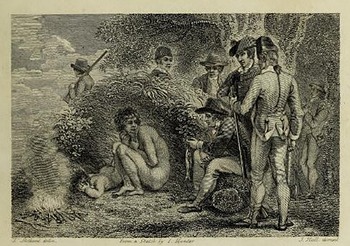
The performance of an Enlightenment civilizing mission founded upon freedom (from savagery) and progress (to civility), and its use in the reiteration of difference, assertion of colonial power, and construction of racial hierarchy in Warrane/Sydney, can be gleaned from Alexander Hogg's 1793 print (figure 1) that records the British officers’ short expedition to observe an Eora woman suffering from smallpox.
Alexander Hogg, Captains Hunter, Collins & Johnston with Governor Phillip, Surgeon White &c. visiting a distressed female native of New South Wales at a hut near Port Jackson, engraving, plate facing p. 19, in Michael Adams, The New Royal System of Universal Geography [. . .] (London, 1793).

This smallpox (or gal-gal-la) outbreak in 1789 had killed large numbers of Eora people, but it did not, as is often assumed, destroy the population who, as Paul Irish has shown, regrouped via familial connections with other people of the New South Wales coastal region.Footnote 72 In Hogg's print, the officers look down at a young naked woman suffering the effects of the disease. This event was recorded as a sympathetic exchange by Captain Hunter, who recalled,
Information was immediately brought to the governor, and we all went to see this unhappy girl, whom we found, as I have already observed, just recovered from the small-pox, and lame: she appeared to be about 17 or 18 years of age, and had covered her debilitated and naked body with the wet grass, having no other means of hiding herself; she was very much frightened on our approaching her, and shed many tears, with piteous lamentations: we understood none of her expressions, but felt much concern at the distress she seemed to suffer; we endeavoured all in our power to make her easy, and with the assistance of a few expressions which had been collected from poor Ara-ba-noo while he was alive, we soothed her distress a little.Footnote 73
Hunter's account was published in 1793 by London publisher John Stockdale, who had also published accounts of Cook's voyages and, in 1789, The voyage of Governor Phillip to Botany Bay. In Hunter's text, he depicted himself and fellow officers as enlightened humanitarians: men who were occupying Eora country in the spirit of friendship, bringing civilization and civility with them. However, look at the woman in the images and note Hunter's description of her tears. Hunter probably included this imagery to highlight her innate sensibility (an eighteenth-century trope regarding women and the feminine), but from the Eora woman's perspective, the event can be read as a terrifying experience. In Hogg's print, the men are standing over the young Eora woman and her baby, clothed as if they might be on a country ramble while she is naked. This is an image of an unequal and violent power exchange.
Deirdre Coleman reads the event as one that presents Hunter and his fellow officers as gallant and operating in an alternative manner to Governor Phillip's forced kidnapping of Eora men. Yet, Coleman emphasizes, by displaying gallantry and tenderness, the episode “reveals Hunter's powerful investment in colonization” as a chivalrous project.Footnote 74 Indicative of ambivalence and inconsistency in European perceptions of Eora people and the impact of colonial occupation, the print of the image that Coleman discusses depicts the scene somewhat differently from that of Hogg. The earlier print (figure 2), based on Hunter's sketch and published as a title page vignette in his 1793 Historical Journal, depicts a more egalitarian exchange, portraying one man sitting on a log at level eyesight with the woman. The slight difference in power exchange is apparent when the images, published only eight months apart, are viewed alongside each other.
John Hall, after Thomas Stothard, based on a sketch by Hunter, title page vignette in John Hunter, An Historical Journal of the Transactions at Port Jackson and Norfolk Island Including the Journals of Governors Phillip and Kings Since the Public of Phillip's Voyage (London, 1793).

Although the differences speak to a tension between romantic views of the Eora and a more explicit assertion of European superiority, both prints employ notions of sympathy to emphasize civility and justify the colonial project as an enlightened one. Crucial to this justification, the presence of Europeans was considered “improving.” As Gascoigne explains, New South Wales “came under European domination in an age energized by the possibilities of ‘improvement,’” of land, industry, institutions, and human nature.Footnote 75 Sympathy and civility underpinned the polite self who represented the cultural refinement, or progress of manners, that defined British commercial civilization.
As Onni Gust has explained, when Adam Smith developed his philosophy of sympathy, he denied its applicability to “savages” due to assumptions about their material culture, rendering it “a particular attribute of whiteness.”Footnote 76 Though universalist, Smith's theory was hierarchical, placing “the “savage” and the “civilized” at the two opposite ends of the material, gendered, and emotional spectrum.”Footnote 77 In these ideological and material contexts, officers’ sympathetic politeness became a display of assumed cultural superiority. In his recent study, Robbie Richardson demonstrated that British cultural representations of North American First Nations defined modernity “in imagined scenes of cultural contact” with the “savage,” and “imaginative and real encounters with Native people were crucial to European self-imagining.”Footnote 78 In Warrane/Sydney, a similar process occurred, as these encounters enabled the actuation of the polite self.Footnote 79
Unlike the denial of femininity that was a feature of what Rana Hogarth has aptly described as “antiblackness,” Indigenous women were perceived as innately feminine in line with the assumption that their “savage” society could be “civilized.”Footnote 80 By recording that they treated Eora women with sympathy and gallantry, the First Fleet officers defined their masculinity as superior to that of Eora men. Suggesting a strong familiarity with stadial history, in their accounts of the colony, officers regularly discussed violence against women in Eora culture. Despite Clendinnen's treatment of these descriptions of the Eora as essentially factual, the perspective of the colonists cannot be trusted; they are simultaneously reiterating and developing Enlightenment knowledge.Footnote 81 As Konishi makes clear, when the colonists discussed gendered violence, they deployed a philosophical trope that assumed that “savage” men would be violent toward women because “savage” men lacked the refinement to act differently. Describing the colonizers’ profound ignorance of Indigenous cultures, Konishi explains, “[w]hile the explorers observed that Aboriginal men and women participated in different economic spheres, and men were responsible for hunting, they also assumed that women served as men's domestic drudges. They failed to see that Aboriginal women exercised a relative degree of independence and possessed their own Dreaming stories, rituals and sacred sites.”Footnote 82
This trope was central to Scottish Enlightenment stadial history.Footnote 83 As John Millar's exposition of stadial theory demonstrates, along with popularized versions such as William Alexander's History of Women (1779), women's social position was used to symbolize a society's position on the stadial model.Footnote 84 For instance, Millar asserted, “From the extreme insensibility, observable in the character of all savage nations, it is no wonder they should entertain very gross ideas concerning those female virtues which, in a polished nation, are supposed to constitute the honour and dignity of the sex.”Footnote 85 The trope of violent gender relations amongst Indigenous people in the settler colonies was the other side of the coin of the assumption that, in Europe, commerce and leisure time led men to respect women, which in turn facilitated further refinement and created the masculine polite self.Footnote 86
Summing up the Enlightenment-informed aims of his gender, race, and class, Lieutenant Governor Collins stated, “[T]he good, the glory, and the aggrandizement of our country were prime considerations with us. And why should the colonists of New South Wales be denied the merit of endeavouring to promote them, by establishing civilization in the savage world; by animating the children of idleness and vice to habits of laborious and honest industry; and by showing the world that to Englishmen no difficulties are insuperable?”Footnote 87 Collins called upon a class-specific politeness that served to differentiate the officer and free white social elite from the Eora, who were to be civilized, and convicts, who were to be made industrious. This is similar to the North American context, where race was a crucial—but not the only—category of identity; white lower-class Britons could also be characterized as heathens.Footnote 88 In this regard, politeness can be understood as a mode of self-fashioning by naval officers and other colonists of elite status (or aspiring to it) and a display of European civility. It formed their perceptions of the world they inhabited and guided their actions in it. Through politeness, embodied by the officer class, Enlightenment myths became material reality—often with dire consequences.
State-sanctioned violence was not antithetical to Enlightenment values of progress and improvement: it was a means to achieve order by coercive consent. Recording Governor Phillip's decision to retaliate following the death of his gamekeeper, John McIntyre, speared by the Bidjigal warrior Pemulwuy in December 1790, Captain Watkin Tench wrote:
His excellency was now pleased to enter into the reasons which had induced him to adopt measures of such severity . . . since our arrival in the country, no less than seventeen of our people had either been killed or wounded by the natives; that he looked upon the tribe known by the name of Bideegal [sic] . . . to be the principal aggressors; that against this tribe he was determined to strike a decisive blow, in order, at once to convince them of our superiority and to infuse an universal terror, which might operate to prevent farther mischief.Footnote 89
In the face of Indigenous resistance to British occupation, Phillip repurposed ideas of European civilization to legitimize violence.
As founding governor, Phillip had hoped that Indigenous people would accept occupation in return for European civility. In his view, the primary threat to this hope were the British convicts. Prior to leaving Britain, he had declared,
I think it shall be a great point gained if I can proceed in this business without having any dispute with the natives, a few of which I shall endeavour to pursuade [sic] to settle near us, and who I mean to furnish with everything that can tend to civilize them, and to give them a high opinion of the new guests, for which purpose it will be necessary to prevent the transports' crews from having any intercourse with the natives, if possible. The convicts must have none, for if they have, the arms of the natives will be very formidable in their hands, the women abused, and the natives disgusted.Footnote 90
From Phillip's perspective, convict violence was disorderly, and the Eora were its potential victims. This race- and class-specific framing enabled him and his officers to envisage their own violence as orderly. In this era, some forms of violence, including the ritual of the duel and flogging of convicts, had an uneasy but not oppositional relationship with polite civility.Footnote 91
The flogging and other harsh treatment of convicts in the colony indicated their exclusion from the polite whiteness of the ruling officer class. This is particularly apparent in Lieutenant Clark's journal written during his voyage on the First Fleet. In it he revels in the flogging of female convicts, whom he routinely designates as whores, and he expresses a “very great concern to think that the marines are getting So Sickly our only dependence is on the few that we have to defend use [sic] from the convicts and Natives.”Footnote 92 Excluding convicts from polite whiteness by placing them in a similar category as “Natives” allowed the officer elite to blame them for Indigenous violence and maintain the myth of themselves as enlightened, polite colonizers. As Collins mused, “[H]ad they [the Eora] never been ill treated by our people, instead of hostility, it is more than probable that an intercourse of friendship would have subsisted.”Footnote 93 This pondering ignores the violence of the state, necessary to dispossess Indigenous nations and secure the colony's survival.
Simultaneously, Indigenous violence was comprehended as an understandable response of a “savage” people following provocation in the form of theft, assault, and murder by lower-class colonists, especially convicts and sailors. At the beginning of his 1793 Complete Account of the Colony at Port Jackson, Captain Tench offers a retrospective on the state of the colony in July 1788 (the date at which his first account, A Narrative of the Expedition to Botany Bay, ends). Discussing relations with the Eora people, he records:
With the natives we were very little more acquainted than on our arrival in the country. Our intercourse with them was neither frequent or cordial. They seemed studiously to avoid us, either from fear, jealousy, or hatred. When they met with unarmed stragglers, they sometimes killed, and sometimes wounded them. I confess that, in common with many others, I was inclined to attribute this conduct, to a spirit of malignant levity. But a farther acquaintance with them, founded on several instances of their humanity and generosity, which shall be noticed in their proper places, has entirely reversed my opinion; and led me to conclude, that the unprovoked outrages committed upon them, by unprincipled individuals among us, caused the evils we had experienced.Footnote 94
Collins expressed a similar sentiment, noting that the Eora had initially “conducted themselves sociably and peaceably toward all the parties of our officers,” and lamented, “How grateful to every feeling of humanity would it be could we conclude this narrative without being compelled to say, that these unoffending people had found reason to change both their opinions and their conduct!”Footnote 95 Collins's use of the descriptor unoffending, Rachel Standfield points out, served to deny the resistance of the Eora and, by extension, their sovereignty.Footnote 96
Convict violence against the Eora may have been disowned by the officer class, who maintained that they sought conciliation with Indigenous people, but when the Eora and surrounding nations retaliated, convicts and squatters were protected by the guns of the British state.Footnote 97 As in North America, colonizers’ desire for land increased resistance from and violence toward Indigenous peoples.Footnote 98 In New South Wales, this process began when the British occupation extended beyond Warrane into Dharug country on the Cumberland Plain and into Darkinjung country around the Hawkesbury River. In 1795, acting governor William Paterson, who had served in India, ordered a detachment of sixty privates and two subalterns to protect settlers on the Hawkesbury and “drive the natives to a distance.”Footnote 99 By 1796, Governor John Hunter had sanctioned a settlers’ militia to protect against attacks, while armed resistance led by Pemulwuy continued with raids on farms around Parramatta.Footnote 100 The colony was simultaneously a militarized, penal, and polite space.
In British historiography, politeness is often presented as antithetical to violence. In Phillip Carter's groundbreaking analysis of politeness and masculinity, he pointed to the critique of male violence within polite ideology and noted its cultural impact, such as the banning of swords from Bath's quintessentially polite ballroom.Footnote 101 Also treating violence and politeness as oppositional, Simon Dickie draws our attention to the continued violence of the elite against the poor in eighteenth-century England to demonstrate the limits of polite culture.Footnote 102 It is not incorrect that, influenced by politeness, in the metropole, interpersonal violence was increasingly condemned and decreasing.Footnote 103 Yet, in colonial space, Enlightenment, politeness, and violence were intertwined.
Demonstrating the deep interrelationship of Enlightenment knowledge production, colonialism, and violence, when Pemulwuy was finally defeated in 1802, his head was sent to Joseph Banks in London. Informing Governor Philip Gidley King of the receipt of the human remains, Banks remarked that it “was Very acceptable to our Anthropological Collectors &/now/ Makes a figure in the Museum of the Late Mr Hunter now purchasd by the public.”Footnote 104 This interplay of colonial violence and scientific knowledge embodied by Pemulwuy's dehumanized head was not a one-off event. As Paul Turnbull has noted, colonial governors regularly sent the skulls of Indigenous people to Banks, who would in turn forward them to race theorists, including Johann Friedrich Blumenbach.Footnote 105
Although the journals of the First Fleet officers depicted the establishment of the Sydney colony as a humanitarian and friendly event, it necessitated violence. If it were otherwise, Warrane/Sydney would be a notable aberration. In the late eighteenth century, in addition to forming alliances with some, the British were fighting wars against Native Americans that involved policies of annihilation, such as Lord Dunmore's war against the Shawnee in 1774.Footnote 106 The British were also, via the East India Company, at war with Indian states, including Mysore, and in the Caribbean they were maintaining slavery in the face of regular resistance and rebellions of the enslaved. As Richard Gott explores, the British presence was everywhere resisted by sovereign and enslaved people and the British typically responded with lethal violence.Footnote 107
In the face of ongoing Indigenous resistance, the maintenance of the Sydney colony relied on military power. Gapps's study shows that without military force, the British would have been driven out by the Eora, who quickly progressed from enacting “opportunistic attacks” on unarmed Berewalgal (that is, Europeans) to something closer to “open warfare,” whereby “large parties of warriors were testing the defences around Sydney cove.”Footnote 108 This is clear in Lieutenant William Bradley's personal journal, which records initial “friendly” encounters that are soon overshadowed by regular attacks on the British. Like many officers, Bradley responded to this resistance of a sovereign people with frustration and anger: “What has been experienced lately in several instances meeting with the Natives, has occasioned me to alter those very favorable opinions I had formed of them, & however much I wished to encourage the Idea of their being Friendly disposed, I must acknowledge now convinc'd that they are only so, when they suppose we have them in our power or are well prepared by being armed.”Footnote 109
Taking a similar view to Bradley, surgeon-general John White stated that the Eora “always behave with an apparent civility when they fall in with men that are armed; but when they meet persons unarmed they seldom fail to take every advantage of them.”Footnote 110 Rather than recognizing this as an effective military tactic by a sovereign people lacking the firepower of the invaders, White's statement calls upon Enlightenment stereotypes of “the native” as treacherous, which in turn served as an indicator of the Eora's lack of true sociability and sympathy.Footnote 111
Although Adam Ferguson in An Essay on the History of Civil Society (1767) argued that virtue stemmed from the warrior culture of the “savage” state, this was not the dominant viewpoint by the end of the century, in either ideology or colonial culture. Scottish Enlightenment thought typically depicted First Nations’ passions as uncontrolled, making them violent rather than civil. As Silvia Sebastiani observes, Henry Home, Lord Kames, considered tactics of violent ambush to be cowardly and this cowardice as evidence of Indigenous inability to extended sociability to outsiders. William Robertson's History of America (1777) also created an image of destructive Native American warfare to highlight their lack of sympathy.Footnote 112 This philosophy was both forged by and enacted through the process of colonial possession, and it was in the context of this process in North America and Australia that its violence became, and remains, material. Enacting this philosophy, First Fleet officers justified their violence by depicting the Eora and surrounding nations as treacherous.
Recording a conflict on a beach in 1788, Captain Hunter deplored the Eora's “treacherous kind of conduct”: “The most friendly disposition had been manifested in every thing we said or did; even when their women took the alarm upon our approach, I spoke to them, and made such signs of friendship as we judged they would understand, and went round at a distance to prevent their apprehension of any insult. It was perhaps fortunate that my gun did not go off; as I was so displeased at their treachery, that it is highly probable I might have shot one of them.”Footnote 113 The ability to go quickly from friendliness to lethal violence does not make Hunter a hypocrite; rather, it demonstrates that ideas of polite, friendly, sociable interaction with the Eora people did not protect them against colonial violence. In Hunter's self-fashioning, it is he who has self-command, who can be friendly. He denies this status to the Eora, whom he deems to be passionate and treacherous, and therefore requiring lethal control.
Naval surgeon George Worgan, discussing early interactions with the Eora people, whom he described as “children of nature,” observed that the “Sailors teach them to swear.”Footnote 114 By comparison, he comprehended encounters between the white officer elite and Eora people as a cultural exchange between the polite and the savage. This discursive context forged Worgan's sympathetic but somewhat contradictory, and always Eurocentric, notion of the Eora people as “an Active, Volatile, Unoffending, Happy, Merry, Funny, Laughing Good-natured, Nasty Dirty, Race of human Creatures as ever lived in a State of Savageness.”Footnote 115
In his manuscript journal written for his brother in London, Worgan narrates a conflict:
A Party of Us made an Excursion up an Arm in the North part of the Bay, where we had not been long landed before we discovered among the Bushes a Tribe of the Natives, who at first did not discover such an inoffensive & friendly Disposition, as those I have spoke of, above; for these rude, unsociable Fellows, immediately threw a Lance, which fell very near one of the Sailors, and stuck several Inches in the Ground, we returned the Compliment by firing a Musket over their Heads, on which I thought they would have [unclear] broken their Necks with running away from Us. about an hour after, we, in our Ramble, fell in with them again, they stood still, but seemed ready for another Start. One of Us, now laid down the Musket and advanced towards them singly, holding out some Bawbles, and making Signs of Peace; In a little time they began to gain Confidence, and two of them approached to meet the Gentlemen who held out the Presents, the Introduction being amicably settled, they all joined Us, and took the Trinkets we offered them.Footnote 116
In Worgan's story, violence operates as a conduit for sociability. Laying aside the musket allows sociable exchange, but this exchange is initially made possible by the European display of superior force. While the Eora's lance makes them “unsociable fellows,” the British musket is a means to friendly exchange. As Alecia Simmonds demonstrates in her study of colonialism and friendship in the late eighteenth-century Pacific, friendship did not constrain violence. It was a coercive means of colonialism, resting upon an idea, drawn from Roman law, of sociable global trade. In the British racialized application, resistance to friendship offered as an instrument of consensual invasion signified savagery and thus the moral right of the British to claim sovereignty, justifying warfare. As Simmonds writes in relation to Cook's Endeavour voyage, “[I]n the aftermath of battle, friendship cleaned the beach of bloodshed.”Footnote 117
Writing about encounters during his survey of the coast near Warrane, Hunter typically depicts them as friendly, recounting, “whenever we have laid aside our arms, and have made signs of friendship, they have always advanced unarmed, with spirit, and a degree of confidence scarcely to be expected: from that appearance of a friendly disposition, I am inclined to think, that by residing some time amongst, or near them, they will soon discover that we are not their enemies; a light they no doubt considered us in on our first arrival.”Footnote 118 Hunter is unable to recognize his very presence in Eora country as an incursion; he refuses to understand that, for the Eora and surrounding nations, he and the other Britons had outstayed their welcome.
In Dancing with Strangers, Clendinnen asserted that Hunter “took little interest in Phillip's civilizing mission.”Footnote 119 She noted that Hunter denied the Eora reason, recording in his journal that when passion overcame them “they act as all savages do, like madmen.”Footnote 120 In other words, Eora men lacked the self-command of refined British gentlemen who, as philosophers like Smith were aware, also sometimes let passion overcome them. Clendinnen did not assess Hunter's discussion of passion in this broader philosophical, and gendered, context, however. When placed in this context, the influence of the Enlightenment and Hunter's commitment to the “civilizing mission” becomes clear. His views on Indigenous people, like those of Collins, reflected Scottish Enlightenment stadial history, particularly its combination of self-improvement and social progress. Hunter was a student at Aberdeen University, and his account suggests that he imbibed Scottish Enlightenment ideology while studying at one of its key sites. He depicts himself as a man of self-command and, convinced that his engagements are friendly, attributes a passionate propensity to violence to the Eora people.
The idea of savage passion is also present in Tench's account and exists alongside an attribution of the virtues of generosity and humanity to Indigenous people. When Tench records conflict, we gain an insight into how these conflicting notions combine and further reiterate the Enlightenment epistemology in which he operates. Writing about the early days of the settlement, he records, “Unabated animosity continued to prevail between the natives and us: in addition to former losses, a soldier and several convicts suddenly disappeared, and were never afterward heard of. Three convicts were also wounded, and one killed by them, near Botany Bay: similar to the vindictive spirit which Mr. Cook found to exist among their countrymen at Endeavour River, they more than once attempted to set fire to combustible matter, in order to annoy us.”Footnote 121 Tench explains resistance by a sovereign people against an invading force as a natural vindictiveness, an eagerness to annoy (a term that also conjures a certain patronizing superiority). Sympathetically emphasizing Indigenous passions and claiming their invasion was friendly, the First Fleet officers appear as a shadow of Captain Cook, who in British culture embodied sympathetic, scientific Enlightenment exploration.Footnote 122 As did Cook, they responded with deadly frustration when their friendly—as they deemed them—advances were rejected.
In their accounts of encounter and resistance, the First Fleet officers deny the reciprocity of frontier exchange and fail to recognize the diplomacy and resistance of the Eora and surrounding nations. Scholars of early colonial encounters in Australia and the Pacific have highlighted unequal and uneven but nevertheless cross-cultural exchanges between Europeans and Indigenous peoples.Footnote 123 In Warrane/Sydney, these exchanges demonstrated the ability of Eora and other Indigenous nations to adapt to the invaders’ presence and, in most cases, the invaders’ unwillingness to reciprocate. As Russell comments in relation to the extending of the handshake on the frontier, the “mark of colonising power was that even when white colonists sought a courteous exchange, they did so with rituals that had meaning in their own culture.”Footnote 124 When First Fleet officers deployed friendship to understand violent encounters with Eora, they were declaring their culture to be universal and asserting its superiority.
In the context of invasion and occupation, this polite and civil friendship was an act of power. As Bradley wrote, “The Governor's plan with respect to the Natives, was, if possible to cultivate an acquaintance with them without their having an Idea of our great superiority over them, that their Confidence & Friendship might be more firmly fixed.”Footnote 125 A refusal of friendship by the Eora reinforced the idea that they lacked sociability and sympathy. In this context, the officers’ performance of polite friendship became a reiterative practice of racialized discourse whereby the inner virtues of sympathy and manly self-control were embodied as white and simultaneously denied to the Eora in their current culture. In her study of the influence of Romanticism in utopian visions of New South Wales and debates concerning slavery and convict labor, Coleman argues that “chivalry is the language of cross-cultural exchange, the medium used by the officers to legitimize their civilizing mission to the native people of New Holland.”Footnote 126 I do not wholly disagree with this robust analysis, but I contend that in the early colonial context, chivalry was enveloped within a performance of friendship intended to display the colonizers’ gallantry and self-command, two key attributes of polite commercial manhood, while denying these characteristics to Eora men.
Combining sympathy, negative appraisal and denial, the marine officer who complained of the poor state of the colony observed, “The natives do not appear numerous, but the most wretched of the human race . . . They do not wish to cultivate our acquaintance or friendship.” Referring to the murder and wounding of convicts and marines, he asserted that “They [Eora] are treacherous.”Footnote 127 Colonists of the late eighteenth century were drawing on a very specific discourse when they described themselves as friendly and First Nations as treacherous. The eighteenth-century ideal of friendship, influenced by Cicero and Aristotle, was one of a relationship based on equality and virtue. Exhibiting self-command over the passions, exemplary friendship was moderate and rational, and, being rational rather than passionate, it was civilized and, by extension, European.Footnote 128
In Sketches of the History of Man (1774, 1778), Lord Kames argued that pure friendship was threatened by selfishness encouraged by luxury in wealthy commercial society and impeded by the lack of civility in “savage” societies. Expressing an idea common to Enlightenment critiques of modernity whereby increased wealth and luxury could undermine commercial civility, Kames maintained that luxury tended to encourage selfishness and confine man's perspective “to himself” so that he “admits not of friendship, and scarce of any other social passion.”Footnote 129 Significantly, Kames compared the selfishness of luxury with that of the savage state, asserting that the savage directs his selfishness outward, “his social affection being directed to a single object, becomes extremely fervid. Hence the unexampled friendship between Achilles and Patroclus in the Iliad; and hence many such friendships among savages.”Footnote 130 The First Fleet officers deployed a similar philosophical framework. Their self-perception as friendly, and thus polite and civil, colonizers enabled them to blame the violence of settler colonialism, including their own violent acts, on so-called native passion and treachery. This view is not illustrative of cognitive dissonance; rather, it is indicative of the power of an Enlightenment-informed metanarrative of progress and European cultural superiority.
Phillip, Hunter, and Collins firmly believed that they were a civilizing force, and though I would add politeness and Enlightenment to her list, Coleman eloquently sums up this process when she writes, “chivalric discourse is the velvet glove which makes the iron fist of colonization and dispossession in New Holland more palatable, a type of gestural diplomacy masking dominion as kindness, gallantry and good intentions whilst bolstering the intruders' sense of their own superiority.”Footnote 131 Friendliness was primarily an assertion of European superiority and not a protection against colonial violence, particularly when civilization via occupation was resisted.
Not all enlightened gentlemen in the colony shared the perspective espoused in the published accounts of Phillip, Collins, and Hunter. Adopting an approach indicative of the anti-imperialist stream of Enlightenment thought examined in Sankar Muthu's 2003 study, Enlightenment against Empire, the colony's astronomer, Lieutenant William Dawes, was unable to reconcile enlightened civility and colonial violence.Footnote 132 Having reluctantly participated in the first failed state mission to murder Eora (for which the party was supplied with bags in which to carry back heads), Dawes refused to undertake such a mission again and was eventually forced to leave the colony. Like the radical French philosophe Denis Diderot, Dawes could not support colonization by coercion. He was, however, part of the colonial project and may stand as an illustration of Sunil Agnani's argument regarding the limitations of Enlightenment anticolonial thought, illustrated by Diderot's ideal of colonization by consent.Footnote 133 Diderot's “fantasy of a noncoercive colonial encounter” is present in Lord Sydney's instructions (on behalf of George III) to Phillip “to endeavour by every possible means to open an Intercourse with the Natives and to conciliate their affections, enjoining all Our Subjects to live in amity and kindness with them.”Footnote 134 Sociability as a performance of European civility was an enactment of this aim. Yet, unlike Phillip and most British officers, Dawes, and, theoretically, Diderot, were not willing to resort to colonization by violent coercion.
At his observatory, Dawes developed a relationship with a young woman, Patyegarang, and learned and recorded the Gadigal language.Footnote 135 Ross Gibson has explored how Dawes was interested not in “simple language-capture” but in seeing the world differently, appreciating “Indigenous language and consciousness.” This perspective, Gibson notes, placed Dawes in a “minority of one.”Footnote 136 That he was forced to leave the colony indicates the limited impact of radical Enlightenment critiques on the practice of late eighteenth-century colonial rule.Footnote 137
Unlike Diderot's appropriation of Tahiti as an idealized site of sexual freedom, it does not appear that Dawes's anti-coercive stance was infused with libertinism. The nature of Dawes's relationship with Patyegarang was the subject of a debate in History Australia in 2013, with Sue Thomas rejecting Cassandra Pybus's assertion of an exploitative sexual relationship between Dawes and Patyegarang. To do so, Thomas highlighted the problematic nature of evidence for what Pybus asserted were similar, “morally dubious” activities by Dawes in Sierra Leone.Footnote 138 In many respects, this debate reflects a tension around the impact of Enlightenment in early Australia, with Alan Atkinson writing, “later generations have found it very difficult to think that the conquest of the country might have been at once both brutal and intelligent, bloodthirsty and benign.”Footnote 139 Reading the early colony in the context of the events of the frontier wars of the nineteenth century, there is an understandable unwillingness to recognize the nuances of late eighteenth-century colonization. These nuances are illuminated by competing Enlightenment perspectives on colonial rule (embodied by men such as Dawes and Hunter) that were played out in the first decade of the British occupation of Warrane. I disagree with Atkinson that it was ever benign, but it was perceived as such by First Fleet officers even as they fired muskets at the Eora people.
When Hunter observes Eora men preparing for a dance and remarks that “no fop preparing for an assembly was ever more desirous of making his person irresistibly beautiful,” he indicates that the invaders viewed these sovereign people through the lens of a gendered culture located in metropolitan urban space.Footnote 140 Deploying a universalist stadial perspective, the First Fleet officers presumed that, just as with Europeans of earlier ages, the Eora were able to progress to modernity. This application of the racialized hierarchy of stadial progress denied the richness of Indigenous cultures and meant that the violence of “friendly” occupation existed in a symbiotic relationship with the cultural performance of politeness. In this context acts such as polite dining also became evidence of the ability of the Eora to become “civilized.”
In attempting to convince the Eora to accept the colony's presence, Governor Phillip forced three men, Arabanoo, and later Coalbee and Bennelong, into a relationship with the colonizers. Enacting the process whereby violence was a means to polite sociability, the men were initially kidnapped; they were then cleaned, shaved, and dressed in gentlemen's clothes but kept shackled at night.Footnote 141 In some Pacific contexts, the sharing of clothing could be a means of cross-cultural exchange. In New South Wales, however, the dressing of these men in European clothes was an assertion of cultural power (although it could simultaneously be a means of Indigenous people appropriating power, as in the case of Bennelong's diplomacy).Footnote 142 That they were dressed in the clothes of the elite is also significant. It was a different form of colonial exchange than that enacted when sailors undressed for curious Indigenous observers or convicts put trinkets on Eora people.
Exploring dress and cultural encounter in the South Pacific, Michael Sturma highlights the tension between the “forming of cross-cultural relationships” and the power dynamics of colonization but neglects the impact of social status and naval rank.Footnote 143 While he sees shaving as indicative of a European offer of sociability, I agree with Konishi that it was often an assertion of European power.Footnote 144 In eighteenth-century Europe, to be clean-shaven was to be civilized. Shaving was a polite social practice that gave men an appropriately refined appearance, and the steel razor was an emblem of technological advancement and industrial Enlightenment.Footnote 145 In the colonial context, shaving symbolized European modernity, and, by extension, an assumption of cultural superiority.
In Captain Tench's description of Arabanoo after his transformation, there are echoes of Hume's philosophy:
I went with every other person to see him: he appeared to be about thirty years old, not tall, but robustly made; and of a countenance which, under happier circumstances, I thought would display manliness and sensibility; his agitation was excessive, and the clamourous crowds who flocked around him did not contribute to lessen it. Curiosity and observation seemed, nevertheless, not to have wholly deserted him; he shewed the effect of novelty upon ignorance; he wondered at all he saw: though broken and interrupted with dismay, his voice was soft and musical . . . To our ladies he quickly became extraordinarily courteous, a sure sign that his terror was wearing off . . . On being shown that he was not to wipe his hands on the chair which he sat upon, he used a towel which was gave to him, with great cleanliness and decency.Footnote 146
Tench invokes the language of sensibility to describe Arabanoo in a sympathetic manner, referring to his unhappy circumstances and his voice “broken and interrupted with dismay” yet still “musical.” As with the woman suffering from smallpox discussed earlier, Arabanoo's suffering proved to the European observer his innate sensibility and, by extension, the possibility of his civility. Indeed, after Arabanoo died of smallpox himself in May 1789, the woman who was visited by Hunter and other officers was earmarked as a possible kidnap victim for Phillip's forced conciliation, but the officers’ boat was unable to land.Footnote 147 In both cases, a recognition of natural sensibility became a justification for civility by force.
In Tench's eyes, Arabanoo was acculturating to a norm informed by Enlightenment notions of improvement. This was stadial history in action, but only because that is how Tench perceived it. Other First Fleet officers, too, viewed Arabanoo through a similar Enlightenment lens. When Hunter met him, he recorded that Arabanoo was “decently cloathed, and seemed to be as much at his ease at the tea-table as any person there; he managed his cup and saucer as well, as though he had been long accustomed to such entertainment.”Footnote 148 This ease of manner was an essential component of polite sociability, manly self-command, and civility.
First Fleet officers depicted their interactions with the Eora people as friendly, and they professed sympathy toward them. This sympathetic friendship enabled them to violently impose their culture while maintaining the self-perception that they were polite, enlightened gentlemen bringing the gift of civilization. We therefore need to rethink the relationship between politeness and violence. Far from oppositional or antithetical, in the colonial context politeness and violence were intimately entwined.
Early Sydney is often understood as the first chapter in the history of the Australian nation. This view can obscure its position as an outpost of an interconnected British, and European, colonial world and a site of contested Enlightenment ideas. As the First Fleet officers’ remarks on Arabanoo illustrate, Enlightenment ideas of civility and improvement were transported to New South Wales and manifested by a polite sociability. This culture of politeness did not condemn violence; rather, it provided a means to justify it and shift ultimate blame on to disorderly convicts and passionate savages. It operated symbiotically with an attempt to occupy via coercive consent.Footnote 149
As the visit of Captain Hunter and other officers to the woman with smallpox illustrates, when matched with a commitment to progress, Enlightenment-informed polite sympathy was an assertion of European superiority and could itself be violent. When Eora people displayed a willingness to acculturate to the norms of European civility, they were celebrated. However, when the British offer of civilization via occupation was resisted, that resistance was met with extreme violence. Rather than recognizing that they were not welcome, the metanarrative of progress that First Fleet officers embodied as self-defined polite gentlemen meant that they rarely questioned the legitimacy of colonization and the violence that maintained British rule. While Lieutenant Dawes offered a rare example of radical Enlightenment critiques of colonization, for most officers it was the “savage” Eora who were impolite and unfriendly. As Worgan wrote in his journal on 24 May 1788, “We saw two Natives at a Distance in the Woods, but they would not be sociable.”Footnote 150