INTRODUCTION
Neospora caninum is an intracellular obligate Apicomplexa, observed in 1984 (Bjerkås et al. Reference Bjerkås, Mohn and Presthus1984) and identified in 1988 (Dubey et al. Reference Dubey, Hattel, Lindsay and Topper1988), strongly related to an abortive syndrome in cattle, which leads to significant economic losses (Reichel et al. Reference Reichel, Alejandra Ayanegui-Alcerreca, Gondim and Ellis2013). Compared with the phylum counterparts, the neosporosis combat lacks effective treatments, despite the dedication of several groups aimed at developing methods to inhibit the parasite cycle. Some approaches, such as immune protection (Jimenez-Ruiz et al. Reference Jimenez-Ruiz, Alvarez-Garcia, Aguado-Martinez, Salman, Irache, Marugan-Hernandez and Ortega-Mora2012; Reichel et al. Reference Reichel, Moore, Hemphill, Ortega-Mora, Dubey and Ellis2015), immunomodulation (Cardoso et al. Reference Cardoso, Mota, Ribeiro, Noleto, Andrade, Souza, Silva, Mineo, Mineo and Silva2012), inhibition of invasion (Pereira et al. Reference Pereira, Candido-Silva, De Vries and Yatsuda2011) or chemotherapy (Strohbusch et al. Reference Strohbusch, Muller, Hemphill, Krebber, Greif and Gottstein2009; Schorer et al. Reference Schorer, Debache, Barna, Monney, Muller, Boykin, Stephens and Hemphill2012; Muller et al. Reference Muller, Aguado-Martinez, Manser, Balmer, Winzer, Ritler, Hostettler, Arranz-Solis, Ortega-Mora and Hemphill2015a , Reference Muller, Balmer, Winzer, Rahman, Manser, Haynes and Hemphill b ), have been developed; however, none of them are commercially available.
Methylene blue (MB) and pyrimethamine (Pyr) are drugs that are commonly applied for, respectively, malaria (Ginimuge and Jyothi, Reference Ginimuge and Jyothi2010) and toxoplasmosis research (Rajapakse et al. Reference Rajapakse, Chrishan Shivanthan, Samaranayake, Rodrigo and Deepika Fernando2013), but sparingly applied for neosporosis research (Lindsay and Dubey, Reference Lindsay and Dubey1989; Lindsay et al. Reference Lindsay, Rippey, Cole, Parsons, Dubey, Tidwell and Blagburn1994; Lindsay et al. Reference Lindsay, Butler, Rippey and Blagburn1996). The development of tagged LacZ N. caninum employing plasmids based on promoter regions from the parasite (Pereira & Yatsuda, Reference Pereira and Yatsuda2014; Pereira et al. Reference Pereira, Baroni and Yatsuda2014) are suitable for drug screening. In this work, we applied the CPRG (chlorophenolred-β-d-galactopyranoside) to establish the IC50 of MB and/or Pyr on N. caninum proliferation and the effects on the invasion process. Additionally, we compared the combination of drugs on tachyzoites resistant and susceptible to Pyr.
The potential use of anti-malarial drugs on neosporosis control might shorten the time required for clinical tests, as these compounds have an extensive background related to side-effects; most of them are not patent protected anymore. MB and Pyr demonstrated activity at a nanomolar scale and are suitable for combinations, indicating the viability of the repositioning of low cost alternatives for neosporosis control or for complementation of protective or immunomodulatory therapies.
MATERIAL AND METHODS
Neospora caninum
For the invasion, proliferation and clearance assays, two strains of Nc-1 N. caninum expressing β-galactosidase, either resistant to chloramphenicol (NcLacZCAT) (Pereira and Yatsuda, Reference Pereira and Yatsuda2014) or Pyr (NcLacZM2M3) (Pereira et al. Reference Pereira, Baroni and Yatsuda2014), respectively, were applied. The tachyzoites were cultivated in Vero cell cultures, purified by filtration (5 µm) and counted in a haemocytometer. The strain resistant to Pyr (NcLacZM2M3) was employed as a positive control. The strain resistant to chloramphenicol (NcLacZCAT) was the reference for the evaluation of MB and Pyr.
Drugs
MB and Pyr were purchased from Sigma-Aldrich. The stock solutions of 10 mg mL−1 (for proliferation and invasion assays) or 20 mg mL−1 (for (3-(4,5-Dimethylthiazol-2-yl)-2,5-Diphenyltetrazolium Bromide) (MTT) assay) were constituted of MB and Pyr diluted in absolute ethanol and Dimethyl Sulfoxide (DMSO), respectively.
Proliferation assay
Purified N. caninum tachyzoites (NcLacZ M2M3 or NcLacZCAT) were distributed (1 × 10³ well−1) on Vero cells in a 96-well plate and incubated for 2 h to allow the invasion. For N. caninum resistant to Pyr (NcLacZM2M3), the combination of MB and Pyr was composed of three distinct dilutions of MB (0·6, 0·3, 0·15 µ m) added to serial dilutions of Pyr (starting from 8 µ m) and incubated on Vero cells (previously invaded by N. caninum tachyzoites) for 72 h at 37 °C. The positive control was Pyr in the absence of MB. For N. caninum susceptible to Pyr (NcLacZCAT), seven fractional inhibitory concentrations (0·7, 0·56, 0·45, 0·35, 0·24, 0·17 and 0·07 µ m) of each drug alone and combined were applied to proliferating tachyzoites for 72 h.
After the drug-step, the wells were washed twice with phosphate-buffered saline (PBS) and CPRG lysis buffer [125 µL of 100 mm 4-(2-hydroxyethyl)-1-piperazineethanesulphonic acid, pH 8·0; 1 mm CaCl2; 1% Triton X-100, 0·5% SDS; 5 mm DTT (dithiothreitol)] was added for 1 h, at 50 °C. The lysates were incubated with 125 µL of CPRG buffer (5 mm CPRG in lysis buffer) for 1 h and the plates read at 570 nm in an enzyme-linked immunosorbent assay (ELISA) reader (Sunrise, Tecan). Two independent assays were performed for each drug evaluation and combination.
Cytotoxicity
MTT assay (Mosmann, Reference Mosmann1983) was employed to evaluate the toxicity of MB, Pyr, DMSO and ethanol. Briefly, 5 × 10³ Vero cells/well were cultivated in 96-well plates in complete RPMI (RPMI supplemented with 5% fetal bovine serum). After reaching cell confluence, the media was discarded and the cells incubated with dilutions of MB, Pyr (starting from 1 mm), DMSO or ethanol (starting from 20%) for 72 h. The media was carefully discarded and the wells incubated with 100 µL of MTT solution (500 µg mL−1) for 4 h, 37 °C and the formazan crystals diluted in acidified isopropanol (HCl 50 mm). The reaction was read at 570 nm in an ELISA reader (Sunrise, Tecan) and the percentage of cytotoxicity calculated. Two independent assays were performed for each drug and solvent.
Invasion assay
The assay followed our previous work (Pereira and Yatsuda, Reference Pereira and Yatsuda2014). Purified tachyzoites (NcLacZCAT, 1 × 10⁶/tube) were incubated with serial dilutions of MB or Pyr (1 mm well−1) for 30 min at 37 °C in phenol red-free RPMI. The parasites, in triplicate, were placed in contact with Vero cell monolayers in a 24-well plate for 2 h at 37 °C for invasion. The plates were washed twice with PBS and the cells incubated in 350 µL lysis buffer for 1 h at 50 °C. In a 96-well plate, a duplicate aliquot of 20 µL was mixed with 230 µL of CPRG buffer for 4 h, at 37 °C, and the plate was read at 570 nm. The percentage of invasion was calculated as indicated in statistical analyses and plotted against the respective drug concentration. Two independent assays were performed for each drug.
Tachyzoite clearance assay
Tachyzoites (NcLacZCAT, 1 × 10⁶ well−1) were incubated with three dilutions of MB, Pyr or the combination (1·6, 0·8 and 0·4 µ m) in Vero cell monolayers cultured in 24-well plates for 72 h, at 37 °C, with 5% CO2. After the lytic cycle, the wells were scrapped, washed twice with PBS and the extracellular tachyzoites were counted in a haemocytometer. For all the drug concentrations, the absolute number of tachyzoites was obtained and the percentage of inhibition was calculated compared with the wells with no drug.
The number of extracellular tachyzoites counted for the wells incubated with 1·6 µ m (the higher drug concentration and consequently, higher inhibition) at the end of the first round was used as the reference to initiate the second round for all the concentrations. New plates with fresh Vero cells received the same number of tachyzoites for the three drug concentrations (1·6, 0·8 and 0·4 µ m), under the same conditions (24-well plates for 72 h, at 37 °C, with 5% CO2). In total, four consecutive cycle rounds were performed and the percentages of inhibition for all the concentrations were calculated. Additionally, at the end of the fourth round, the final parasite load was measured by incubation with CPRG for 30 min and 24 h (Supplementary Fig. 1).
Drug combination quantification and statistical analyses
The percentages of proliferation, toxicity and invasion were calculated by the formula [(ABScontrol–ABSsample/ABScontrol) × 100], where ABScontrol represents the mean absorbance of the drug-free control and ABSsample the absorbance from each drug treatment. The percentages of proliferation or toxicity values were plotted against the respective drug concentration in Graphpad 5·0 software. The IC50, CC50 and the selective index (CC50/IC50) were calculated using Compusyn software (http://www.combosyn.com/). The interaction of the drugs was evaluated through the combination index (CI), represented by the formula (IC50 of drug A associated with B/IC50 of drug A alone) + (IC50 of drug B associated with A/IC50 of drug B alone) (Berenbaum, Reference Berenbaum1978; Chou et al. Reference Chou, Chou and Talalay1983). Three types of interactions might be obtained from the CI values: Synergism (CI < 0·5); additivity (CI = 1) and antagonism (CI > 1) (Chou, Reference Chou2010).
RESULTS
Proliferation and cytotoxicity
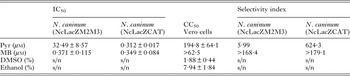
MB and Pyr demonstrated a robust inhibitory effect on tachyzoite proliferation. MB displayed an IC50 for chloramphenicol (NcLacZCAT) and Pyr (NcLacZM2M3) resistant strains, respectively, of 0·349 and 0·371 µ m (Table 1). The N. caninum resistant to Pyr (NcLacZM2M3) demonstrated an IC50 104-fold higher for Pyr when compared with the concentration on the susceptible strain (NcLacZCAT) (respectively, 32·49 and 0·312 µ m; Table 1). The values indicated the suitability of NcLacZCAT strain for both drugs and confirmed the resistance of NcLacZM2M3 to Pyr.
In vitro efficacy and toxicity of pyrimethamine (Pyr) or methylene blue (MB) on Neospora caninum and Vero cells

The IC50, CC50 and selectivity index were calculated for MB, Pyr, ethanol and DMSO on N. caninum and Vero cells. Neospora caninum-resistant strains to Pyr (NcLacZM2M3) or chloramphenicol (NcLacZCAT) were used. Tachyzoites or Vero cells were incubated with the molecules for 72 h, at 37 °C, with 5% CO2, and the proliferation (tachyzoites) or toxicity (Vero cells) was measured after CRPG or MTT assays respectively. The percentage of inhibition was calculated in comparison to the non-treated controls in two independent assays. The ethanol and DMSO toxicity were evaluated only in Vero cells; thus, the columns with tachyzoites were represented by s/n.
No toxic effects of MB on Vero cells were verified below 62·5 µ m, whereas Pyr indicated a CC50 of 194·8 µ m. The selectivity index for MB and Pyr, were, respectively, higher than 168·4 and 5·99 for N. caninum resistant to Pyr (NcLacZM2M3) and higher than 179·1 and 624·3 for N. caninum resistant to chloramphenicol (NcLacZCAT). The percentage of solvents in the CC50 of Pyr (DMSO, 0·15%) or MB (ethanol, 0·62%) did not influence the activities of these drugs, since the CC50 of DMSO and ethanol were 1·88 and 7·94%, respectively (Table 1).
Inhibition of invasion
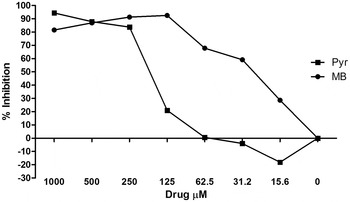
MB inhibited the invasion of N. caninum with an IC50 of 25·9 (±4·2) μM and the effects of Pyr on the tachyzoites were not observed below 125 µ m (Fig. 1).
Inhibition of Neospora caninum invasion by pyrimethamine (Pyr) or methylene blue (MB). Neospora caninum LacZ (NcLacZCAT) were incubated with serial dilutions of Pyr (square) or MB (circle) for 30 min and allowed to invade Vero cells for 2 h in 24-well plates. The invasion was measured by CPRG reaction and the percentage of inhibition calculated in comparison with the drug free control.

Effects of the combination of MB and Pyr on the proliferation of the parasites
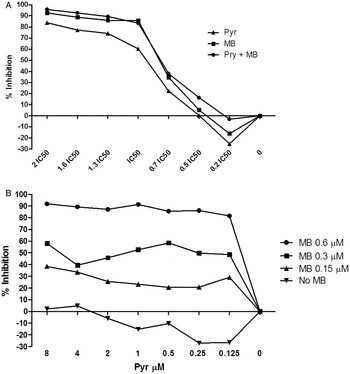
The drug combination of MB + Pyr exhibited more discernible effects on the proliferation of N. caninum (NcLacZCAT) when compared with Pyr alone for all the concentrations (Fig. 2A). The IC50 of the combination was 0·264 (±0·055) μ m, whereas for MB or Pyr were 0·304 (±0·033) μ m or 0·368 (±0·074) μ m, respectively, with a CI of 1·58. When Pyr was applied to Pyr-resistant tachyzoites (NcLacZM2M3), no inhibition effects were detected. The activity of MB on the Pyr-resistant tachyzoites (NcLacZM2M3) followed a similar pattern when compared with the susceptible ones (NcLacZCAT) (Fig. 2B). MB maintained inhibition rates about 87·5 (±6·5), 50·3 (±12·7) and 27·2 (±16·4)% for 0·6, 0·3 and 0·15 µ m, respectively (Fig. 2B).
Combination of pyrimethamine (Pyr) and methylene blue (MB) on N. caninum proliferation. To evaluate the general effects of the MB alone or associated with Pyr, Pyr-susceptible (NcLacZCAT, A) and -resistant (NcLacZM2M3, B) N. caninum LacZ tachyzoites were incubated with dilutions of MB and Pyr. (A) For susceptible tachyzoites, 0·7, 0·56, 0·45, 0·35, 0·24, 0·15 and 0·07 µ m (based on IC50 ~ 0·35 µ m) of MB and/or Pyr were incubated for 72 h, 37 °C, 5% CO2. (B) For resistant parasites, Pyr (8, 4, 2, 1, 0·5, 0·25, 0·125 µ m) was associated with MB 0·6, 0·3 and 0·15 µ m under the same conditions. The proliferation was measured by CPRG reaction and the percentage of inhibition calculated from the absorbance of treated samples compared with the free drug control.

Tachyzoite clearance assay
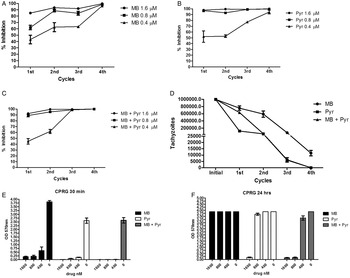
MB and Pyr demonstrated different patterns for the elimination of the parasites. Pyr removed over 90% of N. caninum after the fourth lytic cycle at 1·6 and 0·8 µ m (Fig. 3B) and no visible tachyzoites were detected (Fig. 3D) with a high percentage (>95%) of elimination at the first cycle (Fig. 3B). In contrast, for MB the clearance was moderate when compared with Pyr, indicating ~80% of inhibition for the highest dose of 1·6 µ m (Fig. 3A) and extracellular tachyzoites were still detected after the fourth cycle (Fig. 3D). The elimination of tachyzoites with 0·4 µ m of drug followed a similar pattern for MB and Pyr (Fig. 3A and B, respectively); however, for 0·8 µ m, the treatment with Pyr elevated the inhibition rate such as observed for 1·6 µ m. Pyr at 1·6 µ m cleared the tachyzoites, whereas the β-galactosidase activity was observed for all the concentrations of MB (Fig. 3E and F).
In vitro clearance of tachyzoites. Neospora caninum NcLacZCAT (1 × 10⁶ well−1) were incubated with three serial dilutions (1·6, 0·8 and 0·4 µ m) of methylene blue (MB) and/or pyrmethamine (Pyr) for 72 h. The parasites were counted and re-incubated under the same conditions for four rounds. At each cycle, the tachyzoites were counted and the percentage of inhibition was calculated. After the fourth cycle, the total tachyzoites were detected by CPRG reaction, incubated at 30 min or 24 h. (A) Percentage of elimination for MB. (B) Percentage of elimination for Pyr. (C) Percentage of elimination for the combination MB + Pyr. (D) Absolute number of tachyzoites after incubation at 1·6 µ m. (E, F) Total tachyzoites detected by CPRG reaction after 30 min and 24 h, respectively.

The drug combination eliminated the tachyzoites likewise as for Pyr at 1·6 µ m (Fig. 3C and D), but the clearance effect was also positively observed for 0·8 µ m (Fig. 3E and F).
DISCUSSION
Pyr has a current relevant role for the preventive therapy of malaria, the so-called Intermittent preventive therapy (Venkatesan et al. Reference Venkatesan, Alifrangis, Roper and Plowe2013) and it is successfully adopted for congenital toxoplasmosis in humans (Kaye, Reference Kaye2011; Kieffer & Wallon, Reference Kieffer and Wallon2013). Pyr inhibits the bifunctional enzyme dihydropholate reductase–thymidylate synthase (DHFR–TS) of susceptible protozoans, blocking the conversion of dihydrofolate to tetrahydrofolate, a critical step for thymidine nucleotide biosynthesis (Ivanetich & Santi, Reference Ivanetich and Santi1990). The malaria treatment with Pyr demonstrated limitations due to the increase of resistant Plasmodium strains by the 1990s (Peterson et al. Reference Peterson, Walliker and Wellems1988). For N. caninum, Pyr resistance was artificially obtained through point mutations of DHFR–TS (NcLacZM2M3) (Pereira et al. Reference Pereira, Baroni and Yatsuda2014). This was the first N. caninum-resistant strain, since, to our knowledge, there is no isolation from natural infected host sources. As natural selection occurred after years of Pyr massive treatment for human malaria; this phenomenon might extend to N. caninum in bovine neosporosis if massive treatment occurs in a certain microenvironment such as a dairy farm. In vitro, the Pyr resistance (NcLacZM2M3) was 104-fold higher when compared with the susceptible strain (NcLacZCAT). Due to the malaria experience, the combination of other anti-Neospora drugs with Pyr appears to be a prudent preventive approach for neosporosis control.
As observed for Pyr, MB demonstrated an IC50 at the nanomolar scale for N. caninum, the first synthetic molecule applied against malaria (Buchholz et al. Reference Buchholz, Schirmer, Eubel, Akoachere, Dandekar, Becker and Gromer2008). Due to the low cost, MB was extensively used in the Pacific front by USA militaries in the Second World War (Schirmer et al. Reference Schirmer, Adler, Pickhardt and Mandelkow2011). Although non-systemically deleterious, MB causes visible side-effects, such as turning urine and the sclera green or blue. Therefore, MB was abandoned as a method for the malaria treatment, mainly after the adoption of chloroquine (Ginimuge and Jyothi, Reference Ginimuge and Jyothi2010). There is no reference of MB resistance in Plasmodium (Buchholz et al. Reference Buchholz, Schirmer, Eubel, Akoachere, Dandekar, Becker and Gromer2008) and the low cost, efficiency and limited side-effects revived the drug as a candidate for combination with artemisinin (Dormoi et al. Reference Dormoi, Pascual, Briolant, Amalvict, Charras, Baret, Huyghues des Etages, Feraud and Pradines2012), quinine, Pyr and chloroquine (Garavito et al. Reference Garavito, Bertani, Quiliano, Valentin, Aldana and Deharo2012).
Bovine neosporosis is important for many developing and especially under developed countries’ economies; hence, MB appears as an economic and effective option for the control of this disease. For N. caninum, there are few real candidates for chemotherapy and the anti-malarial drugs have been underutilized, despite their effective potential. Our group aims at determining the real capacity of classical drugs on N. caninum proliferation, using objective tests such as CPRG. The two LacZ tagged strains developed by our group represent a safe option for initial drug screening.
MB cannot be properly evaluated by assays involving Giemsa or haematoxylin–eosin, since MB acts as a stain, interfering with the identification of N. caninum. Due to the advantages of the CPRG assay, MB demonstrated a capacity to block the invasion of the N. caninum, a fact that was not observed for Pyr. Therefore, MB probably acts in the invasion process and proliferation, indicating multi-site targets of the parasite cycle. The invasion inhibition probably avoids the disease propagation, acting on mechanisms related to adhesion and/or invasion, which are the usual targets for preventive approaches (Pastor-Fernandez et al. Reference Pastor-Fernandez, Regidor-Cerrillo, Jimenez-Ruiz, Alvarez-Garcia, Marugan-Hernandez, Hemphill and Ortega-Mora2015; Yoshimoto et al. Reference Yoshimoto, Otsuki, Itagaki, Kato, Kohsaka, Matsumoto, Ike and Park2015).
The effects of MB with Pyr demonstrates an antagonist interaction in the proliferative assay and a positive pattern in the clearance assay (% of the combination inhibition is higher than % of MB alone + % of Pyr alone), revealing that these drugs probably have some different targets. For Plasmodium, the antagonist effect of MB/Pyr combination in vitro (Garavito et al. Reference Garavito, Bertani, Rincon, Maurel, Monje, Landau, Valentin and Deharo2007) was replaced by a synergic inhibition in in vivo tests (Garavito et al. Reference Garavito, Bertani, Quiliano, Valentin, Aldana and Deharo2012).
The use of low-cost and well-established drugs of human apicomplexan diseases for N. caninum expands the current narrow therapeutic options. The price of MB (catalogue number M9140) and Pyr (catalogue number 46706) at Sigma-Aldrich website is USD 0·0027 and USD 0·21 per milligram, respectively. MB and Pyr appears as competitive treatment candidates, when compared, for example, to toltrazuril (USD 0·31 per milligram; catalogue number 34000), currently applied against animal coccidiosis (Philippe et al. Reference Philippe, Alzieu, Taylor and Dorchies2014; Rodrigues Fde et al. Reference Rodrigues Fde, Tavares and Paiva2016). The price from Sigma usually represents several aspects such as costs for synthesis or extraction and purification, essential factors when scaling up for clinical purposes. The next steps should focus on an in vivo treatment model based on MB/Pyr, especially for bovine species affected by N. caninum. The establishment of MB/Pyr use will depend on the time required for the complete drug elimination from the animal to guarantee a safe consumption of milk or meat. To avoid commercial limitations, the use of this composition seems more suitable in neosporosis outbreaks, or as part of the quarantine process of animals coming from very endemic regions with neosporosis. The treatment has also an interesting potential on cows with repeated abortion occurrences with high N. caninum antibody titration and its calves.
There are several methods for Pyr detection in milk (Koesukwiwat et al. Reference Koesukwiwat, Jayanta and Leepipatpiboon2007a , Reference Koesukwiwat, Jayanta and Leepipatpiboon b ; Azzouz et al. Reference Azzouz, Jurado-Sanchez, Souhail and Ballesteros2011), useful in future treatment strategies, especially in commercial herds. MB lacks residue detection approaches in milk or meat due to the sparse application in cattle, although the drug was successfully applied against nitrite intoxication in bovines (Van Dijk et al. Reference Van Dijk, Lobsteyn, Wensing and Breukink1983). The residue management of MB in herds might demand simple adaptations, once there are several sensitive methods of drug detection (Tang and Santschi, Reference Tang and Santschi2000; Xu et al. Reference Xu, Tian, Zhang, Gong, Liu, Zhang, Huang and Zhang2012), allowing a safety neosporosis control strategy allied to a rational commercial purpose.
A simple repositioning of traditional drugs for the combat of neosporosis is strategic for many economies around the world involved with the livestock economy. After our findings, MB associated with Pyr is highlighted as a possible drug combination candidate for neosporosis control, contributing to the complementation of therapeutic approaches.
SUPPLEMENTARY MATERIAL
The supplementary material for this article can be found at https://doi.org/10.1017/S0031182016002584
ACKNOWLEDGMENTS
We would like to thank Maraísa Palhão Verri for the excellent technical assistance.
FINNANCIAL SUPPORT
This work was supported by Coordenação de Aperfeiçoamento de Pessoal de Nível Superior (CAPES) for the Postdoctoral fellowship to LMP (PNPD/CAPES).