Introduction
The soil is the main carbon reservoir (C) of terrestrial ecosystems (Janzen Reference Janzen2004) and soils with permafrost may contain up to 26% of the total organic carbon in the ecosystem. The detailed study of the dynamics of organic matter in Antarctic soils is fundamental to understanding how the Antarctic terrestrial ecosystem works, and how it responds to global climatic changes (Beyer et al. Reference Beyer, White, Pingpank and Bolter2004, Michel et al. Reference Michel, Schaefer, Days, Simas, Benites and Mendonça2006, Simas Reference Simas2006).
Soil formation in the Antarctic is restricted to a few ice free inland areas, in high mountains and narrow coastline areas (Michel et al. Reference Michel, Schaefer, Days, Simas, Benites and Mendonça2006). The cold climate and low water availability are key factors in the soil genesis, in such a way that other factors, such as time and parent material, are strongly controlled by climatic conditions (Campbell & Claridge Reference Campbell and Claridge1987). These factors also underlie different conditions of soil organic matter accumulation and removal by erosion, which is highly variable in Antarctic soils (Michel et al. Reference Michel, Schaefer, Days, Simas, Benites and Mendonça2006).
The soil C content is the result of the primary C input by autotrophic organisms and the action of decomposer microorganisms (Stevenson Reference Stevenson1994). Humic substances (HS) are formed of amorphous macromolecules, formed by secondary reactions (Silva & Mendonça Reference Silva and Mendonça2007). These substances represent the passive pool of soil organic matter and are considered the fraction of greatest stability.
Organic matter accumulation varies from highly organic histosols (organosols) in the maritime Antarctic to continental polar desert soils with negligible C contents. Ornithogenic Cryosols are described as soils rich in decomposable organic material, mixed with the mineral matrix rich in phosphate (Tatur et al. Reference Tatur, Myrcha and Niegodzisz1997).
The process of organic matter mineralization is rapid in the less persistent forms of C existing in the soils, which are volatilized or leached, and accompanied by the gradual concentration of more resistant organic matter (Myrcha et al. Reference Myrcha, Pietr and Tatur1983). Lower temperatures retard the organic matter mineralization, while the presence of vegetation (lichens, algae, bryophytes and two higher plants) enable the fixation of atmospheric C into maritime Antarctic soils (Simas et al. Reference Simas, Schaefer, Melo, Albuquerque-Filho, Michel, Pereira, Gomes and Costa2007). Most models of global warming suggest that the most pronounced effects will occur in periglacial environments.
The changes in the soil C stock may thus indicate possible effects of climate change on the terrestrial environment. Mikan et al. (Reference Mikan, Schimel and Doyle2002), on the basis of enzyme kinetics, hypothesized that the decomposition of lower quality substrates, i.e. recalcitrant polymers of older soil organic matter, should have greater temperature dependence than that of higher quality, the so-called labile organic matter. In contrast, two recent models of C turnover across climatic gradients have concluded that the breakdown of old recalcitrant organic matter is relatively insensitive to temperature (Davidson & Janssens Reference Davidson and Janssens2006). The assumptions and conclusions of these studies have been challenged, but despite their relevance of this issue to the global C cycle, few experimental data exist to address it directly (Davidson & Janssens Reference Davidson and Janssens2006).
Thus, monitoring the soil C content under increasing temperature may reveal its effect on the terrestrial environment in a context of global climatic change. The aim of this work was to study the fragility of Antarctic soils under increasing temperature using the C dynamics and structural characteristics of humic substances as indicators.
Material and methods
Sampling sites and soils
Four soils from ice free areas of Admiralty Bay, King George Island, South Shetland Islands (62°05′S 58°23′W) were sampled at 0–10 cm layers, during the 2006 summer (Table I).
Location and features of soils in King George Island.

Legend: HIS-sme = interstratified-hydroxy-smectite interlayer, pyr = pyroxene, pl = plagioclase, all = allophane, AP = amorphous organic substance-border phosphates, CP = crystalline phosphates.
Characterization of the soil organic matter
Samples were air dried and passed through a 0.21 mm sieve, eliminating the coarse fraction, which was weighed. Total Organic Carbon (TOC) was quantified by wet combustion with external heat source (Yeomans & Bremner Reference Yeomans and Bremner1988). Oxidizable organic C fractions were determined by wet combustion using an oxidizing agent and different amounts of acid (acid-water ratio) in order to separate less and more easily oxidized fractions (Chan et al. Reference Chan, Bowman and Oates2001). The labile fraction corresponds to the sum of more easily oxidized fractions (oxidized with the smallest acid-water ratio) and the recalcitrant fraction is the sum of less easily oxidized fractions (oxidized with the highest acid-water ratio). The total N content was measured by the Kjeldahl method (Bremner & Mulvaney Reference Bremner and Mulvaney1982).
Extraction and fractionation of humic substances
Extraction and fractionation of the soil humic substances in fulvic acids (FAs), humic acids (HAs) and humin were obtained according to the International Humic Substances Society (IHSS) methodology (Swift Reference Swift1996), based on the principle of differential solubility in basic and/or acid media.
To 5 g of sample, 50 ml of 0.1 mol l-1 NaOH solution was added in a N2 atmosphere. After shaking for 24 h and resting for a further 18 h, the material was centrifuged at 2500 rpm for 15 min. The solution was collected and the pH was immediately adjusted to 2.0 with 20% HCl solution. After 18 h, the extract was centrifuged at 2500 rpm for 10 min, reserving the supernatant, composed by FAs. The precipitate (HAs) was redissolved in 50 ml of 0.1 mol l-1 NaOH solution. The residue remaining in the vials contained the humin fraction, which was oven-dried at 45°C. The C content of each fraction was measured according to Yeomans & Bremner (Reference Yeomans and Bremner1988).
Isolation and characterization of humic acids
Isolation of humic acid samples
HAs of all soil samples were extracted according to the technical standard adopted by IHSS (Swift 1996). We used samples with c. 1000 mg HAs, as estimated by fractionation, with 200 ml of 0.1 mol l-1 NaOH solution, in N2 atmosphere. After shaking for 24 h and resting for 18 h, the material was centrifuged at 2500 rpm for 15 min. The solution was collected and the pH was immediately adjusted to 2.0 with 20% HCl solution. The acidified extract was reserved for the precipitation of HAs. After 18 h, the extract was centrifuged at 2500 rpm for 10 min, discarding the supernatant. The HAs were purified with 10% HF + 5% HCl for 24 h and centrifuged at 2500 rpm, repeating the process several times to obtain a purified sample. These were further washed with 200 ml of 0.01 mol l-1 HCl solution, centrifuged to 2500 rpm and transferred to dialysis bags c. 100 ml. The samples were placed in a 20 l container with deionized water, changing the water twice daily until no dialysis increase greater than 1 μS was observed one hour after change. Then, samples were frozen and lyophilized, stored in glass containers and preserved in desiccators using 400 mmHg vacuum. The ash content was determined by calcination, using a furnace at 700°C for 4 h.
Chemical analyses of humic acids
Carbon, hydrogen and nitrogen contents of freeze-dried solid HAs were measured by dry combustion using a Perkin-Elmer 240 CHN Elemental Analyzer. The oxygen content was determined by the difference, considering the ash content.
Total acidity and carboxyl groups of HAs were measured using combined glass electrodes and reference of Ag/AgCl to a microcomputer; 0.1 g of AHs were solubilised in 0.1 mol l-1 NaOH solution, with pH adjusted for 2.0 with standardized solution of HCl 0.1 mol l-1, following titration with 0.1 mol l-1 NaOH in 0.1 mol l-1 NaCl, in N2 atmosphere (Fonseca Reference Fonseca2005).
Phenolic groups were calculated as the difference between the total acidity and carboxyl groups. Humic acid was analyzed by potentiometric titration in order to distinguish the carboxylic and phenolic groups.
Spectroscopic analyses of humic acids
UV-visible spectra were carried out with a UV/VIS 911A-GBC spectrophotometer. The readings in the range of the visible were made in solutions of HAs diluted in sodium bicarbonate solution (0.2 g HAs l-1) (Chen et al. Reference Chen, Senesi and Schnitzer1977). Readings in UV were carried out in different solutions of HAs, with pH adjusted for 2.0 and 12.0. Final spectra were calculated by the difference between spectra obtained at pH 12.0 and 2.0, expressing the data as absorbance (Bloom & Leenheer Reference Bloom and Leenheer1989).
Solid-state 13C NMR spectra of freeze-dried HAs were obtained using an Infinity Plus-400 spectrometer. Two experimental conditions were used for analyses: the first one used the quantitative technique of simple pulse with rotation in the magical angle (MAS), the second one a crossed polarization with rotation in the magical angle (CP/MAS). The 13C NMR spectra of HAs from the soils were recorded in the Infinity Plus-400 spectrometer equipped with Cross Polarization Magic Angle Spinning (CP/MAS), suitable for analysis of solid state samples.
The analyses with technique crossed polarization with rotation in the magical angle (CP/MAS) were done at 100.3 MHz, using a rotating speed of 10000 Hz, a contact time of 1200 μs, a recycle time of 1 s and an acquisition time of 20.4 ms. The line broadening for Free Induction Decay (FID) transformation was fixed at 300 Hz. For the technique of simple pulse with rotation in the magical angle (MAS) were done at 100.3 MHz using a rotating speed of 10 000 Hz, a recycle time of 100 s and an acquisition time of 20.4 ms. The line broadening for FID transformation was fixed at 300 Hz. The total signal intensity and the proportions contributed by each C type were determined by integration of the spectral regions, with the spectra being divided into four main regions: i) alkyl C (0–45 ppm), ii) O–alkyl C (45–92 ppm), iii) aromatic C (92–150 ppm), and iv) carbonyl C (150–215 ppm) (Dieckow et al. Reference Dieckow, Mielniczuk, Knicker, Bayer, Dick and Kögel-Knabner2005).
The soil incubation experiment
The experiment on C and N mineralization were carried out at three temperatures (5, 8 and 14°C), using a completely randomized design with three replicates, and simulating the average local summer temperature and warming condition (IPCC 2007). The experiment was mounted in an incubator, where 50 g of soil was added in 500 cm3 airtight vessels. The soil humidity was adjusted for 60–70% of the field capacity (Cc), and in each vessel 30 ml 0.5 mol l-1 NaOH was used for capture of the C-CO2 evolved. The C-CO2 measurement was carried out in periods of 1, 3, 6, 12, 24, 36, 48, 60 and 72 days from the beginning of the incubation. The content of mineralizable C was determined by titration with 0.25 mol l-1 HCl (Stotzky Reference Stotzky1965, Curl & Rodriguez-Kabana Reference Curl and Rodriguez-Kabana1972).
The evolution of C-CO2 as a function of the time was adjusted according to the equation:
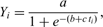
where Yi = C-CO2, a = saturation of the C-CO2 evolved (mg C-CO2 kg-1 soil), b = position parameter, dislocates curve horizontally, c = constant of C-CO2 evolved (hours-1), and t = time (hours) (Matos et al. Reference Matos, Mendonça, Lima, Coelho, Mateus and Cardoso2008). For the coefficients b and c the time to reach the half of the maximum CO2 evolved (t1/2) production is t1/2 = - b/c.
Total soil C content mineralized in the incubations was evaluated statistically by analysis of variance (ANOVA) for the total randomized experiment, followed by the Tukey test (P < 0.05), carried out using SAEG program (Funarbe 2007).
Results and discussion
Chemical characteristics of soil organic matter and humic acids
In Table II we present the data of total organic carbon (TOC). Relatively high TOC contents found in some maritime Antarctic soils are typical of the region of organic matter accumulation due to high preservation of fibric material under colder temperatures (Silva & Mendonça Reference Silva and Mendonça2007).
Content of total organic carbon (TOC), total nitrogen (TN), C/N ratio and values of total C in the labile and recalcitrant fractions of maritime Antarctic soils.

High C/N ratios of all samples indicates that the organic matter of these soils shows low rates of decomposition, with high amounts of fibric material. These soils contain low total N content. These characteristics together reduce the microorganism activity on the organic material, reducing the soil organic matter humification ratio (Stevenson Reference Stevenson1994).
LTC1 and LTC2 mineral soils show a greater percentage of TOC in the labile fraction, whereas organic matter-rich OG and ORG soils present a greater percentage of TOC in the recalcitrant fraction (Table II). The values of Clab/recalc ratio indicate that the organic matter of OG and ORG soils are more resistant to degradation when exposed to the microbial attack and to the action of climate, emitting, proportionally, less C to the atmosphere.
Table III presents the C contents of fulvic acids (FAs), humic acids (HAs) and humin fractions for maritime Antarctic soils. In all soils, the proportion of the humin fraction was greater than HAs, followed by FAs. This pattern is also found in tropical mineral soils, indicating that the route and the process of C stabilization in humic substances (HS) are the same (Stevenson Reference Stevenson1994). The high HS/TOC ratio shows that a great part of the C in the organic matter is in the humified form, which is among the most stable organic fractions (Silva & Mendonça Reference Silva and Mendonça2007). The non-humic compounds account for about 15–30% of TOC in the soils studied. With soil thawing at the surface a great part of soluble organic fraction is removed in solution due to its high solubility.
Carbon contents of fulvic acids (FA), humic acids (HA) and humin (HU) fractions and (HA + FA)/HU and HS/TOC rations of maritime Antarctic soils.

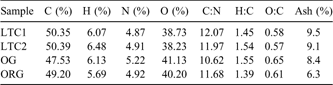
The elemental composition of HAs and atomic ratios (C:N, H:C and O:C) are presented in Table IV. In general, the values of C/N ratios range between 10 and 12, due to biological stability (Stevenson Reference Stevenson1994) and indicate limited secondary organic matter mineralization (Rosell et al. Reference Rosell, Andriulo, Schnitzer, Crespo and Miglierina1989). HAs presented high atomic H:C ratio, reflecting the great aliphatic character of the samples (Steelink & Tollin Reference Steelink and Tollin1985, Stevenson Reference Stevenson1994).
Percentage of C, H, N, O and atomic ratios (C:N, H:C and O:C) and ash content of HAs from maritime Antarctic soils.
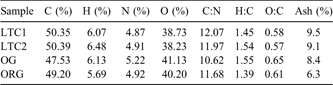
Amongst HAs, the organic soils OG has a greater H:C ratio and a lower C:N ratio, suggesting that its molecular structure has a low degree of aromaticity and high degree of humification compared with the other samples. These results indicate that the OG soil presents greater resistance to degradation, in accordance to the Clab/recalc ratio (Table II). Part of the SOM stability is due to its recalcitrant structure, which results from the humification process, and part is due to the association of organic macromolecules with mineral surfaces and with one another (Swift Reference Swift1996). The soil organic matter of OG soil is characterized by a smaller (FA+HA)/HU ratio than for ORG and LTC1/2 soils (Table III), indicating a dominance of HU among the humic substances. Humins usually form stable interactions with the mineral surfaces (Silva & Mendonça Reference Silva and Mendonça2007). High values of O:C ratio suggest an abundance of functional groups, especially carboxylic and phenolic (Steelink & Tollin Reference Steelink and Tollin1985) and a low hydrophobicity degree. This ratio did not change among the HAs samples.
Spectroscopic characteristics of humic acids
The decline of absorbance with increasing wavelength is characteristic of HS spectra (Stevenson Reference Stevenson1994). The featureless spectra are a consequence of the overlapping of peaks from different chromophore groups located in various parts of the macromolecule and with diverse bonding (MacCarthy & Rice Reference MacCarthy and Rice1985).
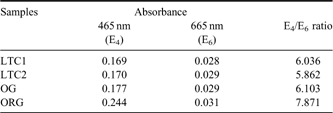
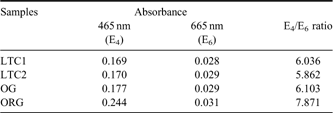
Absorbencies at 665 and 465 nm and E4/E6 ratio of HAs are presented in Table V. The direct decrease of E4/E6 ratio is related to the increase of molecular weight and the condensation of the aromatic C (Stevenson Reference Stevenson1994). Thus, the E4/E6 ratio is associated with the condensation of aromatic groups and not with the total aromaticity of the samples. The E4/E6 ratio for HAs from the Antarctic soils presented values above those cited in the literature (3.0–5.0) (Chen et al. Reference Chen, Senesi and Schnitzer1977). These data corroborate the lower molecular weight and degree of condensation of aromatic constituents, suggesting that the organic matter from maritime Antarctic soils is less modified with a lower degree of humification (Stevenson Reference Stevenson1994), compared to organic matter from other regions.
Absorbencies at 465 and 665 nm and E4/E6 ratio of HAs from maritime Antarctic soils.
Differences between spectra in the UV band at different pH values are due to the increase of absorbance, which is related to the ionization of functional groups with the increase of pH, resulting in conformational changes in the macromolecular structure and the increased interaction between chromophore groups and the solvent (Brown Reference Brown1980). According to Tsutsuki & Kuwatsuka (Reference Tsutsuki and Kuwatsuka1979) an intense signal is observed in the differential spectra of HAs, centred in 280–285 nm, and a shoulder in 350 nm, which is related to the ionization of carboxylic and easily ionized phenolic groups, respectively. HAs of Antarctic soils had the presence of a 240–250 nm signal, and a shoulder between 300–340 nm.
The displacement for lower wavelengths in the differential spectra of HAs in the UV band indicates the presence of a low number of condensed rings (Silverstein et al. Reference Silverstein, Bassler and Morril1994). These results match the high values of E4/E6 ratio of the same ones. It is therefore possible to postulate that the HAs of maritime Antarctic soils present lower condensed aromatic groups than HAs of soils from other terrestrial environments (Chen et al. Reference Chen, Senesi and Schnitzer1977).
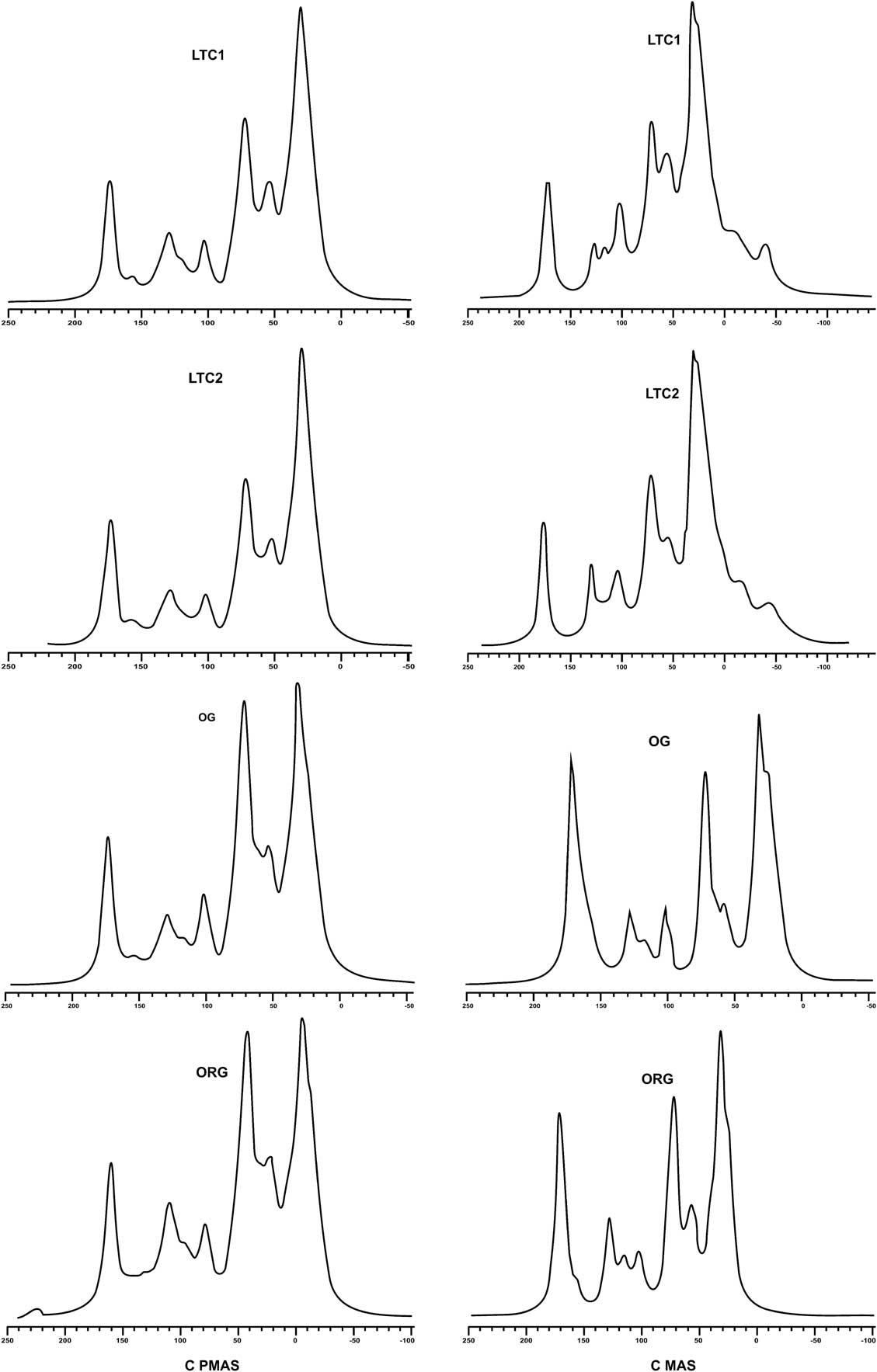
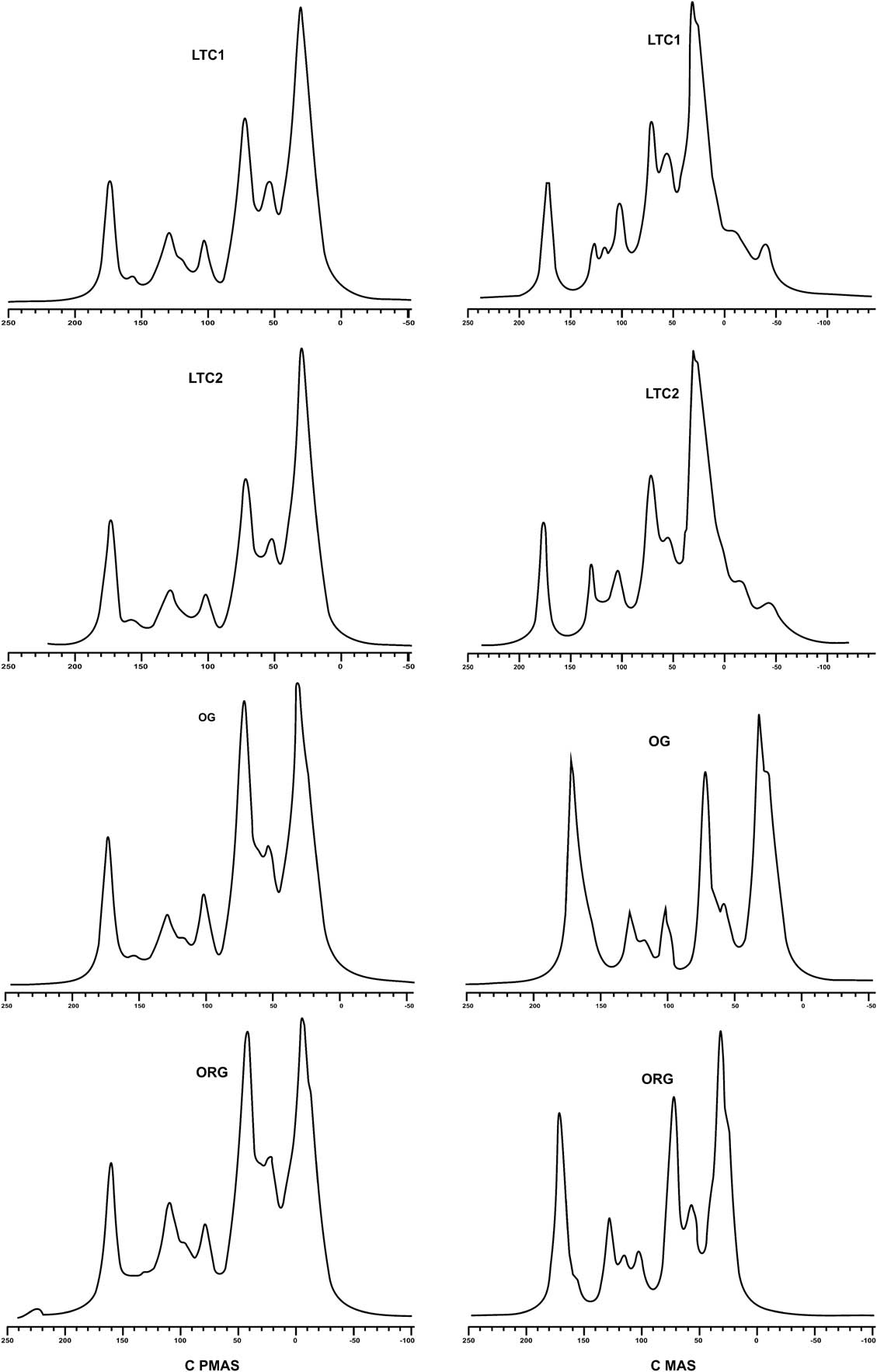
In general, all samples of HA showed a higher aliphatic content (Fig. 1), which is consistent with the high values for the ratio H/C and results from UV-visible spectra. Similarly, high values of O:C ratio, that suggest abundance of functional groups, were confirmed by the high percentages of carbon heteroatom. For both techniques (MAS and CP/MAS), HAs of LTC1 and LTC2 samples have a greater content of aliphatic C than the HAs of OG and ORG soils (Table VI). It seems that the HAs of LTC1 and LTC2 samples are richer in heteroatom C, with a lower content of aromatic and carbonyl C than the HAs from the other soils.
13C NMR spectra (CP/MAS and MAS) of humic acid of maritime Antarctic soils.
Percentages of C types spectra of 13C CP/MAS and 13C MAS of HAs from maritime Antarctic soils.

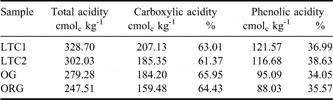
Table VII presents values of total carboxylic and phenolic acidity for HAs. HAs from LTC1 and LTC2 soils presented greater values of total acidity than the other soils. These HAs also had higher percentages of aliphatic C, indicating that most of their acidity is relative to carboxylic groups associated with aliphatic structures. The ORG soil, with higher E4/E6 ratio, presented minor load density, being more hydrophobic.
Values of active H+ sites obtained from the partial volumes of ionizable sites, specifying carboxylic and phenolic functional groups, of HAs from maritime Antarctic soils.

Soil organic carbon mineralization due to increasing temperature
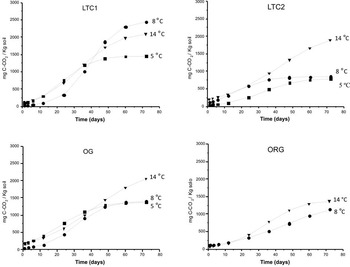
In the mineralization experiment, during the establishment of the first incubation (temp. 5°C) we did not have the ORG soil, but it was added in the following incubations (Fig. 2). The high C mineralization ratio of LTC1, LTC2 and OG soils at the beginning of the incubation is related to the intense microbial activity in this period acting on the labile C. This behaviour can be attributed to the initial mineralization of readily oxidizable organic C, whose exhaustion leads to the reduction of C-CO2 flux (Martines et al. Reference Martines, Andrade and Cardoso2006).
C mineralization (mg C-CO2 kg-1 soil) in relation to incubation time, for maritime Antarctic soils, incubation temperatures of 5, 8 and 14°C.

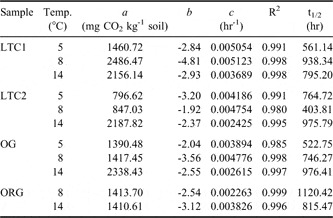
Table VIII presents the values for the parameters (a, b and c) of the logistic equation for C-CO2 evolution. The LTC1, LTC2 and OG soils show parameter a increasing with temperature. The different behaviour of the ORG soil, where the a value was constant, agrees with the data in Table IX, where the C-CO2/TOC ratio is lower than for the other soils. This behaviour is due to the high proportion of labile fractions and TOC content of ORG (Table II), which delays saturation in the C-CO2 evolution. The ORG soil therefore presents the lower C-CO2 evolution rate. The highest rates are presented by LTC1 and LTC2 soils, which have a greater content of labile fractions and greater content of aliphatic C. These characteristics favour the increase of C microbial oxidation when the environmental temperature is increased (Silva & Mendonça Reference Silva and Mendonça2007).
Logistic equation parameters (a, b, c) of C-CO2 evolution and average time of saturation (t1/2) for maritime Antarctic soils.

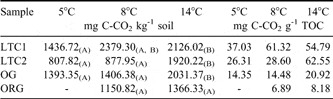
Total carbon contents mineralized in relation to the soil mass (mg C-CO2 kg-1 soil) and to total organic carbon (mg C-CO2 g-1 TOC) for maritime Antarctic soils.

A, B = values followed for different letters indicate significant differences between carbon contents mineralized in different temperatures for one given sample (P < 0.05).
However, the reduction of decomposition rate at 14°C may indicate that, in some environmental conditions, psychrophilic microorganisms are not adapted to high temperatures (Moreira & Siqueira Reference Moreira and Siqueira2006). The biological system may need more time to adapt to new environmental conditions, such as ice retreat, increased soil temperature in vivo, or simply a higher incubation temperature. These results indicate that temperature increase in maritime Antarctic soil may not initially cause increases in soil degradation and in the C emission to the atmosphere. More studies are needed to test this hypothesis.
Table IX presents the data of total C contents mineralized in relation to TOC of the soil, at the end of incubation. As expected C mineralization generally increased in accordance with the increase in the incubation temperature (P < 0.05). However, each soil presents different patterns. LTC1 and LTC2 soil had a greater C-CO2/TOC ratio, indicating that these soils are more susceptible to the thermal changes due to the higher percentage of labile C in relation to TOC (Table II). The organic matter response to the temperature changes is related to C-CO2/TOC ratio and to the content of recalcitrant C. Thus, the relation between incubation data with the soil characteristics suggests the following sequence of soil organic matter fragility: LTC1 > LTC2 > OG > ORG. This sequence correlates with the Clab/recalc ratios (r 2 = 0.83).
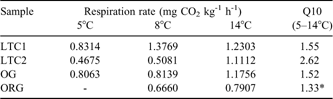
The Q10 coefficient has been commonly used in studies of soil respiratory activity and represents the increase in the respiration rate with a 10°C increase in temperature (Bron et al. Reference Bron, Ribeiro, Cavalini, Jacomino and Trevisan2005). For this, the respiration rates were determined by measuring the total C contents mineralized in relation to TOC of the soil at the end of incubation, and expressed as mg CO2 kg-1 h-1 (Bron et al. Reference Bron, Ribeiro, Cavalini, Jacomino and Trevisan2005, Davidson et al. Reference Davidson, Janssens and Luo2006). Q10 values for respiration were calculated as the quotient between respiration rates (RR) measured at two different temperatures:
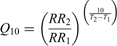
The Q10 was calculated for the extreme temperature of the incubation experiments, 5°C and 14°C.
In Table X, the values of Q10 are consistent with the sequence of the fragility of soil organic matter, i.e. the greater the fragility of soil organic matter, the greater the variation in respiration rate with increasing temperature, i.e. Q10. Comparing these data with the NMR spectroscopy data, the LTC1 and LTC2 mineral soils, which were most sensitive to the increase of the temperature, are the ones with HAs that have great aliphatic character and high abundance of heteroatom C. The more organic soils, OG and ORG, had a greater content of aromatic and carbonyl C, and were more resistant to degradation. These results indicate that structural components of HAs may be used as parameters to interpret the potential of soil C-CO2 evolution with the changes in the environmental temperature.
Respiration rates, mg CO2 kg-1 h-1, and values of Q10 for maritime Antarctic soils.
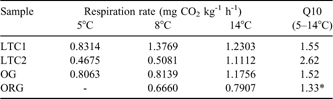
* The Q10 for ORG was calculated for temperatures 8°C and 14°C.
Thus, LTC1, LTC2, OG and ORG soils present, respectively, an increase of 48%, 138%, 46% and 19% of the total C mineralized accumulated from 5°C to14°C. Bokhorst et al. (Reference Bokhorst, Huiskes, Convey and Aerts2007) studied the C mineralization rates with increasing soil temperature of islands from the maritime Antarctic - Anchorage (62°S), Signy (60°S) - and of a cool temperate island - Falkland Islands (51°S). These authors observed, in laboratory studies, that the rate of C mineralization increased with the increase of the incubation temperature (2–10°C), and that this increase was greater for soils from the islands of the maritime Antarctic.
Conclusions
Humic substances in maritime Antarctic soils, mainly the humic acid, have a greater aliphatic character and lower number of condensed aromatic groups when compared with humic substances from other terrestrial environments. Such characteristics suggest that the molecules of humic acid from maritime Antarctic soils are generally less resistant to microbial degradation than the soils from other regions.
An increase in temperature produced a significant increase in the C mineralization of these soils, demonstrating their likely response to global change. The sequence of soil fragility is Lithic Thiomorphic Cryosol > Ornithogenic Cryosol > Gelic Organosol, which correlates with the Clab/recalc ratio and the Q10 coefficient of soil organic matter. It is important to map the extent of these soils in the Antarctic to estimate accurately their contribution in terms of CO2 emission.
These results indicate that structural components of HAs molecule may be used as indicators to interpret the potential of soil C-CO2 evolution with environmental change.
Acknowledgements
The authors thanks FAPEMIG, Minas Gerais State Foundation, for the scholarship to the first author; to CNPq-PROANTAR, Brazilian Program for Antarctic Research, for the financial support during the International Polar Year (Criossolos-IPY ANTPAS Project), to José Brás Julio for his help in carrying out chemical analysis, and to Dr Felipe Simas, for his kind review of the manuscript. This is a contribution of the INCT-Criosfera.